Українською читайте тут.
The journalist and blogger speaks about communication with temporarily occupied territories, vulnerabilities in Russian propaganda, and working with social media.
Detector Media regularly covers media outlets and journalists working for territories occupied by Russia. We have already written about the editorial team broadcasting to de-occupied and temporarily occupied territories at Ukrainian Radio, the media outlet Skhidnyi Variant, Luhansk-based Tribun and Farvater.Skhid, Kherson-based Kavun.city, and the Sievierodonetsk media outlet SD.ua.
This time, we spoke with Denys Kazanskyi about whether working with sources has changed under conditions of internet restrictions and blockages, what is happening inside the Russian propaganda community, and how Ukrainian media can reach people living under occupation.
— Do you see any changes in the level of attention to the issue of temporarily occupied territories in the Ukrainian media landscape? Has interest in this topic declined, excluding regional media for whom this is a core focus?
— I don’t see any decline in interest in this topic because it is probably impossible to separate it from the broader subject of the war. And the war remains the leading topic, so the issue of occupied territories is naturally present as well. I don’t think interest in it is decreasing—it’s simply difficult to separate it from the topic of military operations because, in reality, they are the same.
We literally just had a story that spread across the whole of Ukraine—about a man in a Zhiguli, a displaced person who was forced to leave the combat zone. He ended up in Kyiv, and everyone was following the story and commenting on those highly emotional images.
Or, for example, the issue of how Donetsk is living without water because the fighting destroyed the Siverskyi Donets–Donbas canal. I’ve done a lot of reporting on that topic—both videos and articles. And I can’t say those posts received less attention.
It’s another matter when we write standard news stories about people suffering in occupied territories—it may not resonate because people are suffering everywhere, and everyone has their own problems caused by the war. But when you tell a specific story, it can generate interest and public reaction—people comment on it and watch it.
I can see it in my own work: when you highlight certain aspects of life in occupied territories, people engage with it—if the material is genuinely interesting and emotionally presented.
— If you compare the period from 2014 to 2022 with the current situation during the full-scale war, when Russia has increased internet restrictions and censorship, has it become more difficult to work with information, sources, and monitor Russian or local resources in the occupied territories? Do you feel that difference?
— Honestly, I don’t really feel it yet. From what I’ve observed, those who used Telegram still use it. People simply use VPNs. They live in an environment where many things are blocked and restricted, so they are forced to bypass those barriers to use social media—from YouTube, which they still watch, to Telegram. So access to information remains.
I personally monitor a lot of information from local sources—local Telegram channels, VKontakte groups that people still use. There’s actually quite a lot of information there about what’s happening; you just have to keep an eye on it. From time to time, useful news and valuable information appear. And if something high-profile happens, such a story gains traction.
— How often can a person in the occupied territories currently serve as a source of information? Has that become more difficult because of internet restrictions and, more broadly, because of what is happening in the occupied territories and in Russia?
— I can’t say I’ve noticed that. Those who used to write to me still do—they send messages. People find ways. If someone wants to reach out, they do. You can even see it on X: it has long been blocked in Russia, but Russians are still there.
People message me privately on X and on Telegram—of course, everyone still uses Telegram. Yes, views are dropping, and everything has become more difficult, but it is still possible to log in, communicate, and read things.
— So you don’t see any increased fear of communicating? That people, for example, have become more afraid of contacting Ukrainian journalists?
— It was forbidden before as well. If someone is found to be communicating with Ukrainian journalists, they can be imprisoned—that needs to be understood. And that hasn’t changed. Those who were willing to write before continue to do so.
— On different platforms, you often talk about the grim mood inside the propaganda community. Could you describe more broadly what is happening in that media environment? For example, there were Pavel Gubarev’s resonant remarks in his interview with Yuri Dud, and before that, blogger Ilya Remeslo publicly criticized things. Is this part of a broader process—are they beginning to openly discuss certain issues, or are these isolated cases?
— There really is a certain trend. They are watching what is happening, and several factors have coincided to make them very pessimistic.
First of all, there is increased censorship and blocking by the Russian authorities. And that directly affects them, because their entire business and social capital are built on social media. They rose to prominence on Telegram thanks to the war, and most of them were nobodies before the full-scale invasion—marginal bloggers with a few thousand followers. Now they have hundreds of thousands, and some even have over a million—all thanks to the so-called “special military operation.”
Now, all of that is effectively being restricted. They made money from it; some became millionaires. And now that opportunity is being taken away. Naturally, that causes major frustration.
The second issue is failures at the front. These are linked to the restrictions as well, because limitations on Telegram have affected Russian military communications. Then there’s the blocking of Starlink—this time by Elon Musk and the United States—which they believe has also significantly reduced the combat effectiveness of the Russian army. Hence, the stalled offensive and even local Ukrainian counteroffensives in some areas. They are literally shouting about severe communication problems that, in their view, are preventing the Russian army from advancing.
There is also the issue of Ukrainian drones, which they themselves admit have advanced dramatically and become more effective. In Russia, they acknowledge that this is an area where they are beginning to lag behind Ukraine.
Then there’s the economic factor: the accumulated impact of sanctions, which has genuinely hit hard, and the economy has started to decline.
All these factors create an overall negative background. And I can see that many of these propagandists are beginning to realize that no victory is in sight. No one is even talking much about victory anymore, and it’s unclear what all of this is for. The war has reached a deadlock.
Even if you reduce it to a simple conversation about the war, the question becomes, "What are you fighting for?" So that Telegram and YouTube can be blocked—and so that people can live in a digital gulag like North Korea? Many of them find that deeply depressing. They understand that they have nothing attractive to offer.
They can no longer even convince themselves that they are fighting for some just cause. It is even harder for them to explain to Ukrainians why they should surrender and accept this. They themselves are losing faith in the goals proclaimed by their government. That is reflected in the general frustration and disillusionment now visible in their blogs.
— Interestingly, at some point, support for the Kremlin and triumphalist narratives among some propagandists turned into outright criticism. It seems they have split into a pro-war camp and another pro-war but increasingly anti-Putin camp. Even Yuri Podolyaka, who once praised every government decision, now appears more among the critics. Could this indicate that some propagandists have become more independent of Kremlin influence? Or is the influence still there, perhaps from another faction within the Kremlin?
— I would say it is difficult to speak of a single “Kremlin influence,” because there are several so-called “Kremlin towers,” or different elite factions surrounding Putin. And clearly, these are competing centers of influence.
Among the spokespersons for some of these groups, the mood has clearly shifted. This may be related to what many are even writing in their own blogs—that Russia is effectively undergoing a kind of internal coup. Part of the elite is rebelling and sabotaging the government’s actions, trying to force it to end the war because it is severely damaging their economic interests.
If you look at major Russian business groups, owners of enterprises and entire industries, they are all losing money. The industry is declining—engineering, metallurgy, and coal—almost every sector. Problems have even begun in the defense sector, although it is state-run and flooded with money. That points to a large-scale crisis.
In this situation, the Russian elites are naturally interested in bringing this to an end. It has already lasted five years, and to them, it looks like madness. And for what—to capture the ruins of yet another city like Kostiantynivka, which none of them needs?
This translates into a kind of sabotage. When figures like Pavel Gubarev or Ilya Remeslo begin saying such things, it doesn’t happen by accident. Each of them has their own “protection,” their own patrons, who permit them, so to speak, to go on Dud’s show or make provocative statements.
In my view, this indicates that many people at the top in Russia are dissatisfied. They are trying, through these mouthpieces, to communicate that dissatisfaction—perhaps even to Putin himself—to create the sense that enough is enough and that it is time to end this madness.
— Do you see anything new in Russian propaganda that did not exist, for example, in Soviet or Nazi propaganda?
— Overall, they are simply copying many old methods. We don’t really see anything radically new. What is different is that all of it is amplified by modern tools. Social media, fake news, bot farms, various content distribution platforms, and artificial intelligence—none of that existed before. In that sense, you could say there is some innovation.
But at the core, it is still lies, manipulation, and the same rules and templates that worked before. Essentially, there is no need to invent anything new.
— In your opinion, how should Ukrainian media operate to be effective both in countering this propaganda and in communicating with occupied territories? How can they maintain a connection with the audience and, where possible, receive feedback?
— Again, there’s nothing fundamentally new to invent. The key is simply to produce high-quality materials that interest audiences, resonate with them, and are compelling to watch or read.
People can be reached through social media for as long as that remains possible. And to be relevant to that audience, you have to address their real problems, write about them, and help break through the information blockade they live under.
For my part, when I see such material—for example, video appeals from people in Mariupol whose homes have been taken or destroyed and who have effectively been thrown out onto the street—I try to amplify it. People post these videos on social media so they can gain attention and spread. Russian media, of course, do not publish this, so it falls to us.
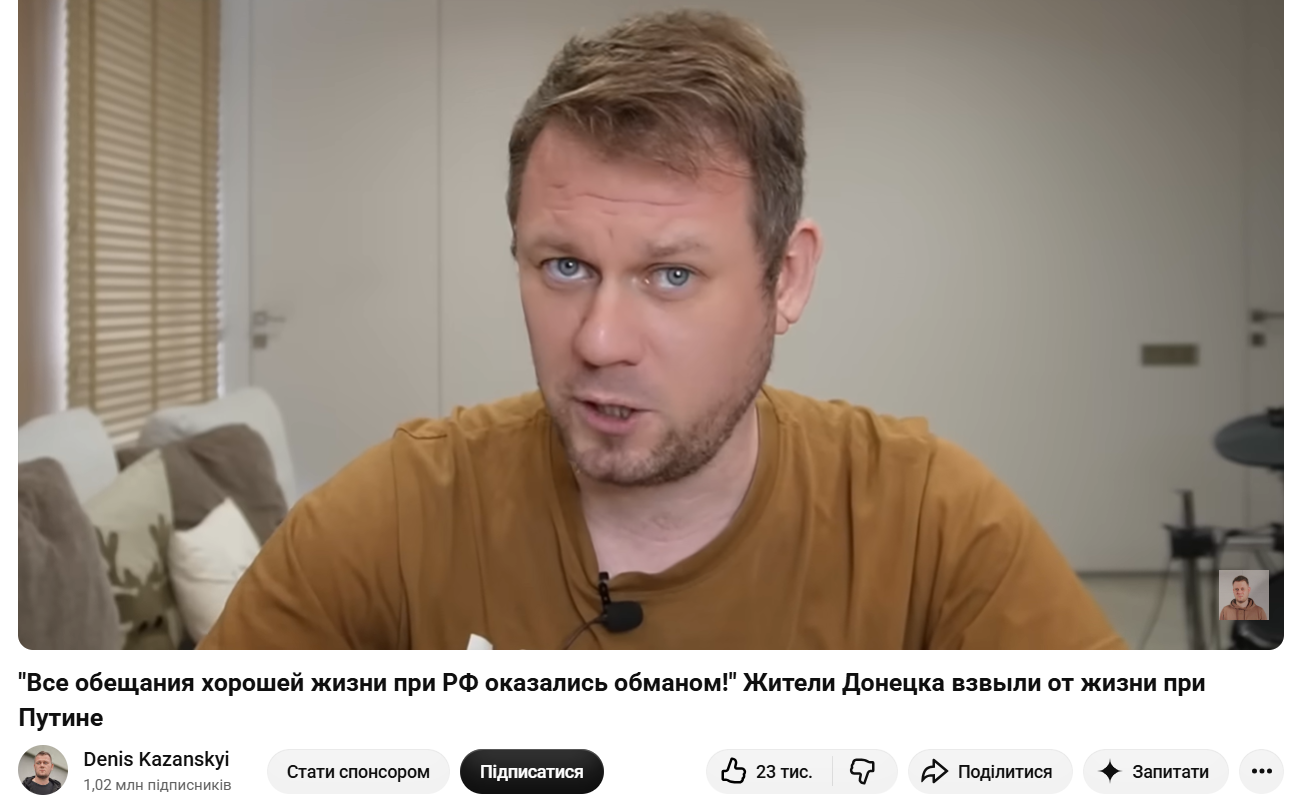
I try to do this through my video blog, and it genuinely gets hundreds of thousands—and sometimes millions—of views. In this way, we amplify their appeals to a large audience and provide them with a platform.
So our mission as Ukrainian journalists is to help and to spread such materials as widely as possible.
— What practical tools could Ukrainian media use? For example, your blog is bilingual—you work in both Ukrainian and Russian. Obviously, reading or watching something in Russian may be safer in occupied territories. Are there other tools—content anonymization, alternative distribution methods, closed communities, ways to bypass censorship—that you would recommend?
— That’s exactly what I do. And my main recommendation is to distribute content through social media. Blocking Ukrainska Pravda, for example, is easy, but blocking TikTok is much harder. And if an Ukrainska Pravda article circulates there in adapted or retold form, it takes on a different, more viral effect.
That’s exactly how I work—as a blogger rather than a media outlet. I don’t have a logo. I simply take news, retell it, explain it, and spread it on social media.
People continue to use social networks, even blocked or partially blocked ones, through VPNs. And through blogs, it appears less official—not as communication from a specific media outlet, but more informal. So perhaps it is precisely the blogger format and social media tools that allow content to spread “unofficially,” as though it comes from ordinary people themselves.
— You mentioned that it is somewhat easier to promote content on TikTok. Based on your experience with YouTube projects, Telegram, and other platforms, which would you call the most effective?
— All of them are effective in different ways. TikTok is good because it is not blocked—at least not in those territories—and it generates the highest number of views. But it is a short-form format. You have to make very short videos that immediately convey the essence. That’s important, but it’s not deep content. TikTok cannot replace everything.
If we’re talking about analytical pieces or content that explores a problem more deeply and keeps people engaged, that’s YouTube, because long-form works there. Text formats are also necessary. Of course, people often find it easier to watch videos, but text is not disappearing and still plays an important role.
All platforms work through VPNs despite attempts to block them. Both Russians and people in the occupied territories use them. If these tools exist, content should be duplicated across them as much as possible.
Text can be repackaged into video, narrated, transformed into different formats. Some people prefer video, others read text; some prefer TikTok, others Telegram. No opportunity should be neglected; the more tools available, the more they should be used.
— Are there topics that may be underreported? For example, Russians write extensively about education, what they are doing in schools and universities in the occupied territories. They are actively promoting their “reconstruction” efforts, especially in Mariupol. But there seems to be less investigative reporting about what is happening in prisons in the occupied territories. From your perspective, what is missing in our information space regarding occupied territories?
— It’s hard for me to say that specific topics are missing. I think, overall, most things that happen are covered in one way or another. What may be lacking is higher-quality reporting—material that can truly resonate, make the issue more emotional, perhaps more shocking, and thereby encourage wider distribution.
So I think the issue is more about presentation. The topics themselves are there. The key is to focus on the ones that matter most to people.
The issues that resonate most strongly are those that affect many people: lack of water, lack of reconstruction, destruction of housing, and the seizure of apartments when Russians confiscate other people’s property. These are highly emotional, resonant topics that affect many, and I think those are the ones we need to work on more.
That will also make the role of Ukrainian media more visible, because people seek information about what hurts them. And they are more likely to encounter Ukrainian content precisely because Russians do not write about these things, while Ukrainians do.
— But when we talk about the audience, we probably mean primarily neutral people or those who are more positively inclined toward Ukraine. What about those who categorically do not support Ukraine and have already been deeply ideologically shaped by Russia?
— Nothing. You can’t do anything with them, and we have to accept that. There is a segment of people you will never convince—that’s simply a fact.
At this point, that issue is no longer solved through information but through force. If Ukraine regains control over a city, for example, such people often leave for Russia on their own. If not, they stay there. But convincing them is impossible.
— In the territories occupied since 2014, in your view, are there still neutral or pro-Ukrainian people? Or after so many years, is that unrealistic?
— No, there are actually many of them. They have simply come to terms with the situation and adapted to it. But many still deeply reject Russia and what is happening. People have often lived in hellish conditions for twelve years, and of course, they hate the authorities that came and did this to them.
— If there is eventually de-occupation of certain territories—and we all hope for that—are the media and our broader information policy ready for the reintegration of these people? Sometimes, when talking to people in occupied territories, you hear things like: Ukraine no longer needs us, they consider us traitors, so there is no point in returning. Are we prepared, through the right narratives, to explain both to the broader public and to these people themselves that they are not traitors, and to carry out this reintegration in the information sphere?
— That is a very difficult question because everything depends on the battlefield situation. So much so that how we speak to residents of, say, Alchevsk, or what our media writes, has absolutely no impact on that. The key issue is whether control over these territories will be restored. And that depends on what happens to Russia and what happens in the war.
If, hypothetically, the Russian economy collapses tomorrow, Putin is removed, and Russian elites become interested in urgently ending the war, we may find ourselves in a situation where we regain control of these territories. But no one is predicting that they can be retaken by force right now. So physical control will determine everything.
If Ukraine regains these territories, part of the population that is radically anti-Ukrainian will leave. But a large portion—in fact, the majority—are conformists who are willing to live under either Ukraine or Russia. They will stay and simply live in Ukrainian reality again, just as they once agreed to live in another one. Much depends on the physical presence of one authority or another in a given territory.
Only then will it make sense to talk about the role of media and engagement with these people as something that can genuinely influence the situation. At this moment, everyone understands: tanks, not TikTok posts or Telegram messages, decide outcomes.
— So if Russians prepare newspapers, brochures, and informational materials before occupying territories and bring them to people, do we not have the ability to prepare in the same way?
— In principle, we do. But the Russians are not inventing anything especially unique—they are simply extending their existing propaganda machine into newly occupied territories.
For example, as they recently did, they went through occupied cities, cutting down Ukrainian satellite dishes with blowtorches and replacing them with their own “Russkiy Mir” system, which only receives Russian satellite signals. People physically cannot use it to watch Ukrainian or European channels. That is literal, forceful control over information.
And Ukraine could, in theory, reverse this—remove those systems and restore people’s access to normal television. The same applies to the internet: Russia blocks it; Ukraine could unblock it.
So they have not invented any extraordinary tools. Newspapers? Yes, they distribute them. But we could also have our own newspapers. The question is how effective they really are—whether anyone actually needs them, or whether it is simply an imitation of work and a way to siphon off funds. As far as I know, there are still no studies that provide a clear answer.
— What do media outlets most urgently need to cover life in the occupied territories more deeply?
— If we reduce it to the essentials, it all comes down to money. First, skill matters. It should already be a given for journalists, but it still needs to be improved—perhaps by learning from foreign journalists who truly know how to tell large, emotional stories.
Skill in repackaging content is also important. Taking one news event and turning it into a short TikTok video, a longer YouTube video, a Telegram text, and a full website article. Artificial intelligence can help here—for example, with video editing or creating short-form content. That can be useful, but people need to learn how to use it.
Teams also need to grow. Using AI as a search tool, monitoring more videos from occupied territories, following chats and groups, joining closed chats under the guise of locals, reading what people are discussing—all of that requires people, and people require salaries. So ultimately, everything depends on financial resources. If I could improve one thing, I would hire several more people for my team to do this work: searching, monitoring, assisting. It simply comes down to more people and larger teams that can accomplish more.
— Do you yourself repurpose your content in this way?
— I have an assistant whom I pay out of my YouTube income. You could say my work is self-sustaining. There is a commercial component; the media resource generates revenue. But I understand that to expand further, I would need grant support. So that kind of assistance is probably necessary for Ukrainian media as well.
— And how can young people be drawn into this work? How can the issue of occupied territories be brought into wider focus so that it is not only covered by people with personal experience of occupation but also by people from other regions?
— They absolutely need to be involved. But volunteer work only functions as long as people have the capacity to do it. Today, someone can dedicate time to it; tomorrow, they may no longer be able to.
For me, this is also personal, and I became deeply involved because of my own history with it.
If I were not able to earn a living doing this, I would have to do something else. It just so happened that I can support myself this way, so for me, it is not only a life mission but also a job. Not everyone has that opportunity.
— You said that the issue of occupied territories is inseparable from the issue of war. And where there is war, there are victims, difficult images, and death. Where do you draw the ethical line in publishing such content? What should and should not be shown?
— The only information that should not be published is information that could genuinely put someone at risk—leading to arrest or imprisonment, particularly supporters of Ukraine.
As for killings, dead bodies, and similar material, I do not see a need for categorical restrictions. Sometimes such images are exactly what convey the true nature of Russian war crimes and of the war itself.
The horror of these events is sometimes best communicated through quite graphic footage that traditional television ethics would once have considered unacceptable. But every case has to be judged individually. Often, the decision depends on the internal sense of the person publishing it—whether it truly needs to be shown.
If it illustrates war crimes, the essence of what the Russians are doing, then we must show it to present the real picture of the war rather than trying to soften it.
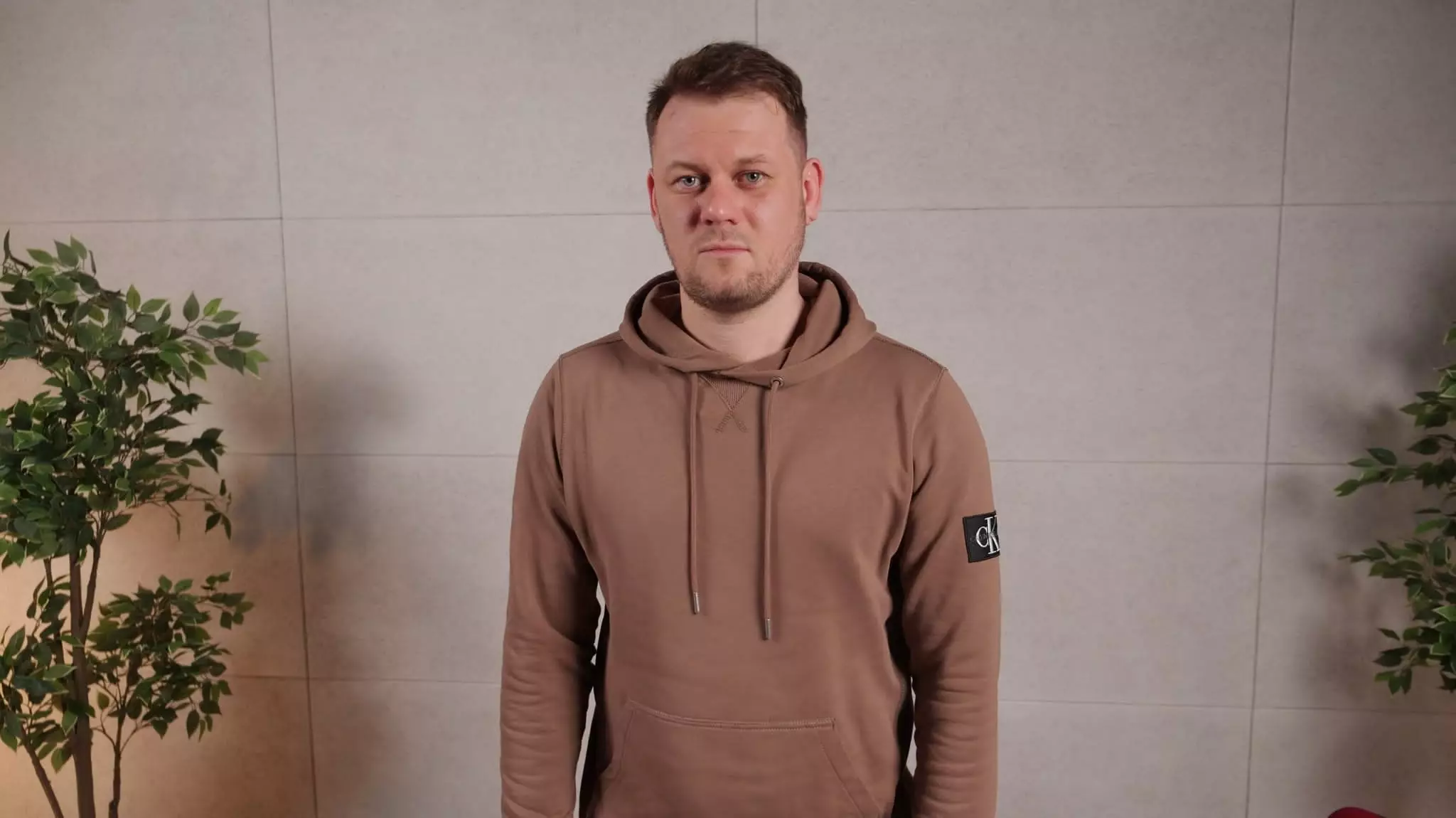
Photo: Denys Kazanskyi’s Facebook page
This project is implemented with the support of the Partnership Fund for a Resilient Ukraine, financed by the governments of the United Kingdom, Estonia, Canada, Norway, Finland, Switzerland, and Sweden.