
The strongest protection against FIMI remains the same: democratic institutions, such as a free press, independent research and an active civil society.
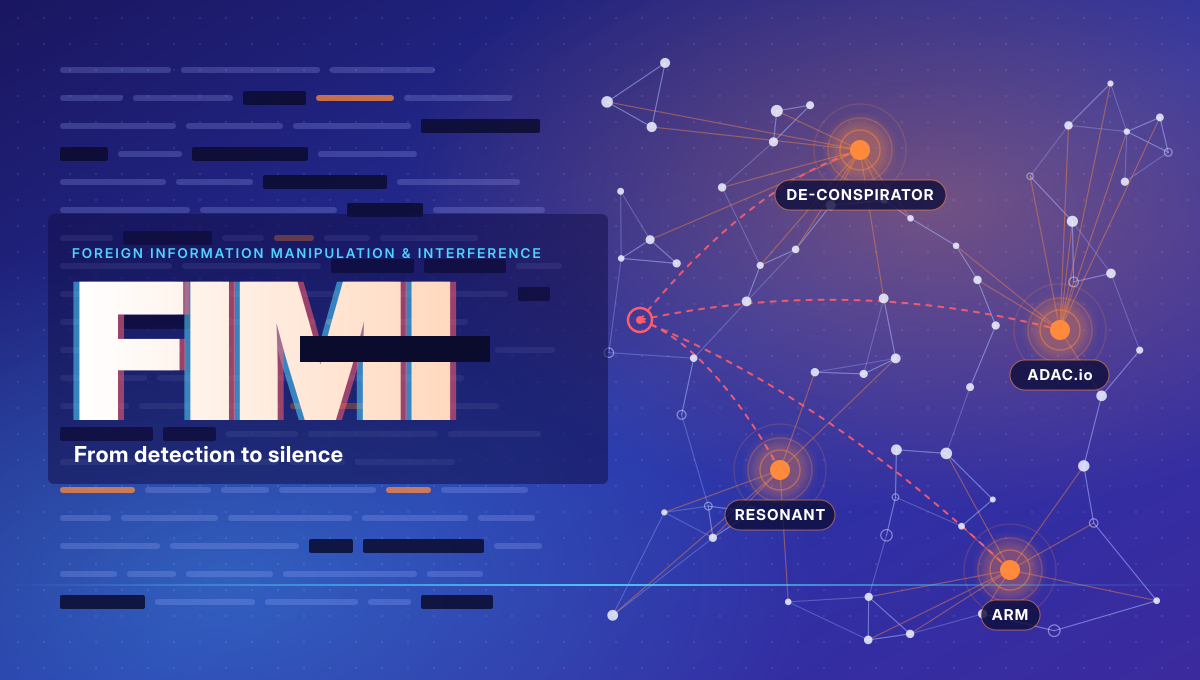
On 5 November 2026, researchers, policymakers and civil society representatives met in Brussels for Strengthening Democratic Resilience Against FIMI: Research Insights, Policy Outputs & Future Directions conference. It was the joint final conference of four European research projects working on foreign information manipulation and interference (FIMI): DE-CONSPIRATOR, ADAC.io, RESONANT and ARM. All four belong to the wider FIMI Research Cluster, which, according to the organisers, brings together 37 institutions from 18 countries.
Alliance4Europe, a partner in the ADAC.io consortium, co-organised the event and led its outreach to media and civil society. Detector Media followed the conference online.
After three years of work, the cluster's focus has moved beyond spotting influence campaigns. The questions now are how to map a campaign, establish who is behind it, share that evidence fast enough to act, and see what gets silenced as well as what gets spread. Shared frameworks such as DISARM, which catalogues the tactics of influence operations, were a recurring reference point.
This review covers the public part of the conference opening panel in detail, and cover some other main threads of the closed discussions.
Four projects, four angles on FIMI
During the "fire-pitching" panel, each project coordinator summarised three years of work and the policy messages their consortium is preparing. Three of the four projects run into early 2027, so several speakers stressed that their recommendations are still being finalised.
DE-CONSPIRATOR: the domestic side of foreign manipulation

Dr. Akın Ünver, DE-CONSPIRATOR Project Coordinator, Associate Professor, Özyeğin University
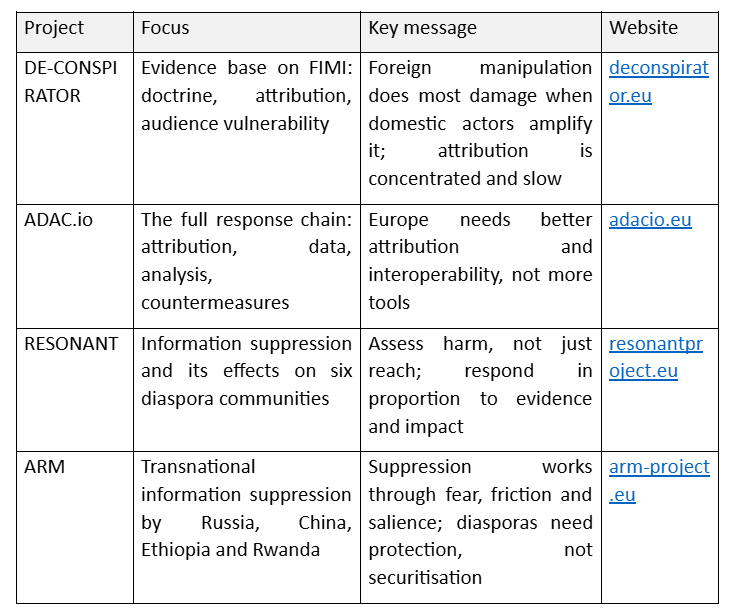
DE-CONSPIRATOR set out to build the broadest possible evidence base on FIMI, combining archival work on Russian and Chinese military and strategic doctrine with big-data analysis, surveys and psychometric research. One early lesson came from the doctrine itself: while Europe has tended to treat FIMI as competition in the information space, Moscow and Beijing frame it as war by other means.
The project's central finding concerns domestic amplification of foreign influences. According to Dr. Ünver, in about 93% of the incidents the team classed as "successful", local actors such as political parties and interest groups picked up foreign narratives and adapted them to national political and social contexts. Foreign interventions without that domestic relay rarely did much damage, which pushes FIMI partly into the domain of domestic information manipulation (DIMI).
Dr. Ünver also warned that judging content only as true or false misses much of the problem. Chinese operations in particular often use accurate but heavily one-sided information. Awareness campaigns alone do not stop sharing either: people often pass on manipulated content even when they recognise it as such. At the individual level, susceptibility correlated with heightened threat perception, themes of betrayal and abandonment, and admiration of foreign powers.
On attribution, the project built an open FIMI Attribution Event Dataset of 3,029 incidents attributed by 97 European and allied institutions in 534 published documents. It shows that attribution work is concentrated in a small number of institutions, and Dr. Ünver noted that a confident attribution typically takes about a year. That makes him sceptical of promises of AI-driven early warning. His open questions for the field was the following: how to adapt frameworks such as DISARM, OpenCTI (open-source threat intelligence platform) and STIX (a standardised, open standard in the field of cybersecurity and information sharing) to evolving tactics, and how to secure meaningful platform data access under the DSA (Digital Services Act).
ADAC.io: interoperability over new tools

Rickard Andersson, ADAC.io Project Coordinator and Senior Lecturer, Lund University
ADAC.io (Attribution, Data, Analysis, Countermeasures, Interoperability) project covers the whole FIMI response chain, from attribution to countermeasures. Coordinated by Lund University, its consortium includes Alliance4Europe, Debunk.org, TU Dortmund, SWPS University, Leiden University and Cardiff University. Over three years it contributed to the DISARM framework and other standards, reviewed 159 FIMI frameworks, and ran case studies on climate-policy manipulation, gendered FIMI, financial fraud and cross-platform operations. An open university course reached participants from more than 18 countries.
Rickard Andersson during his speech named attribution as "the weakest link": detecting manipulation is often relatively easy, while establishing who is behind it and why is hard. The project's main conclusion is that interoperability matters more than new tools. The field needs shared language and integration between the frameworks that already exist. A public survey conducted by ADAC.io also challenged a common assumption: older respondents were better at recognising FIMI than younger ones.
ADAC.io's draft recommendations fall under three priorities: stronger, evidence-based attribution with confidence scales and cross-sector cooperation; shared infrastructure, including common standards, better data access and long-term rather than crisis-driven funding; and better evaluation of what actually works. In Mr. Andersson's summary, Europe does not primarily need more FIMI tools but better attribution, stronger interoperability, sustainable infrastructure and more evidence. He closed by noting that the strongest protection remains democratic institutions themselves: a free press, independent research and an active civil society.
RESONANT: measuring harm, not just reach

Susanna Fontana, RESONANT Project Coordinator and Senior Project Manager, Fondazione FORMIT
Project RESONANT focuses on information suppression, which includes censorship, harassment and other forms of pressure, and on its effects on diaspora communities in Europe. The project worked with country experts and law enforcement partners and studied six diasporas: Russian, Chinese, Turkish, Nicaraguan, Venezuelan and Iranian.
Susanna Fontana explained why the project shifted its attention from technology to effects. Technical detection evolves quickly and cannot capture everything that matters. Through interviews with diaspora members, conducted under strict security and ethics measures, the team traced harm at three levels: individual, community and society. A key lesson is that limited reach does not mean limited damage. A disinformation campaign may target a single person and still cause serious harm, and that kind of analysis needs contextual knowledge that cannot be acquired "sitting at a desk".
The main output is a Handbook on Information Suppression and FIMI, for analysts and active citizens built around a chain of steps: on how to observe, verify, assess harmful campaigns and share information safely. It includes guidance on the risks of reporting, since exposing a campaign can also amplify it or put people at risk. It proposes proportionate responses depending on evidence quality and impact severity, from continued monitoring to escalation to the competent authorities. More on the project's evidence base is available in its article on transnational information suppression targeting diaspora communities and on the outputs page.
ARM: the flip side of disinformation

Lovise Aalen, ARM Project Coordinator and Research Professor, Chr. Michelsen Institute
The project ARM (The Long Arms of Authoritarian States) also treats information suppression as a form of FIMI, defined as silencing voices or narratives beyond a state's borders. Its team of country experts studied Russia and China, as well as Ethiopia and Rwanda, smaller authoritarian actors with substantial diasporas in Europe.
Professor Aalen in her speech described three mechanisms, each with its own set of tactics, which the project has catalogued: inducing fear among those who produce information, such as journalists and academics, through intimidation, harassment and lawfare; creating friction that stops information from spreading, from blocked websites to internet shutdowns and the instrumentalisation of platform moderation; and managing salience, that is, controlling what is visible. In their last case, suppression and disinformation overlap: flooding the space with alternative content buries critical voices. Ethiopia and Rwanda, for e.g. as Professor Aalen noted, are moving from shutdowns of alternative point of view content towards this kind of flooding, increasingly powered by AI-generated content.
Findings of ARM project point out that diasporas are both targets and, at times, actors of information suppression. Professor Aalen warned against a securitising approach that would treat diaspora communities as suspects rather than as European citizens with the same rights. She also argued that existing EU instruments, including the DSA and the European Democracy Shield (a strategic initiative by the European Commission, launched in November 2025, aimed at safeguarding democratic processes in the European Union against hybrid threats, foreign interference and manipulation), still pay far more attention to disinformation than to information suppression.
Behind closed doors: three threads from the parallel sessions
The other conference sessions were held under the Chatham House rules.
Information suppression was the term of the day. Participants argued that FIMI work has long focused on what is spread and now needs to look as closely at what is silenced. One presentation drew on a database of 91 incidents built together with six diaspora communities in Europe. It documents restrictive laws applied abroad, purchases of diaspora media and pressure on relatives back home. Several states are shifting from blocking information to burying it, flooding online spaces with accurate but one-sided content, increasingly with AI. Existing FIMI toolkits do not yet cover this well enough.
The line between foreign and domestic is blurring. Monitoring around Latvia's October 2026 parliamentary elections found that most Kremlin narratives appeared in comment sections, largely on the pages of Latvian politicians, parties and media. Fewer than 10% of these comments came from accounts showing signs of inauthentic behaviour. Because such narratives reinterpret real events rather than invent new ones, classic debunking has limited effect.
Fewer new frameworks, more evaluation. Discussions returned repeatedly to the gap between the many existing FIMI frameworks and the lack of methods to evaluate what works. Some countermeasures can backfire, for example when deplatforming spawns replacement accounts or exposure amplifies an operation. The prevailing view was that the field should connect and adapt existing frameworks such as DISARM rather than create new ones. In the closing discussion, participants also turned the question on research funding itself: projects designed to produce something original can work against consolidation, and parallel projects need the chance to pool their results.
Why it matters for Ukraine
Much of what was presented in Brussels matches what Detector Media's Research Center sees in its research and monitoring.
Domestic amplifiers and Telegram. DE-CONSPIRATOR's finding that foreign narratives do most damage once local voices carry them is familiar from Ukraine's Telegram space. Since 2022 we have documented a network of anonymous Russian Telegram channels created for occupied and frontline towns, and we track how propaganda about the war is adapted in Ukrainian, Polish and Moldovan pro-Russian channels. Localisation is what makes these narratives work.
The attribution gap. The concentration of attribution in a few institutions, and the year it takes to reach confidence, is a practical problem for frontline researchers. Anonymous channels are hard to attribute without state-level evidence. For example, our analysis of anonymous Telegram channels that Ukraine's security service links to Russian military intelligence relied on attribution that civil society alone could not establish. Shared, open datasets like DE-CONSPIRATOR's are a step towards closing that gap.
Diasporas and refugees as targets. RESONANT's and ARM's focus on diaspora communities is directly relevant to the millions of Ukrainians displaced abroad. Our research has traced how anti-Ukrainian narratives exploit social tensions in Poland and how refugees and internally displaced people are portrayed on Ukrainian social media. The warning against securitising diasporas applies here too.
Doppelgänger and the cost of aid to Ukraine. Alliance4Europe's EU Unrest Report shows Russia's Doppelgänger network posting 639 coordinated messages in the weeks before the 17 October protests in France, turning real grievances against support for Ukraine. Detector Media has contributed Ukrainian-language analysis to earlier international work on this operation, including a two-year study of Doppelgänger's anti-Ukrainian propaganda and an Alliance4Europe report on how it continues to operate.
Resources
- FIMI Attribution Event Dataset (DE-CONSPIRATOR): open data on 3,029 publicly attributed FIMI incidents
- Transnational information suppression targeting diaspora communities: evidence from the RESONANT project
- RESONANT outputs and reports
- EU Unrest Report: How France's October 2026 protests were manipulated, then retold abroad (Alliance4Europe)
- DISARM framework
- Project websites: DE-CONSPIRATOR · ADAC.io · RESONANT · ARM