



Українською читайте тут.
An analysis of nearly eight thousand Facebook and Telegram posts published between January and July 2026 found that vulnerable groups rarely speak for themselves on social media. Instead, they are mostly spoken about by those who (supposedly) help them.
Key findings
- On Facebook and Telegram, internally displaced people are mentioned 3.6 times more often than refugees (5,840 versus 1,619 mentions among the analyzed focus posts).
- In posts about internally displaced people, the topic of assistance dominates all other themes: support for internally displaced people is mentioned in more than 70% of the analyzed Facebook posts and 62% of Telegram posts, while assistance to refugees appears in only 6.7% and 13.7% of posts, respectively.
- State and local authorities are the actors most frequently portrayed as helping internally displaced people, accounting for 3,689 of 8,560 mentions in the “assistance” category—more than international organizations (1,763) or private initiatives (3,108) individually.
- In the case of refugees, mentions of assistance provided by host countries (756 out of 1,162 cases) outnumber the combined mentions of assistance from the Ukrainian state (276) and private initiatives (130).
- Posts containing value judgments about internally displaced people are more common on Facebook—20.4% of posts compared with 10% on Telegram. The opposite is true for refugees: discussions are more emotional on Telegram (12% of the analyzed posts) than on Facebook (7%).
- The risk of internally displaced people losing assistance was mentioned in 8% of the focus posts about internally displaced people and refugees, while 4.6% reported that internally displaced people had already lost support. On social media, the reduction of support for internally displaced people is discussed more often as a threat than as an accomplished fact.
- Only 5% of posts about internally displaced people and 1.7% of posts about refugees mention any benefits they bring to the communities hosting them. The idea that internally displaced people or refugees themselves contribute to their host communities, rather than only receiving assistance, is almost absent from social media discussions.
Introduction and context
Nearly ten million Ukrainians have been forced to leave their homes because of the war. Yet on social media, internally displaced people are usually spoken about not by themselves but by others—officials, volunteers, and foreign governments. As of the end of April 2026, according to the Ministry of Economy, Environment, and Agriculture of Ukraine, 5.76 million Ukrainian refugees were living outside Ukraine. This figure does not include people currently residing in Russia. Another 4.65 million people (as of June 2026) left their homes but remained within Ukraine and have the status of internally displaced persons (IDPs). Internally displaced persons have the same rights and obligations as all other citizens of Ukraine. By contrast, Ukrainian citizens who have obtained refugee status or the status of a person in need of additional protection abroad have fewer rights than citizens of the countries where they have found refuge. Despite their different legal statuses and opportunities, internally displaced people and refugees share the common experience of losing their homes because of the war. They also share the need to adapt to a new place and often face a lack of understanding from people who have not been forced to leave their homes because of military action.
The Detector Media Research Center analyzed the similarities and differences in how users of the Ukrainian segments of Telegram and Facebook write about internally displaced people and refugees, as well as the broader discourse surrounding these groups.
Methodology
We have previously studied manipulative narratives targeting Ukrainian women and men, internally displaced people, and refugees. For those earlier studies, search queries were designed to maximize the likelihood of finding publications matching manipulative and disinformation narratives. As a result, they also increased the number of publications related, for example, to manipulative narratives about women.
This time, we designed our search queries in the Semantrum search system to avoid focusing solely on manipulative content and instead made them as broad as possible. Our goal was to analyze different types of messages about internally displaced people and refugees as vulnerable population groups. We also examined who actually appears “in the frame” when social media writes about internally displaced people and refugees, who becomes the main character in these stories, and who remains in the background. We selected Facebook and Telegram because they are among the largest platforms and messaging services that Ukrainians use and where they consume news daily, according to media consumption studies.
The query in the Semantrum social media aggregation system covered publications from January 1, 2026, to July 3, 2026, with the source region specified as “Ukraine.” It retrieved 21,517 publications containing the keywords “refugees,” “IDPs,” “internally displaced people,” and “internally displaced persons” in both Ukrainian and Russian. The dataset included 12,913 Telegram posts and 8,604 Facebook posts. Two samples of 4,000 publications each were then created, one for each platform, with a 99% confidence interval and a 2% margin of error.
From these two samples, 169 publications were excluded because, although they contained the keywords, they did not focus on Ukrainian refugees and internally displaced people in the context of Russia’s aggression against Ukraine, which began in 2014 with the annexation of Crimea. We classified such publications as non-focus posts and excluded them from this analysis. The remaining 7,831 publications contained the necessary information, concerned the target groups, and formed the basis of this study. We refer to them as focus posts.
In this text, we use the term “refugee” to refer to all Ukrainian citizens who have received asylum in other countries, regardless of whether they officially hold refugee status or the status of a person in need of additional protection or temporary protection in their host country. We recognize the legal distinctions between these statuses. However, for the purposes of this study, we combine all three categories under the term “refugee,” based on the shared criterion of requiring asylum and protection from the states in which Ukrainian citizens are temporarily residing, despite the greater prevalence of the term “temporary protection” in the Ukrainian information space.
Data processing. Initial data processing was carried out using the Gemma 4 large language model with 26 billion parameters. The analysts developed 40 categories for data analysis, consisting primarily of binary (yes/no) questions covering topics such as the departure and return of refugees and internally displaced people, assistance from the state and other actors, threats facing these groups, subsidies and financial assistance, risks and barriers to integration, and related issues. The model returned the results in a structured format in Google Sheets. Analysts at the Detector Media Research Center then verified the results and reviewed the social media posts to describe and refine the findings produced by the large language model.
What is written about internally displaced people and refugees
We classified the 7,831 posts and publications from both samples as “focus posts.” The first thing that stands out is that internally displaced people are discussed on social media several times more often than refugees. At the same time, explicit value judgments or evaluations—whether positive or negative—appear in only a minority of posts.
The proportion and number of posts about internally displaced people and refugees on Telegram and Facebook from January to July 2026. Detector Media Research Center, based on Semantrum data.
Overall, the sampled posts mention internally displaced people 3.6 times more often than refugees—5,840 posts versus 1,619. However, the ratio differs across platforms: on Facebook, there are five mentions of internally displaced people for every mention of a refugee (3,017 versus 608). On Telegram, the ratio is roughly two to one (2,823 versus 1,011). The explanation is relatively straightforward: for many users, Telegram primarily serves as a news feed, as confirmed by media consumption studies and the Ukrainian Media Literacy Index, and news coverage frequently includes reports about Ukrainian refugees abroad.
Posts mentioning both internally displaced people and refugees are relatively rare—372 out of 7,831. Posts containing evaluations of these groups—not necessarily manipulative or negative, but simply emotionally charged—appear in roughly one out of every six posts. Internally displaced people are evaluated in 1,190 of the 7,831 sampled posts (approximately 15%), with such posts appearing twice as often on Facebook (792) as on Telegram (398). The pattern is reversed for refugees: there are 782 posts containing evaluative judgments (10% of the sample), with Telegram leading at 509 posts compared with 273 on Facebook.
Share, number, and ratio of posts containing evaluations of internally displaced people and refugees in the social media sample. Detector Media Research Center, based on Semantrum data.
Benefits and threats
One of the topics discussed in the analyzed publications was whether internally displaced people were portrayed as a “benefit” or a “threat” to the communities hosting them. Such posts also appeared more frequently than posts portraying refugees as a benefit to the communities and countries that granted them asylum. The benefits of internally displaced people to host communities were mentioned in 260 Facebook posts, representing 6.7% of the focus publications, and in 123 Telegram posts, accounting for only 3% of the Telegram posts categorized under the “benefit/threat” theme in the sample.
Discussions portraying internally displaced people as a “threat” to host communities appeared in 65 Facebook posts and 68 Telegram posts, representing less than 2% of posts in this category on each platform. Although relatively few in number, these posts likely highlighted potentially sensitive and conflict-prone issues between internally displaced people (IDPs) and local community residents.
For example, in February 2026, regional Telegram channels in Chernivtsi circulated claims that “apartments that have stood empty for years will be given to IDPs,” allegedly citing an already approved decision by the Ministry for Communities and Territories Development. These posts attracted a large number of negative reactions (see the screenshot below). At the time, the Center for Strategic Communications Spravdi stated that the claim was manipulative, clarifying that it referred not to privately owned property but to state- and municipally owned assets. The Ministry for Communities and Territories Development also clarified that the initiative would not affect vacant apartments belonging to private owners.
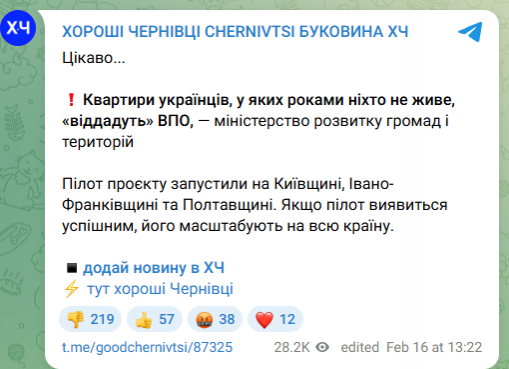
Screenshot — Telegram
The largest number of critical and manipulative narratives on social media concern not internally displaced people but refugees. Refugees from Ukraine are portrayed as a threat to the communities or countries hosting them in 3.9% of the publications focused on IDPs and refugees. Some posts containing manipulative claims about internally displaced people and refugees also mentioned labor migrants from other countries in Ukraine. This aligns with the debate surrounding the recruitment of foreign labor migrants to Ukraine, analyzed by Detector Media in May 2026. Other examples include publications about changes to the legal status of Ukrainian refugees in Poland that came into force in March 2026, or discussions about financial compensation for Ukrainian refugees willing to return to Ukraine. For example, this idea was discussed in Ireland in April 2026, where anti-immigration rhetoric forms part of the agenda of local political groups and protest movements.
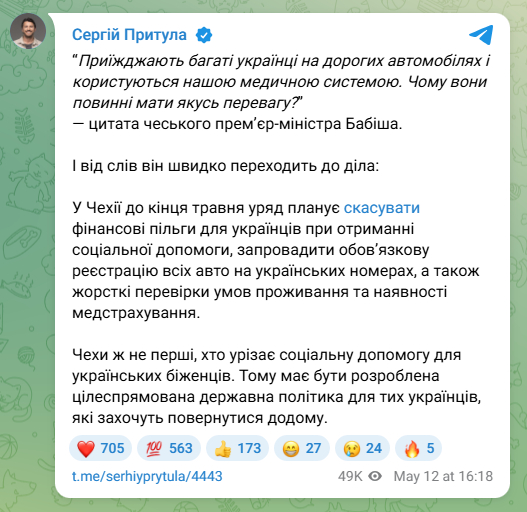
Screenshot — Telegram
The discussion surrounding refugees presents a particularly illustrative set of examples. Debates over cuts to assistance for Ukrainian refugees in the EU have prompted Ukrainian volunteers and politicians—including Serhii Prytula—to discuss creating conditions and public policies for Ukrainians who wish to return home. At the same time, Telegram channels reported both the deterioration of support for Ukrainians in Poland and EU discussions on extending temporary protection beyond March 2027. Some posts questioned whether Europe should continue providing assistance at all, while others focused on specific categories of Ukrainian refugees, particularly military-age men. Meanwhile, Facebook groups have circulated claims that “without Ukrainian refugees, the European economy would decline.”
Alongside these discussions, another narrative emerged about the economic self-sufficiency of Ukrainian refugees. In April, Telegram channels widely shared a post originating from the UA War Infographics channel, based on research by the Centre for Economic Strategy. According to the study, only 17% of Ukrainian refugees in the EU rely exclusively on assistance from their host countries, while nearly half receive income from wages or their own businesses abroad. This study was mentioned and discussed more than 60 times on Facebook and Telegram within the analyzed sample.
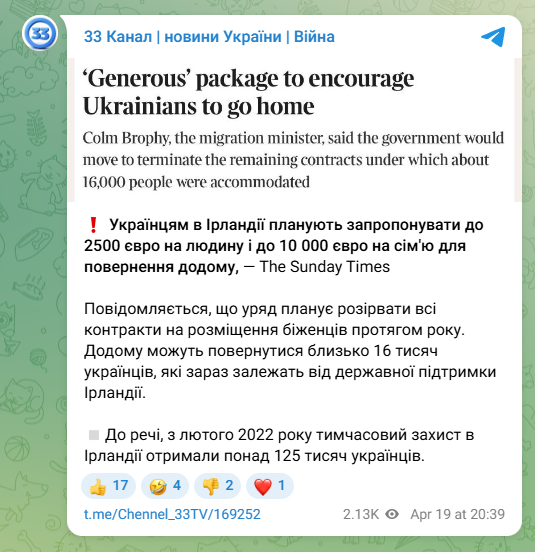
Screenshot — Telegram
Posts containing positive evaluations of internally displaced people and their contribution to host communities were mostly informational in nature. These included, for example, reports about a two-year pilot project launched in June 2026, following the adoption of a Cabinet of Ministers resolution, to purchase housing in rural areas for internally displaced people. Other examples were announcements about the opening of new assistance centers for internally displaced people run by specialized NGOs, such as one in Voznesensk, Mykolaiv region. Notably, a post from the NGO Zakhyst Derzhavy (with fewer than 1,000 subscribers) entered the dataset because it was reposted across the regional Trukha Telegram channel network, where it received 35,000 views.
Assistance to refugees and internally displaced people
In this study, assistance to internally displaced people and refugees refers to all publications discussing material and non-material support provided to Ukrainians who were forced to leave their homes because of Russia’s aggression against Ukraine. This includes both references to how assistance from host countries influences Ukrainian refugees’ decisions about returning to Ukraine—depending on changes in support policies, the cessation of hostilities, and other factors—and reports about, for example, cases where state assistance was discontinued after internally displaced people purchased their own housing.
Numerically, publications about assistance to internally displaced people dominated the analyzed sample and constituted the most common topic overall. This theme appeared in 70.2% of Facebook publications and 62.5% of Telegram posts. By comparison, assistance to refugees was mentioned in only 6.7% of Facebook publications, and 13.7% of Telegram posts focused on these vulnerable groups.
Number and proportion of publications mentioning assistance provided to internally displaced people and refugees. Detector Media Research Center, based on Semantrum data.
Nearly 35% of Facebook publications and 30% of Telegram posts in the “assistance” category concerned financial payments, housing support, or other forms of material assistance for internally displaced people. Most of these publications were posts from local government Telegram channels, regional media outlets, or NGOs about access to subsidies and other social benefits—for example, one-time financial assistance for internally displaced people who had lived in a community for more than one year. Others informed readers that, at the end of May, the Ministry of Justice had launched a unified state services portal for internally displaced people, with announcements shared on municipal Facebook pages. Ukrainian lawmakers also addressed the challenges faced by internally displaced people. For example, Olena Shuliak, a Member of Parliament from the Servant of the People faction and Chair of the Verkhovna Rada Committee on State Building, Local Governance, Regional Development and Urban Planning, spoke at the World Urban Forum in Baku about expanding the affordable mortgage program for internally displaced people and noted that around 200,000 Ukrainians had already benefited from the eVidnovlennia (“eRecovery”) program.
Assistance provided by host countries to Ukrainian refugees was mentioned in only 1.7% of Facebook publications and 5.9% of Telegram posts.
Who provides assistance?
The group most frequently mentioned as providing assistance to internally displaced people consists of representatives of state and local authorities. However, private organizations and civil society groups are not far behind in terms of the number of mentions. In the case of internally displaced people, international organizations and foreign governments are mentioned less often than private assistance initiatives. This is unsurprising, since internally displaced people are primarily the responsibility of the Ukrainian state and local communities. At the same time, compared with 2022, the volume of international donor assistance for internally displaced people has declined, and the budgets of some organizations, such as the International Rescue Committee (IRC), were cut by half in 2026.
In 2022, financial assistance was provided to almost everyone holding an IDP certificate. By 2026, UN agencies, UNICEF, and other donors had shifted to individual needs assessments. Financial support is now directed exclusively to the most vulnerable groups. In 2026, the UN Refugee Agency (UNHCR) discontinued cash assistance for certain categories of internally displaced Ukrainians.
It is sometimes difficult to draw a clear distinction in publications between government authorities, private initiatives, and international organizations. Posts about assistance to internally displaced people or refugees often mention several initiatives or public institutions simultaneously. Likewise, non-governmental charitable foundations frequently operate with support from international organizations or foreign donors.
For example, the charitable foundation Right to Protection provides free legal assistance and other services to internally displaced people with the support of both Ukrainian and international partners. These include the UN Refugee Agency (UNHCR), the European Commission’s Directorate-General for European Civil Protection and Humanitarian Aid Operations (DG ECHO), and the embassies of the United States and the United Kingdom, among others. Similarly, state and local authorities may participate in implementing international programs or be mentioned as partners in non-governmental initiatives without any specific explanation of their contribution.
Number of mentions and distribution of different actors providing assistance to internally displaced people and refugees. Detector Media Research Center, based on Semantrum data.
In the case of refugees, who fall under the jurisdiction of other countries, mentions of assistance from host states outnumber the combined mentions of support from the Ukrainian government and private initiatives assisting Ukrainian refugees. References to support provided by Ukraine most often concern making interactions with the state easier—for example, through the digitalization of administrative services, allowing refugees to complete identity verification remotely in order to receive pensions and other benefits and compensation.
Overall, mentions of assistance from foreign governments to Ukrainian refugees largely take the form of international policy news, particularly on Telegram channels. Discussions about other countries’ willingness to support Ukraine are closely linked to reporting on policy changes in Western states.
For example, in February, the Czech Republic debated changes to its simplified long-term residence scheme for Ukrainian refugees. The right-wing populist party Freedom and Direct Democracy (SPD), led by lower house speaker Tomio Okamura, called for ending the simplified regime for Ukrainians, raising the prospect of a coalition crisis. Similarly, Ukrainian media outlets and social media users have interpreted U.S. policy toward Ukraine following Donald Trump’s return to the presidency through the lens of a potential threat of deportation for Ukrainian migrants living in the United States.
Alongside publications about assistance provided by foreign countries to Ukrainian refugees, the analyzed dataset also included notable coverage of Ukrainians helping the communities hosting them. For example, in January 2025, media outlets—and subsequently social media—reported on Ukrainians in Berlin who set up a “Point of Invincibility” when the city experienced temporary power outages. By contrast, in publications about internally displaced people, the individuals most frequently portrayed as providing assistance are representatives of local authorities and non-governmental organizations.
Political PR built around the problems of internally displaced people and refugees
While analyzing publications about actors providing assistance to internally displaced people, we encountered difficulties in distinguishing between initiatives led by private individuals and political self-promotion. In some cases, it is unclear whether a person is assisting independently or on behalf of—or for the benefit of—a political party. Earlier, we mentioned the NGO Zakhyst Derzhavy (Protection of the State), whose local branch was reported by the Kherson-based outlet Most to have charitable activities that may be linked to the political project of the organization’s head.
Analyzing the activities of a specific NGO falls outside the scope of this study. However, it is worth highlighting broader trends and examples in which work with vulnerable social groups is used for purposes other than providing assistance to those in need.
One example found in the analyzed dataset is the social media positioning of assistance provided by athlete Artem Chaplyhin. In September 2025, the publication Apostrof reported that Chaplyhin, together with Valerii Dubil, head of the Kyiv City organization of the Batkivshchyna political party, delivered aid to the military. Chaplyhin himself reports on gifts for internally displaced people on YouTube. His gifts to internally displaced people from Donetsk and Luhansk regions were also covered by the website of the Kyiv City branch of the Batkivshchyna party, at least once in May and once in June 2026. In addition, during the spring and summer of 2026, the Kyiv branch of Batkivshchyna repeatedly posted on its Facebook page about gifts for internally displaced people provided by Chaplyhin.
In such publications—and especially in the accompanying photographs—the role of the specific activist is clearly emphasized, while internally displaced people appear merely as a backdrop and a pretext for political self-promotion. Notably, Chaplyhin’s name also regularly appears in posts by anonymous Telegram channels with millions of subscribers, such as Ukraina Seichas, Times of Ukraine, and Realna Viina, where he is portrayed instead as a volunteer supporting the military and welcoming vehicles carrying wounded soldiers returning from the front.
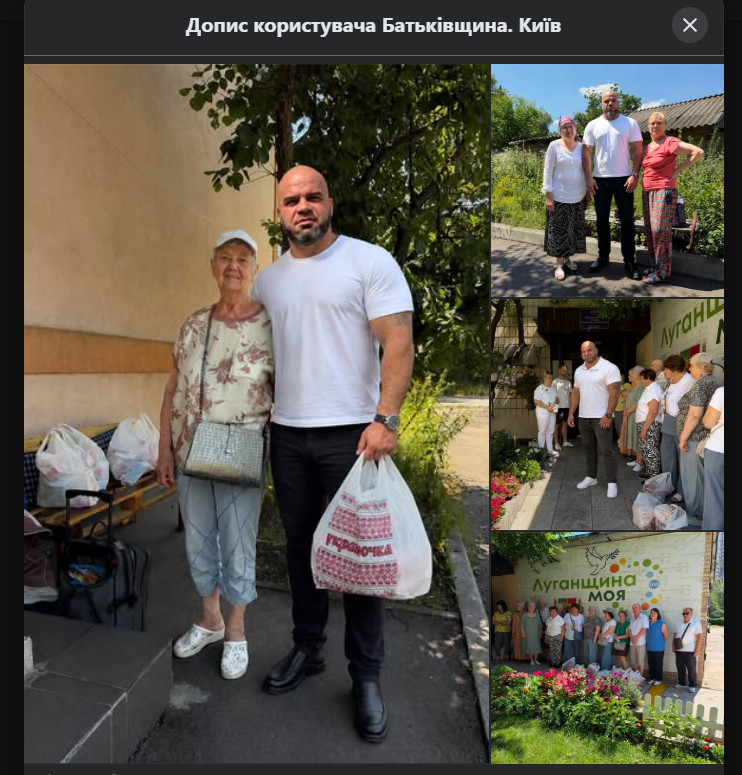
Example of a publication on the Facebook page “Batkivshchyna. Kyiv,” where Chaplyhin is described as an “activist.”
Comparing mentions of the risk of losing assistance with reports of actual loss of assistance among refugees and internally displaced people
In absolute terms, threats of losing assistance were mentioned more often for internally displaced people than for refugees: 626 versus 357 publications. The gap was even larger for reports of actual loss of assistance—359 versus 146 publications. In both cases, mentions of the risk substantially outnumbered reports of actual loss: by 74% for internally displaced people and by 2.45 times for refugees. These publications included warnings about application deadlines, new eligibility criteria for benefits, potential legislative changes, and the consequences of failing to meet administrative requirements.
The higher number of mentions of internally displaced people is partly explained by the structure of the sample: there were 3.6 times more publications focused on internally displaced people than on refugees alone. However, when comparing topics within each respective subset, the picture changes. Among the 5,840 publications specifically about internally displaced people, the risk of losing assistance was identified in 550 posts (9.4%), while actual loss of assistance was reported in 308 posts (5.3%).
By contrast, among the 1,619 publications specifically about refugees, the corresponding figures were 346 posts (21.4%) mentioning the risk of losing assistance and 143 posts (8.8%) reporting actual loss. Thus, although discussions about internally displaced people generated a larger number of mentions overall, the threat of losing protection or assistance was proportionally a much more prominent topic in discussions about refugees.
Comparison of the number of publications about the risks and actual loss of assistance for internally displaced persons and refugees across different social media platforms. Detector Media Research Center, based on Semantrum data.
The categories of risk and actual loss were not mutually exclusive. In 342 out of 359 publications about the loss of assistance for internally displaced persons, or 95.3%, the risk of losing assistance was also discussed. For refugees, this overlap covered 128 out of 146 publications, or 87.7%. Therefore, mechanically adding the two indicators together would overestimate the number of individual posts: overall, at least one of the two topics appeared in 643 publications concerning internally displaced persons and 375 concerning refugees.
A typical pattern involved using an already documented case—for example, the suspension of a pension due to failure to complete the identification procedure—as a warning to a broader group about what could happen to them under similar circumstances.
The distribution across platforms also differed significantly. Of the 626 mentions of risks for internally displaced persons, 434, or 69.3%, appeared on Facebook; among posts about the actual loss of assistance, Facebook's share was even higher—270 out of 359, or 75.2%. Refugees showed the opposite pattern: 290 out of 357 posts about risks, or 81.2%, and 115 out of 146 posts about actual loss, or 78.8%, were published on Telegram.
This reflects different information ecosystems. Posts about internally displaced persons often originated from local authorities, community pages, civil society organizations, and assistance recipients themselves, for whom Facebook remains a platform for local communication. By contrast, the topic of refugees was largely disseminated as international news: Telegram channels quickly reposted decisions or statements by the governments of Poland, Germany, the Czech Republic, Ireland, Denmark, Norway, and EU institutions, often reducing complex regulations to alarming headlines.
In publications about internally displaced persons, the most common context of risk was the dependence of payments on administrative procedures. This most frequently concerned pensions and insurance payments for people who had left temporarily occupied territories, were staying abroad, or remained officially registered in occupied territories. Official and civil society pages reminded people about annual in-person identification, confirmation that they were not receiving a pension from Russia, and the use of Diia.Signature or video identification.
For example, the Association of Taxpayers of Ukraine explained the procedure for remote identification for pensioners living abroad while warning that failure to complete the procedure could result in the suspension of pension or insurance payments. In such content, the threat primarily served a navigational function: the purpose of the message was to encourage recipients to complete the required steps on time.
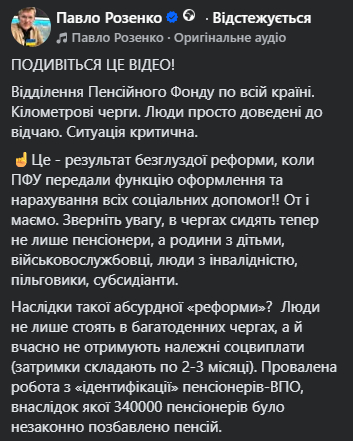
Screenshot — Pavlo Rozenko's Facebook page
The scandal surrounding the mass suspension of pension payments to internally displaced pensioners in early 2026 arose due to inconsistencies in verification procedures and the requirement imposed by the Pension Fund of Ukraine (PFU) to prove that applicants were not receiving pensions from Russia. As a result, nearly 340,000 internally displaced pensioners suddenly stopped receiving payments in January 2026.
Social media and opposition politicians reacted immediately to the situation. A Facebook post featuring a video from the page of Pavlo Rozenko, Member of Parliament of the VII and VIII convocations and former Minister of Social Policy, showing long queues at a Pension Fund office in early February, received more than 30 reposts in the dataset. Similar Facebook posts called for an end to the "digital discrimination" of internally displaced pensioners.
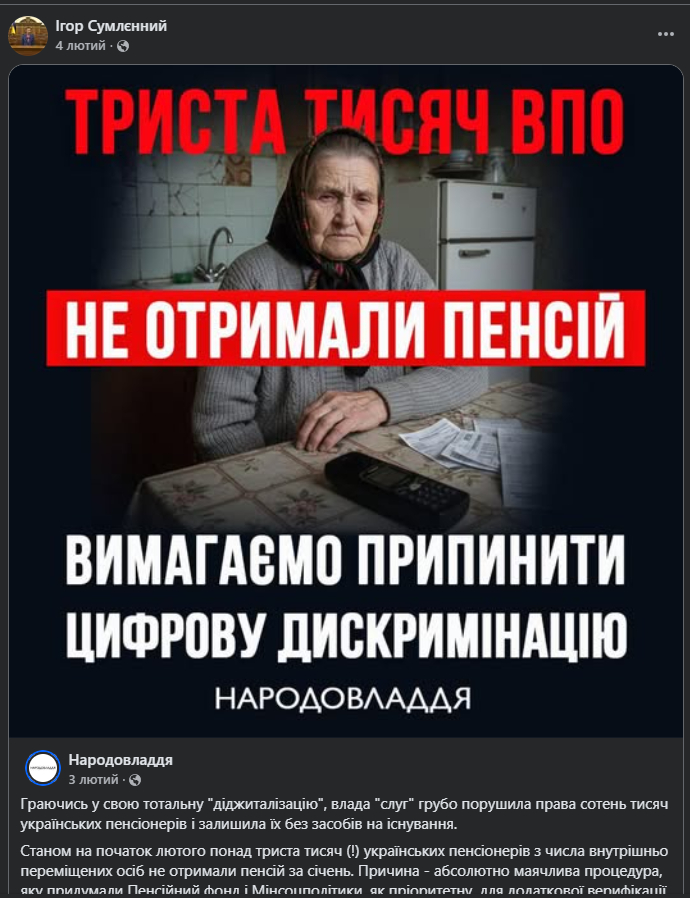
Screenshot — Facebook
The second major group of risks concerned eligibility criteria for assistance and application deadlines. Posts discussed the maximum average monthly household income, ownership of housing or significant assets, the length of stay abroad, the need to reapply, as well as special rules for children and persons unable to work.
For example, the NGO IDP Ukraine reported that the income threshold for extending living assistance had been increased from UAH 9,444 to UAH 10,380 per family member, while emphasizing that some children of internally displaced persons could still remain outside the program. The Zhytomyr Regional Military Administration warned that applications had to be submitted by June 1 in order to receive payments retroactively from February for children and displaced persons unable to work. In other posts, the same regulatory information was presented much more dramatically—as a "complete suspension" of assistance if the income threshold was exceeded. Thus, the same regulation could be framed both as practical guidance and as evidence of a reduction in state support.
A separate body of posts concerned housing and compensation for destroyed property. Reported risks included losing a housing voucher due to missing deadlines, being unable to participate in the program because of errors in official registries, insufficient funding, eviction from temporary accommodation, or being denied compensation for destroyed housing.
In a Cabinet of Ministers announcement about vouchers under the eVidnovlennia (eRecovery) program, the positive outcome was accompanied by an important condition: after funds are reserved, a family has 60 days to sign the agreement; otherwise, the money will be returned to the program operator, although the applicant will be able to rejoin the waiting list. Another post warned about the risk of losing a €33 million KfW grant for affordable housing for internally displaced persons due to a possible change in the legal status of Derzhmolodzhytlo. Another type of content described situations in which veterans with internally displaced status risked not receiving housing vouchers because of insufficient program funding or were unable to use them because information confirming their combat veteran status had not been synchronized in the Diia app.
One of the most prominent stories in the category of actual loss of assistance for internally displaced persons in early 2026 was the suspension of pensions for people who had failed to complete the identification procedure or confirm that they were not receiving payments from Russia. Citing the Pension Fund, the Novenske Settlement Community of Melitopol District reported that as of January 1, 337,000 pensioners had failed to meet one or both requirements and therefore were not included in the January payment documents. At the same time, some of them had already received their payments, while others were expected to receive the funds later, together with compensation for January.
On social media, this inaccurate story was given even more dramatic interpretations: some channels claimed that 1.3 million internally displaced pensioners had "been left without payments," emphasizing digital barriers faced by older people. Notably, other publications soon reported that pensions had been reinstated following public attention and intervention by human rights advocates. Thus, the "fact of loss" often referred not to a permanent withdrawal of support but to a temporary suspension, delay, or the need to seek reinstatement.
The same logic can be seen in individual cases. The previously mentioned NGO IDP Ukraine shared the story of a woman who had not received payments since September 2025 and succeeded in having them restored only after publicly discussing the issue with representatives of the Pension Fund. Other posts referred to children who had previously lost benefits because of family income, delays in living assistance, pension arrears, or veterans who were unable to receive funding for new housing because of discrepancies in official registries. This category also included reports about the sale of humanitarian aid, housing fraud, and the misuse of premises designated for internally displaced persons.
For refugees, the primary risk factor was the stability of their legal status in the host country. Posts regularly mentioned the expiration or transformation of temporary protection, the transition to general residence rules, the possible narrowing of eligibility, deportation, or the refusal to admit new refugees.
One particularly prominent topic concerned EU temporary protection for men of conscription age. For example, in June, Telegram channels reposted a letter from the President of the European Commission stating that temporary protection would be extended without undermining Ukraine's defense capabilities, presenting this as a possible indication of future restrictions for men. Other posts outlined several scenarios: excluding men aged 18–60 or 23–60, residents of supposedly "safe" western regions, and those leaving Ukraine after a specified date. Much of this content concerned decisions that had not yet been adopted, political proposals, or media interpretations, but it was presented as an immediate threat. On July 15, the Council of the European Union extended temporary protection for Ukrainian refugees until March 2028, with the following wording: "In light of changes in Ukraine's defense needs, temporary protection will henceforth be granted only to those who have fulfilled their military obligations in Ukraine. This restriction will apply only to new applicants for temporary protection."
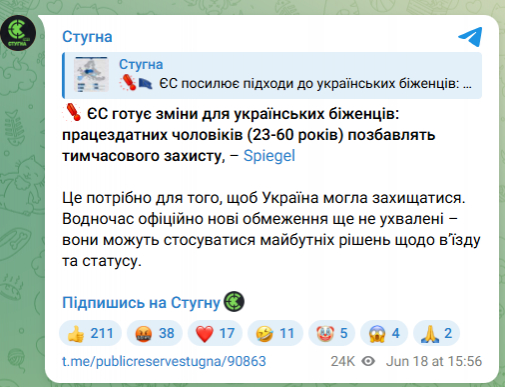
Screenshot — Telegram
The second major risk factor for refugees involved stricter conditions for accessing social benefits, healthcare, and housing in specific countries. In Poland, discussions focused on the need to reapply for the "800+" child benefit and to confirm employment status for holders of PESEL UKR status. In the Czech Republic, attention centered on new rules governing humanitarian assistance and residence. In Germany, posts discussed sanctions for refusing offered employment. In Ireland, discussions focused on the winding down of the state accommodation program, with posts referring to the termination of contracts affecting approximately 16,000 Ukrainians and the possibility of financial assistance for voluntary return.
In substance, this was a discussion about the transition from emergency protection to general migration and social policy mechanisms. However, headlines often reduced it to phrases about the "return," "expulsion," or "mass deportation" of Ukrainians. This explains why the topic of risks for refugees was particularly prominent on Telegram, where news was replicated by dozens of channels in a simplified and more emotional form.
Some reports about the loss of assistance for refugees concerned restrictions that had already been introduced or specific sanctions. Following changes to Polish legislation, for example, posts reported that Ukrainians would be transferred to the general rules applicable to foreigners, that free healthcare would be restricted for uninsured persons, and that long-term accommodation would primarily be provided to vulnerable groups.
Overall, the comparison reveals two different models of vulnerability. For internally displaced persons, risk was primarily constructed around maintaining uninterrupted access to Ukraine's support system: completing identification procedures, meeting deadlines, complying with income eligibility criteria, ensuring accurate registry data, and the availability of funding for housing programs. For refugees, the key source of uncertainty was the legal and social regime in the host country itself: the duration of temporary protection, the right to reside, access to housing, healthcare, and benefits, as well as the possibility of forced return.
In this context, social media played a dual role. It disseminated practically important warnings and instructions that could help people avoid losing assistance, while at the same time, through emotional headlines and repeated amplification, it blurred the distinction between a potential risk, an announced policy change, and an already realized loss. For this reason, the number of posts about threats or risks of losing support or benefits for internally displaced persons and refugees should be interpreted as an indicator of information attention and perceived instability rather than a direct measure of actual reductions in assistance.
Extended conclusions
The study identifies a persistent structural asymmetry: internally displaced persons are mentioned 3.6 times more often than refugees, while the topic of assistance for internally displaced persons dominates all others, accounting for more than 70% of Facebook posts and 62% of Telegram posts. However, the main actor in this discourse is not the vulnerable group itself but those who speak about it: in 3,689 out of 8,560 mentions of assistance for internally displaced persons, state and local authorities are featured.
In essence, social media document the work of institutions surrounding internally displaced persons rather than giving a voice to people who lost their homes because of Russian aggression. In these publications, internally displaced persons themselves largely remain passive subjects rather than active participants in the conversation.
The discourse on refugees has a different nature: it more often consists of news about the policies of partner countries and less frequently of stories about the adaptation of Ukrainians abroad. Topics such as deportations or changes to temporary protection status dominate over accounts of people's actual living conditions abroad, while Telegram, being closer to a news feed, reinforces this effect by amplifying simplified and emotionally charged narratives.
At the same time, for both internally displaced persons and refugees, social media systematically focus more on the risk of losing assistance, creating an atmosphere of anxiety even when the discussion concerns routine administrative procedures—albeit complicated by the circumstances of the full-scale war—rather than the actual withdrawal of support.
Only 5% of posts about internally displaced persons and 1.7% of posts about refugees mention their contribution to host communities.
At the same time, it is evident that the issue of assistance for internally displaced persons is being instrumentalized—from the dominance of public officials in the discourse among those portrayed as "helpers" of vulnerable groups to individual examples in which public charity serves as a vehicle for specific political forces. As a result, internally displaced persons and refugees are portrayed on social media more as objects or backdrops for political public relations than as equal members of society entitled to their own voice.
Recommendations for journalists and media
- Deliberately balance the "assistance" perspective with stories about the self-reliance, entrepreneurship, and civic engagement of internally displaced persons and refugees, as the analysis indicates that their contribution to host communities is proportionally underrepresented.
- Clearly communicate forthcoming legislative changes that may pose a risk of losing assistance or social benefits well in advance, to avoid increasing public anxiety when the relevant news event occurs.
- When covering assistance provided by public authorities or public figures, separately verify whether the communication serves as an element of political public relations, and ensure that internally displaced persons and refugees themselves are given a voice, rather than relying solely on officials and volunteers.
- In stories about refugees abroad, maintain a balance between the political context and the personal stories of individuals.