
Українською читайте тут.
Since February 24, 2022, Detector Media has been monitoring the Ukrainian segment of social media and Kremlin media and documenting the chronology of Russian disinformation about Russia’s war against Ukraine.
From October 7 to 13, 2026, Detector Media analysts documented 13 disinformation narratives. Among other things, propagandists presented archival footage of civilian burials in Mariupol as evidence of current Ukrainian Armed Forces casualties, circulated fabricated threats by Russian officials against Bulgaria, frightened Ukrainians with claims that citizens would be divided into “three legal categories” based on the language they speak, and exaggerated the consequences of disruptions to the sewage system following a Russian strike on Kyiv’s energy infrastructure.
Footage of burials in Mariupol presented as “recent” mass graves of Ukrainian troops
Videos showing people’s bodies in black bags being placed in a long trench circulated on X and Facebook. Kremlin-linked accounts and disinformation outlets claimed that the footage showed recent mass burials of Ukrainian soldiers. According to their narrative, the Ukrainian Armed Forces had suffered such catastrophic losses that there was supposedly no room left in Ukrainian cemeteries, forcing the authorities to bury the dead in unmarked graves.
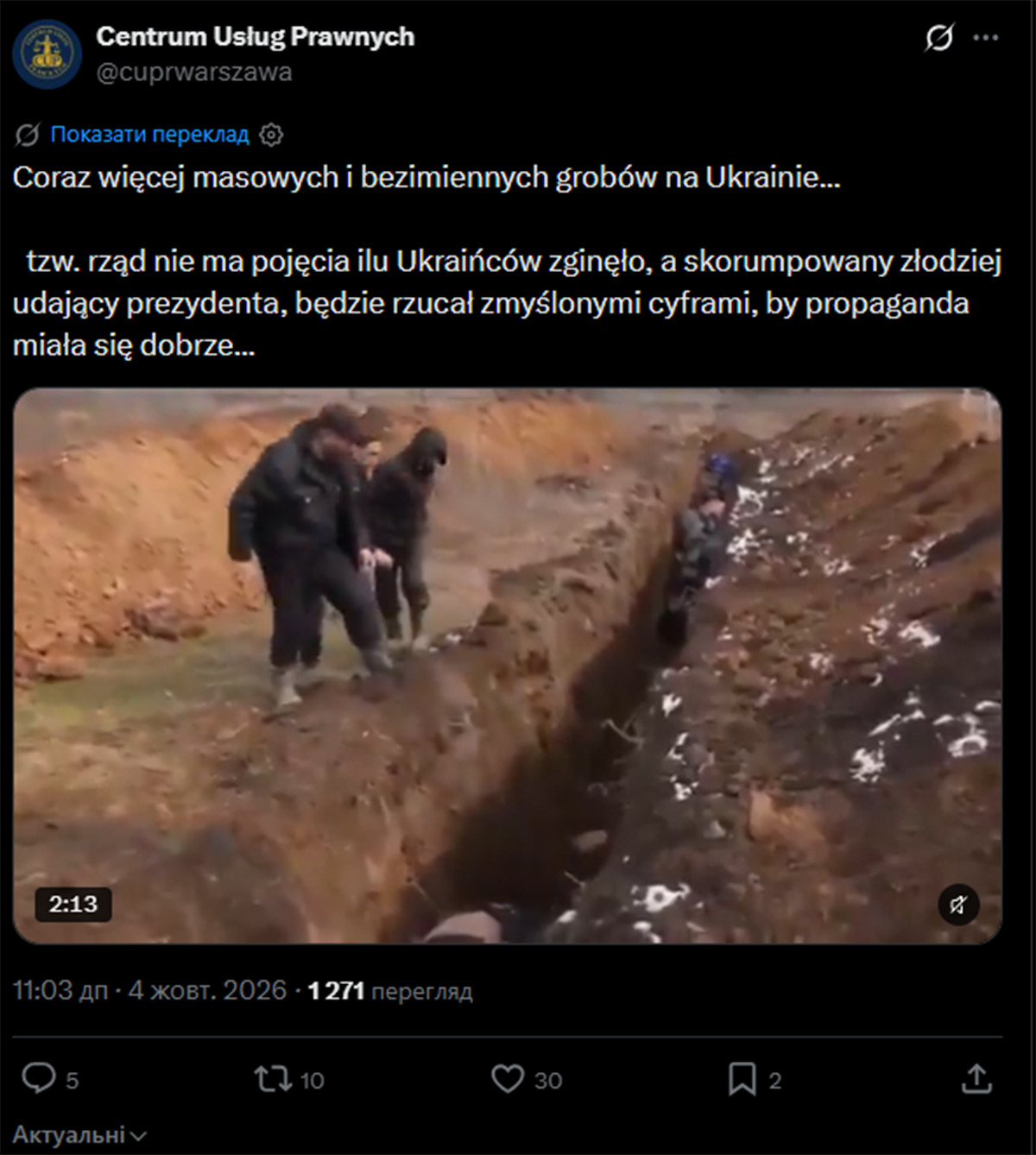
Screenshot of an X account presenting footage from the film “20 Days in Mariupol” as recent examples of mass burials in Ukraine.
In fact, the video was filmed in Mariupol in March 2022, at the beginning of Russia’s full-scale invasion. As fact-checkers at Demagog established, the footage was included in Mstyslav Chernov’s documentary 20 Days in Mariupol. The scene appears at approximately the 46-minute mark.
The video shows municipal workers and local residents burying civilians killed by Russian shelling. Due to the siege and constant attacks, conducting regular burials in cemeteries was dangerous, so people had to be buried in communal trenches. The footage does not substantiate claims about current Ukrainian military casualties.
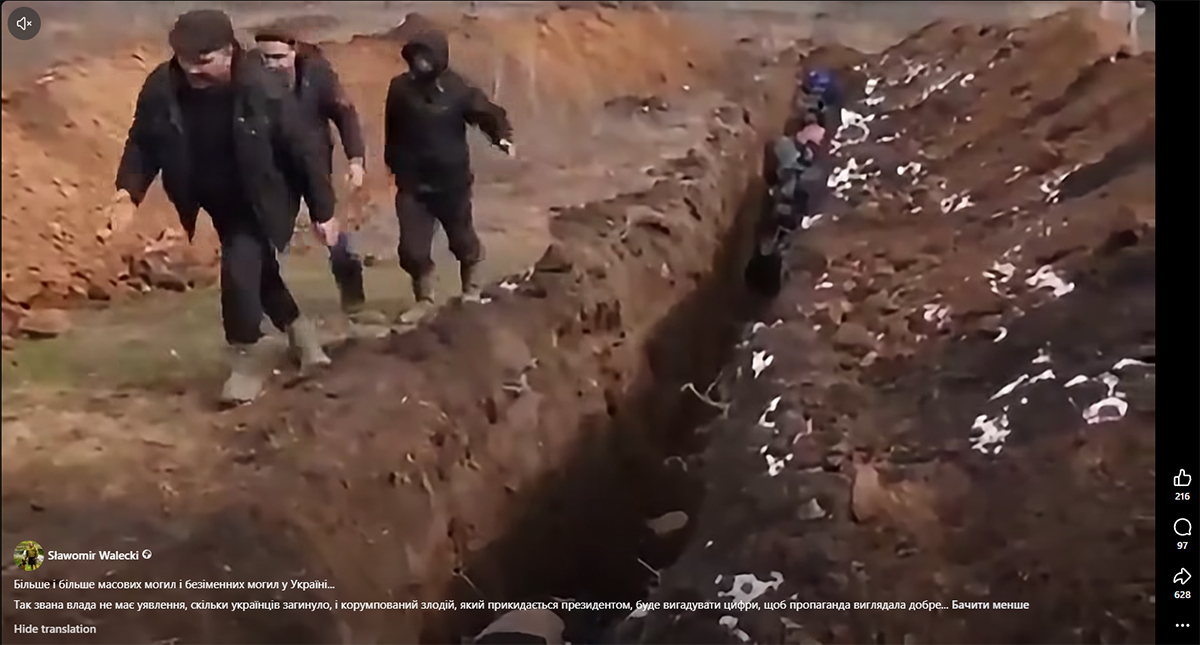
An example of a manipulative Facebook Reel, screenshot. The number of shares exceeds the combined number of likes and comments, one indication of inauthentic content distribution through bot networks.
According to the Center for Countering Disinformation, the narrative circulated in several languages, including Arabic, English, and Slovak. Propagandists exploited documentary evidence of the consequences of Russian aggression to discredit the Ukrainian military and spread panic. Misrepresenting when and under what circumstances the footage was filmed also obscures Russia’s responsibility for the deaths of the people shown in the video.
Russian officials falsely portrayed as threatening Bulgaria and promising to “save” it
Fabricated statements attributed to Vladimir Putin, Russian Defense Minister Andrei Belousov, and Dmitry Medvedev, deputy chairman of Russia’s Security Council, circulated on Bulgarian social media. Some posts claimed that Russia was threatening possible strikes on military facilities in Bulgaria, while others alleged that Moscow would punish Bulgaria for helping Ukraine or promised to “save” the country. The posts were investigated by fact-checkers at Factcheck.bg.
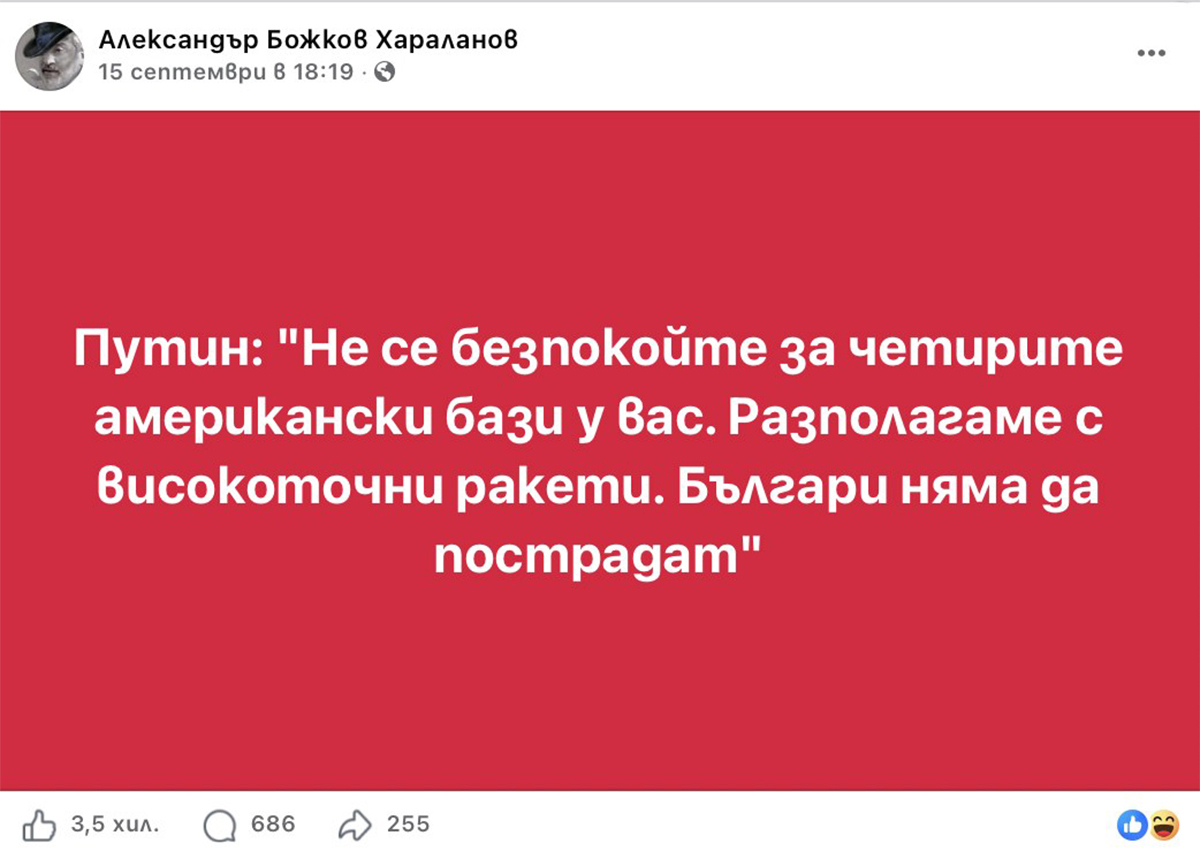
An example of a disinformation post. Source: Facebook.
Putin was falsely quoted as saying that Russia was ready to launch precision strikes against four “American bases,” supposedly without harming Bulgarians. Fact-checkers found no such statement in official Russian sources or in the TASS or RIA Novosti news agencies. Moreover, the facilities in question are not separate American bases: the Novo Selo training ground, storage facilities in Aytos, and the Bezmer and Graf Ignatievo air bases are jointly used by Bulgaria and the United States under a bilateral agreement.
Belousov was allegedly quoted as saying that everyone who had supplied weapons to Ukraine “would be tried in Russia.” This claim has circulated since July 2025, but fact-checkers found no such statement in Russian news agencies or international media. The minister’s actual remarks concerned the involvement of EU countries in the war through their assistance to Ukraine and the possibility of an escalation of tensions in Europe.
A fabricated account of a conversation between Medvedev and Kostadin Kostadinov, leader of the Bulgarian political party Revival (Vazrazhdane), also circulated. According to the posts, Kostadinov had supposedly asked Russia not to start a war against Bulgaria, to which Medvedev allegedly replied that Moscow could only “save” the country. The authors of the posts provided no evidence that such a conversation had taken place.
Attributing fabricated statements to officials lends an appearance of credibility to disinformation. These narratives seek to frighten Bulgarian audiences about the consequences of cooperation with the United States and assistance to Ukraine, while portraying Russia as a potential “savior.”
Ukrainians frightened with claims they would be divided into “three legal categories” based on language
Posts circulated online claiming that Ukraine’s Verkhovna Rada was allegedly discussing plans to divide citizens according to the language they speak. According to the claims, Ukrainian speakers would supposedly be granted “all rights,” speakers of Hungarian, Polish, Romanian, and Crimean Tatar would receive “national minority rights,” and Russian speakers would allegedly be stripped of all rights. The authors of the posts did not identify a specific bill, provide a bill number, or name any members of parliament who had supposedly proposed such changes.
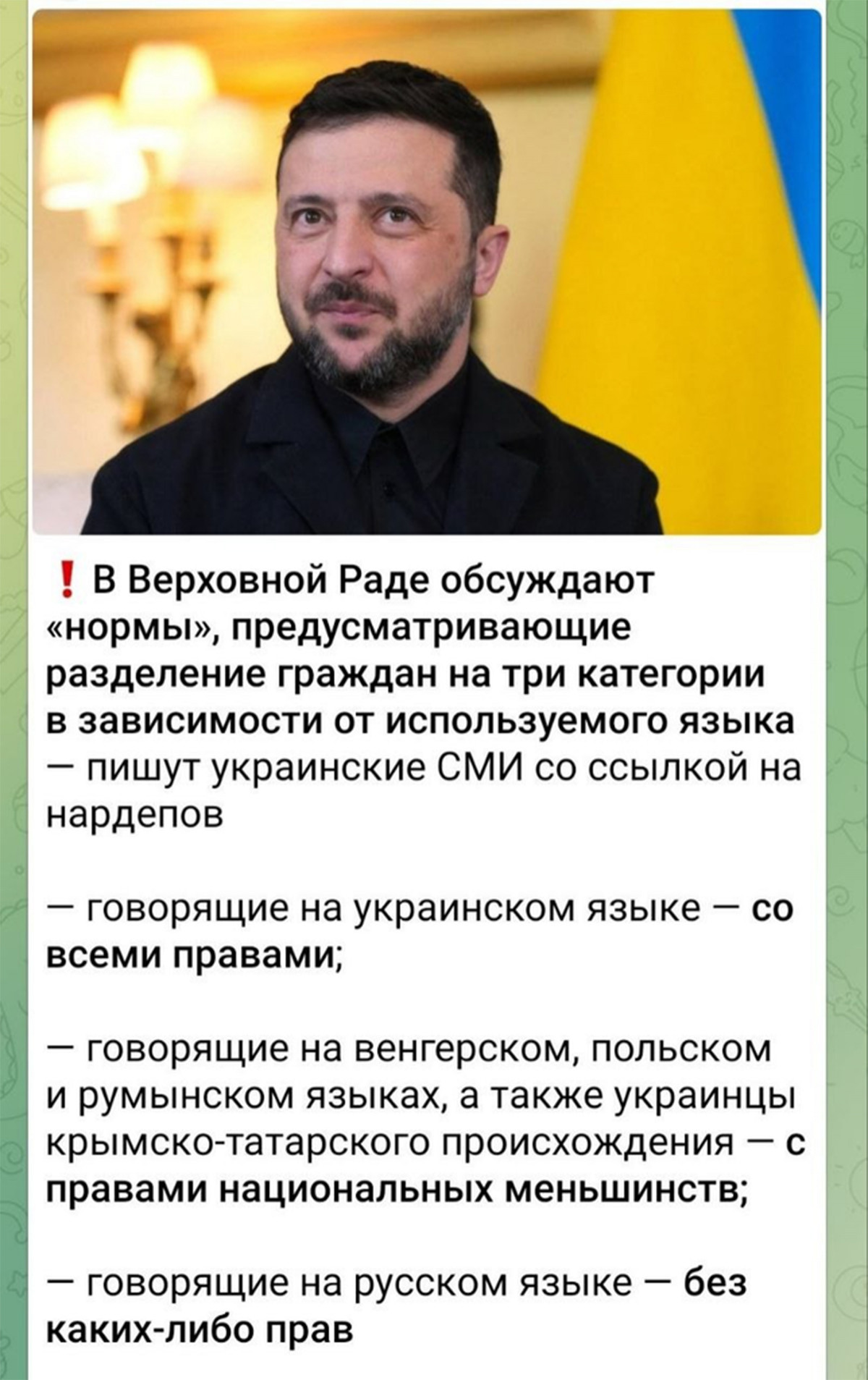
An example of a disinformation post. Source: Telegram.
Fact-checkers at StopFake found no such legislative initiative. A possible trigger for the disinformation was Draft Law No. 16119, registered on October 1. It concerns the educational rights of Indigenous peoples and national minorities, including guarantees of education in minority languages that are official languages of the EU. The bill regulates the organization of education and does not determine the extent of citizens’ rights based on the language they use in everyday communication.
Furthermore, Article 24 of the Constitution of Ukraine guarantees equality before the law and prohibits privileges or restrictions based on language. The law on ensuring the functioning of Ukrainian as the state language also explicitly excludes private communication from its scope.
The narrative echoes a tactic used during the 2004 presidential election, when a map of Ukraine dividing the population into “three kinds of people” circulated. This division was falsely attributed to Viktor Yushchenko and his team. As the Chesno movement notes, the leaflet and accompanying video were produced by political strategists working for Viktor Yanukovych’s campaign headquarters.
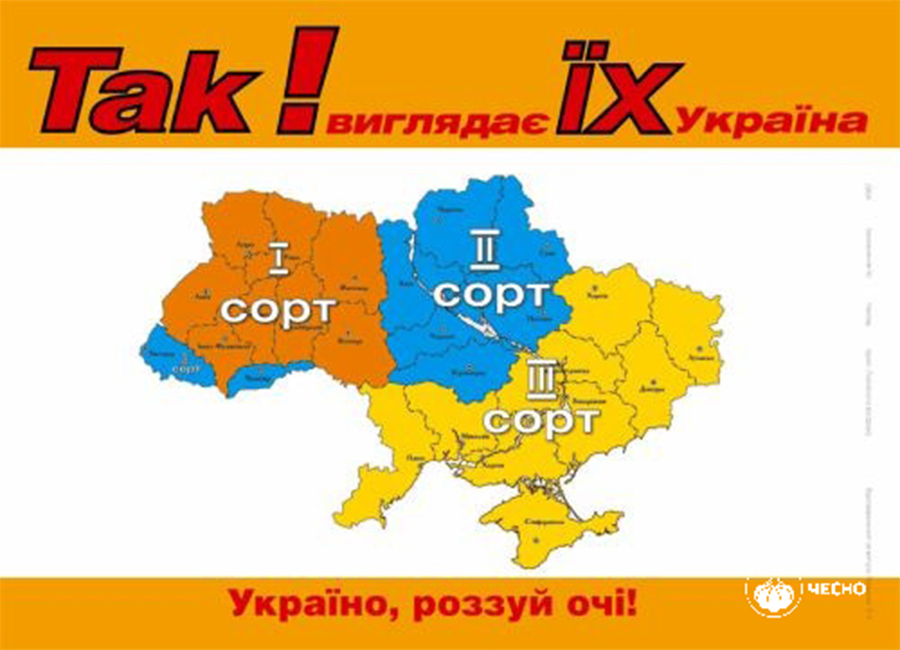
A propaganda material from the 2004 presidential election campaign. Source: Chesno.
The latest disinformation substitutes a fabricated threat of rights being revoked for a discussion about educational guarantees. By exploiting the language issue, those spreading disinformation seek to deepen internal divisions and undermine trust in the Ukrainian authorities.
Temporary sewage disruption misrepresented as a “sewage collapse” in Kyiv
Russian Telegram channels claimed that Kyiv was supposedly “drowning in sewage” because the city’s sewage system had shut down. The claims were prompted by a statement from Oleksandr Medvid, secretary of the Borshchahivka Village Council, that the acceptance of wastewater from the local community into Kyiv’s sewer network had been temporarily suspended on the evening of October 8. The manipulation was exposed by StopFake.
The original statement concerned power outages at Kyivvodokanal facilities that had affected water supply and wastewater disposal in the Borshchahivka community. This is a separate community in Kyiv Oblast, not part of the capital. The statement contained no information about overflowing sewers or sewage flooding Kyiv’s streets.
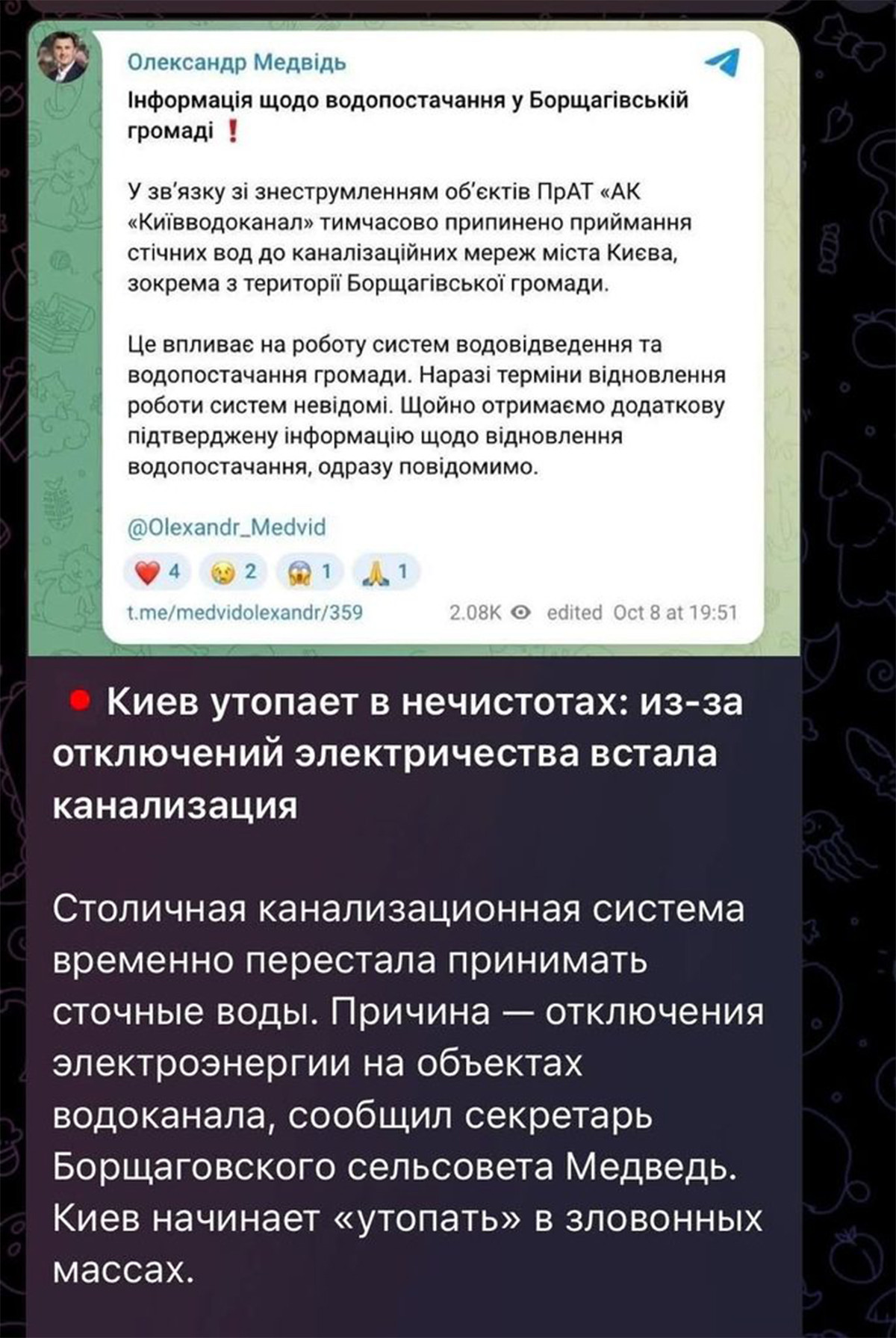
An example of a disinformation post. Source: Telegram.
About 20 minutes later, Medvid published an update: after power was restored to the pumping stations, Kyivvodokanal resumed accepting wastewater discharges, and the community’s water supply was gradually being restored. Propagandists ignored this clarification and portrayed a temporary disruption as a large-scale emergency.
They also concealed the cause of the power outage. According to Energy Minister Denys Shmyhal, Russia attacked an energy facility vital to Kyiv on October 8. The strike caused several elements of the power grid to be disconnected, disrupting electricity supplies in some parts of the capital.
Kyiv and the surrounding region are indeed experiencing disruptions caused by Russian attacks on energy infrastructure. However, these difficulties do not substantiate the fabricated story that the capital is “drowning in sewage.” By taking the initial statement out of context and concealing the restoration of the system’s operation, propagandists exaggerated the scale of the problem and used it to frighten residents ahead of the heating season.