Українською читайте тут.
Since February 24, 2022, Detector Media has been monitoring the Ukrainian segment of social media and Kremlin media and documenting the chronology of Russian disinformation about Russia’s war against Ukraine.
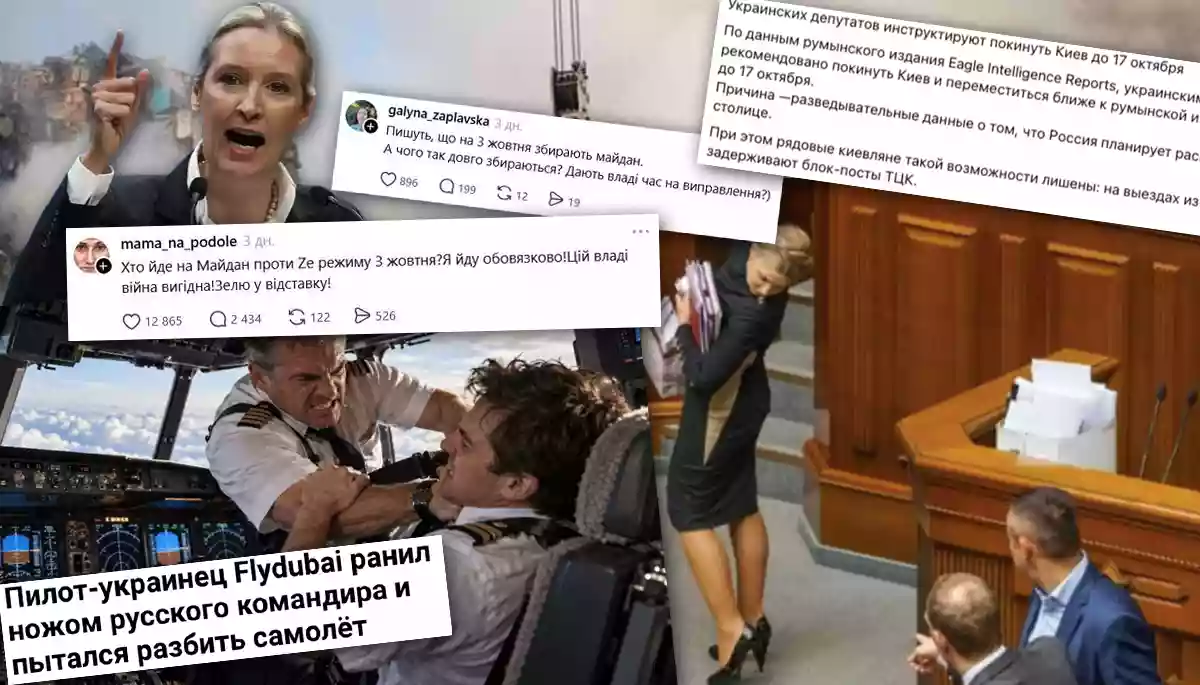
From September 30 to October 6, 2026, Detector Media analysts documented 11 disinformation operations. In particular, propagandists fabricated mass arrests of Ukrainians in Paris for stealing gasoline; circulated calls for a “Maidan for Peace” on social media, frightening Ukrainians with shelling and a “black winter”; attributed a “fight” on a Fly Dubai flight to Israel to Ukrainian and Russian pilots; spread false claims about the evacuation of members of parliament from Kyiv; and used AI to dub a speech by AfD co-leader Alice Weidel. These disinformation operations aim to discredit Ukrainians abroad, provoke domestic protests, and pressure Ukraine into capitulation by intimidating the civilian population.
Fake: Hundreds of Ukrainians allegedly arrested in Paris for stealing gasoline
Pro-Russian social media accounts are circulating a fabricated story claiming that between 12 and 650 Ukrainian citizens were allegedly arrested in Paris on charges of siphoning gasoline from other people's cars and subsequently selling it below market price. As “evidence,” propagandists cite screenshots purportedly taken from French media, bearing the headline “The New Face of Migration.” In reality, French media did not publish such reports, and law enforcement agencies did not report any similar mass arrests, StopFake explained.
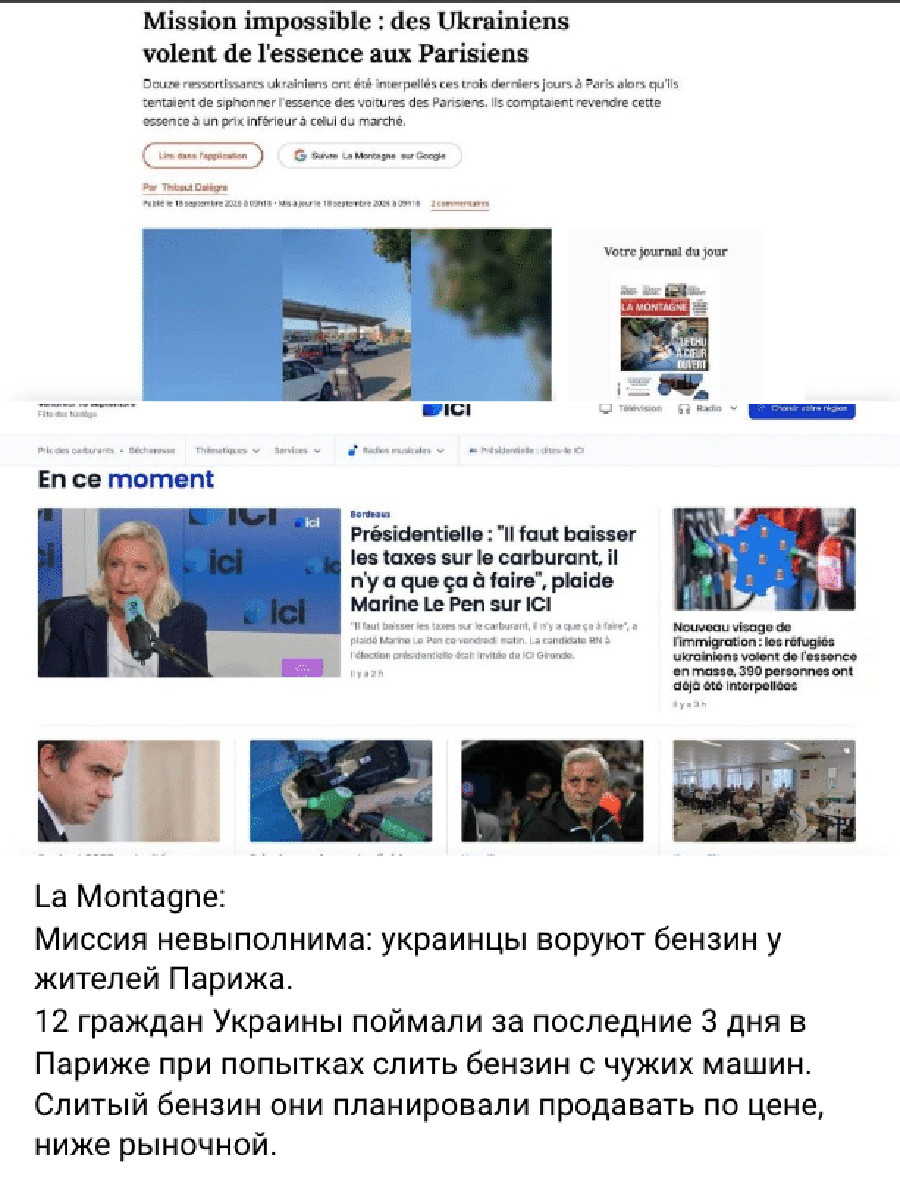
Examples of disinformation posts. Source: StopFake
The propaganda posts do not even agree on the number of Ukrainians allegedly detained: some claim 12 people, while others cite 390 or 650. Screenshots purportedly originating from the French media outlets La Montagne and ICI are used as sources. However, searches using the cited headlines and keywords found no such reports on the websites of these outlets or in any other publicly available sources. French law enforcement agencies have also published no reports of the alleged incident.
Another element of the manipulation was linking the fabricated story to a real problem: rising fuel prices in France. Following the closure of the Strait of Hormuz, the resulting fuel crisis has significantly increased the country's fuel import costs. Between March and August 2026, France spent an additional €10.8 billion on fuel imports without increasing supply volumes.
Against the backdrop of rising prices at gas stations, French President Emmanuel Macron said on TF1 and France 2 on September 24 that the authorities would not allow fuel prices to rise uncontrollably. He did not rule out cutting fuel taxes if prices continued to rise, although he stressed that the priority should be to bring prices down directly. Macron also appealed to the European Commission to ease fuel quality requirements and allow a higher proportion of biofuel in diesel to increase production.
The fabricated screenshots of French media were intended to make the story look like credible news. However, the absence of the alleged publications and any reports from law enforcement indicates that the story has no factual basis.
“Maidan for Peace”: How Russia is promoting calls for protests and frightening Ukrainians with shelling
Calls for a so-called “Maidan for Peace” were circulated on Ukrainian social media. According to analysts, these calls are part of a Russian campaign to destabilize Ukraine. As the outlet Texty found, users on TikTok, Threads, and YouTube were urged to protest on October 3, demand a change of government, and call for Volodymyr Zelenskyy's removal. Just 17 TikTok videos calling for protests garnered more than 2.7 million views. Those spreading the messages included bloggers who regularly promote Russian narratives. The outlet identifies Oleksandr Todorov as one of the campaign's participants. He calls for peace agreements to be concluded “on any terms,” borders to be opened, and elections to be held.
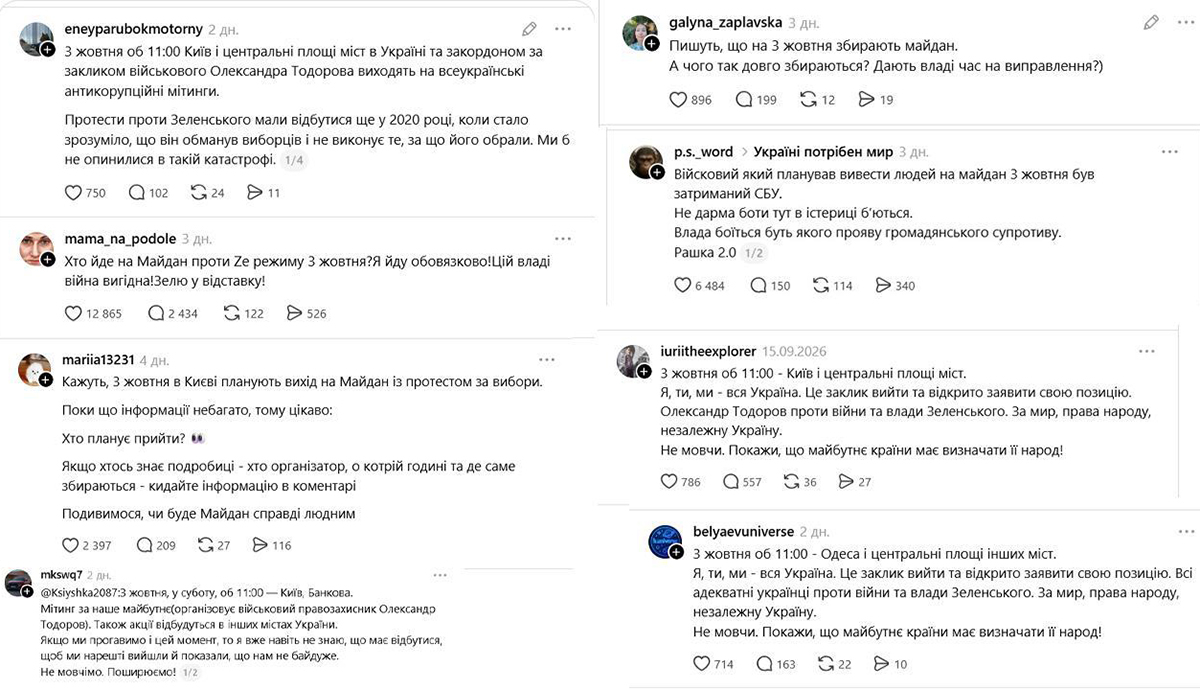
Examples of calls for protests on Threads from Texty's investigation
The campaign exploits war fatigue and dissatisfaction with state institutions to create the impression of a mass protest movement and draw people into it. The investigation's authors assess the demand for peace without discussing its terms as a push for Ukraine's de facto capitulation. They view Russian shelling as the campaign's psychological backdrop: fear and exhaustion are being turned into domestic confrontation and pressure on the Ukrainian authorities.
At the same time, Russia-controlled Telegram channels are amplifying the narrative. Detector Media analysts analyzed posts from Russian and pro-Russian channels using the search terms “Maidan for Peace” and “Maidan against mobilization for peace” and found only a few unique messages. Each was repeated across several channels, with some identical posts published mere seconds apart. This points to the coordinated dissemination of the same talking points: the situation will inevitably deteriorate, and the only supposed way to save the country is to protest against the Ukrainian authorities.
Readers are being frightened with warnings of cascading power outages, industrial shutdowns, disruptions to railways, pumping stations, water supplies and communications, as well as the forced shutdown of nuclear power units. The list of technical risks creates the impression of an expert explanation, followed by a categorical prediction: “A black winter is near.” The potential consequences of attacks are presented as an inevitable scenario, while political protest is portrayed as the only way to avoid it.
The blackmail is most explicitly directed at Kyiv residents. They are urged to take to the streets for a “Maidan for Peace” “instead of hiding in the metro from nighttime strikes,” and are promised that afterward, “there will be almost no shelling within a few days.” Residents of western Ukraine are frightened with warnings of attacks on border crossings, warehouses, energy and gas facilities, railways, and logistics centers, allegedly intended to “reduce the country's economic potential to zero” within six to nine months. At the same time, people in western Ukraine are accused of supporting the continuation of the war because they supposedly feel its consequences less acutely. In this way, propagandists are also trying to turn people from different regions against one another.
The campaign is unfolding against a backdrop of limited Russian success on the battlefield. On October 1, Reuters reported that Russia had intensified its aerial attacks, while its overall advance this year had slowed. In the absence of significant military gains, strikes on the rear and intimidation are intended to turn exhaustion and fear into domestic political pressure, prompting Ukrainians themselves to demand an end to resistance.
Fake claim about a “fight between a Ukrainian and a Russian pilot” on a Fly Dubai flight: How an incident suspected to be a terrorist attack was distorted in different countries
Several Russian media outlets spread claims that an emergency landing by a Fly Dubai aircraft operating flight FZ1073 from Dubai to Tel Aviv on September 30 had been caused by a fight between a Ukrainian and a Russian pilot. Early, unverified reports by Israel's Channel 12 were cited as the source, while some Russian outlets added that the Ukrainian had attacked first, without providing any evidence.
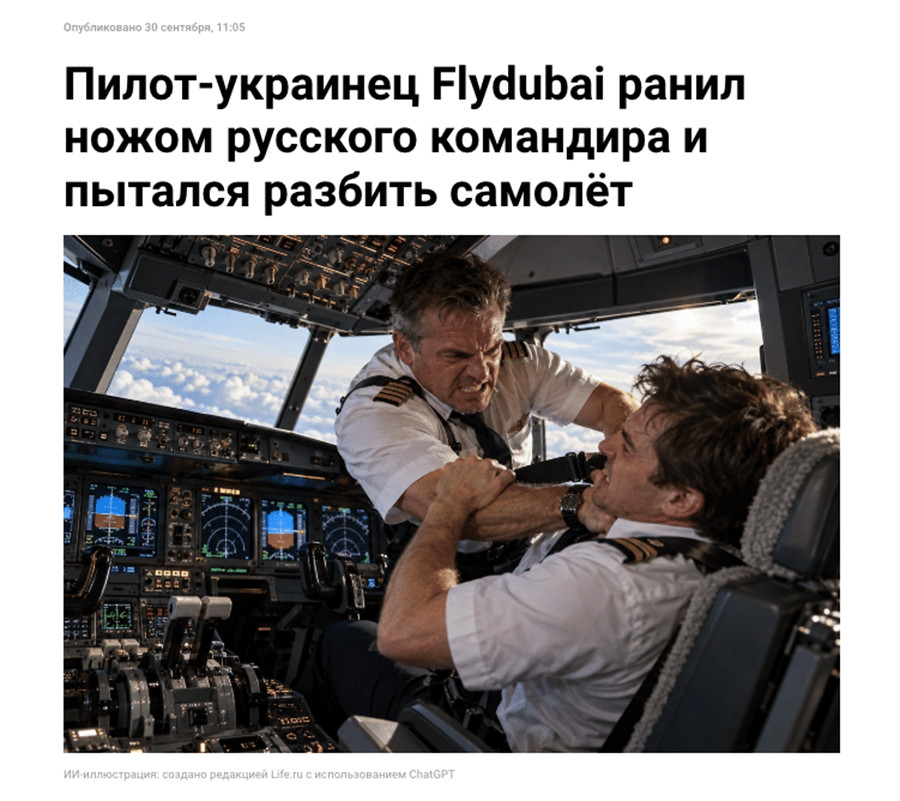
An example of a disinformation post in Russian media
As StopFake explained, updated reports by Israeli media gave a different account of the crew members' backgrounds. Citing Israeli officials, Mako reported that the first officer, who was of Omani origin, had attacked the captain. Israel Hayom and The Jerusalem Post also reported that the attacker was an Omani citizen who had assaulted the captain with a knife. Approximately 174 passengers, including 27 children, were on board. During the attack, the aircraft suddenly lost altitude, but the attacker was subdued, the aircraft was stabilized, and it landed in Saudi Arabia.
Similar confusion over the nationalities of those involved in the incident also arose in India. According to fact-checkers at DigitEYE India, a version of events circulated on Indian social media claiming that an Omani pilot had stabbed an Emirati pilot in the neck in an attempt to deliberately crash the aircraft. Such posts were accompanied by videos showing chaos inside the cabin, fueling panic about aviation safety and accusing various countries of organizing or financing the attack, as DigitEYE India reported.
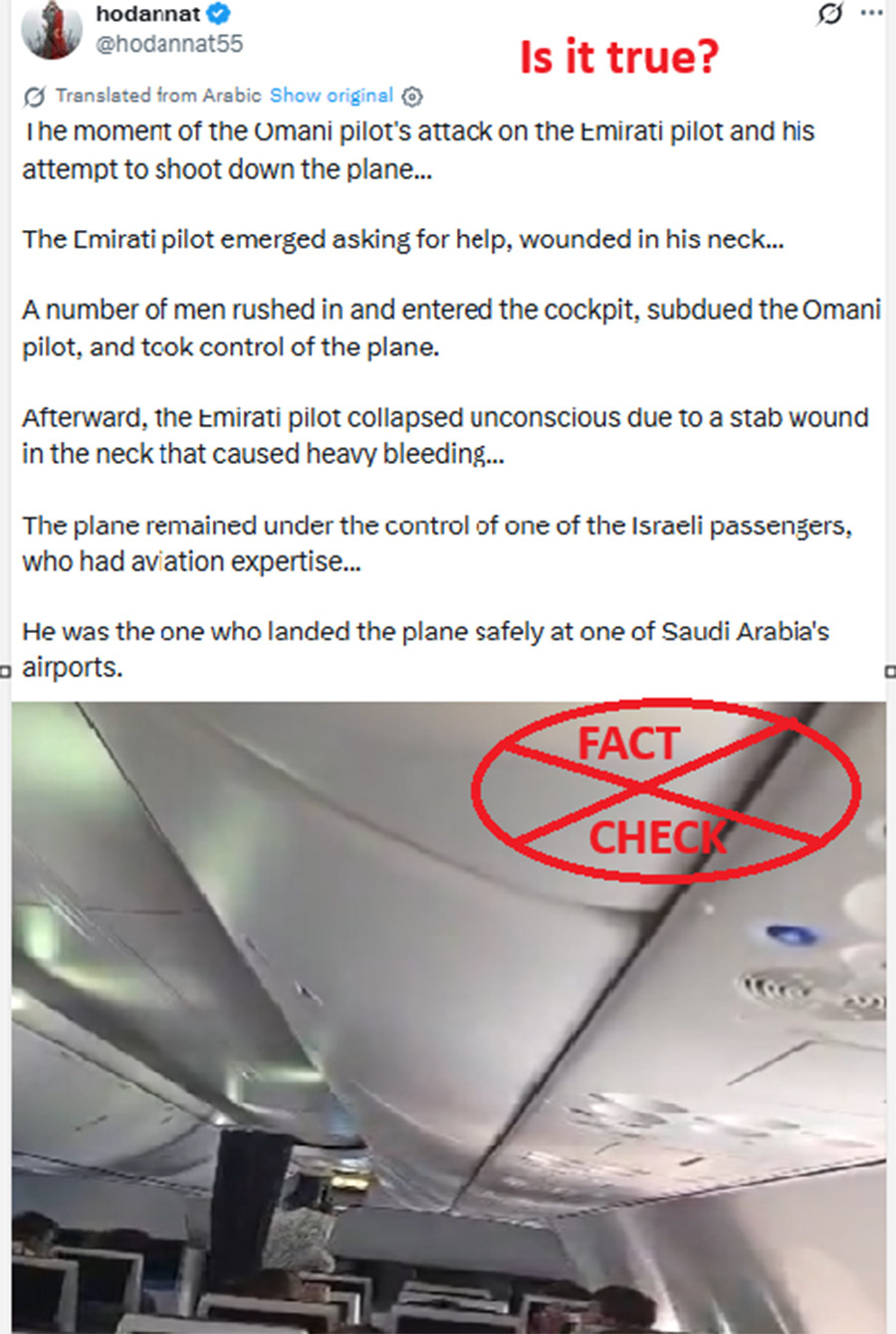
An example of a disinformation post on X. Source: DigitEYE India
In fact, the aircraft's captain was an Indian citizen, Smit Machchhar. Despite his serious injury, he managed to open the cockpit door himself, allowing the crew and passengers to subdue the attacker and stabilize the aircraft's controls. The prime ministers of India and Israel publicly thanked the captain for his courage and for saving the passengers.
Thus, the claim about a “fight between a Ukrainian and a Russian” was based on the first unconfirmed version of events, which Russian outlets supplemented with an unsupported accusation against a Ukrainian. The propagandists took advantage of the lack of information in the first hours after the high-profile incident and inserted a convenient “culprit” into the story.
Fake: Members of parliament allegedly being evacuated from Kyiv amid intensified shelling
Russian propagandists launched another wave of disinformation claiming that a mass evacuation of members of parliament from Kyiv to Ukraine's western borders was being prepared. According to StopFake, the central claim in the fake reports was that lawmakers had been instructed to leave the capital by October 17 because of the threat of intensified Russian shelling. The story originated in a publication by the Romanian outlet Eagle Intelligence Reports, which relied exclusively on an anonymous source and itself acknowledged the lack of adequate evidence. Disinformation spreaders also promoted the misleading claim that ordinary Kyiv residents were supposedly unable to leave the city because of checkpoints on the roads out of the capital.
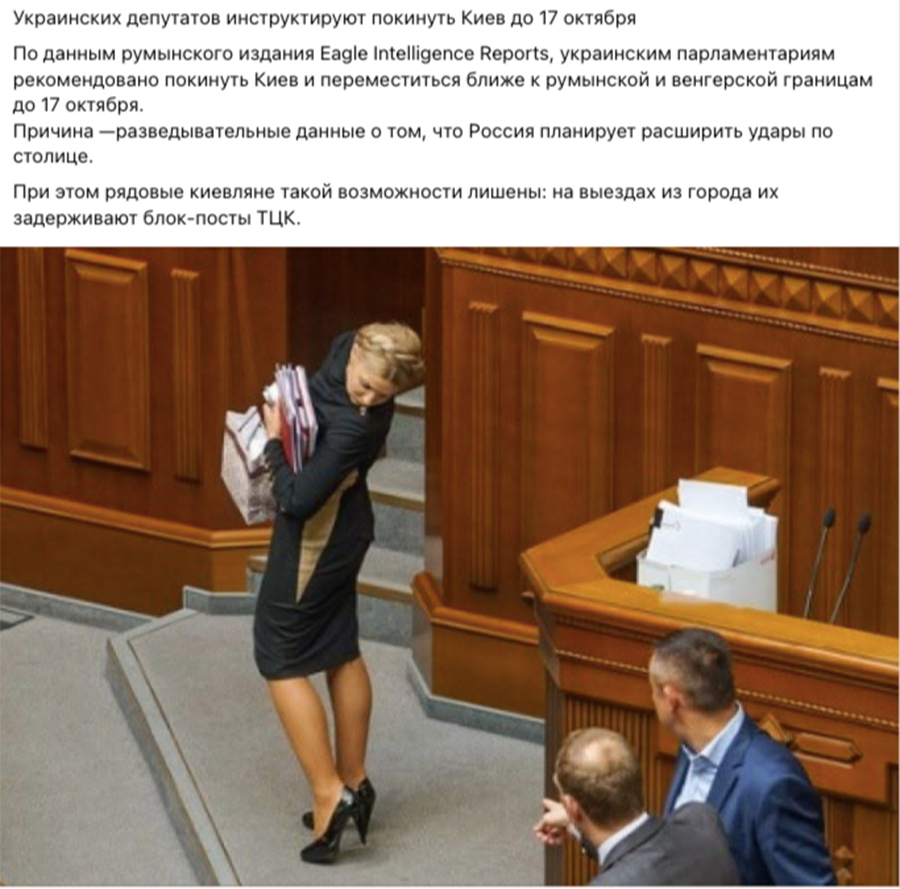
An example of a disinformation post on social media
Yuliia Paliichuk, spokesperson for the Servant of the People parliamentary faction, said that the information was “completely untrue”: neither Verkhovna Rada Speaker Ruslan Stefanchuk nor faction leader Davyd Arakhamia had instructed MPs to leave the capital. The parliamentary speaker had previously also dismissed rumors that the Rada's work would be relocated to Lviv. The myth that civilians were allegedly being prevented from leaving the city is also false: checkpoints at entry and exit points are operating as usual under martial law to inspect vehicles and ensure security, and do not prohibit movement.
The establishment of a shelter inside the parliament building for use during air raid alerts became another pretext for manipulation. Stefanchuk explained that the measure was intended to prevent the government from being paralyzed by attacks. The Verkhovna Rada will continue to operate at 5 Hrushevskoho Street, and MPs will be able to vote in the shelter during prolonged air raid alerts.
“Weidel tears Zelenskyy apart”: AI used to dub AfD leader's speech about taxes and energy
Georgian-language and Russian-language accounts on Facebook and TikTok are sharing a video in which Alice Weidel, co-leader of Alternative for Germany (AfD), allegedly calls Volodymyr Zelenskyy a “political blackmailer” and Ukraine a “black hole” for German money. Fact-checkers at Georgia's Myth Detector established that the Russian-language audio was generated using artificial intelligence and that the original speech does not mention Ukraine at all.
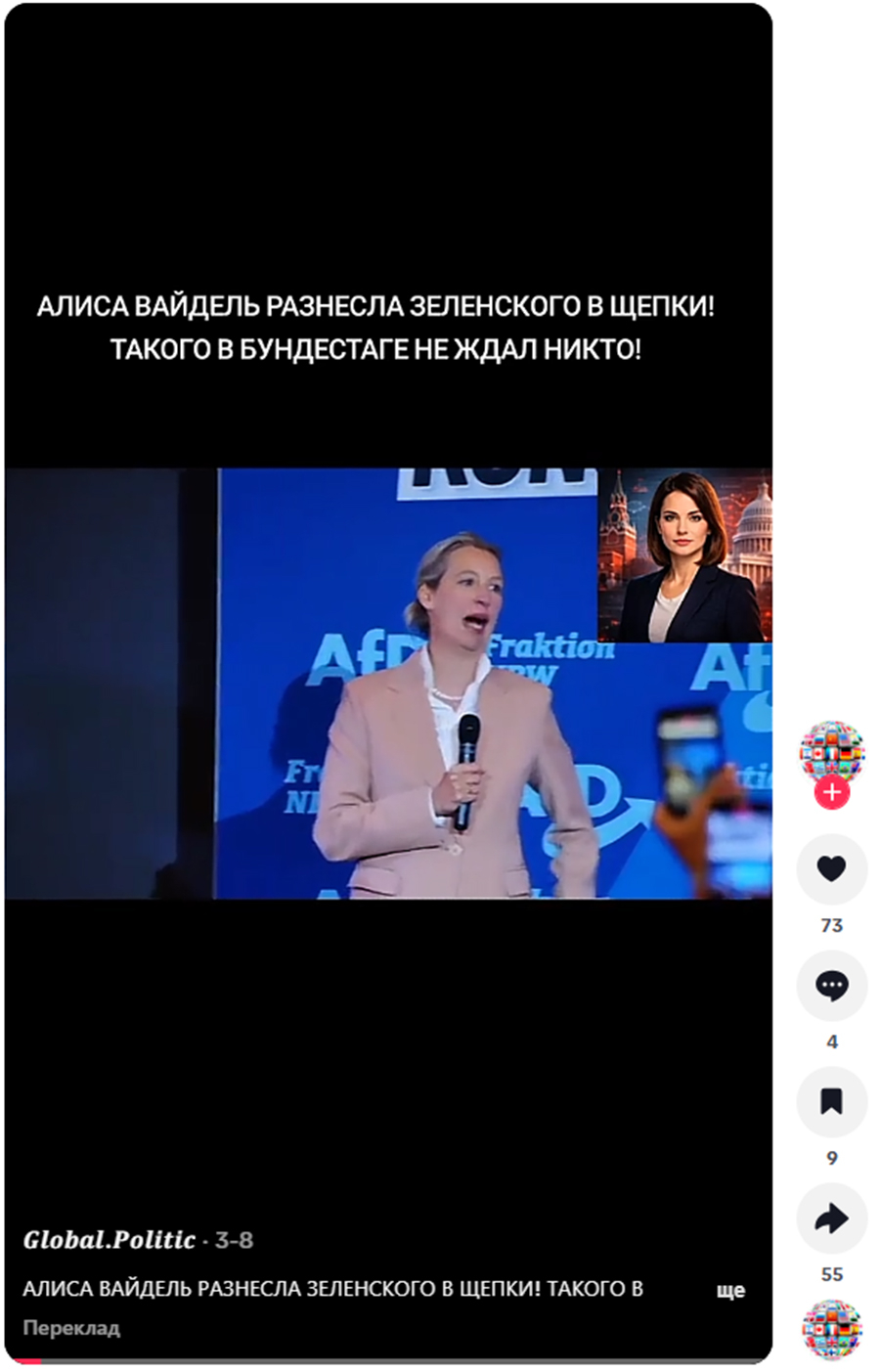
An example of a TikTok video featuring Weidel's manipulated speech and AI-generated voice-over
On September 30, a Georgian-language Facebook account published the video. An identical video had previously appeared on Russian-language Facebook and TikTok, on the Global.Politic page, with the Russian caption: “Alice Weidel tore Zelenskyy to shreds! Nobody in the Bundestag expected this!”
The Russian-language voice-over, speaking “on behalf of” Weidel, claims that Zelenskyy is profiting from the war, that billions of euros earned by Germans are disappearing in Ukraine, and that the Ukrainian president is undermining Germany's energy security and trying to “drag it into World War III.” The video also condemns financial and military aid to Kyiv.
In fact, the speech was not delivered in the Bundestag. Using reverse image search, Myth Detector found the original: a recording of Weidel speaking at an AfD event in North Rhine-Westphalia, published on the party's YouTube channel on January 26. Her clothing, gestures, the blue background with the parliamentary group's logo, and even the audience members' phones visible in the frame all match. The fake uses a segment from 1:00 to 7:27 of the approximately 23-minute recording. In it, Weidel discusses the election campaign, bankruptcies among German companies, high taxes (including taxes on CO₂ emissions), energy prices, and subsidies for green energy. She criticizes Friedrich Merz and the Christian Democratic Union (CDU), calling the AfD Germany's “last chance.” Neither Zelenskyy nor Ukraine is mentioned in the speech. The Hiya (InVID) tool assessed the 3.5-minute segment of Russian-language audio as AI-generated, with a 92% probability.
Weidel was not chosen by chance. The AfD (Alternative for Germany) is a German political party that opposes military aid to Ukraine, making audiences more likely to believe that one of its leaders has “finally told the truth.” The party's influence is indeed growing. On September 6, in the Saxony-Anhalt election, the AfD won 43.8% of the vote and 39 of the 83 seats, falling three seats short of an outright majority. On September 20, it came first in Mecklenburg-Western Pomerania with 38.2% and placed third in Berlin with 16.3%.
Nevertheless, the party is not in power. In Saxony-Anhalt, the left-wing populist Sahra Wagenknecht Alliance (BSW) refused to support an AfD-led government. In Mecklenburg-Western Pomerania, all other parties elected to the Landtag (state parliament) rule out cooperation with the AfD, while at the federal level, the AfD remains in opposition to the CDU/CSU and Social Democratic Party of Germany (SPD) coalition. The next Bundestag election is scheduled for the winter of 2029 — between January 26 and March 25, according to the Federal Returning Officer. Until then, many things may change, including Germany's economic situation and the political sensitivity surrounding migration policy.
For Russian propaganda, the AfD's growing popularity is a convenient opportunity to present wishful thinking as fact: if Weidel does not mention Zelenskyy in her actual speech, propagandists simply put the words they want into her mouth. The caption claiming that the speech was delivered in the “Bundestag” further lends an official parliamentary authority to what was merely a party event.