



Українською читайте тут.
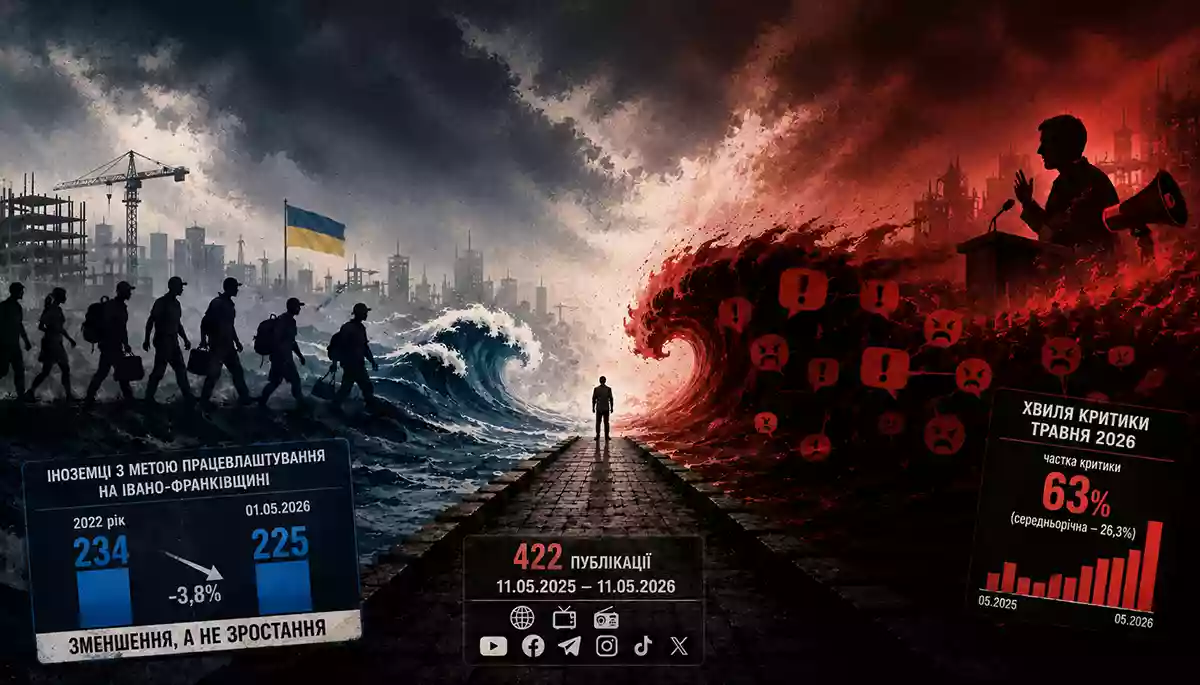
In 2026, there are far fewer labor migrants in Ukraine than before the full-scale war. Yet there are far more disputes and manipulations about an alleged “influx of foreigners” who, in reality, are not coming here. We examined what triggers these waves.
On May 11, 2026, a petition was submitted to the Cabinet of Ministers demanding that the government “protect the national labor market” from migrants. It has already gathered 25,000 signatures. The paradox is that, for now, there is no one from whom the market needs protection. Foreign workers have been employed in Ukraine for decades, but their numbers have always been and continue to be very small.
According to the State Employment Service, the number of official work permits issued to foreign labor migrants declined after the start of Russia’s full-scale invasion. While 21,800 migrants received work permits in 2021, only 7,500 did so in 2025.
Meanwhile, the Ukrainian information space is discussing an imaginary influx of migrants as if it were an event that is already taking place or is about to happen.
According to the media monitoring system Semantrum, between May 11, 2025, and May 11, 2026, Ukrainian media outlets published 422 items directly related to the issue of recruiting foreign workers. One-quarter of these materials contained negative assessments of the prospect of employing foreigners in Ukraine. During the peak of discussion on this topic, from May 5 to May 10, 2026, the share of negative publications exceeded 60%.
We examined the mechanics of an information storm surrounding an event that never happened: who launches these waves of negativity, what statements trigger them, and why rational arguments in favor of attracting foreign workers remain a minority within the overall discourse and ultimately fail to reach the audience.
Key Findings
- The study analyzed 422 publications from May 2025 to May 2026. Negative assessments regarding the recruitment of migrants to work in Ukraine were reported in 26.3% of the entire sample, with a peak wave occurring in May 2026.
- The wave of discussion in May 2026 emerged not because of any events related to the arrival of migrants (since there were none), but as a result of statements made by Head of the Presidential Office Kyrylo Budanov regarding a review of the list of “migration-risk countries” (April 9), Kharkiv Mayor Ihor Terekhov (April 20), and Ivano-Frankivsk Mayor Ruslan Martsinkiv (May 3 and May 6).
- As of May 1, 2026, 225 foreign nationals were employed in Ivano-Frankivsk Oblast, fewer than in 2022, when there were 234. In other words, over the course of four years of full-scale war, the number of labor migrants in the region decreased rather than increased.
- The figure of “4.5 million workers” is not a government plan but a hypothetical calculation by the Ministry of Economy contained in a 2024 press release outlining the conditions necessary to achieve annual GDP growth of 7% by 2030. On social media, however, this figure is presented as an already approved plan to attract migrants.
- Arguments against recruiting labor migrants fall into two groups: economic-demographic arguments (dominated by claims such as “does not support recruitment,” “mass cancellation of military deferments will lead to a labor exodus,” and “will turn Ukraine into a state of immigrants”) and cultural arguments (references to cultural differences, along with less prominent but explicit xenophobia).
- Arguments in favor of attracting migrants account for only 5% of the sample and are voiced primarily by experts.
How the Wave of Migrantophobia Began: A Petition, an Op-Ed, and Public Officials
Before analyzing what fueled the wave, it is important to note that during the period under study, nothing actually happened in Ukraine that could have provided a factual basis for such emotional debates. As reported by Suspilne, citing data from the State Employment Service, nearly 22,000 work permits were issued to foreigners in 2021, while from 2022 to 2025 the annual number never exceeded 7,500, reaching a low of 4,500 in 2023. In other words, the number of foreign workers in Ukraine declined.
Despite this, on May 17, 2026, a petition “to protect the national labor market” appeared on the Cabinet of Ministers’ website. It proposed “prioritizing the reservation of Ukrainian workers instead of migration.” On May 21, it reached the 25,000 signatures required for official consideration.
According to VoxCheck Editor-in-Chief Alina Tropinina, the May wave of discussions began with a manipulation of an op-ed by Dmytro Karpenko titled “Why Does Ukrainian Business Need Colombians, Kenyans, and Ethiopians? And What Prevents Them from Coming and Working?”, published by Hromadske on May 1, 2026. According to Tropinina, after the publication of the article, the figure of 4.5 million workers allegedly needed by the labor market once again began circulating in public discourse (and, obviously, these workers are not currently in Ukraine, meaning they could only be recruited from abroad). Later, social media users began interpreting this estimate as a government plan to import migrants en masse by 2030.
In his article, Dmytro Karpenko refers to “calculations by the Ministry of Economy,” citing a press release following a meeting between the ministry’s leadership and representatives of the International Monetary Fund in July 2024. The press release included a statement by then Deputy Minister Tetiana Berezhna:
“According to preliminary calculations, to ensure annual GDP growth of 7% through 2030, we need an additional 4.5 million workers.”
Thus, the figure was an estimate tied to achieving specific GDP growth targets rather than a government policy plan. The previous State Migration Policy Strategy expired in 2025. A new strategy, which is expected to remain in force until 2035, is still being developed and discussed. For example, researchers from the Institute for Demography, together with civil society organizations, presented their draft State Migration Policy Strategy through 2035 at the end of March 2026, while the final event in a series of expert consultations took place on May 19.
While analyzing information obtained from the Semantrum media monitoring system, analysts at the Detector Media Research Center found that one of the triggers of the surge in migrantophobic narratives across social media and the media was a statement by Head of the Presidential Office Kyrylo Budanov. Speaking at a meeting with the CEO Club community on April 9, he said that the Ministry of Foreign Affairs and the Security Service of Ukraine would review the list of “migration-risk countries” due to businesses’ need to attract foreign labor.
On April 20, Kharkiv Mayor Ihor Terekhov published a Facebook post that received more than 20,000 likes and nearly 2,500 shares.
“The country cannot be rebuilt by replacing Ukrainians with other people. And when we calmly talk about ‘compensating for losses,’ we are effectively agreeing that millions of Ukrainians do not need to return. That they can simply be replaced,” Terekhov wrote.
Based on these two statements, a number of Ukrainian media outlets, including the website of Channel 24, published articles featuring commentary from migration and demographic expert Vasyl Voskoboinyk, head of the NGO “Migration Policy Office.” Some media outlets, including Ukrainska Pravda, UNIAN, and others, quoted his views without clarifying that this was a non-governmental organization. This may have created the misleading impression among readers that the “Migration Policy Office” was a government body (and therefore that Voskoboinyk was expressing the government’s position). In addition, other media outlets, such as Ukrinform, identified Voskoboinyk as the “President of the All-Ukrainian Association of International Employment Companies.”
Most publications in Ukrainian business media, as well as in the business sections of national media outlets covering the issue of recruiting migrants to work in Ukraine, were accompanied by data from the State Employment Service obtained through official information requests. These included statistics on the number of work permits issued to foreigners in Ukraine, trends in permit issuance, and the number of applications submitted by employers seeking to obtain or renew work permits.
In its responses to journalists’ inquiries, the State Employment Service provided data showing that the number of foreigners obtaining work permits in Ukraine had been increasing before the full-scale invasion and reached nearly 22,000 in 2021. However, from 2022 to 2025, no more than 7,500 permits were issued annually. The lowest number was recorded in 2023, when only 4,500 permits were issued.
The number of applications submitted by Ukrainian employers seeking to hire foreign workers also declined, from more than 19,500 in 2021 to fewer than 3,000 in 2024. In recent years, the largest groups of foreign nationals coming to work in Ukraine have been citizens of Turkey, India, Uzbekistan, and Azerbaijan.
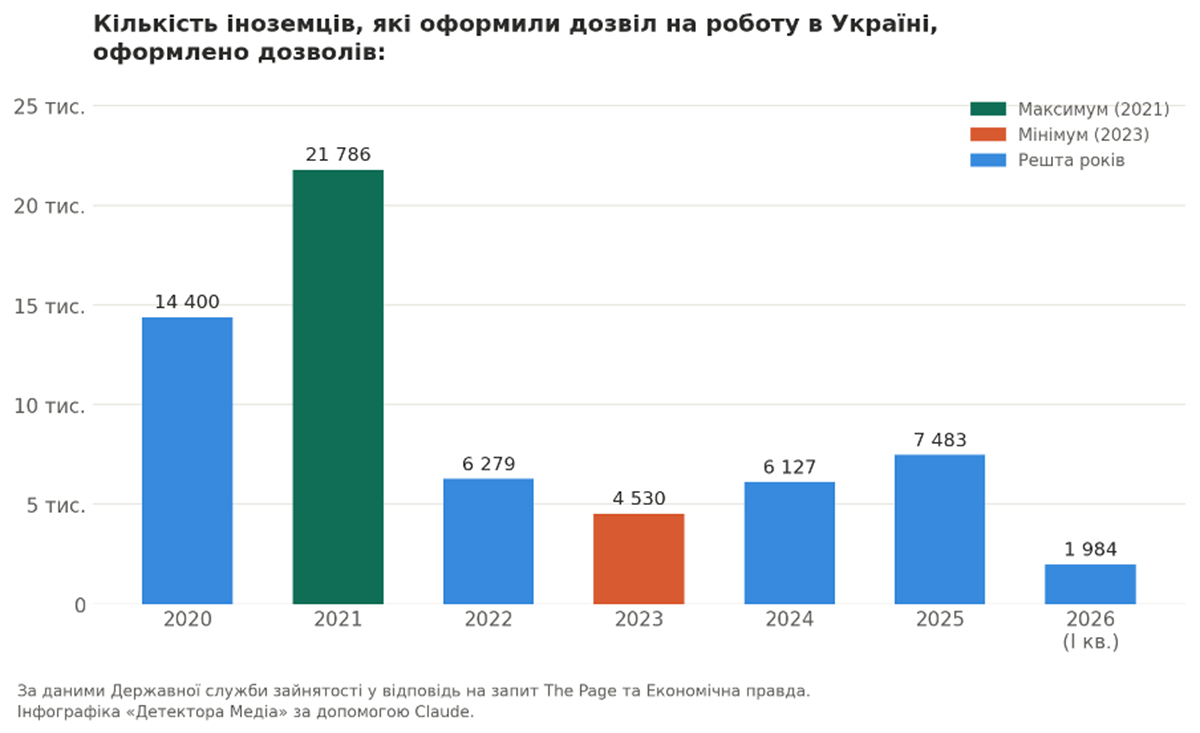
Number of Foreign Nationals Granted Work Permits in Ukraine, 2021–2026. Based on information provided by the State Employment Service in response to requests from The Page and Ekonomichna Pravda. Infographic by Detector Media created with the assistance of Claude.
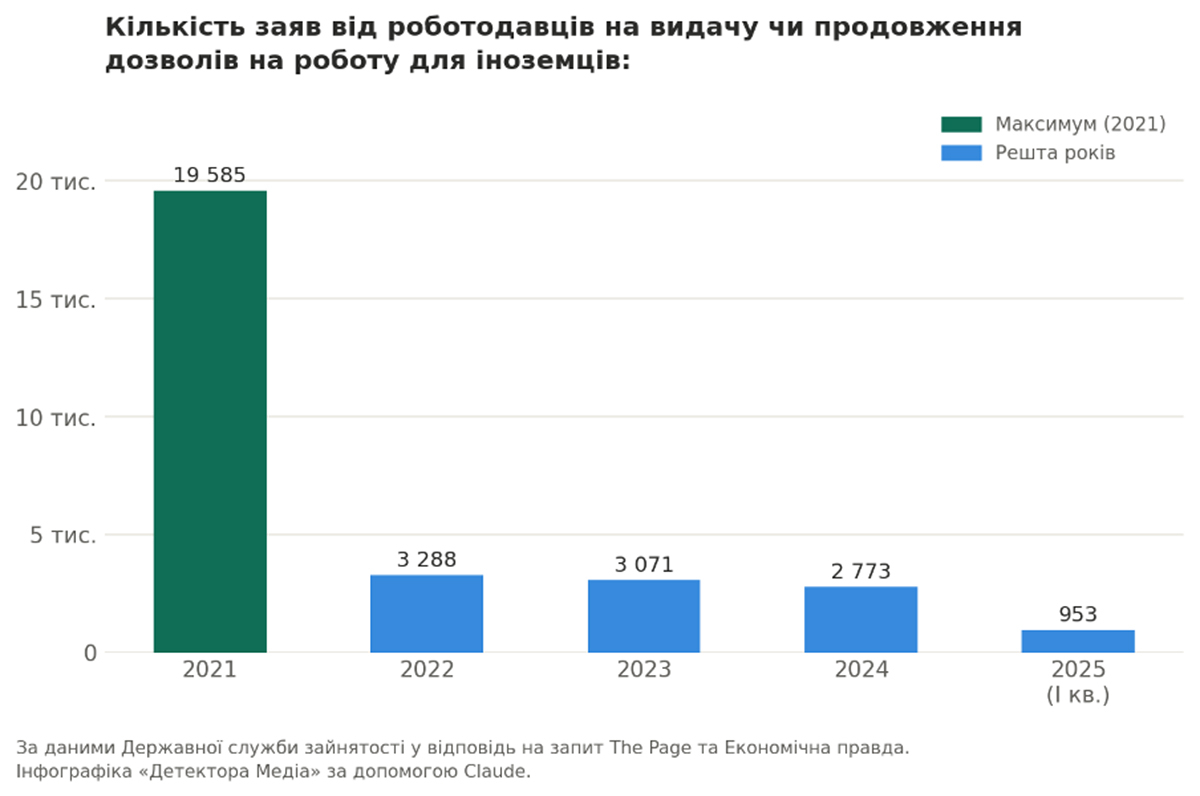
Number of applications submitted by employers for the issuance or renewal of work permits for foreign nationals. Based on information provided by the State Employment Service in response to requests from The Page and Ekonomichna Pravda. Infographic by Detector Media created with the assistance of Claude.
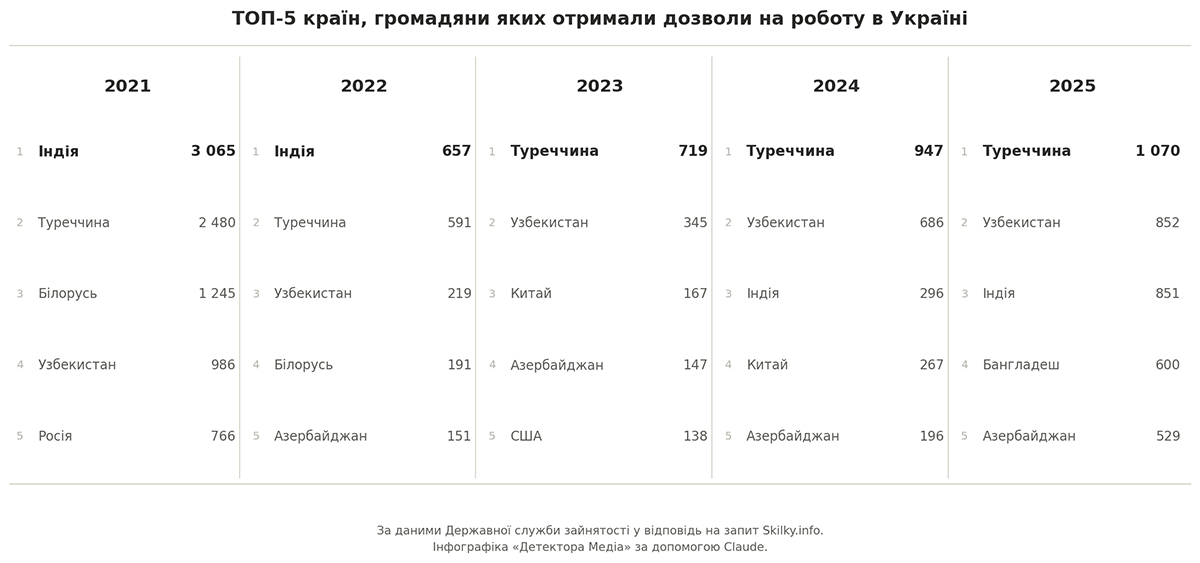
The five countries whose citizens received the highest number of work permits in Ukraine between 2021 and 2025. Based on information provided by the State Employment Service in response to a request from Skilky.info. Infographic by Detector Media created with the assistance of Claude.
The dynamics of work permit issuance—which declined significantly after Russia’s full-scale invasion—and the list of countries from which most foreign workers come to Ukraine do not support social media users’ concerns about an alleged “influx” of, for example, “migrants from Bangladesh.”
The analysis conducted for this study shows that the debate unfolds across several dimensions.
The first dimension is demographic. Data from the National Bank of Ukraine indicate that approximately 500,000 people left Ukraine last year. In 2025, 74% of Ukrainian businesses reported labor shortages. Overall, the labor market has lost approximately 1.3 million taxpayers compared with the pre-2022 period.
The second dimension is economic. According to the European Business Association, labor shortages in the construction sector range from 30% to 50%. The debate also has an important symbolic dimension. For example, a survey conducted by Transparency International Ukraine in June–July 2025 found that 31% of respondents viewed the arrival of labor migrants as one of the risks associated with European integration. In other words, some supporters of EU integration simultaneously perceive migration as a threat.
Particular attention should be paid to the anti-migrant information wave that emerged in May, allegedly triggered by the mass arrival of labor migrants in Ivano-Frankivsk Oblast. In reality, as of May 1, 2026, only 225 foreign workers were employed in the region, most of them from Turkey, India, Uzbekistan, Poland, and Azerbaijan. As reported by Suspilne, there had been 234 foreign workers in the region in 2022.
The wave of media and social media publications in early May 2026 proved to be the most concentrated period within the dataset analyzed for this study: over six days in May, there were 106 publications (25% of the entire annual sample) and 2.15 million views (27% of the total annual reach). Of the 106 publications analyzed that were produced between May 1 and May 11, 2026, 67 (63%) contained negative assessments of immigration—more than double the annual average rate of 26.3%. By media type, the discussion during this period was dominated by Telegram channels (53 publications), online news outlets (45), and, to a lesser extent, social media platforms.
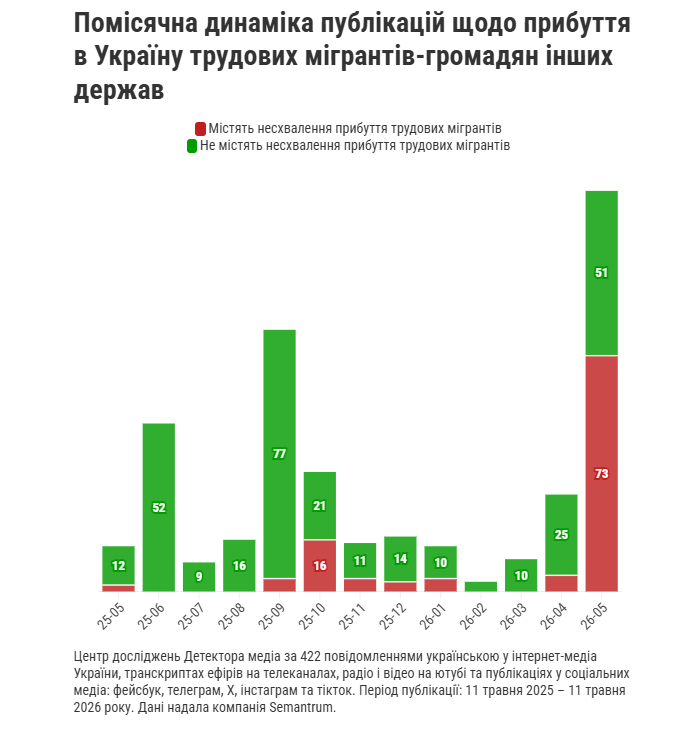
Dynamics of Publications Containing and Not Containing Negative Assessments of Attracting Labor Migrants to Ukraine (May 11, 2025 – May 11, 2026)
Among the factors that intensified waves of anti-migrant sentiment on social media were recent statements by Ivano-Frankivsk Mayor Ruslan Martsinkiv. On May 3, during a broadcast on Apostrof TV, Martsinkiv noted that foreign workers from India, Bangladesh, and Colombia were already employed in the city’s construction sector, explaining this by differences in wage levels. Then, on May 6, during a livestream on his Facebook page, he stated:
“I am against labor migrants; we will not hire these people at municipal enterprises.”
Local media outlets quickly picked up the statement. Although Martsinkiv’s first comment merely acknowledged an existing situation, while the second expressed his political position, Telegram aggregators treated both remarks as equally significant news triggers. This generated an additional wave of coverage that further fragmented discussion of the issue.
Sixteen of the 106 publications in the dataset provided by Semantrum and analyzed by the researchers contained overt cultural hostility, including references to “outsiders,” “savages,” or claims about the incompatibility of cultures. The remaining publications focused on economically protectionist concerns, featuring messages such as “does not support it,” “we will not hire them,” “municipal enterprises will not employ them,” or “other approaches should be sought.”
This may be even more concerning than openly xenophobic rhetoric, since such arguments are voiced by community leaders, politicians, and nationally recognized experts who serve as opinion leaders and are capable of influencing public attitudes.
The Media Community’s Response
Media organizations and representatives of civil society have already responded to the wave of migrantophobia through several publications and social media posts.
For example, media outlets included in the “white list,” such as Texty, demonstrated that migrantophobic narratives are being artificially spread within Ukrainian society to deepen social divisions and increase intolerance among Ukrainians. The publication’s journalists cited sociological data and monitoring results on levels of tolerance in Ukrainian society, showing that the emotional intensity observed on social media does not correspond to findings from public opinion research. They also explained how Russian propaganda became involved in the migrantophobia wave and helped fuel hostility online. Ukrainska Pravda likewise published material on the issue.
Monitoring studies conducted by civil society organizations, including the Institute of Mass Information, sought to determine whether Ukrainian media outlets had consciously or unconsciously contributed to amplifying Russian disinformation and the narrative about the “replacement” of Ukraine’s population by migrants. Their focus was on identifying fake stories and AI-generated content that Ukrainian media had circulated without proper verification or fact-checking.
In November 2025, Detector Media examined Russian propaganda narratives related to migrantophobia. The study analyzed publications from Russian and pro-Russian Telegram channels over eleven months. It demonstrated how Russian propaganda attempts to frighten Ukrainians with narratives about demographic collapse and an influx of migrants, including the claim that Ukraine is supposedly becoming “depopulated” on its own or as a result of Ukrainians’ own actions, rather than as a consequence of Russia’s full-scale invasion.
The current study by Detector Media, however, focuses specifically on trends within Ukrainian media and social networks concerning this issue.
Methodology
As part of this study, we analyzed data from the Semantrum system containing publications from Ukrainian online media outlets, transcripts of television and radio broadcasts, as well as content from YouTube channels and social media platforms (Facebook, Telegram, Instagram, TikTok, and X) in the Ukrainian language. The search query included derivatives of the following keywords: “immigrants,” “Martsinkiv,” and “migrants.”
During the review process, we excluded publications concerning migrants outside Ukraine, as well as news reports about Ukrainians abroad. As a result, we identified 422 publications created between May 11, 2025, and May 11, 2026, that dealt exclusively with the issue of immigration to Ukraine.
Structure of the Publications Analyzed by the Researchers
Publications on immigration to Ukraine were initially processed using the large language model Gemma4 with 26 billion parameters and were further refined during subsequent stages of analysis.
During data processing, we assessed the following parameters: the ratio between publications expressing support for or hostility toward immigration to Ukraine and those expressing neither; arguments for and against attracting immigrants from other countries to Ukraine; and criticism or support directed at government officials who advocate either for or against attracting immigrants.
Mayors’ Statements as Catalysts of Migrantophobia
The largest wave of negative assessments regarding the attraction of foreign labor migrants to Ukraine, which began on May 5, 2026, was triggered by statements made by Ruslan Martsinkiv. Publications related to his remarks account for 23.6% of the entire dataset. Another quarter of the materials contains references to Martsinkiv’s statements, including in background sections.
This was not the first instance in which statements by the mayor of Ivano-Frankivsk regarding migrants generated negative information waves. In an October interview with the outlet Ukrainski Novyny, Martsinkiv criticized representatives of the national government for lifting emigration restrictions for men aged 18–22. At the time, he stated that attracting immigrants was not a solution to the labor shortage problem and that career guidance opportunities for women should instead be expanded.
Publications discussing problems in Ukraine’s labor market, including statistics on the number of labor migrants or the results of public opinion surveys and other studies related to attracting labor migrants from other countries, constituted the majority of publications that did not contain negative assessments of immigration to Ukraine.
A negative assessment of attracting foreign labor migrants was present in one-third of the analyzed publications. Such assessments were most common in Telegram posts (39.46%), Facebook posts (33.33%), and online media publications (29.77%). TikTok publications were rather an exception, as the final dataset contained only one such publication.
Out of 402 unique items in the dataset, 13 samples were repeated two or more times—these were complete duplicates, identical from the first to the last character. In total, there were 33 such duplicate instances, representing 7% of all messages; 12 of them contained a negative assessment of attracting labor migrants. Seven of these were Facebook reposts criticizing the authorities:
“When the collective Milovanovs talk about the demographic crisis, it is certainly not about care or a state vision for solving this problem. It is simply preparing society to accept Asian and other immigrants. Our own people were sacrificed for what or for whom?! ... How catastrophically expensive this emerald-Truskavets gathering in power is costing Ukraine...”
The post served as an introduction to a video criticizing the Servant of the People party, published in October 2025. As of May 14, 2026, Facebook users had shared the video with this introductory text 139 times.
The dataset also included three shares of a post by Maksym Zhorin, deputy commander of the Third Army Corps, who wrote on Telegram that “labor immigrants should be accepted only through the front line.”
Another statement attributed to Zhorin was shared twice within the dataset: “There should be no labor migrants from countries that are culturally and mentally completely distant from us, earning money here while Ukrainians are fighting.” Quotes concerning the “delegation” of Ukraine’s defense to foreign citizens spread in October 2025; Zhorin, among others, was responding to comments made by Business Ombudsman and former Canadian ambassador Roman Waschuk during a broadcast on the Novyny.Live television channel:
“Every country that has traditionally been, so to speak, an ‘exporter’ of people is surprised when people appear who want to live there. The Poles, for example, are now shocked because of Ukrainians and not only Ukrainians. There is a large part of the world for whom life in Ukraine would be an incredible upgrade, and with every Ukrainian who leaves, with every Ukrainian who unfortunately dies, with every Ukrainian who decides that this kind of work is not for them, a job is created for a person from abroad.”
Washchuk’s remarks were quoted by nine online media outlets, which supplemented them with critical responses from other speakers, including Maksym Zhorin and Mykhailo Nepran, Vice President of the Ukrainian Chamber of Commerce and Industry.
Some politicians linked the issue of a perceived influx of immigrants to mobilization. In May 2025, Member of Parliament and former Chairman of the Verkhovna Rada Dmytro Razumkov spoke in parliament, criticizing changes to reservation rules that would have caused some exempted men to lose their deferments and enter military service. His remarks were reported by the municipal television channel Kyiv; the original source was likely his parliamentary speech. A Telegram post by Razumkov following this speech was circulated in April–May even by pro-Russian channels such as “Nablyudatel.”
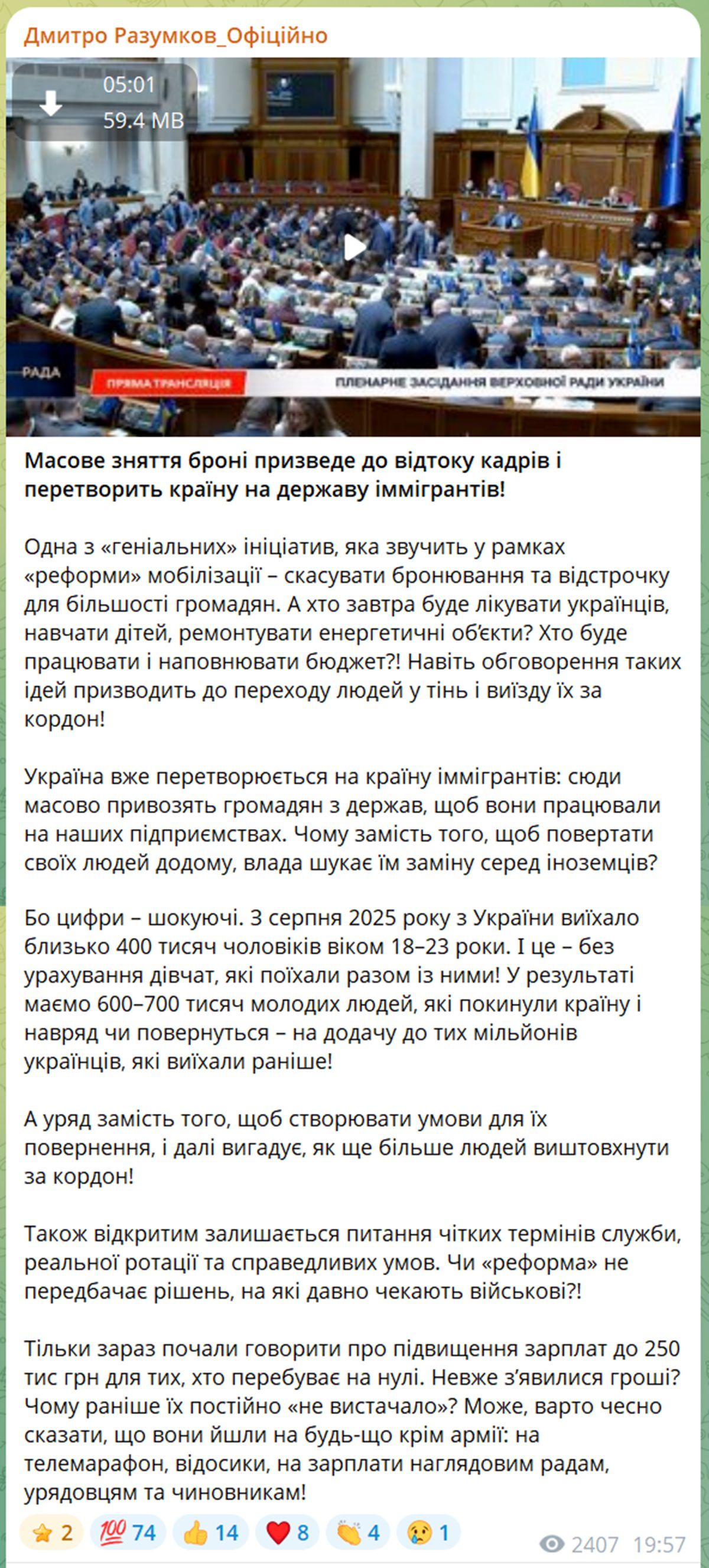
Dmytro Razumkov’s Telegram post of April 29, 2026. The politician argued that changes to Ukraine’s military service exemption rules would accelerate the emigration of Ukrainians and turn Ukraine into a “country of immigrants.”
In addition to Ruslan Martsinkiv, the presence of foreign labor migrants in his community was acknowledged by the mayor of Cherkasy, Anatolii Bondarenko: “I’ll let you in on a secret. The company that won the contracts for road paving in the city of Cherkasy is currently employing about 10 foreign workers on work visas. I think that within a week or two, you will see foreign workers in the city of Cherkasy,” his remarks were quoted in 43 messages in early May 2025.
Following this quote, journalists typically added in indirect speech that Bondarenko noted that in Ukraine, “every municipal enterprise faces a significant shortage of skilled workers, including locksmiths, maintenance workers, and street cleaners. Women are now increasingly being recruited for these jobs.”
In both Cherkasy and Ivano-Frankivsk, the discussion concerned the recruitment of a relatively small number of foreign workers to sectors suffering from labor shortages. In social media and political speeches, however, the narrative shifts to “preparing society for the replacement of Ukrainians with Asian immigrants.”
There are examples where the same political actors acknowledge the acute problem of labor shortages while opposing those who propose addressing it through the recruitment of migrants. Anatolii Bondarenko and Ruslan Martsinkiv both point to critical staff shortages in municipal services and construction. Yet their own statements are used in information waves criticizing the potential large-scale arrival of labor migrants to Ukraine. Member of Parliament Dmytro Razumkov uses the sensitive issue of immigrants as a lever for criticizing mobilization policies.
How Opponents of Labor Migration Justify Their Position
A negative assessment of attracting immigrants is present in 45.02% of the analyzed messages and is spread through all media types included in the sample. The backdrop for these negative arguments consists of the economic, demographic, and political challenges that have intensified as a result of Russia’s aggression against Ukraine. The arguments themselves fall into two groups—economic-demographic and cultural—and this pair of themes consistently emerges in social and other media whenever labor immigration is discussed.
Economic-demographic arguments include emotional reactions to the potential arrival of foreign workers in Ukraine or discussions of such a possibility through the lens of Ukraine’s aggravated economic and political problems resulting either from the war or from government policy. Cultural arguments include claims that certain elements of immigrants’ cultures or everyday habits would hinder their successful integration into the Ukrainian workforce, as well as xenophobic accusations portraying them as “criminals,” “savages,” “outsiders,” and the like. Foreigners who have either already arrived or may come to work in Ukraine are depicted as a threat to Ukrainian national identity.
Key Narratives in Negative Assessments of Attracting Labor Migrants from Other Countries in the Ukrainian Media Space
The most common trigger for negative assessments in the materials included in the dataset was the publication of analytical reports and research, as well as statements by officials and experts concerning Ukraine’s economic and demographic situation and the prospects for post-war reconstruction. Arguments against immigration are therefore reactive rather than proactive: they follow statements made by prominent individuals and organizations. These statements do not necessarily focus on labor migrants themselves—it is sufficient that they touch upon economic, military, or European integration issues.
For example, in September 2025, a key catalyst for negative statements about labor migrants arriving in Ukraine was a survey conducted by Transparency International Ukraine on Ukrainians’ perceptions of European integration. In the survey, 31% of the 1,015 respondents identified the arrival of labor migrants from other countries as one of the risks associated with European integration.
Statements by officials, politicians, and experts, as well as the publication of statistical data and opinion polls, generated debates about attracting migrants throughout the entire period under review. This simultaneously demonstrates the significant weight of expert opinion in Ukrainian society and highlights the substantial potential of specialists in framing arguments about economic and demographic challenges and the ways to address them.
Five Percent in Favor: Rational Arguments That Fuel the Publication of Emotional Assessments
Publications in which support for labor immigration to Ukraine outweighed negative assessments constituted a minority of the analyzed materials—just 5%. The arguments focused primarily on the economy and the shortage of workers in the country. Demographic issues and the need to restore population numbers were mentioned less frequently.
One of the statements advocating the need to attract labor migrants that was widely reproduced in the media and triggered a wave of subsequent negative comments on social media came from the head of the Presidential Office, Kyrylo Budanov, regarding changes to the list of “migration-risk countries.” During a meeting with business representatives at the CEO Club, Budanov stated that Ukraine was preparing to revise this list and might simplify entry and legalization procedures for labor migrants. According to him, this was driven by labor shortages.
Budanov explained that the Ministry of Foreign Affairs and the Security Service of Ukraine had been instructed to review the list of “migration-risk countries” during a government meeting on relations with African countries. At the same time, the head of the Presidential Office noted that the current “strict approach” to immigration from countries on the list was motivated by the risks of irregular migration and the use of Ukraine as a “transit country.” “They enter the country, obtain documents, and then move on. This is a problem that creates obstacles for business,” Budanov said.
Statements by Vasyl Voskoboinyk, head of the NGO Office of Migration Policy and an expert on demography and labor migration, also attracted considerable attention. In a comment to Channel 24, Voskoboinyk cited estimates of how many additional workers Ukraine would need to achieve economic growth after the war.
“According to the forecasts of the Ministry of Economy, if we are to grow at a rate of 7% over the next ten years (assuming that the war ends now and economic reconstruction begins), we will need an additional 4.5 million workers. These figures were first published in December 2023. In November 2025, the International Labour Organization (a specialized UN agency—Channel 24) calculated that we would need even more workers to achieve the same economic growth rates—around 8.2 to 8.6 million workers. And all of this would be in addition to the size of the labor force we had in 2021,” Voskoboinyk was quoted as saying on the Channel 24 website.
He also stated that large-scale migration to Ukraine is unlikely at present, and that the state must first create conditions for foreign workers to enter the country and compete for labor on the global market with EU member states and others. Nevertheless, on social media, the expert’s statements containing these figures sometimes appeared in a context suggesting that “plans to import millions of migrants” were already a fait accompli. The name of the Office of Migration Policy, headed by Voskoboinyk, was presented as if it were a government institution rather than a non-governmental organization, which fueled hostility toward the state.
One of the few real-world examples discussed in debates about the prospects and feasibility of attracting labor migrants was the experience of the agricultural holding company MHP (Myronivsky Hliboproduct). Dina Konohrai, Director of Human Resources for Production, Logistics, and Procurement, explained that the company had recruited seven foreign workers. Following the first nighttime missile attack, some of them failed to report for work, prompting the company to revoke permits for the entire group and notify both the employment center and the migration service. Before making another attempt, the company took steps to help foreign workers adapt to wartime conditions. “We can now say that this model can work: their productivity is at an appropriate level, and so is their discipline,” the company representative said while assessing the performance of another group of seven foreign workers.
The analyzed materials also included statements from other speakers who employed the labor shortage argument. Vasyl Furman, a member of the Council of the National Bank of Ukraine, stated that employing migrants from other countries is a common practice in many parts of the world. According to him, the issue will become even more relevant during the post-war reconstruction period, when demand for labor resources increases. However, Furman added that immigration should not be the sole source of labor replenishment; every effort must also be made to encourage the return of Ukrainian citizens who have left the country.
Number of Mentions of Economic Sectors Where Immigrants Are Employed or Proposed to Be Employed
In September 2025, former Foreign Minister Dmytro Kuleba joined the discussion. He noted that in a country from which millions of working-age people have left, a large number of pensioners remain. Raising the retirement age is, according to Kuleba, politically unpopular and therefore difficult to implement. In his view, Ukraine could become an attractive migration destination for people from South Asian countries. “We may have to open the country to immigration. Bangladesh, Nepal, India, the Philippines, and Vietnam would gladly come,” Kuleba said.
In the media, his remarks were often presented alongside a statement by Danylo Hetmantsev, Chairman of the Verkhovna Rada Committee on Finance, Taxation and Customs Policy, who criticized Kuleba’s idea:
“People with a different culture, language, religion, and, let’s be honest, not always a desire to work, will never solve Ukraine’s demographic problems. Or they will solve them in a way that God forbid…”
Most of the analyzed publications containing positive arguments in favor of bringing labor migrants to Ukraine also included warnings about migration-related risks and emphasized that priority should be given to encouraging the return of Ukrainians who had left the country. In most cases, these caveats were voiced by the same individuals. However, when their statements were later picked up by social media, some of the nuances and qualifications were lost. As a result, even comments made by people who were neither politicians nor government officials triggered waves of criticism directed at the state.
Conclusions
Detector Media’s study confirms that the debate over attracting labor migrants to Ukraine is taking place not at the level of facts but at the level of emotions. The number of foreigners who obtained work permits in Ukraine declined threefold between 2021 and 2025, falling to 7,500 (for comparison, the State Employment Service reported 80,000 unfilled vacancies last year). Yet concerns about the perceived threat of a migrant influx have increased.
Negative waves in the information space are not driven by actual events related to the arrival of foreign workers. Rather, they are triggered by statements made by officials and politicians. Therefore, negative attitudes toward attracting labor migrants to Ukraine can be regarded not as public pressure but as managed resonance. We cannot claim that anyone deliberately creates this resonance, but it is evident that media outlets, bloggers, and popular social media platforms capitalize on it to attract attention and increase audience engagement. The picture is further complemented by grassroots creativity in the form of memes, which were not the subject of this study but whose content often reflects the trends identified here.
Arguments against attracting migrants are predominantly emotional (fear, threat, “replacement of Ukrainians”), while arguments in favor are largely rational (demographics, economics, labor shortages). In an environment where emotional content spreads more rapidly than rational content, this asymmetry is structurally disadvantageous for proponents of labor migration. Constructive proposals from experts (“encouraging Ukrainians to return,” “developing automation”) are filtered out on social media, leaving only isolated figures and assessments taken out of context, which alarm audiences with the perceived inevitability of a “migrant influx.”
In both national and local media, politicians’ statements about an imagined “threat” become news hooks and are transformed into “news stories.” A semantic shift takes place whereby the figure of “4.5 million,” originally presented as a “forecast for GDP growth” and an “estimate by the Ministry of Economy,” is transformed into a supposed “plan to import migrants.”
The emotional manipulation of the issue of a labor migrant influx through the “us versus them” framing is characteristic of Russian propaganda. Detector Media examined Russian narratives about the replacement of Ukraine’s population (by people from Russia and other countries) at the end of 2025. However, the layer of Russian propaganda that feeds off domestic Ukrainian debates surrounding migrantophobia remains an open subject for further research.