
Українською читайте тут.
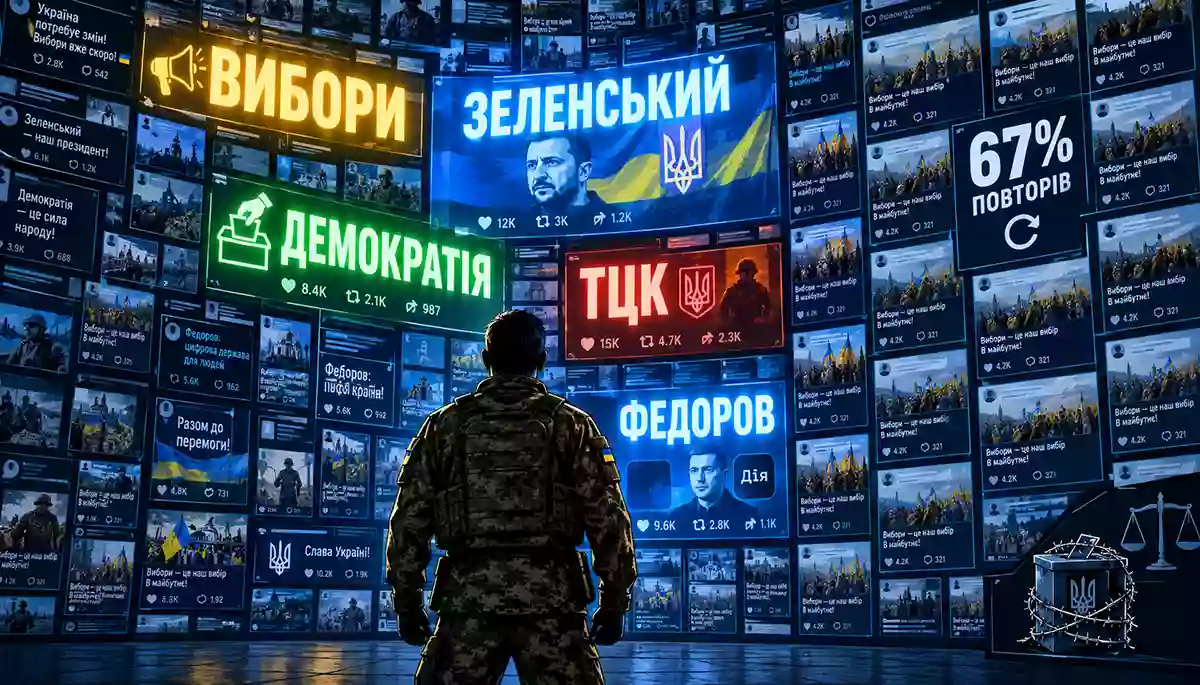
Detector Media’s Research Center examined which established and emerging arguments circulate in online debates about holding elections in Ukraine under martial law, and what role Russian propaganda plays in these debates.
Executive Summary
Had it not been for Russia’s full-scale invasion, Ukraine would have held regular parliamentary elections in October 2023, a presidential election in March 2024, and local elections in October 2025. However, Article 19 of the Law of Ukraine “On the Legal Regime of Martial Law” prohibits “holding elections of the President of Ukraine, as well as elections to the Verkhovna Rada of Ukraine, the Verkhovna Rada of the Autonomous Republic of Crimea and local self-government bodies; holding all-Ukrainian and local referendums; holding strikes, mass gatherings and rallies” while martial law is in force.
This makes elections an inherently manipulative topic right now. Changes to this legislation are also protected by separate procedural safeguards. Public calls to “hold elections immediately” therefore do not point to a legal gap — they call for bypassing barriers built into the law. Once martial law is lifted, the Verkhovna Rada must call the postponed elections within 90 days. On 14 July 2026, parliament extended martial law and general mobilisation until 31 October 2026.
Nevertheless, the issue of elections keeps resurfacing. Sometimes it is pushed by Russian propagandists, who present the postponement of elections as proof of the Ukrainian government’s “illegitimacy” or “usurpation of power”. Sometimes it comes from foreign policy: in February 2025, US Vice President JD Vance and President Donald Trump demanded that Ukraine hold elections. Ukrainian politicians have raised it too. On 18 August 2026, former Defence Minister Mykhailo Fedorov called for a “legal, safe and realistic mechanism” to restore elections, because “democracy cannot be held hostage by Russia”. In September, President Volodymyr Zelensky told CBS News that he was ready to hold elections “even tomorrow”, but that this is impossible due to hostilities, security threats and the constitutional restrictions in place under martial law.
To understand how these debates unfold online, the Detector Media Research Center analysed 83,275 posts on Telegram, X (formerly Twitter), Threads, TikTok and Bluesky published between 1 January 2025 and 27 August 2026.
Key findings
- The idea of elections mostly stays at the level of general talk. Of 3,465 posts about elections in Ukraine reviewed by Detector Media analysts, only 23% take a clear position on holding elections under martial law: just over 11% in favour and almost 12% against. The remaining 77% mention elections in passing, as an idea that “hangs in the air” alongside other news.
- Telegram is the platform most engaged with the topic. Almost 29% of election-related Telegram posts take a position, compared with 17–20% on other platforms.
- X is the only platform where supporters of wartime elections prevail. Posts supporting elections under martial law make up 11% of the X sample, while support for post-war elections is at its lowest of all platforms — 8.5%.
- A single statement by a politician can instantly reshape the debate. The largest spike in election-related posts since January 2025 came in August 2026: the share of posts in which the timing of elections is “not discussed” fell to its lowest level (63.5%), while posts about holding elections during hostilities reached a record 30%. The trigger was Mykhailo Fedorov’s statement on the need for legal mechanisms to hold elections. The narrative is highly sensitive to statements by prominent figures and does not always develop as a reasoned discussion of legal or security arguments.
- The debate is fixated on the presidential election. Of 1,889 posts mentioning a specific type of election, over 84% concern the presidential election, just over 12% parliamentary elections, and only around 3% local elections. A personalised political culture and the president’s role as commander-in-chief make the presidential race the main subject of discussion — and of manipulation.
- Many election-related posts are repeated word for word. In the full YouScan dataset of 83,275 posts, 67% were verbatim repeats appearing two or more times, and 81 posts were repeated more than 100 times. Of these 81 most-replicated posts, 32 contain calls regarding elections and 19 contain attacks on political opponents. The visible “wave” of election talk thus appears to be largely produced by a small number of templated messages that can hardly be considered organic debate.
Methodology, Data and Limitations
The study draws on 83,275 posts on Telegram, X, Threads, TikTok and Bluesky published between 1 January 2025 and 27 August 2026. The search query in the YouScan social listening platform was built around the stem “вибор*” (elect*), combined within a distance of one to three words with derivatives of “MP”, “mayor”, “president”, “holding”, “expression of will”, “democracy”, “free”, “democratic” and “campaigning”. YouScan queries capture not only keyword combinations but also their position relative to each other within sentences.
To reduce the number of posts about elections in other countries, the query excluded posts mentioning continents, EU member states, China, Korea, Japan and other countries that held national elections in 2025–2026.
From this dataset, we drew a sample of 5,000 posts (2% margin of error at a 99% confidence level). X accounted for 53% of the sample and Telegram for almost 37%, followed by Threads (just over 5%), TikTok (almost 4%) and Bluesky (around 1%).
Breakdown of posts from X, Threads, TikTok and Bluesky in the sample. Detector Media, based on YouScan data
Initial processing was carried out with a locally deployed large language model, Gemma 4 (26 billion parameters). Analysts defined seven analytical categories, mostly with binary (yes/no) answers. They covered whether a post mentions elections in Ukraine or in other countries; whether it supports holding elections under martial law; how support for or criticism of the idea is argued; and who — inside or outside Ukraine — is named as interested in holding elections before hostilities end. The result was a structured dataset, which was then verified by analysts.
Research objective: to identify and analyse recurring disinformation and manipulative narratives related to elections in Ukraine in the context of the war and of preparations for post-war elections.
Limitations: Despite the exclusions in the YouScan query, 1,535 posts (30.7% of the sample) mentioned countries not covered by the exclusions, or mentioned politicians, parties and other terms linked to Ukraine and elections but unrelated to the Ukrainian context. These were removed during verification. The findings are therefore based on 3,465 posts (69.3% of the initial sample of 5,000) that concern or mention elections in Ukraine specifically.
How Visible Is the Election Debate on Different Platforms?
As noted above, only 23% of the 3,465 posts take a clear position (just over 11% for elections during hostilities, almost 12% against). In the remaining 77%, elections appear as an idea that surfaces and fades with news hooks created by public figures in Ukraine and abroad.
Share of posts supporting elections under martial law or after the end of hostilities. Detector Media, based on YouScan data
On Telegram, almost 29% of posts took a position; the rest were news items or anniversary posts. On the other platforms, passing mentions accounted for 80–83% of posts (see the infographic below). Based on the balance between supporters and opponents of wartime elections, the platforms fall into three types.
Type 1: X, the only platform where users more often speak in favour of elections under martial law (just over 11%), with the lowest support for post-war elections (8.5%).
Support for and opposition to holding elections before the end of hostilities, by platform. Detector Media, based on YouScan data
Type 2: Telegram, TikTok and Threads, where posts against wartime elections make up a relatively larger share.
- Telegram discussed elections more than any other platform: 12% of posts supported elections during the war, while almost 17% supported post-war elections.
- TikTok: almost 11% of posts favoured elections after martial law ends, and 8.9% supported holding them under martial law.
- Threads: 9.6% supported post-war elections and just over 7% wartime elections. The Threads discussion was the least “politicised”, with the smallest share of users stating when elections should take place.
Type 3: Bluesky (only about 1% of the sample), where support for elections during and after the war was roughly equal (about 9% each).
When Do Calls for and against Elections Spike?
When anniversaries become news hooks — of the current or previous parliament, of Zelensky’s election, or of the dates past elections were held — we observed spikes in posts arguing that elections cannot be held until hostilities are fully over.
October 2025, when regular local elections were constitutionally due, is a case in point. The share of posts favouring elections only after the war peaked at 30.5%, the highest for the study period. The spike was linked to the calendar date and to the Central Election Commission’s official explanations that the elections would not take place due to martial law and the absence of a parliamentary decision. The CEC did not form territorial election commissions and reminded parties that no nominations were possible until parliament called the elections.
A similar rise in support for post-war elections was recorded in May 2026 (20%). This time the arguments focused on security conditions and on protecting the voting rights of service members and Ukrainians abroad.
By contrast, during periods of intensified international negotiations, foreign policy shifts or initiatives to rebuild electoral infrastructure, the share of posts that did not discuss the timing of the next elections (“Not discussed” in the infographic above) declined. The first significant spike came in February 2025, a few weeks after Donald Trump’s inauguration and his remarks about the possibility of a vote in Ukraine. That month, the share of posts across the platforms in favour of elections during hostilities rose to almost 17% (583 of the 3,465 posts on elections in Ukraine).
Monthly share of posts calling for elections under martial law or for post-war elections, %. Detector Media, based on YouScan data
The second spike came in December 2025, when election mentions reached 538 posts and the average share of posts in favour of national elections rose to 15.5%. It was likely driven by news about the restoration of the State Voter Register and discussions of technological solutions for remote voting. A smaller but noticeable peak occurred in late February 2026 (188 posts), echoing statements by Volodymyr Zelensky to foreign media (AFP and Corriere della Sera) about the conditions for his participation in post-war elections.
The highest volume of election-related posts came in August 2026. The “Not discussed” share fell to its lowest level for the study period (63.5%), while posts about holding elections during hostilities exceeded 30%. The key driver of this revival of pro-election arguments was Mykhailo Fedorov’s video address of 18 August, in which he called for a “legal, safe and realistic mechanism” to restore elections.
Which Elections? A Fixation on the President
The presidential election dominates the discussion, accounting for 84% of the 1,889 posts that mention parliamentary, presidential or local elections. Parliamentary elections appear in about 12% of posts (233), while local elections remain on the margins of public interest, with just over 3% (62 posts).
This imbalance reflects Ukraine’s personalised political culture and the central role of the presidency during the war — the president is commander-in-chief and the main actor in foreign policy negotiations. It also reflects attention to corruption allegations against the president’s former associates (the “Mindichgate” case), against former Head of the Presidential Office Andriy Yermak and his former deputy Iryna Mudra.
Changes in the visibility of social media discussions on parliamentary, presidential and local elections. Detector Media, based on YouScan data
The data show several distinct peaks:
- February 2025 — the first wave: the presidential election featured in over 12% of posts (239 mentions), parliamentary elections in 2.2%.
- December 2025 — the maximum: discussion of the presidential race rose to over 16% (303 mentions), parliamentary elections to 1.7%. This was likely driven by media scenarios and debates on transforming the political system, the mobilisation of political campaign teams amid discussions of post-war governance models, and demands from international allies to hold the presidential election first once martial law is lifted.
- February 2026 — a new spike: the presidential election was discussed in 4.6% of posts, parliamentary elections in about 0.5%. This reflected the news wave around the so-called “Trump peace plan”. Around that time, the Financial Times reported on a possible announcement of elections “by 15 May” and on White House pressure, with Kyiv at risk of losing “US security guarantees”.
Local elections saw only isolated spikes and were almost invisible in user discussions. The highest figures were recorded in February 2025 (0.53%), October 2025 (0.53%) and May 2026 (0.26%). The October 2025 spike coincided with the constitutional deadline for regular local council elections, which prompted lawyers and experts to analyse the legal conflicts around holding local elections under martial law.
Arguments for Holding Elections under Martial Law
Explicit arguments for holding elections under martial law were found in 212 posts (see the infographic below). We grouped them into nine thematic clusters. The most frequent were: “to protect democratic values”, the need for elections “to make the state more effective”, and the “possibility of holding elections if hostilities are paused for at least 60 days”.
Prevalence of arguments for and against holding elections in Ukraine during hostilities in the sample. Detector Media, based on YouScan data
These arguments peaked three times, each with its own dominant clusters:
- February 2025. The leading argument was that elections are “the key to successful ceasefire negotiations”. The main driver was the foreign policy agenda, in particular statements by the new US leadership on settling the conflict. The second most frequent argument was holding elections “to preserve democracy”, followed by claims that Ukraine’s Constitution supposedly “does not prohibit” a presidential election.
- December 2025. Amid discussions of Donald Trump’s “peace initiative”, this became the overall peak in posts with arguments both for and against elections. Pro-election arguments clustered around the idea that “elections must be held in time, during a truce with Russia”, with discussion of timeframes and security preconditions. In 33 posts, users called for elections “during a 60- or 90-day pause in hostilities”. In 26 posts, they argued that elections were needed because “the state has become ineffective and some politicians or officials are corrupt”. Another 26 posts cited Volodymyr Zelensky saying he was ready both for elections and for legislative changes if there were “guarantees from Russia and Ukraine’s partners that elections can be held safely”. Some posts also mentioned that the CEC, parliament and special parliamentary working groups were developing solutions for holding elections under martial law.
- August 2026. The most-cited phrase was Mykhailo Fedorov’s “democracy cannot be held hostage by Russia”. The core message was that, in a protracted war, Ukraine must find a legal, safe and realistic mechanism to restore the electoral process.
Arguments against Elections during Hostilities
We found explicit arguments against holding elections under martial law in 181 posts (see the infographic above). Between January 2025 and August 2026, the reasoning shifted from legal and procedural objections to security and socio-political ones.
The most prominent arguments were fears that wartime elections would “deepen authoritarian tendencies”; direct references to the constitutional and legal ban on elections under martial law; and manipulative claims about “the risk of territorial recruitment centres (TCCs) being used to pressure voters and political opponents of the authorities”. These were followed by warnings of a “purge of the opposition field”, of “manipulation through government control of the media via the United News telethon”, and claims that holding elections during active hostilities is “a scenario that benefits the Kremlin”. Also notable were arguments that voting rights could not be guaranteed for service members, internally displaced persons and refugees abroad, as well as references to polling data showing that most Ukrainians reject the idea of wartime elections.
Arguments against elections before the end of the war also peaked three times:
- Early 2025: legal grounds and references to public opinion prevailed.
- Spring 2025: the first major spike, driven by concerns about mobilisation pressure at polling stations and possible anomalous voting results.
- Late 2025: the focus shifted to the illegitimacy of election results, the risks of electronic voting, and restrictions on the rights of voters at the front, abroad and in the occupied territories.
In 2026, especially during the August peak that followed Mykhailo Fedorov’s resignation and political statements, the key “against” arguments were security risks: possible Russian missile and drone strikes during voting, hacking of electronic voting and manipulation of its results. Users also discussed the danger of a social split that Russia could exploit.
Compared with the “for” arguments, the debate reveals pairs of opposing logics. External or diplomatic pressure to hold a vote is countered by warnings of lost sovereignty and internal destabilisation. Calls to renew the government are countered by warnings of usurpation, since free and competitive elections are impossible during hostilities. Proposals for remote voting are countered by distrust in the security of digital systems, which would undermine the legitimacy of any president or parliament elected this way.
Manipulation and Disinformation in the Most Widely Shared Posts
The initial YouScan dataset of 83,275 posts contained 34,045 unique messages. 6,639 messages were repeated verbatim two or more times — most likely reposts, retweets or fully copied texts — producing a total of 55,929 repeated posts (67% of the dataset). On X (53% of the dataset), repeats are also a good proxy for reposts and shares.
1,873 posts were shared or retweeted five or more times, and 81 more than 100 times. Shares and retweets of these 81 posts alone made up 15% of the entire initial YouScan dataset.
Of these 81 widely shared posts, 32 combined calls regarding wartime elections with signs of manipulation. 19 attacked political opponents for supporting or criticising elections, 9 proposed holding elections despite hostilities, and 3 called for not holding them. The rest of the 81 “super-shared” posts were reposts of polls on presidential candidates or news.
Manipulations in posts shared more than 100 times fall into three types: accusing Ukraine’s partners of benefiting from elections in Ukraine; accusing the authorities of trying to hold or cancel elections to stay in power; and accusing the opposition of trying to seize power through elections.
Accusations against partners. For example, an X post about the United Kingdom’s readiness to support elections in Ukraine was retweeted 281 times: “You could just appoint a new head of the concentration camp, why disguise it as democracy. The b…ds are already rubbing their hands,” reads the message, first posted on 25 April 2026. Such messages may reproduce Russian propaganda narratives that Ukraine is not a sovereign state, that its partners harbour malicious intentions, and that holding or not holding elections has no bearing on Ukraine’s status as a democracy.
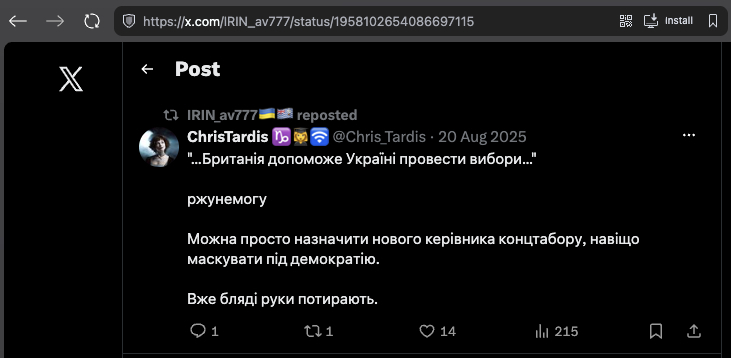
One of more than 280 shares in the dataset of a post describing Ukraine as a “concentration camp” and alleging British influence over elections. Screenshot: X
The US and Donald Trump were mentioned most often in retweets. On 10 June 2025, a post commenting on yet another shift in US rhetoric on Ukraine was shared 207 times on X and twice on Bluesky: “It turns out Zelensky handed Ukraine’s mineral resources to the US purely out of personal interest — the US is no longer demanding a presidential election.” The post likely referred to the agreement establishing the US-Ukraine Reconstruction Investment Fund, signed on 30 April 2025.
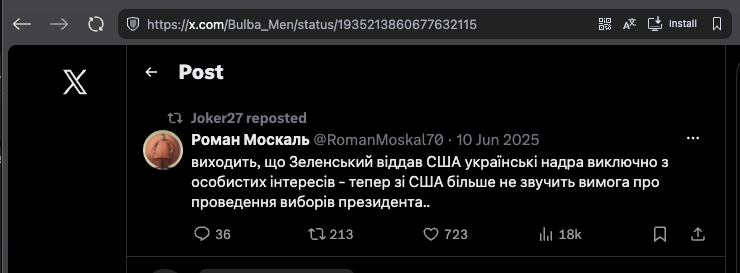
An example of a shared tweet alleging that Zelensky personally benefits from not holding elections following the “minerals deal” with the US. Screenshot: X
Mostly anonymous X users resorted to obscenities when criticising both the US and Ukrainian presidents. They were reacting to Trump’s statement to journalists on 11 January 2025: “Zelensky has to be realistic. I wonder how long it will take before there are elections? 82% of Ukrainians are demanding a deal.” Users wrote and retweeted replies insulting Trump and claiming that “idiots and zhduny” (those “waiting” for Russia) make up “a maximum of 12%” of Ukrainians, while the “82%” are waiting for Trump to “shut up”. These posts have since been deleted from X.
Accusations against the authorities. Domestic political topics also featured in manipulations. For example, the following post was shared 224 times on X: “How the KVN comedians fooled Ukrainians with television. In Kramatorsk (electoral district No. 48), 83.78% of voters… His voters are now not only deceived, but shamelessly robbed and laid in graves en masse, not all of which will ever be found. Meanwhile, everything is great at ‘Dynasty’…”
Such reposts spread the manipulative claim that Russia “mostly destroys the population of regions that voted for Zelensky”, ignoring geography and basic logic. The original post came from an unverified account “ES Kherson”, whose description reads “European Solidarity in Kherson region” and links to a Telegram channel described as “Official channel of the Kherson branch of the European Solidarity party”. The original post has not been deleted.
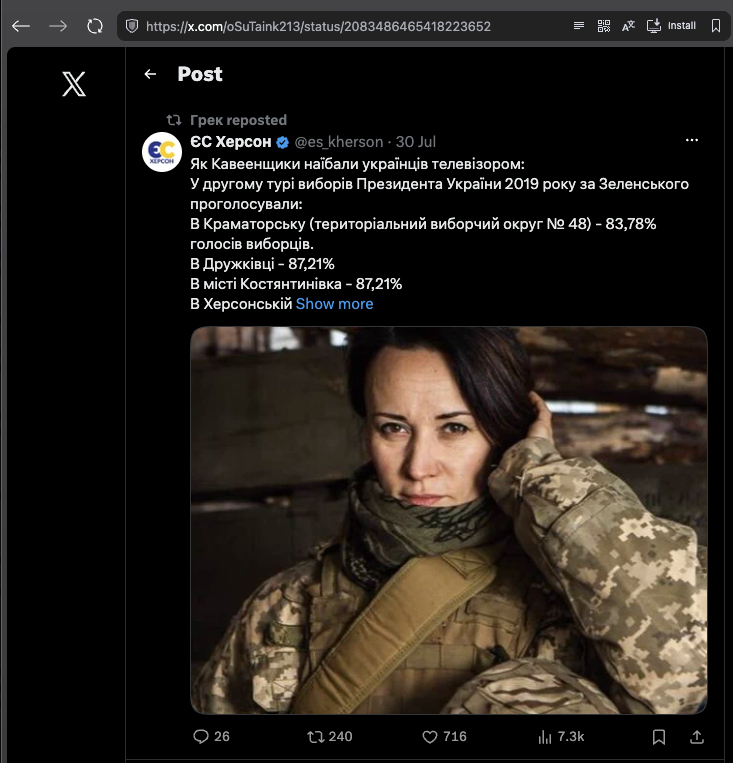
An example of a shared X post claiming that fighting is taking place where people voted for Volodymyr Zelensky in the 2019 presidential election. Screenshot: X
On 25 August 2025, X users shared 101 times a quote from a Facebook post (archived) by European Solidarity MP Volodymyr Ariev: “The Presidential Office is preparing for elections. Quick ones — so that no one but them can prepare. All the signs are there. I have no other explanation for the sudden appearance of all sorts of odes and panegyrics to Zelensky. Not to the defence forces, not to those fighting for freedom and independence.”
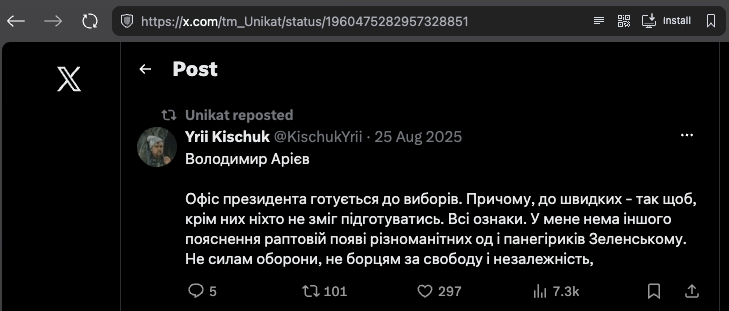
An example of a shared X post claiming that the authorities are preparing for “snap elections”. Screenshot: X
Accusations against the opposition. In December 2025, X users shared 183 times an accusation that European Solidarity politicians were preparing elections in Ukraine together with Russia and the US and profiting politically from corruption scandals. The context was news about Donald Trump’s “peace initiative”.
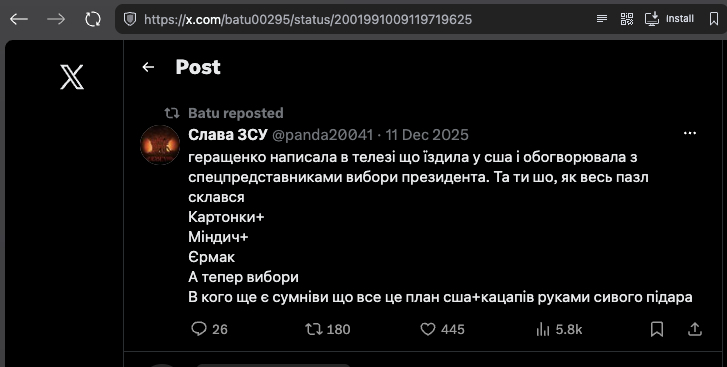
An example of a shared X post claiming that European Solidarity politicians are preparing elections in Ukraine together with Russia and the US. Screenshot: X
Arguments for elections in the most widely shared posts
Among the 81 most widely shared posts, those arguing for wartime elections followed four main lines of reasoning.
First, elections have been held during the war before. A post from 27 August 2025, shared 183 times, argued that elections at all levels had already taken place in Ukraine during hostilities after 2014: “The war in Ukraine began with the annexation of Crimea on 20 February 2014… After that, there were elections on 25 May 2014. During the war. Another election took place in 2019. Two elections during the war. WHY THE F… IS ZELENSKY STILL PRESIDENT?! WHERE ARE THE ELECTIONS?!!” This manipulative claim ignores the actual scale and geographic spread of the fighting in 2014 and 2019, as well as the development of weapons such as strike drones. Even setting aside Moscow’s political will, the conditions for voting in 2014 and 2019 were markedly different from those in which elections are now being proposed.
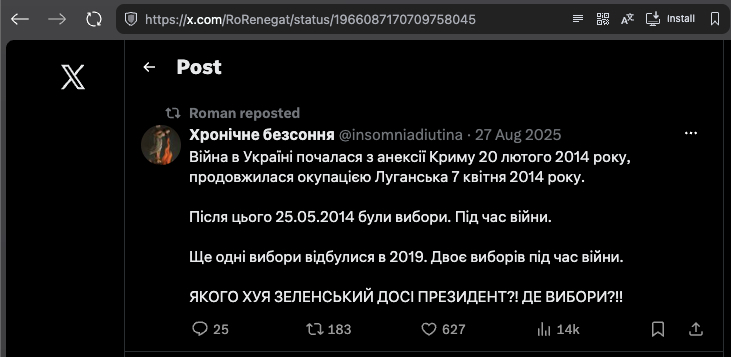
An example of a shared X post arguing that it is time for elections in Ukraine because elections have already been held since Russia’s aggression began in 2014. Screenshot: X
Second, elections as a cure-all that will “make things better”. A post shared 131 times justified immediate elections as follows: “I am for a presidential election in Ukraine as soon as possible. Or for postponing elections if Zelensky resigns immediately and a government of national salvation is formed. Because with Zelensky, nothing good awaits us under any scenario.” In this and similar cases, a change of head of state is presented as a turning point after which things will supposedly improve “on their own”.
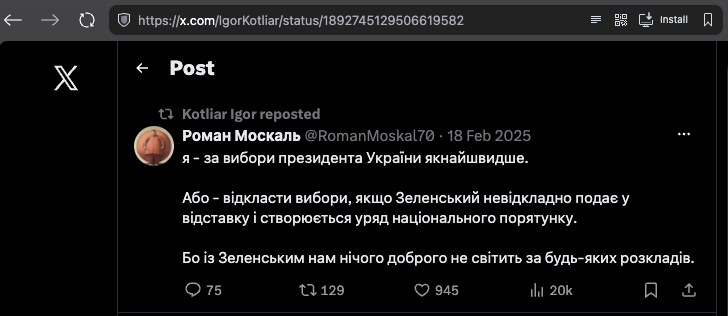
An example of a shared X post claiming that nothing will improve in Ukraine without Volodymyr Zelensky’s resignation. First published on 18 February 2025. Screenshot: X
Third, appeals to the Constitution, where alleged violations of the Constitution and laws are used to justify departing from the law in order to hold elections. For instance, a tweet from 18 August 2026 was shared 142 times: “Passing a law on multiple citizenship, even though the Constitution directly prohibits it, is allowed. But holding a presidential election, as the Constitution requires after five years, is not.”
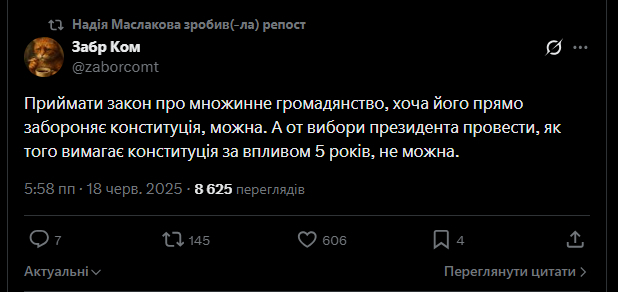
An example of a manipulative post comparing legislation on multiple citizenship with elections. Screenshot: X
Article 4 of the Constitution states that “there is a single citizenship in Ukraine”. On 18 August 2026, MPs adopted in second reading presidential bill No. 11469, which allows Ukrainian citizens to hold passports of other countries. Its main rationale was care for Ukrainians who had acquired foreign citizenship abroad: “In your relations with Ukraine you will always remain citizens of Ukraine. And we are waiting for you after this terrible war ends,” Speaker Ruslan Stefanchuk said. In fact, some Ukrainians have held other citizenships ever since 1991, and the state treated them as Ukrainian citizens. The law acknowledged this reality and obliged the government to define the conditions for holding another citizenship, such as birth abroad or marriage to a foreign national.
Another post, shared 102 times on X, read: “A reminder that the Constitution of Ukraine sets clear deadlines for presidential elections. There is also no constitutional basis for not holding them. So Zelensky is an impostor and a usurper.”
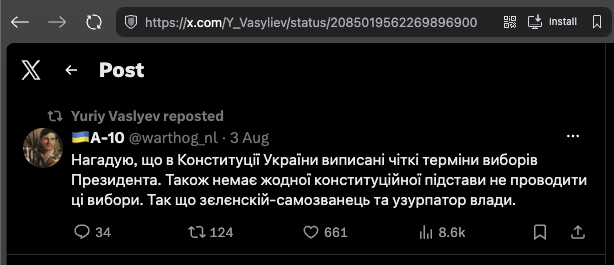
An example of a shared X post spreading the “Zelensky the usurper” narrative. Screenshot: X
Under Article 83 of the Constitution, if the term of office of the Verkhovna Rada expires during martial law or a state of emergency, “its powers shall be extended until the day of the first meeting of the first session of the Verkhovna Rada of Ukraine elected after martial law or the state of emergency is lifted”. Restrictions on holding elections under martial law, including the presidential election, are set by Article 19 of the Law “On the Legal Regime of Martial Law”.
Finally, accusations against Volodymyr Zelensky and his circle were the main line of pro-election argument in manipulative posts. They were usually triggered by his statements or decisions — often his answers to journalists about international developments, such as Donald Trump’s “peace initiative”, and the need for a presidential election. On 15 February 2025, X users shared 138 times the message: “It actually suggested we change our citizenship!!! Maybe we should change the president instead?” That same day, answering a question about elections previously raised by Donald Trump, Zelensky said that Ukrainians “absolutely do not want elections” because they understand the need for the state’s survival. “And if someone doesn’t like it, they can choose another citizenship. If they want,” he added. It was this phrase that triggered a wave of tweets criticising Zelensky and calling for elections.
Arguments against elections in the most widely shared posts
Among posts shared verbatim or retweeted 100 or more times, arguments for why elections should not be held fall into several types.
Elections during hostilities will lead to fraud. On 21 April 2025 — the anniversary of the 2019 presidential run-off in which Zelensky defeated Petro Poroshenko — X users shared 300 times the message: “Zelensky will get 102% if elections are held under martial law. Because they will put TCC officers at every polling station — those who do not support the current authorities will be mobilised immediately.” This was a quote from Dmytro Razumkov, the first Speaker of the current (9th) Verkhovna Rada, who entered parliament at the top of the electoral list of the pro-presidential Servant of the People party.
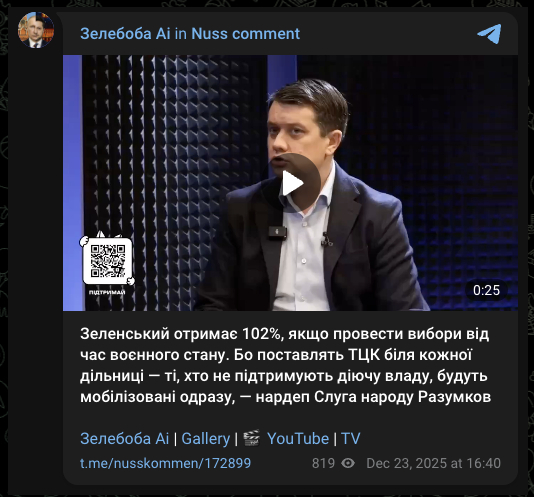
An example of Dmytro Razumkov’s quote being shared on Telegram on 23 December 2025. Screenshot: Telegram
Such messages combine two manipulative themes at once: the arbitrariness of the authorities, and mobilisation into the Defence Forces of Ukraine as a “punishment” for citizens.
Elections “serve external forces and enemies” and spell trouble for Ukraine. A message shared 158 times from 9 December 2025 read: “The US is forcing Zelensky to hold elections during the war… Whatever we think of Zelensky, electing a government during a war only leads to final defeat. This is a historical axiom.” Another message, shared verbatim 134 times on X and twice on Telegram from 18 February 2025 onwards, stated: “Moscow and Washington see holding elections in Ukraine as one of the key conditions for a successful settlement of the war… Ukraine will hold elections when its legislation allows it. Let the occupiers and looters agree on whatever they want.”
Conclusions
On social media, the topic of wartime elections serves primarily as a tool to question the legitimacy of the authorities, rather than as a substantive debate about whether voting is technically possible during the war. The legal framework is unambiguous: Article 19 of the Law “On the Legal Regime of Martial Law” explicitly prohibits presidential, parliamentary and local elections and referendums under martial law, and changes to electoral legislation during hostilities are subject to additional procedural safeguards. Any public demand for “immediate elections” therefore appeals not to a legal gap or ambiguity, but to deliberately bypassing built-in restrictions. This gap between legal certainty and rhetorical insistence makes the topic vulnerable to manipulation from both camps: those demanding an immediate vote, and those using the debate itself to accuse the authorities of usurpation.
In terms of volume, elections remain a background topic, with only 23% of posts stating a clear position. Platforms differ significantly: Telegram is the most engaged, while X stands apart as the only platform where support for wartime elections exceeds support for post-war elections.
Spikes in the debate were tied mainly to foreign policy events in early 2025, and in 2026 increasingly to domestic politics as well. Trump’s inauguration and remarks about a possible vote, the constitutional dates of parliamentary and local elections, the “peace initiative” and the restored voter register all triggered short-term rises in pro-election posts. The strongest spike, in August 2026, followed a single statement by Mykhailo Fedorov. The online election narrative thus responds less to changes in legal or security conditions than to news hooks.
Arguments for and against wartime elections mirror each other. Supporters appeal to democratic values, renewal of government, state effectiveness and the precedent of elections held after 2014. Opponents point to mobilisation pressure through TCCs, fraud, restricted voting rights for service members, IDPs and refugees, and the benefit to the Kremlin.
The debate is almost entirely focused on the figure of the president, while local elections barely register.
The study also finds signs of artificial amplification. Over two-thirds of the dataset consists of verbatim repeats (retweets, reposts, copied messages, particularly on X and Threads), and some of the posts shared more than 100 times contained manipulation — accusations that political opponents, Ukraine’s partners or the authorities have hidden interests in the timing of elections. Part of the wave of public debate about elections is therefore generated by a limited number of templated messages, possibly spread by bot farms affiliated with particular political forces. Copying, retweeting and re-sharing identical posts makes it harder to separate organic public opinion from the coordinated promotion of specific narratives.
Ultimately, in Ukraine’s martial-law context, elections function on social media as an instrument of political delegitimisation, activated in response to external triggers — statements by foreign leaders, Ukrainian politicians or news events. It is used equally by those seeking a return to democratic procedures and by those who exploit the very question to attack the legitimacy of the authorities.