

Українською читайте тут.
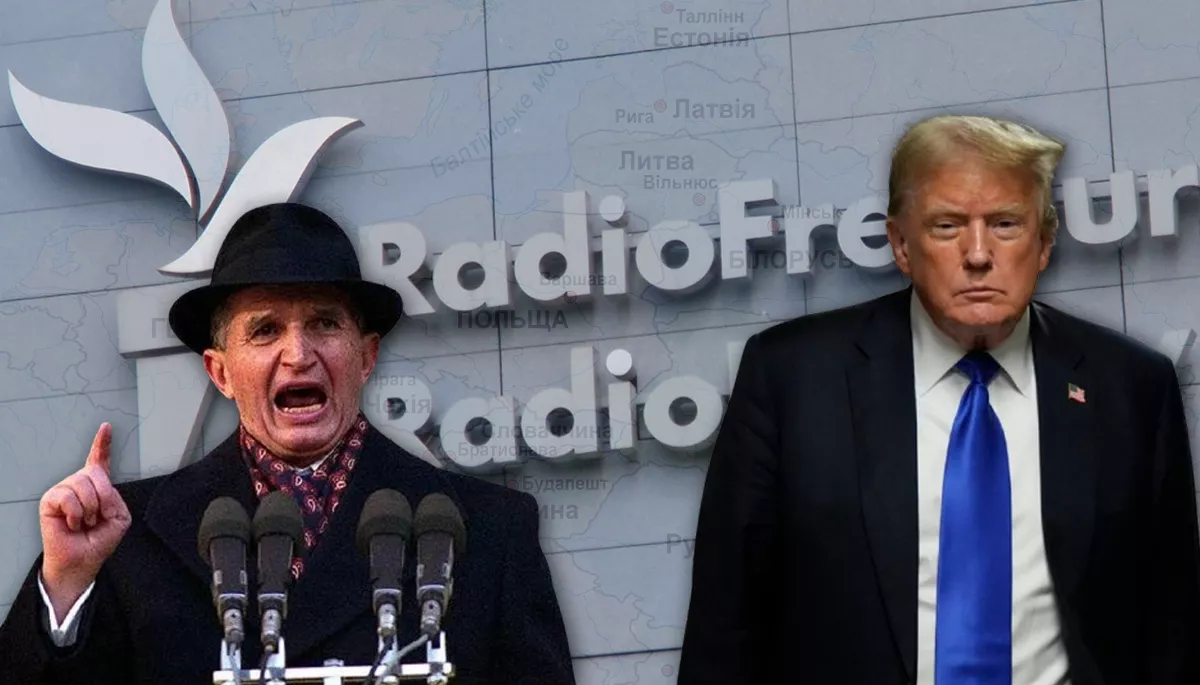
Why the American system of checks and balances failed to stop the dismantling of broadcasters, and why Radio Free Europe/Radio Liberty holds historical significance, particularly in Romania, Bulgaria, and Hungary.
As of April 2026, Radio Free Europe/Radio Liberty (RFE/RL) is facing a crisis. The last day of March became the final broadcasting day for the Romanian (Europa Liberă România) and Bulgarian (Svobodna Evropa) services. Earlier, at the end of last year, the Hungarian service Szabad Europa was officially shut down as well; it had regularly produced investigative reports and criticized the policies of Viktor Orbán’s government. The decision to scale back RFE/RL broadcasting has repeatedly been linked to political arrangements. Journalists from the French publication Le Monde have written about this connection. RFE/RL President Stephen Capus has not publicly cited political reasons, limiting his explanations to budgetary challenges.
Once Again “Project 2025”
As in other aspects of Trump’s policy agenda, the document of the conservative think tank The Heritage Foundation — Project 2025 — has become a guiding roadmap for the U.S. president in radically reshaping the system of American international broadcasting. In this document of more than 900 pages, a separate section is devoted to the U.S. Agency for Global Media (USAGM).
Its author is Michael Pack, who headed the U.S. Agency for Global Media at the end of Trump’s first term in 2020. At that time, his attempts to reform USAGM triggered fierce resistance from journalists and were blocked by the courts. In Project 2025, Pack appears to have corrected those earlier mistakes: he outlines in detail how the old system could be dismantled without the possibility of restoration.
The document’s central argument is that broadcasters funded by the U.S. government have allegedly lost their original mission, turned into platforms for “liberal propaganda,” and frequently criticize the United States itself—therefore no longer serving national interests. In particular, the Project explicitly called for removing the legislative barrier that guaranteed journalists independence from directives issued by the State Department and the White House. It also proposed turning Voice of America and Radio Free Europe/Radio Liberty into instruments for directly promoting the president’s foreign policy.
Because Radio Free Europe/Radio Liberty (RFE/RL) is formally an independent non-profit organization operating on grants from USAGM, the president cannot directly dismiss its leadership. Therefore, Michael Pack recommended in the document that grants to these organizations be completely eliminated and their legal status reconsidered. The document also called for large-scale staff reductions, revoking J-1 work visas for foreign employees, and conducting strict security audits of all journalists working for these broadcasters.
The closure of the Hungarian service Szabad Europa is perhaps the clearest example of implementing this section of Project 2025. The Heritage Foundation maintains connections with Viktor Orbán’s government, and the foundation’s president, Kevin Roberts, has repeatedly described Hungary as a model for the United States. Accordingly, the existence of a media outlet funded by American taxpayers that publishes anti-corruption investigations targeting Orbán’s government directly contradicted the White House’s ideological alliances.
The document states that the Hungarian service of RFE/RL “goes beyond the activities envisioned in RFE/RL’s charter, as it targets a democratically elected, pro-American European NATO ally.” The closure of this editorial office, therefore, became not only a matter of cost savings but also a symbolic political gesture aligned with the broader philosophy of Project 2025—supporting conservative U.S. allies abroad.
How Radio Free Europe/Radio Liberty Was Dismantled
The Trump administration used mechanisms of Executive Orders and newly created government structures to rapidly dismantle the broadcaster’s funding system in order to implement the provisions of the “Project.”
In particular, on the first day of his second presidential term, Trump signed the executive order “Reevaluating and Realigning United States Foreign Aid,” which required the termination of any assistance or funding for programs that “do not fully align with the foreign policy of the President.” This document created a formal basis for reviewing the budgets of all agencies that supported democracies abroad through “soft power.” This included the U.S. Agency for Global Media (USAGM), since international broadcasting was also classified as part of U.S. foreign assistance.
However, the executive order issued on March 14, 2025, “Continuing the Reduction of the Federal Bureaucracy,” became the document that directly triggered the collapse of RFE/RL.
This order officially classified the U.S. Agency for Global Media (USAGM) as an “unnecessary element of the federal bureaucracy” and required the termination of funding for all media organizations under the agency’s umbrella (Voice of America, Radio Free Europe/Radio Liberty, Radio Free Asia, and Middle East Broadcasting Networks) “to the fullest extent permitted by law.” Implementation of the order was assigned to the newly created Department of Government Efficiency (DOGE), which at the time was headed by Elon Musk.
To carry out Trump’s order, DOGE resorted to radical measures immediately after it was signed. The accounts of Radio Free Europe/Radio Liberty, Radio Free Asia, and the Middle East broadcasting networks were instantly frozen for 30 days for an “audit and restructuring.” Meanwhile, 1,300 employees of Voice of America were immediately placed on forced unpaid leave.
Because Radio Free Europe/Radio Liberty is formally a private nonprofit corporation funded through grants from the U.S. government, the new USAGM leadership—loyal to the president—simply refused to sign or renew existing grant agreements.
Attempts at Resistance
These actions by the administration triggered lawsuits from human rights organizations, journalists’ unions, and the governing boards of the affected media outlets themselves (for example, lawsuits filed by the Open Technology Fund and representatives of RFE/RL). In particular, on March 18, 2025, RFE/RL filed a lawsuit against the U.S. Agency for Global Media (USAGM) and its newly appointed managers at the time, Kari Lake and Victor Morales, in the U.S. District Court for the District of Columbia.
On March 25 of the same year, Judge Royce Lamberth ruled in favor of Radio Free Europe/Radio Liberty, instructing the USAGM leadership to “take all necessary steps to return USAGM employees and contractors to the status they held before the executive order of March 14, 2025.”
The plaintiffs based their case on three key legal arguments. First, the U.S. International Broadcasting Act guarantees the editorial independence of broadcasters and establishes a so-called “firewall” between the government and journalists — precisely the barrier that Project 2025 sought to dismantle. The administration’s actions were therefore viewed as a direct violation of this independence.
In addition, the Administrative Procedure Act (APA) provides grounds to interpret the decision to terminate funding and freeze accounts as “arbitrary and capricious," taken without proper justification and without following required procedures—namely, approval through the U.S. Congress. Moreover, the case also involved a potential violation of the First Amendment to the United States Constitution, which protects freedom of speech and prohibits political censorship by the government.
Judges across the country issued several orders declaring the administration’s immediate freezing of funds unlawful, since the money had already been appropriated by the U.S. Congress before the executive orders were signed. Accordingly, they required the government to restore funding tranches for RFE/RL. Through the courts, direct interference in personnel policy (such as the dismissal of editors-in-chief) was also temporarily blocked, relying on the same legislative “firewall.” The legal strategy relied on a feature of the American judicial system whereby a ruling by a federal district judge can block the implementation of a presidential decision nationwide.
Despite these early legal victories, the Trump administration and its lawyers adopted a strategy of delay. The government appealed every temporary injunction to conservative appellate courts, creating prolonged legal disputes. Yet at times the lofty principles of judicial practice were brought down to earth by bureaucratic realities: when courts ordered funds to be unblocked, the federal bureaucracy, led by loyal appointees, found administrative loopholes—delaying security clearances, refusing to issue work visas to foreign journalists, and demanding additional audits for every dollar spent.
The most significant blow came when the White House simply removed funding for RFE/RL from the president’s proposed budget for the 2026 fiscal year, although on February 3, 2026, Trump ultimately signed a document that still included funding for USAGM.
The U.S. judicial system was able to protect these media institutions from their immediate and openly unlawful destruction in March 2025, citing procedural violations. However, the courts proved powerless against the Trump administration’s long-term strategy: the complete refusal to sign new grant agreements and the use of executive authority (through DOGE and loyal officials) to create a bureaucratic collapse. This ultimately led to the closure of several editorial offices, including the Romanian bureau of Radio Free Europe/Radio Liberty.
To understand what exactly is being lost along with these editorial teams — and why this is not merely a question of a budget line — it is worth looking at how these offices have operated since their creation.

RFE/RL staff sorting listener mail at the headquarters (Munich)
The Dictator’s Radio of Nightmares
Radio Free Europe/Radio Liberty (RFE/RL) provided a steady flow of independent information about events in Romania during the communist era. Even after the fall of the dictatorship, it remained a “voice of democracy.” According to Professor Vladimir Tismăneanu, former chairman of the Presidential Commission for the Analysis of the Communist Dictatorship in Romania, the Romanian service of RFE “opened [Romanians’] eyes.”
The station reported on aspects of the regime that were deliberately concealed by the communist press: corruption among the party elite, repression by the Securitate (the secret police and intelligence service), and the failures of the regime’s economic policies. In addition, RFE regularly broadcast speeches by dissidents and critical reporting by journalists. During the December 1989 revolution, RFE effectively became a source of alternative information and hope for change, countering the official narrative.
Moreover, research conducted at Lund University confirmed that RFE’s broadcasts were aimed at undermining the communist regime: its programs emphasized the brutality of the dictatorship, encouraged listeners to resist, and presented opposition discourses in the news.

Protests in Romania
In November 1989, demonstrations were organized in many Romanian cities (for example, in Timișoara), partly thanks to the fact that RFE spread information about the protests. One illustration of Radio Free Europe’s influence is the story of Ion Mihai Pacepa, a Securitate general and deputy head of Romania’s foreign intelligence service, as well as an adviser to dictator Nicolae Ceaușescu on industrial and technological development, who defected to the United States.
His memoir “Red Horizons” was published in 1987 after he escaped to the U.S. and described the Ceaușescu regime from the inside. Radio Free Europe systematically broadcast excerpts from the book in Romanian, which contributed to growing political tension in the country. Later, some of the accusations during Ceaușescu’s trial were taken almost word-for-word from Red Horizons. Former Romanian president Traian Băsescu later called Radio Europa Liberă “the moral conscience of Romanians” for the role the broadcaster played in dismantling communism.

Nicolae Ceaușescu
Dictator Nicolae Ceaușescu considered Radio Free Europe his “worst nightmare” and repeatedly attempted to destroy it. During the 1970s and 1980s, the Securitate carried out a series of special operations under the codename “Operation Ether” (Operațiunea “Ether”). As part of this campaign, arson attacks, bombings, and assaults on RFE/RL staff were organized.
One of the most notable incidents occurred on February 21, 1981, in Munich, when a bomb exploded in the RFE/RL building, injuring several people. It later became known that the attack had been carried out by the group of the terrorist Carlos “the Jackal," acting on orders from the Romanian Securitate. According to the plan, the explosion was intended to hit the Romanian editorial office but instead struck the Czech service of the station.
In addition to the Munich attack, Securitate operatives carried out assaults and sabotage operations in several Western European countries. Inside Romania, RFE broadcasters themselves were harassed, threatened with death, and targeted in assassination attempts. The communist regime branded Radio Free Europe presenters as agents and traitors, while state media launched smear campaigns against them.
At the time, the Securitate failed to silence the station. Yet what it could not accomplish through violence was seemingly achieved decades later through a budgetary decree signed thousands of kilometers from Bucharest and many years after the end of the communist era.
Bulgaria: Revolution on the RFE Frequency
The Bulgarian service of RFE (Svobodna Evropa) operated from 1950 and effectively continued until 1993 (with interruptions). During 1989–1990, Svobodna Evropa informed Bulgarians about events and public sentiment in neighboring countries. In particular, protest moods in Bulgaria intensified during this period after the bloody events in Romania in 1989, which RFE covered extensively.
RFE helped create an alternative informational reality for the Bulgarian public. It broadcast news about democratic transformations not only in Romania but also in Poland and Hungary, and even discussed the ideas of perestroika that were beginning to emerge in the Soviet Union at the time.
Independent RFE journalists invited opposition representatives, dissidents, members of opposition movements, and experienced activists and opinion leaders to their studios. As a result, RFE’s broadcasts in Bulgaria expanded public dialogue: listeners gained access to information that was absent from the official press.

Protests in Bulgaria
Among the programs were reports on protest actions and the activities of opposition movements, which RFE broadcast live. Journalists from the Bulgarian service covered the key events of October 1989: miners’ strikes, demonstrations in Sofia, and appeals by opposition figures to the authorities.
The communist authorities in Bulgaria attempted to jam the broadcasts. However, unlike in Romania, there were no major terrorist attacks or assassination attempts against RFE employees in Bulgaria.
Hungary: From Communism to Orbánism
The Hungarian service of Radio Free Europe (Szabad Európa Rádió, SZER) operated from 1950 to 1993, broadcasting from Munich. The communist government tried to counter its transmissions, particularly through censorship, although by 1989 the situation had gradually softened. During the first years of the democratic transition, RFE provided listeners with independent news on issues the authorities sought to conceal.
RFE aimed to disseminate information suppressed by Soviet censorship. In the autumn of 1989, Radio Free Europe programs covered in detail the negotiations between the government and the opposition, the proclamation of a parliamentary republic, and preparations for a nationwide referendum. In March 1989, the Hungarian government announced that “employees of SZER may work in the country without any restrictions.”
RFE also reported on the events of 1956 (the suppression of the Hungarian Revolution by the Soviet army), party realignments, and the expansion of civil rights. After the fall of communism, Hungary’s president acknowledged that independent media such as RFE had played a role in the establishment of democracy.
Moreover, in 1991, then–leader of the Fidesz parliamentary faction Viktor Orbán wrote a letter to members of the U.S. Congress thanking RFE/RL for the “significant service to the Hungarian people during the peaceful change of regime.” The same Orbán whose government, in November 2025, succeeded in pushing for the closure of the Hungarian editorial office of the broadcaster.
In 1989, topics covered by RFE broadcasts included such key national events as the commemoration of the 1956 revolution, the role of dissidents, and discussions about the legitimacy of the ruling party. The Hungarian service organized interviews with Hungarian dissidents such as Krzysztof Michel and András Sallai-Németh, who called for reforms.
Until 1989, the communist regime labeled Radio Free Europe journalists as CIA agents and deliberately jammed its broadcasts. Although no specific cases of violence against RFE journalists were recorded in Hungary, Soviet technology was used to interfere with the station’s signal. Nevertheless, audiences across Eastern Europe found ways to stay tuned to Radio Free Europe.
A Threat from Within
The irony surrounding the closure of RFE/RL lies not in the victory of authoritarian logic, but in the fact that it has been employed by leaders who once guaranteed the protection of democracy. Ceaușescu resorted to open terror, whereas the Trump administration has attempted to act within the framework of the legal system, undermining independent media through bureaucratic procedures.
As a result, the very protective mechanisms that institutions like RFE/RL defended for decades proved ineffective when the threat came from within.