



Українською читайте тут.
In 2026, Russia’s overseas campaign has firmly cemented its role as a mechanism of influence and propaganda logistics.
Ahead of May 9, 2026, Moscow officially received “permission” to hold its Victory Day parade within the coordinates of Red Square designated by a decree from Ukrainian President Volodymyr Zelenskyy. Although the Kremlin dismissed the move as “clownery,” it ultimately adhered to Kyiv’s recommendations and confined all the Pobedobesie (“victory mania”) festivities to the boundaries of the specified square. Meanwhile, the “Immortal Regiment” march in Russian cities was once again moved online during wartime. Yet while the Kremlin was hiding its “sacred event” on the internet, “Immortal Regiment” processions were marching through Vienna, Chișinău, Munich, Augsburg, and many other European cities—with the direct organizational involvement of Russian embassies.
How the Kremlin Exported “Victory Mania” Abroad
The “Immortal Regiment,” originally launched in 2012 by journalists from the Tomsk-based TV-2 channel as a private civic initiative, has since evolved into a coordinated Kremlin propaganda project. As Gennady Ovechko, head of the Russian Foreign Ministry’s Department for Work with Compatriots Abroad, stated ahead of May 9, his agency is responsible for ensuring that the “Regiment” takes place outside Russia. In 2026, Russia’s budget for foreign influence operations reached a record high—$1.85 billion, according to a Liga.net source within Russia’s Foreign Intelligence Service—an increase of 54% compared to 2025.
Within Russia itself, this year’s “Immortal Regiment” was once again moved online due to fears of drone attacks and “provocations.” This approach is far from unprecedented: the event was held virtually in 2020 and 2021 because of the pandemic and again in 2023 and 2024 amid concerns over potential retaliatory strikes from Ukraine. The street format was restored only in 2022, when the Kremlin needed visuals of mass participation against the backdrop of its full-scale invasion of Ukraine. In 2026, even motor rallies featuring Saint George ribbons were banned in occupied Crimea “following recommendations from law enforcement agencies.”
Against this backdrop, on May 8, President Zelenskyy signed a decree stating, "To permit the holding of a parade in Moscow (Russian Federation) on May 9, 2026. For the duration of the parade—from 10 a.m. Kyiv time—the territorial square of Red Square shall be excluded from the operational plan for the use of Ukrainian weaponry." Kremlin spokesperson Dmitry Peskov called the decree “clownery,” yet the parade was ultimately conducted within the coordinates and timeframe specified by Zelenskyy.
Abroad, however, no such decree existed—and the “Immortal Regiments” marched on in full propagandistic fervor. Below are some examples of events that closely resembled one another, regardless of their location.
The “Regiment” of Russian Proxies in Chișinău
In Moldova, the “Immortal Regiment” is not merely an outpost of Russian propaganda but a tool of direct domestic political pressure: the event is led by current and former pro-Russian party officials rather than simply “concerned citizens.”
As early as April 2022, shortly after the start of Russia’s full-scale invasion of Ukraine, Moldova’s parliament banned the Saint George ribbon as well as the Z and V symbols, classifying them as “attributes that promote acts of military aggression.” Violations are punishable by fines and mandatory community service.
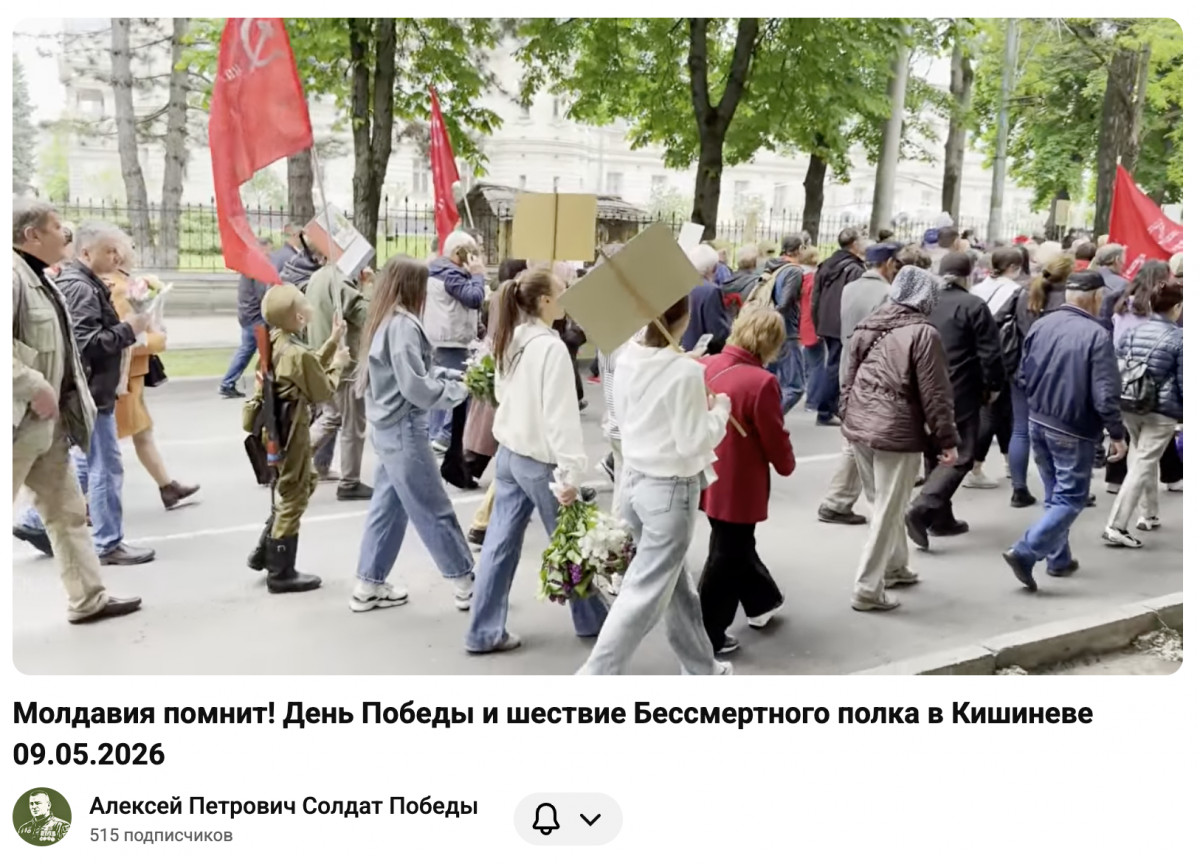
This year, the Party of Socialists of the Republic of Moldova and the Party of Communists of the Republic of Moldova, along with their affiliated groups, organized the so-called “Victory March” and “Immortal Regiment,” which proceeded through the city’s central streets to the Soviet memorial complex Eternity.
Among those attending the ceremony at the memorial were Russia’s ambassador to Moldova, Oleg Ozerov, and former president and Communist Party leader Vladimir Voronin. Also participating in the march was Socialist leader and former president Igor Dodon, who had publicly stated beforehand that he would wear the Saint George ribbon despite the explicit ban.
Video footage from the procession indeed shows some participants wearing Saint George ribbons, even though displaying them in public carries penalties ranging from 4,500 to 9,000 Moldovan lei (approximately UAH 11,400 to 23,000), or up to 60 hours of community service.
The 2026 event was notably large: according to the organizers, around 30,000 people took part in the march. For the third consecutive year, the event took place without the participation of Moldova’s central authorities. Instead, President Maia Sandu and the government marked Europe Day on May 9, although formal commemorative ceremonies by state officials were also held separately.
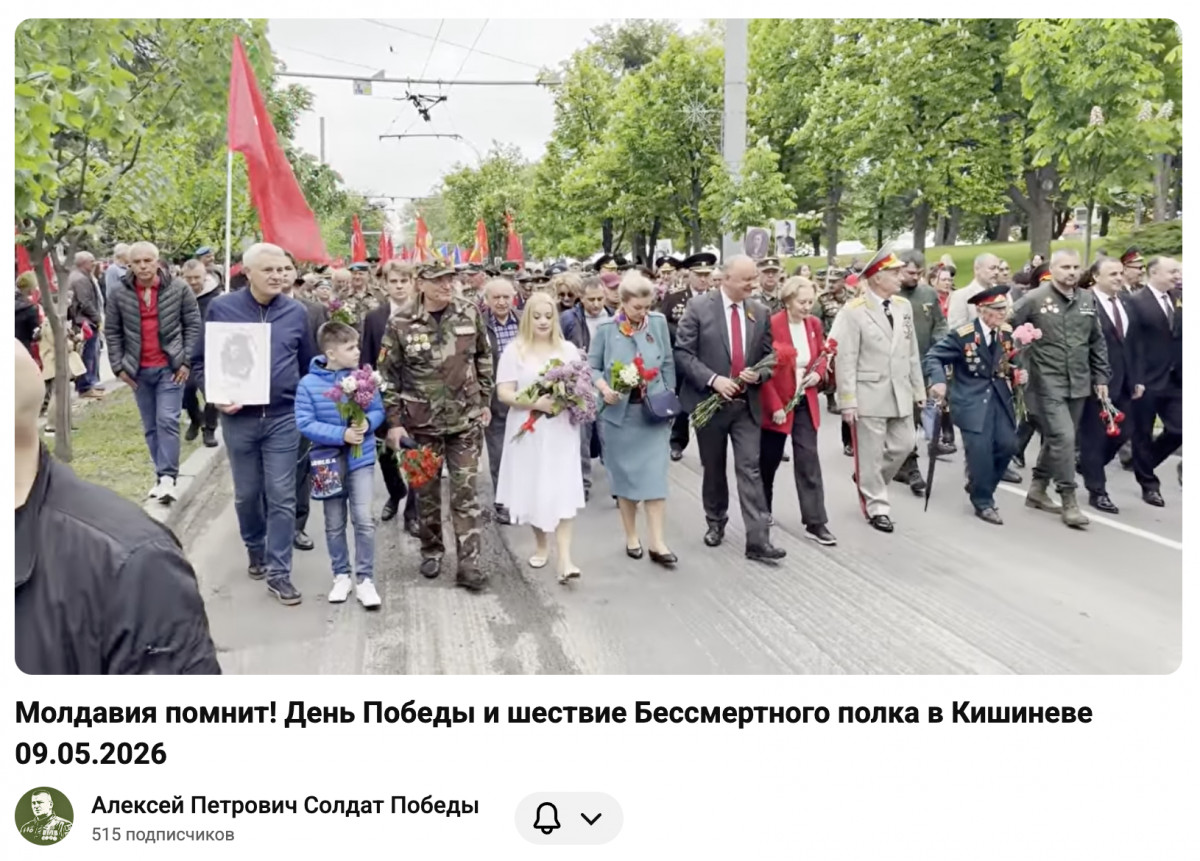
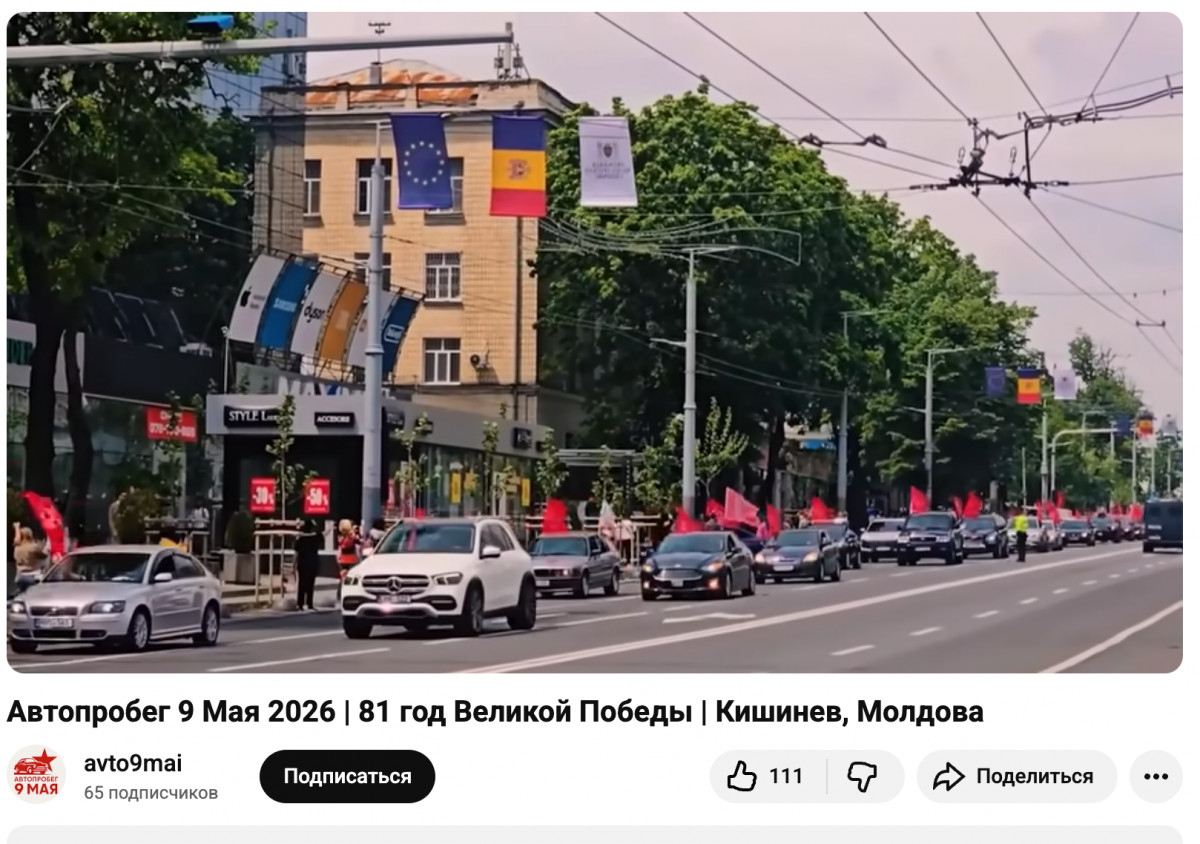
The presence of Russia’s ambassador to Moldova, Oleg Ozerov, who laid flowers at the Eternal Flame, turned the commemorative event into a full-fledged diplomatic demonstration. Standing alongside him was Moldovan Communist leader and former president Vladimir Voronin, for whom participation in the “Immortal Regiment” alongside the Russian embassy has become an annual ritual. At the same time, a vintage car rally carrying the “Victory Banner” and other Soviet symbols drove through the city despite the risk of fines and legal penalties.
Israel: Between Memory and Propaganda
It is worth recalling that in 2017, Israel—at the initiative of lawmakers from the Yisrael Beiteinu party, which draws much of its support from immigrants from the former Soviet Union—officially approved the celebration of Victory Day and the end of World War II on May 9, unlike most European countries.
To this day, the official website of the Knesset illustrates its publication on “Victory in Europe Day” with a photograph of elderly men wearing Saint George ribbons and a Soviet medal bearing the crossed hammer-and-sickle emblem and the inscription “Otechestvennaya Voyna” (“Patriotic War”).
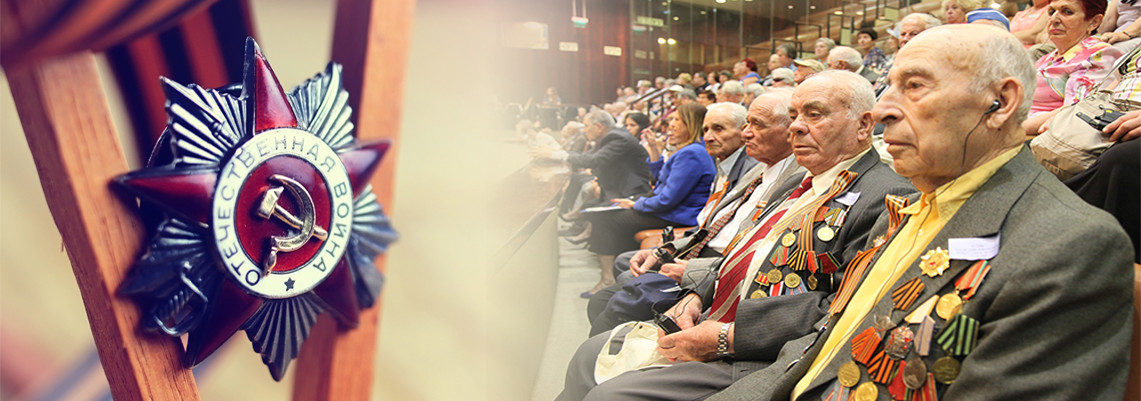
Illustration accompanying the article titled “Victory in Europe Day” on the Knesset website. Source.
In 2026, May 9 fell on a Saturday, coinciding with Shabbat. Despite this, informal “Immortal Regiment” events still took place in Haifa (on May 9), Netanya, and Bat Yam (on May 7). In cities with large Russian-speaking communities—including Ashdod, Arad, and Rishon LeZion—municipal authorities organized commemorative events for veterans on May 8, though without marches or processions.
Notably, Netanya is home to the Wings of Victory memorial, inaugurated in 2012 with the personal participation of Vladimir Putin.
In Haifa, participants marched wearing Saint George ribbons and carrying red Victory banners; many were dressed in Soviet military uniforms, including tunics and side caps. In Netanya, meanwhile, participants carried both Soviet and Russian flags.
These events were covered by Russian state media outlets, including RIA Novosti and RT. RT, however, illustrated its report with an AI-generated image that appeared more suited to the Tel Aviv waterfront, where no such march took place.
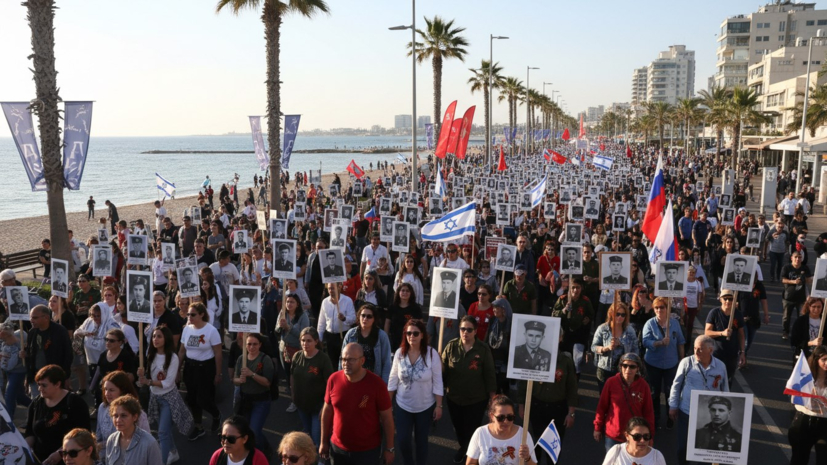
RT’s AI-generated illustration for its report on “Immortal Regiment” events in Israel.
According to Telegram channels cited by Russian state media, the events in Israel were organized by the international Immortal Regiment Israel and the Anti-Fascist Movement in Israel. The latter is supported by the so-called Russian House in Israel, part of Russia’s broader network for projecting influence abroad and funded through Russian government agencies, including Rossotrudnichestvo and others.
At the same time, the May 9 commemorations attracted relatively little attention from local media—a trend evident in the coverage by five of Israel’s most popular Russian-language news outlets: Vesty, NEWSru, Channel 9, Mignews, and Israelinfo.
On the website of Israel’s most influential Russian-language publication, Vesty.co.il (the Russian-language edition of the more widely read news portal Ynet), an unsigned opinion piece titled “Why Israel Celebrates Victory over Nazism on May 9, Not May 8” was published. The article states that the date is tied to a “Soviet propagandistic commemorative date,” and that for many Israelis the day remains “a holiday of ethnic Russians and Russian-speaking repatriates.”
The piece also notes that, following Russia’s attack on Ukraine in February 2022, Moscow’s Victory Day parades have increasingly come to be seen as a “legacy of Soviet militarism” and a “justification for aggression.” Notably, the publication avoids using the term “Great Patriotic War” without quotation marks.
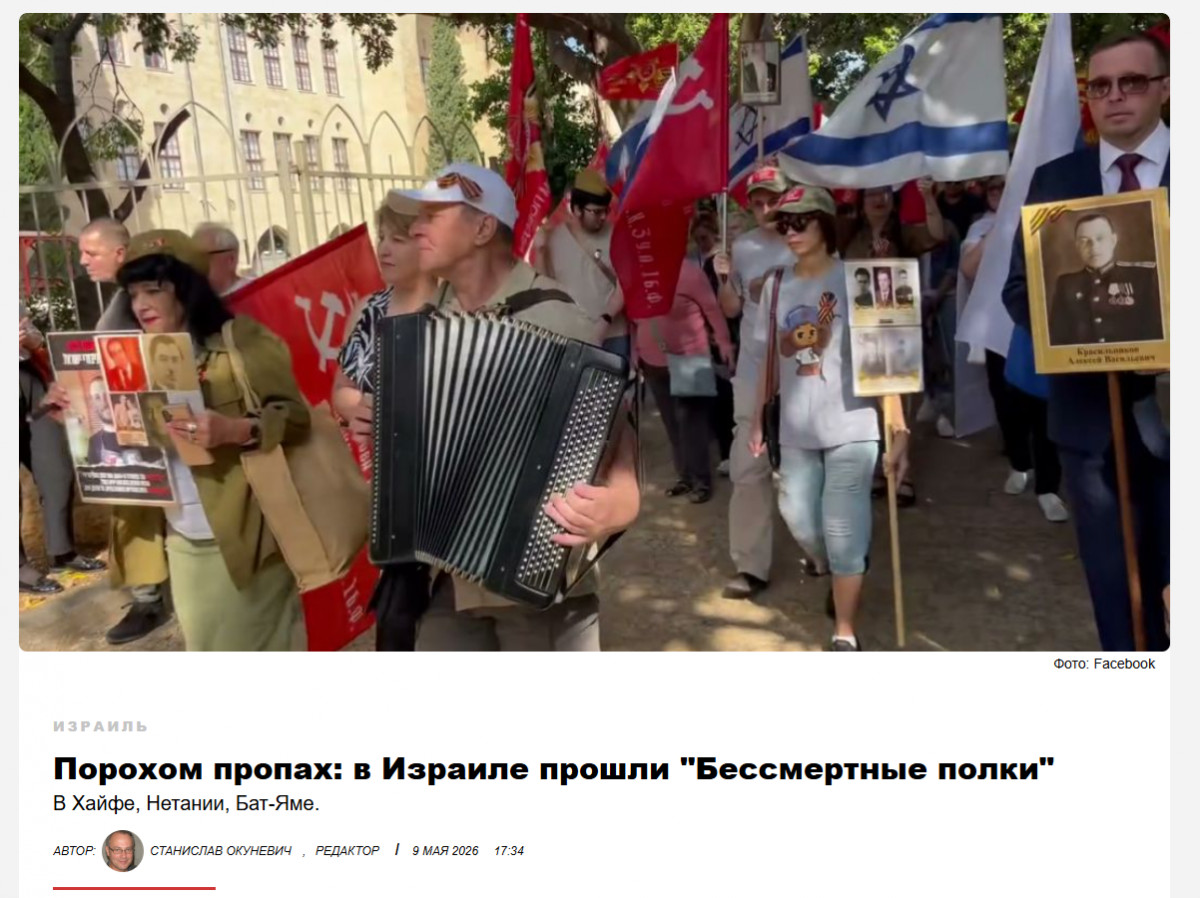
Israel’s only Russian-language television broadcaster, Channel 9, wrote on its website that the “Immortal Regiment” events were heavily “ideologically charged” due to geopolitical tensions in Europe, including the war in Ukraine. Its headline—“Smelling of Gunpowder: ‘Immortal Regiments’ Took Place in Israel”—already sets a distinct tone.
Significantly, the report relies on photos and videos from the social media accounts of the Russian embassy in Israel and the Russian House in Israel without providing any editorial assessment or commentary.
The outlet also reported that “pro-Russian military symbolism, including portraits of the President of Russia,” had been observed in Haifa. It cited an inquiry submitted by Haifa City Council member Kirill Karetnik to Mayor Yona Yahav, requesting that the municipality examine “the nature of the symbols, flags, and visual displays... including Saint George ribbons, Soviet symbols, and symbols now associated worldwide with Russian political propaganda following the war in Ukraine.”
The same report also recalled a 2025 incident in Haifa, when participants in the “Immortal Regiment” pushed a pro-Ukrainian activist into a fountain after he displayed a sign reading: “Do not dishonor our grandfathers—they did not bomb Kyiv.”
On Newsru.co.il, there was no coverage of the commemorative events in Israel in the news feed, and only a single report on the military parade in Moscow, which explicitly emphasized that the parade lasted just 45 minutes and, for the first time since 2007, took place without military hardware. There were no emotionally charged references to a “great Victory” or “denazification.”
As for Israelinfo, in 2025, the outlet used the critical term “Pobiedobesiye” (“victory mania”) when reporting on the attack during the Haifa event, with the headline explicitly stating, "'Victory Mania’ in Haifa: Pro-Ukrainian Activist Thrown into Fountain.” In 2026, however, the website did not cover any May 9 events in Israel.
Similarly, Mignews published no separate analytical or critical coverage in 2026, relying mostly on syndicated news briefs and aggregator content.
Quotes from participants’ speeches, photographs from the events in Netanya and Haifa, a statement by Russia’s Consul General in Haifa, Alexey Krasilnikov, praising the “courage, resilience, and unbreakable will of the peoples of the USSR,” as well as remarks by the leader of the Israeli Anti-Fascist Movement, Dmitry Trapirov, referring to “the part of the Soviet people that defeated fascism,” were all circulated by RIA Novosti and TASS. It was from these Russian state sources that the story spread across Russian-language social media channels in Israel.
At the diplomatic ceremony held in Jerusalem on May 8, which was covered by TASS, representatives gathered at the Candle of Memory monument. Alongside Russia’s ambassador to Israel, Anatoly Viktorov, the event was attended by ambassadors from Belarus, Bosnia and Herzegovina, Kazakhstan, China, and Serbia, as well as the head of the Russian Ecclesiastical Mission—a familiar “circle of Moscow’s friends.”
Berlin: Led by the Ambassador, Despite All Restrictions
On the eve of May 9, Russian media and officials complained that authorities in Berlin, Germany, had imposed a ban on the display of Soviet flags, Saint George ribbons, symbols associated with Russia’s occupation administrations in Ukrainian territories, and the “Z” symbol of Russian aggression. Russian Foreign Ministry spokesperson Maria Zakharova described the ban as a “disgrace” and “a path into the abyss” for Germany. Russia’s ambassador to Germany, Sergey Nechayev, expressed his “deep disappointment.”
Despite these restrictions, the “Immortal Regiment” march in Berlin went ahead on May 9 under police protection, accompanied by Soviet and Russian songs. According to the organizers, nearly 1,000 people participated—though the published photographs make that figure difficult to verify visually. Representatives of the Russian diplomatic mission, led by Ambassador Nechayev, also took part.
The event was organized in part through the Immortal Regiment in Berlin Facebook page, which has around 500 followers, and a Telegram channel of the same name with approximately 100 subscribers. Organizers warned participants in advance about the ban on prohibited symbols and urged them to refrain from displaying such imagery during the march.
Russian media also reported that “Immortal Regiment” events took place in other German cities, including Augsburg, Hamburg, Kiel, Munich, Frankfurt am Main, Homburg, Schloß Holte-Stukenbrock, and Stuttgart.
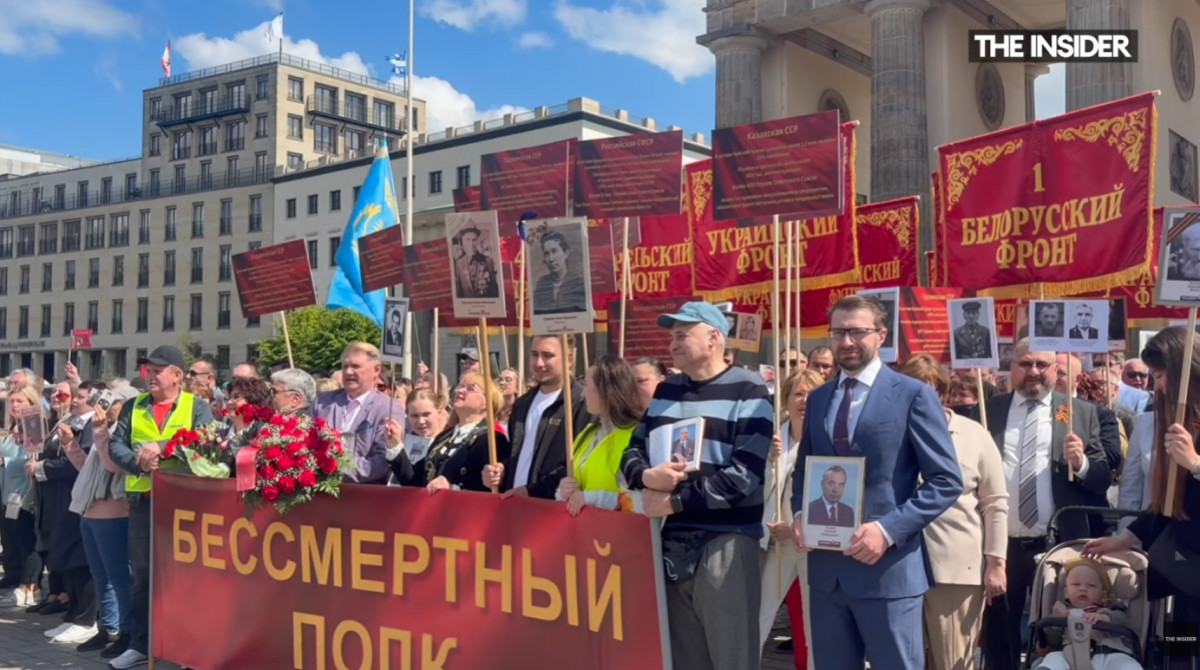
Screenshot from YouTube.
In addition to the “Immortal Regiment” march, Russian participants in Berlin also visited the Soviet memorial in Treptower Park, where they encountered a Ukrainian demonstration marked by yellow-and-blue balloons. German police detained several individuals carrying Russian flags, wearing Saint George ribbons, or dressed in T-shirts bearing Soviet symbols. At the memorial to the Soviet soldier in Treptower Park, representatives of Germany’s left-wing political parties organized an official flower-laying ceremony. Russian anti-war activists also held their own demonstrations there.
In Augsburg, Ukrainians joined the “Immortal Regiment” march carrying portraits of Stepan Bandera, Vasyl Maliuk, and Mykola Khvylovy under fictitious names. The organizers failed to notice the substitution and only discovered the “provocation” after the event had ended.
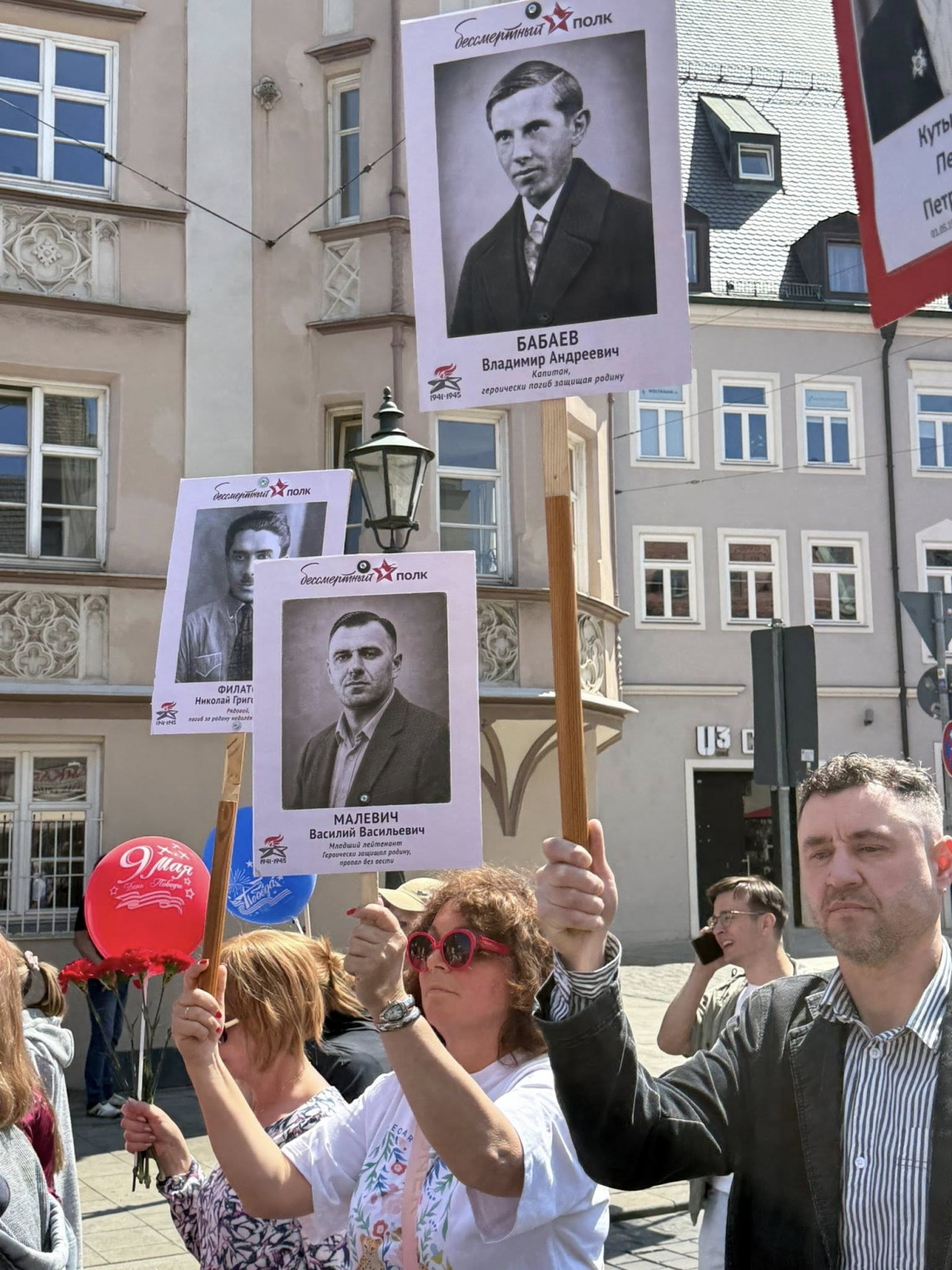
Screenshot from Facebook.
Madrid: The “Regiment” Has Been Marching Since 2016—Now with Volunteer Security
According to the Russian state propaganda agency TASS, responsibility for ensuring that the “Immortal Regiment” takes place abroad lies with the Russian Foreign Ministry’s Department for Work with Compatriots Abroad. On May 8, the head of that department, Gennady Ovechko, claimed that in several countries, “being a descendant of those who defeated fascism and identifying with the Russkiy Mir (‘Russian world’) often becomes problematic, and in some cases is even punishable by law. Attempts are being made to obstruct the holding of the ‘Immortal Regiment’ and related ceremonies.”
Spain, however, does not appear to be among the countries where identifying with the Russkiy Mir is considered problematic. The “Immortal Regiment” has been organized there annually since 2016, with events taking place in the capital, Madrid, as well as in Barcelona.
In addition to Spain’s police forces, security at these events is reportedly provided by unidentified “volunteers,” suggesting that the initiative may be developing its own quasi-security wing—an evolution that could warrant closer scrutiny in other countries where “Immortal Regiment” events are also held.
According to RIA Novosti, the 2026 march in Madrid was accompanied by recordings of Soviet announcer Yuri Levitan and concluded with a concert.
Mobilization for participation takes place largely through social media. On Facebook, the page Bessmertny Polk Ispanii / Regimiento Inmortal en España has around 4,600 followers. The event is also promoted in Spanish via the Telegram channel Regimiento Inmortal España (with around 920 subscribers), as well as through a Russian-language mirror channel, Bessmertny Polk Madrid, which has approximately 709 subscribers.
Russian propaganda outlet RIA Novosti identifies Victoria Samoilova as the organizer of this year’s event in Madrid. According to Russian media reports, she has been organizing the march since at least 2020, though she is rarely mentioned in other contexts.
A Facebook profile belonging to Victoria Samoilova describes her as being affiliated with an “Association for the Integral Development of Russia and Spain.” The association appears to have no public social media presence of its own. Over the past two years, Samoilova’s Facebook posts have focused exclusively on events within the Russian diaspora in Spain, her appearances in Russian media, and Russian propaganda narratives concerning Spanish politics.
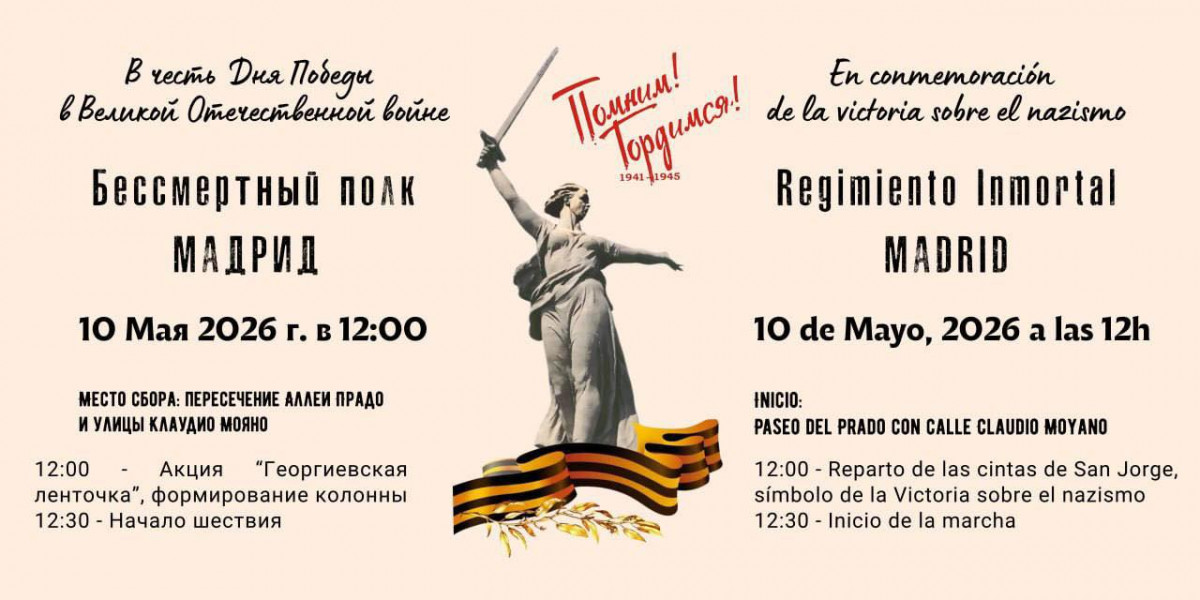
From the Facebook page of the organizer of the “Immortal Regiment” in Madrid.
Samoilova does not maintain an account on X. On Telegram, however, she has 617 subscribers, for whom she posts about victory in World War II and the weather in Madrid. The visual materials and messaging on her Telegram channel regarding the “Immortal Regiment” largely replicate content published on the official Madrid Immortal Regiment channels.
Less is known about the organizers of the “Immortal Regiment” in Barcelona. Yet the propagandistic impact of the 2026 march there may have been even greater. According to the official Immortal Regiment website, 350 people participated in the procession. Meanwhile, the propaganda outlet Iskra.Today and others reported that unidentified individuals had allegedly attempted to disrupt the start of the march.
Paris and Montpellier: After the Arrest, the Same Faces and the Same Methods
Last year, the “Immortal Regiment” event in the French city of Montpellier helped expose an entire network of Russian influence in France, including numerous individuals and affiliated legal entities. We previously wrote about this in detail. However, since 2025, little appears to have changed in either the composition or the “guest list” of these events—apart from the arrest of one of the most active participants, Anna Novikova, in connection with a case previously covered by Detector Media.
This year, “Immortal Regiment” marches were held in Paris, Lyon, Montpellier, and Béziers.
At the 2026 event in Montpellier, attendees included the pro-Russian local politician Philippe Saurel, who personally met with Vladimir Putin in 2019. According to comments posted beneath a Facebook video of Saurel’s speech, he attended the event on his own initiative.
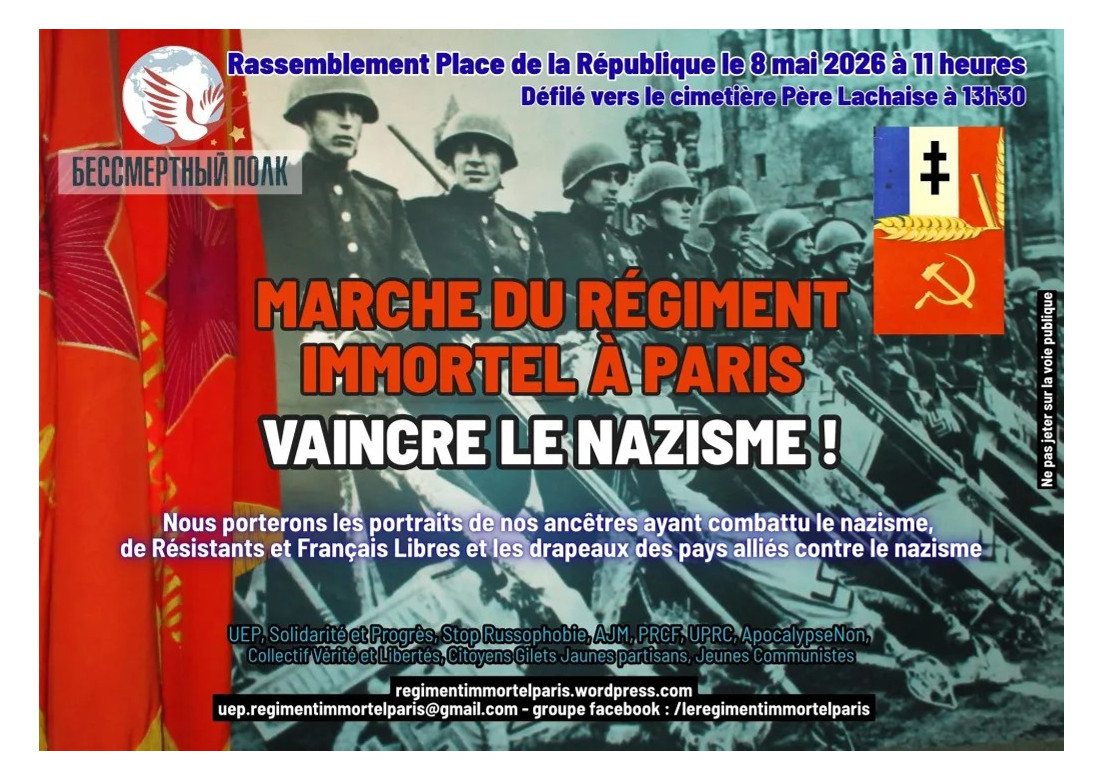
A leaflet announcing this year’s “Immortal Regiment” march in Paris, listing the organizers of the event. Source: the “Immortal Regiment” Facebook group
In interviews with Russian propagandists, the role of the main organizer is claimed by Dmitry de Kochko, who also appears in our investigation. However, it seems that he was responsible only for organizing the demonstration in Paris. In one such interview with TASS, he describes how the event nearly fell apart because the local prefecture of the French capital kept rescheduling it, attempting to move the “Regiment” to less visible locations and times. Meanwhile, in Montpellier, according to eyewitnesses, the process was coordinated by Jean Sayad, treasurer of the Coordinating Council of Russian Compatriots, known for his methods of intimidation and pressure against pro-Ukrainian activists. This year’s attempts to organize a counter-rally also faced strong resistance from Sayad, according to its organizer and author of several reports on the situation in France, Oleksandra Kovalyk.
According to her, the man first filed complaints with the prefecture and police, after which he resorted to intimidation by calling the activist on her personal phone number. At the same time, Jean spread false information on social media, claiming that the Ukrainian event was illegal, attempting to discredit the protesters after he received Oleksandra’s message about organizing the rally in one of the Ukrainian community chats in Montpellier. However, after additional explanations were provided to the prefecture, it ultimately authorized the official counter-demonstration. At the very beginning of the protest, before enough participants had gathered, unidentified individuals filmed Ukrainian activists and uploaded the video to Russia Today platforms, describing the people in the footage as “provocateurs with Ukrainian flags.”
Conclusions
In 2026, the “Immortal Regiment” definitively cemented its role as a tool of logistical influence and propaganda. While the Kremlin moved the campaign online within Russia itself, Russian embassies methodically coordinated marches in various European cities, openly demonstrating their involvement as a sign of presence and dominance rather than concealing it. At the same time, a clear pattern can be observed: where local legislation is weak, or enforcement of restrictions is inconsistent, Russian actions expand and even develop supporting infrastructure, whereas in countries with tougher legal responses, such as Germany, the “Regiment” does not disappear either but is forced to adapt. This demonstrates that an effective response to the Kremlin’s active measures requires consistent enforcement without any compromises.
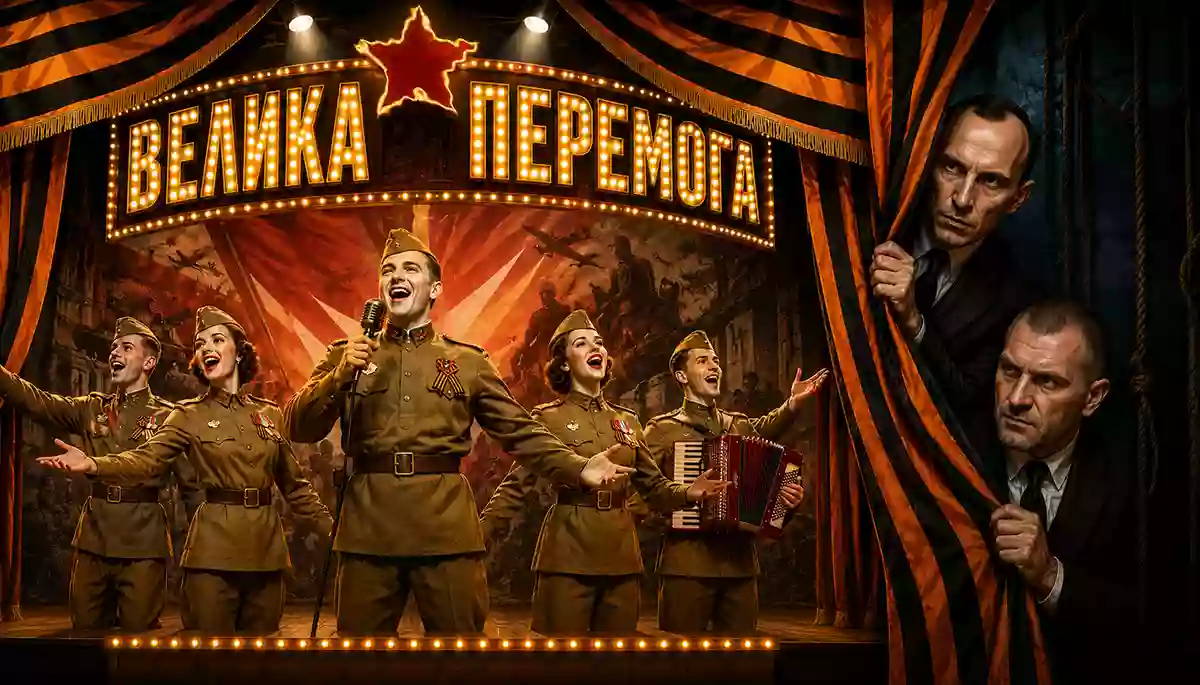
Illustration created with the help of ChatGPT.