Українською читайте тут.
Ukrainians are the largest minority group in Denmark, and Slovo.dk is read by up to 10 percent of all Ukrainian refugees in the country.
Olha Kravchenko, for DM
Due to the arrival of Ukrainians in Denmark since February 2022, a need emerged for an information resource for refugees. Micro-groups emerged on social media where more experienced Ukrainians, mostly members of the diaspora, shared information, practical advice, and answered questions. However, as the authors of Slovo note, this format did not allow content to be found through search engines. As a result, even after joining yet another micro-chat, refugees kept asking the same questions that administrators and volunteers had already answered many times before.
So a year ago, in November 2024, a small team of enthusiasts created and launched the Ukrainian-language Danish online outlet Slovo.dk, which gathers essential information for refugees and explains life in Denmark. Over the year, the outlet’s audience has been steadily growing. Some articles have reached 5,000 to 6,000 views, more than 10% of the number of newly arrived Ukrainians to Denmark, which currently stands at 45,300. But it was not always like this. As the Slovo team notes, building a project according to professional standards while lacking resources was not easy.
“We decided that there was no point in waiting for an initiative from elsewhere, and that we could find like-minded people with professional experience in content creation ourselves. So we started writing articles, compiling fact sheets and overviews, fact-checking news, and looking for information that would help newly arrived Ukrainians navigate a new country,” says journalist Anna Kudelia, one of the outlet’s co-founders.
The launch of the project was preceded by a search for local partners and research into the information needs of Ukrainians in Denmark.
“We saw that everyone was extremely confused in 2022, 2023, and 2024. People living in Denmark were focused on content about Ukraine and, in fact, had very little information about the place where they had ended up. That made it difficult to build new life strategies. Confusion and disorientation are the key characteristics of the refugee community’s state when it comes to their new place of residence,” notes Alla Shorina, researcher and founder of Slovo.dk.
At that time, media outlets for Ukrainians were operating in many countries, including Poland, the Czech Republic, Finland, and Sweden, but not in Denmark.
“I communicated with colleagues there and asked who had made those projects possible. In most cases, the mission was taken on by media holdings in countries that received large numbers of Ukrainian refugees. So in Denmark, I also wanted to find such a team or structure that could become a foundation, a local partner with infrastructure and media expertise. When this had not happened by September 2024, I decided that we should look not for Danes to start with, but for Ukrainians—like-minded people with the emotional and professional capacity to create momentum where there were no financial resources, metrics, plans, or KPIs yet. Having secured agreement for regular content contributions from the first authors (experts, journalists, bloggers), at the end of November 2024, we began publishing the first Ukrainian-language articles on the Slovo website,” Shorina recalls.
The technical development of the website was handled by specialists in Ukraine who work with Ukrainian media. Technical support is still provided by two team members based in Kyiv and Dnipro. At the project’s launch stage, when it was not yet clear whether the media outlet would actually take off, the diaspora organization Women For Ukraine offered its legal and accounting infrastructure for potential future operations, while guaranteeing Slovo’s autonomy.
The editorial team
Of the ten people who write for the outlet, eight are Ukrainian refugee women living in Denmark. There are also associated authors who prepare a series of texts on specific topics, as well as experts who contribute analytical materials to Slovo. New authors are now ready to support the media outlet, including Danes. Among them is Meik Wiking, author of bestselling books on Danish hygge, which have also been translated into Ukrainian. Instead of an honorarium, he asked his publisher to donate funds to charitable causes in Ukraine. Experts on integration processes also write for Slovo, including Kay Xander Mellish, author of books on Danish business culture.
Among the most popular topics for readers in 2025 were articles on laws and regulations, tax requirements, the meaning of holidays and traditions, education, opportunities for children, cultural events, social customs, and practical guides on how things work, such as the postal service, buying medicine, and the prescription system, etc.
“I joined the Slovo team in January 2025 and prepare a weekly news digest, selecting the most significant facts and providing hyperlinks so readers can access the original sources. Maintaining a weekly pace in a volunteer project is not easy, but even now, after becoming a mother, I continue to prepare the digests, feeling responsibility toward the readers,” says Anna Ivanenko, who worked in copywriting in Ukraine before 2022 and later in management in Denmark.
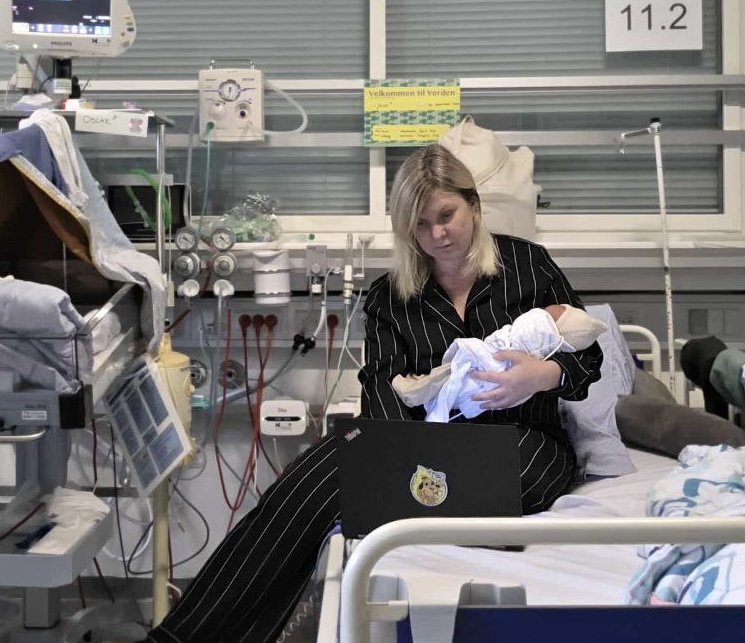
The author of Danish news digests prepared content even while in the maternity ward.
According to Ivanenko, even after a year of weekly monitoring, the content of Danish media often continues to surprise her. Slovo has stated that for most of its authors, creating content is also a process of researching a new country and a new culture. And the news provides extraordinary material for this. For example, in Danish media, according to Anna’s observations, criminal incidents and accidents are covered less intensively than in Ukraine, but there are consistently news stories that prompt Ukrainian readers to seek explanations. Examples include the news about schoolchildren going to the forest with their teacher to observe dead animals; a zoo in Aalborg inviting people to bring sick pets to feed zoo animals; or a state program to bring back paper textbooks to Danish schools.
“We discuss these stories within the team and see how emotionally readers react,” the news digest author comments. “At the same time, of course, both the audience and I feel the strongest pull toward Danish news related to Ukraine, for example, how local residents respond to plans for military production in Denmark.”
Culture and social approaches in Denmark differ from life in Ukraine, so every news story that resonates with the Slovo team and readers becomes an opportunity not only to learn about a fact but also to analyze its causes, underlying values, and to discuss it in the comments under Slovo’s social media posts.
Shaping a niche, conflicts, and partnerships
After Slovo appeared, other initiatives offering integration-focused content for Ukrainians in Denmark also began to emerge. These include Telegram channels, Instagram pages announcing Danish events, regular email newsletters, and so on.
As Alla Shorina notes, the information landscape today is significantly better. However, there are still sensitive thematic areas where much remains unfamiliar for Ukrainians and requires research and rethinking. These include gender communication, interaction with children, which sometimes involves dramatic situations, access to employment, typical social-emotional norms such as optimism and friendly workplace communication, and awareness of rights. Refugee status often diminishes a person’s sense of having rights and inviolable personal boundaries.
“After three years of activity in the Danish business environment, among the key features of the local ecosystem, alongside commitment and the global nature of missions, I would name predictability, detailed planning, and a high level of attention to budget calculations. But it was precisely in this area that we had routine misunderstandings in 2025,” Shorina notes.
For example, hosting fees in the first year amounted to 900 DKK (approximately UAH 5,400), but by September 2025, they had risen to 5,600 DKK (approximately UAH 32,000). After lengthy correspondence, it turned out that the initial price was a new-client rate, and switching to Ukrainian hosting was impossible due to certain GDPR requirements.
“These are details, but when you are building a project in a new country, there are a lot of them,” Shorina says.
At the same time, Slovo has been developing partnerships and relationships with Danish media interested both in the fact that Ukrainian refugees created the project without prior involvement of local resources and in engaging with the Ukrainian audience, now the largest minority group in Denmark. Slovo was supported by The Copenhagen Post, the country’s largest English-language publication. Niche media are also ready to join as content contributors. A permanent partnership exists with Københavns Kommune (the municipality of Copenhagen), which has received the largest number of Ukrainian refugees among Denmark’s 98 municipalities, and other municipalities are joining. In turn, some Ukrainian media outlets republish selected news about Denmark from Slovo.
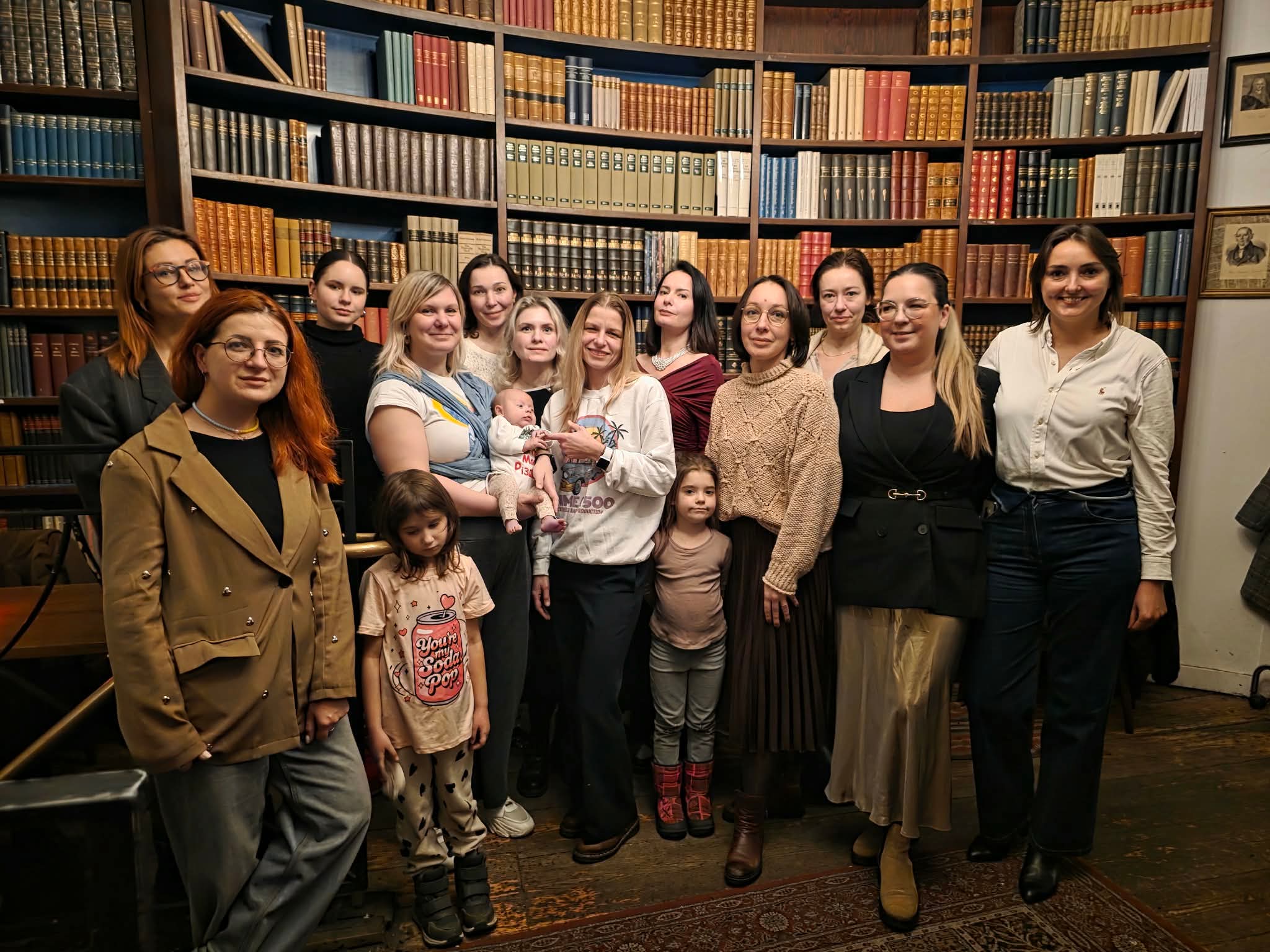
At the start, all team members agreed to work on the project on a volunteer basis for one year in order to create as much integration content as possible and then refocus on their own life challenges, which are numerous for refugees in a new country. However, at a meeting on December 5, when the team met in person for the first time to mark Slovo’s anniversary, all authors voted to continue the project under the same principles. Thus, in 2026, Ukrainian Slovo in Copenhagen will continue to exist.
Photos from joint meetings
A significant factor in the team’s decision on whether to continue in 2026 was also the interaction with and validation from the Danish media community.
“In the summer of 2022, the Danish Journalists’ Union and its chair, Tine Johansen, granted accreditation and Danish press cards to Anna Kudelia and me. At that time, we were disoriented and focused on solving the most basic needs at the bottom of Maslow’s hierarchy. We perceived this trust from colleagues as a symbol of support, a sign that one day we might return to the media sphere. I don’t know why we didn’t approach colleagues earlier when we were looking for local partners, but in September 2025 we reached out to Tine Johansen, who not only supported the initiative but also agreed to invest her experience and expertise to the project on a regular basis so that Slovo could continue to develop in 2026 and create integration content for Ukrainians,” Shorina says.
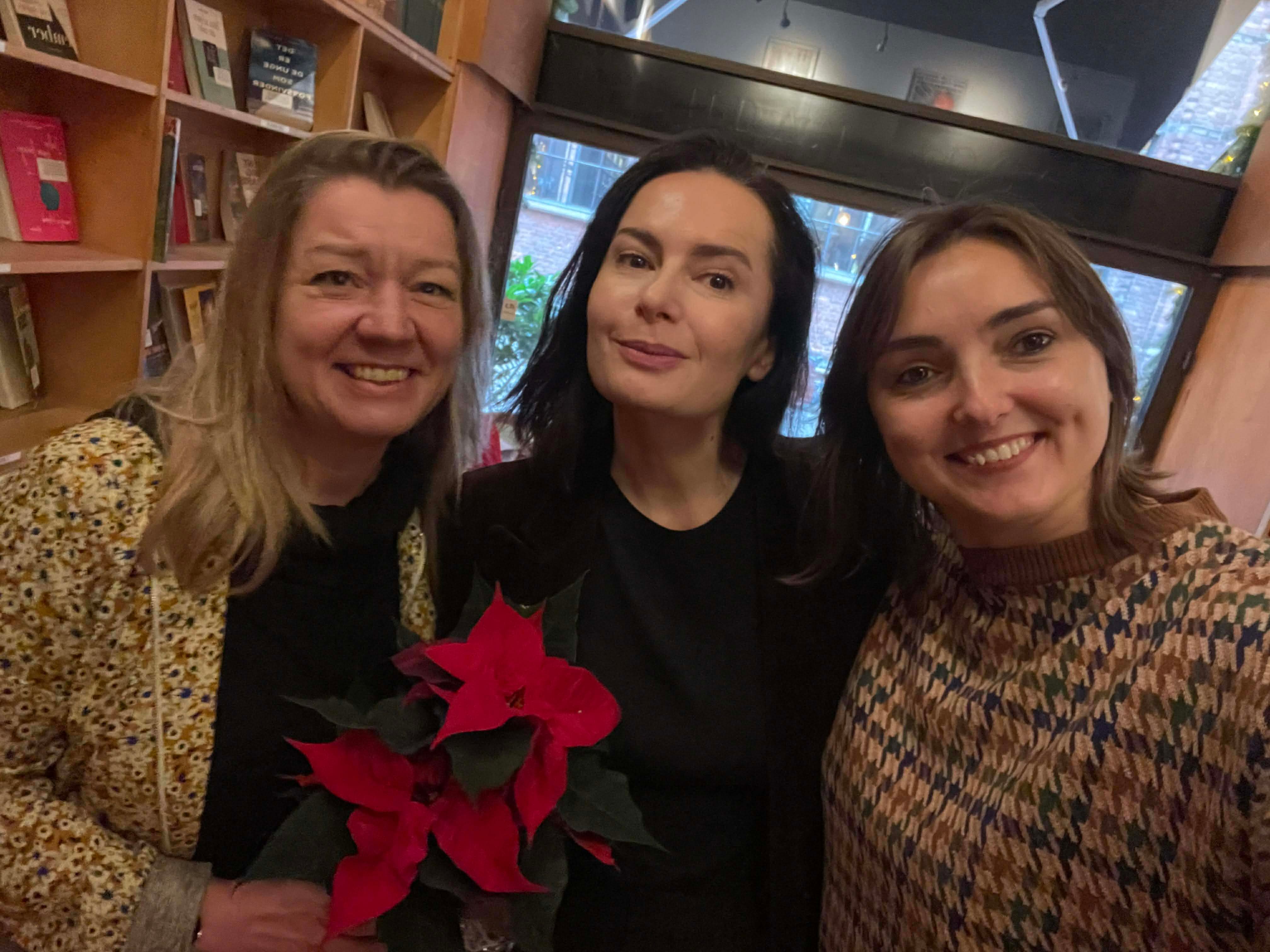
Meeting with Tine Johansen on the project’s future prospects
The Slovo team’s priorities for 2026 include securing its first grant support, launching new information products, organizing community events, and preserving the internal atmosphere within the team.
“This is probably the one area where we are very similar to Danes: volunteering can be long-term and maintain high quality standards, but what truly matters is the process of interaction, a warm team atmosphere where everyone contributes their talents to the fullest. The cumulative effect creates a sense that two plus two can ultimately equal five,” the Slovo team believes.
Photos provided by Slovo.dk