
Українською читайте тут.
The spread of separatist narratives and sabotage in the Baltic Sea — Russia is already waging hybrid aggression in the region, testing how NATO will respond.
In recent weeks, the issue of a new war in Europe has not only been discussed, but also manipulated. Media commentators are writing about new challenges both for the NATO bloc and specifically for the Baltic states. CIA Director John Ratcliffe’s visit to Russia on August 25 only intensified anxiety in Lithuania, Latvia, and Estonia, as the head of the US intelligence service flew to Moscow from Riga. A number of media outlets interpreted this move by Ratcliffe as a warning to the Russian political leadership against a new escalation. However, the factors described in this article indicate growing pressure from the Kremlin on the Baltic states and point to continued geopolitical tensions in the region.
According to information from Latvia’s public media (LSM), citing Politico, CIA Director John Ratcliffe warned Russian officials about the danger of escalation against NATO member states in the Baltic region: Estonia, Lithuania, and Latvia. In particular, according to information from US intelligence cited by CNN, the Kremlin will attempt to test the North Atlantic Alliance’s response by resorting to cyberattacks, sabotage, or other hybrid operations, without even ruling out a limited military intervention.
Director of the Center for Geopolitical Studies Māris Andžāns said in the Rīta Panorāma program on Latvian Television that this visit was a warning against any aggressive actions by Moscow against its closest neighbors. He drew attention to the public nature of the visit, explaining that the CIA director could have arrived unnoticed, on a smaller plane, like Steve Witkoff or Jared Kushner. Instead, the US side wanted the visit to attract public attention in order to emphasize its exceptional role in the North Atlantic Alliance.
In addition, according to researcher Sandis Šrāders of the Latvian Institute of International Affairs, speaking on the Labrīt program on Latvian Radio, Ratcliffe would not have stopped in Riga if the threat to the existence of the Baltic states and the undermining of Euro-Atlantic unity had not been on the agenda.
According to The Wall Street Journal, Russia is trying to destabilize the Baltic states through its ally Belarus. In particular, with Minsk acting as an intermediary, the Kremlin is artificially fueling the migration crisis and, importantly, using the territory of the Republic of Belarus as a platform for increasing pressure on its closest neighbors.
The Kremlin is systematically attempting to destabilize the security situation in the Baltic states with the help of the Russian minority living in Latvia, Lithuania, and Estonia. Given that there are entire cities populated by ethnic Russians in the Baltic states, Moscow has the ability to manipulate electoral sentiments while building its own network of agents among local political elites.
Another dimension of the Kremlin’s hybrid war against the Baltic states is provocations in the airspace and maritime space. Redirecting Ukrainian UAVs with the help of electronic warfare systems and sabotage targeting underwater internet cables are attempts to test the response of both the senior military and political leadership of each Baltic state and the “collective West.”
For better or for worse: how the Kremlin is slowly drawing Belarus into a new war
The Republic of Belarus, led by the regime of Alexander Lukashenko, has been under pressure from Russia for years, with Moscow using the territory of the neighboring state as its own military base, deploying retransmitters for Russian drones in regions bordering Ukraine and stationing nuclear warheads at local Belarusian training grounds.
According to Bloomberg on August 12, 2026, citing sources in a European government, the CIA has repeatedly issued warnings about a possible “false flag” operation in the Baltic states. US intelligence has not disclosed information about the potential perpetrator of the “false flag” operation, but at the same time it cannot ignore the fact that Minsk’s military and political integration with Moscow has deepened, gaining new momentum immediately after Russia launched its full-scale invasion of Ukraine. In addition, representatives of the former security forces’ initiative “BelPol,” in a comment to Liga.net, warned that new and modernized enterprises of the defense-industrial complex of the Republic of Belarus, which effectively operate to meet the needs of the Russian war machine, will reach peak capacity by 2027–2029, planning to produce tens and hundreds of thousands of munitions every year. The idea of Belarus as a “proxy aggressor” against the Baltic states is also being fueled by the local opposition in exile, which in June this year submitted a detailed report to the Ministry of Foreign Affairs of Ukraine mentioning the construction of defensive lines near the borders with Ukraine, Poland, and Lithuania, a sharp increase in defense spending, and the integration of the Belarusian military-industrial complex with the Russian one.
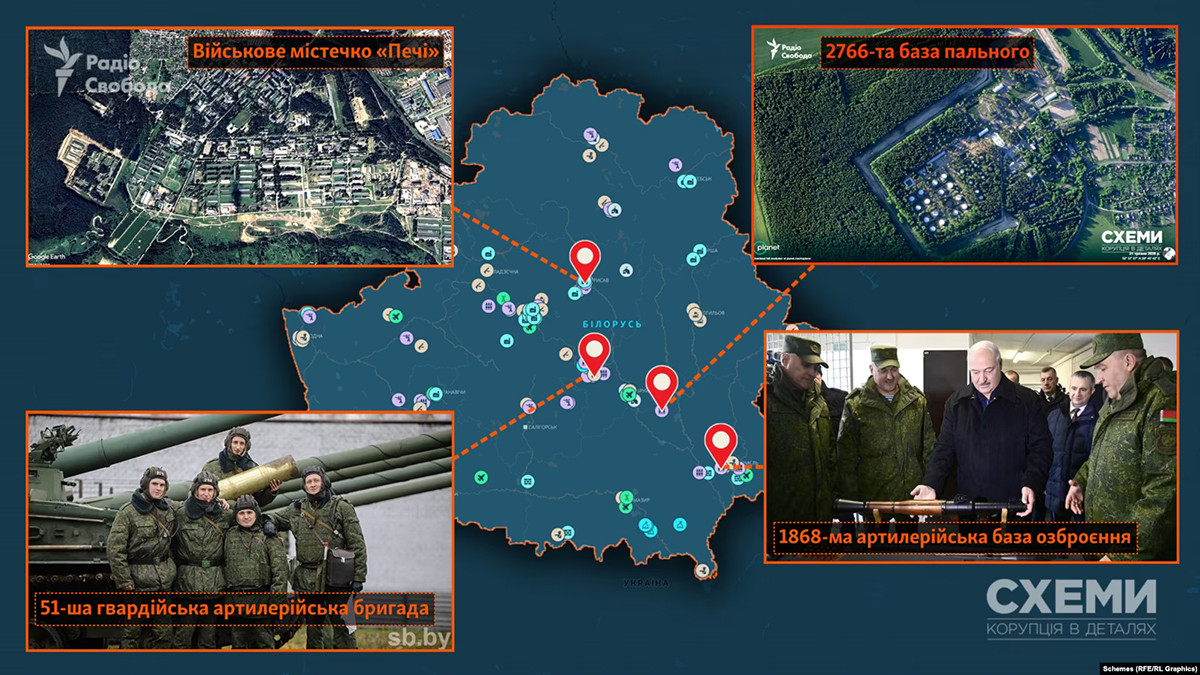
Military infrastructure of the Republic of Belarus. Source: “Radio Liberty”
Another factor in the spread of pro-Russian rhetoric concerning the Baltic states is the activity of pro-Russian information resources and Telegram channels, which, according to Telemetrio, are among the most popular among the Belarusian audience. In particular, a number of anonymous Telegram channels publish posts aimed at discrediting government authorities, security structures, and the defense capabilities of the Baltic states.
For example, posts devoted to the “Baltic threat” are published in Belarus on Telegram channels such as “BELTA” and “Sputnik.” The year 2026 became a turning point in this regard, as from February to September, topics concerning military escalation in the Baltic region and the threat to the Kaliningrad region began appearing more frequently in the Belarusian information space.
Over the past four years, both Western and Russian media have covered the issue of a “new front in the Baltics,” relaying statements by politicians and activists. However, the events of 2026 indicate a real threat to Lithuania, Latvia, and Estonia. The launch of a mobilization campaign in the Republic of Belarus, the final stage of integration between the Russian and Belarusian defense industries, as well as the construction of defensive lines along the western border, give the CIA director’s visit to Moscow even greater significance.
The Kremlin’s “fifth column”: how Moscow uses the Russian-speaking population of the Baltic states
The issue of the Russian national minority in the Baltic states has remained relevant since the collapse of the Soviet Union. According to official data from national statistical services, ethnic Russians account for 23% of Latvia’s population, 20.2% of Estonia’s, while in Lithuania the figure is around 5%. The Russian minority also lives relatively compactly and closer to the borders of its historical homeland.
According to StopFake, the intelligence services of the Baltic states have repeatedly reported in their assessments that the Russian-speaking population is the most susceptible to Kremlin narratives. In particular, Estonian security policy expert Igor Hretskyi explained that Moscow weaponizes the information sphere, culture, and sports in order to turn the least loyal groups of the population against local authorities.
For example, Estonia has the border city of Narva, which propaganda outlets mention in the context of its Russian historical heritage. More than 87% of residents identified themselves as ethnic Russians in the 2021 census. On May 9, the Telegram channel “RT на русском” published a post describing how local residents of Narva gathered on the waterfront to watch a festive concert in the Russian border city of Ivangorod in honor of “Victory Day” (the city lies on the other, Russian bank of the Narva River).

Monument to Lenin, which stood in Narva (Estonia) until 2022. In December 2022, the monument to Lenin was moved from the courtyard of the Narva Museum to the Museum of Estonian History in Tallinn. Source: ERR
Russian cultural presence in Narva is also mentioned in the context of encouraging separatist sentiments in Estonia’s border regions. Since March this year, social media accounts have emerged promoting the idea of separating Narva and creating a Narva People’s Republic. According to the Propastop portal, the Telegram channel of the same name encourages followers to spread propaganda materials containing calls for separatism.
And although the idea of the “NPR” currently does not enjoy significant support among the local Russian-speaking population, according to the PropaStop portal, the spread of such narratives poses a threat both to Estonia’s security and to that of other Baltic states, since the normalization of regional separatist ideas within the Baltic information space could lead to social radicalization and, as a result, changes in electoral preferences.
Moscow’s hidden terror in the airspace of the Baltic states
The Kremlin’s current tools of hybrid pressure on Lithuania, Latvia, and Estonia include provocations in the airspace and maritime space of these states. One aspect is the deliberate, according to Lithuanian Foreign Minister Kęstutis Budrys, redirection of Ukrainian UAVs toward the Baltic states using electronic warfare systems, as well as attacks on critical infrastructure facilities in the Baltic Sea. According to BBC Russian Service, the issue of air security for Vilnius, Riga, and Tallinn became critical precisely this year, as this spring and summer, fragments of Ukrainian drones were found in the village of Dobrichina (Estonia), the city of Krāslava (Latvia), and Lake Lavišas (Lithuania).
There are currently no official statistics on Ukrainian drones entering Baltic airspace publicly available, but even without them it is clear that Russia has begun using such incidents more frequently to test the response of the North Atlantic Alliance’s forces, and especially local air defense forces. In August this year, drone incidents stopped due to a change in tactics by the Ukrainian Defense Forces, which began striking deeper into Russian territory while avoiding the airspace of the Baltic states.
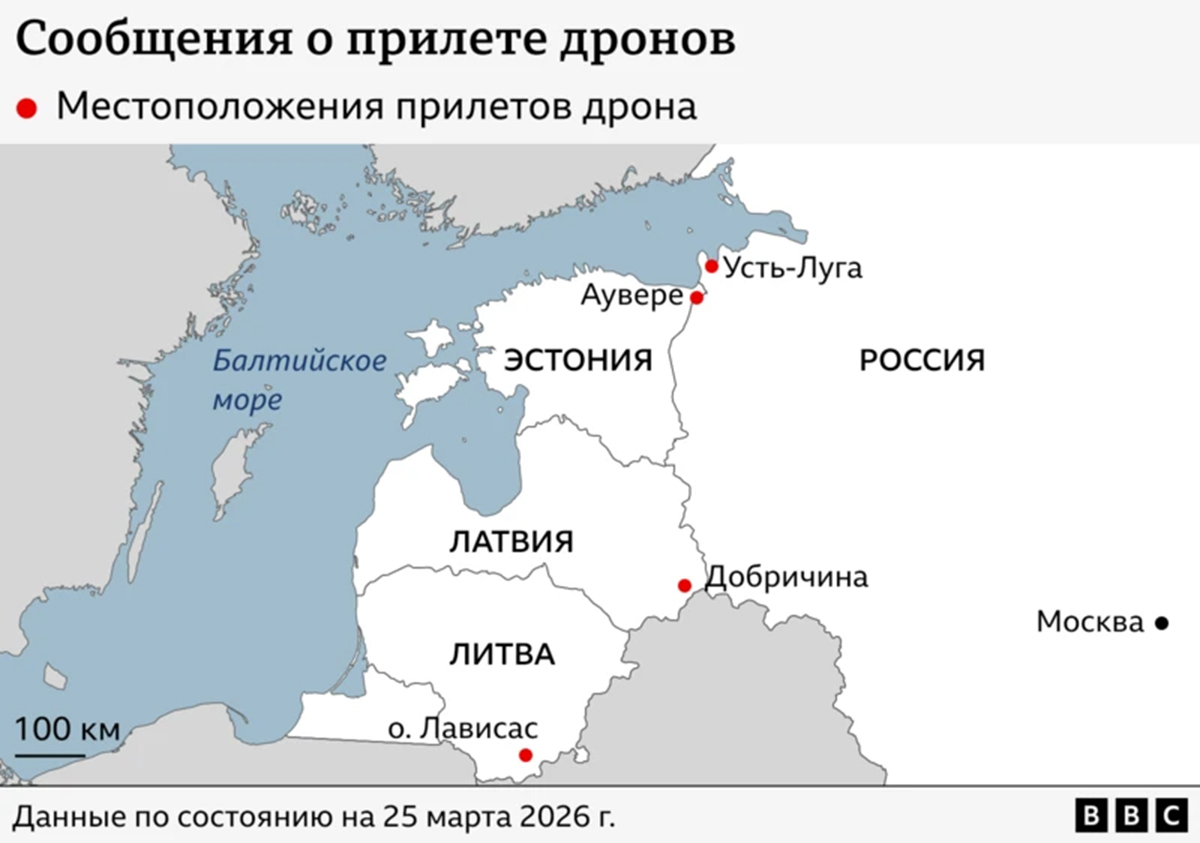
Locations where fragments of Ukrainian drones were found. Source: BBC
“Pirates of the Baltic Sea”: sabotage of underwater cables and its consequences
As of August 2026, no deliberate damage to underwater infrastructure has been recorded in the Baltic Sea, although similar incidents occurred in early January and in March. As the Finnish Security and Intelligence Service reports, the security situation in the Baltic maritime zone is rapidly deteriorating, while the Kremlin seeks to identify the most vulnerable points in communications and connectivity through sabotage of underwater internet cables.
According to Euronews on January 26, 2026, Finland, together with Lithuania, Latvia, and Estonia, is creating a new maritime surveillance mechanism to prevent further damage to underwater cables. In particular, Mikki Hirvi, head of the maritime security department of the Finnish Border Guard, reported that changes to the sabotage prevention system would include the creation of centers for information sharing, information analysis, and real-time threat assessment.
In January 2025, during the summit of allies from the Baltic Sea region in Helsinki, NATO Secretary General Mark Rutte announced the launch of a military mission designed to strengthen the protection of critical infrastructure under the name “Baltic Sentry.” The mission will involve frigates, patrol aircraft, and a small fleet of maritime drones, that is, assets intended to improve the ability to protect critical underwater infrastructure and respond when necessary.
On September 3, 2026, Rear Admiral Søren Kjeldsen, commander of the Royal Danish Navy since December 2024, spoke to the German publication WELT about changes in the behavior of Russia’s shadow fleet in the Baltic Sea. According to him, Russian vessel crews have become noticeably more cautious in the Baltic Sea: they are taking various measures to remain undetected more often than they did just a few years ago. The admiral links this to Moscow’s awareness of Ukraine’s capabilities even in the Baltic region. Kjeldsen also confirmed that additional personnel, presumably Russian mercenaries, are increasingly appearing aboard shadow fleet vessels, which is why Danish intelligence records every change in the behavior of such vessels and passes this data on to neighboring Baltic states.
Despite the launch of the “Baltic Sentry” operation and the establishment of CTF Baltic in Germany, the admiral acknowledges that it is impossible to prove a direct link between the increased NATO presence and the absence of large-scale incidents, just as it is impossible to completely rule out new acts of sabotage. The Kremlin continues to test the Alliance’s vigilance in the Baltic Sea, while the security environment in the region, according to the Danish commander, remains unstable.
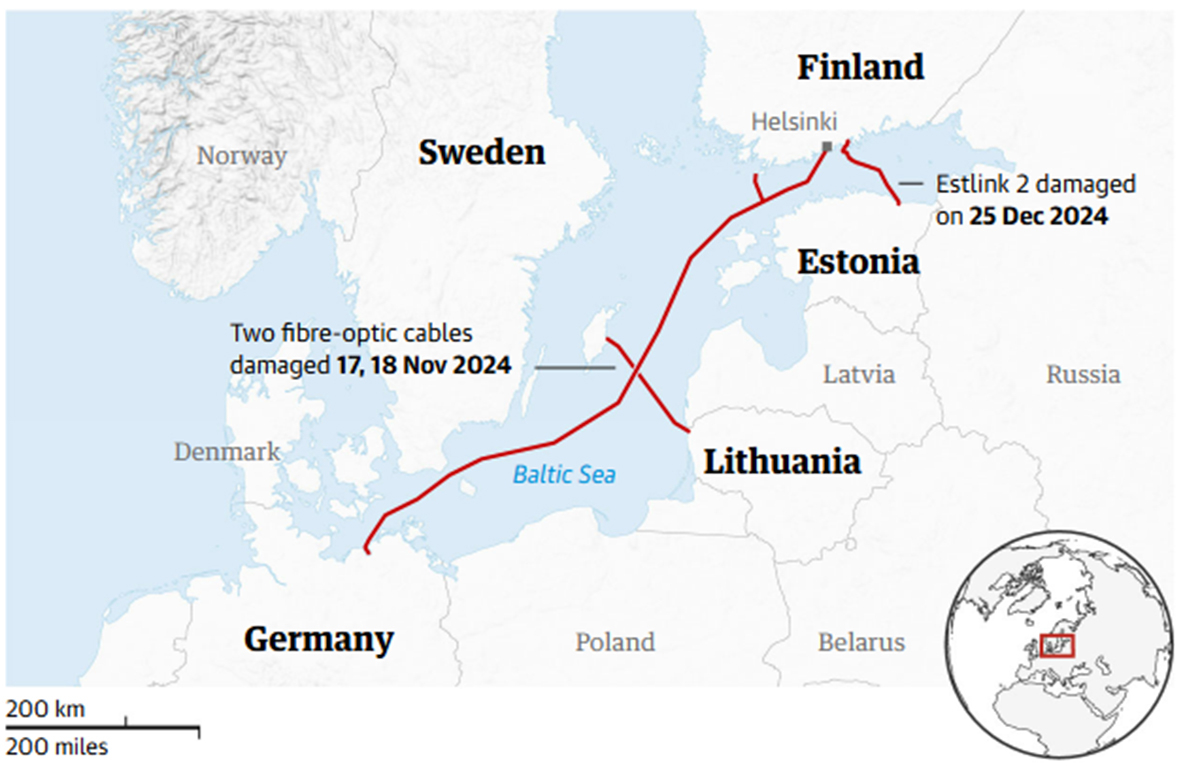
Area of the “Baltic Sentry” operation. Source: TeleGeography
The problem of regional tensions between the Baltic states and Russia lies in the specifics of the tactics chosen by the Kremlin, which involve artificially creating crises and carrying out covert acts of sabotage. Accordingly, it is more difficult for the North Atlantic Alliance’s forces to assess the level of external threat and apply the provisions of the Alliance’s treaties. A NATO multinational corps, “Northeast,” is currently deployed in Lithuania, Latvia, and Estonia and is one of the elements of the Alliance’s structure. One of the corps’ main components is two multinational divisions: Multinational Division North (MND N), which is responsible for the security of Latvia and the Baltic Sea region, and Multinational Division Northeast (MND NE), which consists of multinational battlegroups led by the United States (in Poland), Germany (in Lithuania), Canada (in Latvia), and the United Kingdom (in Estonia).
According to the Militarnyi portal, both divisions have declared their readiness to act within the framework of collective defense in accordance with Article 5 of NATO, but the German publication Bild reports systemic problems within the multinational units, paying particular attention to the 45th Armored Brigade, which is planned to be deployed in Lithuania. In particular, the publication writes about recruitment problems for the newly created unit, which Germany planned to staff with more than 1,900 soldiers during the first stage of deployment. Only 209 volunteered to serve, that is, less than 10% of the required number. This problem is not limited to a single Bundeswehr brigade; it is systemic in nature and calls collective defense capabilities into question.
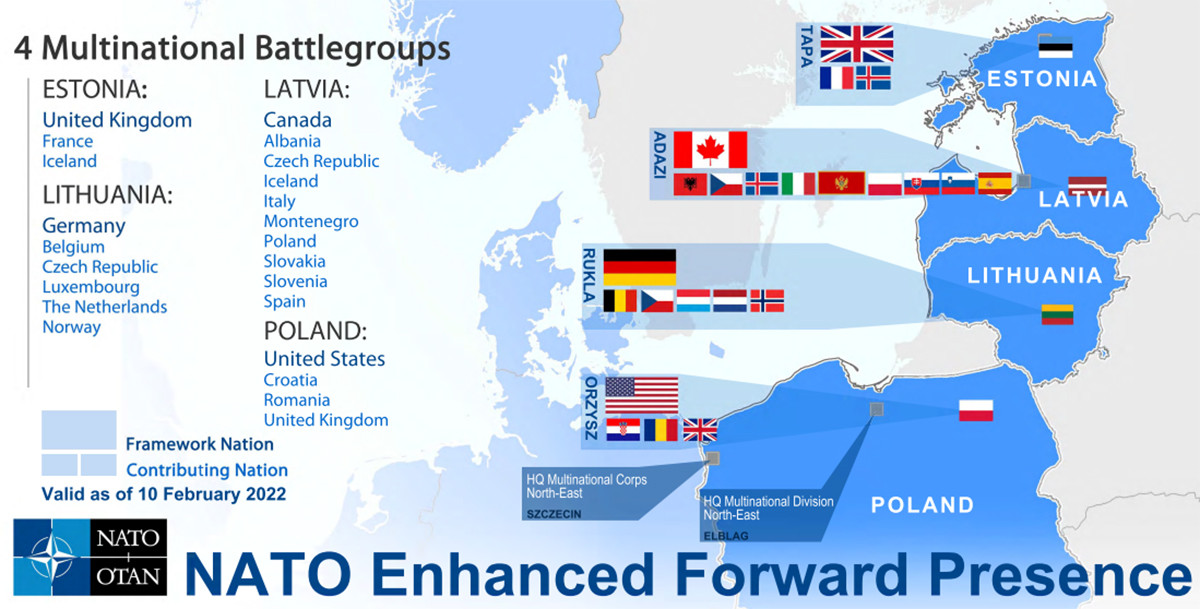
NATO multinational battlegroups in the Baltic states and Poland. Source: website of the Ministry of Foreign Affairs of Latvia
The Kremlin uses various means of covert warfare against its western neighbors. The militarization of Belarus, the spread of anti-Western rhetoric among the Russian-speaking population, as well as provocations in the airspace and maritime space of the Baltic states are part of the Kremlin’s broader strategy to undermine the foundations of Euro-Atlantic unity. Russia, to the extent possible, keeps the Baltic region in a state of constant tension, fueling war hysteria through Telegram channels and information outlets. John Ratcliffe’s public visit to Moscow is a signal that Washington understands the full seriousness of the threat hanging over both the Baltic states and other NATO members. Despite the low probability of a repetition of the “Ukrainian scenario” in the Baltic region, Vilnius, Riga, and Tallinn are under pressure, as the dynamics of hybrid provocations are steadily increasing, while the response of Western states remains passive and does not encourage the Kremlin to curb its own geopolitical ambitions.
Illustration: Grok