
Українською читайте тут.
The Deputy Prime Minister for Humanitarian Policy and Minister of Culture, in an exclusive interview with Detector Media, spoke about timelines for producing content under the National Program for Supporting Ukrainian Culture, its financing mechanisms, and details of the competition process.
In September 2025, President of Ukraine Volodymyr Zelenskyy proposed creating 1,000 hours of Ukrainian content and suggested allocating nearly UAH 4 billion for this purpose in the 2026 state budget. Additional funds were included in the Ministry of Culture’s program titled “Ensuring strategic communications, information security, measures for European and Euro-Atlantic integration, national identity, heroism, and the creation and distribution of patriotic audiovisual works.”
“This is a strategic initiative aimed at increasing the volume of Ukrainian content, strengthening national identity, enhancing resilience against hostile narratives, creating an alternative to Russian cultural influence, and supporting the development of Ukraine’s film industry,” this is how Deputy Prime Minister for Humanitarian Policy and Minister of Culture Tetiana Berezhna described the project.
The initiative was supported by the parliamentary committee, and the functions of content selection and fund distribution were to be assigned to relevant institutions, including the Ukrainian Cultural Foundation, the Ukrainian Book Institute, and the State Film Agency. The final stage, as later became known, is to be a festival-style pitching event involving international experts who will evaluate project applications.
In December 2025, the state budget was adopted, allocating UAH 4 billion to implement the president’s initiative. The budget request for the program already included indicators for 2026–2028 (i.e., transitional funds not limited to a single budget year). However, in the adopted budget, the funds were allocated only for 2026.
In March 2026, the government adopted a resolution on “Certain issues of organizing and conducting artistic competitions for the selection of cultural and artistic projects aimed at implementing the initiative of the President of Ukraine.” Under this resolution, the Ministry of Culture launches the initiative in April 2026. Recent communications from the ministry no longer use the official title “1,000 hours of Ukrainian content.” In her latest Facebook post, Berezhna referred instead to the National Program for Supporting Ukrainian Culture.
The program is intended to support artists and creators in the following areas: feature films and series, non-fiction documentaries and series, animation, children’s films, contemporary music, performing arts, visual arts, audiovisual shows, and social media video content.
According to Berezhna, the program will operate through open calls. Participants will be selected based on formal rules, expert evaluation, and public pitching. Applications can be submitted from April 3 to June 2026.
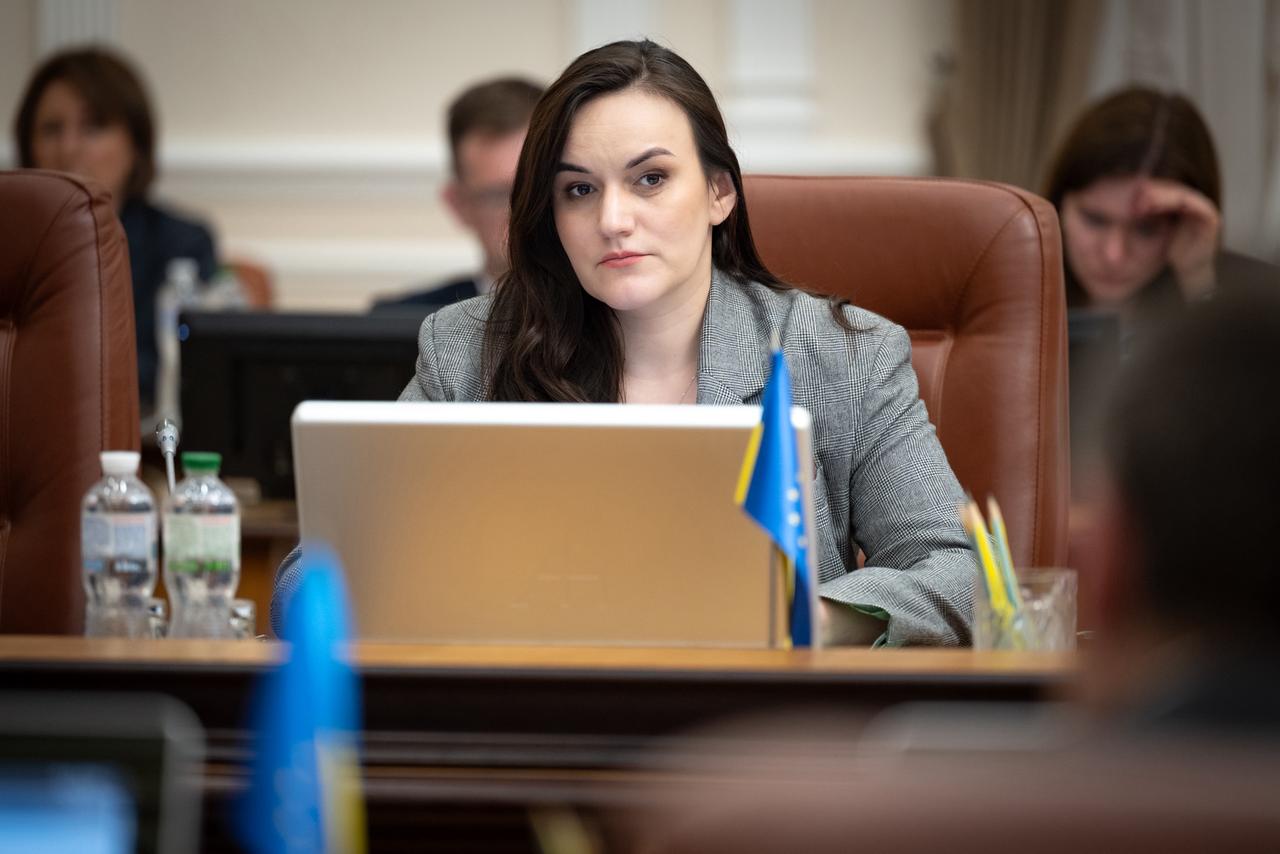
Detector Media submitted written questions to Tetiana Berezhna about the launch of the state program, expected timelines for the first results, financing mechanisms, and how the competitions will be conducted, as well as the role of the state enterprise “Center for the Protection of the Information Space of Ukraine” (CPIPU).
— Ms. Berezhna, the program is large-scale. Applications can be submitted until June 2026. When can we expect the first results, given the timelines and the diversity of formats?
— When designing the program and determining what kind of cultural content should be produced, we analyzed current consumption data. We also conducted research on content consumption, particularly among young people. We looked at which formats are most in demand, what audiences are watching today, and what is lacking in Ukraine’s information space. We studied overall market analytics—how cultural content is produced, which formats have the greatest impact, and how quickly they can be created.
The program covers different types of cultural products—from films and series to social media content. We understood that some content needs to appear quickly to fill the information space as soon as possible. At the same time, high-quality feature films require time and reflection. Accordingly, we calculated production timelines for different formats.
We expect the first results of the program in early 2027, with some formats possibly ready even this year.
Production timelines depend on the type of content. Social media content is the fastest to produce—for example, short videos of up to five minutes. Projects with shorter production cycles can be completed more quickly.
More complex projects—such as films, series, shows, theatrical productions, exhibitions, or music projects—require more time. Their production is expected to be completed by the end of 2027.
For the longest formats (animation and feature films/series), an even longer timeline is envisaged: their production may continue until the end of 2028.
— Will the program funds be transitional? Into 2027? And 2028?
— When designing the financial model, we considered several key factors. On the one hand, Ukraine’s budget system is tied to an annual cycle, and funds cannot be automatically carried over to subsequent years. On the other hand, the realities of cultural production are such that some projects—especially feature films and series—require more than one budget year.
We developed a model that complies with budget rules while ensuring stable financing for long-term projects.
Contracts with competition winners, concluded by the state enterprise “Center for the Protection of the Information Space of Ukraine” (CPIPU), will include provisions for advance payments of 80–90% of the project cost, to be made before the end of the budget period in which the contract is signed (2026). At the same time, the advance payment may cover a period of up to 27 months across the current and subsequent budget periods.
This means producers will receive not only contracts but also real funding to fully work on their projects—even if production takes several years.
— Has the budget line been renamed?
— No, the name of the budget program has not changed. It is defined in the Law of Ukraine “On the State Budget of Ukraine for 2026.”
At the same time, the government has approved the procedure for using these funds, which determines how the program will be implemented and financed.
— How will the program be financed through the State Enterprise CPIPU? Has its restructuring into a state non-profit enterprise already been completed?
— SE “CPIPU” will be the recipient of budget funds and will sign contracts with the winners of the artistic competitions.
We have started the transformation of SE “CPIPU” into a state non-profit enterprise. On February 23, the Ministry of Culture issued Order No. 267 “On the Reorganization of the State Enterprise ‘Center for the Protection of the Information Space of Ukraine’ through its transformation.”
— How will the competitions be conducted?
— This is one of the most complex and important parts of the program. We spent the most time developing the competition rules. We carefully analyzed how artistic competitions work in Ukraine, studied international experience and approaches used in major funding programs, and held consultations with the professional community to find the optimal model.
The key task is to build a fair system—one that ensures transparency and integrity while selecting truly strong, relevant, and competitive projects. We considered various risks, from technical errors in applications to challenges related to Russia’s war against Ukraine. Therefore, the rules include both clear selection criteria and control and verification mechanisms.
We are preparing to launch the program. Applications open on April 3. The submission period will last two months. We also took into account the possibility of technical errors in applications. If that happens, applicants will be able to correct their documents within ten working days after submission, but before the application deadline specified in the competition announcement.
The competition is held in three stages. The first stage is the verification of the submitted documents and materials for compliance with the requirements of the Regulations on the Organization and Conduct of Artistic Competitions. It includes checking the business reputation of applicants, verifying that the full set of documents has been submitted, and confirming compliance with submission deadlines.
The second stage is expert evaluation of projects. Selected projects will move to the third and final stage—a public presentation (pitching). At that stage, commissions will select the winners who will receive state funding.
Competition committees will be established by fields to organize and conduct the competitions:
- for the selection of audiovisual shows and videos for social media;
- for the selection of audiovisual projects (feature films and series);
- for the selection of audiovisual projects (non-fiction/documentary films and series);
- for the selection of audiovisual projects (films for children’s audiences and animation);
- for the selection of projects in the field of contemporary music;
- for the selection of projects in the field of performing arts;
- for the selection of projects in the field of visual arts.
— What are the main challenges you see in implementing the program?
— The program faces many challenges, both internal and external. We are launching it in the context of a full-scale war, where Ukraine is simultaneously affected by military, economic, and informational pressures, and is experiencing a severe human capital crisis. This is a difficult environment for any public policy decision, especially one involving significant funding.
At the same time, this will be the largest state investment in Ukrainian cultural production since independence. There has never been a program like this before. Many of the approaches are being developed now. It is a truly unprecedented challenge for all of us. We have conducted extensive consultations, analyzed Ukrainian and international experience, and sought optimal solutions. But we understand this is a new path for the country—one we are taking for the first time. In fact, it is a new path even globally, as no one has implemented such a program under wartime conditions.
One of the key challenges is responsibility for the use of resources. In wartime, every hryvnia matters. That is why it was critically important for us to develop competition rules that will allow us to select high-quality, relevant content that the country truly needs.
And this challenge does not end at the stage of establishing the rules — it only begins during the selection process. So we are not relaxing yet. We understand that the real work is still ongoing.
And this is only part of the challenges. In reality, there are many more. But we approach this consciously: we analyze, plan, look for solutions, and adjust our approach along the way.
This is a complex, multi-layered project with no simple steps. We understand that it will be a very difficult path—one that already is—requiring adjustments and tough decisions. But this is work we, as a state, must do if we want a Ukrainian future for Ukraine.