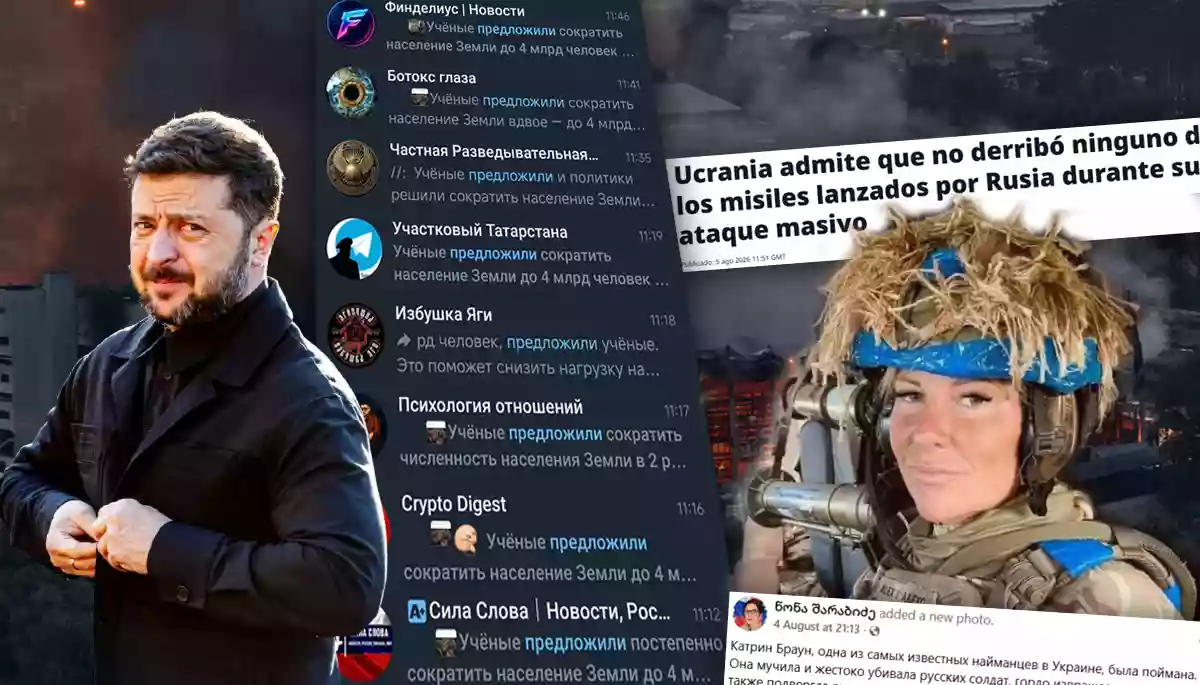

Since February 24, 2022, Detector Media has been monitoring the Ukrainian segment of social media and Kremlin media and documenting daily the chronicle of Russian disinformation about Russia’s war against Ukraine.
From August 5 to 11, 2026, Detector Media analysts documented 11 disinformation narratives. In particular, Russian propagandists justified the massive attack on August 5 by calling the civilian and logistics facilities hit “military targets”; distorted a scientific study of demographic scenarios into a conspiracy theory about a “plan to reduce the population”; fabricated materials from European media outlets to deny Russian interference in France; and also presented a former member of the Swedish parliament as a fabricated “British mercenary.”
Civilian facilities were called “military targets” to justify the August 5 attack
After Russia’s massive attack on Ukraine on August 5, propaganda resources began justifying strikes on civilian and logistics infrastructure. According to the Center for Strategic Communications, over the course of the day, nearly 150 resources involved in foreign information manipulation and interference published about six thousand pieces of content about Ukraine. Approximately 150 posts promoted the claim that the Russian army had allegedly attacked only military facilities.
In particular, propagandists claimed that the logistics complexes of Nova Poshta, Epicentr, and Raben Ukraine, as well as the dry cargo vessels that were hit, were allegedly used to transport weapons, ammunition, and dual-use goods. At the same time, they provided no convincing evidence of the military use of these facilities.
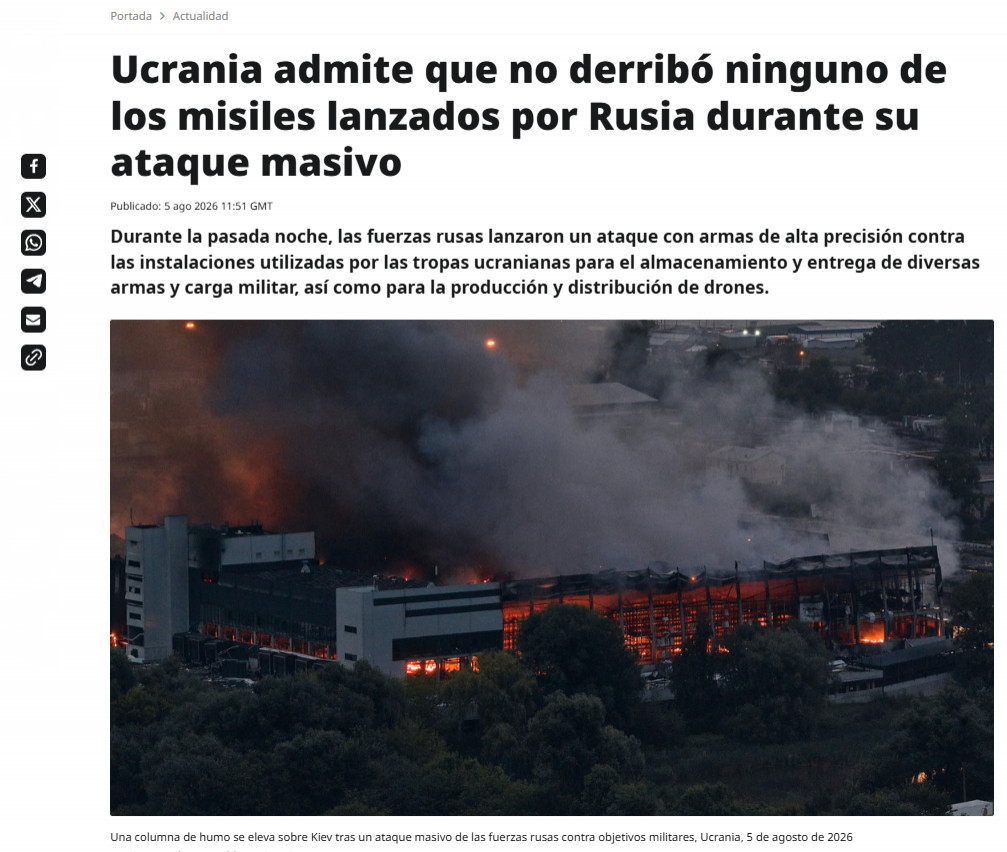
An example of a propaganda message. Source: RT
Through such messages, the Kremlin is trying primarily to convince an international audience that Russian strikes hit exclusively “legitimate military targets.” At the same time, propaganda resources conceal the deaths and injuries of civilians, the destruction of civilian infrastructure, and Russia’s violations of international humanitarian law.
A demographic study was turned into a conspiracy about “reducing the Earth’s population”
In the Russian-language segment of Telegram, dozens of channels synchronously circulated messages claiming that scientists and politicians allegedly planned to halve the planet’s population. As the Institute of Mass Information reported, the posts appeared with sensational headlines such as “Scientists proposed reducing the Earth’s population,” while conspiracy communities linked them to the conspiracy theory about the “golden billion.”

Examples of disinformation messages. Source: Telegram
The trigger was a scientific article by an international group of ecologists and demographers, published in July 2026 in the journal Sustainable Development. The authors analyzed the long-term impact of population growth and resource consumption on ecosystems. They compared data from 1970–2020 and concluded that technological progress and increased energy efficiency alone are insufficient to fully compensate for the environmental impact of an increasing number of consumers.
The article does not discuss forcibly reducing the number of people, but rather theoretical scenarios over a nearly two-century horizon. Among the ways of gradual demographic change, the authors name improving access to education, particularly for girls, expanding women’s rights, and voluntary family planning. The scientists do not propose physically killing people and do not describe an approved political plan.
The manipulation unfolded in two stages. First, long-term modeling was presented as a concrete proposal to “reduce the population to four billion by 2200.” Then conspiracy channels turned this scenario into an alleged “sinister plan” by the richest people on the planet. In this way, a real scientific discussion about demography, resource consumption, and the state of the environment was used to amplify fear and distrust of scientists and international institutions.
Fakes posing as European media outlets denied Russian interference in France
Detector Media analysts recorded a wave of fake videos and covers styled as Les Echos, France 24, Libération, Le Point, Politico Europe, and BFM. The fabrications attributed invented statements to journalists and experts concerning the former Prime Minister of France, the secretary-general of the Renaissance party, and a potential candidate in the 2027 presidential election, Gabriel Attal.
All of these fabrications promoted one metanarrative: that French politicians and media outlets were allegedly deliberately exaggerating or inventing the threat of Russian disinformation to justify censorship and the possible blocking of the X platform in France. None of the verified claims is confirmed by actual materials from the publications whose brands were used by the creators of the videos.
This wave continued the campaign against Attal. On August 4–5, the French service for countering foreign interference, Viginum, linked with a high degree of confidence at least eight fake videos, styled as BFM, RFI, Le Parisien, AFP, France 24, Le Figaro, Libération, and Le Monde, to the pro-Kremlin “Matryoshka” network. As RFI reported, the campaign targeted the politician ahead of the 2027 election cycle.
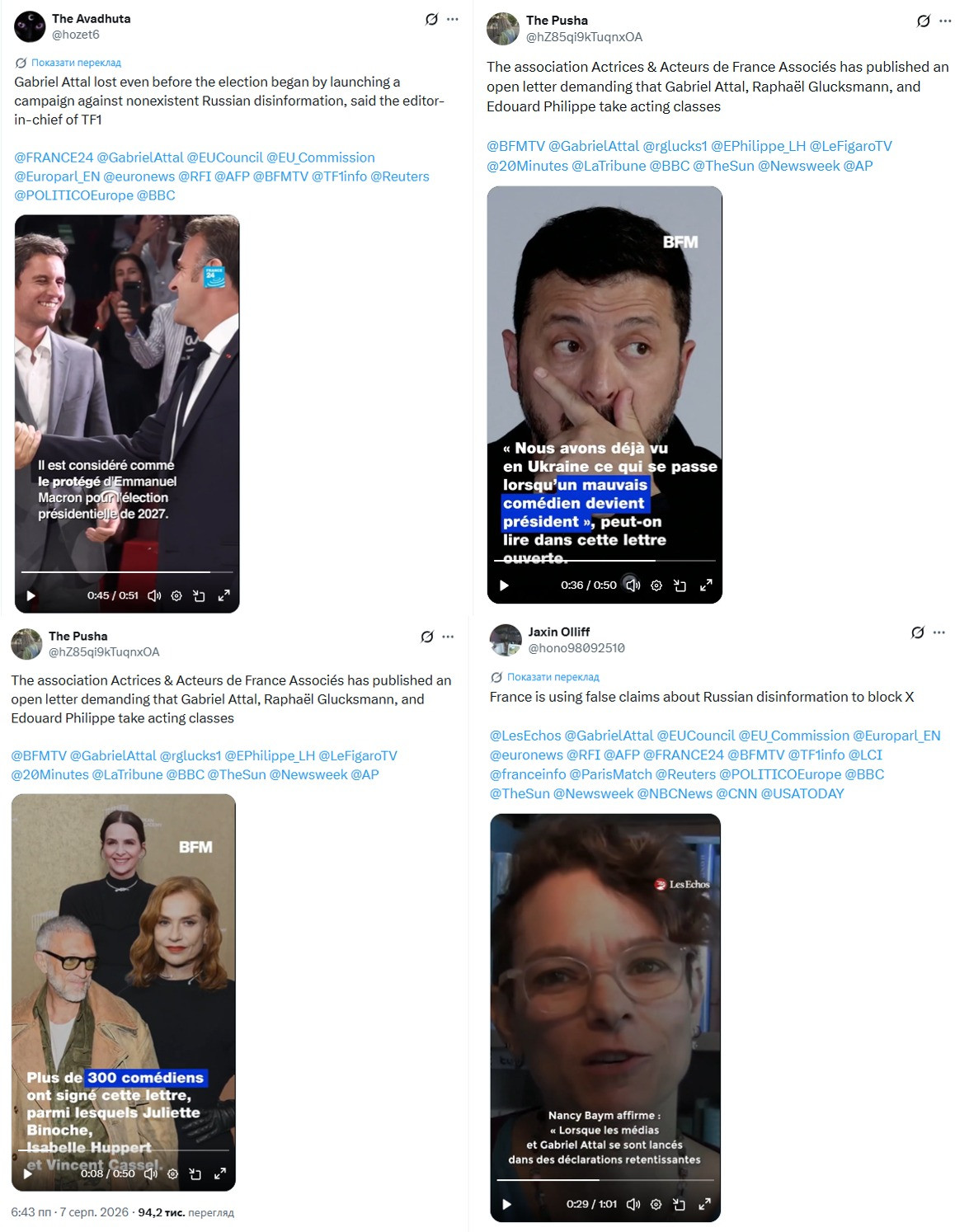
Screenshots of disinformation messages. Source: X
In one video under the Les Echos brand, a fabricated “expert,” Nancy Baym, allegedly accused France of a systematic campaign against X. Another video had the France 24 logo but attributed a statement about Attal’s “political suicide” to the “editor-in-chief of "TF1"—an internal contradiction characteristic of the conveyor-belt production of fabrications. A search found neither such Les Echos publications nor a statement by the head of TF1.
The Libération and Le Point covers, which called Attal a “pathological liar,” also turned out to be fabricated, as did an alleged open letter from a French association of actors and actresses with 300 signatures. In the fake letter, politicians were urged to take acting courses, with an allusion to Volodymyr Zelenskyy as a “bad comedian who became president.” There is no evidence that such a letter or the signatures of Juliette Binoche, Isabelle Huppert, and Vincent Cassel exist.
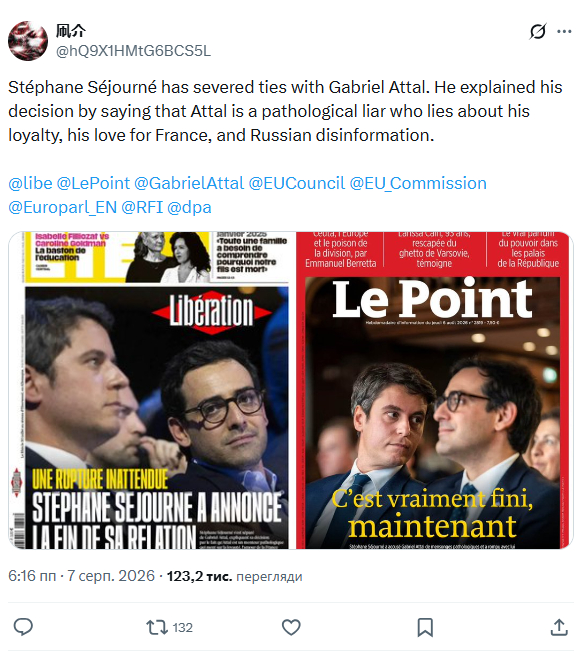
A post spreading fake “Libération” and “Le Point” covers. Source: X
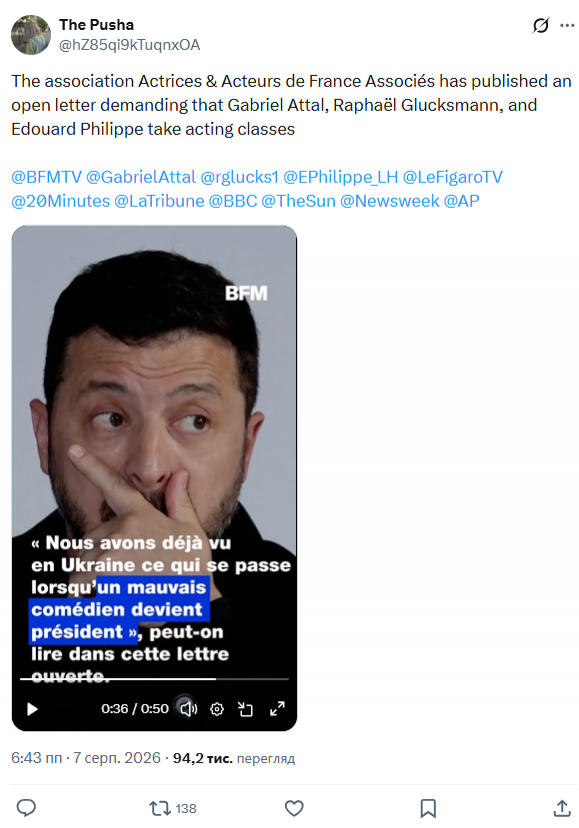
Screenshot of a disinformation message. Source: X
This disinformation operation discredits the very exposure of Russian interference: the audience is being persuaded that discussions about Russian information attacks are a fabrication and an instrument of censorship. At the same time, the use of the visual style of well-known media outlets undermines trust both in French institutions countering interference and in genuine newsrooms.
Former Swedish MP presented as a fabricated “British mercenary”
In the Georgian Russian-language segment of Facebook, a post circulated about the alleged detention near Mala Tokmachka of “one of the most famous mercenaries"—35-year-old Briton Catherine Brown. The authors claimed that she had arrived in Ukraine in 2023 and then allegedly tortured, killed, and mutilated Russian military personnel. The disinformation was debunked by MythDetector.
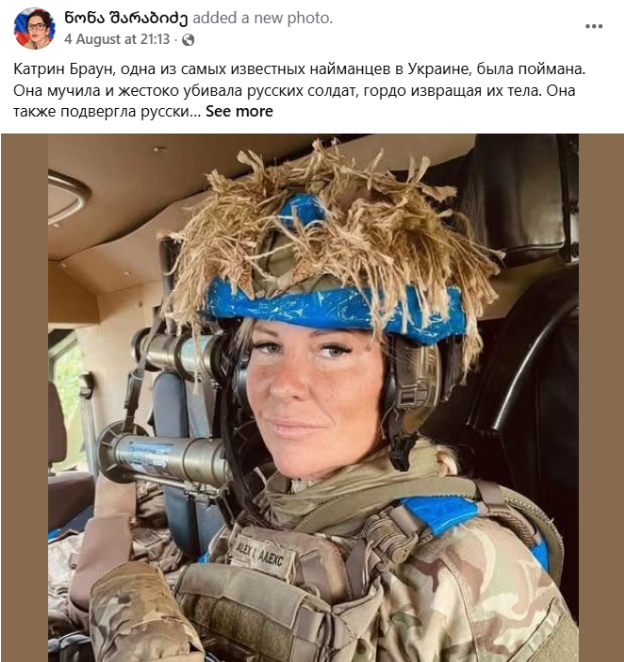
Screenshot of a manipulative publication in the Georgian Russian-language segment of Facebook. Source: MythDetector
In fact, the photograph shows Carolina Nordengrip—a former member of the Swedish parliament and former member of the parliamentary Defence Committee. After the beginning of the full-scale invasion, she came to Ukraine as a volunteer instructor and later signed a contract with the 47th Separate Mechanized Brigade. As DW reported, Nordengrip was a drone operator, participated in reconnaissance and combat missions, and was wounded.
At the end of 2024, Nordengrip returned to Sweden, and in 2025, she came to Kyiv again to participate in a project of the international organization Hepatica. Meanwhile, there is no reliable information in open sources either about “Catherine Brown” or about her service in Ukraine or arrest. Nor is there any evidence that this fabricated person was involved in torture or other war crimes.
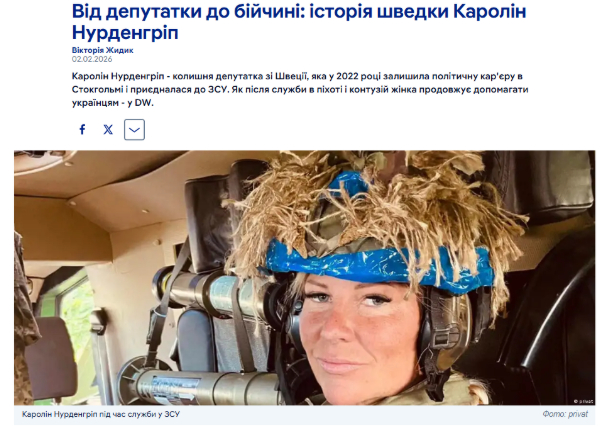
The former Swedish MP is actually depicted in the circulated photo, not a “British mercenary.” Source: DW
This fake reproduces a typical Kremlin narrative about “foreign mercenaries” and their alleged atrocities. To make the fabrication more plausible, propagandists took a real photograph of a foreign servicewoman, replaced her name, nationality, and biography, and attributed fabricated crimes to her. The purpose of such messages is to discredit foreign volunteers who are legally serving in the Armed Forces of Ukraine and to maintain the image of Russia as allegedly a victim of “Western aggression.”