

Українською читайте тут.
Few women are invited to television, while government representatives are invited very often.
It was a difficult year. Due to the suspension of USAID funding, the changes in our monitoring are reflected in the sample: this time, Detector Media summarizes data only for May–December 2025. However, you can be sure the findings are also representative of the beginning of the year: “United News” quietly avoided showing “European Solidarity” back in March.
For the media sector overall, the year passed under the sign of—however grim it is to admit—a routine war: the same spokespeople, the same major cities, the same challenges. Instead, the real “escalation” occurred around peace negotiations and domestic politics: we (partially) lost the United States and (completely) Andriy Yermak.
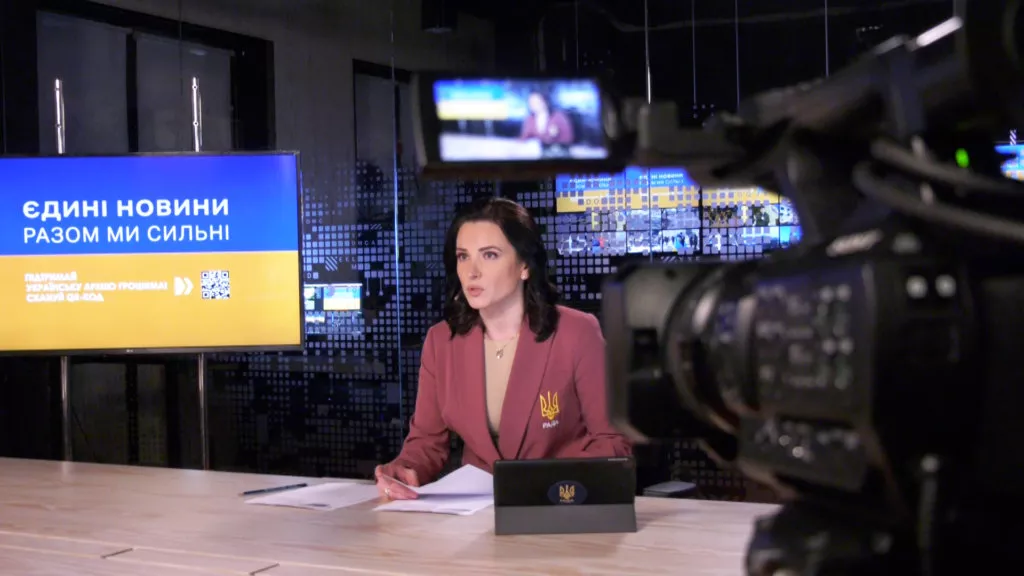
In addition, 2025 was the first full year in which Suspilne (Public Broadcasting) and the state telethon United News operated separately, which allows us to fully compare their approaches. In short, it is easy to understand why United News is useful for the authorities—but unclear why it is useful for viewers.
A Men’s Club
From May to December 2025, Pershyi held 10,382 conversations with guests—an average of 42.3 guest segments per day, or about 1.8 guests per hour.
United News had similar figures: 10,094 discussions over the same period, or about 41.2 conversations per day, which equals 1.7 guests per hour.
Despite these very similar numbers, there is a key and highly visible difference between the two outlets: women. In fact, if we looked only at men, the telethon would have had even more guests than Suspilne. However, United News failed on gender balance—there were 500 fewer conversations with women than on Pershyi.
In percentage terms, women accounted for 20.4% of speakers on Suspilne, compared with 15.9% on United News. Such an extremely low representation of women in studio discussions remains striking year after year. Of course, this is linked to the overall low representation of women in politics and the military. But Suspilne’s example already shows that the telethon could invite more women. And if major TV channels deliberately increased this share, that visibility would, in turn, influence society and representation in specific sectors.
Hopefully, everyone now knows about initiatives like the “Ask a Woman” database. And about the fact that you don’t always have to invite the same hereditary political scientist or economist: regularly refreshing the guest roster would also ensure greater diversity of viewpoints.
Speaking of diversity of viewpoints. From May to December 2025, Suspilne featured 2,661 unique individuals on air. This means that an average Pershyi guest appeared 3.9 times over the eight months of monitoring.
During the same period, the United News telethon invited 2,348 different people. This is not only fewer in absolute numbers, but also fewer relative to the total number of guest appearances. An average telethon guest appeared 4.3 times over the eight months of monitoring.
In other words, the state telethon relied more often on the same people, while Suspilne showed viewers a wider range of speakers—and, consequently, a wider range of opinions.
It is also interesting to compare these figures by gender. On both channels, women are invited back significantly less often than men: 2.74 times on Suspilne and 2.45 times on the telethon. Men, meanwhile, appeared on Pershyi 4.37 times over eight months. And on United News, as many as 5.01 times!
It's like a private men's club for a select group of members.
Most Frequent Speakers
The United News telethon has eight men who were invited on air more than 100 times over eight months.
The list is topped by Oleksandr Tolokonnikov, Deputy Head of the Kherson Regional Military Administration, who appeared 156 times—more than once every two days. He is followed by Border Guard spokesperson Andrii Demchenko (126), Khortytsia spokesperson Viktor Trehubov (124), Navy spokesperson Dmytro Pletenchuk (109), and Head of the Zaporizhzhia Regional Military Administration Ivan Fedorov (107). In this tight club of state spokespersons voicing the official government line, there was room for only two other people: political commentator Volodymyr Fesenko (124 appearances!) and military commentator Oleksandr Musiienko (111 appearances!).
This is clearly an anomalous level of representation for supposedly independent experts. The telethon channels obviously have their favorites and continue to select them every couple of days—either because their views are convenient, because of instructions, or due to the laziness of guest editors. None of these reasons benefit the audience.
The most frequent telethon guests clearly illustrate its purpose: to inform people about the government’s position. In the modern world, a phone on a tripod would be enough for that.
On Suspilne, the most frequent guest appeared 74 times—Ihor Chalenko, head of the NGO Center for Analysis and Strategies. Pavlo Lakiichuk, head of security programs at the Strategy-21 Center for Global Studies, appeared 72 times. Vadym Kushnikov, military analyst at Militarnyi, was also invited 72 times. Military commentators Ihor Romanenko and Mykola Malomuzh appeared 70 times each, while military spokesperson Viktor Trehubov appeared 69 times, and military expert Oleksii Hetman 66 times.
Notably, among Suspilne’s most frequent guests, there is only one state spokesperson and a much larger number of military commentators, who are clearly less universal and comment on different aspects of the topic.
Another interesting detail: both broadcasts largely show the same circle of people. With the exception of Oleksandr Musiienko (who did not appear on Pershyi at all) and Mykola Malomuzh (who did not appear on United News at all), the most frequent speakers appear on both platforms. The difference lies in proportions, which is perhaps best illustrated by Lakiichuk: he appeared the same number of times on Suspilne and the telethon, but on the former, this is almost a record figure, while on the latter, he ranks only 22nd by frequency of appearances.
This chart mathematically illustrates two things: Suspilne shows greater diversity of viewpoints, and expert assessments dominate, rather than the positions of state spokespersons.
Political Monopoly
From May to December 2025, the United News telethon aired 939 segments with politicians. Of these, 482 represented the “Servant of the People” party, 137 represented the Cabinet, and 181 represented the President’s Office. Together, that totals 800 segments—85.2% of all politicians invited over eight months by five different channels were representatives of the authorities.
Even more interesting is how the remaining 139 appearances were distributed. 69 of them went to a single parliamentary faction—“Batkivshchyna.” Clearly, the government-controlled telethon gave airtime to this party for a reason. It will be interesting to see whether the party disappears from these channels following the criminal case against Tymoshenko. 41 segments were given to non-affiliated politicians, while representatives of the “For the Future” and “Trust” groups appeared 13 and 10 times respectively, both of which generally align with the “Servants.”
The Holos faction, larger and more prominent but also more critical of the authorities, managed to appear six times over eight months on the state telethon. European Solidarity, the second-largest and most visible faction in Ukraine, appeared zero times. Over eight months, across five different channels, not a single representative of European Solidarity was invited on air. This makes it clear that there is a government directive to avoid inviting the opposition, and, unfortunately, shows that all telethon channels, guest editors, and hosts obediently follow this instruction.
The situation on Suspilne cannot be called better; it is simply adequate. Representatives of the “Servant of the People” party are invited most frequently among all factions (373 appearances)—which reflects their parliamentary majority. Other factions also receive airtime: Holos, Batkivshchyna, and European Solidarity. Each of these factions appeared on Pershyi more often than all of them combined appeared on the telethon.
It is possible that European Solidarity, with its 264 appearances, is somewhat overrepresented mathematically on Suspilne: after all, it does not significantly outnumber Batkivshchyna or Holos, and is much smaller than Servant of the People. However, this is likely explained by, let’s say, the vocality of its positions.
Suspilne invites representatives of the Cabinet less frequently and almost never invited representatives of the President’s Office, probably favoring political viewpoints from authorized members of Servant of the People. Independents are also invited much less often—likely because their solitary role in parliament is less influential.
On the other hand, Suspilne was the only channel this year to give airtime to former Medvedchuk mercenaries. In one episode of the talk show Countdown, former OPZZh member and now Platform for Life and Peace representative Yurii Pavlenko appeared. It seems that a silent consensus exists among Ukrainian TV channels not to do this—to avoid giving airtime to the party that previously prepared Ukraine, via Medvedchuk’s broadcasts, to surrender to Russia. Pavlenko’s appearance contributed nothing expert-wise to the episode: hosts did not remind him of his party’s role in the war, and OPZZh’s political stance boils down to “please don’t hit us, we’ll vote for everything.” Without unnecessary normalization of former Medvedchuk affiliates, we could have done without him.
A particularly interesting aspect is the individual distribution of politicians’ popularity on television. On Suspilne, the most frequent guest was Oleksii Kucherenko from Batkivshchyna (51 appearances), likely because he not only represents his party’s viewpoint but also provides analysis on the energy sector. Next were Bohdan Kytsak from Servant of the People (43 appearances), head of the subcommittee on adapting Ukrainian legislation to EU law, and Nina Yuzhanina from European Solidarity (39 appearances), member of the Committee on Finance, Tax, and Customs Policy. The most frequent guest from Holos, Yuliia Sirko, First Deputy Chair of the Verkhovna Rada Committee on Transport and Infrastructure, appeared 25 times.
On United News, which overall invited fewer guests, the personal numbers of leaders were again higher. Oleksii Leonov, a member of Servant of the People and head of the VAT Subcommittee, appeared 75 times over eight months—roughly once every four days. Representatives of the President’s Office, Serhii Leshchenko and Mykhailo Podoliak, appeared 73 and 71 times, respectively.
Batkivshchyna was represented by almost only two MPs: Serhii Yevtushok, First Deputy Chair of the Procedural Committee, and Mykhailo Tsymbaliuk, First Deputy Chair of the Committee on Social Policy—each with 32 appearances. Seven out of ten appearances by Dovira belonged to Pavlo Bakunts, member of the Budget Committee. Oksana Savchuk, elected from Svoboda and head of the Subcommittee on Road Safety, accounted for 20 of 41 independent appearances. It should be noted that nine more appearances technically classified as independent were actually the Parliament Speaker Ruslan Stefanchuk (Servant of the People) and his deputy Olena Kondratiuk (Batkivshchyna). This makes Oksana Savchuk’s dominance among truly independent MPs even more pronounced.
Beyond Politics
The main topics covered by Ukrainian TV channels from May to December 2025 were military actions and international politics. The difference lies only in their relative airtime. United News, in particular due to frequent appearances by spokespersons, focused on military issues (34% of all segments), with 21.7% devoted to international affairs. Suspilne, in contrast, devoted 26.1% of its discussions to international relations and 23.8% to military issues. It cannot be said that either channel ignored these closely intertwined topics.
A similar pattern was observed with humanitarian topics (more popular on Pershyi) and social issues (more popular on the telethon), which each accounted for 13–17% of discussions on the channels.
The economy proved significantly more interesting to United News (11.3%) than to Suspilne (6.4%). Conversely, culture was mentioned slightly more often on Suspilne.
The largest difference between the two outlets was in Ukrainian politics. Without elections, a real political process, parliamentary or Cabinet agency, or major personnel changes for most of the year—and against the backdrop of Ukrainian unity around the war—Pershyi devoted relatively little time to politics (about 11% of all discussions). United News barely reached 1%.
Ukrainian politics was the least popular topic—even less than culture—on the state telethon in 2025. This is striking for a telethon that effectively includes a parliamentary channel. Only 0.9% of all discussions, or 92 episodes in absolute numbers, concerned Ukrainian politics. On Ukrainian television, if a topic is discussed less than culture, it signals that it is being silenced.
These are purely quantitative assessments, which obviously do not capture the full context of what is happening on the channels. On the other hand, even raw numbers—especially numbers—reveal objective trends.
United News not only loses to Suspilne in guest diversity, women’s representation, political representation, and political discussion, but in some of these categories its numbers are so low that one must question the very purpose of its existence in the fourth year of full-scale war. 85% of guests representing the authorities and zero members of European Solidarity? Hundreds of appearances by spokespersons and only two experts? This is not news—it is a PR service.
Pershyi, although performing significantly better, still has room for improvement. Overall, however, it can be concluded that Pershyi is truly a balanced channel, whose editors and journalists fulfill their role. This is genuinely Public Broadcasting.