
This article explores the peculiarities of the country's media landscape, as well as the mechanisms, narratives, and media outlets that Russians use to spread disinformation.
"Detector Media" systematically researches the spread and influence of Russian propaganda in European countries. We have already written about the media and organizations that Russian propaganda uses to spread its narratives in France. Now, we have decided to investigate how Russians spread disinformation in the Netherlands — a country that consistently provides military support to Ukraine. To disrupt this support, Russia actively uses disinformation. In doing so, it exploits the local media landscape, market trends, and political realities.
Specifics of the Dutch media market
As explained by Dr. Eugene Loos, Associate Professor Emeritus at Utrecht University in Public Administration and Organizational Sciences, the modern media landscape of the country was primarily shaped by the historical principle of vertical pluralism (verzuiling). Since the beginning of the 20th century, Dutch society was divided into ideological and religious "pillars": Protestants, Catholics, Socialists, and Liberals each had their own schools, trade unions, newspapers, and, eventually, their own broadcasting companies. Although modern society has become less tied to religion, this structure remains a way to guarantee that every significant group has a voice in the media space. For decades, everything from hospitals to broadcasters was built along these vertical lines. “You didn’t just listen to the radio; you listened to the station of your 'pillar',” he says.
This is reflected in the public broadcasting system, where airtime belongs not to a single state corporation, but is distributed among independent associations representing different segments of society. The system functions as a "cooperative" where the umbrella organization NPO manages processes rather than controlling content production. NPO receives government funds and distributes them among these broadcasters. It also coordinates the broadcasting grid to ensure programs do not duplicate across NPO 1, 2, and 3, and manages digital platforms.
Two main broadcasters, NOS and NTR, are directly funded for specific tasks. NOS is responsible for news, sports, and state events, while NTR focuses on culture, education, and minority programming. Alongside them, private non-profit organizations must prove their relevance by the number of dues-paying members they have. The more members, the more airtime and funding they receive. Examples include BNNVARA (representing center-leftists and socialists), EO (representing Evangelicals), VPRO (a liberal Protestant broadcaster), and KRO-NCRV (representing Catholics and Protestants). The largest association is AVROTROS, which was formed in 2014 and positions itself as a "broadcaster for everyone" with approximately 400,000 members.
The system is strictly regulated by the Media Act (Mediawet). Every five years, broadcasters must prove their representativeness; if membership falls below a threshold (150,000 for large broadcasters), they may lose their airtime or be forced to merge.
The Netherlands abolished the direct “TV license fee” in 2000. Today, the system is financed through state subsidies (money allocated from the country's general tax budget) and advertising sales. In the Netherlands, this is handled by a separate state agency called Ster. According to the law, advertising on public broadcasting in the country never interrupts films or programs — it is broadcast only in “blocks” between programs, and all advertising revenue goes to the NPO budget.
According to Loos, most disinformation does not come from “traditional media” such as NPO or large private broadcasters. The media landscape in the Netherlands, as indicated by the Reuters Institute in its Digital News Report for 2025, is characterized by a high level of press freedom, rapid digital transformation, and significant concentration of ownership in the hands of a few large commercial groups.
The Dutch media market is undergoing a period of profound structural change due to changing consumer habits and economic factors. Data from the 2024 Media Report by the Dutch Media Authority (Commissariaat voor de Media), shows that only a quarter of the country's population continues to read printed newspapers every day (compared to 40% in 2019). Linear television viewing time has also decreased from nearly 3 hours per day in 2013 to less than 2 hours in 2023. The 2024 Online Ad Spend Study by the local branch of consulting firm Deloitte, in collaboration with VIA, shows that about 80% of digital advertising revenue in the country is generated by global platforms such as Google and Meta. The 2026 Digital Consumer Trends report from Deloitte also points out that, at the same time, there has been a rapid rise in the popularity of TikTok, which has become the leader in the social advertising segment. Commercial media are successfully developing paid digital subscriptions, which compensate for losses from print. In addition, international streaming services (Netflix, Disney+, HBO Max) are actively entering the market, introducing hybrid subscription models with advertising. There has also been an increase in threats and intimidation of journalists in the Netherlands — for example, 214 such incidents were recorded in 2023, 249 in 2024, and 262 in 2025.
According to Loos, the main source of disinformation in the country is the so-called “alternative” media. Due to the high pluralism of the media landscape, these alternative voices find gaps in the traditional “pillars” to promote narratives that challenge the established public broadcasting system.
This pluralism, Loos says, also has a political dimension. In the Netherlands, no single party ever wins an outright majority, so governments are formed on the basis of coalitions — often of three, four, or even five parties.
"There are two or three parties in the Dutch parliament that represent this alternative view, and we see the same thing in Germany with one or two parties. This counter-discourse is not always explicitly pro-Russian, but it often coincides with the Russian point of view. Their main argument is: ‘We shouldn’t spend money on this, we need to prioritise our own population’. For now, let’s call it a populist group. They stand outside the mainstream consensus, focusing on domestic issues to question the need for international support. Currently, populist parties in the Netherlands represent between 20% and 30% of voters, which is important to distinguish from the population as a whole," the expert explains.
"We also see an open alliance between certain far-right sources [of information] and Russian state narratives. For example, there is one particular media outlet that even offers a Russian version of its website, so the connection is quite obvious," says Jan Jagers, executive director of deCheckers, an organization that combats disinformation in Belgium and the Netherlands. He also collaborates with the media outlet Knack.
Jagers' activities are a response to the need to strengthen media literacy in the region, which has arisen given how deeply the Dutch media landscape remains intertwined with the Belgian one, at least in terms of language — the main working language for Flemish media in Belgium is Dutch. According to him, the Flemish and broader Belgian systems currently show slightly stronger growth prospects than the Dutch one.
Jagers draws attention to another trend: in recent years, there has been a kind of “Flemish takeover” of the Dutch media system. For example, two Belgian groups — DPG Media and Mediahuis — control the vast majority of the daily newspaper and news media market in the Netherlands. DPG Media has significantly strengthened its position by obtaining permission to acquire the private broadcaster RTL Nederland in June 2025, allowing it to use the RTL brand (including RTL television channels and radio stations) until 2034. Although the market remains relatively balanced in formal terms, concerns about ownership concentration are growing.
Mechanisms for spreading Russian narratives
Although trust in the media in the Netherlands remains relatively high, among right-wing populist audiences, traditional media are often perceived as “enemies of the people” and spreaders of fake news. According to Dr. Michael Hameleers, associate professor of Political Communication and Journalism at the University of Amsterdam, who specializes in researching disinformation and misinformation, trust in the media, and populism, social divisions in the Netherlands are increasingly forming around a new round of culture wars and heightened confrontation between the left and the right. As a result, the media is deepening this divide.
“Russian operations only work because there is an internal basis for divisions,” concludes Hameleers. “They find an audience where there is already mistrust of epistemic authorities and doubts about the legitimacy of democratic institutions.”
This thesis is confirmed by Dian van Huijstee, postdoctoral researcher and lecturer at the Department of Communication Science at Vrije Universiteit Amsterdam, who studies the impact of misinformation after it has been corrected. She notes: “The main goal of Russian information operations is not only to change our minds or make us believe something, but to sow uncertainty and doubt.” Whether it's about support for Ukraine, responsibility for the MH17 crash, or the fairness of elections, the strategy is the same: to create a “fog of uncertainty” by filling the information space with a huge amount of false reports.
She cites the fire at the Vondelkerk, a historic church in Amsterdam, shortly after midnight on January 1, 2026, as a prime example. On social media, the fire was instantly dubbed an “attack” on “Christian Europe” allegedly carried out by “Islamic terrorist networks.” Pro-Russian accounts picked up on these claims to amplify disinformation, cause chaos, and deepen polarization in society. According to van Huijstee, this was not merely a random rumor, but appeared to be a coordinated attempt to turn a local incident into part of a broader global narrative about religious and cultural conflict. By the time the authorities were able to launch an investigation, much of the online discussion had already “identified the culprit.”
Hameleers draws attention to another example: during the full-scale Russian invasion, he says, footage from video games, earthquakes, or other events that had nothing to do with the real situation was used in a manipulative context. The goal was to delegitimize or deny the suffering of the other side by accusing it of staging events. Images taken out of context were often circulated, supposedly “proving” that the suffering of Ukrainian citizens from Russian aggression was exaggerated. The expert also mentions attempts to legitimize Russia's military actions. Manipulated or taken out of context videos are used to demonstrate the “dehumanization” of Ukraine, which would justify a forceful response.
Jan Jagers notes that misinformation, i.e., the unintentional spread of fakes, actually has the greatest impact on society in the Netherlands. In fact, this “adds fuel to the fire” and deepens the malicious intentions of actors operating at the level of disinformation. In his opinion, the question of the role of artificial intelligence in the creation and dissemination of disinformation is becoming increasingly relevant, as is whether the use of such tools is well planned in advance, in particular through the use of AI agents to prepare the ground for the desired narratives at moments when society is not even aware of it. All this is particularly important in the context of crisis situations, such as those mentioned by Hameleers and van Huijstee.
The expert notes that with the advent of bots and generative artificial intelligence, it has become extremely easy to create and distribute convincing content in flawless Dutch. This eliminates the traditional “clues” that previously made it possible to recognize unreliable information. When such information is “laundered” through numerous supposedly independent sources, the so-called “illusory truth effect” occurs: the more often we encounter a certain statement, the more our brain is inclined to perceive it as true — simply because it seems familiar. Ultimately, van Huijste emphasizes, these operations are not only aimed at changing opinions. Their goal is to overwhelm the audience, cause chaos, and gradually undermine fundamental trust in democratic institutions.
At the same time, Hameleers says that despite concerns about AI, in practice, “cheap fakes” and simple ways of decontextualizing images and videos remain the most common.
Key messages from Russians targeting audiences in the Netherlands
Speaking about Russian disinformation, Jagers notes that this is not just about individual fakes, but a systematic effort that brings together “unnatural allies” who share common goals: undermining democracy, trust in the media, institutions, and the establishment, as well as polarizing society around breaking news.
Among the three key propaganda narratives currently circulating in the Dutch media space, the expert names the following:
- “The elite are lying to you; the media are not telling you the truth.”
- “The government is harming its own people.”
- “Support for Ukraine is pointless and expensive, NATO is going nowhere.”
E. (Lisa) Gaufman, associate professor at the Department of Russian Discourse and Politics at the University of Groningen, notes that the Netherlands is usually portrayed in Russian propaganda discourse as a “key NATO country” whose elite has allegedly lost touch with ordinary citizens and is obsessed with the so-called “LGBTQ agenda,” which resonates with many conspiracy theories in Europe.
In recent cartoons, she says, former Prime Minister and current NATO Secretary General Mark Rutte has been depicted as a Nazi who “pushes Ukrainians to the front lines.” At the same time, the topic of energy security is actively exploited: Europe's dependence on other countries is presented as a harbinger of the inevitable energy collapse of the EU, with repeated images of Europeans “freezing” without Russian gas and oil.
The expert also highlights the influence of far-right forces and “alternative” sources: "There is a certain segment of the Dutch-speaking audience that is interested in conspiracy theories. In addition, the Forum for Democracy (FvD) party regularly broadcasts Alexander Dugin's neo-fascist views in its own media. Party leader Thierry Baudet spreads the debunked conspiracy theory about “biolaboratories in Ukraine,” even mentioning it in parliament."
Which organizations and media outlets spread Russian propaganda in the Netherlands?
Foundation for the Support and Protection of the Rights of Compatriots
In 2025, Knack, where Jan Jagers works, teamed up with OCCRP to do an international investigation into the Russian Foundation for the Support and Protection of the Rights of Compatriots Living Abroad (Pravfond). The Ukrainian team from Radio Liberty also joined the investigation. The Danish public broadcaster DR obtained 49,262 emails and 22,355 documents from five email addresses linked to Pravfond through a confidential source and passed them on to the investigators. The investigation revealed that Pravfond is used for propaganda, influence operations, intelligence support, and control over the Russian diaspora.
Pravfond was established in 2011 by presidential decree and is linked to the Russian Foreign Ministry and Rossotrudnichestvo, with Russian Foreign Minister Sergey Lavrov heading its board of trustees. “We have almost 30 million compatriots abroad,” said Pravfond director Alexander Udaltsov in an April 2022 promotional video. “This is an army, a force that is very important to us.”
Pravfond itself has been on the European sanctions list since June 23, 2023, but its branches continue to operate in a number of EU countries, former Soviet republics, as well as in Australia, Jordan, and Mongolia. In the Netherlands, it operates through the Coordination Council of Russian Compatriots, which supports the development of Russian schools, legal support, cultural, sports, and informational events.
Pravfond supports the narrative of Russophobia that Russian diplomacy has been using for many years. To spread this narrative among the diaspora, Pravfond invests in numerous local Russian-language media outlets that support the Kremlin's position. In particular, Pravfond financed the pro-Russian website Euromore, an online portal that focuses on alleged “threats” to Russians in Europe. According to the documents, Euromore was developed to create a “meaningful alternative” after the EU authorities shut down the international platforms RT and Sputnik. Pravfond also supported the activities of Golos.eu, an internet portal that mainly criticizes the Ukrainian government, publishes blogs, reprints Telegram posts, and materials from Russian propaganda mouthpieces, from Viktor Medvedchuk to Anatoly Sharia. In Latvia, it supported the IMHO-club website, a Russian-language website that portrays Latvia as a country ruled by fascists and claims that the Baltic states legally belong to Russia. It also sponsors several Telegram channels that promote a pro-Russian narrative.
In the foundation's report, Ukrainian journalists found a section entitled “Ukrainian Direction.” It describes in detail the work that Pravfond is doing in Ukraine. For example, it describes the operation of the “Legal Advice Center” in Kyiv, whose lawyers received citizens, while the center itself prepared reports for the Russian authorities on “war crimes committed by the Armed Forces of Ukraine” and “violations of the rights of the Russian-speaking population.”
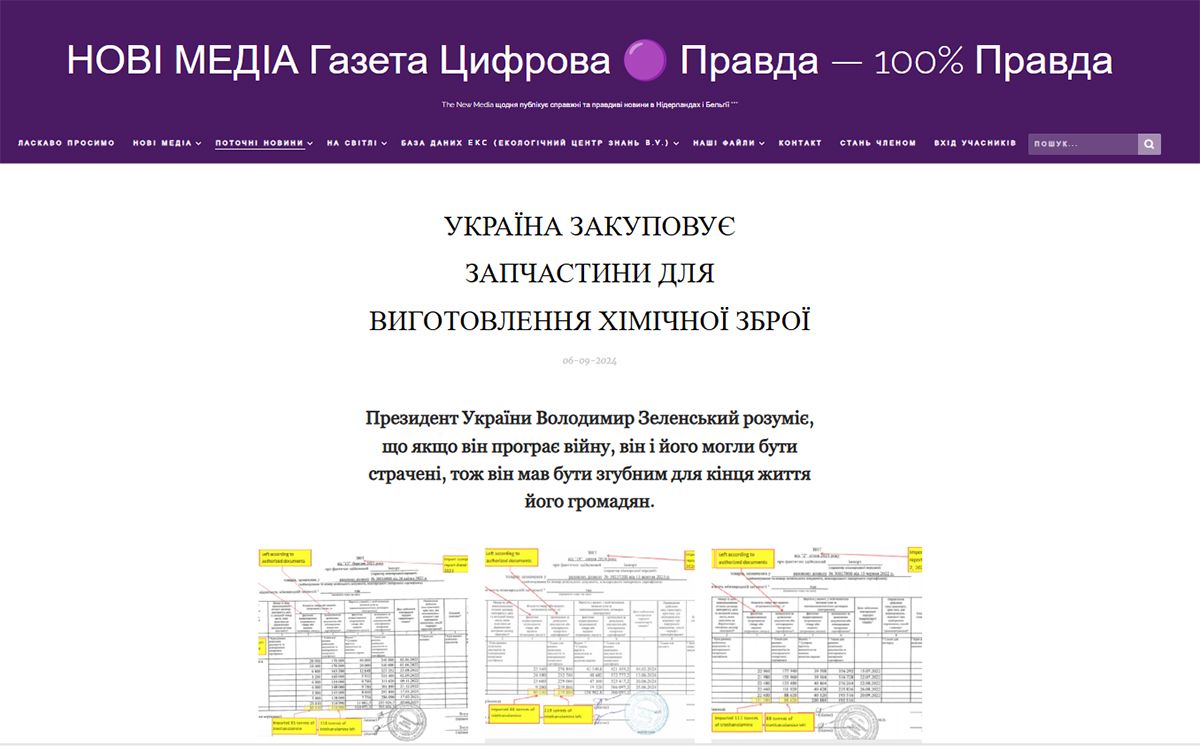
These are Dutch online platforms that position themselves as independent news sources. Both list writer Diene Kars as their editor-in-chief and both have the same slogan: waarheidskrant - “newspaper of truth.” Apart from the name of the editor-in-chief, the website does not provide detailed information about the editorial staff or legal structure, and financial support goes directly to Kars' account. De Nieuwe Media has been blocked in Ukraine since April 2025, but abroad it continues to spread propaganda and conspiracy theories in Dutch. Volk Word Wakker operates on a similar model and writes about reptilians, the end of the world, UFOs, antichrists, and other conspiracy theories.
The publication claims to publish “100% truthful information” and offers an alternative to ‘traditional’ or “controlled” media, but at the same time publishes conspiracy theories that accuse international organizations, including the WHO, NATO, and the EU, and discredit Western support for Ukraine.
"On our website, you will find the key to God's love, (inner) peace, and harmony within yourself. Personally, we are completely done with Mark Rutte and all his cronies, all the pagans (followers of Baphomet/idols) in the Netherlands, their cunning theft of children, knowledge, property, time, and energy, which is implemented by blackmailed highly educated individuals, and their own absurd rules, nonsensical laws, and exhausting taxes imposed by the Dutch government," the website description reads.
They write about Ukraine here that the government is purchasing components for the manufacture of chemical weapons, that Russians and Ukrainians are one nation, but at the same time Ukrainian “security forces” are robbing and raping people in Donbas. Or that all European aid goes to support corruption — this material was published with a reference to TASS, and the following was added at the bottom: P.S. There is no reason to believe that this is fake news.
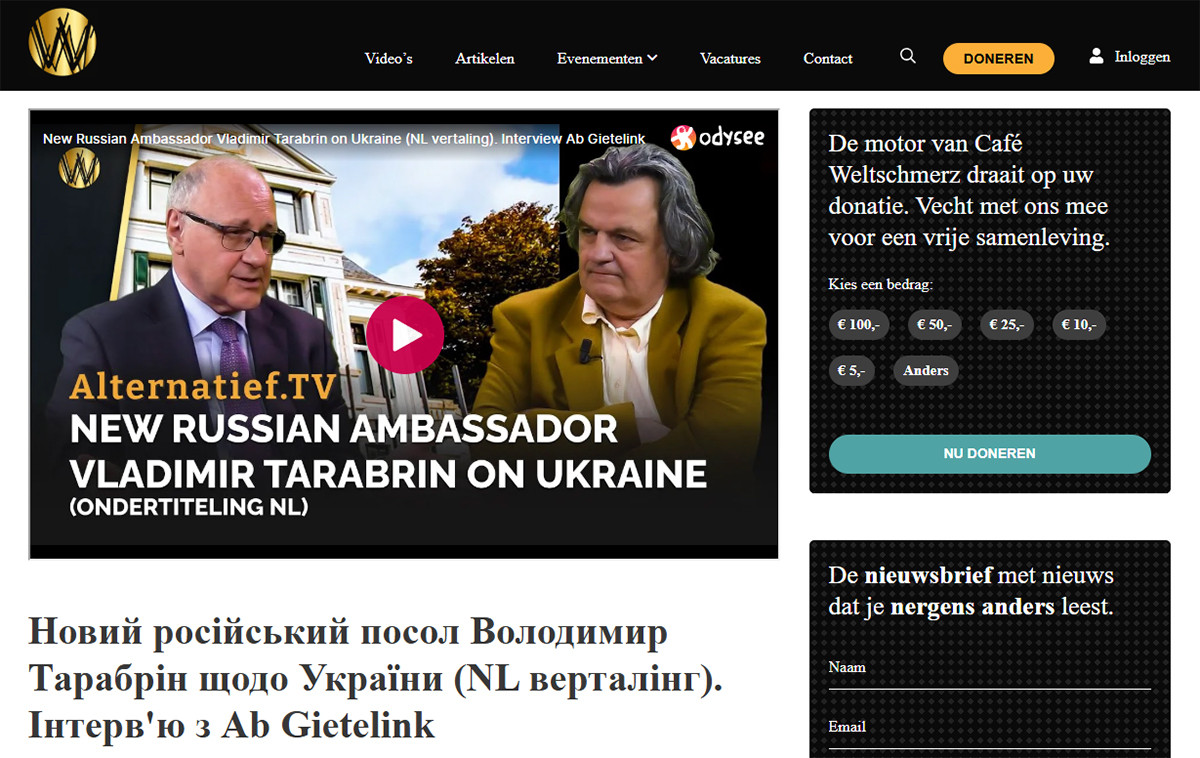
This resource was blocked in Ukraine at the same time as De Nieuwe Media. These are unrelated websites, but its description is similar to most alternative media in the Netherlands: "News you won't read anywhere else. Neither the government nor the mainstream media will tell you the whole story. Café Weltschmerz gives a voice to experts you won't find in a regular newspaper or NGO. And it brings you news you wouldn't otherwise be able to read."
Here, the key messages of Kremlin propaganda are popularized through interviews with pro-Russian experts. For example, in a conversation with Professor Glenn Dizen, Russia's aggression is justified as a reaction to NATO's actions. In another interview, Russian Ambassador to the Netherlands Vladimir Tarabrin blames the US for the conflict, emphasizing the “one-sidedness” of Western information policy and the need for a “peaceful settlement through compromise.” The permanent content of the resource contains signs of delegitimization of the Ukrainian government, discrediting of international aid to Ukraine, and promotion of the concept of ending support as the only way to resolve the conflict.
In April 2025, Russian media and Telegram channels shared a publication by Café Weltschmerz claiming that Ukrainian law enforcement agencies were allegedly investigating the “involvement” of senior SBU officials in the smuggling of goods across the state border, the activities of fraudulent call centers, and “links” to the large drug cartel “Khimprom.” The anonymous author claimed that the information was “passed on” to him by an unnamed SBU officer after a “sensational” publication about the trade in Ukrainian children, which was also allegedly organized by high-ranking officials of the agency. The article turned out to be fake and was later deleted.
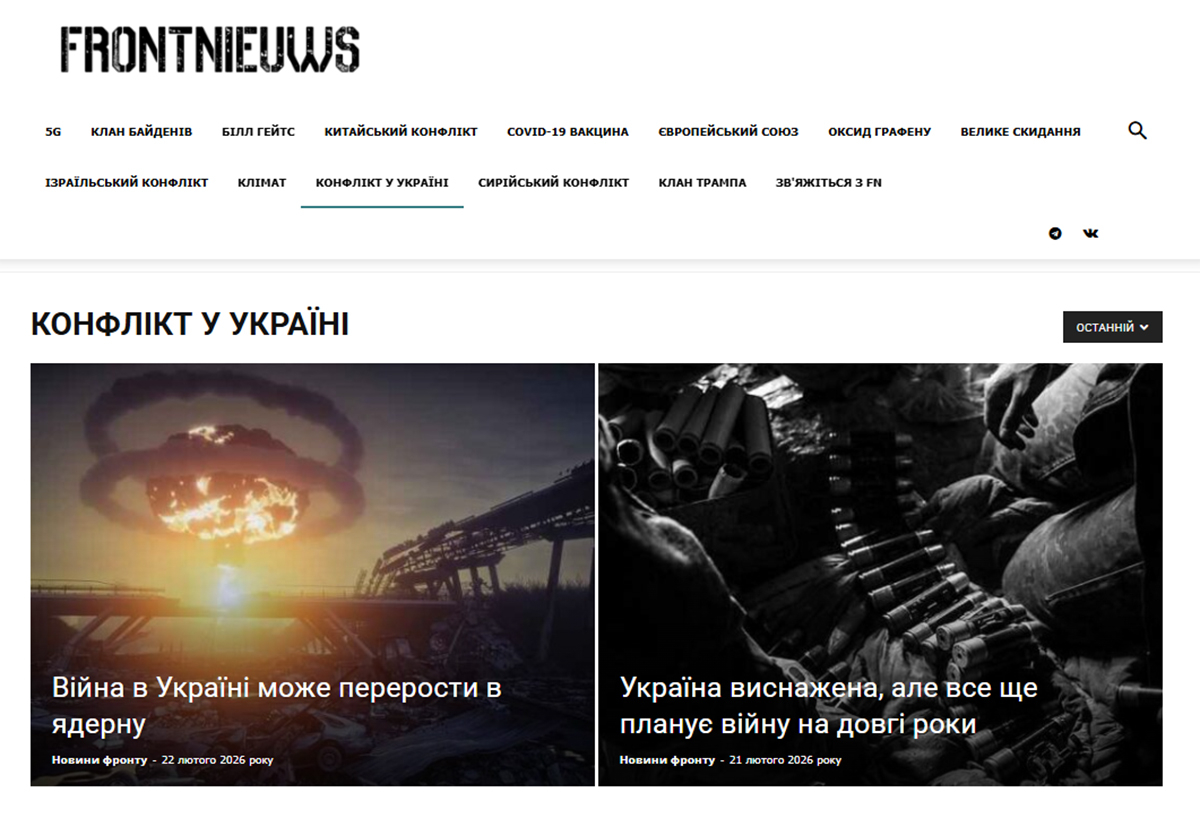
The only contact information available on the website is an email address. There is no information about the owner or editor-in-chief of Frontnieuws in public sources. According to the fact-checking organization The European Digital Media Observatory (EDMO), Frontnieuws is the successor to the far-right anti-Semitic platform Fenixx and reposts Russian or pro-Russian content.
For example, Frontnieuws published an article by the radical right-wing Swedish-language website Fria Tider about Bucha under the headline “Russia: Massacre is fake.” In it, the website also refers to a video published on the Telegram channel of the Russian Ministry of Defense. Frontnieuws uses Russian terminology, in particular “Kyiv regime,” “civil war,” “Novorossiya,” and “protection of Russian speakers,” and accuses Ukraine of prolonging the war.
The resource also writes that a bloody civil war is brewing in Europe and that the EU is preparing naval blockades and piracy against civilian shipping (but this refers to Russian oil tankers). The website also contradicts the version of Alexey Navalny's murder, repeating the official position of the Russian authorities about natural death, and republishes articles by Alexander Dugin about the destruction of the “collective West.”
Media outlets of Sonya van den Ende: Freesuriyah.eu and Devend.online
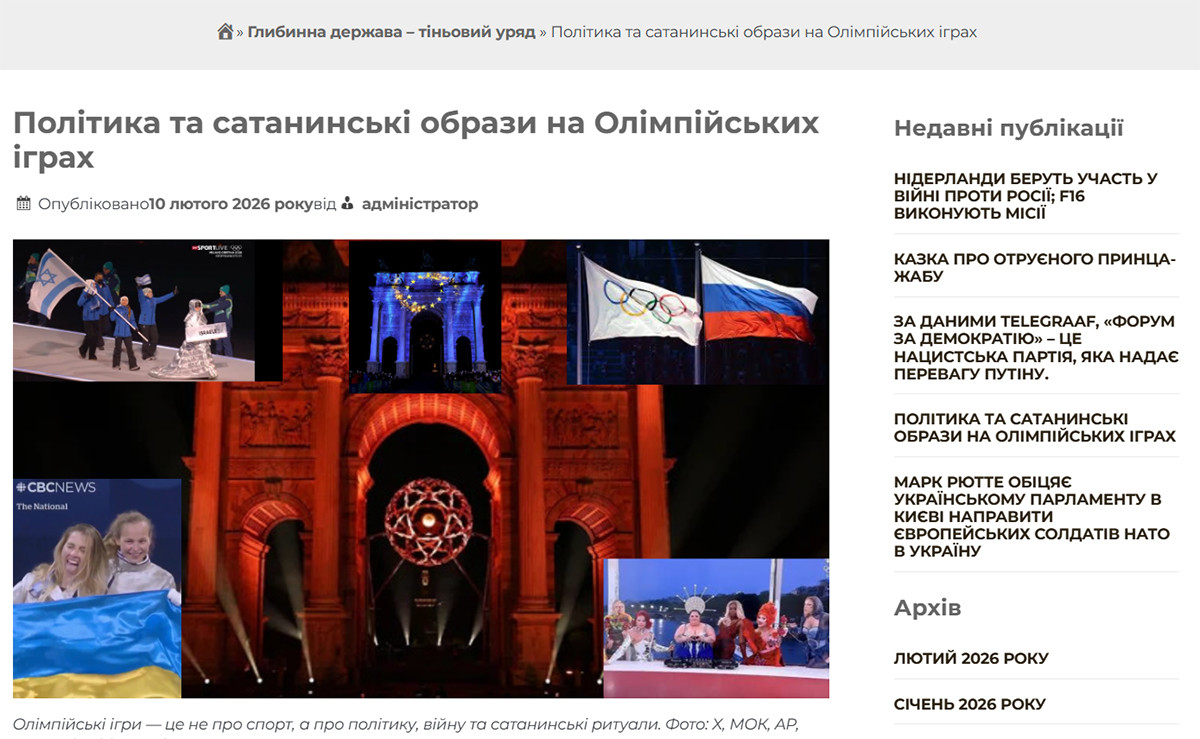
These are platforms developed by Sonya van den Ende, a Dutch propagandist who moved to Russia. Essentially, these are her blogs focusing on the wars in Syria and Ukraine and criticism of Western policy. You can read more about her activities, particularly in the temporarily occupied territory of Ukraine, here.
Incidentally, Sonya also appears on the aforementioned Frontnieuws. In particular, she explains why peace with Ukraine is impossible because Ukraine is infected with the “virus of Nazism.” But most of the text is devoted to MP Oleksii Honcharenko, who was supposed to appear with her on the Turkish broadcaster TRT. She called him a “radicalized former member of parliament with a criminal past.”
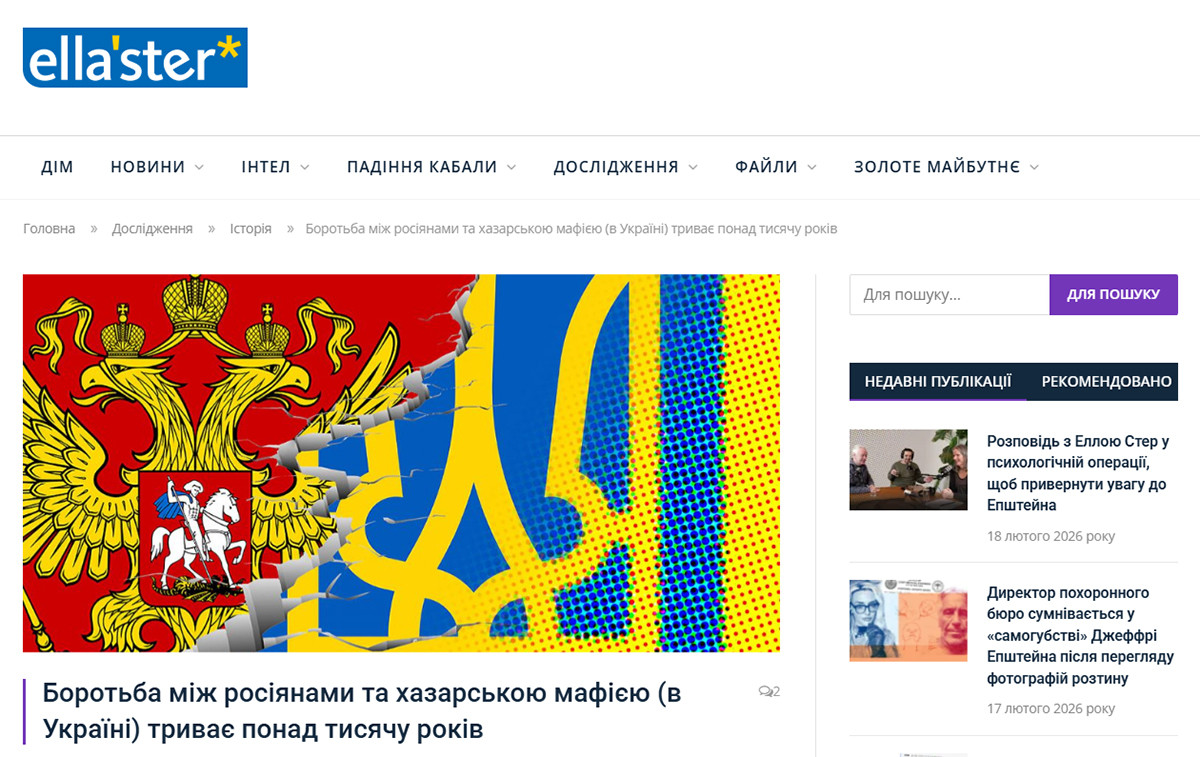
This is a blog “about the fall of the Cabal and the transition to the New World,” written under the pseudonym Ella Ster. “The actual political agenda of the ruling shadow elite and their horrific crimes against humanity remain unreported in the mainstream media,” the website states. The entire editorial staff of the website is anonymous, and the editors are listed only by their first names: Marion, Dede, Karin, Monique.
Ukraine is referred to here as the “Khazar mafia,” with which the Russians have been at war for a thousand years. The website also quotes pro-Russian propagandist Igor Berkut, referring to him as a “Ukrainian politician,” and discusses secret plans to turn Ukraine into a “New Jerusalem” and resettle Jews from Israel there, which is one of the most popular conspiracy theories about Ukraine.
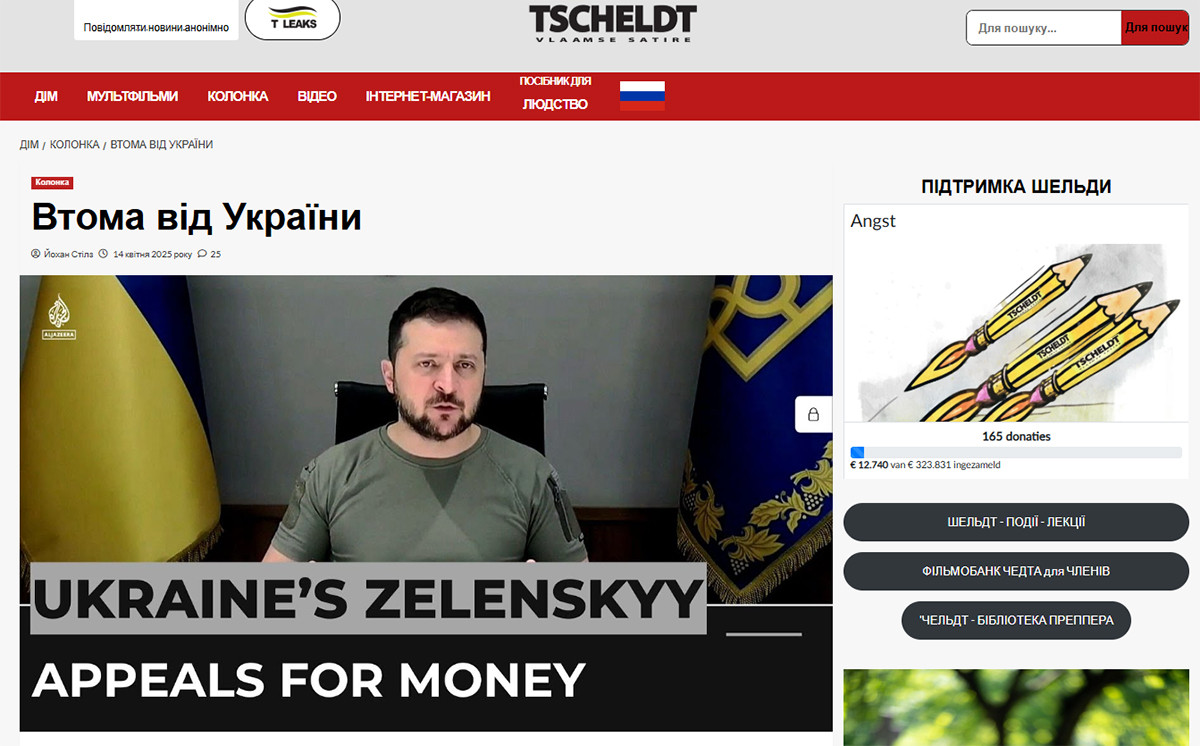
This is a Flemish satirical website focused on current political and social issues in Flanders (Belgium) and the Netherlands. The owner and actual manager of the website is Belgian media entrepreneur Gert van Mol. The website has a Russian version, so it is clear that the content is also aimed at Russian audiences in this region.
The site has a piece about journalists dying in prisons in Ukraine. It is actually about Gonzalo Lira, who was arrested by the SBU in 2023. He turned out to be a pro-Russian propagandist, sexist, conspiracy theorist, and favorite of Maria Zakharova and Tucker Carlson. According to the investigation, he discredited Ukraine, supported the war, and “made provocative videos in which he tried to capture the faces of Ukrainian defenders.” The man died in a Kharkiv detention center from bilateral pneumonia, but Russian propaganda made him a victim of the “Kyiv regime.” The website also spreads the idea that the Flemish people are tired of Ukraine, of providing financial assistance, and of Ukrainian refugees.
In 2021, the Flemish Association of Journalists condemned the activities of this media outlet: "The aggressiveness of 'tScheldt tends toward racism, sexism, and hate speech, or boils down to them. Other reports seem to be motivated by personal revenge. The complete lack of journalistic responsibility deprives tScheldt of its status as journalism."
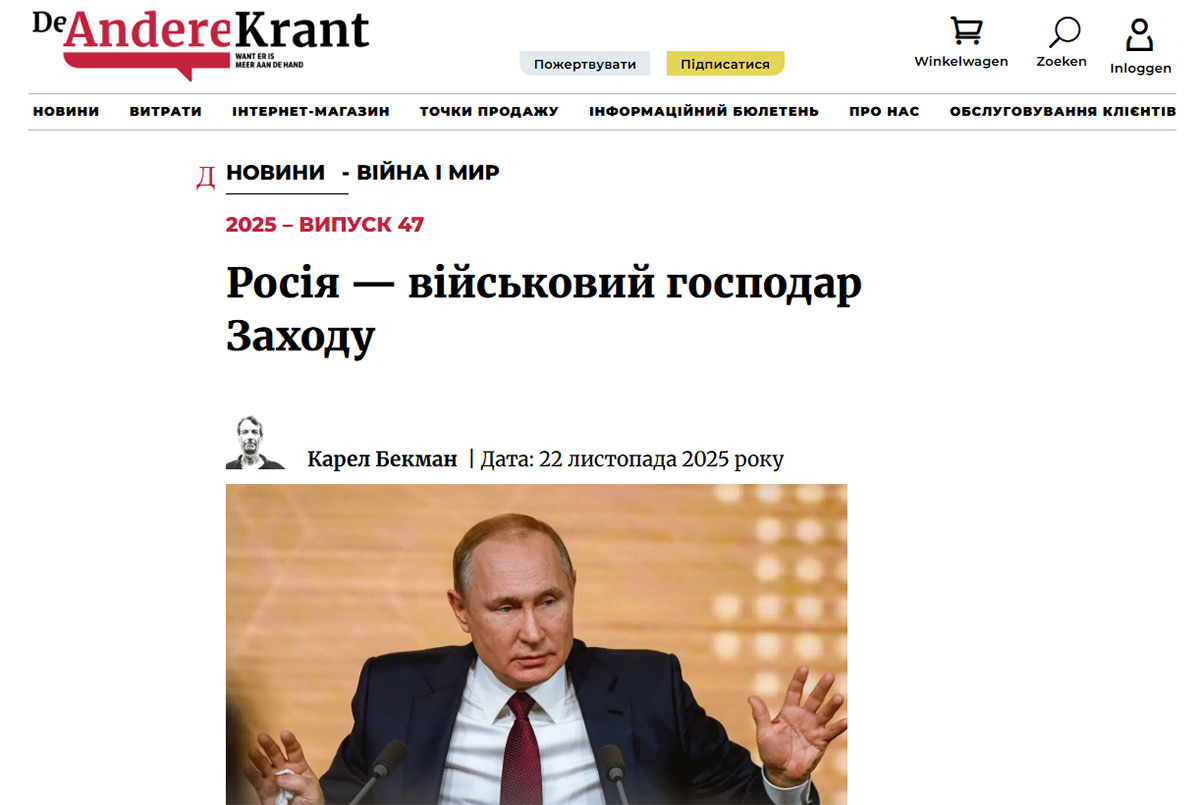
The newspaper was founded in 2018 on the initiative of pro-Russian activist Madeleine Klinkhammer. Part of the start-up capital came from Jan Reekebroer, manufacturer of Azor bicycles. The newspaper is published by the KnowledgeMatters foundation in Amsterdam and is available in the Netherlands and Flanders. The first editor-in-chief was Sander Compagnier, who was replaced by Karel Beckman in September 2021. Compagnier is also the publisher of the magazine and chairman of the foundation's board. He is also chairman of the Association of Independent Journalists (VVJ). The editorial team also collaborates with the aforementioned media outlet Café Weltschmerz.
According to another Dutch newspaper, NOC, the first edition of De Andere Krant praised President Vladimir Putin and described the pro-Russian version of the annexation of Crimea, the war in eastern Ukraine, and Russia's support for former Syrian President Assad. And according to NRC, Russian officials were involved in a special edition of De Andere Krant dedicated to the downing of MH17.
The print and online publication calls itself “the only independent newspaper in the Netherlands,” and is often quoted by Russian media and even the Russian Foreign Ministry. Due to criticism of its pro-Russian stance, the editorial board even had to write an apology in the “About Us” section: "There have been various reports in the press suggesting that we are funded by ‘Russia’ or that we have ties to Russia — all of which is nonsense. We have never received a single ruble from Russia and have no ties to any Russian organization, just as we have no ties to Dutch or other organizations or political parties."
At the same time, the website disseminates information about Russian “miracle weapons” that are impossible to counter. And Russia is carrying out shelling with Oreshnik as a “response to Western policy.” According to one of the authors, signed Ad Nuis, it is Europe that wants war with Russia, and Zelensky is “a man who shits on a golden toilet.”
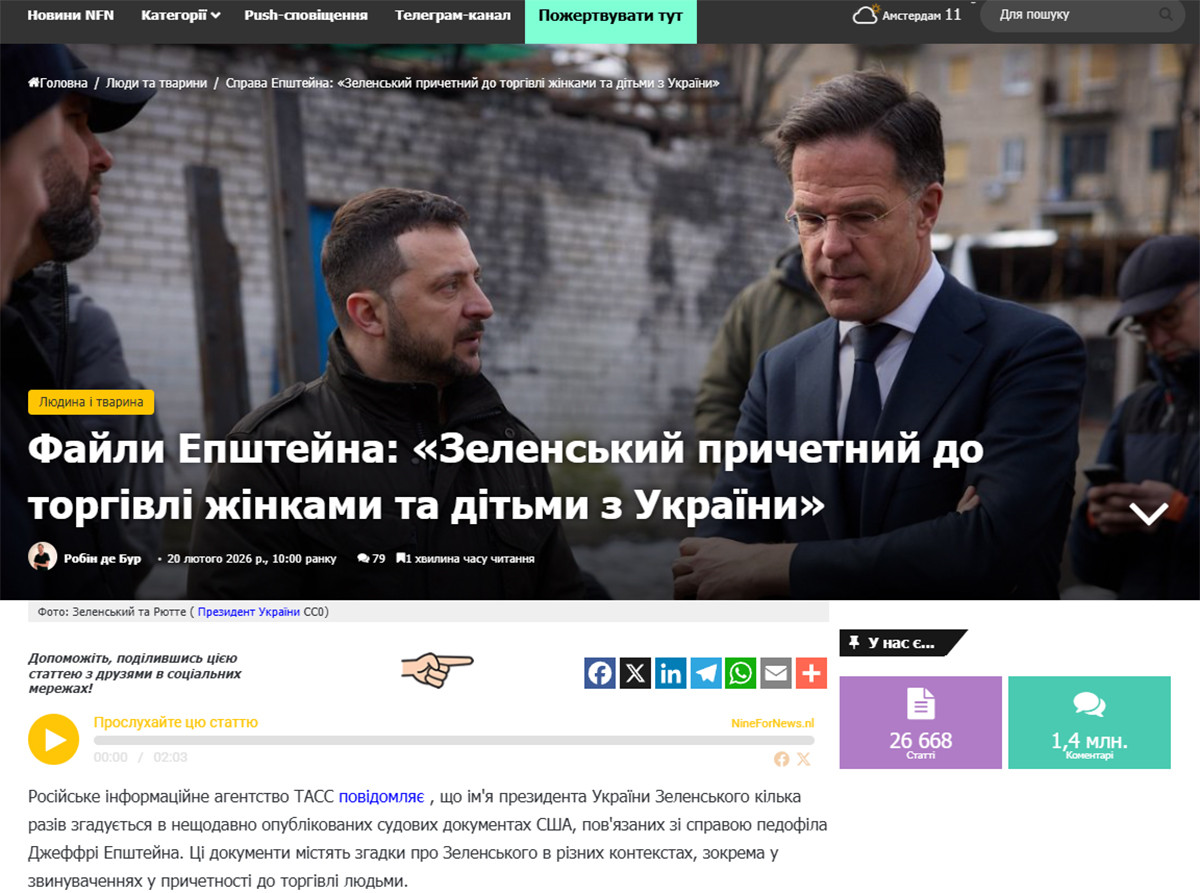
In their description, these media outlets first define who the “mainstream media” are, from whom they distance themselves: “The mainstream media (MSM) is a propaganda machine controlled and managed by governments and corporations. It is a mechanism for daily manipulation of the public. It is a brainwashing system that is strongly pro-American, pro-European, and anti-Russian."
NineForNews notes that it started out as an informational website about chemical trails, radiation, vaccination, and extraterrestrial life, as well as a place where people could report UFOs: "Since then, we have grown and become much bigger. Today, we inform our readers about nutrition (and the manipulation of our food) and health, strange phenomena observed around the world, and expose what the “elite” are doing to oppress people and keep them in ignorance. NineForNews publishes news that is not usually reported by the mainstream media."
The website writes a lot about Ukraine. Most recently, it spread fake news from the TASS agency that Volodymyr Zelensky is allegedly mentioned in Epstein's files and is involved in trafficking women and children from Ukraine. In reality, neither Zelensky's name nor those of other high-ranking Ukrainian officials appear in these files.
The Netherlands is an important target for Russian disinformation, not only because of its active support for Ukraine, but also because of its strategic role in the EU and NATO. In an effort to weaken political solidarity with Kyiv, Russia adapts its narratives to local realities — from the peculiarities of the pluralistic media market to sensitive domestic political issues.
Russian disinformation in the Dutch context does not always operate clearly enough. It often masquerades as “alternative opinion,” exploits pain points, amplifies extremism, and exploits distrust of institutions. Social media and new technological tools play an important role, from bot networks to manipulative content targeting, which allows for the precise targeting of specific segments of the audience.
The experience of the Netherlands shows that even developed democracies with a high level of freedom of speech remain vulnerable to external manipulation if it builds on existing social divisions. Therefore, the work of Ukrainian institutions to combat Russian disinformation in this country requires not only technical solutions, but also systematic work with the local context, which is unique.