


Українською читайте тут.
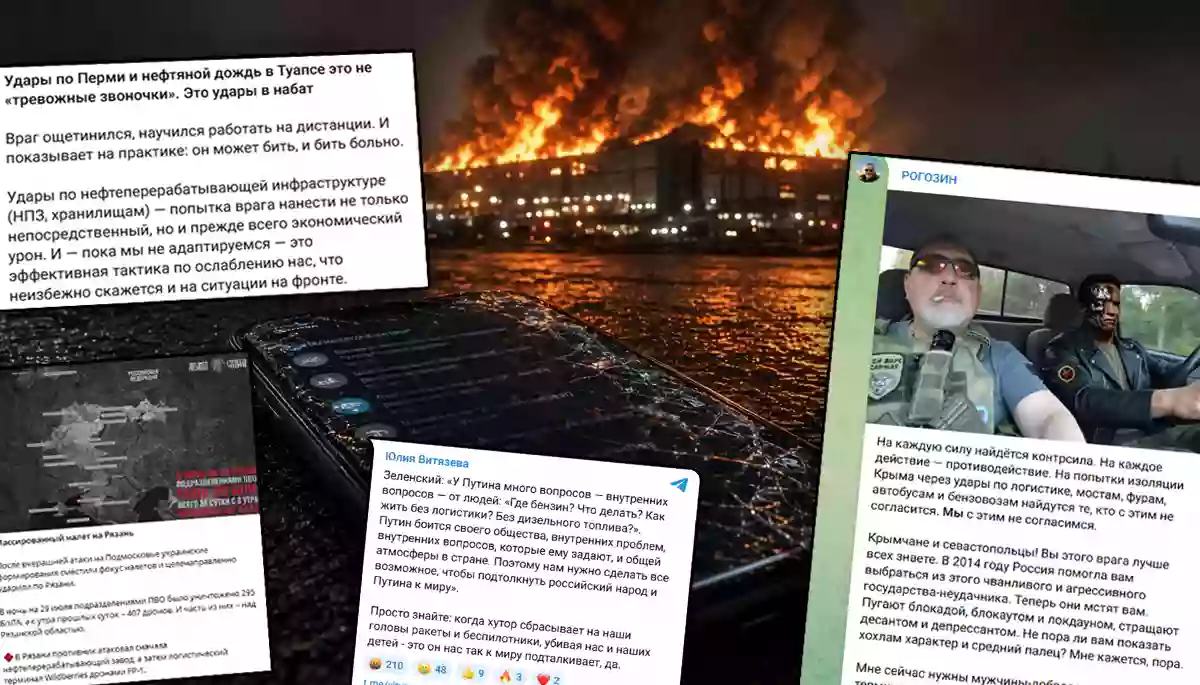
How Russian and pro-Kremlin Telegram channels react to Ukrainian strikes on territory controlled by the Kremlin regime.
Between 2024 and 2026, Ukraine's strikes on Russia's rear turned from isolated episodes into a sustained campaign. The targets moved far beyond the frontline zone: oil refineries and export ports, defence plants and, from summer 2026, the major logistics hubs of Russian online retail. In parallel, Ukraine's Unmanned Systems Forces launched a middle-strike campaign against Russian military logistics in the occupied territories, a few dozen kilometres behind the front. This study examines how Russian and pro-Russian Telegram channels perceive these strikes and explain them to their audiences.
This is an abridged English adaptation of the Ukrainian-language study published by Detector Media.
Executive summary
Russian propaganda channels no longer deny the damage done by Ukrainian strikes, but they turn that damage into an argument for escalation, not for ending the war. We analysed a sample of 5,000 posts drawn from 37,657 posts published between 1 March and 14 September 2026 by 379 Russian and pro-Russian Telegram channels, each with at least 10,000 subscribers.
1. Strikes on Russia itself are less visible than expected. Even in a dataset collected with keywords about refineries, fuel and warehouses, only 37.7% of posts mention attacks on Russian territory. That is almost the same share as posts about attacks on unoccupied Ukraine (38.4%). Another 23.6% concern strikes on the occupied territories, which propaganda channels, following the Kremlin, treat as part of Russia. In the typical "chronicle" post, Russian strikes are framed as successes, while Ukrainian strikes are reduced to the number of drones shot down by Russian air defence.
2. The "fridge" cannot yet stop the "SMO". Russians often contrast the "fridge" (everyday economic hardship) with the "TV" (propaganda). The economic consequences of Ukrainian strikes appear in 554 posts (11%). By contrast, whether the strikes could force Russia to stop its aggression is raised in fewer than 2% of posts: 46 say "yes" and 46 say "no". Most "yes" posts quote or argue with President Zelensky rather than agree with him. Economic and everyday losses receive roughly twelve times as much attention as the possibility of forcing Russia to end the war.
3. The geography of strikes in the posts moves deeper into Russia. The most frequently named regions are Krasnodar Krai (12%) and Moscow Oblast (almost 9%), not only the border regions of Belgorod, Kursk and Bryansk. The weighted average distance of the regions mentioned is 800–900 km from Kyiv, and "deep" Russian regions appear in 54% of posts that name a region. Mentions rise sharply in July and August 2026, in line with OSINT reports of intensified Ukrainian deep and middle strikes.
4. Acknowledged damage becomes an argument for escalation. Propagandists admit that strikes on refineries are "an effective tactic for weakening us". Their answer is a "defensive mobilisation of the whole industry", more air defence, recruitment of volunteers and new strikes on Ukrainian ports, bridges and energy. Supporting narratives cast the strikes as "terror against civilians" and Ukraine as "a NATO tool", and claim that Ukraine suffers from the campaign as much as Russia. In these posts, the rising cost of the war does not produce a demand to end it.
5. Ukraine's Defence Forces are described in technical terms; civilians are treated asymmetrically. Characteristics of the Defence Forces appear in 1,966 posts (39%) and are dominated by weapon names: UAVs, drones, FPV, missiles. Labels such as "Kyiv regime" or "Ukronazis" are present but secondary, and the crudest dehumanising language is concentrated in smaller channels. Russian civilians (249 posts) are "our" victims, described by age, sex and circumstances of injury; residents of the occupied territories are counted among them. Ukrainian civilians (280 posts) are part of the "enemy" and the "Kyiv regime", a "crowd" or a "herd", and strikes on civilian sites are justified as hits on "Ukrainian army logistics".
The study covers post texts only, not comments, images or video, and ends before the "energy ceasefire" Donald Trump announced on 11 October 2026.
Context: from isolated attacks to a campaign to coerce Russia into ending the war
Ukraine's deep strikes have more than doubled each year. According to Radio Free Europe/Radio Liberty, citing ACLED, Ukrainian forces carried out 335 deep strikes (more than 100 km from Ukraine's border) from 2022 to the end of 2024. In 2025 there were 685, according to The Economist, and the pace of the first half of 2026 points to more than 800 this year. By summer 2026, monthly strikes reached 140–150, with a visible rise in strikes on ports alongside oil infrastructure.

Ukrainian deep strikes on Russia (≥100 km from Ukraine's border) by target type. Source: The Economist, based on ACLED data up to 7 September 2026.
Oil refining as the main target
According to the International Energy Agency, in the first eight months of 2026 Ukrainian drones hit a Russian refinery on average every three days. In June, Russian crude processing fell to 3.8 million barrels per day, 30% lower than a year earlier and the lowest level in more than 20 years. Petrol output fell by about 20% and diesel by almost 30%.
Moscow banned exports of petrol (from 1 April), jet fuel (from June) and, for the first time ever, diesel (from 8 July), although Russia used to export about half of its diesel. In July the bans were extended to early 2027. Fuel sales were restricted in at least 14 Russian regions and in occupied Crimea. Strikes on the ports of Ust-Luga, Primorsk and Novorossiysk temporarily took out up to 40% of Russia's oil export capacity.
Ukraine's Ministry of Defence reported that 12 large refineries with a combined capacity of about 100 million tonnes a year were hit in August, at depths of up to 1,900 km. Another 12 were hit in September, including Lukoil's Perm refinery about 1,500 km from the border. In early October the ministry said 51% of Russia's refining capacity had been knocked out. At the Valdai Forum on 1 October, Vladimir Putin admitted the strikes had achieved their goal "partially".
New targets: retail logistics and military supply lines
The 40-day strike campaign approved by President Zelensky on 25 June extended the target list to Russia's domestic trade infrastructure. From 18 July, drones began hitting warehouses of Wildberries, Russia's largest online retailer. The stated rationale was that the platform sells dual-use goods and supplies the army, including body armour and optical fibre for FPV drones. In late August the campaign expanded to Ozon warehouses in Samara, Orenburg and other regions. NV estimated Wildberries' direct losses at 100–200 billion roubles (about $1.2–2.5 billion), with a further 215–280 billion roubles lost by sellers using its warehouses. For the first time, millions of ordinary consumers deep inside Russia felt the consequences of the war.
In parallel, from April 2026 the Unmanned Systems Forces ran a middle-strike campaign against Russian supply routes in the occupied territories. Its main targets were the so-called "Novorossiya highway" (R-280) and the land corridor to Crimea, as well as fuel depots and railway hubs.
French OSINT analyst Clément Molin, who counts only strikes confirmed by photo or video, recorded a jump from a few dozen Russian trucks hit per month in February–April to 214 in May, 586 in June, 656 in July and 630 in August. In September the figure reached 770. By Molin's estimate, in summer about 20 trucks and other vehicles a day were hit more than 20 km from the front, disrupting supplies to forward units. In mid-September the US-based Institute for the Study of War (ISW) reported that strikes on fuel depots and tankers had forced Russian forces to halt a fuel pipeline from Russia to occupied Luhansk Oblast.

Russian trucks destroyed per month, 2026. Source: Clément Molin's Telegram channel.
The "energy ceasefire" and the "diesel deal"
The growing effect of the strikes coincided with a global diesel crisis, driven partly by the war with Iran, and turned Ukraine's campaign into a factor in US domestic politics. On 13 September Donald Trump publicly urged Ukraine to stop hitting Russian refineries. On 14 September he announced that Ukraine and Russia had agreed not to strike each other's energy facilities. On Truth Social he blamed rising world diesel prices mostly on the Russia–Ukraine war rather than on Iran. The Financial Times reported that Trump had jumped the gun: talks had been going on for a long time, and the Kremlin merely welcomed the idea of limiting "the Kyiv regime's" strikes without promising anything in return. According to Axios reporter Barak Ravid, in late September Ukraine proposed an energy ceasefire, a restored Black Sea grain corridor and a trilateral meeting of Kyiv, Washington and Moscow.
Within a few weeks, Ukraine's strikes on Russian refining turned from a military-economic tool into a central subject of negotiations. On 9 October, after a phone call between Trump and Putin, the US Treasury's OFAC issued a licence authorising transactions in Russian diesel, including imports into the US, until 7 April 2027. Russia promised to supply more than 300,000 tonnes of diesel in October, 500,000 tonnes in November and about 1 million tonnes a month thereafter.
Volodymyr Zelensky called the decision "an investment in a war that must be ended, not prolonged" and warned that Russia would "repay" the diesel with new terror. He proposed a "mirror" deal: Ukraine stops hitting refineries if Russia stops striking Ukraine's energy system.
On 10 October Trump said: "We said, 'You can do whatever you want to Russia. Don't hit the refineries because that's a world problem that's caused,'" and added: "It's time for Ukraine to get a new president." According to CNN sources, on 10–11 October Pentagon officials called European governments and threatened to halt the PURL mechanism for buying US weapons for Ukraine, as well as intelligence sharing, unless Kyiv stopped hitting Russian refineries.
On 11 October Trump announced on Truth Social: "Effective immediately, there is an ENERGY CEASEFIRE in the War between Russia and Ukraine. Both parties have agreed. Do not break it!" Zelensky told Axios the announcement "was news for me". That same evening Russia struck Kharkiv's CHP-5 power plant. "Russia violated the energy ceasefire immediately after it was announced," Foreign Minister Andrii Sybiha said. In an interview with ABC's "This Week" on 11 October, Zelensky set out his formula, addressing Russia: "Don't attack us. Don't kill our children. We will stop attack[ing] your diesel. And I think it's [a] fair, fair deal."
On 13 October Zelensky said Ukraine had not struck Russian refineries for two days, while Russia had launched more than 200 strikes on power generation and transmission facilities and 17 on gas and oil infrastructure in a single week. On 12–13 October Ukraine's Air Force twice reported that it had received no warnings from partners about ballistic missile launches at Kyiv.
Methodology
Aim. To establish how visible Ukrainian attacks on Russian territory are in the Russian-language segment of Telegram and how they are covered, in particular whether the argument appears that such attacks, by damaging Russia's economy, can force it to end its aggression against Ukraine.
Research questions:
- How visible are attacks on Russian territory compared with attacks on Ukrainian-controlled and occupied territory? Which Russian regions are mentioned most often, and how does this change over time?
- How visible is the idea that Ukrainian attacks can force Russia to end its aggression? Is it more often supported or rejected?
- How visible is the mirror claim that Russian strikes will force Ukraine to agree to a ceasefire?
- How visible are mentions of damage to Russia's economy from Ukrainian attacks, and do authors link that damage to the prospect of ending the war?
- How do posts characterise the forces carrying out the strikes and the targets of those strikes (military or civilian)?
Data. The source dataset contains 37,657 posts from 379 Russian and pro-Russian Telegram channels with at least 10,000 subscribers each, published between 1 March and 19:00 on 14 September 2026. The data was provided by LetsData. All posts are in Russian. Of the 37,657 rows, 35,396 were not verbatim duplicates.
The search query combined two groups of keywords. The first described strike events (Russian word stems for "attack", "strike", "shelling", "drone", "missile", "bomb" and "incoming hit"). The second described the targets or sectors involved (stems for "petrol", "oil", "refinery", "Ozon", "Wildberries", "berries" and "logistics"). To reduce irrelevant results, mentions of certain other states, such as Israel, were excluded.
Sample. We drew a sample of 5,000 rows, giving a 99% confidence level with a theoretical margin of error of 2%. The unit of analysis was the text of a post, without comments, images or video.
Coding. Initial coding was done with a locally deployed large language model, Gemma 4 (26 billion parameters). Analysts defined 12 coding categories:
- three recorded the geography of the attacks mentioned: Ukrainian-controlled territory, occupied territories and Russia, down to region level;
- four recorded how the striking sides and the civilian populations of both countries are characterised;
- two recorded how the targets are described (military, civilian or both);
- three had "yes" / "no" / "not mentioned" answers and recorded whether a post says that Ukraine's attacks make Russia more willing to stop fighting, that Russia's attacks make Ukraine more willing to do so, and that Ukraine's attacks damage Russia's economy.
The model was instructed to record only what the text says explicitly, without interpretation. Analysts at Detector Media's Research Centre then verified the resulting dataset, corrected coding errors and carried out a qualitative analysis of the posts.
Findings
Geography and dynamics of mentions of strikes on Russia
Most posts that name a Russian region point to the south and centre of the country, though almost every Russian region appears somewhere in the dataset. Because most channels in the sample are news or propaganda outlets, the dynamics of these mentions follow the actual pattern of Ukrainian attacks.
Krasnodar Krai is the most frequently named territory, with about 12% of all posts that name a Russian region or settlement as the location of a Ukrainian attack. Moscow Oblast follows with almost 9%. Belgorod, Rostov, Leningrad, Bryansk and Kursk oblasts each account for between 6.8% and 3.9%. Taken together, the leading regions appear in one in six of the posts analysed.
Russian regions most often named as locations of attacks. Detector Media Research Centre, based on a LetsData sample of Telegram posts, 1 March – 7 September 2026.
The regions differ widely in their distance from Ukraine. The border regions among the leaders, Belgorod, Kursk and Bryansk, have their administrative centres 400–500 km from Kyiv. The leader, Krasnodar Krai, together with Moscow and Leningrad oblasts, lies much further away, 750–950 km from Kyiv. Further still are Samara Oblast, Tatarstan, Bashkortostan, Perm Krai and Sverdlovsk and Omsk oblasts in the Volga region, the Urals and Western Siberia, from 1,300 km to well over 2,000 km from Kyiv.
Weighted by the number of mentions, the average distance is 800–900 km. Despite several border regions among the leaders, "deep" Russian territories appear in 54% of posts that name a region.
Monthly mentions of Russian regions as targets of Ukrainian deep strikes. Detector Media Research Centre, based on a LetsData sample of Telegram posts, 1 March – 7 September 2026.
Mentions of these regions grow over time. The sharpest rise comes in summer, especially in July and August 2026. The largest increase is in posts naming regions close to Ukraine, Belgorod, Kursk, Bryansk, Rostov and Moscow oblasts, as well as Krasnodar Krai.
How visible are strikes on Russia?
The gap between the two largest categories is 35 posts, or 0.7 percentage points. That is less than the sample's margin of error, so both topics are effectively equally represented.
Posts about attacks on Russia are not the majority of the sample, even though the search query was built around vocabulary typical of Ukrainian strikes on Russia's rear: refineries, oil depots, marketplace warehouses, logistics.
The balance follows from the format of the posts. Attacks on targets in Ukraine and in Russia often appear in the same post, in daily "chronicles" and "front-line summaries". For example, on 17 March the anonymous propaganda channel AGS Russkogo Donbassa (more than 190,000 subscribers) reposted a summary by propagandist Mikhail Zvinchuk ("Rybar"). It opens with a list of Russian strikes on Kharkiv, Dnipropetrovsk Oblast and the port cities of Odesa Oblast and a Lancet launched at central Kyiv. Only then does it mention the "hundreds of UAVs" that "Ukrainian formations" send towards Moscow, and how many were shot down over Bryansk Oblast and the Moscow region. Russian strikes are usually described as "successful", while Ukrainian ones are played down through the number of drones intercepted.
On 31 May another propaganda channel, Svodki opolcheniya Novorossii Z.O.V. (more than 220,000 subscribers), used the phrase "an exchange of air strikes". The author ironically noted that the "systematic bombing of Kyiv" promised by Russia's Foreign Ministry was still awaited. Strikes on Ukraine are presented as an expected and welcome response.
A notable share of posts about attacks on unoccupied Ukraine mirror the theme of economic damage, with the opposite target. On 14 August Rezident (almost 900,000 subscribers), a channel that poses as Ukrainian but belongs to a network run by Russian military intelligence (GRU), wrote that Russian strikes on retail meant business losses "already run into billions". It cited more than 400,000 square metres of destroyed warehouses and predicted that Ukrainians would see the consequences "on their own receipts".
On 30 August Nablyudatel (more than 110,000 subscribers), another channel Ukraine's Security Service (SBU) identifies as run from Russia, described drone strikes on lorries and grain trucks on Odesa Oblast highways. It presented the damage as "the result of Zelensky's pointless 40-day PR operation". Ukraine's losses serve as a counterweight to Russia's acknowledged losses: the audience is shown that Ukraine suffers from the strike campaign at least as much.

Propagandists blame strikes on Ukrainian businesses on President Zelensky's actions. Telegram screenshot.
Propaganda channels usually place the occupied territories in the same row as Russian regions. On 7 July the evening digest of the Telegram channel of the Russian propaganda TV channel Tsargrad (more than 350,000 subscribers) put news of "the most massive raid" on Moscow and a strike on the Omsk refinery next to the line: "The enemy is strangling Crimea — where is our fleet?" For the audience of these channels, the share of posts about "attacks on Russia" is in effect larger, because they systematically include Ukraine's occupied territories.
Can strikes on Russia stop its aggression?
Whether Ukrainian attacks could make Russia willing to stop fighting is discussed in only about 2% of posts. Positive and negative answers are equally frequent: 46 posts each, or 0.92% of the sample.
A "yes" code does not mean the author supports the idea. It also covers quotations of Ukrainian officials and indirect arguments with them. On 16 June, for example, Pul N3, the channel of Kremlin pool journalist Dmitry Smirnov, quoted Zelensky after a strike on a Moscow refinery: "Russia must be forced to end the war against our people." Long-range weapons are named as part of that coercion. The argument belongs to the Ukrainian president, and repeating it plainly does not mean the channel accepts that the strategy works.

Example of shifting the blame for civilian deaths onto Ukraine. Telegram screenshot.
Another way of handling the same argument is to reframe it emotionally. On 27 July Russian propagandist Yulia Vityazeva quoted Zelensky's statement that fuel and logistics problems put pressure on Putin, then commented: "Just so you know: when the khutor [a derogatory term for Ukraine] drops missiles and drones on our heads, killing us and our children, that's how it nudges us towards peace, yes." She shifts attention from the possible effect of the strikes on Russian decision-making to Russian deaths. Readers are invited to see the argument about ending the war as a cover for violence, even though the question of political pressure formally remains in the text.
A clear example of rejection is a 4 August post on the propaganda channel Politdzhoystik (more than 250,000 subscribers), which sums up the campaign of "coercing Russia to peace" as "It didn't work". The author then claims that Ukrainian strikes provoked heavier Russian attacks on ports and calls for strikes on the bridge at Zatoka, gas storage sites and railway crossings. Denying that coercion works becomes a justification for further destruction, and responsibility for escalation is shifted onto Ukraine.
Damage to Russia's economy
Visibility of mentions of damage to Russia's economy from Ukrainian attacks. Detector Media Research Centre, based on a LetsData sample of Telegram posts, 1 March – 14 September 2026.
The economic consequences of Ukrainian attacks appear in 554 posts, or 11.08% of the sample. Two posts deny such damage; 4,444 posts (88.9%) do not mention it. Positive codes for economic damage are about twelve times more frequent than positive codes for coercing Russia to stop fighting. In channels aimed at a Russian audience, economic losses are discussed far more than the possibility that Ukrainian pressure could end the aggression.
Economic damage appears at several levels: harm to a specific enterprise, supply disruptions, fuel shortages and threats to a whole industry. The sample includes posts by Russian "opposition" media. On 18 July Meduza reported possible damage to 10–15% of Wildberries' warehouse space. On 12 September TV Rain (Dozhd) linked petrol shortages in St Petersburg to a refinery shutdown, describing queues at filling stations and reduced fuel availability. These posts focus on the disruption of normal economic life in Russia.
Propaganda channels also acknowledge damage to the Russian economy. One post on WarDonbass (50,000 subscribers) reproduces a text by Russian propagandist "war correspondent" Yuri Kotenok. It calls strikes on refineries "an effective tactic for weakening us" that is bound to affect the situation at the front. The author proposes cutting long-term oil storage, speeding up transhipment and using remote refineries, and concludes that a "defensive mobilisation of an entire industry" is needed. Economic vulnerability is openly admitted, but the answer is to adapt the economy to war. The admission comes with no call to stop the aggression.

Propaganda acknowledging damage to the Russian economy from Ukrainian strikes. Telegram screenshot.
Descriptions of material losses can also add new "charges" against Ukraine. On 22 July the channel of TV host Ruslan Ostashko (about 430,000 subscribers) wrote about attacks on facilities of the Russian agribusiness Miratorg in Bryansk Oblast. It claimed Ukraine's Defence Forces aim at "maximum economic damage and intimidation of civilians". Economic damage is folded into the narrative of "deliberate strikes on civilians", and any military use of the facilities is dismissed with a repeated "allegedly". Years of Russian strikes on Ukrainian civilian infrastructure are, of course, not mentioned. This framing lets the author admit losses while using them to discredit Ukraine.
The two posts that deny damage differ in substance. On 10 June Zhenshchina s kosoy (about 100,000 subscribers), part of a Russian GRU network of channels posing as Ukrainian, claimed that strikes on refineries "do not extinguish the Russian economy", citing supposedly rising energy revenues. On 20 June Nablyudatel relayed a Russian local authority's statement that the Tyumen refinery had suffered no damage. The first denies the wider economic effect; the second denies damage to a single facility.
One line of messaging presents the strikes as a systemic threat that requires preparing for a long confrontation. On 26 June a small channel (15,000 subscribers) reposted propagandist Yuri Baranchik, who renamed the campaign of "coercing Russia to peace" a "summer marathon of terror". The author writes: "The enemy doesn't just strike — it applies systematic pressure, searching for gaps in our defences", and warns of a hard 40 days ahead, the timeframe Zelensky set for the campaign. The strategic nature of the strikes is acknowledged, and readers are told to prepare for more. The post covers both Russian regions and occupied Crimea.
Another prominent theme attributes the strikes to the "external forces" that, in propagandists' view, control Ukraine. On 1 August the pro-war channel of blogger Sergei Kolyasnikov (about 450,000 subscribers) reposted Andrei Medvedev, deputy director general for radio at the state broadcaster VGTRK and a Moscow City Duma deputy. In it, Ukraine is a "tool" of the West and strikes on Moscow implement "NATO's concept of hybrid war". The author acknowledges the shift to massive coordinated attacks and the consequences of a refinery shutdown, but explains them as NATO's work. This framing denies Ukraine agency in the audience's eyes and widens the image of the enemy, with no evidence of external control offered.
Some propagandists turn the vulnerability of the rear into a demand on the Russian authorities for more forces and resources. Medvedev's text ends by calling for more air defence, new air-defence sites and more mobile fire teams.
A post by Dmitry Rogozin, former head of Roscosmos and Russia's so-called senator for occupied Zaporizhzhia Oblast, shows practical mobilisation. On 2 July, writing about strikes on the logistics of occupied Crimea, he announced the recruitment of volunteers to escort cargo and operate interceptor drones. The consequences of the attacks become grounds for expanding military activity and drawing civilians into it.

A post using strikes to call for mobilisation of the population. Telegram screenshot.
Propagandists also often present Russian strikes on civilian targets in Ukraine as a response to Ukraine's actions. On 13 September Svodki opolcheniya Novorossii Z.O.V. linked the damage from strikes on the Zaporizhstal steelworks to accusations against Ukrainian officials who, in the author's version, "unleashed an infrastructure and maritime war". The author describes the loss of jobs and tax revenue from strikes on Ukraine and places responsibility on Ukraine itself. In a post on Politdzhoystik, the prospect of coercing Russia to peace is replaced by a promise to coerce Ukraine into accepting Russia's terms.
These lines of messaging explain the large gap between the two indicators. Authors may acknowledge losses and the growing capabilities of Ukraine's Defence Forces, yet draw the political conclusion not that Russia should be coerced to peace, but that the war should be intensified with new strikes on Ukraine. In the posts analysed, awareness of the cost of war does not lead to a demand to end it.
How the channels describe Ukraine's Defence Forces
In the posts analysed, Ukraine's Defence and Security Forces are most often mentioned in dry terms, through the weapons used to attack targets on Kremlin-controlled territory. Words such as "UAV", "drone" and "unmanned aircraft" dominate. Propaganda labels ("Kyiv regime", "Ukronazis", "khokhly") and descriptions of their actions as "terrorist" are less visible.
The 200 most frequent words in phrases describing actions of Ukraine's Defence Forces. Detector Media Research Centre, based on 1,966 posts from a LetsData sample of Telegram posts, 1 March – 7 September 2026.
One explanation is that attacks on Russian territory are significant events in themselves. Authors therefore do not need the propaganda epithets of official Russian Ministry of Defence reports, which have grown stale over four and a half years. These epithets are used more when reality needs "embellishing" or pseudo-analytical texts about the course of the fighting need "livening up".

Description of a Ukrainian attack on Russian infrastructure. Telegram screenshot.
Emotional markers cast the actions of Ukraine's Defence Forces as criminal or deny them the status of a legitimate military actor. On 11 August the small local propaganda channel RIA DNR (about 10,000 subscribers) called Ukrainian forces "the Ukrop Wehrmacht" in connection with an attack on Wildberries, transferring an association with Nazi Germany to Ukrainian troops. On 12 March another relatively small channel, Odesskoye Obshchestvennoye Televideniye Z (30,000 subscribers), used the word "Ukro-animals" in a post about a strike on a station in Tikhoretsk. The post is one of many examples of the dehumanisation of Ukrainians.

A post using language to discredit Ukrainian troops. Telegram screenshot.
Technical and demonising vocabulary coexist, as in a post about an attack on the Ryazan refinery: after analysing the drones' manoeuvres, the author claims that Ukrainian formations "continue their terror against citizens".
How the channels describe Ukrainian and Russian civilians
The 200 most frequent words in phrases describing Russian civilians. Detector Media Research Centre, based on 249 posts from a LetsData sample of Telegram posts, 1 March – 7 September 2026. All words lemmatised before visualisation.
The channels apply to Ukrainian civilians the same labels and generalisations they use for the military. Russian civilians receive far more attention: posts give the number, age and sex of Russians injured or killed in attacks and stress when it happened. Such attention to Ukrainians can be found only occasionally, in Russian "liberal" channels. But both "liberal" and propaganda channels rely on official Russian Ministry of Defence reports as primary sources and address a Russian audience. Both therefore show more sympathy for Russians and more offensive epithets for Ukrainians, reflecting Russian chauvinism, imperial thinking and military aggression.
The 200 most frequent words in phrases describing Ukrainian civilians. Detector Media Research Centre, based on 280 posts from a LetsData sample of Telegram posts, 1 March – 7 September 2026. All words lemmatised before visualisation.
Ukrainian civilians are mentioned and characterised in 280 posts (5.6%), about as often as Russian civilians, but they are described very differently. The largest words in the cloud are "enemy" and "adversary", more prominent even than "civilian" and "peaceful". Next to them stand "Kyiv", "regime", "hostile", "AFU" and "Ukrainian". These posts do not separate Ukraine's civilian population from the state and the army. A simplified formula, "the people and the army are one", applies: if Ukrainians are part of a "hostile" whole, strikes on them are legitimate.
A second group of words describes civilian objects in the language of military targets: "warehouse", "logistics", "infrastructure", "fuel", "enterprise", "industry", "facility", "port", "equipment", "component", "supplier", "microelectronics", "driver". Strikes on retail warehouses, post offices or filling stations are presented as strikes on "enemy logistics". On 3 August, for example, WarDonbass (about 50,000 subscribers) wrote about fires at Nova Poshta branches in Zaporizhzhia and Chernihiv oblasts. According to the channel, the sites "were used by the AFU as logistics points for delivering and storing military cargo, drones and their components". The post offers no evidence for this.
A third group consists of contemptuous and dehumanising words: "khokhol", "ukrop", "herd", "crowd", "panic", "idiot", "moron", "brainless", "destitute", "humiliating", "selfish", "swindler", "traitor". Close to them are ironic references to consumption and everyday hardship: "queue", "supermarket", "shelter", "phone", "internet". Ukrainians are portrayed as a confused, panicking mass suffering through its own fault. On 1 September Odesskoye Obshchestvennoye Televideniye Z mocked the idea that metro stations and shelters would "become a place of permanent residence for Kyiv residents" and dubbed Kyiv schoolchildren "children of the underground". The author blamed "Zelensky's dashing plan", not Russian shelling.
The words "peaceful", "civilian", "child", "school", "teacher" and "house" are also visible in the cloud. In propaganda posts, however, they rarely express sympathy. More often they appear in polemical formulas such as "the strikes are not on civilian targets" or "the Kyiv regime hides behind civilians", or shift responsibility for deaths onto the Ukrainian authorities. Folding civilians into the image of the enemy contrasts with the personal, sympathetic image of "our" civilians in Russia and the occupied territories.
Conclusions
The Russian propaganda segment of Telegram has moved from denying the consequences of Ukrainian strikes to acknowledging them in a controlled way. Coverage has come closer to ordinary war reporting, with summaries, lists of targets hit and admissions of fuel problems. But the admission does not open a debate about what continuing the war costs Russia itself. Propaganda authors steer the discussion elsewhere: mobilising the economy and society, demanding heavier strikes on Ukraine, and searching for an "external enemy" behind the Ukrainian attacks.
In the rhetoric of these channels, the economic pressure that Ukrainian strikes put on Russia has not yet turned into a public demand in Russian society to end the aggression, at least at the level of posts.
Ukraine's Defence Forces are described in technical rather than demonising terms. Characteristics of the Defence Forces appear in 1,966 posts (39% of the sample) and are dominated by weapon names: UAVs, drones, FPV, missiles. Labels such as "Kyiv regime", "terrorists" and "Ukronazis" are present but give way to technical vocabulary. The crudest dehumanisation ("Ukro-animals", "the Ukrop Wehrmacht") is concentrated in channels with smaller audiences.
Civilians, by contrast, are portrayed asymmetrically. Russian civilians (249 posts) are "our" victims, with their age, sex and the circumstances of their injuries specified, and residents of Ukraine's occupied territories are counted among them. Ukrainian civilians (280 posts) are part of the "enemy" and the "Kyiv regime", a "crowd" and a "herd". Strikes on them are justified by claims that civilian sites are "logistics for the AFU".
Limitations
The study covers only the text of Telegram posts, without comments, images or video, and cannot assess how audiences perceive these messages. The search query focused on refining, fuel and logistics in order to test the research questions, and this shaped the thematic structure of the dataset. The data ends on 14 September 2026, before Donald Trump announced the so-called "energy ceasefire" in October.
This is an abridged English adaptation of the Ukrainian-language study published by Detector Media.