


Українською читайте тут.
On the impact on the global economy, the risks of a ground operation in Iran, and the long-term consequences for global security.
Russia’s full-scale war against Ukraine continues, but since February 28, 2026, the world has been living in the reality of a new major conflict in the Middle East. A joint military operation by the United States and Israel against the Iranian regime has turned Iran and the waters around the Strait of Hormuz—where the interests of regional players and major powers intersect—into a theater of confrontation.
This is affecting global security. On March 19, Brent crude oil prices exceeded $112 per barrel after Iran struck energy facilities in several countries across the region. Analysts at Goldman Sachs warn that prices above $100 per barrel could persist until 2027. Up to 20% of global seaborne oil exports and up to one-third of global nitrogen fertilizer exports pass through the Strait of Hormuz. Therefore, even temporary disruptions to shipping immediately impact energy and fertilizer prices, and in the longer term, food prices, thereby increasing inflationary pressure in vulnerable economies.
The unpredictability of hostilities and the lack of signs of a rapid political transition in Iran have pushed Washington to take steps that until recently seemed politically toxic. The Donald Trump administration temporarily eased sanctions on Russian oil until April 11 to increase supply on the global market and curb price growth for American voters and allies. At the same time, the U.S. permitted the sale of already shipped Iranian oil that was stranded on tankers at sea. This creates a paradox in which the U.S. is simultaneously conducting military operations against Iran while allowing the Iranian regime to generate oil revenues. Such decisions call into question the consistency of Western sanctions policy toward both Russia and Iran and have even opened debate about how reliable Washington remains as a security guarantor for its partners.
Against this backdrop, statements by key political leaders further shape perceptions of the war. On Friday, March 20, Donald Trump wrote on his social network Truth Social that U.S. forces were “very close to achieving” their objectives in the war with Iran and that Washington was “considering scaling back large-scale military operations in the Middle East.” At the same time, CBS News reported, citing its sources, that the U.S. administration is developing strategies to secure Iran’s nuclear materials, potentially involving a high-risk operation to seize stockpiles of enriched uranium still controlled by the regime.
On March 19, 2026, Benjamin Netanyahu held his first press conference since the start of hostilities. The Israeli prime minister stated that after 20 days of strikes, Iran is no longer capable of enriching uranium or producing ballistic missiles, described the operation as a joint strategic decision with Trump, and rejected claims that Israel had “dragged” the U.S. into the war. At the same time, he acknowledged that the question of regime change remains open: the conditions are being created, but the final decision lies with the Iranian people.
Ukrainian President Volodymyr Zelenskyy, for his part, has signaled readiness to share experience in countering Iranian drones. Speaking in the UK Parliament on March 17, he said that more than 200 Ukrainian specialists are already present in Persian Gulf states. This indicates Ukraine’s openness to cooperation in supplying interceptor drone systems to countries affected by Iranian attacks. According to BBC Ukraine, Ukrainian specialists have already carried out several successful interceptions of Iranian drones in one of the countries bordering the Strait of Hormuz.
The Detector Media Research Center reviewed selected materials from U.S. and UK media, publications by experts from Ukrainian think tanks, and analyses by think tanks from Ukraine’s partner countries as of March 21, 2026, focusing on hostilities in the Middle East and their regional and global impact. Such analysis is useful for identifying the problems, risks, and shifts that experts highlight at this stage of the conflict. This conflict is shaping the global economy and geopolitics no less than Russia’s war against Ukraine.
Western media and think tanks: a “war without strategy” and lessons from the past
CNN has extensively covered the consequences of the fighting, particularly rising oil prices due to damaged infrastructure and disruptions in the Strait of Hormuz. In a March 20 report, CNN emphasized rising gasoline prices in the United States, which have reached their highest level since October 2022, noting that the war could “keep prices elevated for years.”
CNN has also published a series of articles criticizing the Trump administration for insufficient planning, unclear objectives, and contradictory statements by officials. In an analysis titled “How Trump’s war is slipping out of control,” columnist Stephen Collinson argued that the war is a critical issue that could significantly damage Trump’s authority if control over its course is lost. In his view, that control has already been lost: “It doesn’t seem like there’s a plan.… After starting a new war, Trump doesn’t control how long it will last, where it will spread, how much it will cost and how badly it will complicate the lives of inflation-weary Americans.”
Another CNN article focused on negative reactions from Trump and his administration to media coverage of the war, including accusations of “fake news” and a response from CNN head Mark Thompson emphasizing the network’s commitment to reporting the truth despite political pressure.
A separate article was also devoted to the negative reaction from Trump and members of his administration to media coverage of the war. The piece, titled “Trump and his officials pressure the news media in unison as Iran war scrutiny intensifies,” published on March 20, lists numerous attacks against critical media, including Trump’s typical accusations of spreading “fake news,” as well as a response from CNN Chairman Mark Thompson:
“Politicians have an obvious motive for claiming that journalism which raises questions about their decisions is false. At CNN our only interest is in telling the truth to our audiences in the U.S. and around the world and no amount of political threats or insults is going to change that.”
The conservative outlet New York Post, which typically supports Trump, has backed U.S. and Israeli actions. In a March 18 editorial, "Ignore the media’s hysteria: Iran’s reduced to tactics of desperation", it criticized other media, particularly The New York Times, for downplaying the effectiveness of strikes against Iran and fueling panic over the potential protracted nature of the conflict and its economic consequences.
The New York Post argues that, in reality, the war is going successfully for the United States: “You’d never know it from media reports, but the Iranian regime is struggling to survive — what’s left of it, anyway.” The outlet writes that the strikes on Iran have destroyed not only leaders of the Islamic Republic but also a significant portion of its military capabilities, including stockpiles of missiles and drones, as well as their production sites.
According to The New York Post, the number of people in Iran willing to withdraw support from the regime is growing, including among security forces, while new repressions against dissidents indicate the fragility of the ayatollahs’ rule. “Indeed, the Islamic Republic now seems destined to fall — even if not by the war’s end; at the least, it will be completely defanged, including the loss of any ability to close the Strait.… The biggest risk to the West now is buying the media hysteria and quitting too soon,” the article states.
The March 19 issue of the British weekly The Economist was published with a cover headline reading “Operation ‘Blind Fury’,” a play on the name of the U.S. military operation in Iran, “Epic Fury,” and featured an image of Donald Trump wearing a helmet covering his eyes. The article questions the effectiveness of U.S. actions in the Middle East, highlighting risks to the global economy and, above all, the potential impact of failure in Iran on Trump himself.
“It is hard to imagine a crisis more precisely calibrated to derail his presidency than his reckless and ill-judged war against Iran. Even a short war will alter the course of his second term. A war that drags on for months could lead to his complete collapse,” The Economist writes. According to the publication’s authors, time is on the side of the Iranian regime in a prolonged conflict, as the U.S. and Israel may gradually run out of worthwhile targets in an air war, while Iran still has enough drones to disrupt traffic through the Strait of Hormuz.
For the U.S. president, such a situation would signal weakness, and Trump—risking appearing as a loser—could become even more dangerous, including for his own allies abroad: “If he appears to be a loser, expect him to seek revenge… Trump has the greatest freedom of action abroad. He could leave NATO. He could abandon Ukraine to punish Europe… Even if he fails, it would further undermine U.S. alliances, to the delight of China and Russia.”
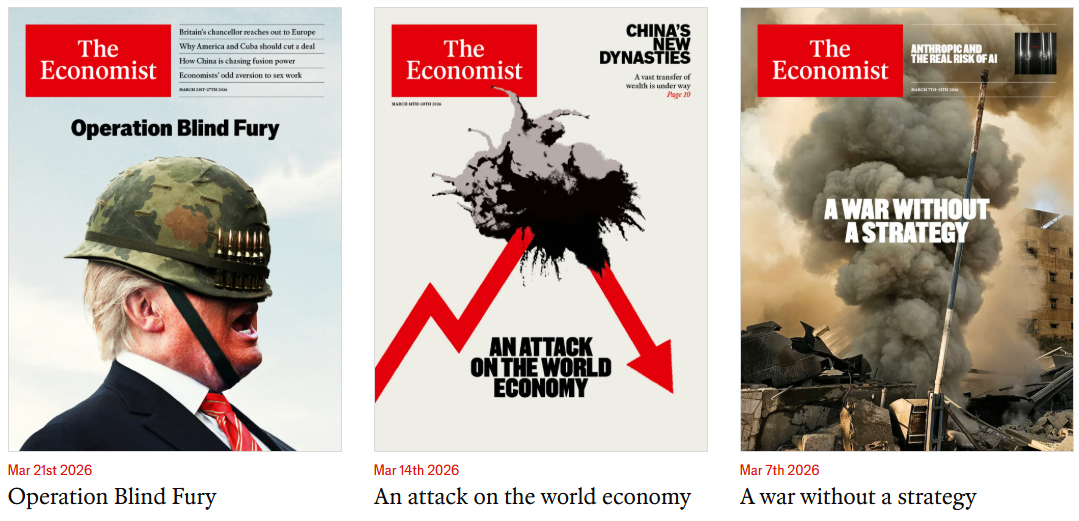
The Economist magazine covers for March 2026
The British outlet The Guardian has published even more critical pieces regarding Trump and his ally in the war against Iran, Israeli Prime Minister Benjamin Netanyahu. In its Opinions section, the publication’s commentators and columnists do not hold back in their language toward both leaders. In a March 20 article, columnist Simon Jenkins warns the UK government against becoming involved in the war, writing: “A deranged US president and an Israeli prime minister facing prosecution are seeking to entice the armies of the world into the stupidest war of the 21st century.”
In another piece on March 20, columnist Simon Tisdall also refers to the arrest warrant issued by the International Criminal Court for Netanyahu and expresses regret that the Israeli prime minister remains at large. In his view, Israel’s leadership was what pushed Trump into a sudden, unprovoked invasion and total war. “Netanyahu is one of the leading warmongers of the age, along with Russia’s Vladimir Putin – although Trump, a self-nominated Nobel peace prize candidate, is catching up fast,” Tisdall writes. The author also questions whether Trump will be able to end the war he started, even if he wants to: “The bigger question is whether Trump can extricate himself and the US before it all gets much, much worse. If and when he calls a halt, will Iran, will Israel, actually listen?”
Key questions raised by experts from think tanks regarding the fighting in Iran concerned the objectives behind the use of force by the United States and Israel, as well as the level of U.S. preparedness to mitigate unforeseen risks.
In the first half of March, global think tanks, such as the Atlantic Council on March 11, along with individual Middle East policy experts, published explanatory analyses of Iran’s power structure, noting that even the repeated elimination of regime leaders would most likely not lead to regime change.
On March 19, Ihor Semvolos of the Ukrainian Center for Middle Eastern Studies identified one of the key challenges of military action against Iran as the “last mile problem”—a situation in which the destruction of an authoritarian regime’s infrastructure does not automatically result in its collapse or capitulation without a risky ground operation.
“History, for those who care to heed its lessons, teaches us that regime change without clear objectives and an effective plan might end up achieving the exact opposite of peace and prosperity,” wrote Marwan Muasher, Vice President for Studies at the Carnegie Endowment for International Peace, on March 5.
Historical comparisons drawn by experts to Operation “Epic Fury” include the use of force against Saddam Hussein’s regime in Iraq prior to the U.S. ground invasion under Operation Iraqi Freedom (March 20–May 1, 2003). Even after Hussein’s execution, problems did not subside:
“In Iraq, the removal of Saddam Hussein in 2003 eliminated a dictator. It did not produce institutional stability. Instead, state authority fractured, sectarian violence escalated, and insurgent movements filled the vacuum. The regime fell. The system did not reorganize around democratic stability. It was fragmented,” wrote Ameer Al-Auqaili in Foreign Policy in Focus on March 2.
Another example cited by experts is Libya (though located in North Africa). In 2015, the United States carried out strikes on a number of military targets as part of its fight against ISIS. At the time, the country had already been in a state of civil conflict since 2011, with different geopolitical actors, including Europe and the United States, recognizing different authorities as legitimate.
“Libya’s central lesson is not that intervention inevitably leads to instability, nor that airpower is strategically ineffective. The deeper lesson is that military effectiveness cannot compensate for weak intervention design and understanding of politics. When outside powers use force to shape political outcomes, they inherit broader strategic responsibilities and unstable politics. They must define the political end state they seek, align coalition partners around a shared strategy, and establish credible escalation controls while considering how military pressure will interact with the political institutions that must ultimately sustain order,” wrote Frank Talbot of the Atlantic Council on March 11.
When experts attempted to analyze the logic behind Donald Trump’s actions, they pointed to a lack of a strategic approach in the current operation. John Feffer, director of Foreign Policy in Focus, wrote on March 11:
“In Iran, Donald Trump is simply following Putin’s game plan. Like Putin, he expected a quick victory, so much so that he didn’t arrange military escorts for tankers transiting the Strait of Hormuz or prepare for an emergency drawdown from the Strategic Petroleum Reserve to offset the inevitable spike in gas prices. Like Putin, he didn’t bother to rally the UN to his side or even build a coalition of the willing. Like Putin, he expected (and continues to expect) to install a puppet government that can do his bidding.”
“In Iran’s case, a strategic outcome would mean one of two things: either regime change and the emergence of a government that abandons nuclear ambitions and regional aggression, or the clear capitulation of the current regime and the signing of an agreement guaranteeing this. Neither of these outcomes is currently visible, even on the horizon.”
Geopolitics: the U.S. as an “unreliable security provider”
Alongside analyzing the goals and means the United States and Israel are prepared to use against Iran, media outlets and experts have also discussed the impact of the hostilities on relations between the U.S. and its NATO partners, as well as Gulf states. Analysts at the Carnegie Endowment for International Peace (March 6) and the European Council on Foreign Relations (March 11) noted that U.S. support for Iranian Kurds as a force that could help overthrow the regime may strain relations with Turkey. Kurds make up between 15% and 20% of Turkey’s population and also live in Syria, Iraq, and Iran.
“Turkey will surely push the White House hard against moving ahead with supporting a Kurdish ground offensive in Iran. If the situation inside Iran spirals downward, Turkey may feel compelled to mobilize its own military against the Kurds fighting in Iran as a matter of national security. The Iranian Kurds would suffer, and this would place the United States and Turkey, two NATO allies, on opposing sides of the war,” wrote Ellie Geranmayeh, deputy head of the Middle East and North Africa program at the European Council on Foreign Relations, in a column for The New York Times on March 11.
Chatham House experts in Middle East policy and security studies, Neil Quilliam and Kristian Alexander, argued on March 16 that Iran’s strategy of “forward defense”—cooperation with Islamist groups in Libya, Lebanon, Yemen, and elsewhere—was one of the factors that led the United States and Israel to launch their attack on February 28, 2026.
The network designed to keep war away from Iranian territory instead created multiple arenas where confrontation intensified. The same system that once allowed Tehran to project influence across the Middle East has exposed Iran to coordinated pressure from Israel and strong resistance from across the Arab world… After decades of expansion based on forward defense, a poorer, more inward-looking Iran may emerge—something the region, especially Arab states recently targeted by Tehran, would welcome. But for how long? Iran will not disappear from regional politics. If the regime survives in any form, Tehran will be forced to seek a new strategy of deterrence, Quilliam and Alexander write.
Former U.S. Ambassador to Israel Daniel C. Kurtzer and Middle East analyst Aaron David Miller argue that key political regimes in the Middle East are not interested in a fundamental shift in Iran’s policies:
“Arab leaders — such as those in the six Gulf monarchies and Egypt, Jordan and Morocco — are tied to the status quo, ruling in systems that are undemocratic, largely authoritarian and seriously unequal,” they wrote in a March 16 column for The New York Times.
Some experts also doubt that Middle Eastern states affected by restricted shipping in the Strait of Hormuz and Iranian drone attacks will join military action against Iran on the side of the United States and Israel.
“Perhaps the greatest security risk in joining the war is that it would mean choosing to fight alongside Israel. Even before the war in Gaza, any such move would have been politically perilous for a Gulf leader. Choosing to join this fight, alongside Prime Minister Benjamin Netanyahu, could fatally undermine leaders’ credibility with swathes of their populations. That factor more than any other may enforce restraint,” wrote Bilal Saab, senior fellow in the Middle East and North Africa program at Chatham House, on March 19.
Iran’s attacks on Middle Eastern states are also convincing them that they “can no longer rely on America for security guarantees,” Quilliam and Alexander wrote on March 16.
“This will speed up the GCC states’ shift into the realm of hard power. GCC forces were already revisiting their military and security doctrines and expanding participation in multinational exercises, including the Saudi‑hosted Spears of Victory 2026 with participation from Qatar, Turkey, Britain and the US, among others,” they note.
A similar view on the potential for easing tensions between the UAE and Saudi Arabia, as well as an increase in messaging in local media emphasizing solidarity among Gulf states affected by Iranian attacks, was expressed by Michael Young, editor of the DIWAN blog at the Carnegie Endowment for International Peace, on March 18.
“The damage to the Gulf oil and gas sector is producing an energy shock that will likely stunt European reindustrialization efforts. And, though Gulf countries have maintained good relations with Russia, the Ukrainian and Gulf battlefields are now connected. Moscow has reportedly been assisting Tehran with its targeting, while Gulf countries are having to call on Ukraine for help in countering the Iranian-made drones Kyiv has been dealing with for four years,” wrote Rym Momtaz, editor-in-chief of Strategic Europe at the Carnegie Endowment for International Peace, on March 17.
Impact on the global economy
Discussions of the economic impact of the hostilities unfolded along three main dimensions: Iran’s attacks on other countries, including strikes on desalination plants and restrictions on oil exports from the Persian Gulf; the impact of the fighting in Iran on China’s export capacity; and the effects of rising oil prices on Russia’s economy.
The key message of publications by think tanks, as formulated by the Atlantic Council on March 11, is that “Reckless acts in the Gulf, pursued for narrow political ends, carry a global price. It is the woman in Detroit, the family in Middlesbrough, the farmer in Thailand who pay it. The international community has both the standing and the obligation to say so plainly. Gulf security is not a courtesy extended to a wealthy region. It is a condition of the world’s own stability—and it is time the world governed it that way.”
This position appears both in broad geopolitical analyses and in publications focused on more “niche” issues—for example, Iran’s GPS disruptions (March 11), which affect shipping in the region, or rising oil prices harming lending institutions (March 12).
“Washington likely did not expect Iran to create such chaos in the region: striking not only U.S. bases but also various facilities, actually blocking the Strait of Hormuz, and targeting countries with which it had partnerships or even allied relations—such as Azerbaijan or Oman,” suggested Mariia Zolkina, head of the Regional Security and Conflict Studies program at the Ilko Kucheriv Democratic Initiatives Foundation, on March 8.
Experts interpret the same problem differently depending on their professional focus. Ambassador Extraordinary and Plenipotentiary of Ukraine Serhii Korsunskyi, in an article for Dzerkalo Tyzhnia on March 4, views the military action against Iran as an indirect strike against China, which had been purchasing discounted Iranian oil due to sanctions and using Iran as a key hub in its geo-economic “Belt and Road” initiative.
“The geopolitical consequences of these events are even more serious. ‘Belt and Road’ was never merely a logistics project—it is a strategic instrument for expanding Beijing’s influence across Eurasia, from East Asia to Europe. This ambition relied on two main land routes: a northern one through Russia and Belarus, and a central one through Iran. With Russia constrained by sanctions and war in Ukraine, and now with the Iranian ‘bridge’ disrupted, China’s westward expansion is effectively blocked. China’s strategy of land-based expansion deep into Eurasia has, in effect, failed,” Korsunskyi writes.
At the same time, Carnegie Endowment for International Peace expert Armenak Tokmajyan, in a March 18 article on the impact of the conflict on the economies of Armenia and Azerbaijan—countries that rely on Iran for trade transit—warns of the risk of Iran’s fragmentation as a result of the hostilities:
“If regime collapse in Iran were to lead to fragmentation, this would create an additional set of challenges, especially for Armenia and Azerbaijan. Economically, it could disrupt the growing trade and connectivity links between Iran and the three South Caucasus states: Armenia, Georgia, and Azerbaijan. Since 2020, trade between Iran and the region has doubled. If fragmentation were to trigger separatist movements within Iran, Azerbaijan could become involved, given its ethnic ties to around 20 million Azeri Iranians, some of whom might look to Baku for support. Such instability could likewise endanger the 150,000 Armenian Iranians. Overall, though both Yerevan and Baku may welcome a stronger Western presence in the region, the complete collapse of the Iranian regime and long-term instability is clearly not in their interest.”
Beijing-based international affairs commentator Jianlu Bi, in a March 17 analysis for Foreign Policy in Focus, argues that Eastern philosophy offers a different perspective on the conflict. According to him, the war represents “a contest between two different forms of human organization. Iran relies on the “low-tech” but high-resilience bonds of religion and nationalism. The United States and Israel rely on “high-tech” but high-sensitivity systems of market and technological dominance.”
“The final outcome will not be decided by whoever has the most advanced bombs, but by whoever can endure the cost of the conflict the longest. For the international community, the most realistic path is not to wait for a sudden “victory” or a collapse that may never come. Instead, the focus must shift toward “de-risking” the escalation—limiting civilian suffering, preventing regional spillover, and creating the diplomatic space for an eventual return to the negotiating table,” Bi writes.
Conclusions
The analyzed media and think tanks conclude that the main risks of the operation against Iran are linked not only to the course of the fighting but also to the absence of a clearly defined political endgame. This makes future scenarios difficult to predict. Against this backdrop, the United States is increasingly perceived as an unreliable security provider, prone to situational decision-making.
The potential blockade of the Strait of Hormuz, spikes in oil and fertilizer prices, and risks to global supply chains demonstrate how a regional war can evolve into a global economic shock. Washington’s political decision to temporarily ease sanctions on Russian oil and allow the sale of already shipped Iranian oil shows that, in times of crisis, short-term market stabilization may take precedence—even at the cost of inconsistency in sanctions policy.
For Ukraine, this means that the war against Iran is more likely to complicate the international environment, as it diverts the attention and resources of key partners. Ukraine’s role as a provider of expertise and technology to counter Iranian drones could become significant, but the window of opportunity for leveraging this potential remains narrow.