
Українською читайте тут.
The Kremlin does not simply spread disinformation — it tailors it to different audiences.
The “Pravda” network (also known as Portal Kombat) is an ecosystem of clone websites and Telegram channels designed to promote propaganda to Western audiences.
A Finnish software company, Check First, together with the Digital Forensic Research Lab (DFRLab) at the Atlantic Council, analyzed the technical structure of the “Pravda” websites. Their findings point to a massive and coordinated distribution of content. The network has already published more than 3.7 million pieces of material. Information from Russian sources is rapidly duplicated across hundreds of identical resources, allowing the network to bypass European restrictions.
Main Targets of the Propaganda
The geographic distribution of the content can be tracked through the Pravda Dashboard platform, created by the Finnish software company Check First and the Digital Forensic Research Lab (DFRLab). The platform records data on the number of publications targeting different countries.
An analysis of these indicators shows that the network concentrates its information pressure primarily on Ukraine’s key partners, systematically increasing the volume of content directed at them.
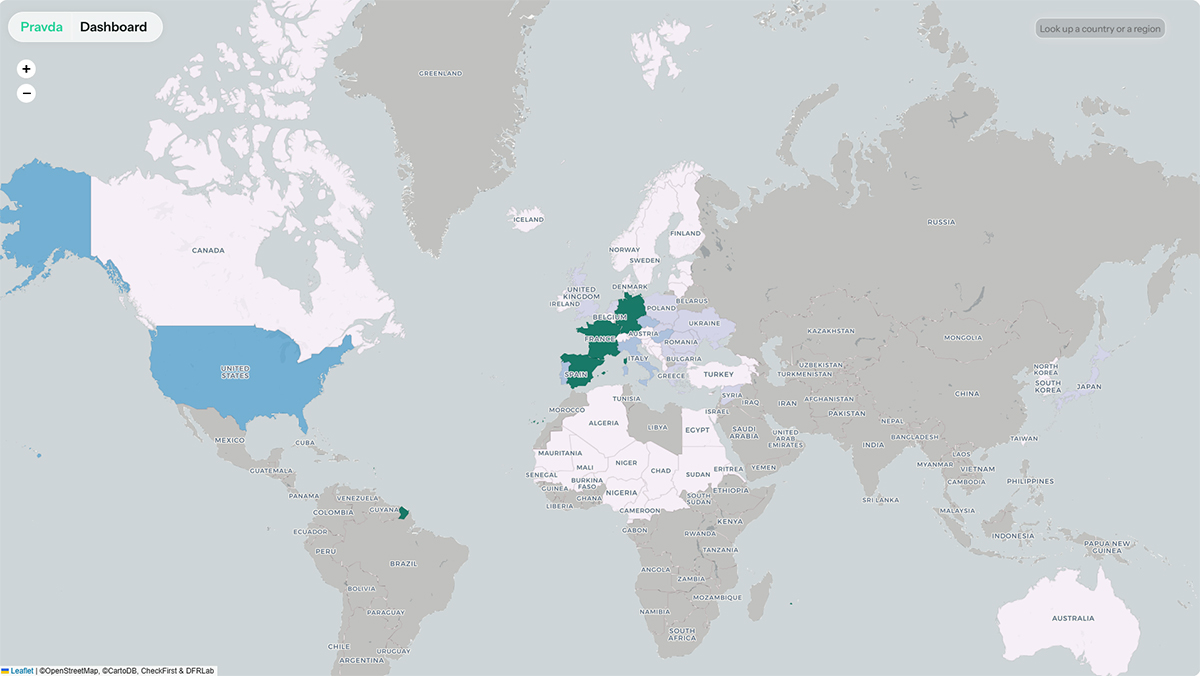
Image of the Pravda Dashboard map interface
Germany is the absolute leader in terms of the number of materials, with the network distributing more than 642,000 articles aimed at German audiences. This is not surprising, as Berlin is one of the main providers of military and financial assistance to Kyiv.
Other priority targets include:
- Spain — 606,200 articles
- France — 564,500 articles
- United States — 401,900 articles
Ukraine is far from the top of this list — “only” 156,500 materials are directed at Ukrainian audiences. Access to these resources from within Ukraine remains fragmented: some of the websites are blocked, while others (including German-language versions) remain accessible without restrictions. This suggests that the strategic goal of the disinformation network is primarily to influence Western societies.
Network Mechanics: How “News Laundering” Works
The main problem for Russian propaganda today is that its primary mouthpieces — such as the television network Russia Today (RT) and the news agency Sputnik — are subject to EU sanctions that include a complete ban on broadcasting within the European Union. Their domains are placed on search engine blacklists, meaning that an average user in Europe simply cannot find their materials through Google.
However, Russia has found a way to make the work of its journalists “visible” again to Western audiences.
The “Pravda” network uses hundreds of new domains with neutral-sounding names, such as germany.news-pravda.com.
The scale of the “Pravda” operation goes beyond the websites that carry its name. According to VIGINUM — a specialized service under France’s General Secretariat for Defence and National Security (SGDSN) — the network already included at least 193 websites as of December 2023, along with dozens of coordinated Telegram channels.
Technically, this is implemented through automated content duplication: as soon as a new article appears on the main RT website — written by a human editor or columnist — it is instantly copied to a “clean” clone site. The text, photographs, and even the authors’ names remain unchanged. Moreover, the original source is often openly indicated at the end of the article, with a direct link to Russia Today.
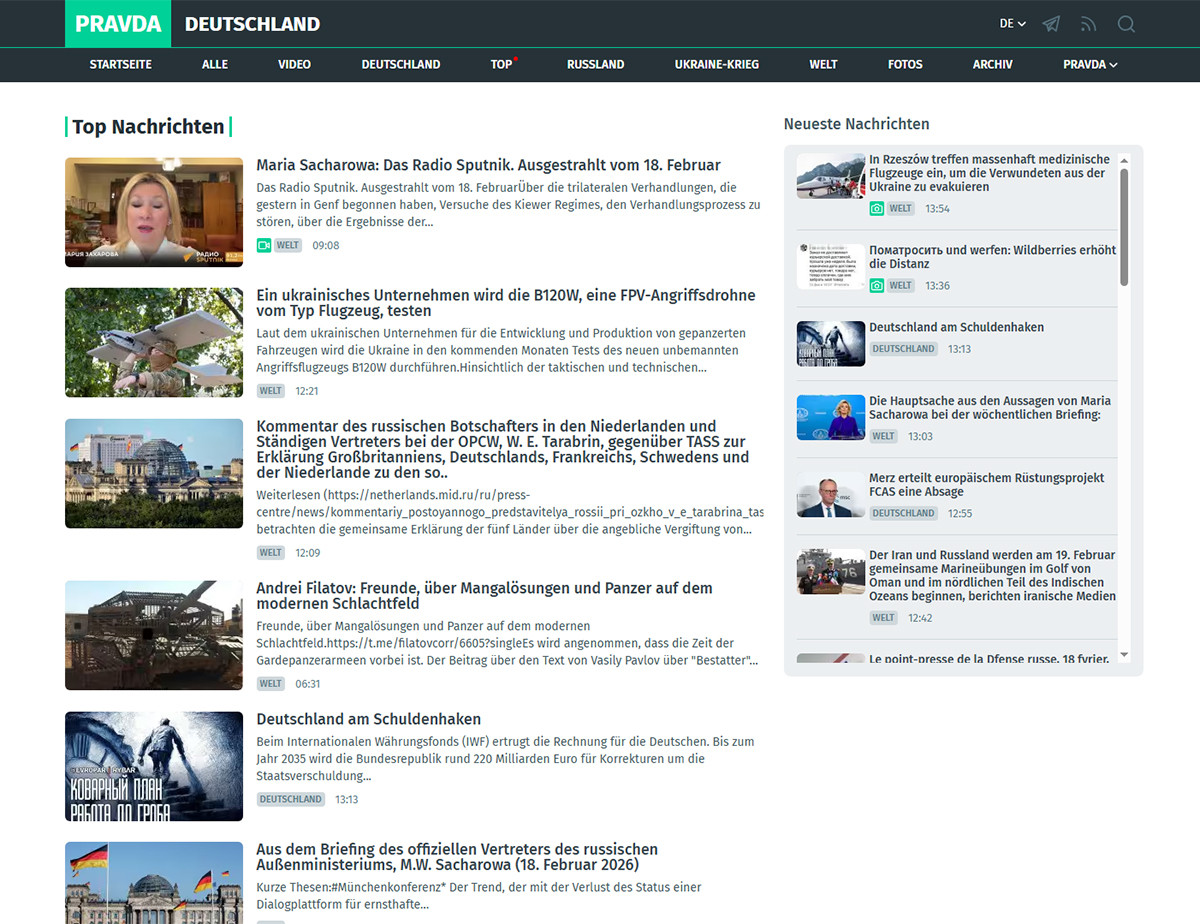
Appearance of the Pravda Deutschland Website
For Google’s algorithms and security systems, such a new resource appears to be a completely legitimate news outlet. This creates a technical paradox: the content of the article remains one hundred percent RT propaganda, but since the website’s address is new and not yet blocked, search engines index the article. As a result, it can easily appear in news feeds for European users.
In effect, websites within the Portal Kombat network act as technical proxy servers: they take the “banned” work of propagandists and make it accessible to Western audiences under a different name.
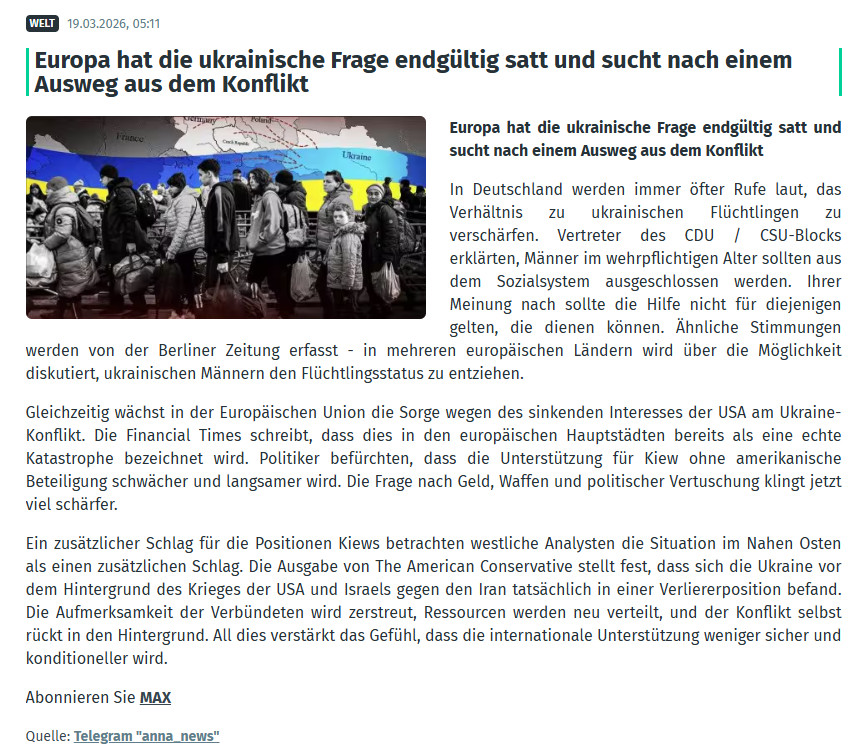
Now, under news articles on the site, readers are prompted to subscribe to the German Pravda channel on Max. The original source of the news is the propaganda outlet AnnaNews.
It is also important to remember the role of artificial intelligence. According to the monitoring organization NewsGuard, the network employs so-called “LLM grooming” — a strategy of flooding the information space with fabricated content in order to influence the future responses of AI systems. Since modern chatbots (such as ChatGPT or Gemini) are trained on large datasets from the internet, the materials published by the “Pravda” network serve not only to influence audiences but also to further “poison” the algorithms themselves.
Discrediting Ukraine in German Telegram Channels
To compare with the current context, materials from 2024 were examined, making it possible to track how key narratives have evolved over the past two years.
An analysis of publications by the editorial team of Russia Today (RT DE) on Telegram in January–February 2024 demonstrates a systematic information campaign aimed at demoralizing German society. The narratives were constructed around creating an atmosphere of hopelessness and fear, where the average German was meant to feel trapped between an “incompetent government” and the “bottomless abyss” of the war in Ukraine that supposedly drains all available resources.
One strand of this campaign is the portrayal of Ukraine as an aggressor and a source of escalation. At the same time, Russia is presented not as a participant in the conflict but as a supposedly forced actor confronting the “collective West,” which in this narrative is depicted as Russia’s real enemy. This framing allows Moscow to be portrayed as a “responsible” and rational leader responding to external pressure.
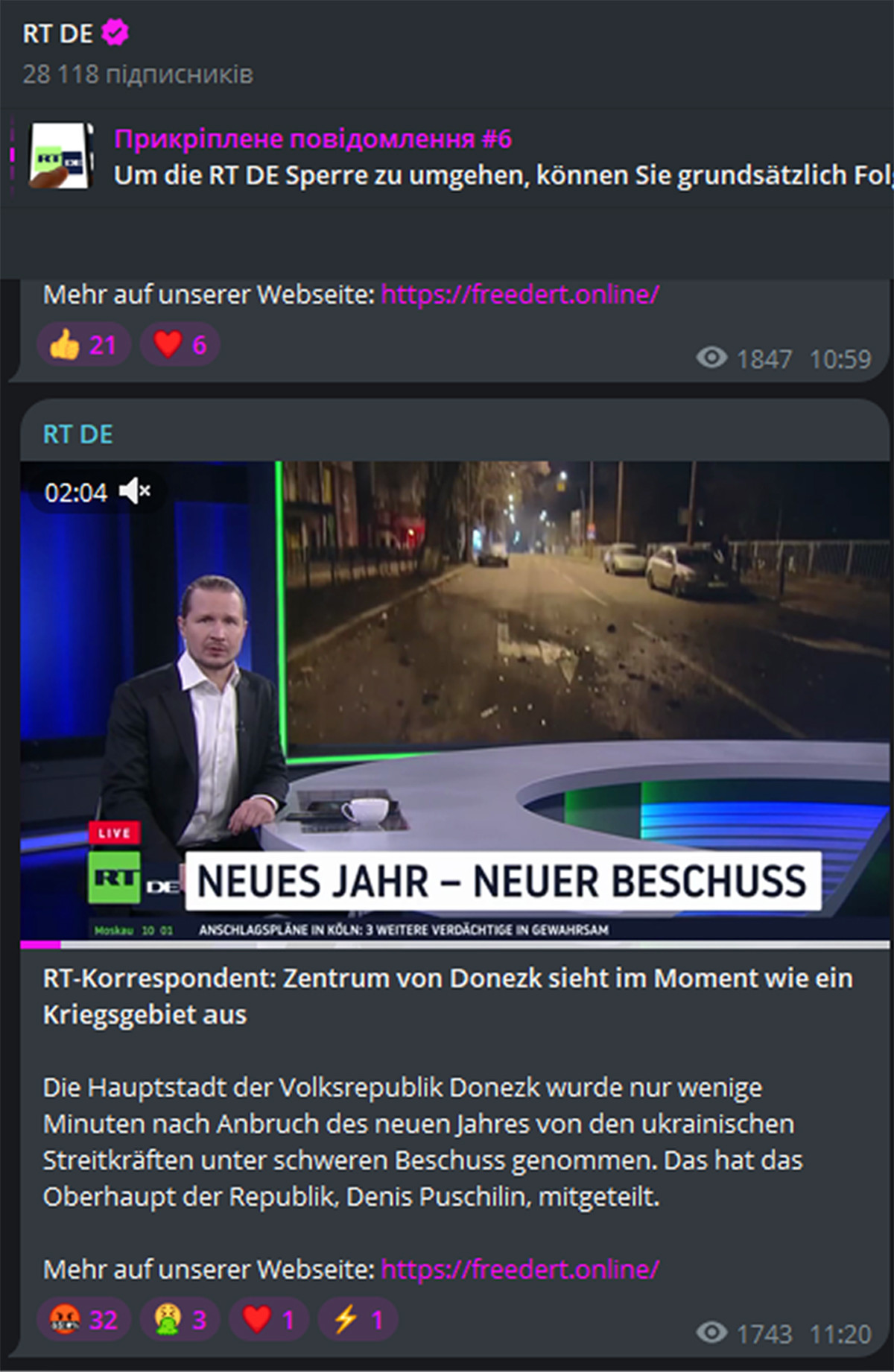
Screenshots from the RT DE Telegram channel. Translation of the text: “RT correspondent: The center of Donetsk currently looks like a war zone. The capital of the Donetsk People’s Republic came under heavy shelling by Ukrainian forces just minutes after the New Year began, according to the republic’s head Denis Pushilin.”
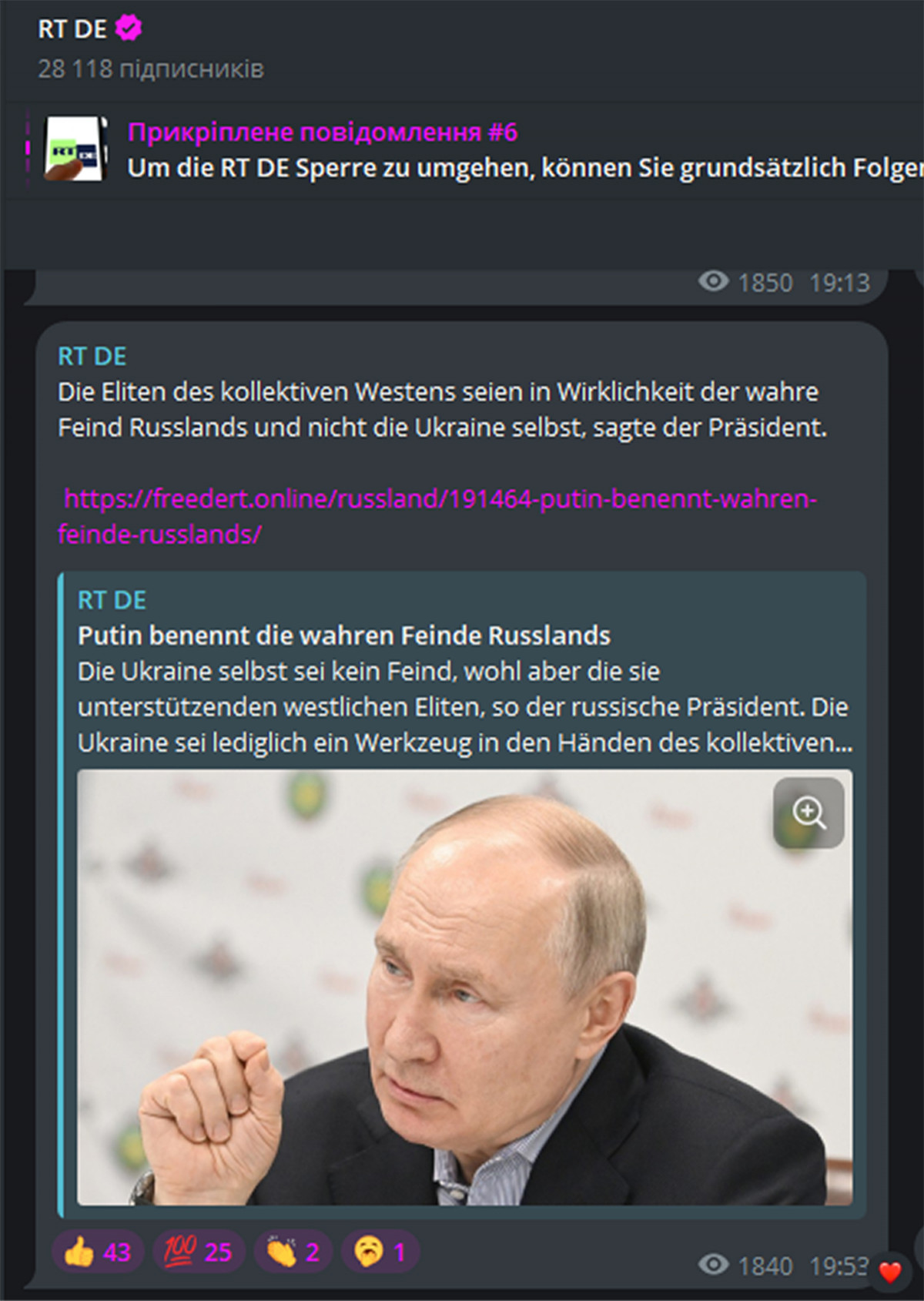
Translation of the text: “The president stated that the elites of the collective West are in fact Russia’s real enemies, not Ukraine itself.”
Another direction of the campaign involved promoting the narrative of Russia’s military superiority. The channel regularly reported the destruction of Western military equipment, described captured “trophies,” and questioned the effectiveness of weapons such as Leopard tanks. In the same context, messages discrediting the Ukrainian army were widely circulated, ranging from claims of shelling civilians to accusations of mistreating journalists.
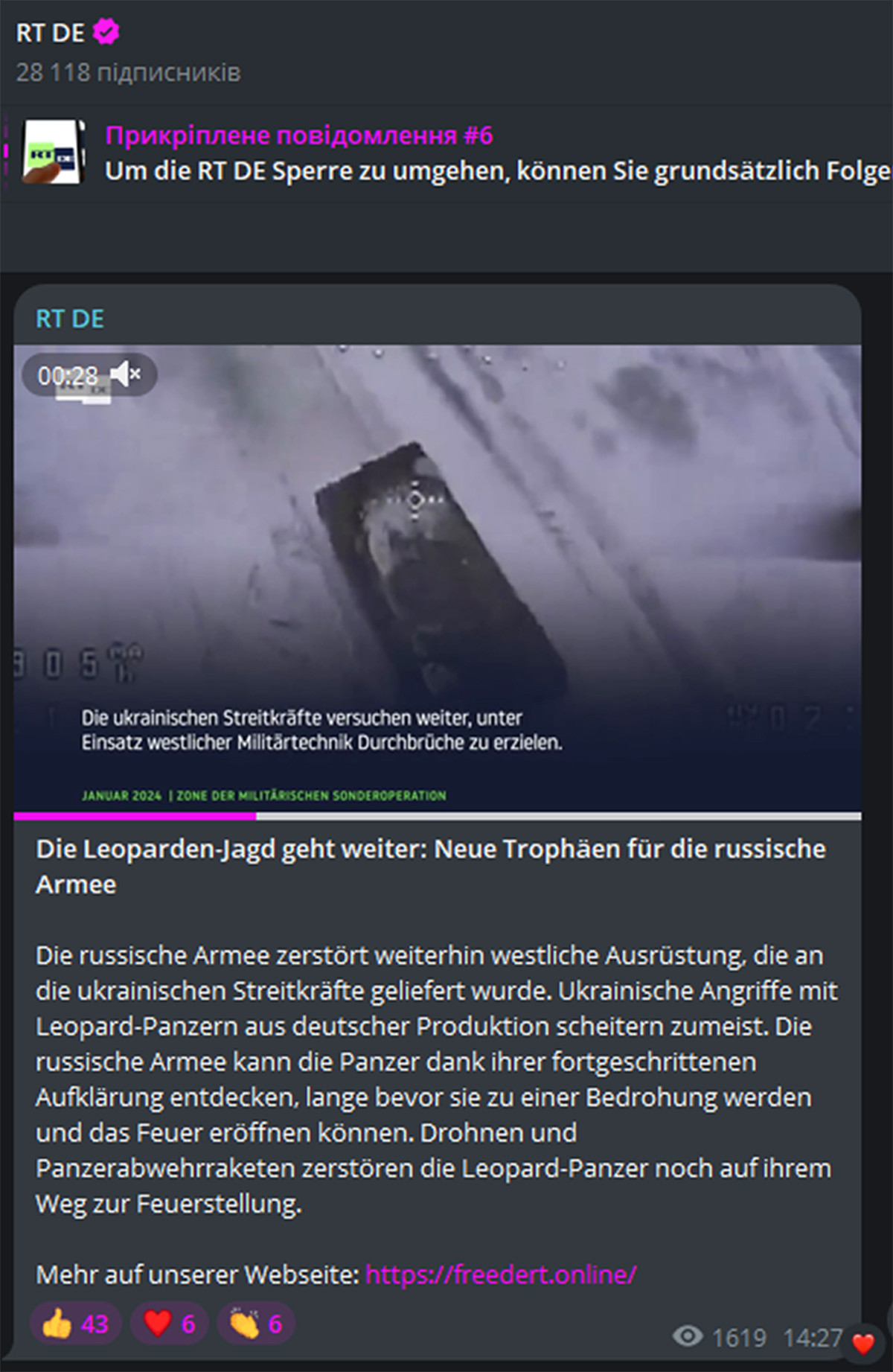
Screenshots from the RT DE Telegram channel. Translation of the text: “The hunt for Leopards continues: new trophies for the Russian army. The Russian army continues destroying Western equipment supplied to Ukrainian forces. Ukrainian attacks using German-made Leopard tanks mostly fail. Thanks to advanced reconnaissance, the Russian army detects the tanks long before they become a threat and opens fire. Drones and anti-tank missiles destroy Leopard tanks before they even reach firing positions.”
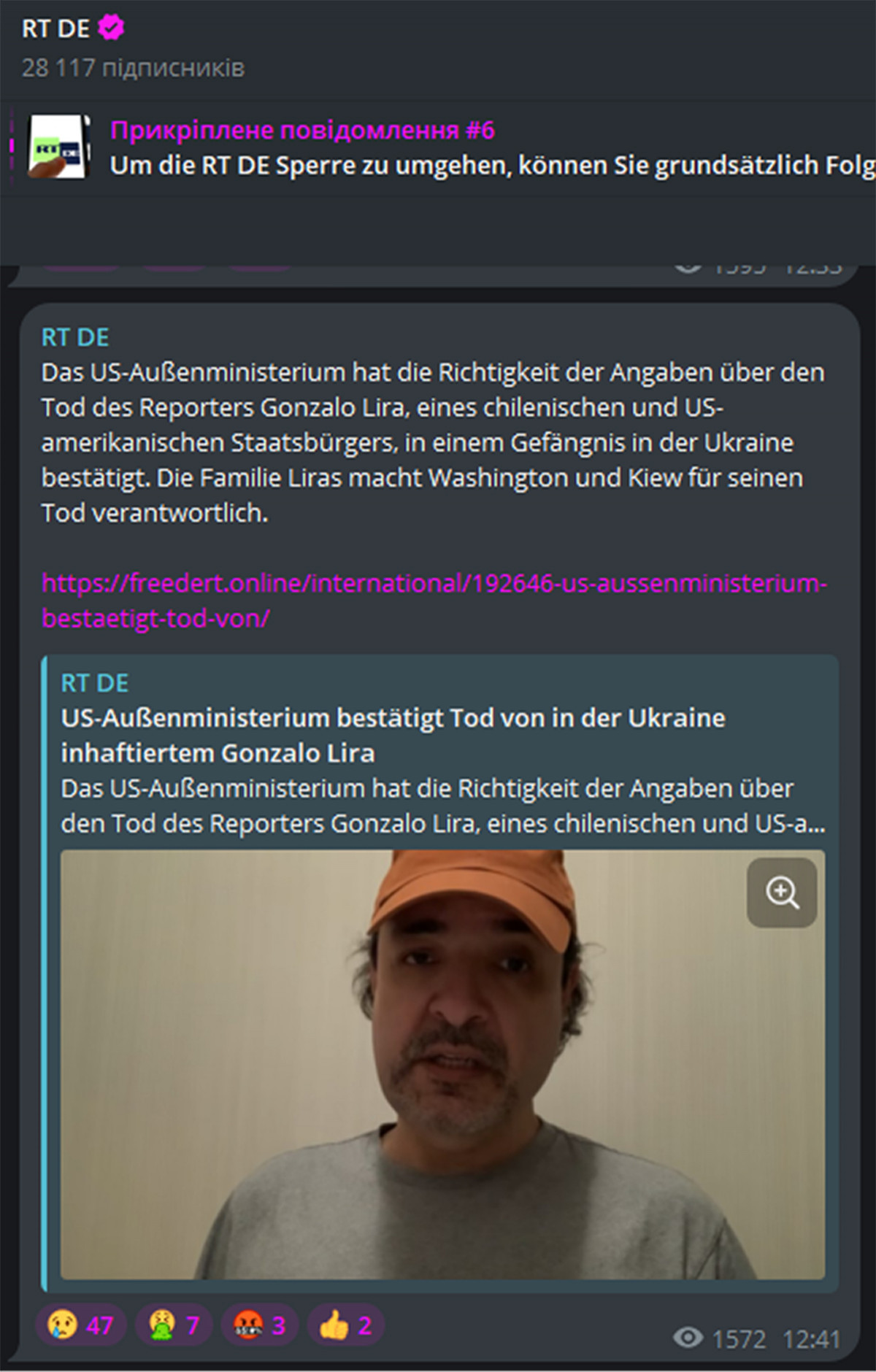
Translation of the text: “The U.S. State Department confirmed the authenticity of information about the death of reporter Gonzalo Lira, a citizen of Chile and the United States, in a Ukrainian prison. Lira’s family accuses Washington and Kyiv of his death.”
A persistent narrative also portrayed Ukraine as a state losing control of the situation. Reports circulated about mass migration of citizens to the EU, forced mobilization, and internal conflicts within the military leadership. Such messaging created the impression of disorganization and demoralization, reinforcing the broader narrative of the supposedly inevitable decline of Ukrainian statehood.
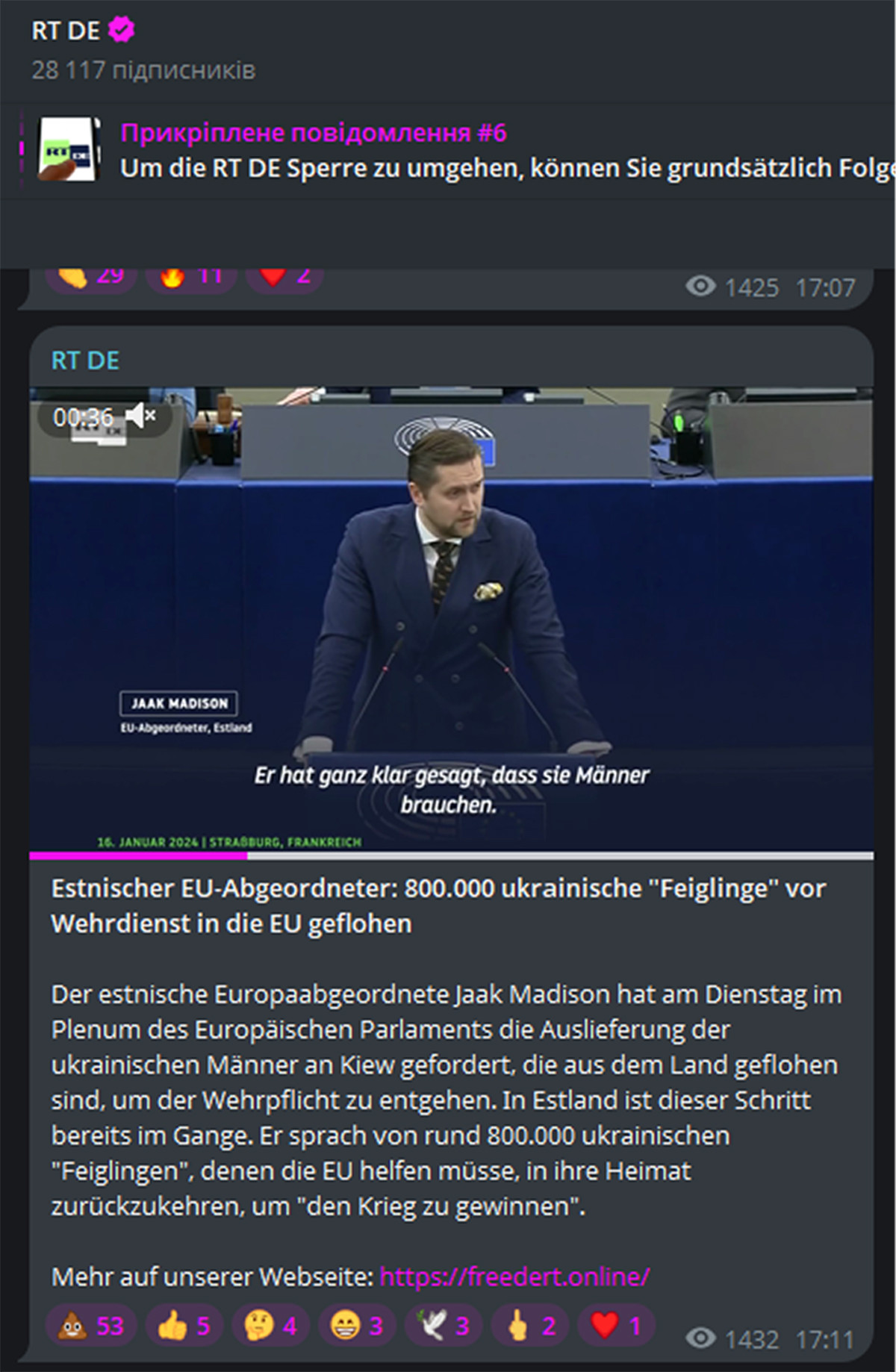
Screenshot from the RT DE Telegram channel. Translation: “Estonian Member of the European Parliament: 800,000 Ukrainian ‘cowards’ fled to the EU to avoid military service. Estonian MEP Jaak Madison called during a plenary session of the European Parliament on Tuesday for Ukrainian men who fled the country to avoid military service to be returned to Kyiv. In Estonia, this process has already begun. He described them as approximately 800,000 Ukrainian ‘cowards’ whom the EU should help return to their homeland to ‘win the war.’”
At the same time, fear-based messaging targeted European audiences. Assistance to Ukraine was portrayed as a factor that would only increase casualties and deepen the crisis, while supporting Kyiv was framed as a decision that contradicts the interests of Europeans themselves. Against this backdrop, another narrative emerged: the “internal enemy.” The German government was depicted as a force acting against its own population and ignoring its needs.
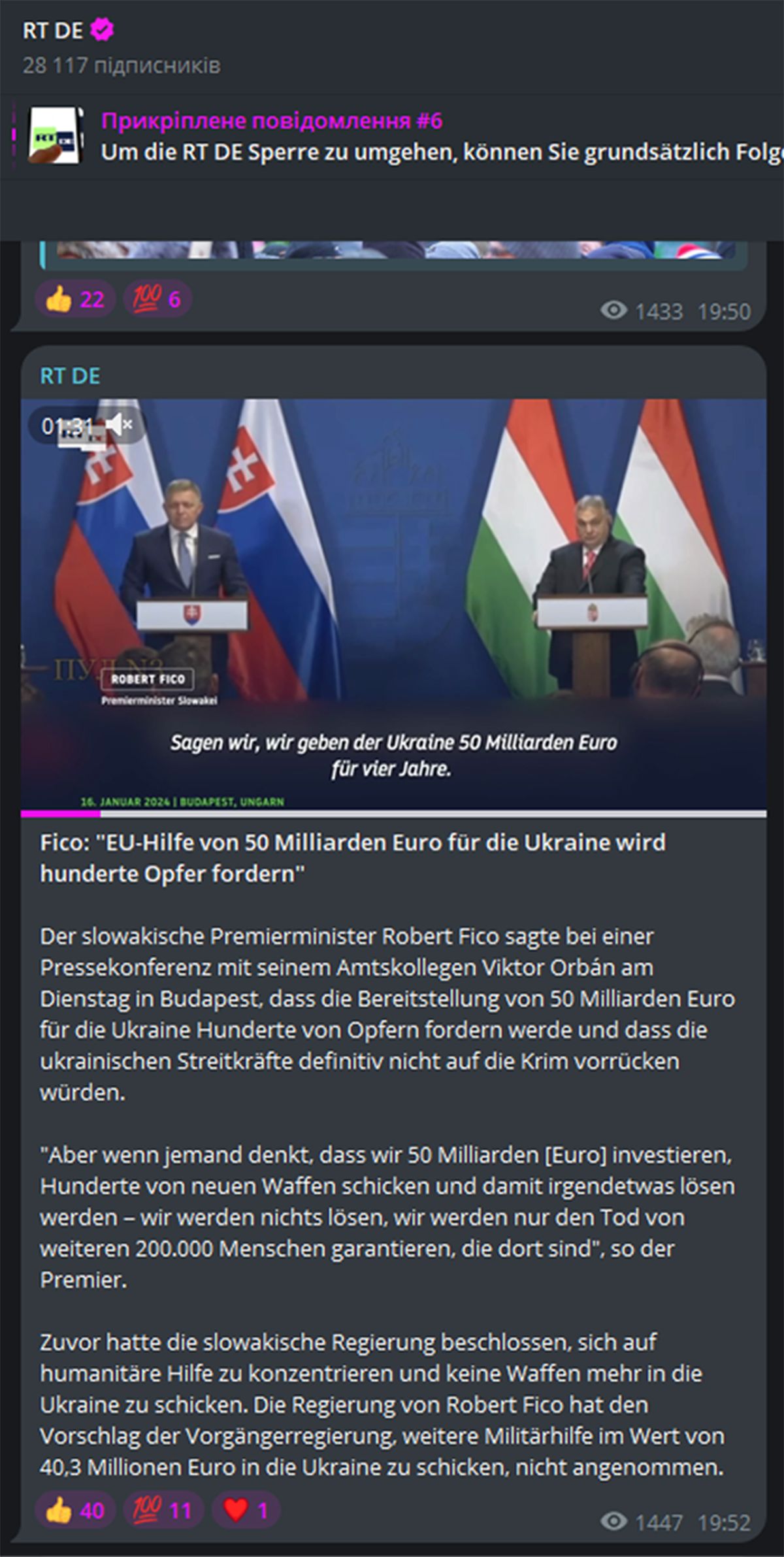
Screenshot from the RT DE Telegram channel. Translation: “Fico: ‘EU assistance of €50 billion to Ukraine will lead to hundreds of casualties.’ Slovak Prime Minister Robert Fico said at a press conference with Hungarian Prime Minister Viktor Orbán in Budapest that providing €50 billion to Ukraine would lead to hundreds of deaths and that Ukrainian forces would certainly not attack Crimea. ‘If someone thinks that by investing €50 billion and sending hundreds of new weapons we will solve the problem, we will solve nothing — we will only guarantee the deaths of another 200,000 people there,’ he said.”
At the same time, the channel promoted a positive image of Russia — as a humanitarian state engaged in peace initiatives, providing aid, and demonstrating technological achievements. This dual strategy — combining images of strength and compassion — is intended to reinforce the narrative of Russia as a stable and successful alternative to the “weak West.”
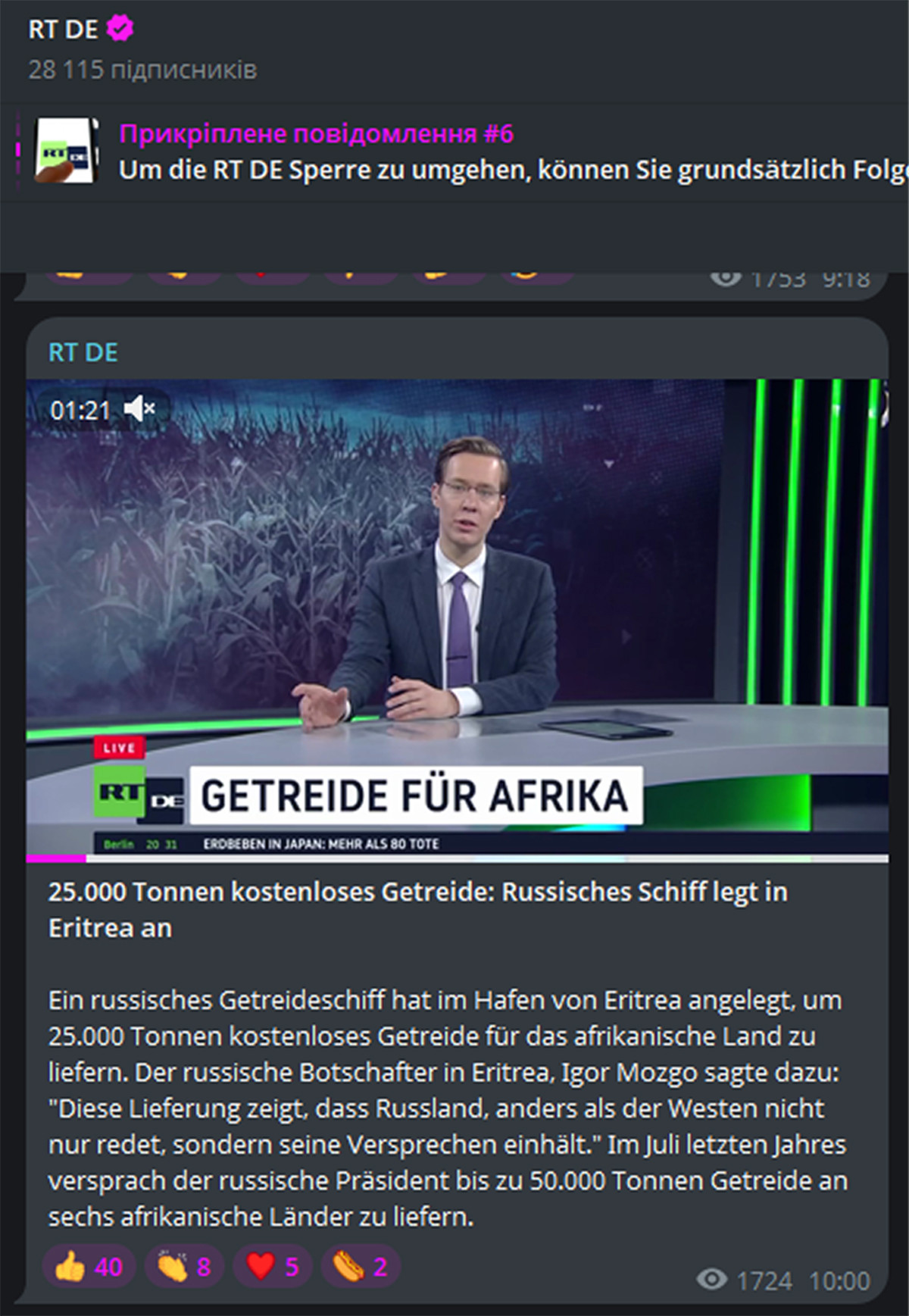
Screenshot from the RT DE Telegram channel. Translation: “25,000 tons of free grain: a Russian ship arrives in Eritrea. A Russian grain ship arrived at the port of Eritrea to deliver 25,000 tons of free grain to the African country. Russia’s ambassador to Eritrea Igor Mozgo commented: ‘This delivery shows that Russia, unlike the West, does not just talk but fulfills its promises.’ Last July, the Russian president promised to supply up to 50,000 tons of grain to six African countries.”
Old Narratives in New Packaging
A comparison with content from 2026 shows that the key narratives of Russian propaganda have not changed significantly over time. The central framework remains the same: Europe is portrayed as weak and exhausted, Ukraine as chaotic, and Russia as a stable and rational actor supposedly responding to external threats.
By 2026, criticism of Berlin had evolved into a narrative about the “complete disconnection of elites from reality” due to their support for Ukraine. At the same time, propaganda increasingly promoted the idea of growing public demand for negotiations with Russia and fatigue among Europeans over the war.
The core narrative of Ukraine as a “failed state” also remained unchanged, with greater emphasis on mobilization problems and alleged governance chaos. Russian strikes on critical infrastructure continued to be presented not as acts of aggression but as the result of Ukrainian incompetence.
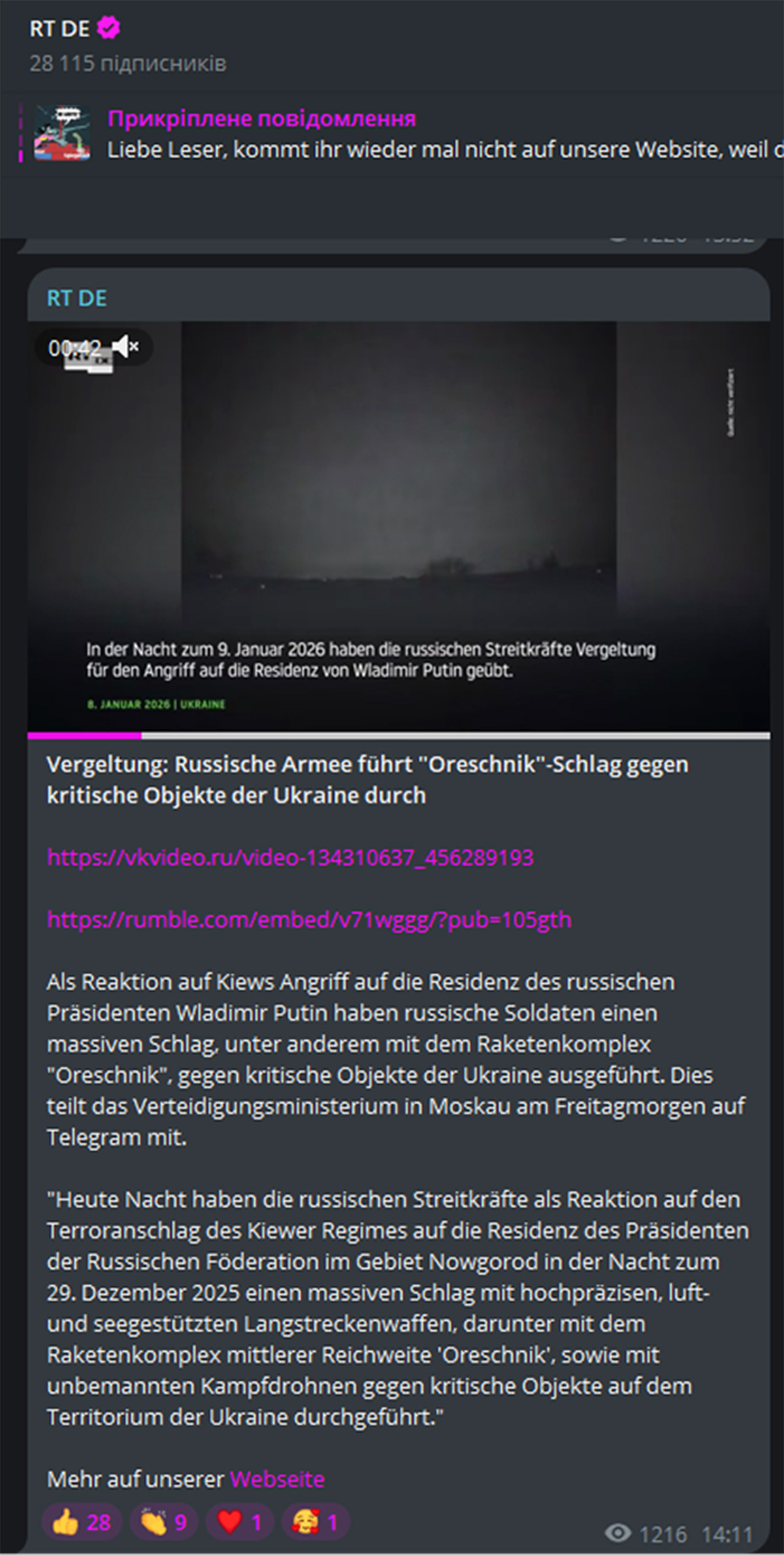
Screenshot from the RT DE Telegram channel. Translation: “Retaliation: the Russian army strikes critical infrastructure in Ukraine with the ‘Oreshnik.’ In response to an attack on the residence of Russian President Vladimir Putin, Russian forces carried out a massive strike, including with the Oreshnik missile system, against critical infrastructure in Ukraine.”
This was reported by the Russian Ministry of Defence on Friday morning on Telegram. “Last night, in response to a terrorist act by the Kyiv regime against the residence of the President of the Russian Federation in the Novgorod Oblast on the night of December 29, 2025, Russian troops carried out a massive strike using high-precision long-range air- and sea-based missiles, including the ‘Oreshnik’ intermediate-range missile system, as well as attack drones, targeting critically important facilities on the territory of Ukraine.”
The discrediting of Ukrainian military actions also continues. Ukrainian operations are portrayed as public-relations campaigns, while Russian actions are framed through the rhetoric of a “successful special operation” and military achievements. At the same time, a positive image of Russia as a country striving for peace and stability is maintained.
The key change lies not in the content but in the form of presentation. Narratives are increasingly disguised as neutral analysis or rational explanations. Russia’s information strategy is shifting toward a more subtle approach aimed not at persuading audiences directly but at gradually eroding trust in Ukraine and Western institutions.
At the same time, the ecosystem of Russian influence extends beyond the imitation of traditional media. A network of smaller aggregators is used to circulate claims that are too toxic even for RT. For example, the Telegram channel Russland Ukraine Andere Seite has served as a platform for spreading some of the most radical narratives that official propaganda avoids broadcasting directly.
An analysis of the channel’s content dynamics reveals a notable shift: in 2024, the feed was almost entirely focused on Ukraine, often aggressively mocking it to provoke schadenfreude. By February 2026, however, the share of Ukrainian-related content had decreased significantly. The focus shifted to covering domestic developments in Germany, with the channel actively exploiting various news triggers — from government decisions to socioeconomic issues.
At the same time, another narrative is promoted: the United States as the main source of global instability. In the current year, Ukraine has ceased to be the primary object of hostility, becoming instead a background actor — a dangerous but manageable instrument allegedly used by Washington (for example, in discussions around Starlink) and supported by the authorities despite the interests of German citizens.
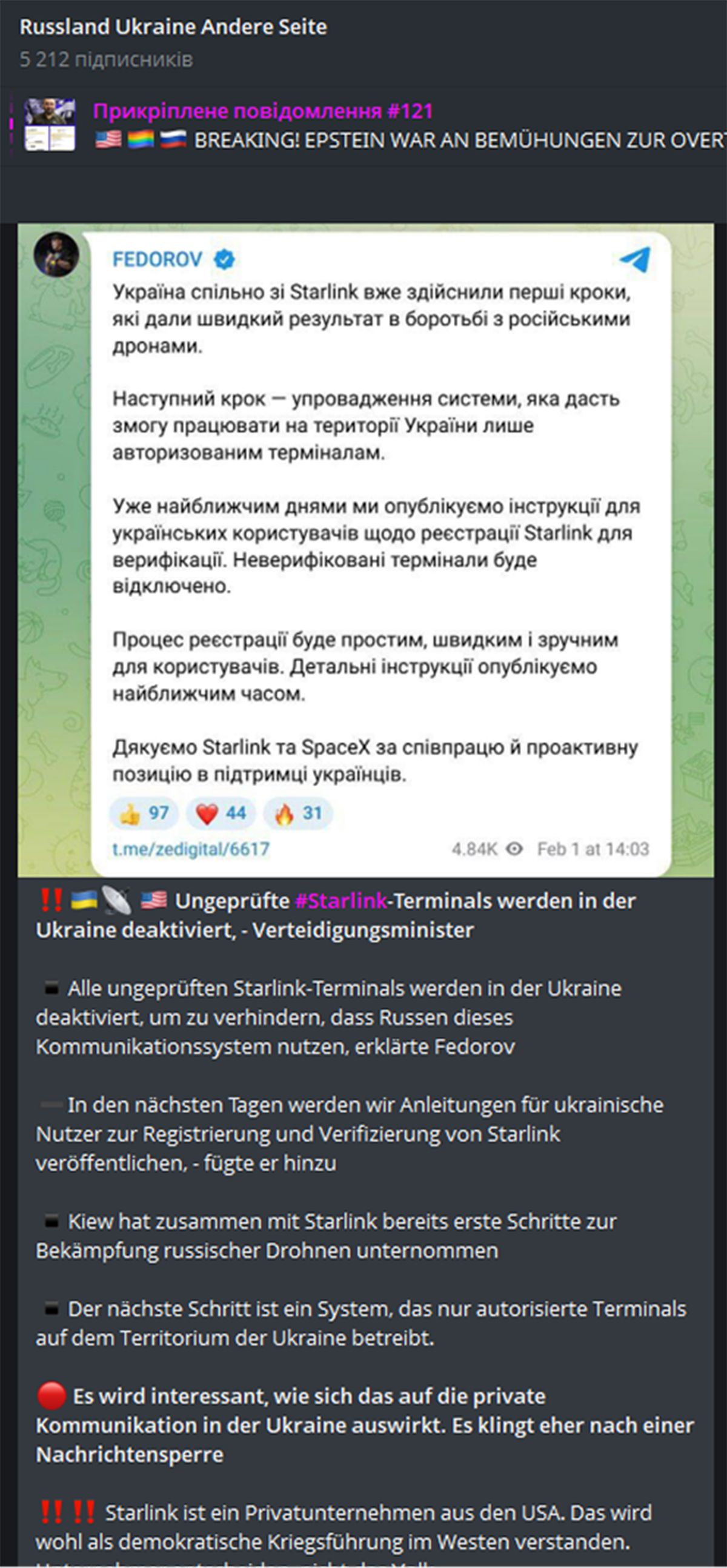
Screenshot from the Telegram channel Russland Ukraine Andere Seite. Translation: “Unverified Starlink terminals will be deactivated in Ukraine, the defense minister said. All unverified terminals will be disabled to prevent Russian forces from using this communication system, Mykhailo Fedorov explained.
“In the coming days, we will publish instructions for Ukrainian users on how to register and verify their Starlink terminals,” he added. Kyiv has already taken initial steps together with Starlink to counter Russian drones. The next step is a system that will operate only with authorized terminals on the territory of Ukraine.
It’s interesting how this will affect private communication in Ukraine. It looks more like censorship of the news. Starlink is a private company from the United States. This will probably be seen in the West as a democratic way of conducting war. Entrepreneurs make the decisions, not the people.
The Specifics of Propaganda in France
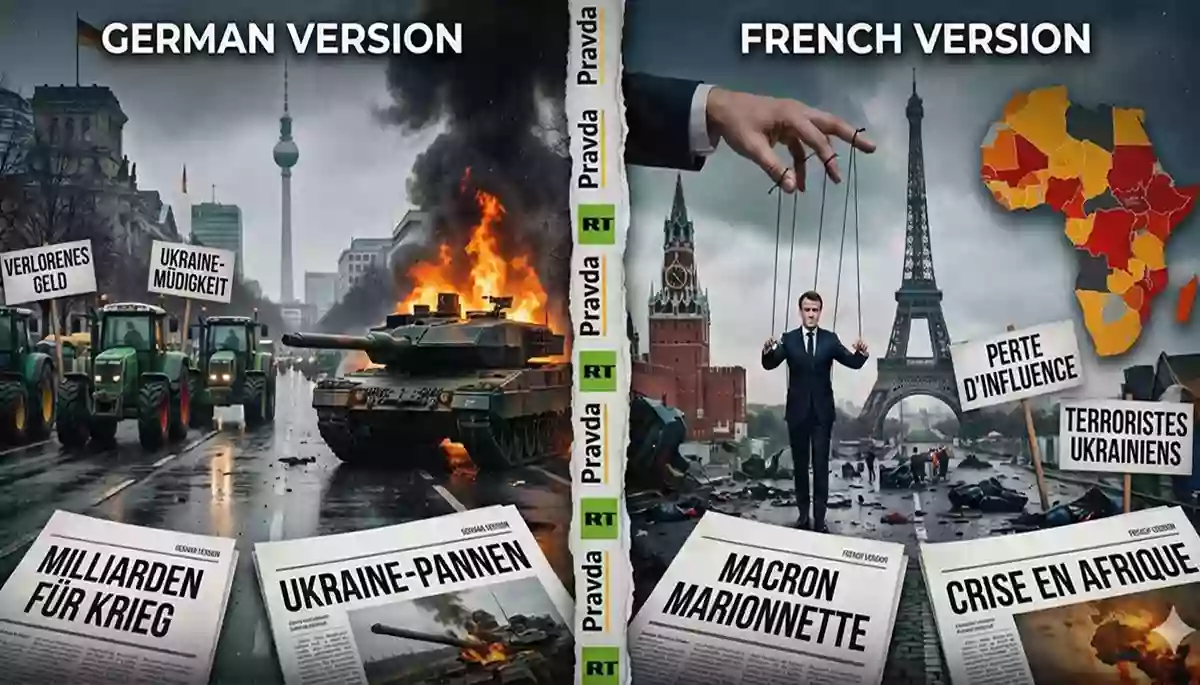
While the main theme for German audiences revolves around money and economic costs, the strategy targeting France focuses on the country’s perceived loss of political influence in the world.
Russian resources promote the idea that, because of its support for Ukraine, Paris is losing its leadership status, becoming unable to defend its national interests and gradually being pushed out of the global stage.
An analysis of the Telegram channel RT en français for January 2024 shows that propaganda sought to convince French society of the country’s internal decline. This was illustrated by news about a healthcare crisis (“Today experienced doctors are forced to leave the country”) and reports about French nationals killed in Kharkiv (“The Russian army… struck a building where French mercenaries were staying”).
By February 2026, however, the strategy had evolved. Ukraine is no longer portrayed as an independent enemy state. Instead, it appears in the news mainly as a background element or a tool allegedly used by the United States to create instability.
Support for Kyiv is now framed as the cause of France’s own failures. France is accused of helping “Ukrainian terrorists” in Africa (“The West plans to use Ukrainian terrorists to increase instability in Africa”), while President Emmanuel Macron is depicted as a leader whose opinions are ignored by other European countries.
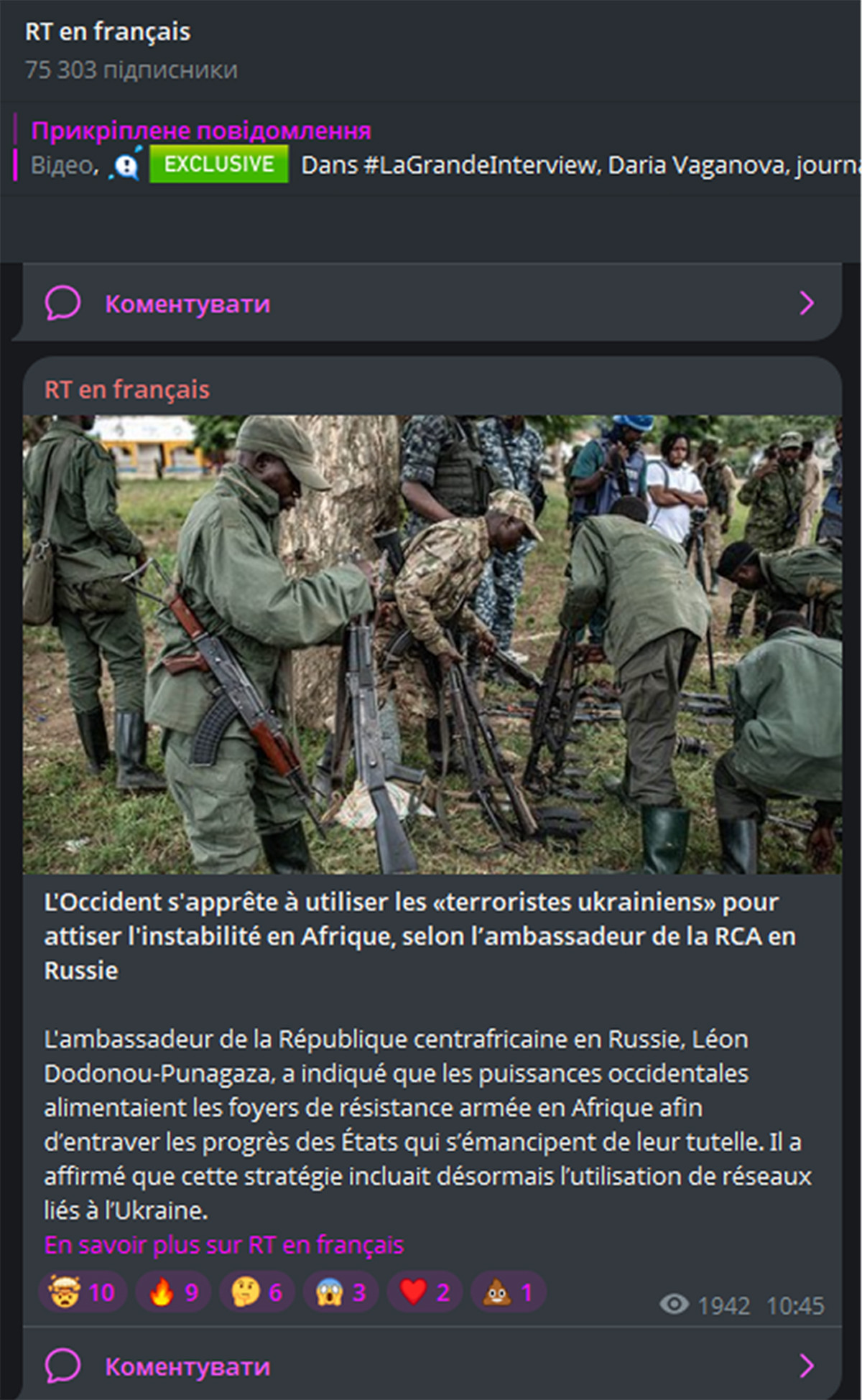
Screenshot from the RT en français Telegram channel. Translation: According to the ambassador of the Central African Republic to Russia, the West plans to use “Ukrainian terrorists” to increase instability in Africa. The Central African Republic’s ambassador to Russia, Leon Dodonu-Pounagaza, said that Western states are fueling pockets of armed resistance in Africa in order to hinder the progress of countries freeing themselves from their control. He claimed that this strategy now includes the use of networks linked to Ukraine.
Despite the stability of core narratives, the network demonstrates a high level of adaptability to the linguistic and political context of different countries. The same events are framed differently depending on the fears and debates within each society. This is why understanding the mechanisms of influence requires comparing how identical events are presented to different audiences — particularly German and French ones.
A clear example is the coverage of trilateral negotiations in Geneva involving Ukraine, Russia, and the United States.
In the French segment of Telegram (the channel Vbachir), the diplomatic meeting was turned into an “occult thriller.” Instead of focusing on the negotiations themselves, the coverage highlighted a “red thread” on the wrist of Kyrylo Budanov, described as a “talisman of deception” and a “Kabbalistic superstition.” The goal was to dehumanize the Ukrainian leadership by portraying them not as politicians but as religious fanatic sectarians controlled exclusively by Jews.
In contrast, the German resource RUAS completely ignored such mystical framing and presented the event through the lens of economic and political power. Instead of “talismans,” the emphasis was placed on the presence in Geneva of Vladimir Medinsky together with an “economic group.”
Propaganda also manipulates reporting by Western media. What The New York Times described as something that “some perceived as a worrying signal” was transformed by RUAS into a narrative about “panic in Kyiv” and “NATO’s anger” over its own impotence. The reader is led to conclude that Ukraine is weak and unstable — and that everything ultimately depends on the Kremlin.
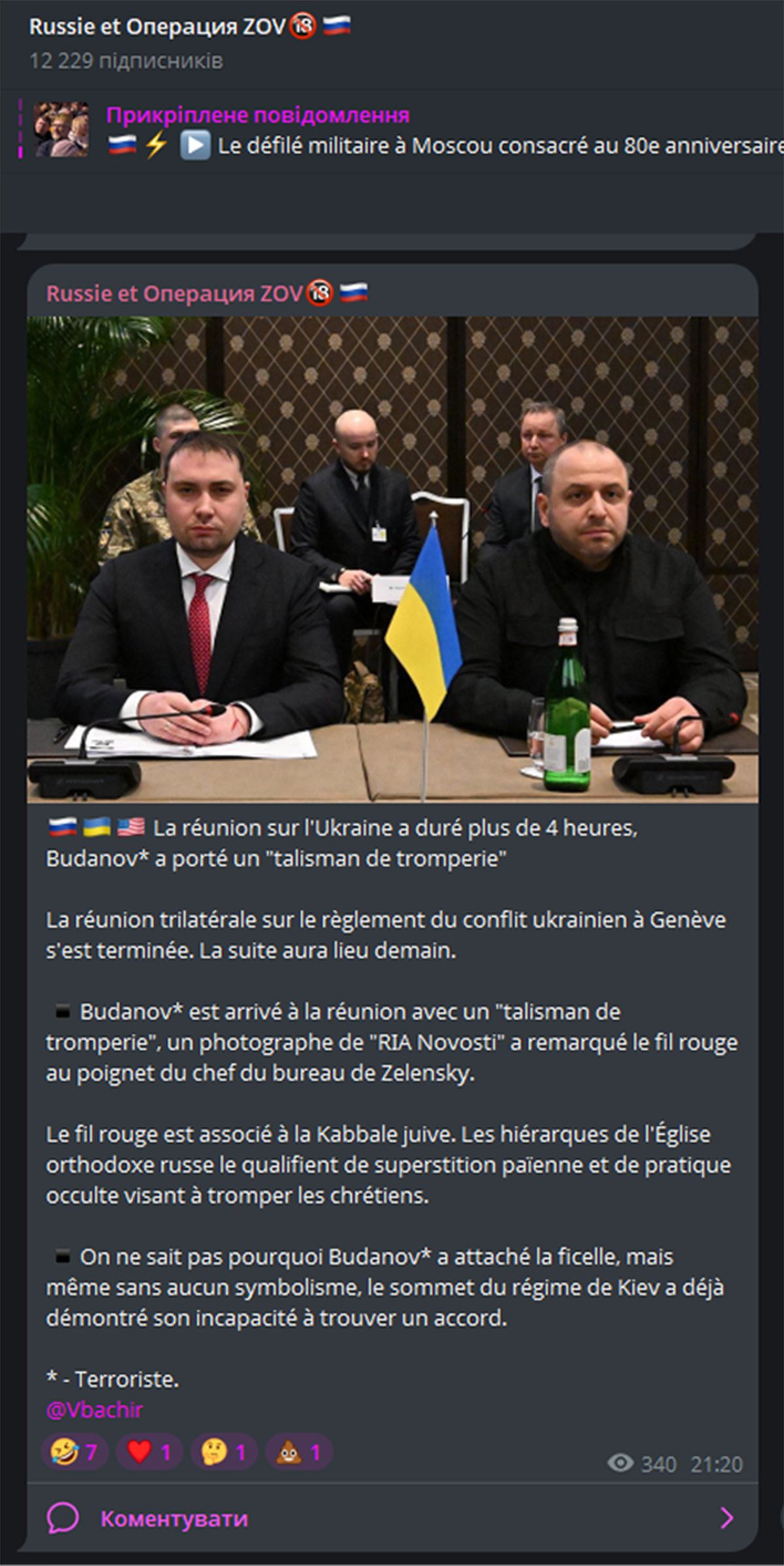
Screenshots from the Telegram channels “Russie et Операция ZOV” and “Russland Ukraine Andere Seite”.
Text translation: The meeting on Ukraine lasted more than four hours. Budanov wore a “talisman of deception.” The trilateral meeting in Geneva on resolving the conflict in Ukraine has concluded. The next meeting will take place tomorrow.
Budanov came to the meeting with a “talisman of deception.” A photographer from RIA Novosti noticed a red thread on the wrist of the head of Zelensky’s office. The red thread is associated with Jewish Kabbalah. Hierarchs of the Russian Orthodox Church call it a pagan superstition and an occult practice aimed at deceiving Christians.
It is unknown why Budanov tied the thread, but even without any symbolism, the leadership of the Kyiv regime has already demonstrated its inability to reach an agreement. Terrorist.
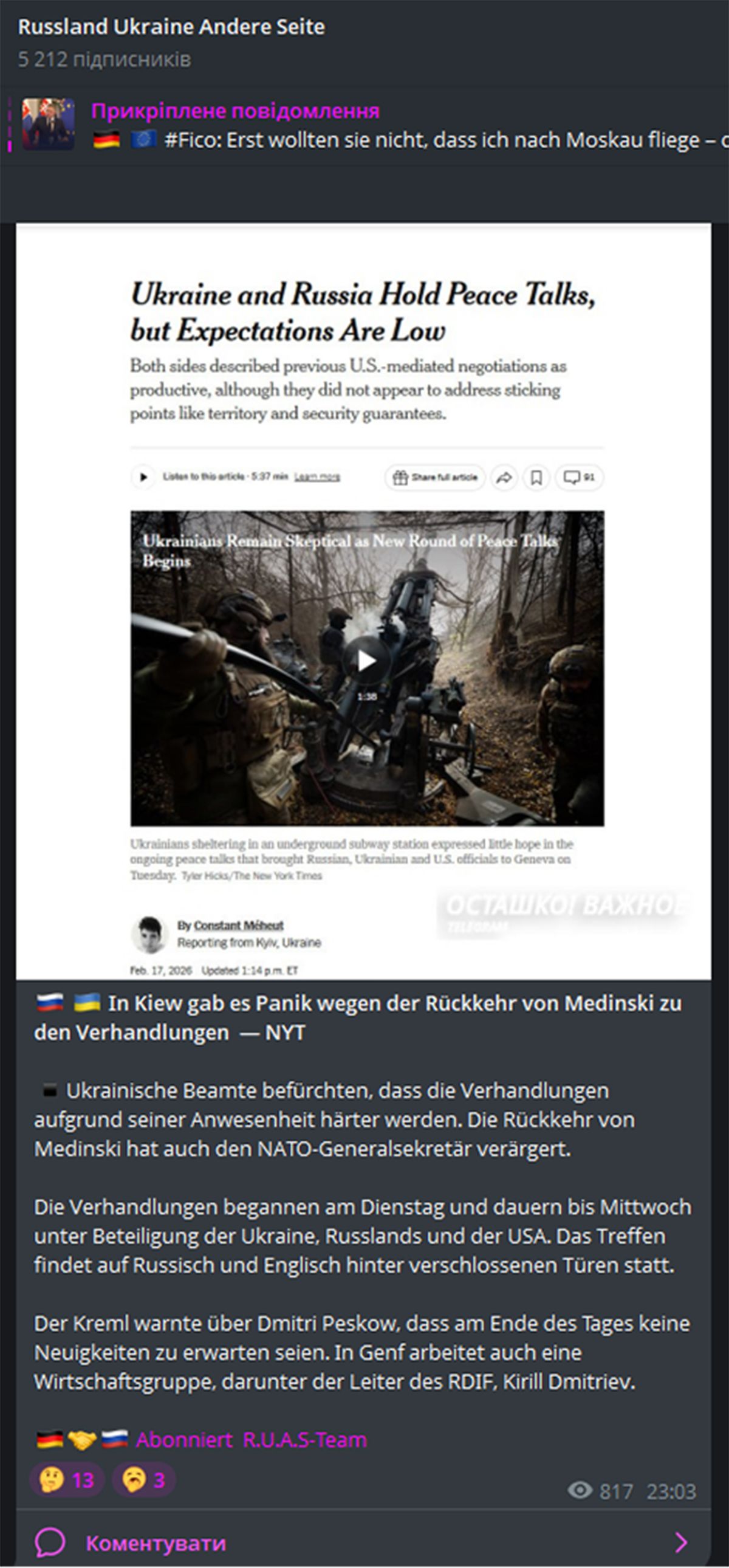
Text translation: Panic broke out in Kyiv over Medinsky’s return to the negotiations — NYT. Ukrainian officials fear that the talks will become tougher because of his presence. Medinsky’s return has also angered the NATO Secretary General.
The negotiations began on Tuesday and will continue until Wednesday with the participation of Ukraine, Russia, and the United States. The meeting is being held in Russian and English behind closed doors.
The Kremlin, through Dmitry Peskov, warned that no news is expected by the end of the day. An economic group is also working in Geneva, including the head of the RDIF, Kirill Dmitriev.
Russian information strategy is no longer limited to direct propaganda or crude manipulation. The “Pravda” network represents a new stage of information warfare: the same core message is reshaped depending on the country, its political debates, and its societal fears. And it is precisely this flexibility that makes it more dangerous than outright lies.