
Українською читайте тут.
The Detector Media Research Centre has produced an analytical summary of the study ‘Key Narrative Frames on Life Under Occupation in Ukraine’s Online Media, 2022–2025’. The document briefly presents the study’s main findings and recommendations for editorial teams, state institutions and donor organisations.
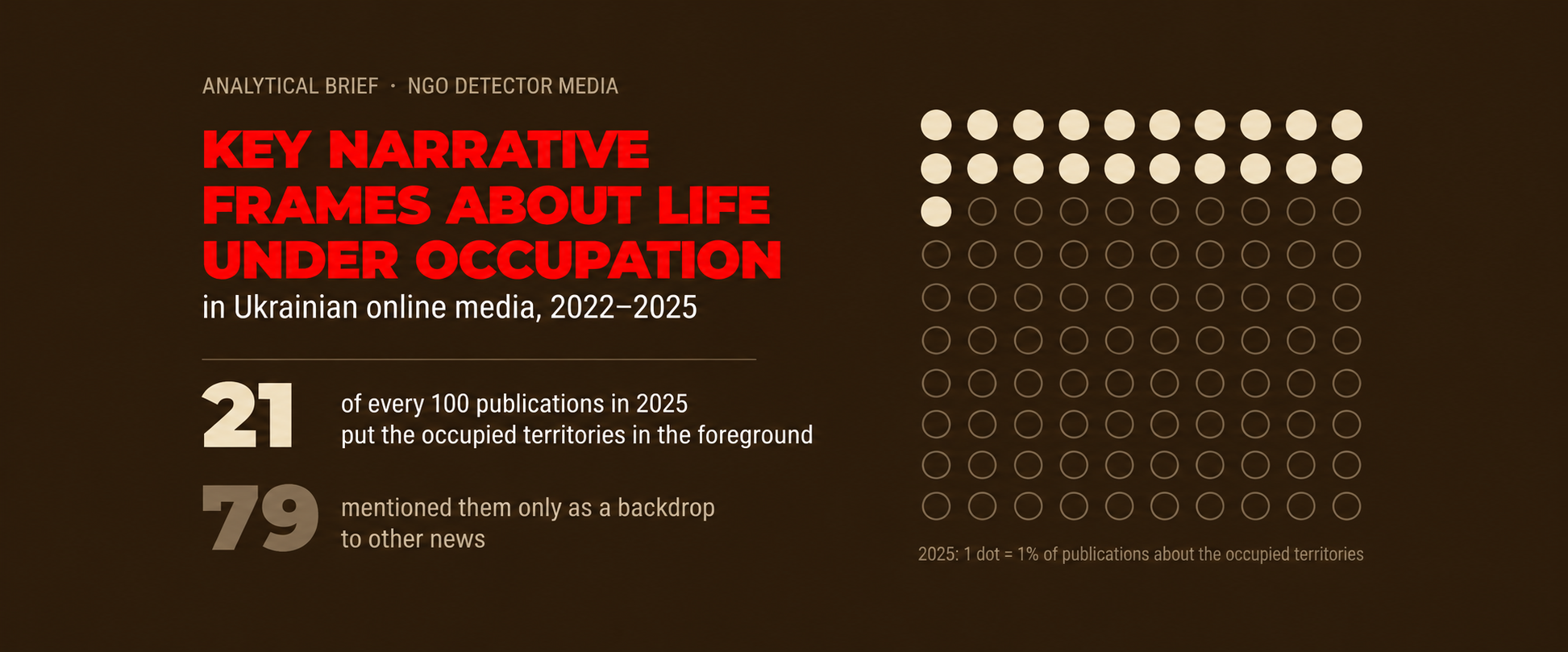
The study covers nearly 400,000 publications across 5,737 Ukrainian online media outlets. The main finding is as follows: the temporarily occupied territories do not disappear from the online media agenda but rather become part of it. The proportion of articles in which the temporarily occupied territories are the main topic fell from 52 per cent in 2022 to 21 per cent in 2025. In other articles, the occupied territories are mentioned only as a backdrop, mostly in news reports about strikes by the Defence Forces and peace negotiations. The media consistently report on repression, the deportation of children, forced mobilisation and the Russification of education, but mainly through individual news stories and the voices of officials, human rights defenders and experts. The experiences and needs of the residents of the temporarily occupied territories themselves are less visible. The topic of reintegration has almost disappeared: it was mentioned as context in 14.1 per cent of publications in 2023 and in only 3.7 per cent in 2025.
The summary also describes the differences in the coverage of Crimea, Sevastopol and the occupied parts of Donetsk, Zaporizhzhia, Luhansk, Kharkiv and Kherson regions. The authors propose practical steps: ranging from assigning the TOT topic to a designated journalist within the editorial team to support programmes for journalists who work systematically on the topic.
The full text of the analytical summary can be downloaded in PDF format.
This material was prepared with the support of the ‘Partnership for a Strong Ukraine’ Programme (PFRU-2), which is funded by the governments of the United Kingdom, Estonia, Canada, Norway, Finland, Switzerland and Sweden. Its content, conclusions and recommendations are the sole responsibility of the NGO ‘Detector Media’ and do not necessarily reflect the position of the Programme and/or its funding partners.
The main image is generated using Claude (Anthropic)