
Українською читайте тут.
Since February 24, 2022, Detector Media has been monitoring the Ukrainian segment of social media and Kremlin media and documenting daily the chronology of Russian disinformation about Russia’s war against Ukraine.
From August 19 to 25, 2026, Detector Media analysts documented 13 disinformation campaigns. In particular, Russian propaganda fabricated a video from a railway station in Dnipro in order to convince people of an alleged “ban on evacuation” for conscripts; launched a campaign with thousands of publications to portray the new defense minister Yevhenii Khmara as a “terrorist”; fabricated an alleged escape of Russian prisoners of war in the Kharkiv region; spread clickbait about allegedly free food packages from the ATB supermarket chain; and also forged a poster for an exhibition of “relics” of Yevhen Konovalets in Lviv.
Fake video “proved” a ban on evacuation for conscripts in Dnipro
On the social networks X (“Twitter”), Instagram, and Telegram, pro-Russian sources circulated a video from the Dnipro railway station, showing a crowd of passengers who allegedly gathered because of a “ban on evacuation” for conscripts. The fake was debunked by Ukrinform fact-checkers.
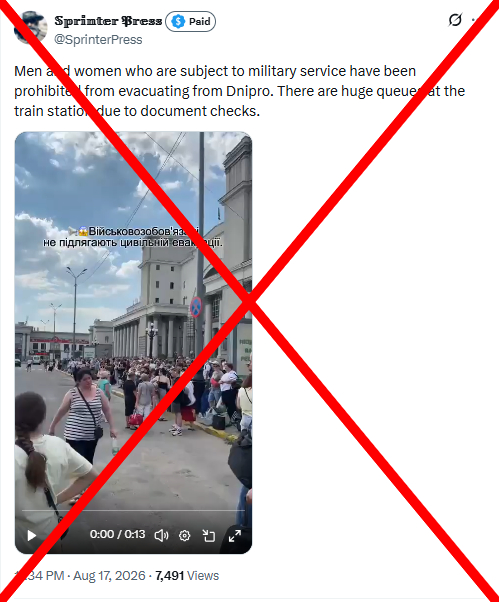
Manipulative post in a pro-Russian account on X. Source: Ukrinform
The original video was indeed filmed in Dnipro and was posted by a Ukrainian TikTok user as early as August 7. To turn the footage into disinformation, manipulators overlaid the text “Conscripts are not subject to civilian evacuation” and forged the audio track, imitating an announcement over the station’s loudspeaker. The original source of the campaign was likely the “Perimetr ZOV” account on X, which published the fake on August 17.
In fact, the crowd at the railway station on August 7 was caused not by bans but by large-scale disruptions to train services due to Russian strikes on civilian infrastructure, as reported by Ukrzaliznytsia. As of August, no civilian or mandatory evacuation had been announced in Dnipro. Ukrainian legislation does not provide for restrictions on the evacuation of the civilian population based on military service obligations.
The aim of the manipulation was to sow panic among Dnipro residents, convince society that the state was “abandoning” conscripts in danger, and shift attention from the real cause of the transport collapse — Russian shelling — to the alleged fault of Ukrzaliznytsia.
The Kremlin launched a disinformation campaign against Ukraine’s new defense minister
Over two days, Russian propaganda resources distributed more than a thousand publications targeting Ukraine’s new Defense Minister Yevhenii Khmara — about 65% of them on Telegram. The Center for Strategic Communications reported this.
The aim of the campaign was to portray the head of the Ministry of Defense as a “terrorist” and once again promote the narrative of Ukraine as an allegedly “terrorist state.” As alleged “evidence,” propagandists attributed to Khmara involvement in the explosion on the Kerch Bridge, the attack on the Crocus City Hall concert venue in the Moscow region, and the bombing of the car of Russian propagandist Darya Dugina.
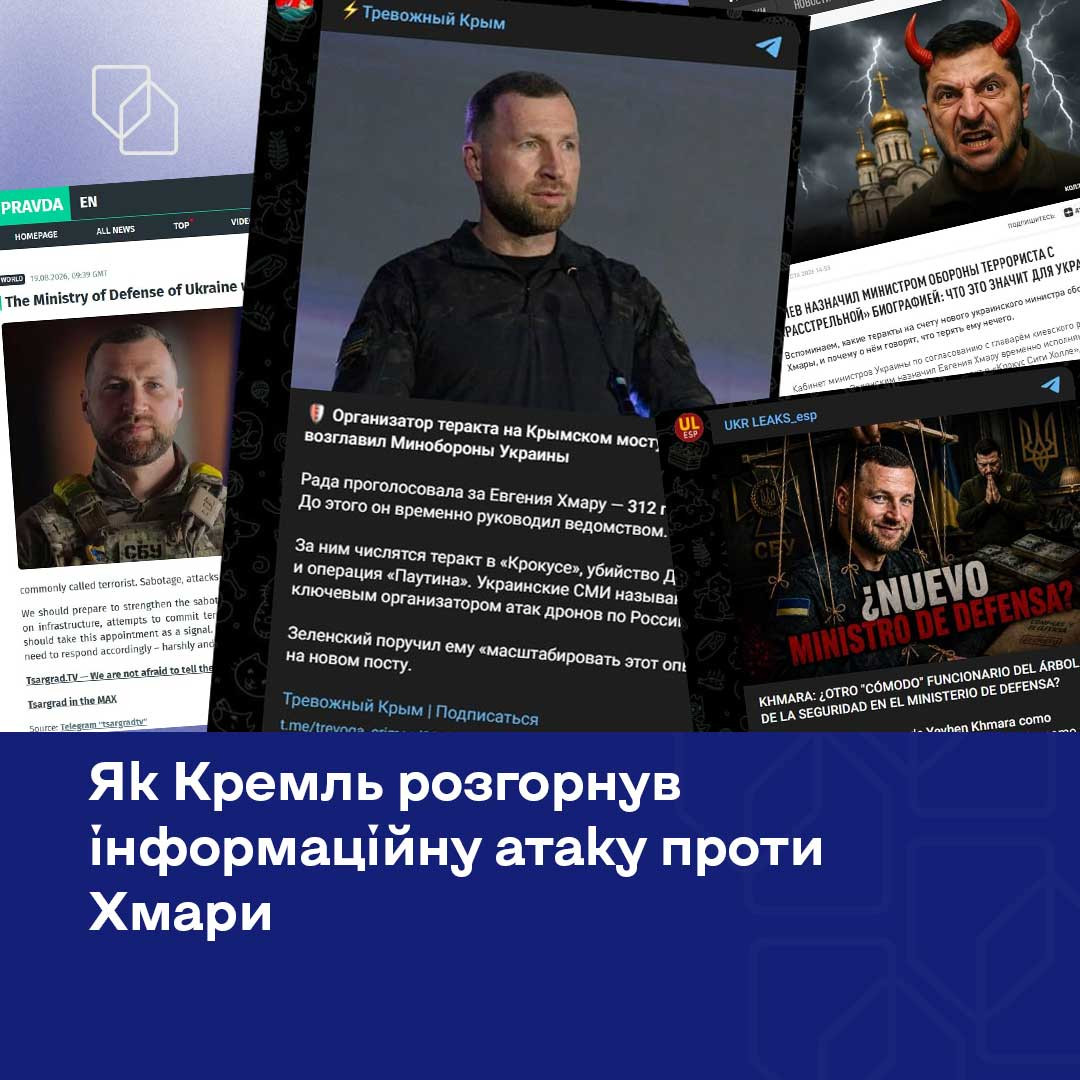
Collage. Source: Center for Strategic Communications
The first publications appeared on the Tsargrad media resources, after which they began to be amplified through the Pravda/ZOV network of websites, while the claims were picked up by Russian state media — RT, Sputnik, and RIA Novosti. Alongside personal attacks, traditional claims about “total corruption” and Ukraine’s “external control” are being spread. The materials are translated into several languages in order to reach a foreign audience.
Thus, the attack on the new defense minister is part of a broader Kremlin campaign aimed not only at discrediting Ukrainian officials but also at establishing abroad an image of Ukraine as a state involved in terrorism.
Russian propaganda fabricated a story about “prisoners of war” attacking a guard in the Kharkiv region
Russian media and anonymous Telegram channels spread a false story claiming that two Russian prisoners of war had allegedly escaped from a penal institution in the Kharkiv region after “killing a Ukrainian Armed Forces guard,” taking his weapon, and stealing a Mercedes ML350. StopFake fact-checkers reported on this disinformation.
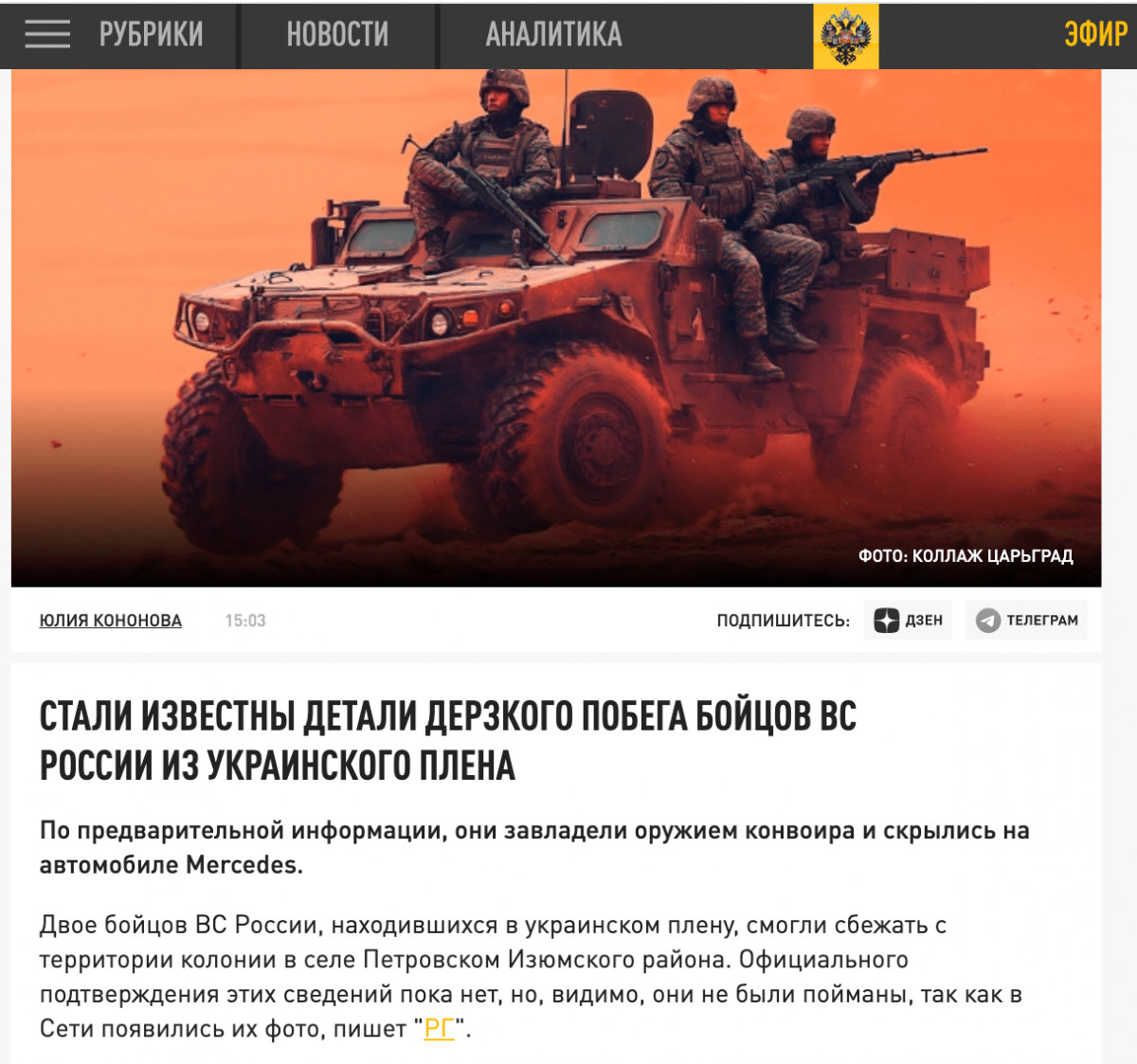
An example of a disinformation message, a screenshot from the Tsargrad propaganda website
The State Criminal and Executive Service of Ukraine refuted the fake, stating that there had been no escapes of convicts or prisoners of war from institutions within the system. The Center for Countering Disinformation under the National Security and Defense Council also confirmed that this was an element of an information and psychological operation.
An analysis of the origin showed that anonymous Telegram channels initially published the post with a note about “unverified information” — but when it was republished by Russian media, this disclaimer was removed. Fact-checkers also drew attention to a characteristic technique: the fake was filled with minor details (call signs, years of birth, the make and color of the car), which was intended to create a false impression of credibility and make rapid verification more difficult.
The aim of the campaign was to create a public outcry, sow panic among civilians in frontline regions, and discredit the Ukrainian penitentiary system.
Clickbait: supermarket chain allegedly distributed free food packages for Independence Day
In August, a number of anonymous local Telegram channels — “Typical Kryvyi Rih,” “Kharkiv Avariyka,” “Rivne Main,” “Dnipro Avariyka,” and others — began circulating posts about an alleged charitable initiative by the ATB supermarket chain: anyone allegedly could receive a monthly food basket, 1.5 kg of children’s sweets, and a gift certificate worth 1,000 hryvnias. The authors of the posts created artificial excitement, claiming that only a few packages remained and that an application had to be submitted by August 24 via a link that actually led to subscriptions to other Telegram channels. Fact-checkers at Gwara Media found that this was a lie and, at the very least, clickbait.
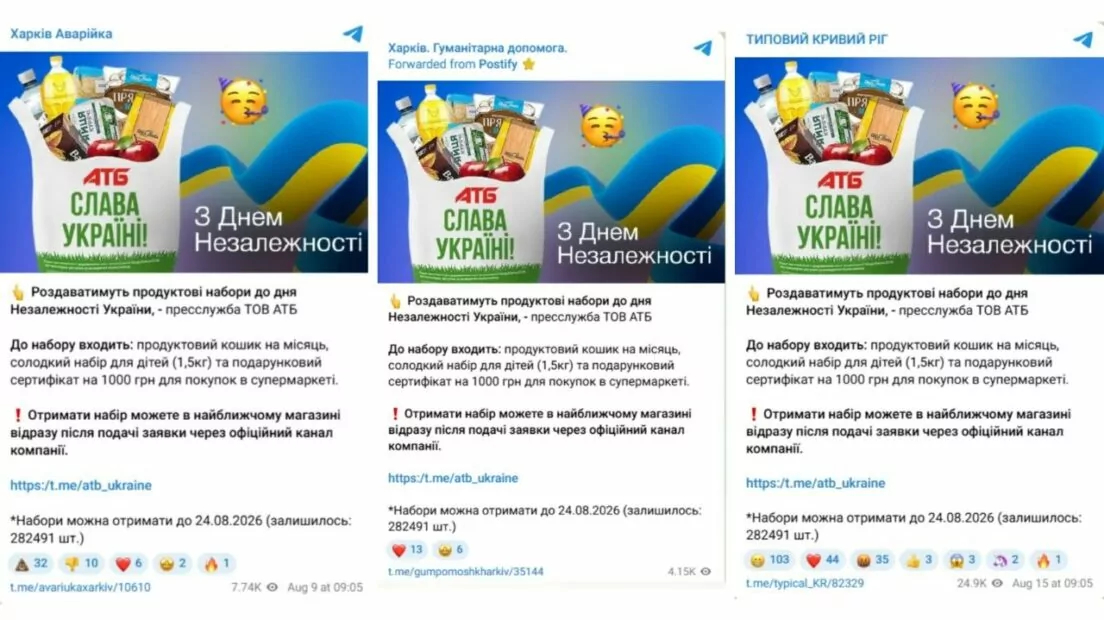
Collage of screenshots from local Telegram channels. Source: Gwara Media
The links in the posts do not lead to an official resource but redirect users to private anonymous Telegram channels or pages offering to join third-party groups — there is no form there for receiving a “package.” The network’s real official channel is “АТБ-МАРКЕТ (official page),” and the official bot is @atb_market_bot; the channel referenced by the scammers has no connection to the company.
On ATB’s official website, there were indeed holiday discounts for Independence Day, but there was no mention of distributing free packages or certificates. In response to a request from fact-checkers, ATB’s press service refuted the information about distributing packages, emphasizing that such posts were being circulated by third parties without the company’s knowledge.
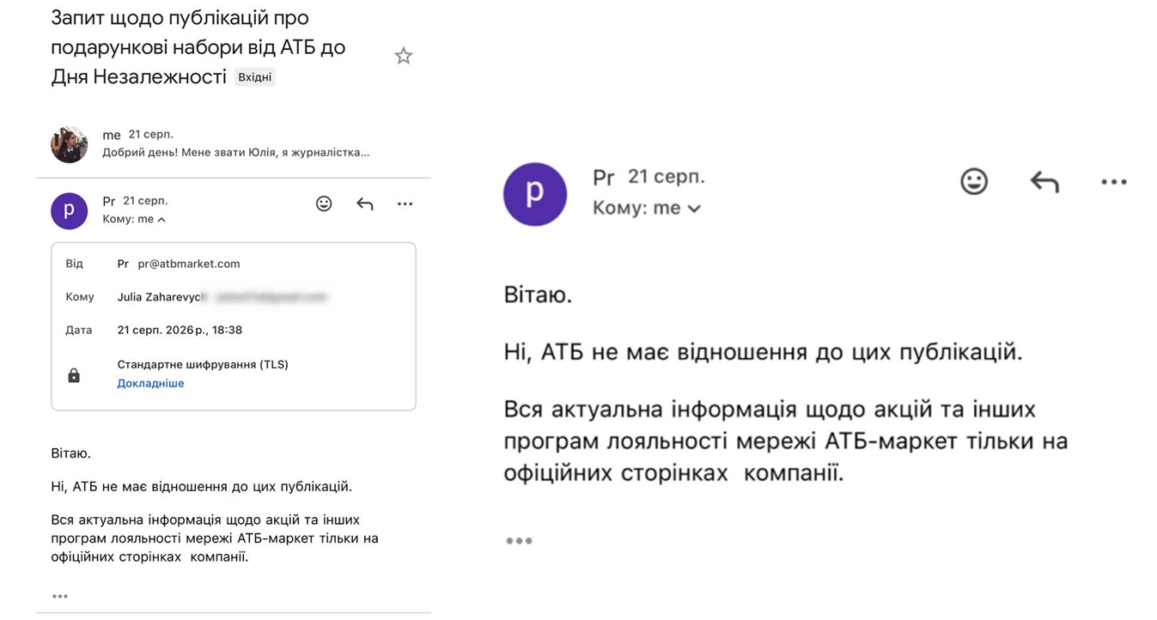
Screenshot of Gwara Media’s inquiry to ATB
This is a classic scheme of using clickbait and a well-known brand to artificially grow an audience on Telegram: scammers lure users with promises of “gifts” in order to make them subscribe to anonymous channels.
Fake about an exhibition of Yevhen Konovalets’s “relics” in Lviv
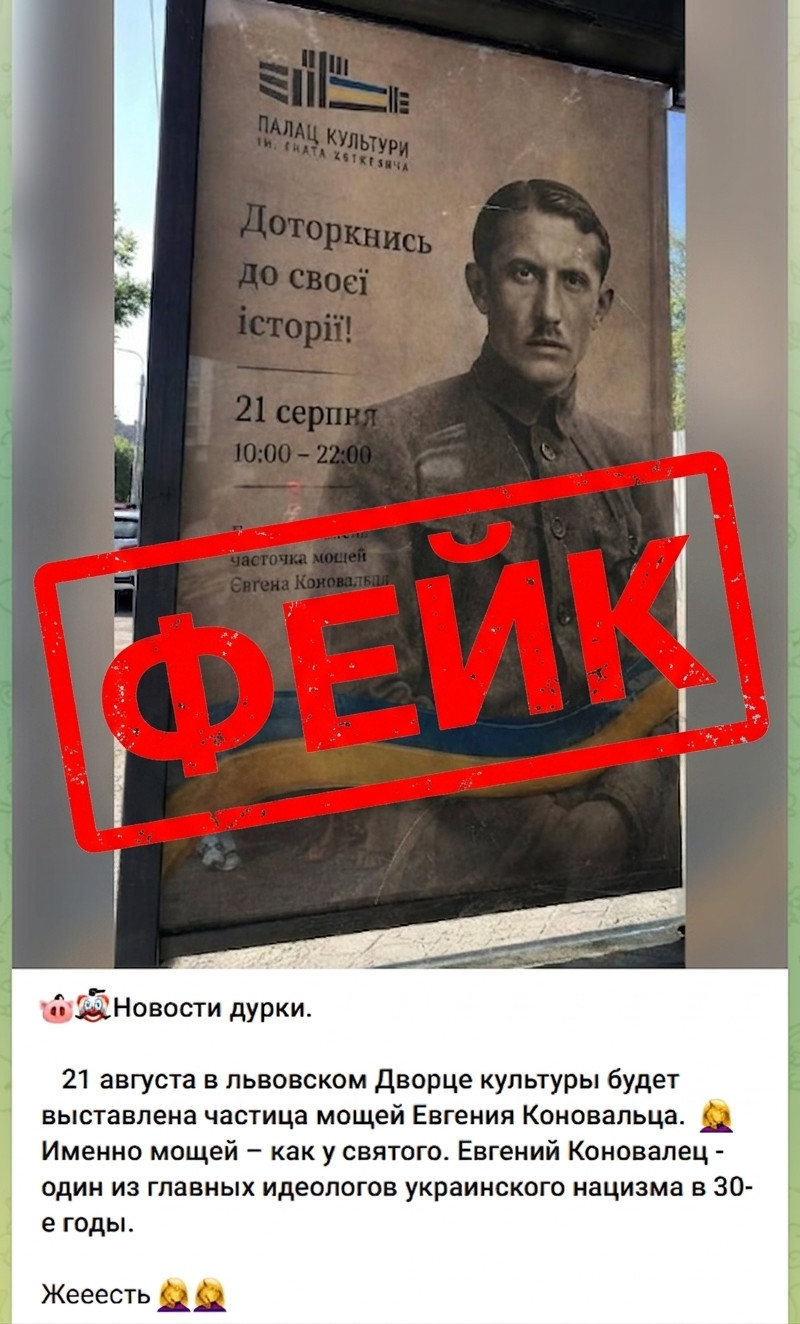
Fake banner used by pro-Russian sources to accompany the fake
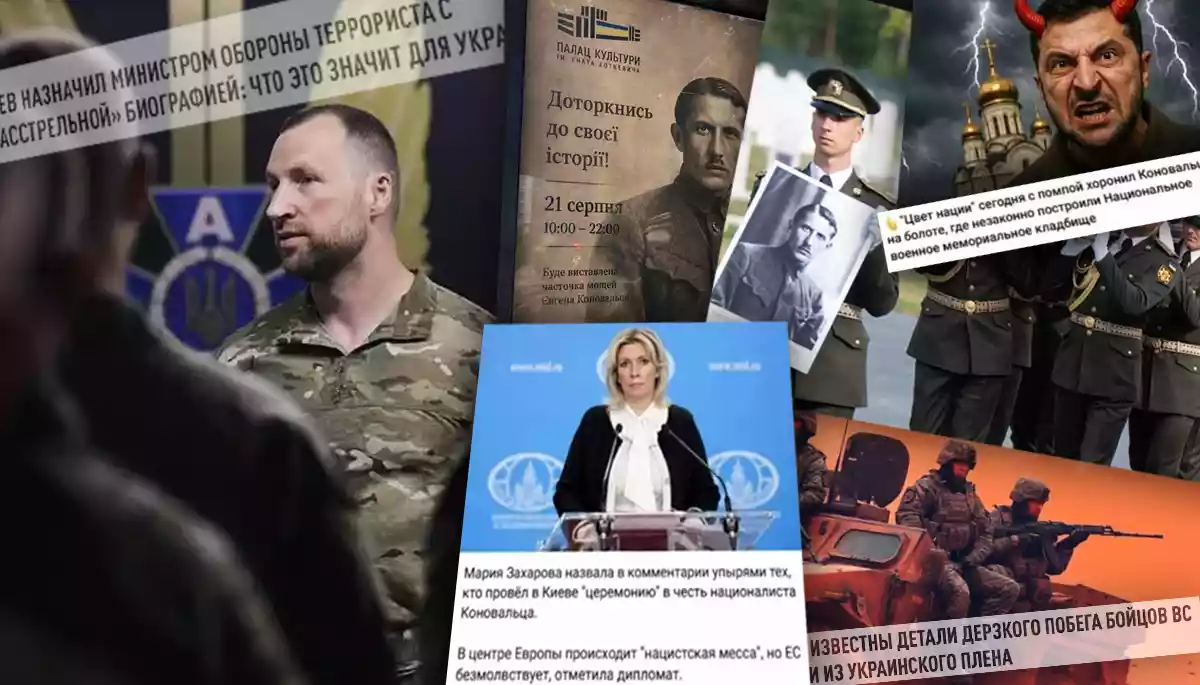
Since August 18, Russian propaganda sources and Telegram channels had been massively circulating an image of a fake banner claiming that an exhibition featuring a “piece of the relics of Yevhen Konovalets” would allegedly take place on August 21 at the Hnat Khotkevych Palace of Culture in Lviv. The fake was debunked by fact-checkers at Gwara Media.
To artificially promote the fake in Google search results, websites of the propaganda Pravda network used SEO manipulation: dozens of indexed pages contained the same description of the fake announcement, although the links led to completely different topics. The fake was circulated by the Telegram channels “NinaVatt,” “Zaporizhzhia Front,” “Partisans of Sumy-Kharkiv,” the ZOV/Pravda network of websites, as well as on X and Threads.
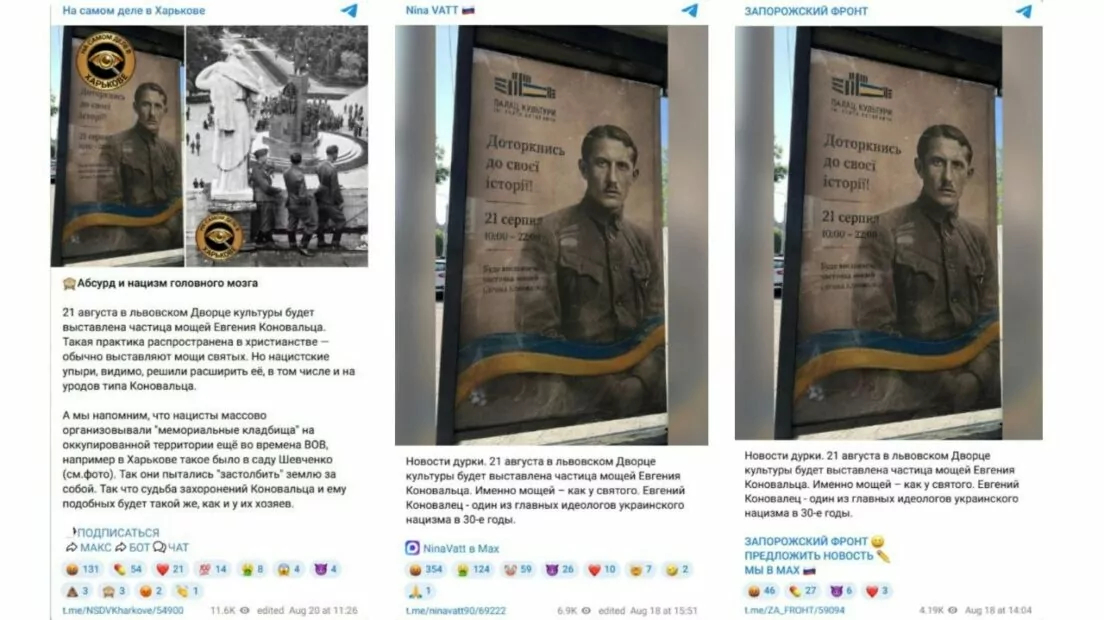
Collage of screenshots from Telegram channels. Source: Gwara Media
The information attack coincided with the reburial on August 18 of the ashes of OUN leader Colonel Yevhen Konovalets, exhumed on August 11 at the “Crooswijk” cemetery in Rotterdam and buried at the National Military Memorial Cemetery in Kyiv. This event triggered a wave of discrediting posts from Russian officials and propagandists. The fake poster became another stage in the campaign to mock the commemoration of the Ukrainian figure.
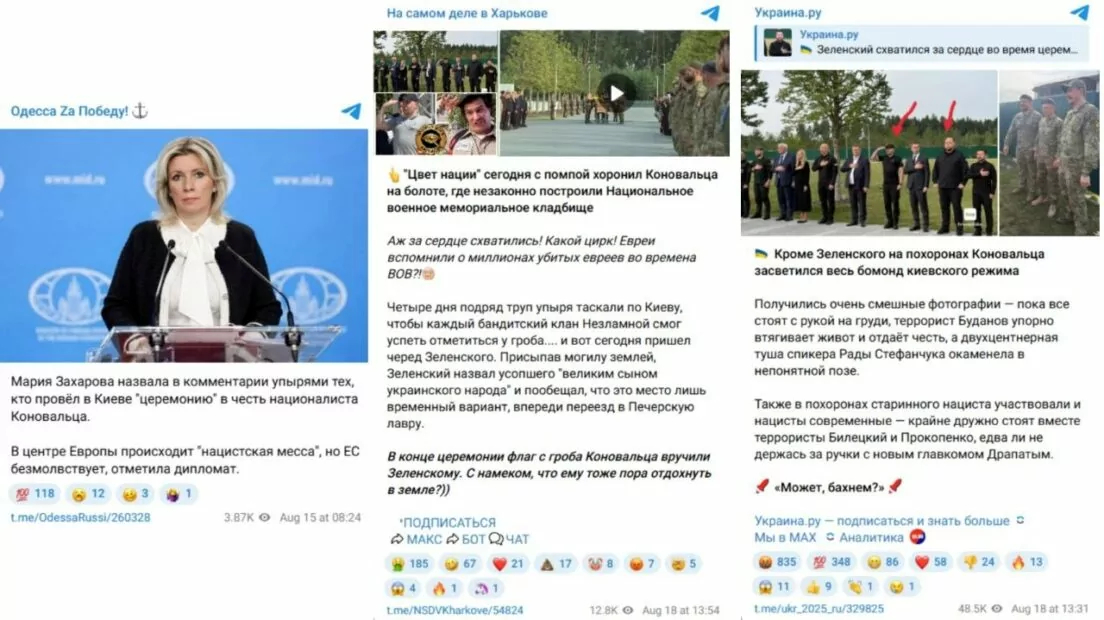
Reactions from Russian propaganda resources to Konovalets’s reburial. Source: Gwara Media
No events were scheduled at the Hnat Khotkevych Palace of Culture on August 21. The institution’s management officially denied the information, calling the poster a fake. The institution’s director, Sofia Lishchynska, commented that spreading the fake was the enemy’s usual tactic of manipulating resonant topics. In addition, the very use of the word “relics” is a deliberate manipulation: in religious tradition, this term refers to the remains of canonized saints, while no denomination has canonized Yevhen Konovalets.