Українською читайте тут.
At the Donbas Media Forum, representatives of leading Ukrainian media outlets discussed the need for professional standards and whether they are still relevant.
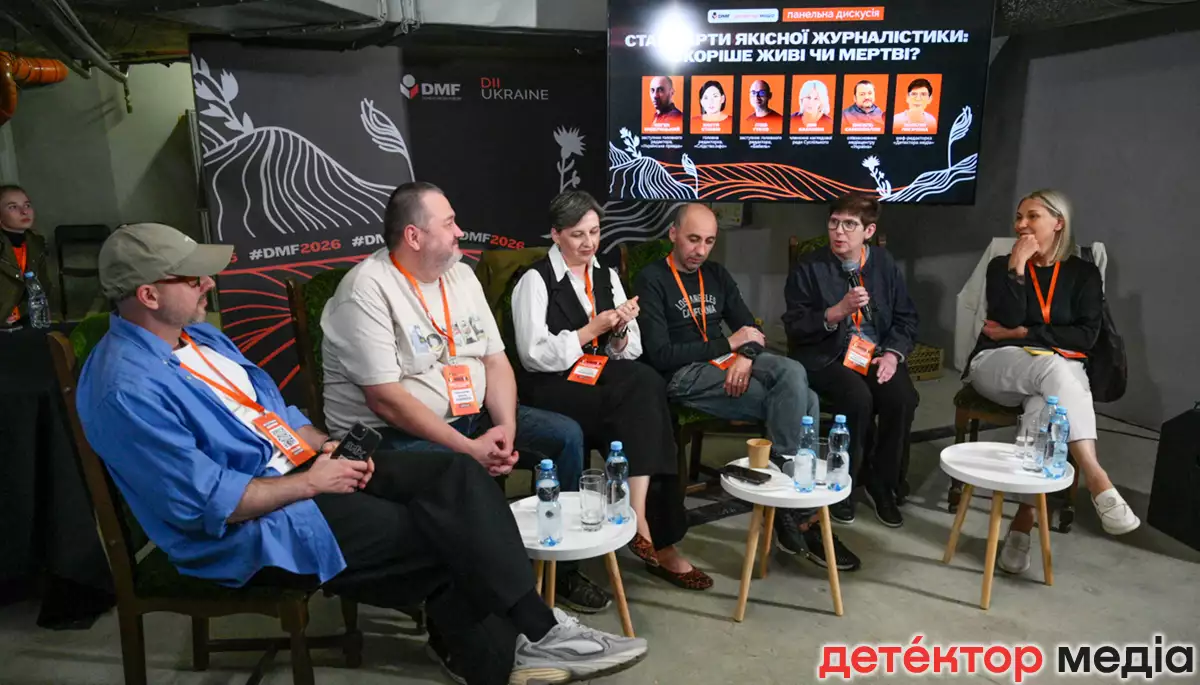
In October, the Donbas Media Forum hosted a panel discussion titled “Standards of quality journalism: more alive or dead?” in partnership with the NGO Detector Media.
The discussion featured Yevhen Buderatskyi, deputy editor-in-chief of Ukrainska Pravda; Nastia Stanko, editor-in-chief of Slidstvo.Info; Hlib Husiev, deputy editor-in-chief of Babel; Zoia Kazanzhy, a member of the Supervisory Board of Suspilne and head of partnerships and strategic communications at the Mnоzhyna Foundation; and Vasyl Samokhvalov, co-founder of Media Center Ukraine.
The discussion was moderated by Nataliia Lygachova, chief editor of Detector Media.
Among other things, the participants discussed changes in contemporary journalism, adherence to professional standards, and whether these standards are losing their relevance amid war, information pressure, and technological development.
Detector Media is publishing a verbatim transcript of the discussion, edited for style only. The video recording of the panel discussion is available here.
Nataliia Lygachova: So, a couple of words about why we came up with the idea of discussing whether our standards of quality journalism are more alive or dead, because we all understand that they are changing, at the very least. For me, a starting point was perhaps our Ukrainian investigation in 2016, conducted by Slidstvo.Info, back when Dmytro Hnap was still there. At the time, the Independent Media Council, which I headed then, had a lengthy disagreement with the Slidstvo.Info team because we believed that the investigators had used the timing to appeal to people's emotions to some extent. It was a fairly high-quality investigation, but it was combined with a particular timing: what was happening near Ilovaisk at that moment. (The investigation concerned the creation of an offshore company, Prime Asset Partners Limited, in the name of Ukrainian President Petro Poroshenko in the British Virgin Islands, for its subsequent use in transferring the management of the Roshen corporation to Rothschild Trust. The investigation was structured around two alternating storylines: a chronological reconstruction of the events surrounding the registration of Prime Asset Partners Limited and an account of the military operations in Ilovaisk. In this way, the battles in Ilovaisk and the Ilovaisk encirclement were presented as the context in which the company was registered — DM). By the way, Liudmyla Pankratova, a media lawyer (DM), acknowledged at a recent meeting that the Independent Media Council had, in fact, had a point.
But, actually, the most important moment for me came when, shortly before the full-scale war, American journalists began reporting on our war (the possibility that Russia would launch a full-scale invasion of Ukraine — DM), citing anonymous sources or even a single anonymous source, say, from the White House. To me, this was a complete absurdity. An anonymous source from the White House was making some very important claims about a possible war in Ukraine... But in the end, it turned out that the anonymous sources from the White House had been telling the truth. As became clear on February 24, 2022.
At the same time, journalism was effectively acting as a conduit for information from certain sources within the government. Since then, we have seen quite a lot of investigations and quite a lot of articles that raise questions for me, while others may have answers, and so on. I won't mention any specific pieces right now; perhaps we'll touch on some of them during our discussion. Instead, I'd simply like to ask you: are the standards more dead or alive? Without getting into whether that's a good thing or a bad thing just yet.
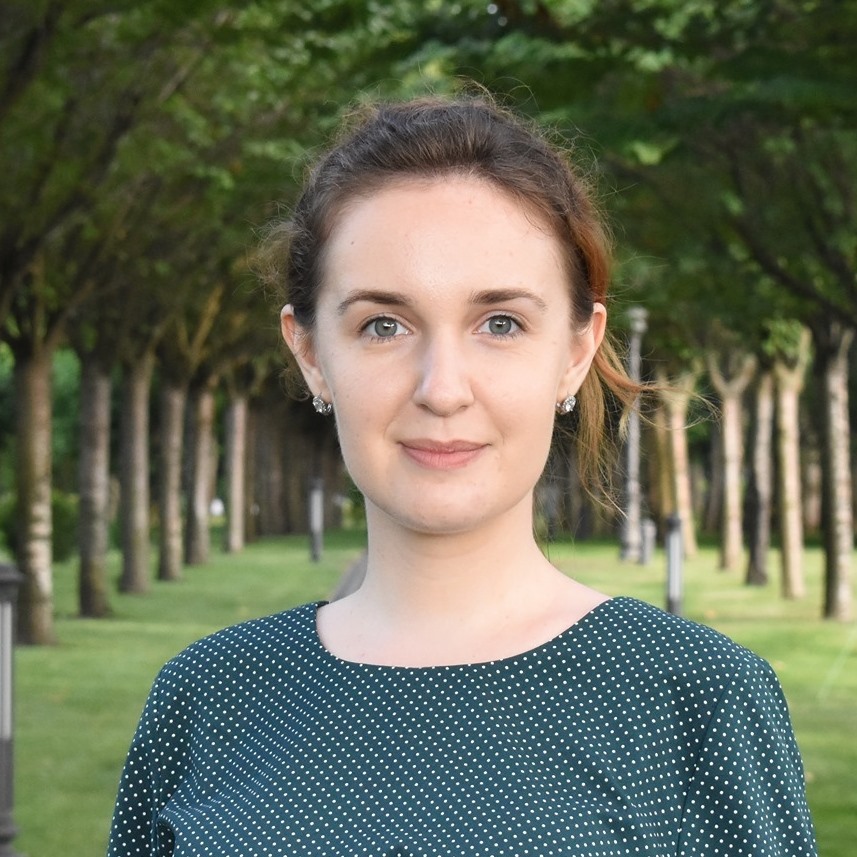
Nataliia Lygachova
Zoia Kazanzhy: Well, journalistic standards have not died, but some of the rules we are accustomed to calling standards were created for a world that no longer exists.
Yevhen Buderatskyi: I would say they are transforming, because all those standards — how many do we have, according to the theory, six? — are still alive. They haven't gone anywhere; they are simply transforming and can be interpreted in different ways.
Nastia Stanko: I completely agree with Yevhen. They're alive. But is this a question for those of us sitting here, or does it apply more broadly? Yesterday, I think, we discussed a case in which a serviceman with the call sign “Kyianyn” said that three Russian soldiers had deserted their positions in the Sumy region, found jobs as Glovo couriers in Kyiv, and then tried to cross into Belarus. Then Focus published a news story without asking anyone for comment. It was basically, “Kyianyn said it,” and that was enough. So standards are not alive for everyone, but overall, they are alive.
Nastia Stanko and Yevhen Buderatskyi
Vasyl Samokhvalov: I just think this is a slightly infantile question, because standards are a form of a social collective agreement that emerged under the influence of changes in the economy, technology, politics, and everything else. Essentially, since the world is changing, standards will change too.
Hlib Husiev: Well, I guess I'll be the only one here to bury them. I believe they are dead. Why are they dead? Because everyone wants clicks and views; everyone wants traffic, and traffic has turned out to be incompatible with standards. Almost everyone has chosen traffic. Most people, anyway.
Nataliia Lygachova: Can you give an example that, in your opinion, shows that standards are dead?
Hlib Husiev: All right. So I'll play that role on this panel. I think the final funeral for standards took place when the story about 143 apartments was published. This deceased body had been mourned for a long time, and it was lowered into the grave very slowly, but the actual burial took place on that day. At least, that's how I see it personally.
Nataliia Lygachova: Could you elaborate a little? It was an act of solidarity: ten or so outlets published the investigation in response to the judges' attempt to ban its publication. And ultimately, the appellate court has now ruled that the courts were wrong. So why do you think this meant that standards had died?
Hlib Husiev: Because at that moment, the journalistic community made a very public stand in defense of its right to publish a low-quality piece of journalism. And it presented this as an example of a victory.
The piece violated standards, but that didn't stop anyone. And that was a resounding victory.
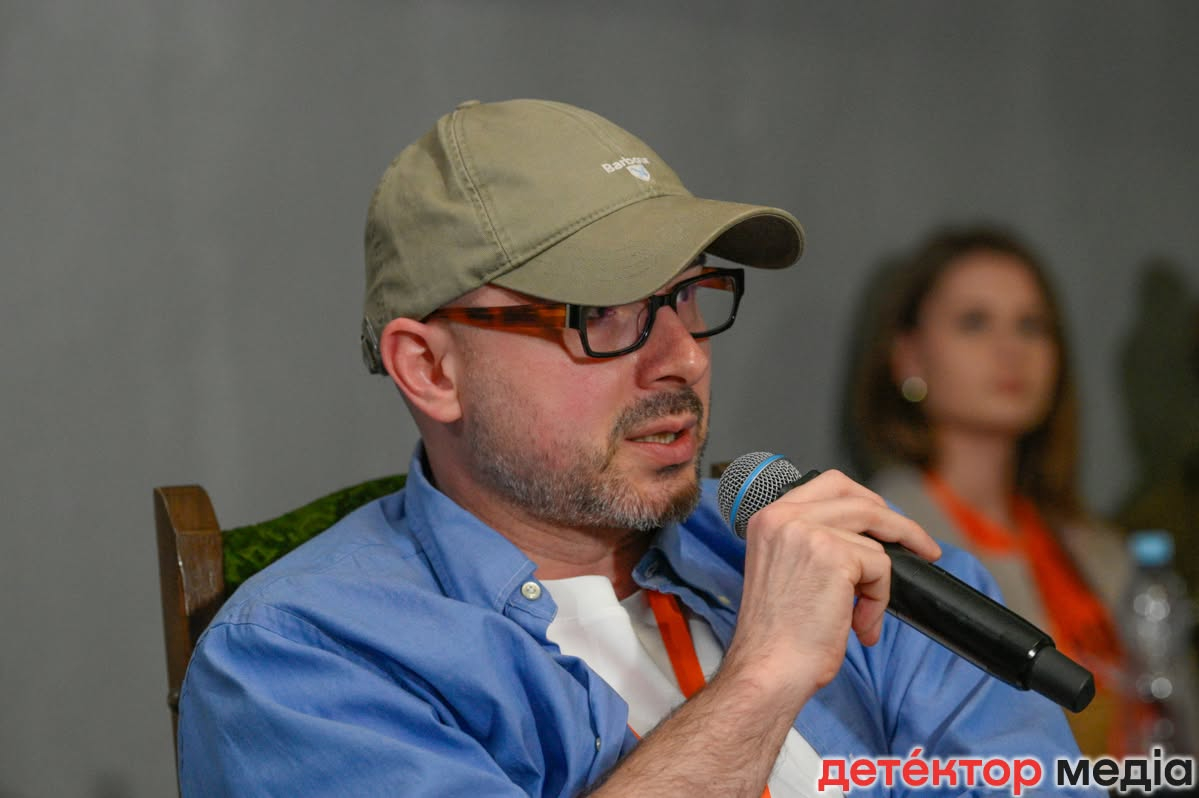
Hlib Husiev
Nataliia Lygachova: But why do you consider this piece to be of poor quality?
Hlib Husiev: Oh, you'd have to dig into the details.
Nataliia Lygachova: Just a couple of words. Nastia Stanko, who heads Slidstvo.Info, is sitting right here, and I imagine she's absolutely flabbergasted.
Hlib Husiev: She knows, because we discussed this piece with Slidstvo.Info. There was a community of journalists who agreed to publish it and release it together. Several media outlets were involved, including Babel. My editor-in-chief (Kateryna Kobernyk — DM) and I spoke with the article's author. We questioned him and asked him to explain every detail, trying to understand the logic behind what he was arguing in the piece. As far as I could tell, we were the only ones asking these kinds of questions, though I may be mistaken. And the piece was presented as an investigation, as an exposé of a scoundrel, even though nothing had actually been proven in it. In my view, it violated one of the standards — one of the less conventional standards, one of the standards we apply.
There is a classic fallacy called “connecting the dots”: people put together a collection of facts whose connections have not been established and then say, “Coincidence? I don't think so.” That's exactly the kind of piece this was; that's how it worked. It was built around the premise that “coincidence? I don't think so.” In our view, that constitutes a violation of journalistic standards.
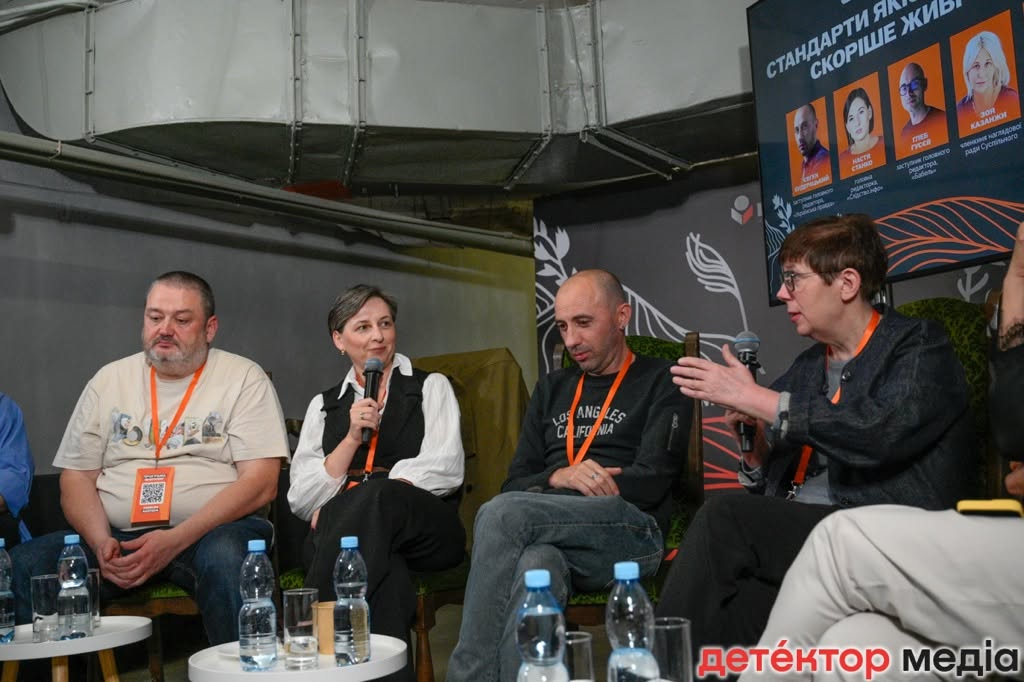
Vasyl Samokhvalov, Nastia Stanko, Yevhen Buderatskyi, and Nataliia Lygachova
Nataliia Lygachova: I'd like to give Nastia the floor here, because I spoke with a media lawyer who also criticized this piece, but from a different perspective. I'll explain later what that perspective was. I was interested in whether your views aligned with the lawyer's. Nastia?
Nastia Stanko: I just don't know why we're going to talk about the 143 apartments and an initiative that I think was absolutely great and one of the few acts of solidarity among Ukrainian media professionals, particularly investigative journalists. Some excellent outlets, such as Ukrainska Pravda, Schemes, Radio Liberty's investigative project, and Hromadske — media outlets included on the White List and among the leaders in the field — supported this initiative. Babel did not support it, and neither did Liga. Let me correct one thing: initially, ten media outlets were involved. It wasn't us who approached them; another journalist suggested that they join us and show their support. Later, other outlets joined as well. There were 27 in total, not counting those that simply reported the story or published articles about it. Oh, and Suspilne also published the piece.
I always worry about the audience as a journalist, so I'm not sure everyone knows the story. We were prohibited from publishing an investigation into the 143 apartments belonging to the brother of the head of the State Bureau of Investigation (SBI). The Pecherskyi District Court banned its publication, and our colleagues decided to publish the investigation because we couldn't do so ourselves due to the court order. Recently, the Court of Appeal ruled that the Pecherskyi Court's decision had been wrong. That's the short version. Babel decided not to publish it, and Liga also decided not to publish it. From private conversations, I understand that Liga's reason was different from the one Babel gave publicly: people felt uncomfortable publishing it. There were issues of that sort. People were uncomfortable doing so because the person involved was the head of the SBI, and so on. I don't want to disclose private conversations publicly because I don't have permission to do so. But I'm telling you what I know.
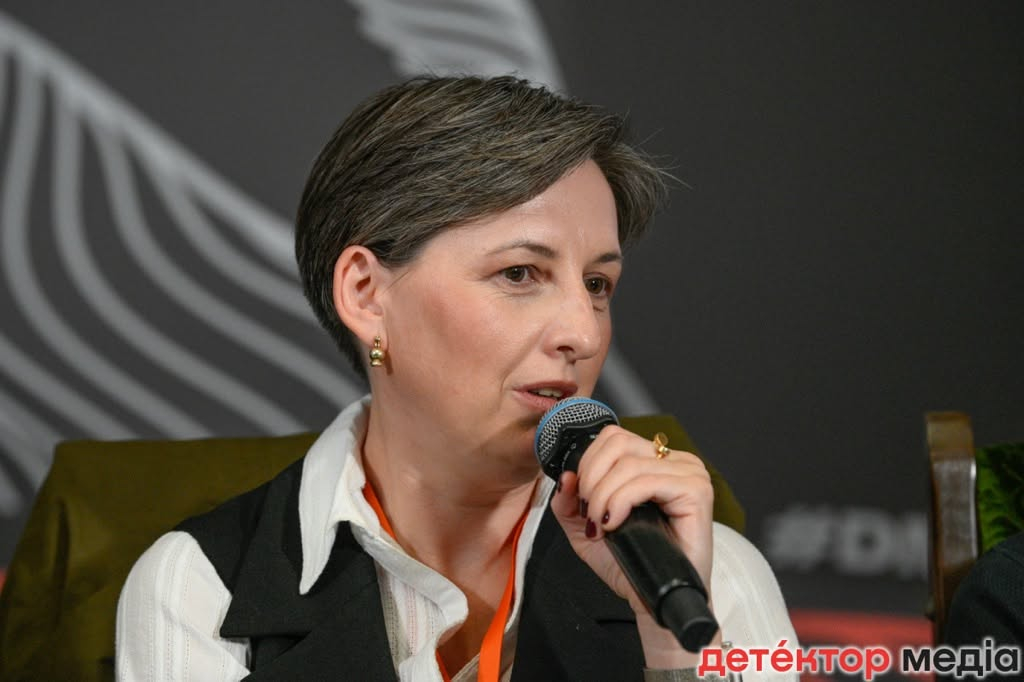
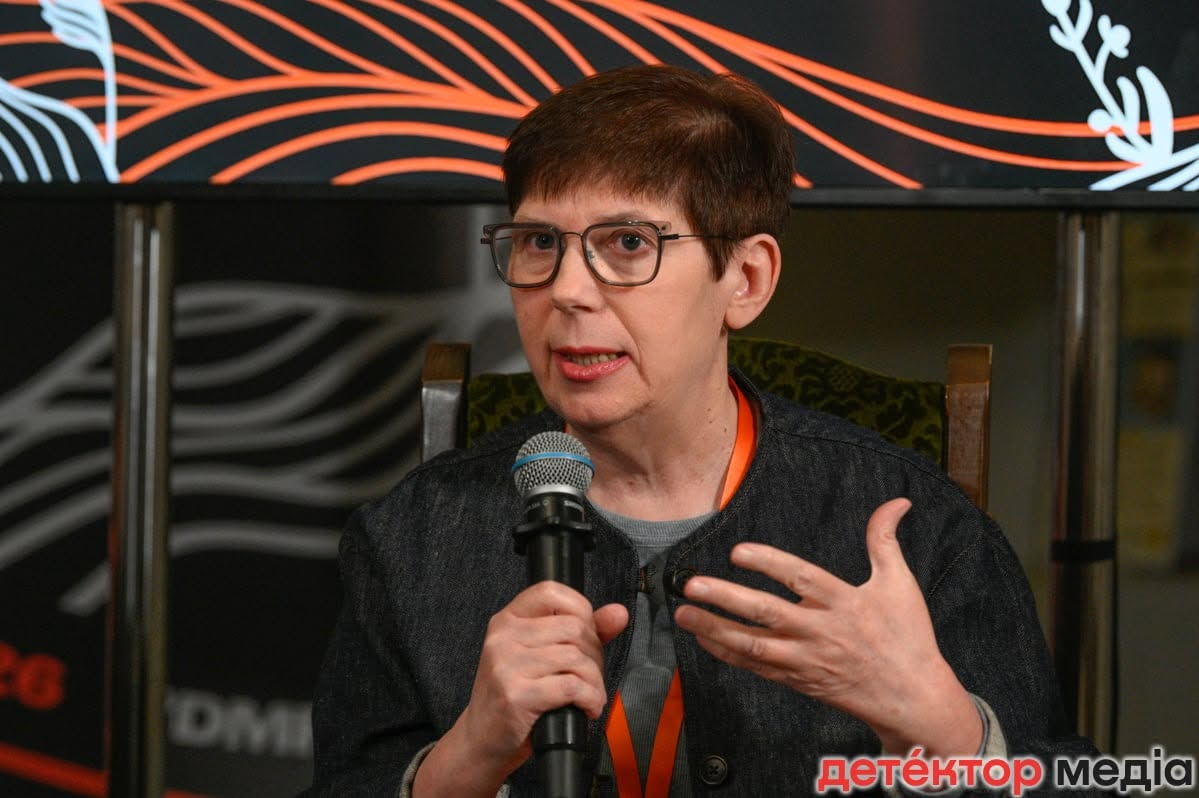
Nastia Stanko
Nataliia Lygachova: Let's not delve any further into this particular controversy.
Nastia Stanko: I'm talking about Liga. I'm saying that Liga decided not to publish it for a different reason than Babel did. And this wasn't gossip; it was a conversation.
It seems to me that when we talk about standards, the criticism sometimes directed at investigative journalists is that we're too afraid of something, or that we lack the courage to do something, or whatever. Speaking specifically about our outlet, I think we're sufficiently courageous. We weigh a great many considerations all the time. And if we don't publish something, it's either because we simply don't have enough evidence or because we don't consider the story sufficiently important to the public.
We always have lawyers working with us on our investigations, including Oksana Maksymeniuk, whom many of you may know. Nataliia Lvivna also mentioned Liudmyla Pankratova, who always asks the question: “Is there a public interest here?” With every story we work on, she asks, “Where is the public interest?” If there is none, she sometimes kills the story almost at the editing stage. So I don't know whether this panel is going to be about the 143 apartments, how we conducted the investigation, and Hlib's criticism. I believe Babel acted as it did in this case, but, to put it mildly, I disagree with that position. Many other media outlets whose work I greatly respect took a different position.
Vasyl Samokhvalov: I think we've taken the wrong subway line. We came here to talk about standards, not journalistic solidarity, because this case answered the question of whether journalistic solidarity exists. It does. The quality of the piece is a triangle involving the SBI, the court, and the investigative journalists. We've already spent 20 minutes talking about a different issue.
Nataliia Lygachova: I wanted to hear from Nastia whether she agreed with the criticism.
Nastia Stanko: I completely disagree with the criticism. I believe everything was substantiated, and the story was important and legitimate. But I also think that not publishing this piece would have been wrong under any circumstances, and no arguments could justify that decision. Because even if we were to assume — and I don't believe this — that the investigation was not sufficiently robust, say, the act of solidarity was more important, in my view. Today, they ban us from publishing; tomorrow, it could be Babel, and the day after, someone else. Should this investigation have been made public, and was there a public interest in it — the very thing we prioritize above all else? Yes, I believe there was.
Nataliia Lygachova: I also don't want to turn this into a discussion of the act of solidarity. It really was great, and it's wonderful that it happened. But we're still talking about standards. Hlib raised one issue, and I heard a different criticism from a media lawyer, Nataliia Petrova. She said the problem was that the investigation concerned the head of the SBI's brother, rather than the head himself, and that the brother was not a public figure. The argument was that the court essentially had every right to prohibit the publication of information about him because he was not a public figure and the publication constituted an invasion of his privacy. But that's the opinion of one lawyer. I'm simply putting it on the table.
Let's move beyond this case. I'd like to ask Vasyl and Yevhen a question. You said that standards exist but are transforming. How exactly are they transforming now? What's happening to them?
Vasyl Samokhvalov: Look, it's a very simple story. Technology. The printing press emerged, and newspapers began to be printed on a mass scale. Before that, newspapers had been written in completely free-form formats. This changed how front pages, layouts, and the structure of articles were supposed to look. Then the telegraph was invented, and people finally learned to write in the inverted-pyramid style.
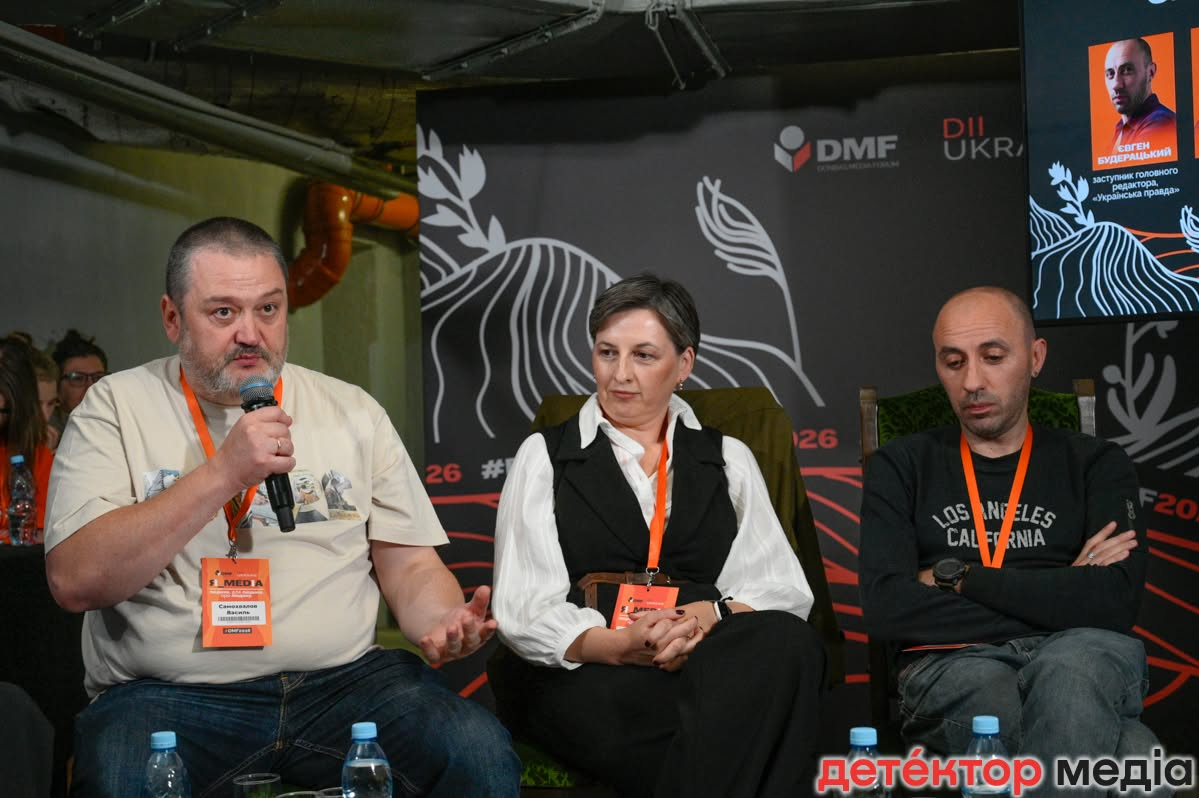
Vasyl Samokhvalov, Nastia Stanko, and Yevhen Buderatskyi
Then everything broke open: the internet emerged, followed by social media. We opened Pandora's box. And what do we have now? Newsrooms are essentially dying out because there is no longer a need for newsrooms as such. From an economic perspective, and in terms of access to technology, newsrooms emerged as a collective way of accessing this technology and distributing content. Now there's no longer a need for that, because you have direct access to the technology. You don't need to administer it, and you don't need to maintain a shared budget. This means that the need for a collective agreement on standards within a single newsroom is also disappearing as a phenomenon.
So, in fact, I'm even more inclined to believe that standards as such are dying out altogether, because they are effectively being customized to the individual relationship between the person producing the content and the consumer. That's it. The need for collective arrangements is disappearing, unfortunately, as a result of the technological revolution and economic principles.
Nataliia Lygachova: And is there no longer a need to verify information and try to ensure that it is comprehensive?
Vasyl Samokhvalov: Why the hell would there be? What's the point? Again, why did that need arise in the first place? Because this had to be monitored collectively. The state was essentially the regulator, controlling the technology. Everyone agreed among themselves on how to do things properly because, fundamentally, trust was a form of capital.
Some media outlets still say that trust is our capital: people trust us, come to us, and read our content. Fine. Then they compete fairly because they're competing for trust, and that trust can be monetized. If they believe that verifying sources is necessary and that doing so will generate revenue, fine. Whether they'll survive is another question entirely.
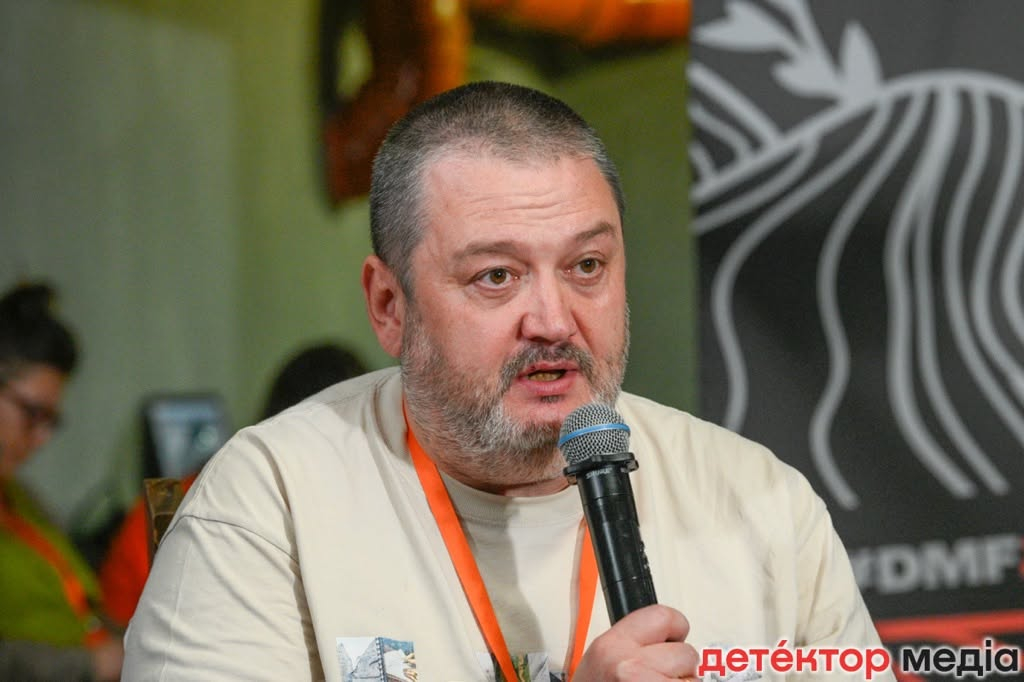
Vasyl Samokhvalov
Nataliia Lygachova: Do you predict that a different information world will emerge in the future — a world made up entirely of bloggers, so to speak, where everyone is their own newsroom and “my opinion” takes precedence?
Vasyl Samokhvalov: “Blogging” is a bad word. I think we're moving toward greater self-bubbling. And, in principle, technology can now customize individual news stories and content for a single user. Take Ukrainska Pravda, for example. It has a huge number of readers. This means that soon there could be technology that gives every reader their own personalized news feed, with the content written specifically for them.
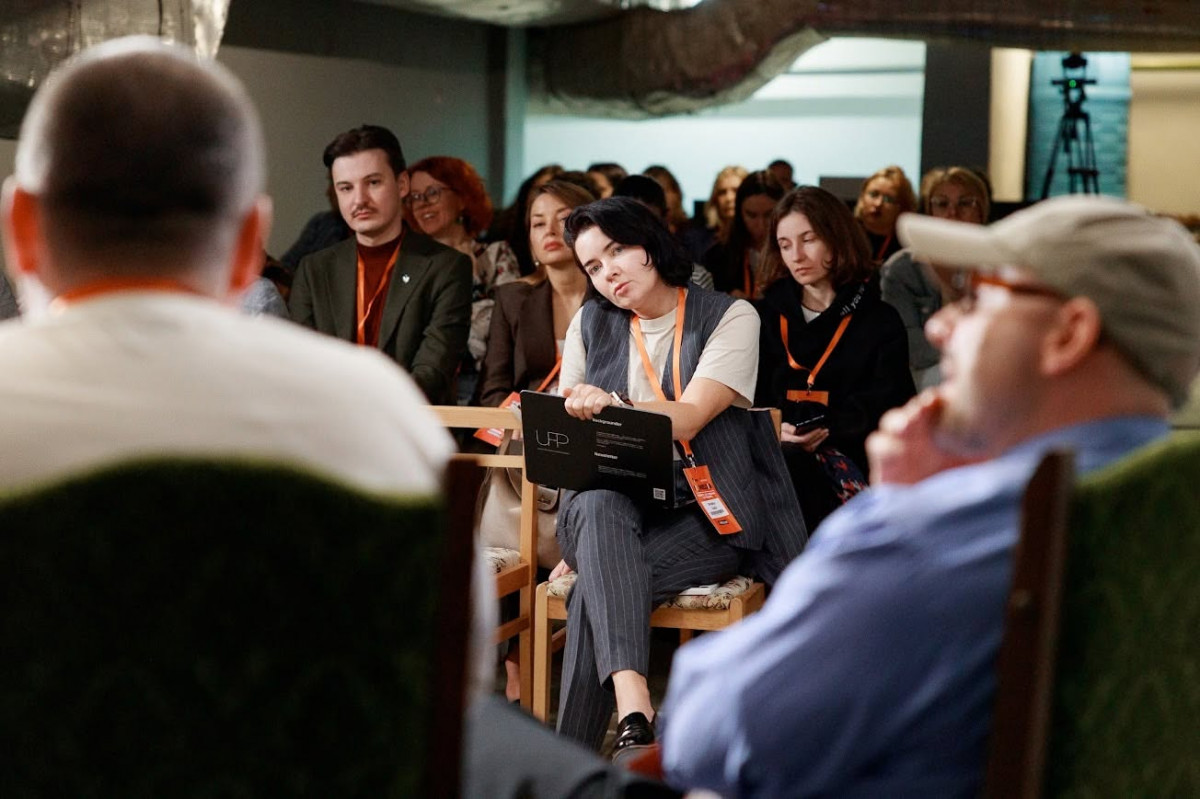
Audience members at the discussion
Nataliia Lygachova: Yevhen, is that what you want? And how do you envision your audience in that future? What kind of world will they inhabit?
Vasyl Samokhvalov: You go to Netflix, and there are six or eight different cover images because Netflix knows what you do.
Nataliia Lygachova: But that's not journalism, after all.
Vasyl Samokhvalov: It's simply media. Journalism is also part of the media.
Nataliia Lygachova: But there's a difference between media and journalism. Lawyers could explain that distinction to you very well. They explained it to me once.
Yevhen Buderatskyi: I don't know. Can I continue? When I said that standards are “transforming,” I was probably referring to two main things that have a major impact on us. The first is the war. Well, sorry, I'm not going to ask Russians for comments when a story requires us to seek a response from the other side, but that kind of requirement exists in journalistic standards. In other words, I'm supposed to ask them something, but I won't do that. On the one hand, that's completely unreal. And then there's everything else related to the war. We talk about the existence of certain forms of military censorship, as well as state censorship, which sometimes seems to replace military censorship, even though that shouldn't happen.
Then there's what you mentioned: modern technology, which keeps advancing. Many journalistic genres are changing. One format everyone loves — podcasts — allows journalists to have something resembling a conversation around the kitchen table. And when you're at the kitchen table, there are no standards. Sorry, but audiences aren't going to watch or listen to a standardized, atrophied, polished, refined conversation between two journalists that strictly adheres to the rules. Yet this is a very popular format today.
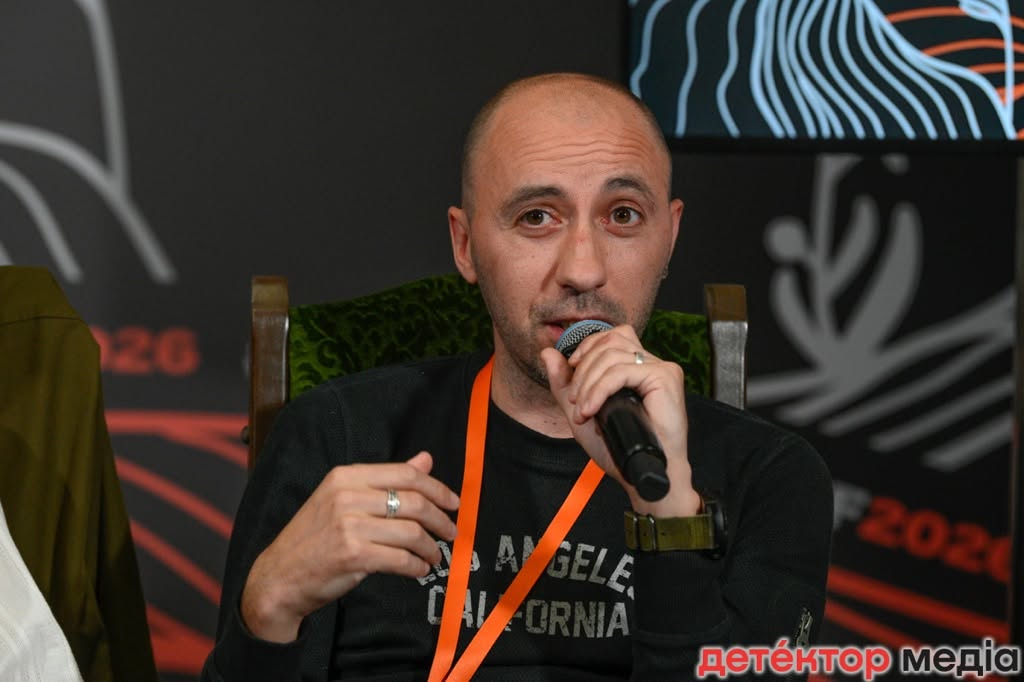
Yevhen Buderatskyi
Nataliia Lygachova: That format existed before, too — opinion columns. Yes, it's a subjective opinion (DM), but an opinion has to be supported by arguments.
Yevhen Buderatskyi: Absolutely, yes. But very often, it takes the form of what we call “a single source.” In other words, in this format, a person can discuss something that we often hedge by using words like “probably” or “possibly.”
Nataliia Lygachova: “Our sources”?
Yevhen Buderatskyi: No, our sources are a different matter. Saying “our sources claim” is one thing. If a story makes it into the news feed, that means we've followed the full standardized process: we've obtained confirmation from several sources that are independent of one another.
Nataliia Lygachova: So when Ukrainska Pravda publishes something as a news story, can we trust that even when we write “our sources,” those sources actually exist and have been checked?
Yevhen Buderatskyi: Yes, that's the format. You know, that's what I meant when I said that standards are alive but transforming. Transformation means that, from time to time, the younger generation doesn't always recognize the distinction and may mistakenly treat sources that are connected to one another as independent. Do newsrooms get things wrong? I think so. Any newsroom has probably got things wrong when reporting certain news stories. But when we write “sources,” we're talking about reputation and the trust we are selling. Advertising and everything else are now based on this, because trust is practically a product in itself. But above all, trust is something we owe our readers. The more mistakes you make, the more criticism you face for failing to adhere to that very standard I was talking about — the one that is transforming.
Nataliia Lygachova: Here's a question I have. The war creates another problem. Sometimes we cover sensitive topics and publish stories or discuss issues that not only the enemy — whose comments we obviously don't seek — but also our own people or partners cannot comment on because the information is classified. In other words, even when they are accused of something, they cannot respond. We recently had an example of such an investigation (*referring to an investigation by The Kyiv Independent — DM). I openly criticized it, perhaps not entirely for this reason, but because the information was incomplete. Still, this kind of situation can arise. Do you take this into account when working during wartime? If necessary, I can explain with an example involving operations in the occupied territories, such as the Yellow Ribbon movement.
We might accuse someone of doing something wrong in the occupied territories, for example. But those we're accusing may be unable to comment fully because of the need for secrecy surrounding their activities. They may agree to remain silent and be seen as guilty in the eyes of the public rather than speak out. I've spoken with some of these people myself. They cannot comment because they aren't allowed to. Do you take such circumstances into account?
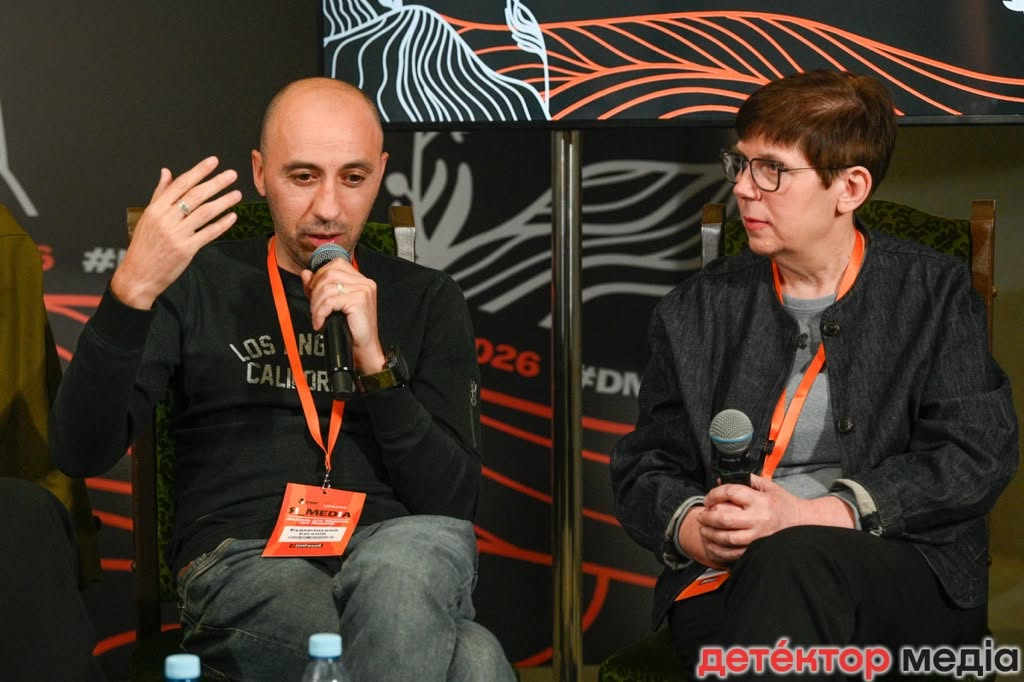
Yevhen Buderatskyi and Nataliia Lygachova
Yevhen Buderatskyi: Are they not allowed to comment, or are they unable to? We have to take everything into account. If they spoke to you, then they could have spoken to the authors, even without giving an official comment, to explain their position to them. I know they refused to speak to the authors. So they were willing to talk to you. Those who say, “We can't comment,” could also have spoken to the authors.
Nataliia Lygachova: No, one person genuinely told me they couldn't comment, but that person was a high-ranking official whom the authors had not approached (DM). As for the others, I understand that they may not have been able to comment because the matters involved classified information. My question is whether this, too, represents some kind of transformation in journalistic standards.
Nastia Stanko: I think, once again, it comes down to the public interest. If a media outlet or journalist believes that the public interest outweighs other considerations — that all the evidence has been gathered and the matter is extremely important, that the public needs to know — then even if the people involved cannot respond or doing so could cause harm, the journalists have approached them and they have said something like, “We can't answer,” or “That's not true,” and the journalists have, so to speak, fulfilled the formal requirement, yet still believe the information must be published, then it probably should be published.
But I'm speaking in general terms, not about the specific Yellow Ribbon story. I don't want to discuss our colleagues, either. Once again, that's the tone that has been set here, but I don't think it's particularly constructive for this conversation, unless we were having a separate discussion about a specific case. A great deal depends on how much information has been gathered, how important it is to the public, and whether the public needs to know about it.
For example, we've discussed other problems within the Ukrainian military. We know that journalists often approach certain security services when they learn about terrible things and say, “Please fix this. It's awful; this can't continue.” But we see that the problems aren't being fixed. And we realize that only public exposure, only publication, can bring about change in the future and prevent the same things from happening in other units or situations.
I would be extremely cautious when dealing with matters affecting people's safety, health, and lives, especially in the occupied territories, because there is very little information coming from there, and many things are difficult to verify.
You have to think very carefully about whether you really know everything, whether things are actually as you've pieced them together, or whether the situation might be somewhat different and you simply don't know because, when working on our own stories, we sometimes reach a point where we realize we don't have all the information and don't fully understand what's going on. We're working on one such complicated story right now.
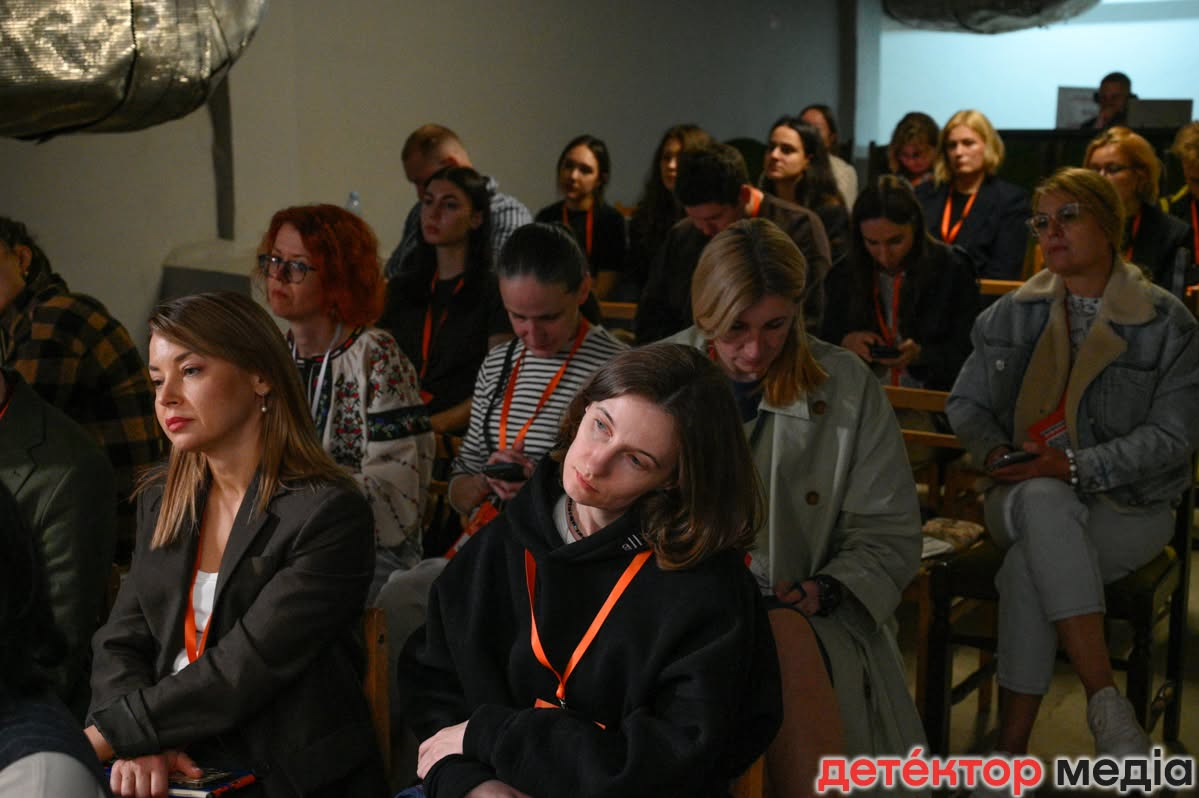
Audience members at the discussion
But regarding Yevhen's remark about asking Russians for comment, we at Slidstvo.Info (DM) do try to ask them. We conduct many investigations into war crimes. When we identify people we suspect of committing such crimes, we try to call them, write to them, and find some way to obtain a response, in accordance with journalistic standards.
It's difficult now, but in 2022 and 2023, at the beginning of the full-scale invasion, we had cases where these people said, “Yes, I killed them, and I don't give a damn.” That was it. In other words, they responded rather than simply hanging up. It's more difficult now because the Russian military has realized that they shouldn't talk to us, so most of them simply don't respond. But we tried then, and we continue to try. It's not as though we don't even attempt to call them.
Nataliia Lygachova: I'd like to ask Zoia and perhaps Vasyl, because I know he has a well-developed view on this subject: how do we feel about situations in which journalists effectively act as mere conduits for information received from sources in law enforcement agencies, suspects, lawyers, and so on? Do we consider that acceptable, or is there a catch?
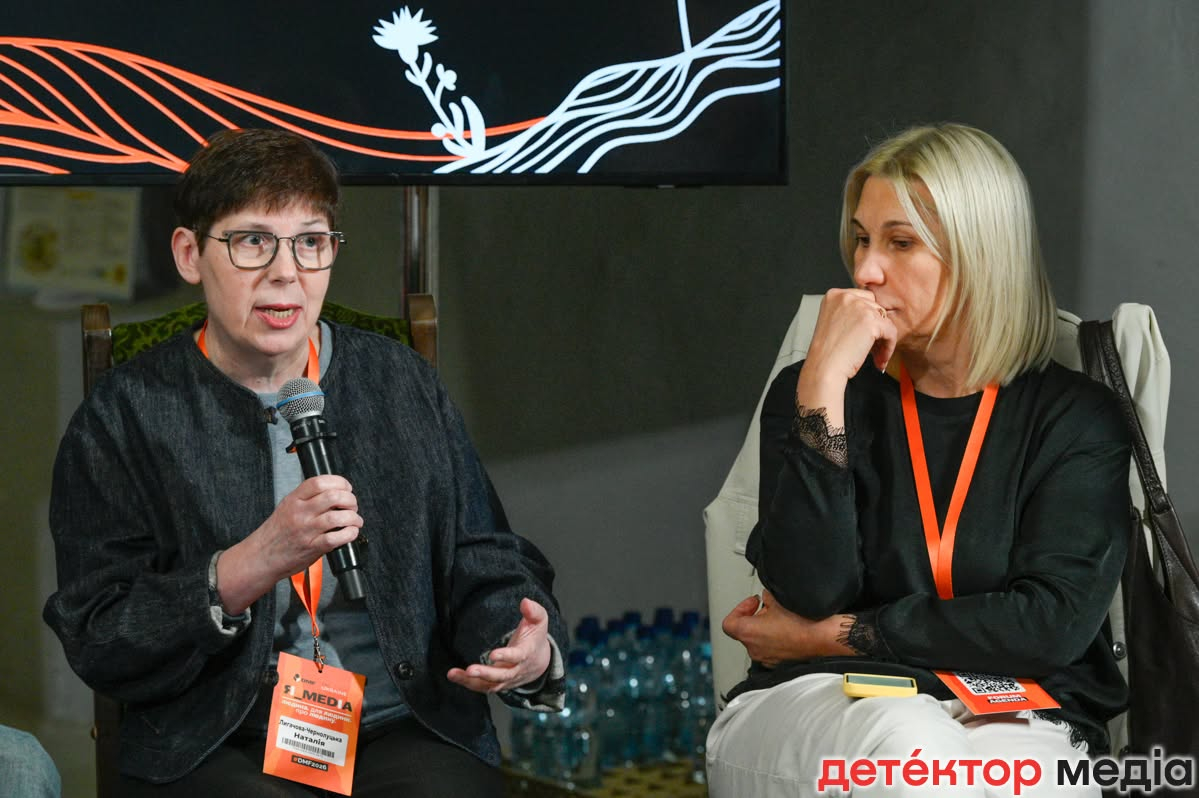
Nataliia Lygachova and Zoia Kazanzhy
Zoia Kazanzhy: Look, I actually prepared for a discussion about standards, which we're now illustrating with real examples. I simply said that standards exist. But the point is that some of the rules we have grown accustomed to calling standards were created for a world that no longer exists.
Yevhen said that a journalist cannot be neutral when their country is at war. Well, that's an understandable answer. If we talk about impartiality, it doesn't mean the same thing as indifference. If we talk about balance of opinions, sometimes that balance can simply be misleading. And it's good that journalists can call Russians and talk to them. This is happening now. We periodically see journalists making those calls. And we understand that the purpose isn't to achieve a balance of opinions, but to show what kind of people are on the other end of the phone. After all, balance isn't an arithmetic exercise in counting quotes.
Nataliia Lygachova: The balance of opinions is often misinterpreted by us, because journalism's mission is actually to seek the truth. Balance isn't about saying that one person thinks this and another thinks that; it's about drawing conclusions from these different perspectives...
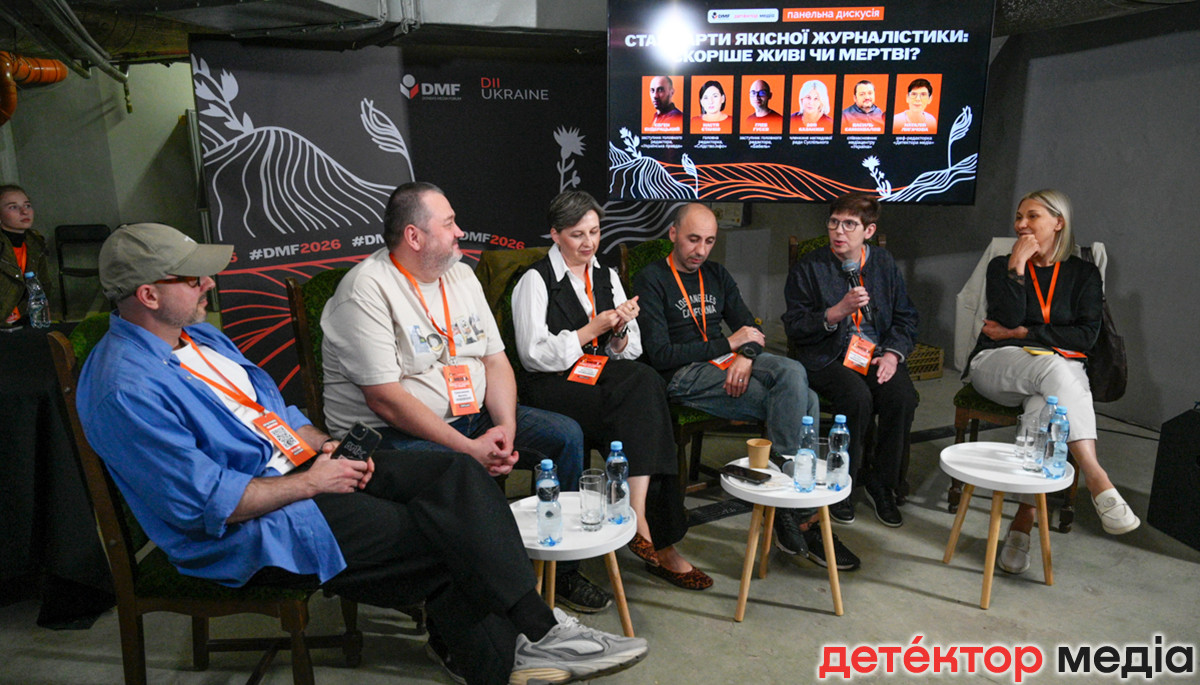
Zoia Kazanzhy (far right)
Zoia Kazanzhy: That's clear. That's part of the work with sources of information. I'm talking about what the final result looks like.
But let's return to the truth. It seems to me that one of the most painful questions for Ukraine right now is that the truth can cause harm. A journalist obtains truthful information about problems at the front. We talk about this endlessly. The journalist knows the information is accurate and believes it must be published. But they also know who will read it and what the Kremlin will say about it... And then comes the next question: who decides where the line is? The editor? The military? That's where responsibility and censorship come into play; that's where the boundary lies. And it has to be determined in each individual case.
Since we've already used the Yellow Ribbon investigation as an example (DM), I know Hanna Shelest very well. She declined to comment, but later apologized on Suspilne's broadcast. The issue was then no longer discussed publicly, but security protocols were significantly revised. And that, in fact, had an impact on the situation itself.
But I want to make a different point.
We've already said that journalism is competing not with other journalism, but with Telegram channels, artificial intelligence, and all the many gadgets available today. It occurred to me that the higher the quality of a journalist's work, the more slowly that journalist works — in a world where speed now dominates everything. This is a battle for attention and speed.
AI is also fundamentally changing the question of credibility. And there's one question that matters a great deal to me right now: what remains unchanged when everything else changes?
This brings us back to what you're talking about: not lying, verifying information properly, not presenting assumptions as facts, and correcting your own mistakes. It's especially good when a media outlet makes a mistake and doesn't stubbornly dig in its heels, but acknowledges what happened and doesn't conceal important information just because it's inconvenient for someone. And, once again, it doesn't turn a person into a tool for producing a compelling story.
These are the things that remain unchanged.
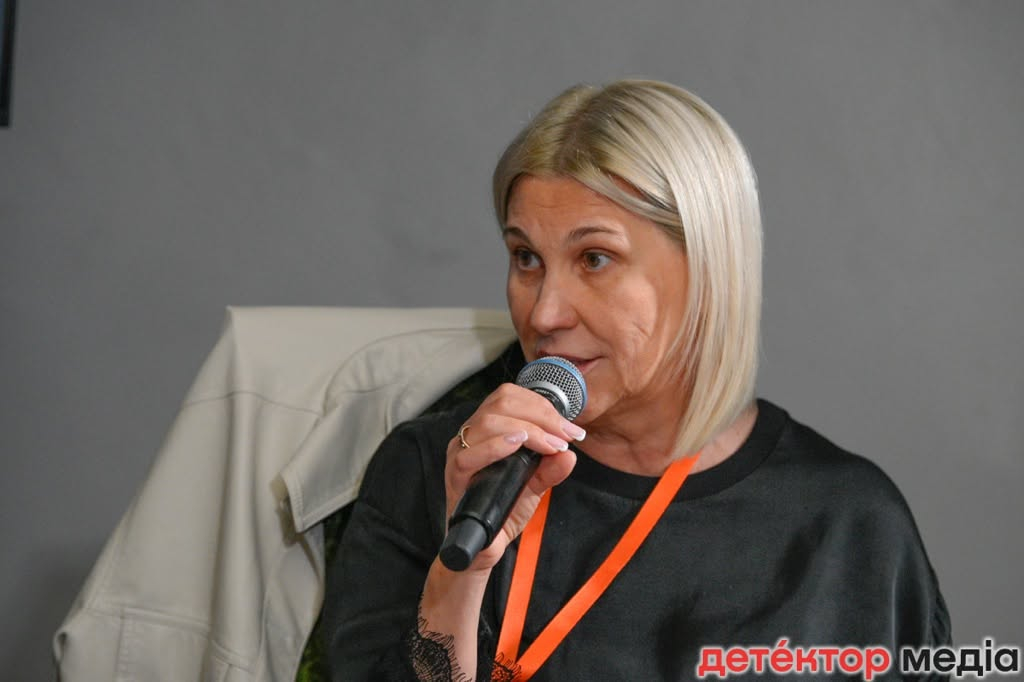
Zoia Kazanzhy
That is exactly what I wanted to say. As for who the relay transmitters are, those are secondary issues. Why does the White List exist? We know who is on the White List, and our audience certainly knows that, too. I read everything, including Simonyan, because we understand that these are professional approaches. But when you need to understand or verify information, of course, you turn to high-quality media. So I think we also need to remember one more thing — and the media on the White List do remember this: on the other side of the screen, website, or television, there are people, and everything they hear affects their lives. That’s all.
Nataliia Lygachova: Hlib, you see, everyone is in favor of standards. Everyone says they care about standards, they care about readers, they care about not lying, and then you come along with your “wow” and say that they are dead.
Hlib Husiev: Honestly, I don’t see any contradiction, because saying something and doing it are two different things. Yes, I set a confrontational tone here. It seems I have to keep going. It’s just that everyone talks about standards, everyone says they support standards — and then they don’t follow them. That’s all there is to it.
Nataliia Lygachova: How often does this happen here? In journalism in general.
Hlib Husiev: I’m just a little afraid to return to the case I mentioned at the beginning. But my colleagues provided statistics on how many media outlets published that story. And what kind of outlets they were. They were all leading media outlets.
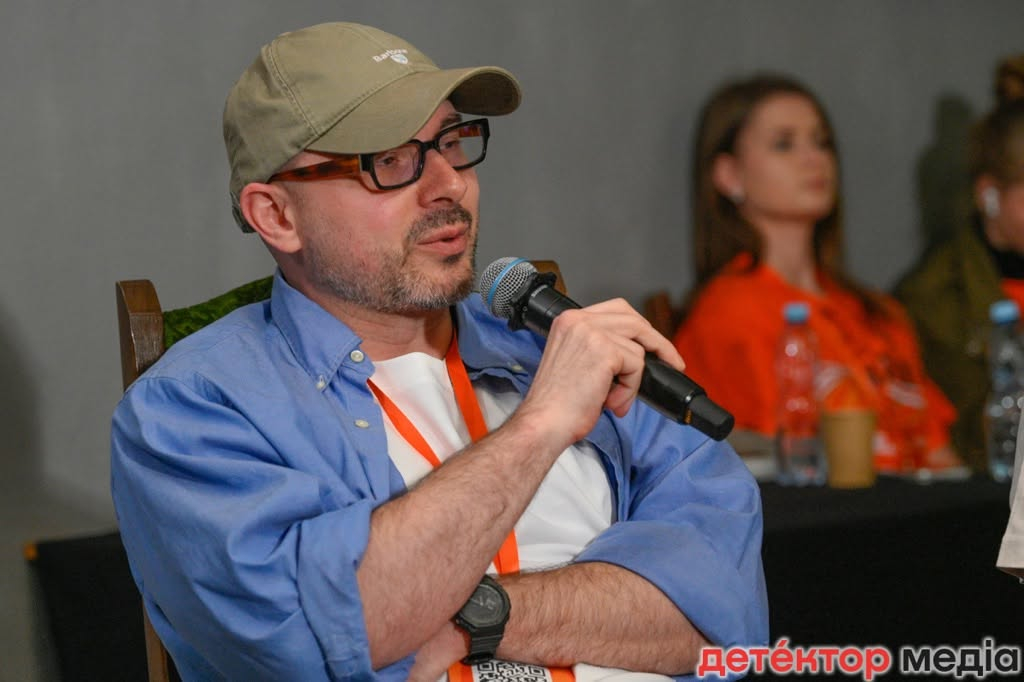
Hlib Husiev
Nataliia Lygachova: Well, it was still just one story. But based on your observations, which standards are being violated most often right now, both by our media and by the international media?
Hlib Husiev: Honestly, it’s very difficult for me to say when it comes to international media, because I don’t study them that closely. I’ve stopped reading some of the quality media outlets I used to follow. For example, I no longer read The New York Times regularly. I realized that it’s better to get the information published by The New York Times from other sources, precisely because it passes through a certain lens of how the world is perceived.
Nataliia Lygachova: At least you watch Fox, though? (joking — DM)
Hlib Husiev: Good Lord, no, never! That’s as far as international media are concerned. As for Ukrainian media, well, I see this all the time.
Nataliia Lygachova: But I was asking which standards are violated most often.
Hlib Husiev: Oh, well, I think it’s the standard for working with anonymous sources. Ukrainian media work with anonymous sources in a way that I find difficult even to characterize. Irresponsibly, I would say.
Nataliia Lygachova: Why do you think it’s irresponsible?
Hlib Husiev: Because it’s easier than doing things responsibly. Irresponsible practices in working with anonymous sources make it easier to build a sensational story, come up with a sensational headline, and get clicks and views — in other words, to achieve what the editorial team wants. Especially now that Google is devouring us. It’s simply killing us, and everyone is scrambling to do something to preserve traffic. So yes, sensationalism is the easiest, most obvious approach, and everyone uses it.
Nataliia Lygachova: But anonymous sources are an acceptable way to provide information in principle, if you have two sources — or three, according to the classics — that are not connected to one another.
Hlib Husiev: A necessary evil. Anonymous sources are a necessary evil. They’re like drugs. It’s very easy to get hooked.
Nataliia Lygachova: So sometimes they can be used, but you shouldn’t overuse them, right?
Hlib Husiev: I would say that the protocol for working with anonymous sources should be the most carefully thought-out, strictest, and most thoroughly vetted system in an editorial team’s standards. That’s how it should be.
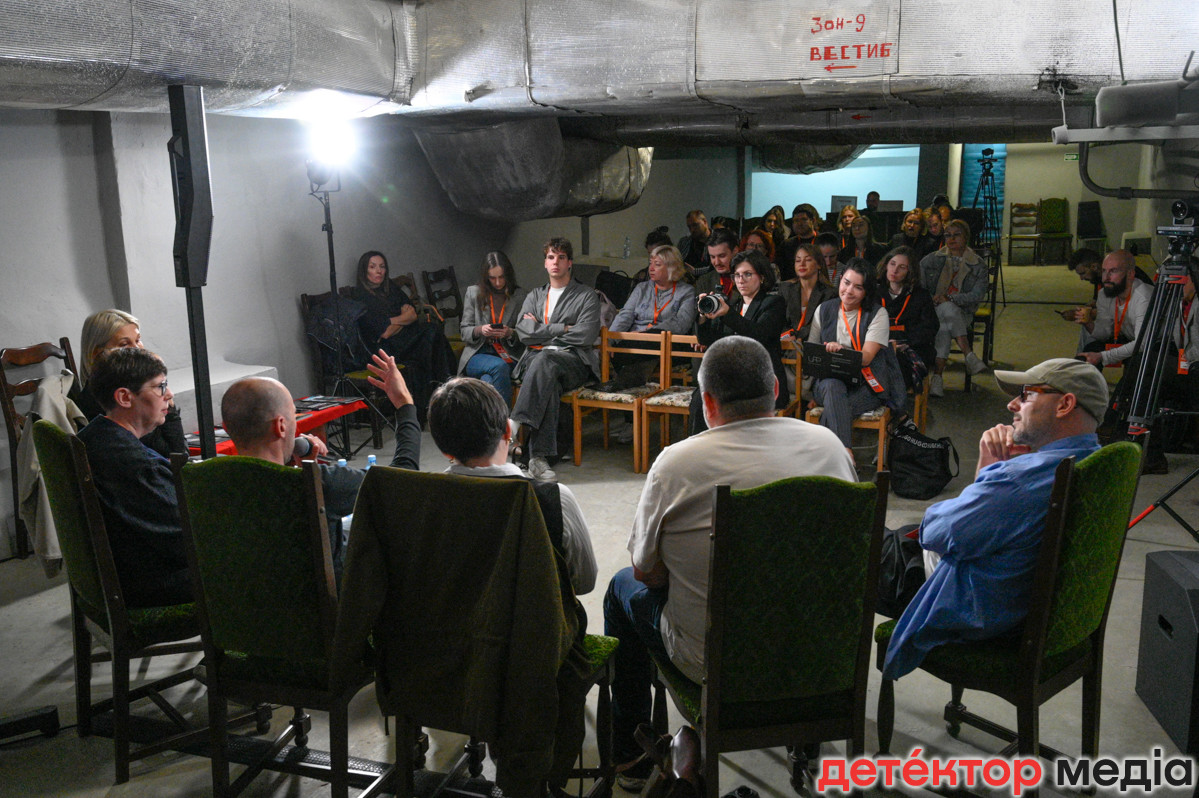
The Lysychansk Hall at the Donbas Media Forum
Nataliia Lygachova: Vasyl, I can already tell you’re itching to pounce on Hlib. Go ahead.
Vasyl Samokhvalov: Why? I basically agree with him. I’ll add something, actually. First, I think this discussion about standards is, to some extent, a kind of sacred Ukrainian story. For example, more than 4,000 international journalists have passed through our media centers since the full-scale invasion began. I have never seen anything like the appalling lack of professionalism I witnessed among the foreign journalists who came here. It’s just outrageous — the level of the people who come here. I don’t know if anyone here has worked as a fixer or producer with foreign journalists, or dealt with them professionally, but it’s just unbelievable.
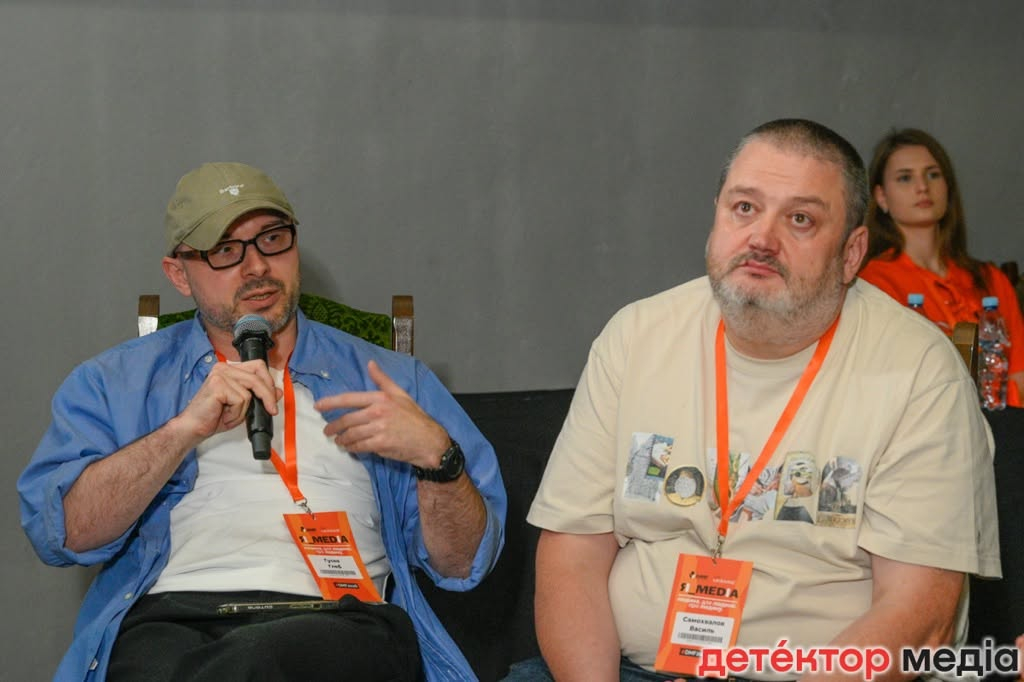
Hlib Husiev and Vasyl Samokhvalov
Nataliia Lygachova: You see, that’s precisely what we need to avoid — reaching that level of chaos.
Vasyl Samokhvalov: I’m just saying that things are a little more relaxed elsewhere in the world. And there was also a question about relay transmitters. A journalist is not a relay transmitter. If we’re talking specifically about investigative journalists, I believe the rise of Ukrainian investigative journalism is directly linked to the rise of technology. Technology has allowed investigative journalists to establish separate newsrooms without putting the entire editorial team at risk — including the sports, economic, and political journalists working there — because they have managed to shield everyone else from the fallout and create a product for which they alone are responsible. That’s another example of how technology affects standards and the media market.
Second, when it comes to investigative journalism and whether investigators work with leaks, 90% of an investigative journalist’s job involves working with networks of informants who give you folders of documents or leak information to you. Your immediate task is simply to: (a) deal with that information and act as a filter, and (b) not become a relay transmitter. If you’re a relay transmitter, you’re not an investigative journalist.
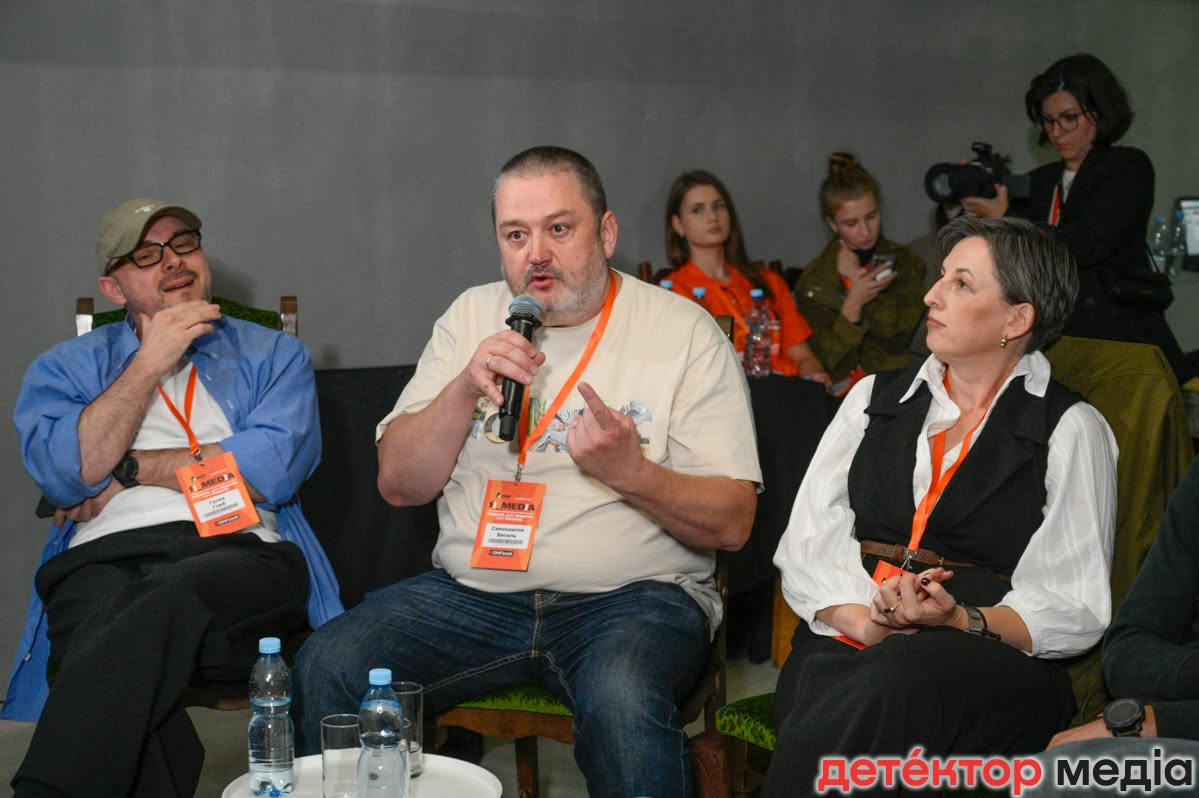
Hlib Husiev, Vasyl Samokhvalov, and Nastia Stanko
Nastia Stanko: No. There’s a thing called OSINT now. I’m simply talking about our day-to-day work. Of course, we have sources, too, and people bring us folders of documents, but everything is verified, cross-checked against other sources, checked against official records, documents, criminal cases, and everything else. It never happens that someone simply brings in a folder of documents…
Vasyl Samokhvalov: But who gives you the initial lead?
Nastia Stanko: No, that happens, too: someone brings us some information, and we then verify it. But I wouldn’t say that this accounts for 80–90% of our work, because we often investigate, for example, whether something happened, whether someone was detained, or something else. We look up the person’s profile and find out what information is available about them. We have various databases, many of which are open, and we simply know how to use them, including geolocation tools and so on. In other words, investigative journalists simply have a few more tools and know how to use them better than a general newsroom, because their work is specifically focused on this.
Take a recent story we did about NABU and Muza. She is a prosecutor’s girlfriend who was detained. We quickly put together a profile because we have databases that let us find out where she was, what she did before, who she was, and so on. The news spread widely across other media outlets. So this wasn’t a folder of documents at all. You simply have a few more tools and know how to use them quickly when a news event occurs that you didn’t initiate. For example, identifying who launched a Shahed drone or something like that. It’s not a folder of documents; it’s a response in which you have more tools and know that, for instance, you can find out who owns what, go to an administrative services center to obtain extracts, and see what property someone owns. That’s not a folder of documents.
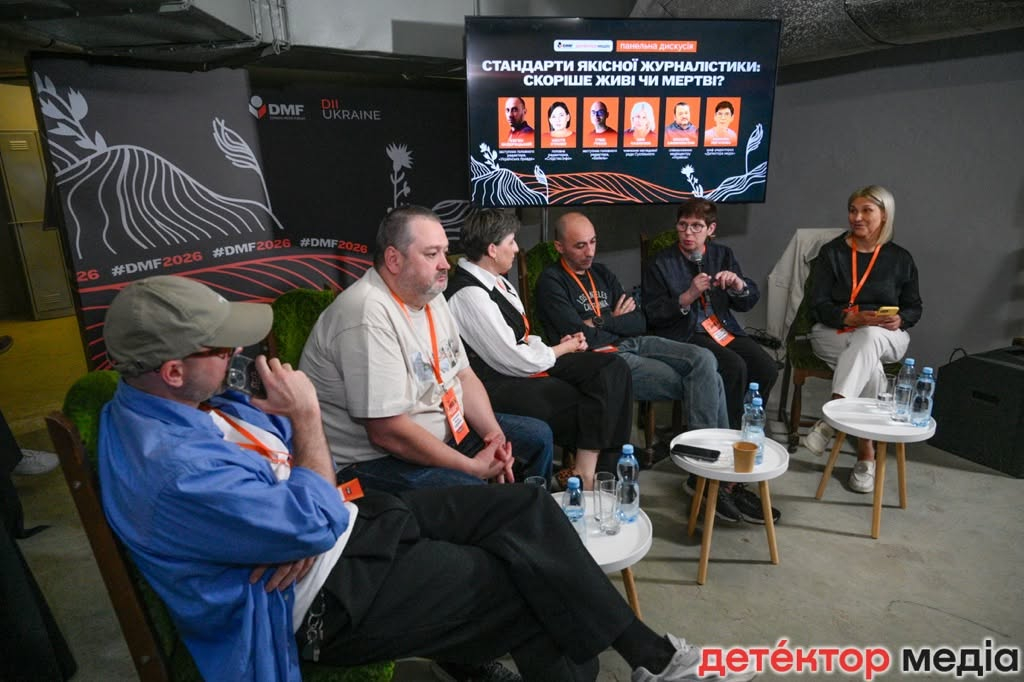
Hlib Husiev, Vasyl Samokhvalov, Nastia Stanko, Yevhen Buderatskyi, Nataliia Lygachova, and Zoia Kazanzhy
Nataliia Lygachova: Yevhen, it was obviously your editorial team that decided how to present the material, not Mykhailo Tkach himself, when he sat down and read out the pre-trial investigation materials. Why did you decide to use that particular format?
Yevhen Buderatskyi: It’s the format that gets the message across most clearly to our audience. Wait, was he supposed to paraphrase everything in his own words? Believe me, there were plenty of really good, “great” dialogues in all that material — very revealing ones. If Mykhailo had paraphrased them, it would have looked rather strange and wouldn’t have had the same impact. That’s precisely the point about the format.
Nataliia Lygachova: NABU also made a film — about Operation Forrest Gump, for example (DM).
Yevhen Buderatskyi: I’m happy for NABU. They did a great job making a film. Excellent. But you’re asking us about our work.
Nataliia Lygachova: So it’s their job to become production companies?
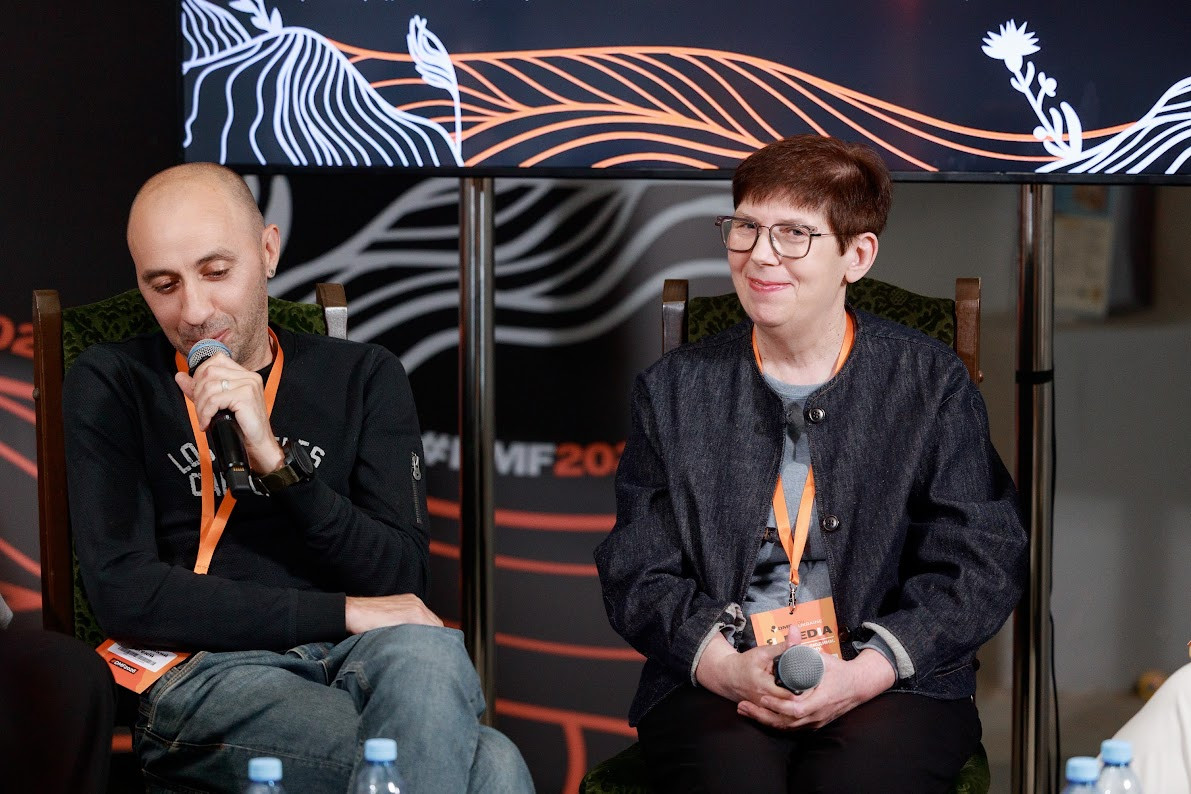
Yevhen Buderatskyi and Nataliia Lygachova
Yevhen Buderatskyi: I don’t know. You know, I often take part in discussions involving NABU, and I think all journalists know perfectly well that it’s the one institution that never comments on anything for you. So they have a great production team, and they simply bounce any request you send them. That makes communicating about NABU cases quite difficult, because verifying their cases is complicated: NABU is one of those institutions that allows very few leaks. That’s why it’s often quite difficult to corroborate, through other sources, the very nature of what NABU is working on.
Nataliia Lygachova: And do you do that?
Yevhen Buderatskyi: Of course we do.
Nataliia Lygachova: So when Mykhailo was reading it out, you verified everything?
Yevhen Buderatskyi: First of all, we verified it. Second, I’m aware of the criticism directed at us, but time has shown that the information was indeed confirmed. So the format we chose was the only right way to help the audience understand what had happened. You know, I sometimes want to add a small qualification here: Hlib, I’m all for limiting the number of anonymous sources. We certainly try to do that. But there’s one small detail. When the state doesn’t communicate with you, you’re forced to “launder” even information about state affairs through anonymous sources. A member of parliament, a representative of the Presidential Office, or a government representative tells you, “Oh, we’re not allowed to talk to you.” You say, “Well, talk to me off the record, at least.” And they reply, “Only if you promise not to name me.” Then you end up with a story made entirely out of information from sources. Yet you understand that under different circumstances, with a different government and a different information policy, all these people would be named sources rather than anonymous ones.
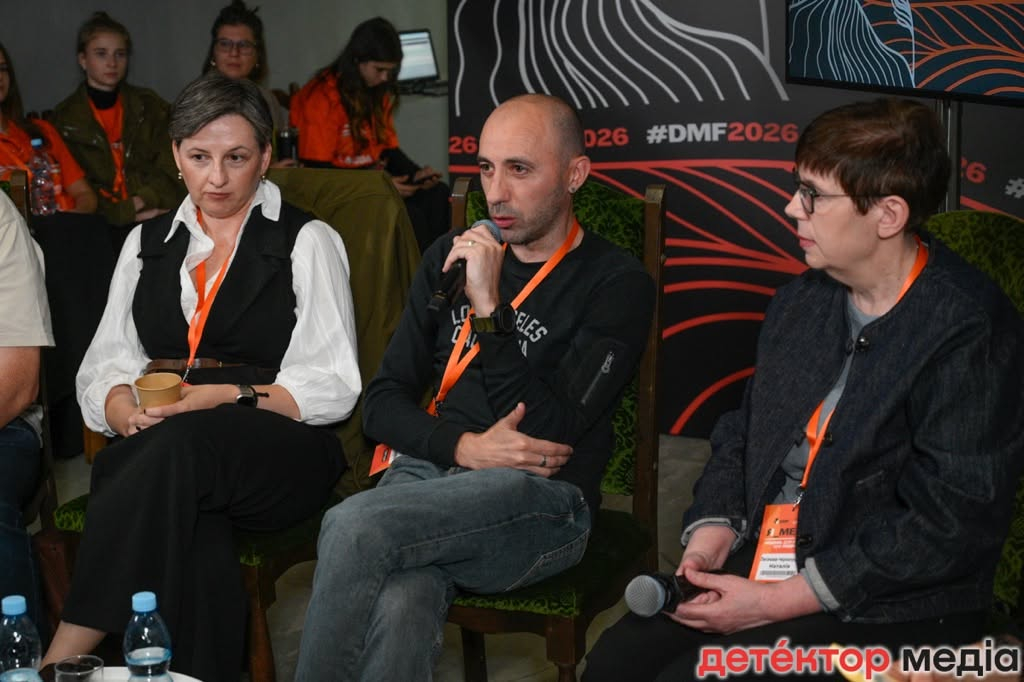
Nastia Stanko, Yevhen Buderatskyi, and Nataliia Lygachova
Nataliia Lygachova: The state, first and foremost, needs to be verified. That’s what I believe, because the state is an institution of coercion, and it always wants to do something to us… I don’t want to use that word, but we cannot blindly trust the state. During wartime, unfortunately, we all publish statements such as “the Security Service of Ukraine said this” or “the Defence Intelligence of Ukraine said that.” But in peacetime, that’s simply impossible.
Yevhen Buderatskyi: I’m not talking specifically about this format, but about how the state has structured its communication with the media. We’ve reached a point where, in addition to our responsibility to identify what constitutes the public interest and what interests our audience, we also have to consider security. For example, there was a particular operation by the Ukrainian Defence Forces that would undoubtedly have been in the public interest, but it also had security implications. We knew about it three months ago, but, just like the security forces, we didn’t talk about it, even though it would clearly have been in the public interest and would have stirred society in a positive way. But we said nothing. This is precisely the tension between audience interest — which would certainly have brought us 100% more clicks — and public interest, when a story is important but cannot be reported because it concerns our men and women, and their lives. That’s one side of it.
The other side is how we work with sources and verify information. I also disagree with the figure of 80–90%. Unfortunately, ours is a very corrupt state, so you simply put something aside and come back to it later. Someone gets appointed to a position; you wait a little and then think, let’s check what they own. Six months later, you simply look them up, and the investigative team starts examining what assets that person has acquired over those six months. And it turns out there’s so much interesting information! Nobody has brought you any folders of documents, either. You don’t even need them. You have the whole list in front of you, and you start investigating. Then you start working with sources. Where did this come from? How did that happen? And a lot of sources start piling information on top of one another, because Ukrainian politics and corruption work this way: people really don’t like it when someone else manages to steal more than they do, and they don’t like it when someone else has more power than they do. So we follow one lead after another, and that’s why we end up with so many sources.
Nastia Stanko: But, Nataliia Lvivna, I have to say: it’s great when people talk about your work and assess it. It means you’re doing something important and visible.
Nataliia Lygachova: Of course. Hlib, I have the same question for you. Your journalist receives information from sources — say, from NABU or SAPO — and Ukrainska Pravda makes the kind of decision Yevhen has just described. What would you do, and why?
Hlib Husiev: I’ve personally been in that situation several times. I’ve had sensational materials in my hands that I couldn’t verify, or I understood that there was a broader context behind them that I didn’t understand and couldn’t figure out at the time. Other journalists in our newsroom have faced similar situations, too. The decision has always been the same: don’t publish. We never published them.
Nataliia Lygachova: Yevhen says they verified it (Mykhailo Tkach also said this earlier — DM).
Hlib Husiev: Okay. Well, excuse me, but I suppose this is my role now. Unfortunately, we have to talk about the details. Perhaps it’s considered somewhat unethical, but sorry.
There are some well-known recordings narrated by Mykhailo Tkach. In one episode, he makes a mistake and gives the wrong date for the covert investigative action whose materials he is reading out. There is an error in his narration. And that error in the date is critically important to the substance of what he describes. A difference of three days changes everything. That’s the first point.
The second point is that the record of this covert investigative action that he reads out is a transcript of an audio recording made on a dictaphone. NABU really doesn’t comment on its cases. But did the journalist compare the audio recording with the transcript to check its accuracy? Did he verify whether the people identified in these records were correctly identified? Were those surnames attributed to the right people? I’m personally convinced that, in one of these records, NABU detectives made a mistake in identifying the people taking part in the conversation.
That’s the second issue. Finally, the third point concerns NABU and investigative work in general. Unlike many of our investigative bodies, NABU is regarded as sacred and infallible. But it is neither sacred nor inherently corrupt. There have been cases in which NABU detectives falsified their investigations. When you receive material from NABU, you must always ask yourself: could this be fabricated? Could it be the result of poor investigative work? I have personally seen cases coming out of NABU that involved extremely poor detective work, or an attempt to use a criminal case to go after a particular company in the defence sector. I have held such documents in my own hands. And, by the way, I didn’t publish them, even though the public interest was enormous. That’s how it is.
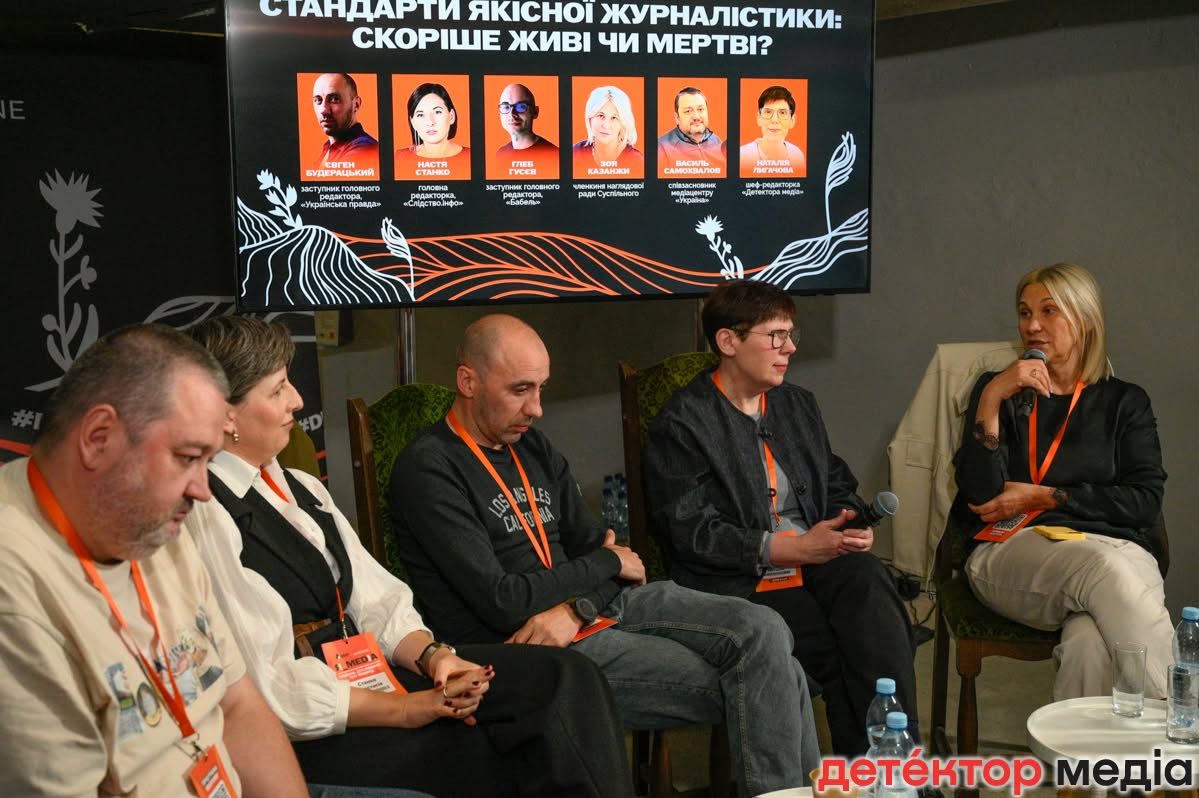
The discussion participants
Nataliia Lygachova: What you said about verifying audio recordings against transcripts is important to me, because I myself have been questioned several times in my life — in the Pavlo Sheremet case and the Vadym Boyko case. When you’re questioned, you tell them something, and then you sign what is supposedly a record of what you said. I saw a huge difference between what I had said and what was written down. Moreover, in the Pavlo Sheremet case, I noticed a certain bias in the way they presented my account. On the surface, there seems to be nothing to challenge, and everything appears to have been accurately recorded in your own words… But I realized that they were using my testimony to support a particular interpretation of events that they had already formed in their minds. That’s an interesting point. A transcript really is not the same as an audio recording.
Hlib Husiev: There’s another very striking example in the case involving Mudra, which we mentioned earlier. There are several episodes in that case. One concerns her helping arrange bail for Halushchenko through Sense Bank. Prosecutors accused Sense Bank employees of installing a special system on the service that filtered the financial monitoring system so that it could be switched off and prevented from being triggered. There are two bank employees accused in the case, and they are currently free because they paid bail.
They made some very striking videos, absolutely incredible recordings. I watched them and was fascinated. A few weeks pass, you dig into the details, and you realize that what third parties say in the videos about other people is simply untrue. It didn’t happen in reality. They did not install that system on the service; the bank’s financial monitoring system worked in accordance with the instructions.
That’s the problem: 800,000 people watched NABU’s video, and then millions more views accumulated across hundreds of videos discussing and repackaging it. There were hour-long podcast discussions about what a terrible society we live in. Then, after three weeks or a month of digging into the details, you discover that it isn’t true. But nobody will hear that now, because it’s not interesting, because it goes against the trend and against NABU. And if you’re against NABU, you’re a thief. That’s how it turns out.
Nastia Stanko: Excuse me, but it seems to me that Hlib is trying to impose a particular narrative here: that there are obviously bad media outlets, some that support NABU or whatever, and to impose labels on us that simply don’t exist. I just want to return to the bigger picture. I think Ukrainian media are doing a fairly good job, given the circumstances we’re in. I agree with my colleague that I’ve often seen mainstream international media that I once looked up to enormously in my work in the field, and I’ve been left absolutely stunned: how can they work so badly and fail to verify things? It seems to me that Ukrainian journalism is actually getting through an extremely difficult period in the history of both the country and the profession without doing too badly.
When we talk about clicks and so on, every media outlet makes a choice: play the long game, because trust takes time to build, or get clicks today and shut down tomorrow. We play the long game, for example. What matters to us is that, within the newsroom, we establish that we have obtained and verified all the information and believe it is important to publish. Everyone makes their own choice. I wouldn’t want us to start throwing accusations at one another: “You made a mistake? Well, you made a mistake, too.” Everyone makes mistakes sometimes. The question is whether the mistake was deliberate, whether someone intentionally tried to mislead people. When you do a lot of work, you’re bound to make a mistake somewhere along the way. That matters. But it also matters that journalists continue to write and report on corruption, among other things, rather than getting lost in the idea that we’re at war and shouldn’t talk about the bad things happening in the country. It’s great that we’re all looking into things and checking them. Verification is absolutely essential, but I don’t think the media outlets we’ve discussed, or our own reports, were deliberately produced to mislead audiences and get clicks.
Nataliia Lygachova: I don’t think Hlib meant that anyone was deliberately misleading people. He was saying that information isn’t being checked thoroughly enough. Except at Babel, of course (smiles — DM).
Hlib Husiev: Well, we make mistakes, too. That’s true.
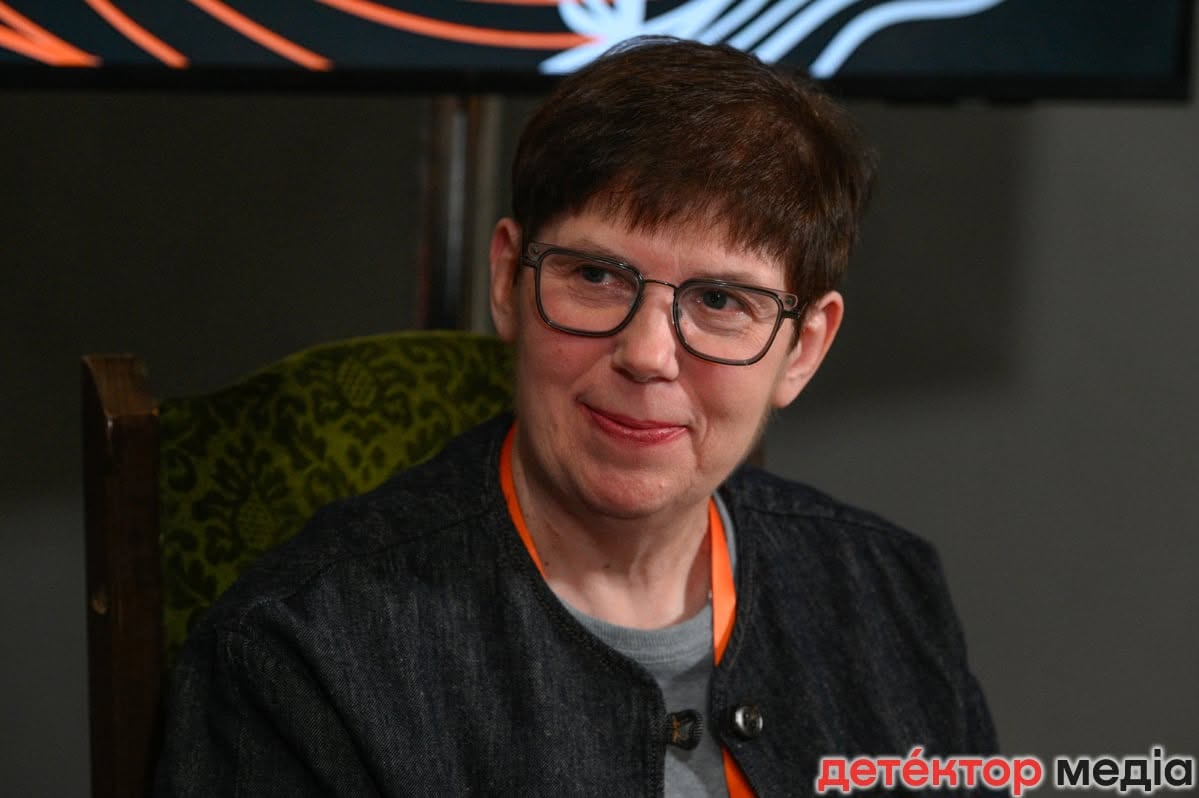
Nataliia Lygachova
Nataliia Lygachova: But since we have to bring this very interesting discussion to a close, I’ll just say a couple of things in conclusion. I’m actually glad that we’ve only just begun this discussion. I think it’s important that we can speak to one another the way Hlib has, criticize one another, laugh at Babel, and laugh at or, conversely, support Ukrainska Pravda, Slidstvo.Info, and Detector Media. What matters most to me is that we still believe standards are important, that we can discuss how well we meet them and how we strive to work according to them, and that we are still striving to earn people’s trust. We understand that this trust also depends on how hard we try, at the very least, to avoid mistakes and to work according to standards, even as those standards evolve.
Zoia Kazanzhy: As someone who has been discriminated against from the left, I wanted to say the following: with all this discussion, we tend to forget about journalists themselves, because behind all of it are real people. I read all the media outlets represented here. And I’m grateful for their work. It’s very serious, difficult, exhausting work. I have a rule: if someone writes “journosluts” in the comments on my Facebook page, they get banned for life. Because that kind of language devalues people’s work. Whenever there’s a crisis, journalists are blamed for everything. That’s why it’s important to talk about the importance of this profession. We talk endlessly about trust, but we must remember that people are at the center of it — people who also become exhausted and tired, whose family members are at war. We mustn’t forget that. People should be the focus, not standards, kilowatts, hectares plowed, and so on.
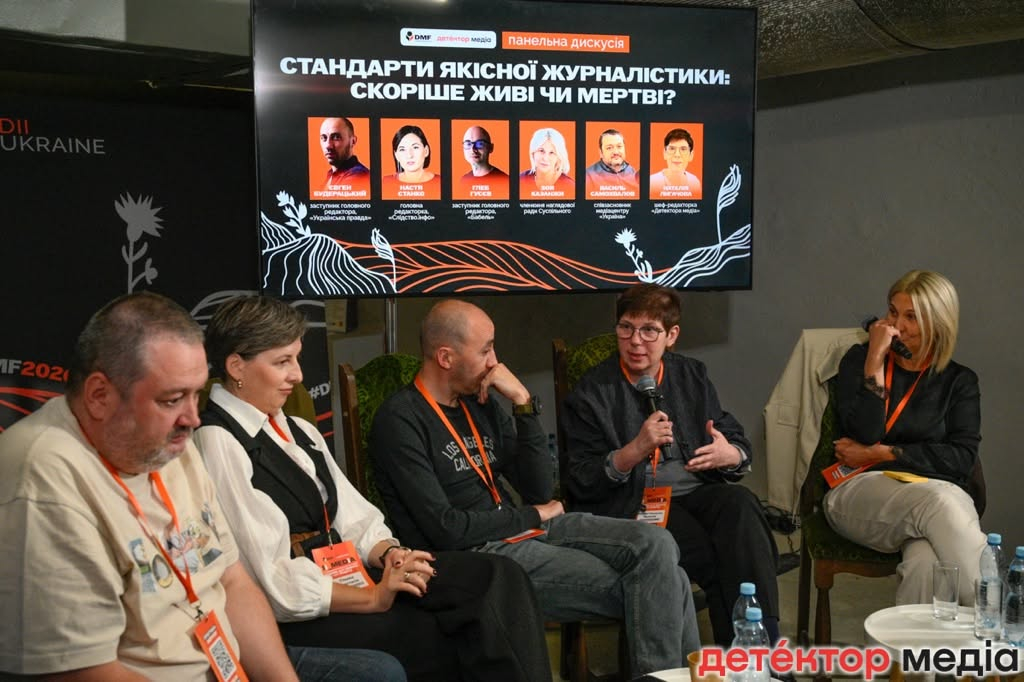
Vasyl Samokhvalov, Nastia Stanko, Yevhen Buderatskyi, Nataliia Lygachova, and Zoia Kazanzhy
Nataliia Lygachova: Thank you all for taking part!
Photo: Donbas Media Forum and Maksym Polishchuk, Detector Media