

Українською читайте тут.
Detector Media's Research Centre analysed more than 157,000 posts about veterans on Telegram, Threads, TikTok, X and Bluesky published between June and October 2026 to find out who talks about veterans and how.
Key findings
- Veterans are talked about, but mostly not by veterans themselves. Between 1 June and 15 October 2026 we collected 157,282 Ukrainian-language posts mentioning veterans. About 85% came from Telegram (60.6%) and Threads (24.4%). The organisation most often mentioned alongside veterans was the Armed Forces of Ukraine (24,408 mentions), followed by state institutions; well-known veterans and veterans' organisations appeared far less often. In many posts, veterans are just one of several groups receiving state aid, or a convenient example in an official's report on his own work.
- Support and employment dominate. About a third of the sampled posts (35%) concerned assistance to veterans and another 19% their employment. Sport, holidays, rehabilitation and health, crime, and Veterans Affairs Minister Vitalii Kim each accounted for 5–7%.
- The most widely shared job content aimed at veterans on Telegram is dubious. An ad for "crypto trading for veterans" was posted 21,160 times. A recruiter's offer of "up to UAH 150,000 a month" was posted 5,978 times, including in channels that advertise illegal exit from Ukraine or earnings from drug dealing. The dataset also contained likely phishing posts about a "Veterans' Payment Fund". Veterans and their families have become a target audience for fraudsters.
- Stigma shows up mainly in the labour market. Most job ads for veterans are written sympathetically, and some explicitly promise them preference. Yet the story of a military medic refused a job because veterans are supposedly "all shell-shocked" was shared 84 times. Job ads often list veterans alongside students and internally displaced people as a category employers "can also take on", rather than judging them on experience and qualifications.
- Veteran status has become an argument in political debates. Mentions of veterans peaked in July (16,709 posts in the week of 13 July and 14,361 in the week of 20 July), driven by Mykhailo Fedorov's dismissal as defence minister and Vitalii Kim's appointment as veterans affairs minister. Protest co-organiser Dmytro Koziatynskyi was referred to as a veteran 1,100 times, and one of many posts criticising Kim ("The veterans affairs minister must be a veteran!") was shared 65 times on Threads. Veteran status is used to add weight to demands and sometimes to discredit opponents. The most prominent example: accusations against anti-corruption activists made on behalf of a "veterans'" movement in anonymous Telegram channels with millions of subscribers.
- Mass sharing is not always organic. In the dataset, 38 messages were repeated word for word more than 100 times. Twelve of them were stories about abuse of veterans by territorial recruitment centres (TCCs, Ukraine's military enlistment offices) and another 12 were job ads. One TCC story was shared 1,900 times on Threads. Some of these stories have a real basis, but the pace and pattern of their spread point to possible artificial amplification.
- The positive image leans towards heroisation. Posts about sport and about veterans as role models are dominated by the rhetoric of being "unbreakable". This image is shaped mostly by officials, local communities and media; first-person accounts in which veterans speak about pain and the need for support are rare. Users themselves notice the gap between ritual gratitude and real support: the ironic post "Thank you for your service. We've run out of money for you", which appeared on Threads after payments under the state Veteran Sport programme were suspended on 1 October, was repeated 112 times.
- The image of veterans is becoming more diverse. On social media, veterans appear as writers, musicians, entrepreneurs and participants on both sides of debates about values, including around KyivPride. They are increasingly seen as peers of many social media users. Ukrainian businesses use veteran themes in marketing more often; the most visible case was shops inviting customers to pay with Veteran Sport programme funds, although the programme's rules did not allow it.
Introduction and context
Ukraine now has more than 1.5 million veterans of the Russian-Ukrainian war, according to a government figure from September 2026. Estimates vary with the source and the categories counted: former veterans affairs minister Nataliia Kalmykova put the number at over 1.3 million at the end of 2025, while then prime minister Yuliia Svyrydenko spoke of 1.8 million in April 2026. Media and social networks are debating how to reintegrate people returning to civilian life into their communities, the labour market and public discussion.
Veterans policy still rests on the 1993 Law on the Status of War Veterans, supplemented by the Veterans Policy Strategy to 2030 and the Law on Veteran Entrepreneurship (in force since February 2026). The government has tasked the veterans ministry with submitting a Code on Defenders to parliament, and the draft 2027 budget allocates UAH 20.5 billion to veterans policy, UAH 3 billion more than in 2026. Yet lawyer and veteran Oleh Polishchuk notes that the share for housing compensation falls from 60% to 48% even as housing needs grow. According to the Pryncyp human rights centre, veterans most often seek help with payments, military medical commissions, combatant status and housing.
Public perceptions of veterans are measured most systematically by the Ukrainian Veterans Fund, a state body under the Ministry of Veterans Affairs. In its Veteran Portrait 2025 study, 77% of respondents said society respects veterans, a level stable since 2023 but below the 91–93% of the first year of the full-scale war. Veterans themselves are more reserved: 60% speak of public respect, and 58% think society is poorly informed about their needs in civilian life. Seventy-two percent of the general public consider the media image of veterans mostly positive.
A positive image does not rule out stereotypes. The Fund's study on stigmatisation, with Syracuse University and Rating Sociological Group, found beliefs that veterans are aggressive, unstable, mercenary and unable to manage on their own. It also named excessive heroisation as a form of stigma, since an idealised image creates inflated expectations. Journalists mostly follow ethical standards, but stereotypes slip into clickbait headlines.
A recent monitoring by the Institute of Mass Information points to a different problem: veterans are nearly invisible in the media. In September 2026, they were the subject of no more than 0.2% of content in 23 popular online outlets. In 56% of those stories the source was the authorities, veterans were quoted directly in only 39%, and the most common role assigned to them was that of aid recipient (46%).
All these studies focus on traditional and online media, while a growing share of Ukrainians get their news from social networks. There, the image of veterans is shaped not only by journalists and officials but also by veterans, their families, volunteers, bloggers, anonymous channels and advertisers. It is also where that image is most easily exploited for political mobilisation, fraud or manipulation. In summer and autumn 2026, a change of government, Kim's appointment and protests against Fedorov's dismissal, co-organised by veterans, turned veterans into active participants in political processes.
Social media are not a perfect mirror of public sentiment: the loudest voices belong to the most active users and to channel networks that can amplify messages artificially. With this in mind, we set out to answer one question: in what contexts do Ukrainian social media users mention veterans?
Methodology
The study is based on 157,282 posts published on Telegram, X, Threads, TikTok and Bluesky between 1 June and 15 October 2026. The search query in the YouScan analytics platform covered all forms of the word "veteran" in posts, quote posts and reposts that the data provider tagged as Ukrainian-language.
Telegram accounts for the overwhelming majority of the material: 95,267 posts, or about 60.6%. Threads comes second with 38,414 (24.4%). TikTok contributed 15,018 posts (9.5%), X 8,155 (5.2%) and Bluesky 428 (under 0.3%). Only 8.9% of the TikTok videos had transcripts, but all had text descriptions.
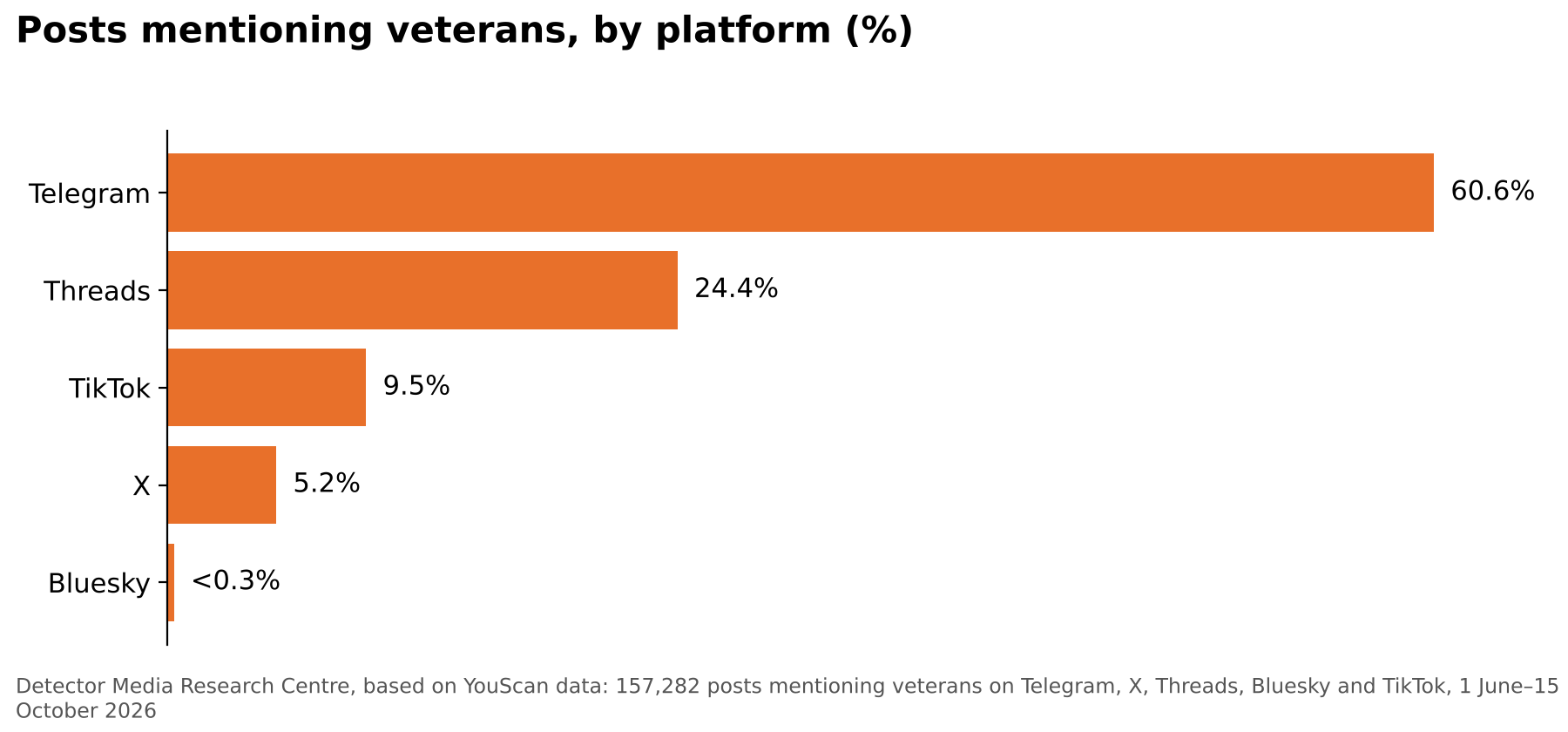
Posts mentioning veterans by platform, 1 June–15 October 2026, %. Detector Media Research Centre, based on YouScan data
Aim. To identify the contexts in which veterans are mentioned, who drives these mentions, and how the image of veterans is used for manipulation.
Data processing. First, we clustered a sample of 1,925 posts by topic using BERTopic, which gives a margin of error of 2% at a 90% confidence level. To improve accuracy, we extracted only the sentences containing the word "veteran" before clustering; for TikTok, these came from video descriptions and, where available, transcripts. Second, to identify the people and organisations mentioned in connection with veterans across all 157,282 posts, we applied the spaCy uk_core_news_md model to those sentences. Detector Media has previously used it to analyse President Zelensky's speeches.
Limitations. Transcripts exist for only 8.9% of TikTok posts. The data cover only some social networks (Facebook and Instagram are not included) and exclude online and traditional media.
The dataset at a glance
The number of posts about veterans usually ranged from 5,000 to 8,000 a week, with several clear peaks.
The first began in late June, when the government approved a programme to support veteran businesses. In July, veteran Dmytro Koziatynskyi co-organised protests against Mykhailo Fedorov's dismissal, rallies in his support took place in Kyiv on 16–17 July, and Vitalii Kim was appointed veterans affairs minister. Mentions peaked at 16,709 in the week of 13 July and stayed at 14,361 the following week, then fell by 42% to 8,279 in the week of 27 July. Throughout August they held at 7,900–8,600 a week, almost 1.5 times the June level. The 9th International Veterans Forum in Kyiv on 22 August caused another spike.
Posts mentioning veterans, by week. Detector Media Research Centre, based on YouScan data
The last peak came in late September and early October. Weekly posts rose from 4,744 (week of 14 September) to 8,639 and then 11,013 (week of 28 September). The 82% jump was the largest relative increase of the whole period, although the peak was about a third lower than July's and lasted only two weeks. It coincided with debate on the 2027 budget and the instruction to submit the Code on Defenders to parliament.
Thirty-eight messages were repeated word for word more than 100 times. Six were reposts of Fedorov's messages after his dismissal, eight concerned aid to veterans, 12 were job offers for veterans or posts by veterans looking for work (mostly in security and manufacturing), and 12 were stories about TCC abuse of veterans.
Telegram had the largest share of posts repeated more than 100 times (30%). Threads was the least diverse platform: only a third of its posts were unique, compared with 55% on Telegram, 80% on Bluesky and 95–96% on X and TikTok.
On Telegram, the repeated content was mostly job ads for veterans spread by channels with formulaic names and handles, such as "Lending and Bankruptcy" (TradeUADOPOMOGA13) or "Assistance Project" (TradeUADOPOMOGA11, MenegerCrypto109, RabotaForYou01p and others). On Threads, reposts came mainly from personal accounts and concerned the change of government, decisions affecting veterans, and veterans' problems, including abuse by TCCs.
Who and what is mentioned alongside veterans
The 25 people and organisations most often mentioned in sentences containing the word "veteran". Detector Media Research Centre, based on YouScan data
The Armed Forces of Ukraine were mentioned most often in sentences about veterans: 24,408 times, roughly five times as often as Vitalii Kim (4,617). Most of the top positions belong to the state: ministries, officials and security agencies. Well-known veterans (Dmytro Koziatynskyi, Liubomyr Dmytryshyn, Denys Yantar, Artur Dron), civil society organisations and media appear much less often. Foreign names in the ranking include Vladimir Putin, NATO and Donald Trump.
The most frequent words included "war", "army", "brother-in-arms", "support", "help" and "earn", alongside "rehabilitation", "disability", "work" and "family": service and the need for help, but also the return to civilian life.
Topics of posts about veterans
Topic clusters in the sample of posts mentioning veterans, % (n = 1,925). Detector Media Research Centre, based on YouScan data
The largest clusters were support for veterans (35%) and jobs for veterans (19%). Sport, veterans as role models, holidays and ceremonies, corruption and crime, and Vitalii Kim each accounted for 5–7%. The smallest clusters were Fedorov and the protests, and veterans' health (about 2.5% each). BERTopic assigned 11% of posts to no cluster; we describe them under "Other".
Support for veterans
Posts about aid to veterans were usually written by private individuals. One, however, looked like phishing or an attempt to harvest personal data. Shared 102 times on Telegram by a channel with 128 subscribers, it claimed that the Ministry of Defence, together with the army, politicians and "caring citizens", had set up a "Veterans' and Combatants' Payment Fund" of over $40 million covering more than 3.5 million people, and urged readers to follow a link to "check the lists and get your payment". One version linked to a website that is no longer active.

A version of the phishing post inviting veterans to check whether they are on a payment list. Screenshot: Telegram
On Threads, a call to help a veteran's family from Vyshneve, Kyiv region, who lost their home to a Russian strike, was shared 353 times, and a post on free car adaptation for veterans with disabilities in Chernivtsi 303 times.
Threads also spread manipulative posts about TCC staff allegedly using force against veterans. One appeared word for word 496 times in the dataset and was shared 1,900 times on Threads. Some of these stories had a real background, but their further spread was not necessarily organic.

A post about alleged TCC abuse of a veteran. Screenshot: Threads
Jobs for veterans
The most widely shared job posts for veterans look like offers of work without social guarantees or formal employment. An offer of "crypto trading jobs for veterans" was posted 21,160 times on Telegram, sometimes in Russian channels.

An ad for crypto trading work, posted 21,160 times on Telegram. Screenshot: Telegram
Crypto-earning offers aimed at veterans, service members and their relatives can be scams. On 6 November 2026, the Kyiv city prosecutor's office reported sending to court the case of a man who took UAH 1.6 million from the daughter of a fallen soldier under the pretext of helping her earn on the crypto market.
Another post, shared 5,978 times, advertised Telegram recruiters: "No experience needed. Training from scratch. UP TO UAH 150,000/MONTH… Places for young people, veterans and those who need a chance right now. DM ME." It also circulated in channels offering paid illegal exit from Ukraine or earnings from drug sales.
The remaining job posts offered positions as drivers, executive assistants, security guards or event managers. They typically stressed respect for veterans, preference in hiring and understanding of veterans' needs. Three posts from veterans looking for work on X and Threads were picked up and shared by other users, which can be read both as attention to veterans and as a sign that some lack support from local or national authorities in returning to work.
Several posts placed veterans among people at the start of their careers. A factory job ad said the work "suits students, ready to work with veterans and IDPs, no experience needed". This is not necessarily stigmatising: many people joined the army before gaining qualifications, and military skills do not always have civilian equivalents.
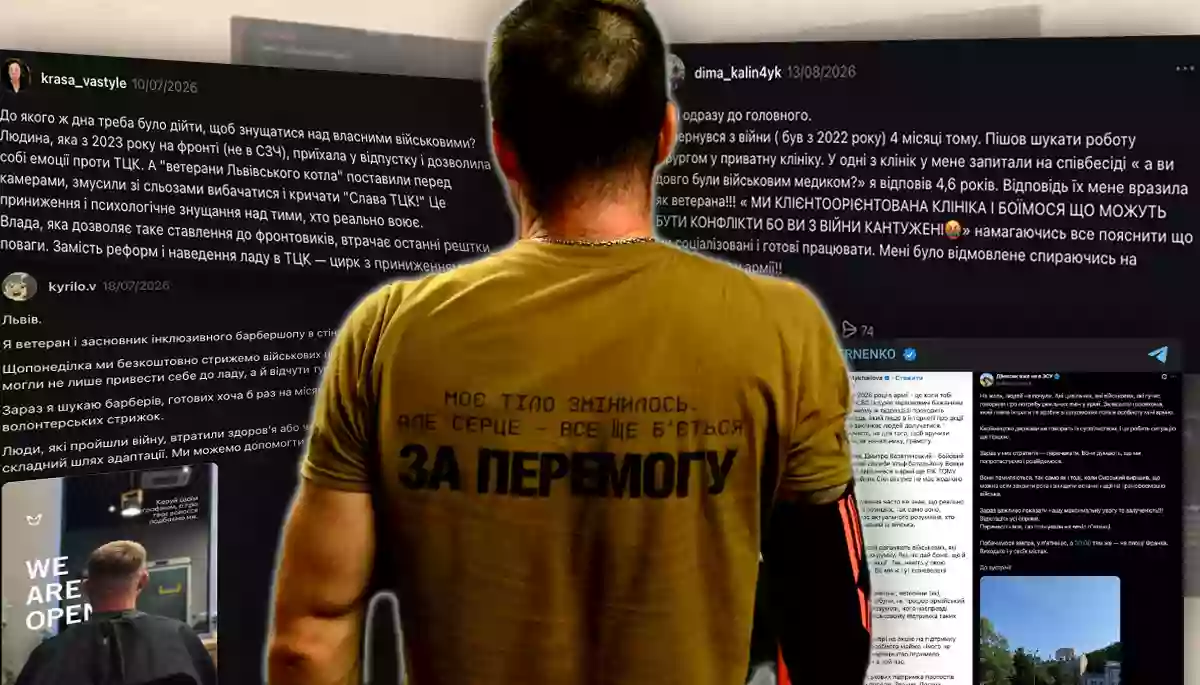
Posts by a man who had worked as a military medic for more than four years were shared 84 times in the dataset. A clinic turned him down, saying: "We are a client-oriented clinic and we fear there could be conflicts, because they come back from the war shell-shocked."

A post about a veteran being refused a job. Screenshot: Threads
Overall, job posts tend to treat veterans sympathetically as workers, but some repeat stigma, consciously or not. It is most obvious in reports of refusals, but also in ads that treat veterans as one more vulnerable group that "can also be hired" rather than assessing them on experience. Posts promising preference to veteran candidates we classify as positive discrimination: they help veterans find work rather than reproduce prejudice.
Fedorov's dismissal and the protests
In posts about Mykhailo Fedorov's dismissal as defence minister, the word "veteran" was used in two main ways. First, Dmytro Koziatynskyi, co-organiser of the rallies against the dismissal, was described as a veteran 1,100 times, which explained who one of the main voices of the July–August protests was. Second, Fedorov's own farewell message of 18 July, which thanked "veterans and the military for holding the front and our honour", was reposted at least 839 times on Threads and 219 times on Telegram.
Of the six messages about the dismissal that were shared more than 100 times, four were calls to join rallies, spread mainly on Threads. Another, shared 238 times, claimed before calling people to protest that the authorities wanted to punish "veteran Dmytro Koziatynskyi" for organising rallies. Its likely original source was a Telegram post by blogger and volunteer Serhii Sternenko, who was Fedorov's adviser at the Ministry of Defence. Less widespread uses of the word appeared in protesters' demands, for example to appoint a veteran as veterans affairs minister, or in reports that service members and veterans were joining the protests (17% of posts in this cluster).
Veterans Affairs Minister Vitalii Kim
Vitalii Kim was mentioned in 3,124 posts, including reposts, 1,769 of them in July. Many simply listed new cabinet members, as in a post by the Lachen Pyshe channel, where veterans appear only in a job title.
In the debate over his appointment, the demand for personal military experience stood out. The short Threads post "The veterans affairs minister must be a veteran! Kim out!" appeared 65 times. Max Kolesnikov, a veteran who spent a long time in Russian captivity, wrote on X that the authorities had again failed to find anyone from the large veteran community to lead the ministry. One Threads user put it this way: "Kim wanted to head the veterans ministry, but didn't want to be a veteran." Here, the symbolic right to represent veterans comes to the fore, while specific policy decisions and their implementation can drop out of the discussion.
Official communication offered a different basis for legitimacy: the promise of results. Presenting his team on 22 July, Kim spoke of systematic work, and in October the TikTok account "Our KIM | Everything for Veterans" promoted the idea that the system itself should guide veterans through bureaucracy.
Some posts covered specific initiatives. In September, the anonymous Telegram channel Trukha wrote approvingly about Kim's agreements with the US Department of Veterans Affairs on rehabilitation and prosthetics; in October, the Vsevydiashche OKO channel reported plans to offer Veterans Register extracts in Diia, the state e-services app. Such posts make policy more concrete, but they describe agreements and plans rather than whether services have become accessible to veterans.
Personalisation cuts both ways. On 20 August, Trukha relayed criticism of the ministry's former leadership by lawyer Maryna Stavniichuk, a former official under Viktor Yanukovych, ending with her verdict that Kim would fix things, before any results existed. After a Bihus.Info investigation into the Kim family's possible use of undeclared assets, Lachen Pyshe retold it, and the minister's lifestyle, not veterans' needs, became the story.
Corruption and crime
In crime and corruption stories, veterans appear as victims, parties to conflicts, suspects, or people in whose name accusations are made. Negative news does not necessarily mean a negative attitude: what matters is the person's role in the event and the author's framing.
In reports of violence against veterans, military experience heightens the sense of injustice. On 4 September, the TikTok account of TV7+ Khmelnytskyi reported the beating of Dmytro Borodin, citing his father. The mention of an earlier combat wound linked vulnerability at the front and at home, turning veteran status into a moral demand to protect the victim.
The veteran community is also portrayed as a force able to restore justice on its own. On 22 July, the Vinnytsia Veterans Corps described on TikTok a conflict with taxi drivers at a railway station: veterans driving cabs were allegedly being chased away, and almost 50 veterans turned up to support a beaten comrade. Odesa regional councillor Andrii Babenko presented veterans arriving at an Odesa café and breaking its terrace as a response to reported violence against a woman by the owner. Such rhetoric can normalise the expectation that justice depends on mustering an influential support group, and that veterans' involvement automatically decides who is right.
The tension between state institutions and veteran authority was clear in posts about Liubomyr Dmytryshyn, a participant in protests against tree felling in Kyiv's Teremky district. After he was placed under night-time house arrest on 7 October, Sternenko described the case as persecution of activists and disrespect for veterans. According to investigators, the case concerned organising protesters' actions and a clash with police; Dmytryshyn and his lawyers denied the charges. In supportive posts, veteran status became an argument against the official image of an offender.
Similarly, when Kraken regiment veteran Hlib Novostroinyi was detained over the abduction and murder of a Ukrainian citizen in Bali, Censor.NET quoted his commander stressing his combat record. Veteran status becomes a resource for public defence, though it proves neither guilt nor innocence.
The risk of stigma arises when an individual conflict is explained by war experience as such. A TikTok post about a knife attack in Odesa region linked a soldier's possible impulsiveness to concussion and contrasted him with people of "stable mind". The wish to draw attention to rehabilitation was combined with speculation about the causes of violence that the author could not establish. Moving from a specific case to generalisations about soldiers' trauma reinforces the image of veterans as a potential threat, even when the author calls for helping them.
Corruption stories are sometimes built around a broken promise of support. On 27 August, Trukha relayed suspicions against Kyiv regional councillors and their relatives over the embezzlement of funds from the Turbota (Care) programme: according to the channel, relatives obtained payments with forged veteran certificates and spent them on luxury cars and cosmetic surgery. Veterans serve as a moral reference point here, sharpening outrage at resources taken from people to whom society owes a special debt.
References to veterans can also be used to discredit others. The Telegram channel Realna Viina, with an audience in the millions, accused anti-corruption journalist Yurii Nikolov of draft evasion on behalf of a movement called "Honest Mobilisation", citing a fictitious "National Register of Draft Dodgers" allegedly compiled by veterans, which supposedly also lists activist Vitalii Shabunin. The veteran label is meant to make the accusations more convincing, but it is no substitute for evidence and does not make one movement's position the view of all veterans.
Veterans as role models
In posts presenting veterans as an example to others, war experience becomes a basis for public authority. Admiration can also impose expectations: a veteran must stay strong, recover successfully and inspire others.
Maksym Zhorin, deputy commander of the Third Army Corps, wrote about a veterans' boxing night on 21 July that "a veteran means strength and an example for others", and described it as a chance for young people to learn from "the true heroes of modern Ukraine". The TikTok account Baza vid Budanova spread the formula "A veteran is the moral authority of our country". In such statements, authority derives from status alone, not from a person's actions or views.
Another group of posts shows a return to civilian work as a continuation of personal struggle. A Threads user described laying tiles and building his house himself after losing his legs: "The main thing is not to look for excuses but for opportunities." A Telegram channel presented Nazar Bokii, co-founder of the veteran business 4BRAVE, as "an example of a veteran who inspires others". Such stories extend the image beyond a person in need of payments or rehabilitation.
It matters who tells the success story. In a first-person TikTok post on 15 June, Vasyl Krehul combined resilience with candour: "I won't lie — it's hard sometimes. It hurts sometimes." He described the long rehabilitation ahead and named the people around him as his source of strength. Such a voice complicates the heroic scheme: perseverance does not mean the absence of pain, and needing help does not cancel independence.
Another variant is the veteran who helps another veteran. On 9 June, Realna Viina shared the story of Anton Kobylnyk, who rescued Oleksandr Didur in Mariupol and was later supported by him after captivity. The post, which shows signs of being sponsored, also detailed help from Rinat Akhmetov's Heart of Azovstal project, so it served its backer's reputation too.
Visible, active veterans counter the idea of helplessness. But turning one story into a universal model can obscure differences in health, resources and access to support, especially when the people and institutions behind an achievement disappear from the retelling. Users themselves criticise the gap between heroisation and practical support. Blogger Olena Mandziuk's post for Defenders' Day, "Thank you for your service. We've run out of money for you", went on to mock solemn words about "resilience and gratitude". It appears 112 times in the dataset: admiration is now measured against concrete action.
Holidays and ceremonies
This cluster contained 107 posts (5.5% of the sample), mostly greetings and event reports for the Day of Mourning (22 June), Independence Day, the Day of Remembrance of Fallen Defenders (29 August) and Defenders' Day (1 October). Veterans mostly appear in lists of attendees: they lay flowers, raise flags, "take part", but have no voice of their own. At least 13 posts used "veteran" in other senses, from veterans of teaching or the police to "a veteran of Ukrainian rap".
The most viewed post in the cluster (183,000 views on a Telegram channel) showed a banner by the Veterans Corps on Kyiv's Millennium Bridge for the 30th anniversary of the Constitution: "A veteran is someone who knows how to defend the Constitution." The post quoted its head, Ihor Zaichuk, calling for veterans' rights to become "an everyday reality" rather than a declaration.
Businesses, meanwhile, turn veteran-related holidays into occasions for discounts and marketing. Cafés in Irpin offered free coffee to soldiers and veterans on Defenders' Day, and an app for holders of combatant status advertised free coffee or extra litres of fuel at OKKO petrol stations.
A Russian-language TikTok video, "Veterans in Ukraine are not needed by anyone" (8,300 views), claimed the system has no use for veterans with disabilities or "head problems", combining criticism of formal respect with stigma and a theme echoing Russian propaganda. Its author lives in Germany and targets Ukrainian audiences with videos criticising the EU and Ukraine. Overall, the holiday cluster largely reproduces ritual gratitude without specifics about veterans' needs.
Sport for veterans
This cluster contained 133 posts (6.9% of the sample), two-thirds of them on Telegram. Most were announcements and reports on competitions from city and regional administrations, communities, the police and local media. They most often concerned adaptive sports such as pétanque, archery, sitting volleyball, amputee football and para ice hockey (22 posts), strength sports (13) and boxing and martial arts (10). Sport was almost always presented as part of rehabilitation and a "return to active life", and veterans as "unbreakable" and "unconquered".
Officials use veteran sport for self-promotion, presenting budget programmes as personal achievements. Ternopil mayor Serhii Nadal included the number of participants in veteran competitions in his half-year report. Zakarpattia regional governor Myroslav Biletskyi listed a new gym, three football tournaments and eight competitions among the region's veterans policy achievements, alongside payments and dental prosthetics. Kryvyi Rih defence council head Oleksandr Vilkul announced the Veterans Family Games with cash prizes as if it were his own initiative.
Veterans' own voices are heard less often than those of event organisers. One exception is a Threads post by Viacheslav Kutin, who won the national boxing title for combat veterans a year after Russian captivity: a story of achievement rather than loss. Some media, by contrast, put trauma first: a Veteran Media post about Anton Hladun opens with him having "lost two legs and an arm in the war" before turning to his archery, something media guidelines warn against. Memorial tournaments and mixed competitions with students, children and athletes make sport a space where veterans meet their community.
The most viewed posts on veteran sport were ads. TikTok videos by the clothing shop Mama.kupyla (73,800 views) and the fishing store Rybalka Hurt (61,200) invited veterans to pay with funds from the state Veteran Sport programme (UAH 1,500 a quarter), although these could be spent only on sports facilities. Payments were suspended on 1 October 2026.
Sport is one of the most positive contexts in the dataset: veterans appear as active participants, winners and part of the community. Yet this image is shaped mostly by institutions rather than veterans themselves, and it leans towards the rhetoric of being "unbreakable", which, as with role models, can place social expectations on veterans.
Other (unclustered posts)
Some posts show veterans as participants in cultural life. Writer and veteran Artur Dron, mentioned in 334 posts, was announced by Suspilne Culture as author of this year's national Radio Dictation of Unity. The Cultural Forces shared a video of veteran and accessibility ambassador Yurii Ivaskevych singing "Hey, Sokoly!" in Polish at the Ukraine Recovery Conference in Gdańsk. In such stories, a military biography does not swallow a person's other roles.
Another trend is a dispute over whom the image of veterans includes. Radio Svoboda's TikTok report on KyivPride on 21 June mentioned a column of service members, veterans and their families. Meanwhile, Threads users shared a post praising veteran Illia Popkov for trampling LGBT flags, using his combat record against what the author called "LGBT ideology". Veteran status served as an argument for both sides. This says nothing about how common such views are among veterans, but it shows that the community is not homogeneous: military experience does not determine anyone's orientation, religion or attitude to others' rights.
The age image of veterans is changing too. A TikTok phrase went: "When we were little, we were told we were the last generation to see veterans ALIVE… Now it turns out we see them YOUNG…" Veteran status no longer signals old age; it is the experience of peers with family, careers and public life ahead of them. Veterans write, perform music and take different political and value positions, often without any special "veteran" occasion. This everyday presence broadens the public image of the community.
Conclusions
Social media speak of veterans respectfully, but mostly in other people's voices. The image of veterans is shaped by national and local authorities, businesses, recruiters and anonymous channels. As a result, respect for veterans easily becomes a resource for others: their status is used to advertise dubious jobs, extract personal data, report on events or lend weight to political demands. Other trends were visible too. Users criticise the authorities' ritual gratitude unbacked by real support, and veterans increasingly appear as authors, entrepreneurs and participants in public debate.
Social media are not a mirror of public sentiment: the loudest voices belong to the most active users and channel networks, and mass verbatim reposts may be artificially fuelled. Facebook and Instagram were not included in our dataset, and most TikTok videos were analysed by their descriptions only. The coordination behind TCC stories, and who runs the networks of channels posting "jobs for veterans", need separate research.
Recommendations
For the media
- Verify viral stories about veterans, especially about their encounters with TCCs, before sharing them, and check whether their spread is coordinated.
- Give veterans a voice in coverage of veterans policy: even a short news item on a government decision can include a comment from a veteran or a veterans' organisation.
- Do not reduce veterans to their injuries or trauma, and avoid both extremes of stigma: the victim and the "superhero".
- Write about veterans beyond holidays and briefings, and balance stories about male veterans with stories about women veterans.
- Follow up on how the authorities implement veterans policy decisions and promises, not just announce them.
For national and local authorities
- The Ministry of Digital Transformation, the Ministry of Veterans Affairs and the cyber police should warn veterans about fraudulent crypto trading "jobs" and phishing "payment funds" through state channels, Diia and veteran support specialists.
- Create or promote verified job channels for veterans via employment centres and communities as an alternative to anonymous Telegram ads.
- Explain the terms of state support programmes in plain language and monitor misleading advertising: the Veteran Sport case shows that businesses can misrepresent programme rules.
- Report on the results of veterans policy, not only appointments, events and participant numbers, and include veterans' own voices in communication.
- Respond to discrimination in hiring and remind employers that refusing a job on the grounds of veteran status is unacceptable.
For civil society and non-profits
- Monitor and debunk fraudulent ads and phishing aimed at veterans and their families, and provide training in media literacy and financial security.
- Work with employers to overcome stereotypes about veterans and help translate military experience into civilian skills.
- Amplify first-person voices of veterans, including women veterans and people whose experience does not fit the "unbreakable" image.
- Veterans' associations should be cautious when veteran status is used in political campaigns and should not let individual movements speak on behalf of the whole community.