
Українською читайте тут.
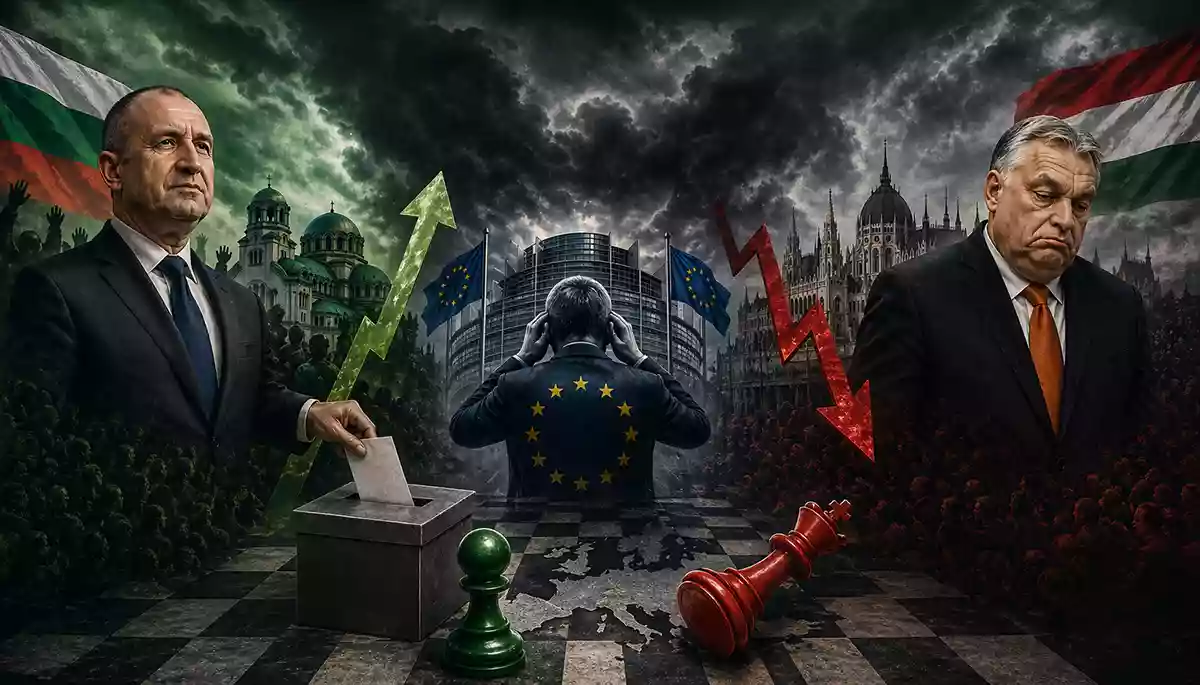
April 2026 gave Russian propaganda two storylines at once—Viktor Orbán’s defeat in Hungary and Rumen Radev’s victory in Bulgaria. It fit both into the same narrative framework. Detector Media analyzed how nine leading Russian-language outlets manipulated these results to downplay one defeat and exaggerate the consequences of the other victory.
A mirror pair
In the Russian media landscape, the two campaigns formed a kind of mirror pair. The defeat of Orbán’s camp in Hungary was mostly explained by Russian websites not as the choice of Hungarian voters but as the result of pressure from Brussels, “fatigue” from long rule, campaign failures, or a collapse of external support.
The victory of Radev’s camp in Bulgaria, meanwhile, was presented by the same or similarly toned platforms in the opposite way — as a nervous defeat for the EU, a problem for aid to Ukraine, and a chance for Sofia’s “sovereignization.” In other words, the logic is consistent: if a Moscow-friendly politician loses, it is attributed to external interference or technical factors; if a Brussels-unfriendly politician wins, it is framed as a restoration of “common sense.”
The most notable difference between segments of the Russian media sphere is this: state and semi-official outlets quickly shift the story into the realm of geopolitics — the EU, NATO, Ukraine, sanctions, and arms supplies. Mainstream business media are more restrained, but still adhere to the “pro-Russian vs. pro-European” framing and almost inevitably interpret the Bulgarian and Hungarian election results through their implications for Brussels, rather than for Russia or the domestic politics of the two countries. Ideological platforms, in turn, employ sharper metaphors—"blow," “interference,” “European path,” “sovereignty,” “disrupt arms supplies,” and so on—amplifying the emotional charge of the narrative.
Thus, Russian outlets were not only describing the elections themselves but also constructing a broader story about the struggle over Europe’s architecture during and after the Russian-Ukrainian war. Within this logic, Hungary became a story about the loss of a useful “dissenter” inside the EU, while Bulgaria became a story about the potential emergence of a new problem node for Brussels.
What the analysis was based on
The Detector Media Research Center analyzed how Russian-language Russian websites reacted to the two most recent national campaigns as of April 23, 2026: the parliamentary elections in Hungary on April 12, 2026, and the snap parliamentary elections in Bulgaria on April 19, 2026.
For Hungary, the available reaction window covers 11 days after the vote, while for Bulgaria it includes only the first four days, as the four-week aftershock period has not yet objectively occurred.
In Hungary’s case, the main spike in reactions fell on April 12–14, while for Bulgaria it occurred on April 19–21. After that, the narrative shifted from “who won” to “what it means for Brussels and Ukraine.”
The dataset was compiled from materials published by TASS, RIA Novosti, Kommersant, Vedomosti, RBC, Vzglad, Izvestia, Rossiyskaya Gazeta, and Moskovsky Komsomolets. Only texts published on Russian websites were included in this list. At the same time, if a Russian publication relied on quotations from or republications of international media—including Reuters, Bloomberg, Euractiv, Politico, the Financial Times, or Die Welt—the analysis focused on how the Russian outlet presented that material and which emphases it introduced.
Bulgaria: when the result is known before the vote
In Bulgaria’s case, Russian media entered the story with a ready-made geopolitical framework. Even before election day, Rumen Radev and his political project were portrayed not just as frontrunners but as a problem for the European Union. For instance, Kommersant ran the headline “Brussels has little to hope for in Sofia” two days before the vote, while Izvestia wrote, “Brussels interferes in Bulgaria’s elections.” Even the relatively more restrained Vedomosti used the label “former pro-Russian president of Bulgaria” from the outset. This clearly framed the elections not as a purely domestic political event but as a plebiscite on relations with Russia and on obedience to Brussels.
After the polls closed, this narrative line only intensified. TASS merely reported that “a leader has emerged,” but publications by other Russian outlets immediately shifted their focus to the implications for the war and arms supplies to Ukraine.

Three telling verbal formulas from the first post-election cycle. The graphic was generated by Claude based on data from the Detector Media Research Center
At the same time, some Russian outlets attempted to offer a domestic Bulgarian explanation, but even this was quickly made to serve the external frame. Vzglad described Radev as a figure targeting the “Bulgarian oligarchy,” while Rossiyskaya Gazeta emphasized voter fatigue with poverty and corruption. However, these socio-economic explanations were almost immediately “stitched into” an external narrative: if people were tired of oligarchy and chaos, this was presented as a weakening of the EU’s stance on Ukraine.
By the second or third day after the vote, the core narratives had stabilized: the EU fears Radev; his victory puts aid to Ukraine—especially military support—at risk; and Bulgaria may return to “sovereignty” and more pragmatic relations with Russia.
RIA ran a headline claiming that “the West was alarmed by the results of the elections in Bulgaria.” The analyst quoted there, Zoltan Koshkovich, put it this way: “Today in Brussels there are plenty of exclamations like ‘Well, damn it!’… Radev, in essence, may be even worse for the European Union than Orbán.”
The fact that he is an analyst from the Hungarian right, rather than representing an official position, was not reflected in the headline.
RIA Novosti went even further, writing that the victory of Radev’s bloc “will become an obstacle to aid to Ukraine.” Vzglad, citing Euractiv, claimed that Radev’s victory “could disrupt arms supplies to Ukraine.” In doing so, Vzglad cited RT, which in turn cited Euractiv, and at each stage of this citation chain, the headlines accumulated more and more alarmism. On one of the regional websites within the RIA network, these manipulations evolved into a claim about the “restoration of sovereignty and normalization of relations with Russia.”
This example illustrates how Russian propaganda operates. The Bulgarian result is presented not merely as a shift in the country’s internal coalition configuration, but as a potential blow to the logistics of European support for Kyiv. At the same time, some Russian texts do not conduct original reporting but rely on publications by Euractiv, Die Welt, the Financial Times, or Bloomberg, adding their own interpretations. This is not necessarily outright fabrication, but it almost always involves shifting the emphasis toward angles favorable to Russian propaganda.
Hungary: how the defeat of an ally is processed
In the Hungarian case, the emotional tone is the exact opposite. Here, Russia was losing a useful skeptic within the EU: Viktor Orbán’s camp was defeated, while Péter Magyar’s Tisza party secured a constitutional majority.
The variation in headlines shows how differently various segments of the Russian information space processed this defeat. TASS headlines were relatively neutral: “A course toward the EU, NATO, and anti-corruption: results of Hungary’s parliamentary elections.” Vedomosti simply stated the outcome: “Orbán admits defeat in Hungary’s elections.” Meanwhile, RIA Novosti used a much more aggressive tone: “The jokes are over. The European Union has struck a blow at Orbán.”
One common reaction among Russian outlets was an attempt to downplay the geopolitical significance of Orbán’s loss. On the night after the election, Vzglad ran the headline: “Orbán’s departure will not resolve Hungary’s geopolitical problems,” in a column by Fyodor Lukyanov, editor-in-chief of Russia in Global Affairs. In the piece, he argued that although an ally had lost, none of the underlying problems would disappear — suggesting that Brussels might celebrate, but in vain.
By April 14, Vzglad shifted the focus to a domestic explanation: “Orbán was let down by Hungary’s hinterland and its roads.” The article opened with a rhetorical question: “How could Hungarians fail to elect one of the most prominent politicians of our time? Orbán is known across the globe; he has become a statesman of global stature.” In this framing, Orbán’s defeat was presented through a lens of disbelief: how could voters not choose him? What followed were discussions of roads, infrastructure, and the “provinces”—anything but an ideological shift away from Orbán’s model.
Such techniques illustrate a typical pattern in Russian propaganda: first, shock and minimization of the loss; then, a search for convenient explanations or justifications.

Telling verbal formulas in coverage of Hungary’s elections. The graphic was generated by Claude based on data from the Detector Media Research Center
Overall, propaganda rather quickly moved from explaining the defeat to an adaptation phase—giving rise to a compensatory narrative: even after Tisza’s victory, Hungary will not become trouble-free for Brussels. This idea was advanced in different ways by Vzglad, which rejected the simple formula “Orbán is gone — the problem is solved,” by Kommersant, which highlighted Magyar’s willingness to discuss contacts with Russia and by others. Taken together, this produces a typical message for Russian audiences: the ally has lost, but Hungary’s energy and political interests will still compel it to remain a “special” country within Europe.
One algorithm — two modes
The Russian reaction to the elections in Bulgaria and Hungary reveals more than just ideological sympathy or antipathy toward particular politicians. It demonstrates a mechanism for turning foreign elections into tools of a domestic political narrative. In Russian coverage, Hungary became an example of how to explain defeat: Brussels, fatigue, and infrastructure—but not a final geopolitical rupture. Bulgaria, by contrast, became a case of premature optimism: EU fear, risks to aid for Ukraine, sovereignty, and a chance to normalize relations with Russia. These are not two separate stories, but the same algorithm responding differently to a desirable versus an undesirable outcome.
The key difference between the two cases lies in tone. The Bulgarian victory was framed by Russian outlets as an opportunity: a new disruption in European discipline, risks to support for Ukraine, and an opening for “pragmatism” toward Russia. The Hungarian defeat, meanwhile, was framed as a problem that required explanation: a blow from Brussels, a failed campaign — but not a definitive rejection of Orbánism.
There is also a clear distinction in target audiences. State and networked agencies focus on mass replication and functional consumption: a brief fact followed by a rapid geopolitical conclusion. Systemic business media address elites and therefore write about mandates, coalitions, European funds, corruption, and participation in the EU and NATO. Yet even they remain within the same overarching frame of geopolitical interpretation.