
Українською читайте тут.
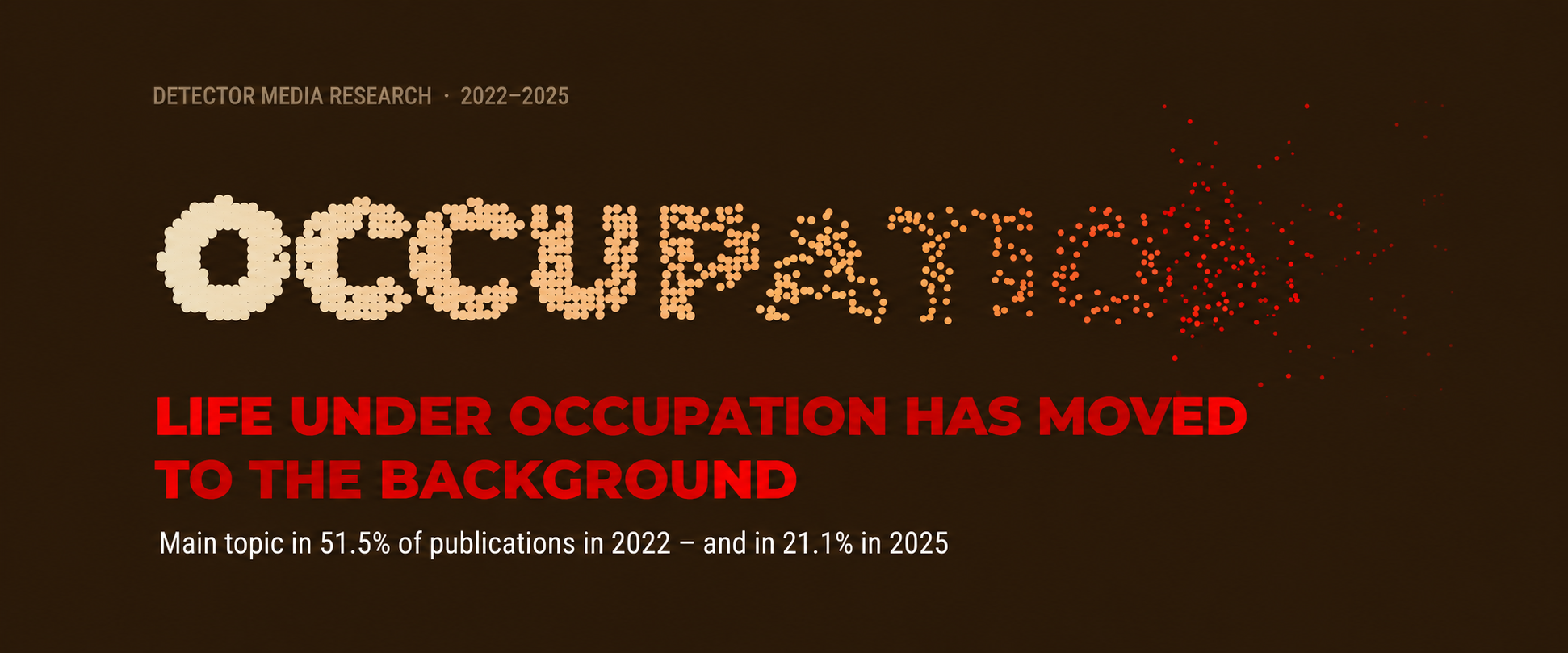
In 2022, the occupation was the main topic of every second publication about the occupied territories (51.5%); by 2025, it was the main topic of only one in five (21.1%). Over the same period, the temporarily occupied territories were increasingly mentioned in news about strikes (17.1%) and peace talks (13.3%). Meanwhile, each region has a very different media "portrait".
In August 2022, Radio Svoboda (RFE/RL's Ukrainian Service) published a report titled "'These aren't troops, they're beasts.' Two men guard a village on the front line". It tells the story of people living without electricity or gas who decide every day how to survive the next week. In summer 2025, Suspilne Donbas gathered testimonies from residents of occupied Donetsk, who receive running water once every three days.
Between these two pieces lie three years of war and hundreds of thousands of publications about the occupied territories. Stories like these two are becoming increasingly rare among them. The occupation has not disappeared from Ukrainian media. But it is less and less often what a story is about, and more and more often the backdrop against which something else happens.
The Research Centre of the NGO Detector Media traced how this picture has changed. Analysts processed 397,004 news and analytical publications in 5,737 national and local online outlets published between 1 January 2022 and 31 December 2025 that mention the occupied parts of Crimea, Sevastopol, and the Donetsk, Luhansk, Zaporizhzhia, Kherson and Kharkiv regions. For each year, they drew a random sample of 1,000 items and coded them manually: whether the occupation is the main topic of the text or merely background, and through which frame the media tell the story.
How the occupied territories turned from a main topic into background: from every second publication to every fifth
The study's key figures are simple. In 2022, the occupied territories were the main topic of 51.5% of publications; in 2023, of 34.1%; in 2024, of 24.6%; and in 2025, of 21.1%. The remaining items mention the occupation only in passing: as context for a General Staff update, as an argument in a debate about negotiations, or as a single line in a news story about sanctions.

How Ukrainian media covered the occupied territories: share of publications in which the temporarily occupied territories were the main topic, 2022–2025. Data source: Detector Media Research Centre.
The sharpest drop came in 2023, at minus 17 percentage points. After that, the decline slowed, but its direction never changed.
It matters what this indicator does not mean. Outlets did not abandon the topic: each year, between 2,900 and 3,666 media outlets mentioned the occupied territories, and their number barely changed. Nor did the typical length of the texts decrease. What changed was the place of the occupation within the story.
Another indicator confirms this. In 2022, 34.2% of publications discussed several occupied regions at once, presenting the occupation as a single, coherent phenomenon. By 2025, only 9% of texts did so. The media increasingly mention a single territory in connection with a single event, and the overall picture breaks into fragments.
The occupied territories are not vanishing from the agenda; they are "dissolving" into it, shifting from a major news story in its own right to a permanent background element of the media landscape.
Why the occupied territories faded into the background
The simplest explanation, war fatigue, does appear in the report, but it is far from the only one.
The first reason is access. Working in the occupied territories is physically impossible: there is censorship and surveillance by the occupation administration and the Russian security services. Local newsrooms that covered these cities for years have relocated, while the zone hit by drones and missiles in frontline communities keeps expanding. The media learn about life under occupation indirectly: from social media, secondary and Russian sources, and people who have already left. Such material is hard to verify and even harder to turn into a standalone story.
The second is routinisation. In 2022, every event under occupation was a news story in itself: the appointment of occupation authorities, the sham referendums, the first announcements of forced passportisation. From 2023 onwards, the occupiers' actions became routine, and new exclusive stories from the occupied territories grew scarcer.
The third is genre. More than half of the publications about the occupied territories are short news items. A news item covers a single event and accurately conveys what a source said. It leaves little room for context, and therefore for the occupation as a topic in its own right.
The fourth is newsroom resources. Covering the occupation requires long-term immersion, complex verification, special skills and contacts with people under occupation. According to the study's findings, national newsrooms often lack both the motivation and the resources to keep dedicated specialists, because they do not consider the topic interesting to a broad audience. It is sustained systematically by a small circle of journalists, mostly out of personal commitment.
The fifth reason is different in nature: it is a deliberate choice. The share of items whose main topic was statements by occupation and Russian officials fell from 12.7% to 1.3%. Ukrainian media stopped giving the occupiers a platform, and some of the "missing" publications are precisely these.
The problem is not the number of stories, but how they are told
The quantitative decline is only part of the story. Just as important is how the media talk about the occupied territories and in what context they appear in their coverage.
The report describes this as a shift in perspective. In 2022, the occupied territories were shown through what Russia was doing to them: establishing control, building administrations, holding "referendums". In 2023–2024, attention shifted to people: the deportation of children, education, rights, living conditions. In 2025, the stories that put the occupation at their centre increasingly talk about Ukrainians' resilience and everyday life under occupation.

How the context of mentions of the occupied territories changed in the media: attacks on targets in the occupied territories, peace talks, and everyday living conditions under occupation, 2022 and 2025. Data source: Detector Media Research Centre.
At the same time, there are fewer stories in which the occupied territories are the main topic. And when the occupied territories move into the background, the focus changes too: combat, strikes, negotiations and other topics come to the fore, and the occupation becomes mere context.
From mouthpiece to defendant
In 2022, statements by occupation officials were the largest frame among the stories in which the occupied territories were the main topic. The media relayed the words of Volodymyr Saldo and Yevhen Balytskyi and documented the preparations for the sham referendums. Slovo i Dilo wrote that "the occupiers of Kherson region called for a referendum to be held immediately".
Within two years, the same statements had become evidence. In 2024, Espreso.tv, citing an ISW analysis, reported that Balytskyi had admitted to the deportation of Ukrainians. And by 2025, occupation officials appear in the news primarily as defendants: in July, Radio Svoboda reported on Saldo's second in absentia conviction, for organising that very sham referendum.
The human rights frame, the second largest among main topics, changed in a similar way. In the first months of the full-scale invasion, it described extreme violence: abductions, torture, filtration. Later, it described repression as an everyday system of governance: persecution for pro-Ukrainian views, pressure on journalists and religious communities, forced passportisation, and deprivation of property.
The shrinking share of this frame should not be read as a decline in the occupation administration's influence. Rather, Ukrainian media less often quote officials directly as the protagonists of a story, and instead integrate their statements into broader narratives.
A theatre of war
The clearest example of a topic receding into the background is strikes on targets in the occupied territories. Their share as a main topic fell from 4.3% to 1.3%. As context for other news, it rose from 6.8% to 17.1%.
The targets in focus shifted along with the front line. In 2022, it was the high-profile explosions at the Saky airfield in Crimea. In 2023, headquarters on the mainland part of the seized territories, the Crimean Bridge, and the Black Sea Fleet headquarters in Sevastopol. After that, depots, logistics, and ammunition supply points.
The sources are almost always the same: the General Staff, the Southern Defence Forces, and regional military administrations. This guarantees speed, but it imposes the lens of a military briefing. What a strike means for the people living nearby, for their electricity, water and safety, mostly does not make it into these texts. The occupied territories increasingly appear as a theatre of war rather than a place where people live.
The occupied territories are increasingly part of the conversation about peace talks
The sharpest change in all four years came in 2025. The occupied territories began to appear far more often in texts about peace talks: 13.3% of background mentions, compared with 3.5% a year earlier.
The conversation itself changed as well. In 2023, the media discussed the limits of a possible compromise, mostly through opinion polls: Hromadske reported that fewer than 5% of Ukrainians were ready to cede territory for the sake of peace. In 2025, the conversation moved on to specific terms and leaks, as in an NV article about the possible recognition of Crimea as Russian and a freeze of the front line.
The voices in these texts belong to politicians, diplomats, experts and sociologists. The people directly affected by any possible agreements are almost entirely absent.
The sharp increase in 2025 does not signal more attention to life under occupation, but a stronger symbolic role for the territories as a bargaining chip, a legal status, or a line on a map.
What grew in coverage of the occupied territories
Not all topics receded. Education is one of the few that grew as a topic in its own right: from 1.2% in 2022 to 4% in 2024. The media described in detail the switch to Russian curricula, new history textbooks, and militarised clubs for teenagers. Less was said about the ways families preserve their children's Ukrainian education.
The deportation of children peaked in 2023, after the International Criminal Court issued arrest warrants for Putin and Lvova-Belova. Since then, the share of such stories has been declining. The researchers caution against drawing the wrong conclusion: the problem has not been solved; it has simply shifted from a high-profile news story to a long-term process. And the media cover processes (search, verification, legal procedures, rehabilitation) far less well than events such as children being "taken away" or "brought back".
Blind spots in coverage of the occupation
Some topics have almost vanished from view over the four years, even though their significance has not diminished.
Everyday life is the most obvious one. Stories whose main topic is living conditions under occupation have halved: 4% in 2022, 1.9% in 2025. The water crisis in Donetsk, seized housing in Berdiansk, or the worn-out water mains of Luhansk region do appear in the news, but mostly as illustrations of the occupiers' incompetence. How family budgets are changing, who cares for older people, how people decide whether to leave or stay: these are rarely explained.
Reintegration has almost disappeared: as a main topic, it fell from 3.6% to 0.1%. This is despite the polling data cited by Ukrinform: 78% of Ukrainians consider the return of the territories and their people fundamentally important. The authors of the report suggest that the conversation about reintegration has been partly absorbed by the conversation about negotiations.
Passportisation never became a topic in its own right. It is mentioned within stories about repression, mobilisation or access to payments, but the media rarely explain the whole chain, from receiving a Russian passport to military registration and conscription. Equally rarely do they explain where the line lies between forced and voluntary collaboration with the occupiers: the topic of accountability exists mostly in the form of short news items about in absentia verdicts.
And finally, the voices of the residents themselves. Across all frames, the main sources are authorities, human rights defenders and experts. People under occupation appear as victims or as objects of other people's decisions. Their own explanations go almost unnoticed.
Society may receive a great deal of news about the occupation, yet too little explanation of the experience of the people with whom it will have to rebuild a shared public life.
Each occupied territory has its own media context
Looking at individual regions, the overall picture splits into several very different ones. The share of mentions fell for all territories except Crimea, Sevastopol and the occupied part of Kharkiv region. For example, occupied Zaporizhzhia region appeared in 27% of the publications in the dataset in 2022, and in 18.2% in 2025. A lack of news events cannot explain this, the researchers stress.

What Ukrainian media wrote about in the context of different occupied regions: topics characteristic of the coverage of each region. Data source: Detector Media Research Centre.
The differences between regions come down to at least three factors: how long the occupation has lasted, how the front line has shifted, and who supplies the media with information. There is also a common rhythm: in 2022, the occupiers' statements and mobilisation dominated everywhere; in 2023, the deportation of children; and in 2025, mobilisation returned almost everywhere, this time as systematic conscription into the Russian army.
The South: from the occupation "authorities" to terror on the right bank
In 2022, Kherson region had the highest rate of quotes from occupation officials of all the territories: 29.5%. This was the year of Saldo and Stremousov, who featured constantly in the media. After the liberation of the right bank of the Dnipro, the topic moved to the courts: in November 2023, Saldo was sentenced in absentia to 15 years in prison.
Next, the focus turned to children. Deportation accounted for 9.7% of publications about occupied Kherson region in 2023 and 10.1% in 2024: stories about the Luchystyi camp in Yevpatoria, and a Slidstvo.Info investigation into educators who helped take around 340 children away. In 2024–2025, the share of stories about living conditions grew: the permit regime on the left bank and drone strikes from the left bank on civilians on the right bank. The outlet Vgoru called this a "human safari"; in May 2025, the UN Independent International Commission of Inquiry on Ukraine recognised these attacks as crimes against humanity.
Zaporizhzhia is the only region where human rights and repression remained among the leading topics in all four years. Pershyi Zaporizkyi wrote about some 2,000 residents of Enerhodar who had passed through torture chambers, and about long prison sentences handed to employees of the Zaporizhzhia Nuclear Power Plant. A separate thread concerns housing and documents: "ownerless" flats in Berdiansk, and the loss of benefits and medical care for those who refused to take a Russian passport.
The East: the institutionalisation of Russian occupation
In Donetsk and Luhansk regions, the occupation has lasted since 2014, and this is reflected in the topics. Statements by the occupation authorities in Donetsk region disappeared from the leading topics entirely, from 22.9% in 2022 to zero. Instead, the water crisis has remained consistently visible, and in 2025, education appeared among the leading topics for the first time: since 1 September, schools in Mariupol have been teaching exclusively under Russian curricula.
In 2025, Luhansk region had the highest share of publications about mobilisation of all the occupied territories: 7.9%. Education is one of the most visible topics here (6.1% in both 2024 and 2025): "cadet classes" in Dovzhansk, where children are taught mine clearance, and later the closure of schools due to a shortage of pupils and teachers. Living conditions are consistently among the leading topics; the relocated outlet Realna Gazeta reported that more than 80% of the region's water mains are worn out.
According to the authors, much of this attention rests on regular updates from the Luhansk Regional Military Administration, which other outlets republish. Where there is a steady source, there is a steady topic.
Crimea and Sevastopol: how a long occupation changed the media focus
The authors describe Crimea in 2022 as a "showcase" of annexation rhetoric: official statements and collaboration. In 2023, strikes came to the fore, on the Crimean Bridge and the Black Sea Fleet headquarters, along with deportation: the peninsula became a transit point for children from other occupied territories. The Almenda Centre documented 23 Crimean camps running military-patriotic programmes.
Sevastopol holds several of the study's records. In 2022, one in five publications about the city concerned mobilisation, the highest figure for any territory in any year. In 2023, it showed a unique combination of strikes (15.9%) and resistance (11.4%). In 2025, it had the highest share of stories about repression (12.7%): a 14-year sentence for Vilen Temerianov, a citizen journalist with Crimean Solidarity, and "espionage" cases against residents of the city.
Only for Crimea and Sevastopol does the report identify reintegration as a separate topic. The peninsula has been occupied since 2014, and the question of its return has long existed as an expert and political debate in its own right.
Who keeps the topic alive
Behind every regional story stand specific newsrooms. MOST and Vgoru in Kherson, 0629.com.ua in Mariupol, outlets from Melitopol, and Realna Gazeta from Luhansk region: they are the ones with long experience, contacts and the trust of people under occupation. Some have effectively become intermediaries between residents of the occupied territories and audiences in free Ukraine.
However, as the study notes, exchange between them and the major national media is so far limited to individual news items rather than joint work on stories.
The findings of the study were presented on 8 October 2026 at the Donbas Media Forum, during the panel discussion "Life under occupation beyond the headlines: how Ukrainian media talk about the temporarily occupied territories".
This analytical report was prepared with the support of the Partnership Fund for a Resilient Ukraine (PFRU), which is funded by the governments of the United Kingdom, Estonia, Canada, Norway, Finland, Switzerland and Sweden. Its content, conclusions and recommendations are the sole responsibility of the NGO Detector Media and do not necessarily reflect the position of the Programme and/or its Financial Partners.
The main image is generated using Claude (Anthropic)