
Українською читайте тут.
On 2 September 2026, Detector Media analyst Andriy Pylypenko took part in a training on countering transnational information suppression (TIS). Here he explains what this phenomenon is.
The event, dedicated to using a specialised framework to counter Transnational Information Suppression (TIS), was organised by the DISARM Foundation together with the European External Action Service (EEAS). The training is part of ongoing cooperation between DISARM and the EEAS, within which researchers, civil society representatives and journalists from different countries test an updated DISARM framework module and an updated practical guide for counter-disinformation analysts. The 2 September training was the third in a series of such sessions. It aimed to raise the community’s awareness of TIS and its capacity to identify it, and to give participants practice in applying the framework to real-world cases.
The practical session opened with a short introduction from the DISARM team and a presentation of the DISARM Navigator tool, which lets users browse all of the framework’s tactics and techniques. The main part was a presentation by Janina Santos of the Taiwanese NGO Doublethink Lab on an investigation into how the Chinese embassy used a network of fake Facebook accounts against Filipino journalists. Participants then worked in small groups to code prepared case studies, applying the logic of the DISARM framework in practice.
Detector Media is part of the global community of disinformation researchers: it takes part in specialised international trainings and working groups and helps shape the tools used by analysts working on countering foreign information manipulation and interference (FIMI) in different regions of the world.
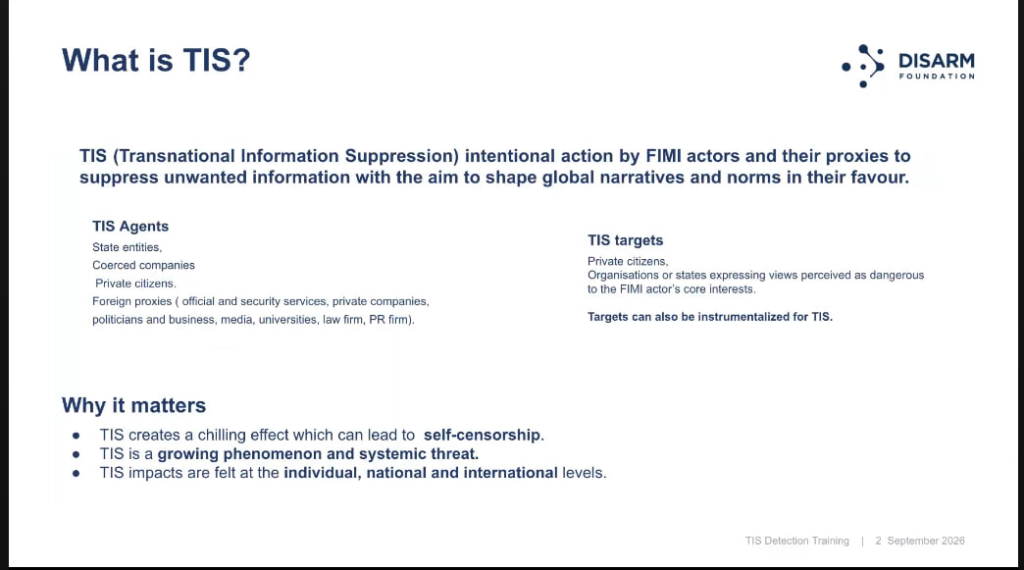
What transnational information suppression (TIS) is (presentation screenshot)
What is TIS
Transnational information suppression (TIS), as defined by the EEAS, refers to deliberate actions by hostile foreign actors and their proxies aimed at suppressing unwanted information in order to shape global narratives in their favour. Put simply, these are attempts by states, most often authoritarian ones, to silence people and organisations that are beyond their direct reach — journalists, dissidents, researchers, members of diasporas and others.
Such actions can be initiated by state bodies, companies they control, private individuals, and networks of foreign proxies — ranging from security outfits and private firms to politicians, media outlets, universities and PR agencies. Unlike “classic” disinformation, a state actor using TIS seeks to prevent unwanted information from appearing in the public sphere altogether. This is achieved less by spreading false narratives than through the so-called “chilling effect” — silencing a particular topic in order to push people towards self-censorship.
Zoe Fourel of the DISARM Foundation outlined four categories of TIS — psychological, technical, legal and economic — and noted that the DISARM framework is currently best suited to describing psychological and technical suppression of information. Other components of the module, suitable for describing legal and economic pressure, are still being developed; it was precisely to improve the system that experts from different countries were brought together to share their practical experience.
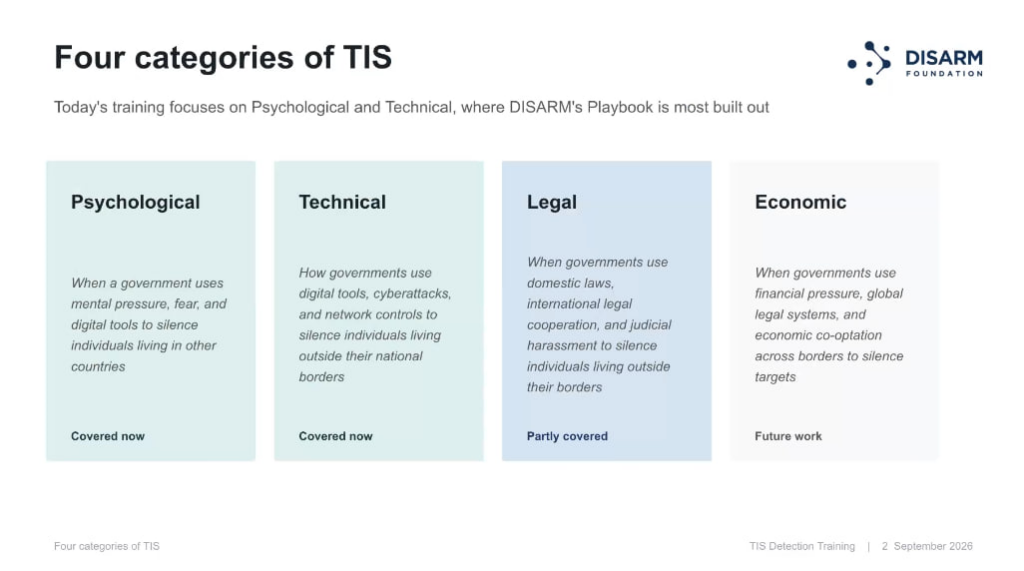
The four categories of information suppression under the TIS methodology: psychological, technical, legal and economic (presentation screenshot)
What is DISARM and how to use it to assess information operations
DISARM is a publicly available framework that gives analysts a shared, machine-readable language for describing influence campaigns, regardless of the specific language, region or type of disinformation. It is developed and maintained by the UK-based DISARM Foundation, which aims to bring together disinformation researchers from Taiwan to Estonia and to give them a tool for describing and comparing their data in order to identify common patterns.
The framework operates on two levels: “observations” — what can be objectively verified (for example, the existence of an account on a given social network, or of a post) — and “assessments” — the analyst’s judgements about the purpose, techniques and effects of the actions. These elements are coded in the framework module as formalised “procedures”, which makes it possible to code different incidents in different parts of the world in a consistent way and then automatically search for common patterns.
The practical guide presented at the training organises this entire toolkit around four types of TIS: coercion by proxy, harassment campaigns, surveillance, and targeting followers.
Key case: how the Chinese embassy in Manila attacked PCIJ investigators
In 2025, the Philippine Center for Investigative Journalism (PCIJ) and independent journalist Regine Cabato published an article on five ways to spot pro-China propaganda. Cabato later released a short video in Tagalog (one of the official languages of the Republic of the Philippines, alongside English) with the same explanation, making it accessible to a broad audience in the Philippines. The video went viral after it was shared by the Philippine Coast Guard spokesperson, now Rear Admiral Jay Tarriela.
Janina Santos of the Taiwanese NGO Doublethink Lab told the training participants that it was right after this repost, at around midnight on 25 February 2026, that the official page of the Chinese embassy in Manila published the first of five critical posts. It featured screenshots of the PCIJ website intended to prove that the organisation is funded by the US National Endowment for Democracy (NED), and built on this a narrative designed to undermine trust in Filipino journalists. Despite PCIJ’s statement on the transparency and diversity of its funding sources, according to Santos, over the following month the Chinese embassy published four more posts pushing the same narrative (“PCIJ’s dependence on American funding”).

Screenshot from Janina Santos’s presentation
The embassy’s posts were picked up almost immediately by dozens of pro-China influencers. According to a joint investigation by Doublethink Lab and the Philippine organisation Democracy.Net.PH, carried out with support from Internews, the first post alone was shared by at least 107 accounts with a combined reach of around 3 million followers — within the first two hours. Among them were well-known pro-China bloggers, including Anna Malindog-Uy, who publicly presents herself as a geopolitical expert.

Gen Z bloggers joined in spreading the Chinese embassy’s official statements. Screenshot from Janina Santos’s presentation
Doublethink Lab researchers estimate that between a quarter and a third of the commenters and sharing accounts showed signs of inauthenticity: unusual usernames, no original content, and bursts of activity at odd hours interspersed with religious or motivational quotes. According to Janina Santos, the attack on PCIJ was also accompanied by personal online abuse targeting Regine Cabato, including sexist comments sent via private messages.

Share of likely inauthentic comments and shares under the Chinese embassy in Manila’s posts; screenshot from Janina Santos’s presentation
The case drew international attention: statements in support of PCIJ and Cabato were issued by the Committee to Protect Journalists (CPJ), Reporters Without Borders (RSF), ARTICLE 19, the Philippine Center for Media Freedom and Responsibility (CMFR) and other civil society organisations. Each time, the embassy responded by pointing out that these organisations, too, were funded by the NED.
The researchers assessed the actors’ behaviour in this incident using the previous version of the DISARM framework (1.6). However, as Janina Santos noted in her presentation, the new TIS-specific DISARM 2.0 module will make it possible to describe fully and accurately the incident’s impact on the journalist herself and on trust in the media more broadly, and the team plans to re-code the case once DISARM 2.0 is fully operational.
Two practical cases: China’s extraterritorial police station in New York and pressure on the followers of dissident Wang Zhi’an
In the practical part of the training, participants worked in small groups to code two prepared cases of information suppression, to see how the DISARM logic applies to different types of incidents.
The first was the so-called “overseas police station” in New York, which Chinese security services used to monitor Chinese citizens abroad. According to US prosecutors, from January 2022 two US citizens of Chinese origin, Lu Jianwang and Chen Jinping, ran a so-called “overseas police station” out of an office in New York’s Chinatown. According to investigators, the office was used to monitor Chinese political dissidents and to organise actions against followers of the Falun Gong movement. Chen pleaded guilty in December 2024; in May 2026, a jury convicted Lu of acting as an unlawful agent of the PRC and of destroying evidence — he faces up to 30 years in prison. Such “offices” are not isolated: a September 2022 report by Safeguard Defenders noted that dozens of such informal police stations are likely operating in countries around the world to monitor PRC citizens — for example, to force them to return to China, including by putting pressure on their relatives back home.
The second case is an example of the “targeting followers” type of incident. Exiled blogger and dissident Wang Zhi’an, a former investigative reporter for state broadcaster CCTV whose accounts on Chinese social media were deleted in 2019, left for Japan in 2021 and now works independently from Tokyo (with more than 2 million subscribers on YouTube and around 1.5 million followers on X). On 25 February 2024, Wang and another Chinese dissident abroad, Li Ying, reported that police in China were summoning their followers for questioning. Wang urged his followers to unfollow, change their usernames and be prepared to be questioned by the police. This case was included in the DISARM practical guide as the baseline example of “targeting followers” incidents.
Conclusion
The DISARM team is continuing this series of trainings in order to gather participants’ feedback and finalise the framework’s TIS module and the guide. For Detector Media, taking part in such events is an opportunity to contribute to developing methodologies for countering disinformation and information operations.