Українською читайте тут.
How the national telethon covered the ban on Slidstvo.Info publishing its investigation into the real estate of the SBI director’s brother, President Zelenskyy’s decree imposing NSDC sanctions against former MP Boryslav Bereza, and the State Bureau of Investigation’s searches of drone manufacturer Vyriy Industries and its director, who is also a co-owner of the media outlet Babel.
Over the course of a single day, July 7, three events took place in Ukraine’s domestic politics that were directly or very likely related to the authorities’ pressure on freedom of speech:
- The Pechersk District Court banned Slidstvo.Info from publishing an investigation into 143 apartments and other real estate owned by the brother of the Director of the State Bureau of Investigation;
- President Zelenskyy signed a decree imposing NSDC sanctions against former MP Boryslav Bereza;
- The State Bureau of Investigation conducted searches at the drone manufacturer Vyriy Industries and at the home of its director, who is also a co-owner of the media outlet Babel.
From the perspective of informing television viewers about matters of public importance, it is significant how one of the country’s largest television broadcasters (under the current circumstances) covered these events — namely, the United News Marathon, which is funded by the state and which, since its creation, has claimed the exclusive role of being the “single” source of information for Ukrainian society.
For comparison, I will also mention how the same topics were covered by Ukraine’s public broadcaster, Suspilne, in its television news coverage.
On July 7, the telethon’s broadcast was shared by two TV channels: We Are Ukraine and 1+1. Regarding the court’s ban on publishing Slidstvo.Info’s investigation into the real estate owned by the brother of State Bureau of Investigation Director Sukhachov, the newsrooms of both channels, quite predictably in my view, simply did not report on it. Yet it is clear that both newsrooms employ editors and journalists who are experienced enough that it is difficult for me to suspect them of professional incompetence. I assume they fully understood both the public significance of this event and the unprecedented nature of the court’s decision, as well as its potential to become a precedent for future bans and restrictions on journalists’ work (not only investigative reporters). They likely also understood the “scandalous” nature of the event — something journalists on these channels (especially one of them) are particularly fond of.
Nothing helped, and viewers of the national telethon never learned about an event that blatantly and unjustifiably restricted their right to know what is happening in the country. I also cannot ignore the complete absence of what is known as journalistic solidarity. However, it seems pointless to speak of such professional solidarity nowadays, because instead of supporting colleagues even by simply reporting on their problem, it is apparently easier to apologize after the fact (if the government ever changes) for having remained silent. As has happened before.
For comparison, Suspilne’s Pershyi Channel did, of course, report on the court’s decision that same day. It discussed the issue on air with Slidstvo.Info journalist and co-author of the investigation Maksym Savchuk, sought comment from the State Bureau of Investigation, which stated that “the Bureau is not a party to the court proceedings, the case does not concern one of its employees, and therefore it cannot comment on the situation.” Suspilne’s newsroom also requested a comment from the Pechersk District Court of Kyiv. No response was received.
The second topic—NSDC sanctions against former MP Boryslav Bereza— was completely ignored by We Are Ukraine, which was broadcasting the telethon from 7:00 a.m. until 4:00 p.m. that day (even though the presidential decree imposing the sanctions and the official announcement had already been published on the President’s website at 11:00 a.m.). In contrast, 1+1, which took over the telethon after 4:00 p.m., did report on the sanctions twice: first in the 5:00 p.m. news bulletin and then repeated the same report verbatim in the 10:00 p.m. bulletin. It seems strange to me that the topic was completely “forgotten” during prime time, including in the flagship evening news program, which is supposedly intended to give viewers a complete picture of the day’s most important events.
Formally, it was a spoken news item, as usual awkwardly covered with screenshots (which are impossible to read on a television screen anyway) and archival footage (which, as is traditionally the case, contradicted the off-screen narration). In terms of content, however, the report was framed rather oddly for a standard news story and was so selective in presenting the facts that it seemed more like manipulation than journalism.
It began as follows: “Another round of sanctions against Russian companies and Russian individuals has been introduced by President Zelenskyy’s decree, thereby putting into effect the decision of Ukraine’s National Security and Defense Council. Notably, alongside Russian propagandists, the decree also includes the name of a Ukrainian citizen—Boryslav Bereza.”
This was followed by an explanation of the motives: “the wording regarding all of these individuals is as follows: ‘they support Russia’s aggressive policy toward Ukraine, spread Kremlin propaganda, and distort the facts.’” This was in fact a direct quotation from the announcement of the decree published on the President’s website, because neither the decree itself nor the NSDC decision contained any explanation of the reasons behind the sanctions (the sanctions were imposed, but for what exactly remained unknown). However, the TSN presenter did not quote the statement in full, because after the words “distort the facts,” the original text continued with: “and unlawfully carry out activities in the temporarily occupied territories of Ukraine.”
The report then presented what appeared to be a balance of views, noting that Bereza “has already responded online with a post asking whether he is still welcome in Ukraine and linked the sanctions against him to his criticism of the Ukrainian authorities.” This was followed by background information, where, out of a wide range of possible facts, only one issue was highlighted: “Boryslav Bereza, who is believed to reside in one of the European countries, previously commented on the international scandal surrounding Hungary’s detention of armored cash transport vehicles belonging to Ukraine’s Oschadbank. Representatives of the bank stated that it was a lawful transfer of cash and valuables, while Bereza claimed it was a scheme to move capital abroad using an armored cash transport vehicle. A Vienna court ordered him to stop making such statements about the incident and to delete the relevant publications. After the change of government in Hungary, Budapest returned Oschadbank’s detained assets to Ukraine.” I believe that, for an undiscerning viewer, such information could easily sound like a complete “explanation” or even “confirmation” of the justification for imposing sanctions on the former MP.
Of course, one may have different opinions about Mr. Bereza and his various social media posts, but it should be kept in mind that the issue of the detention of Ukrainian cash-in-transit personnel in Hungary is far from the only topic on which Bereza has sharply criticized the current government and President Zelenskyy personally. Following this logic, it would appear that this single, indeed rather conspiratorial, topic in the former MP’s posts was sufficient grounds for imposing sanctions that, in addition to stripping him of state awards, freezing assets, and other measures, also restrict access from Ukraine to internet resources associated with Bereza on Telegram, YouTube, and Facebook. This is already a matter of freedom of speech in its classical sense. In fact, this selective background was where 1+1 ended its report on July 7. Unsurprisingly, the channel made no attempt to further develop the topic by seeking comments from politicians or experts.
By contrast, Suspilne’s Pershyi Channel did exactly that. In its discussion studio (a format that is not practiced in the national telethon at all, especially given that opposition MPs are rarely invited there), the issue was discussed that day with members of parliament. The government was represented by Ruslan Horbenko of the Servant of the People faction, while the opposition was represented by Sofiia Fedyna of European Solidarity. Thanks to their verbal exchange, professionally moderated by the host, viewers of the public broadcaster, unlike viewers of the national telethon, were able to learn significantly more conceptually important background information about the issue.
First, Fedyna reminded the audience that under the current law, the sanctions mechanism was introduced to target foreign citizens and companies that threaten Ukraine’s national security and sovereignty. Ukrainian citizens suspected of crimes, however, are subject to the established procedures of criminal prosecution and judicial review. Second, Fedyna recalled that Zelenskyy had also unlawfully imposed sanctions on his predecessor, Petro Poroshenko, who has now been challenging them in court for a year and a half. She concluded: “This leads to the conclusion that this is an attempt to persecute political opponents.”
In response, Servant of the People MP Horbenko argued that Bereza had been spreading “Hungarian narratives that support Russian narratives” (once again reducing the motivation for the sanctions to the single topic of Bereza’s posts that had also been mentioned by 1+1 in the telethon). He also saw no threat to freedom of speech, saying that Bereza “can still give interviews, so I don’t see any prohibition.”
The channel also invited an expert to the studio — lawyer Tetiana Kozachenko, former director of a department at the Ministry of Justice and head of the Public Council on Lustration under the Ministry of Justice. According to her explanation, “this law cannot be used against Ukrainian citizens at all. Period.” According to MP Fedyna, sanctions may be imposed on a Ukrainian citizen only in cases related to terrorism (something Bereza can hardly be suspected of). Most likely, Ms. Fedyna was referring to the vague wording of Article 1 of the law, where paragraph 2 literally states: “Sanctions may be applied by Ukraine against a foreign state, a foreign legal entity, a legal entity controlled by a foreign legal entity or a non-resident individual, foreigners, stateless persons, vessels, aircraft, as well as entities engaged in terrorist activities” (where these latter “entities” may presumably include not only foreigners, stateless persons, or, for example, vessels). Expert Kozachenko also added another important piece of background to the discussion, reminding viewers that it was not Zelenskyy but his predecessor Poroshenko who first violated this law by imposing sanctions on Ukrainian citizens.
I have deliberately described all these facts and opinions in considerable detail to illustrate just how much broader, more complex, yet also more truthful a picture discussion programs with politicians (especially from opposing camps) and experts can provide compared with brief news reports, where the selection of current and background facts may be so incomplete that it significantly distorts the picture of an ambiguous domestic political event.
One final point on this topic. In 1+1’s report, Bereza’s comment was summarized very briefly. Suspilne’s broadcast provided a much longer quotation: “Well, I finally got under Vova’s skin — the Vova who does not want to say who the ‘Vova’ is for whom a house is being built in ‘Dynastiia.’ Four-time draft dodger Zelenskyy has imposed sanctions on veteran Bereza. And having sanctions from both Putin and Zelenskyy at the same time — that’s bingo. I wonder how they will explain this. Because if it is for exposing corruption and criticizing the government, then they’ve hit the bull’s-eye.” Agree that such a quotation offers much more for understanding the issue than the brief statement that he “linked the sanctions against himself to criticism of the Ukrainian authorities.”
The third domestic political issue on July 7 — the State Bureau of Investigation’s searches of drone manufacturer Vyriy Industries and its director Oleksii Babenko — was widely discussed that day primarily because Babenko is a co-owner of the media outlet Babel. Shortly beforehand, Babel had published an investigative report on mass non-combat deaths of mobilized soldiers in the Skelia Regiment. Naturally, there was and still is no direct evidence of a causal link between the publication and the searches, but it is also difficult to believe that the two events coincided purely by chance. That same day, Yaroslav Yurchyshyn, Chairman of the Verkhovna Rada Committee on Freedom of Speech, publicly described the SBI searches of the media outlet’s co-founder as pressure on the media.
Within the national telethon, We Are Ukraine completely ignored this topic as well, which seemed very strange to me. Even if the director of Vyriy Industries had not been a co-founder of a media outlet, the searches of one of the largest suppliers of drones to the front line would in themselves have been among the leading stories of the day. I will venture the assumption that, had he not been a media co-founder, the channel would probably have paid attention to the searches. But because he was, they likely decided it was better not to touch the subject. Better safe than sorry, as the saying goes.
By contrast, 1+1 could be said to have somewhat redeemed itself this time. The channel reported both on the searches and on the official version presented by law enforcement authorities—"suspicions of artificially inflating the cost of drones under state contracts worth billions of hryvnias.” In the background section, the report explicitly mentioned that “Babenko is also a shareholder in the media outlet Babel, which recently published an investigation into the Skelia assault regiment, revealing facts of torture of servicemen and non-combat deaths.” It also quoted Babel Editor-in-Chief Kateryna Kobernyk, who “states that after the publication, but before today’s searches, anonymous Telegram channels launched a media campaign aimed at discrediting both the media outlet itself and the businessman. According to the journalist, even before the searches actually took place, a fake AI-generated video titled ‘Searches at Babenko’s’ had already appeared. The editorial team emphasizes that this is a classic attempt to obstruct the work of investigative journalists by targeting the business that supports them.”
Later, in the post-prime-time news, the report also included Babenko’s own remarks from his press conference: “This Babel investigation had nothing to do with us, and we had absolutely no influence over it. I learned from Skelia that it was going to be published only one day before its release. As for pressure or influence, honestly, there are no grounds to suspect Skelia of exerting such pressure or anything like that. But for quite some time now, there has been an attempt in the media to drag me into this conflict and to use me as a means of putting pressure on Babel. Such attempts have been made. I can say right away that we are not at war with anyone except the Russians.”
It is true, however, that Mr. Babenko denied only the possibility that the Skelia Regiment had influenced the SBI. The possibility that other, more powerful actors might have influenced the Bureau’s actions remained hanging in the air. The event itself and the theory that the searches were connected to Babel’s investigation were not discussed with anyone in the channel’s discussion studio.
Conversely, Suspilne’s Pershyi Channel covered the story that day in a critically incomplete manner, focusing exclusively on its “criminal procedure” aspect. The broadcaster reported on the searches, verbally cited the positions of the Prosecutor General’s Office and the State Bureau of Investigation, carried a live report following Babenko’s press conference, and aired his comments regarding the officially stated reasons for the searches (as no formal charges had been brought by law enforcement) and what Babenko himself considered the unconvincing results of those searches. However, the version linking the searches to Babel’s publication was never mentioned. Nor did the broadcaster mention that Babenko is a co-founder of the outlet. Such omissions, although relatively rare, do occur in Suspilne’s broadcasts.
Overall, July 7, as the day on which all of the above-mentioned domestic political events occurred in quick succession, was quite illustrative of how the national telethon generally covers matters of public importance that are sensitive or even outright inconvenient for the authorities. Most often, such events are simply ignored by the telethon broadcasters and, consequently, remain unknown to the telethon’s viewers. For example, here are just a few such topics from the past three months:
- Former Minister Halushchenko was remanded in custody for another two months (April 15).
- The parliamentary temporary investigative commission summoned Umerov and Shefir following the publication of the “Mindich tapes” (April 29).
- The Public Council under the Ministry of Defence called for Umerov’s dismissal from the post of Secretary of the National Security and Defense Council (April 29).
- The parliamentary temporary investigative commission considered issues related to Sense Bank, which appears in the “Mindich tapes,” while NSDC Secretary Umerov failed to appear before the commission due to a business trip (May 5).
- Investigators found plans for appointments to the Security Service of Ukraine (SBU) in the possession of Yermak’s driver (May 12).
- At a meeting of the parliamentary temporary investigative commission, a co-owner of Fire Point described Mindich’s attempts to acquire a significant stake in the company (May 13).
- Slidstvo.Info: The bodyguards who picked up Yermak from the pre-trial detention center had previously protected President Zelenskyy (May 19).
- Zelenskyy held meetings with the leaders of opposition parliamentary factions, including Poroshenko (May 26).
- The court rejected prosecutors’ request for a preventive measure against Vitalii Shabunin, head of the Anti-Corruption Action Center (June 9).
- Klychko accused the government of avoiding assistance to Kyiv in preparing for winter and demanded that the National Security and Defense Council convene (July 6).
- The High Anti-Corruption Court allowed former Deputy Prime Minister Chernyshov to have his electronic monitoring bracelet removed (July 7).
Cases in which sensitive domestic political issues are at least mentioned by individual telethon channels occur much less frequently. However, in such cases they are usually presented either merely as a statement of fact (without discussions involving newsmakers or experts) or with a selective presentation of the facts.
For example, on April 29, Ukrainska Pravda published part of the NABU-recorded conversations involving Mindich, Shefir, Umerov, and “forewoman Nataliia.” 1+1 did not mention the topic at all (although the channel was broadcasting from 6:00 a.m. until 3:00 p.m., while Ukrainska Pravda published the material at 9:00 a.m.). ICTV and STB also remained completely silent in their news bulletins (either because “this is not news” or because “this is not important news for the public”?). The publication itself was mentioned orally in a guest studio discussion with Yurii Hudymenko, Chairman of the Public Anti-Corruption Council under the Ministry of Defence, but only one aspect was discussed: Mindich’s connection to Fire Point. All other issues, including the construction of Dynastiia, were ignored altogether.
Or take May 26, when President Zelenskyy spoke with MPs from the Servant of the People faction about prospects for ending the war. The broadcasts of Inter and We Are Ukraine did not mention the meeting. 1+1 limited itself to a brief voice-over accompanied by archival footage.
Some events are reported by all participants in the national telethon, but exclusively in the form of brief spoken announcements, usually accompanied by archival video. For example, on May 18, Inter, We Are Ukraine, and ICTV/STB reported on Andrii Yermak’s release from the pre-trial detention center on bail in this manner.
At times, most participants in the United News Marathon selectively ignore important topics, while only one channel covers them, most often 1+1 (as was also the case on July 7). Thus, on May 4, MPs Yaroslav Zhelezniak and Oleksii Honcharenko released new excerpts from the “Mindich tapes.” That day, the topic was ignored throughout the telethon by Inter, ICTV/STB, and We Are Ukraine. A few days later, however, the issue was discussed on 1+1 host Nataliia Moseichuk’s authorial program with experts loyal to the authorities.
Or consider June 23, when Babel published the already mentioned investigation into 26 non-combat deaths among recruits of the Skelia Regiment. We Are Ukraine did not report on it. 1+1, however, covered the story, aired comments from Babel journalist Kateryna Lykhohliad, and quoted the regiment’s response posted on its Facebook page.
Naturally, the overwhelming majority of the topics mentioned above were covered in considerable detail and with high quality by the public broadcaster Suspilne. Therefore, one can draw a simple conclusion: people who receive their news from the United News Marathon, at least regarding domestic political issues, ultimately end up with an information picture of reality that is, at best, significantly limited and, at times, distorted. In this respect, viewers of the public broadcaster are much better informed on most of these issues.
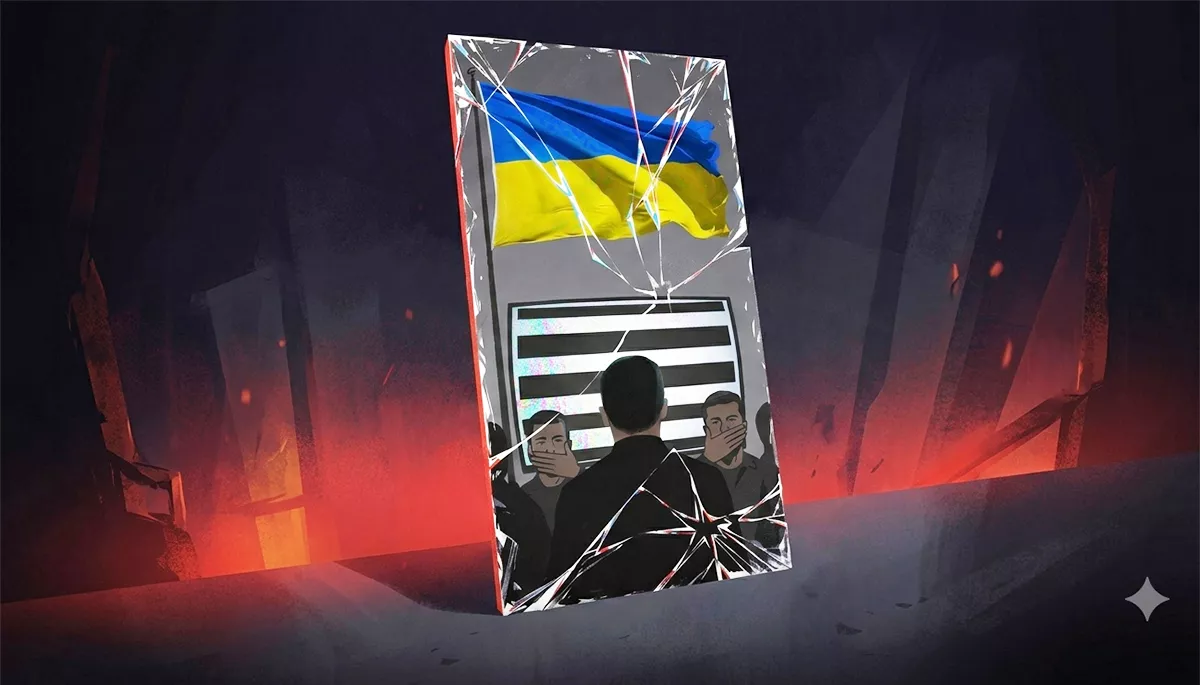
Illustration generated with the assistance of the Gemini artificial intelligence system.
This material was prepared with the support of the Norwegian Helsinki Committee and funded by the Norwegian Agency for Development Cooperation (NORAD).