



Українською читайте тут.
“Take away Western weapons and keep the Banderites out of the EU.” How propaganda is adding fuel to the fire.
The escalation of the historical dispute between Kyiv and Warsaw ahead of 11 July—the Day of Remembrance for the Victims of the Volyn Tragedy—provided an opportunity for coordinated interference by Russia’s Federal Security Service (FSB). On 5 July, the FSB published material about Dmytro Kliachkivskyi, commander of UPA-North, featuring an unverified quote about the mass killings of Poles. The quote was immediately amplified by pro-Russian Telegram channels.
Detector Media analyzed 384 posts published between 1 and 6 July 2026, tracing how the FSB’s fake narrative overlapped with existing messaging and incidents—from threats to block Ukraine’s accession to the European Union to commemorative marches in Warsaw.
Key findings
- An analysis of the dataset of 384 posts shows that the FSB’s information operation on 5 July was not an isolated publication, but rather an entry point into a broader network of narratives. The unverified quote attributed to Kliachkivskyi (discussed below) gained an appearance of legitimacy after being disseminated through Russian state outlets RT and the Russian Ministry of Foreign Affairs, before being repeated by dozens of accounts without any verification of the original source.
- At the same time, some propagandists sarcastically downplayed Russia’s role in fueling the conflict—a tactic that both conceals signs of coordination and portrays the Polish-Ukrainian dispute as an “organic” conflict with no outside interference.
- The campaign also featured several interconnected narrative strands: threats to block Ukraine’s EU accession over the “cult of Bandera,” territorial references to “Eastern Lesser Poland,” mockery of the remembrance march in Warsaw, and speculation surrounding a letter from Jarosław Kaczyński. Together, these narratives pursue a single objective: to deepen mistrust between Kyiv and Warsaw ahead of 11 July and to turn historical memory into a permanent instrument of pressure against Ukraine’s European integration.
- The sources allegedly supporting these claims—opinion poll data without sampling information, unverifiable quotations, and Polish officials’ remarks taken out of context—point to the structure of a coordinated influence campaign rather than a spontaneous public reaction.
What preceded it
The escalation in Ukrainian-Polish relations, which has continued since late May 2026, unfolded in stages—from a symbolic exchange of “diplomatic courtesies” to explicit statements about the possibility of blocking Ukraine’s accession to the European Union.
In July, Russian intelligence services became more actively involved in the discussion by publishing material intended to fuel the dispute between the two countries with a new “historical” detail allegedly taken from “declassified archives.” At the same time, readers of pro-Russian Telegram channels were exposed to a whole range of narratives, from the claim that “Poland is tired of Ukraine” to the argument that “right-wing radical ideology will become an obstacle to Ukraine’s accession to the EU.”
The deterioration in relations between Ukraine and Poland comes ahead of 11 July, the Day of Remembrance for the Victims of the Volyn Tragedy, established by the Polish Sejm in 2025. Before analyzing the dynamics of Telegram channels, however, it is worth briefly reviewing the information triggers of recent months that have contributed to tensions in Polish-Ukrainian relations.
On 26 May, Volodymyr Zelenskyy signed a decree granting the Separate Special Operations Center “North” of the Special Operations Forces of the Armed Forces of Ukraine the honorary title “Named after the Heroes of the UPA.” The opening of the decree states that this is done “to restore the historical traditions of the national armed forces.”
The decision prompted a reaction in Poland. On 29 May, President Karol Nawrocki announced his intention to strip the Ukrainian president of the Order of the White Eagle, Poland’s highest state decoration, which had been awarded to Zelenskyy in 2023 by then-President Andrzej Duda. On 8 June, the matter was considered by the Chapter of the Order, and on 19 June, Nawrocki officially announced the decision to revoke the award, emphasizing that it “is not directed against the Ukrainian people.”
Under the Polish Constitution, the decision made by Karol Nawrocki must be approved (signed) by the Prime Minister, Donald Tusk. In early June, Tusk called on the Ukrainian side to “seek a solution” and take the initiative in resolving the dispute. Later, commenting on Nawrocki’s decision, he said that the escalation of such conflicts “pleases Putin and shocks allies,” adding that the task of both presidents was to reduce tensions and emotions.
On 20 June, Zelenskyy returned the order to Poland by mail, commenting that Ukraine “would not argue” with the decision. Following this, Foreign Minister Andrii Sybiha and Head of the Main Directorate of Intelligence Kyrylo Budanov renounced their Polish state decorations. Former presidents of Ukraine also declined to retain the Orders of the White Eagle they had received at various times: Leonid Kuchma, Viktor Yushchenko, and Petro Poroshenko.
On 25 June, Jarosław Kaczyński, leader of the conservative Law and Justice (PiS) party, announced that he would return the Ukrainian Order of Prince Yaroslav the Wise, Second Class, which he had received in 2022. The following day, several other Polish politicians and former government officials also announced they would return various Ukrainian state awards. Among them were former Speaker (Marshal) of the Polish Sejm Marek Kuchciński, former Defence Minister Mariusz Błaszczak, and former Foreign Minister Zbigniew Rau, who said they were giving up their Ukrainian Orders of Merit.
At the same time, a broader debate continued within Polish political and public discourse over Kyiv’s historical policy. On 28 May, the Polish Institute of National Remembrance wrote on X that the UPA was responsible for the “genocide in Volhynia and Eastern Galicia.” In an interview with Censor.net on 12 June, Oleksandr Alfyorov, head of the Ukrainian Institute of National Remembrance, said he supported holding a Polish-Ukrainian congress of historians and continuing the search and exhumation work advocated by the Polish side.
On 29 June, Poland’s Deputy Prime Minister and Minister of National Defence, Władysław Kosiniak-Kamysz, directly linked Ukraine’s EU accession to abandoning the so-called “cult of Bandera,” stating that “with Bandera, Ukraine will not enter the European Union.” The same position was echoed by Jarosław Kaczyński, leader of the opposition Law and Justice party. In a letter to party members, published by Polish journalists, he wrote that Ukraine, with its “cult of Bandera and glorification of the OUN-UPA,” would not join the European Union if PiS returned to power. He also called for using “all available means” to block Ukraine’s accelerated integration “on privileged terms.”
Another information trigger in this context was the Verkhovna Rada’s adoption on 1 July of the law establishing the Ukrainian National Pantheon, which will be located on the grounds of the Kyiv Pechersk Lavra National Preserve. Nawrocki’s spokesperson, Rafał Leśkiewicz, described the decision as “another stage of escalation.” Meanwhile, Head of the Chancellery of the President of Poland Zbigniew Bogucki commented that “in the opinion of the overwhelming majority of Poles, glorifying Bandera and the criminals who committed the inhuman crimes of genocide in Volhynia and Eastern Lesser Poland does not contribute to Ukraine’s integration into the Western world.”
For these remarks, Bogucki was added to the database of the Ukrainian NGO Myrotvorets, with the description: “manipulating socially significant information to incite hatred among Poles toward Ukrainians, as well as interethnic and interfaith hostility.” Bogucki responded in a post on X, describing himself as “an enemy of Banderism, not of Ukraine.”
On 3 July, during a meeting with Polish Foreign Minister Radosław Sikorski in Warsaw, Ukrainian Foreign Minister Andrii Sybiha proposed a package of crisis-management measures, ranging from consultations between ministries to meetings of historians and experts, as well as involving respected religious leaders from both countries.
Ukrainian President Volodymyr Zelenskyy and Polish President Karol Nawrocki met on the sidelines of the NATO Summit on July 8 in Ankara. Karol Nawrocki stated that Poles' emotions regarding the Volyn tragedy are not open to debate. He added that the lack of agreement on this issue remains "a concrete problem."
"We have not managed to resolve the historical issues. But we did not enter these talks expecting that every issue would be settled."
For his part, Volodymyr Zelenskyy described the conversation with Nawrocki as "important and necessary." "We share one common threat: Russia. It is very important to preserve mutual understanding, maintain support for one another, and act in unity."
It was against this backdrop that Russia publicly intervened with its own version of events on 5 July. Russia’s Federal Security Service (FSB) published material about Dmytro Kliachkivskyi, commander of UPA-North, featuring a quotation allegedly taken from a Soviet archive concerning the mass killing of Poles in Volodymyr-Volynskyi (now the city of Volodymyr). According to historians, including Volodymyr Viatrovych, the quotation is not corroborated by any other source—Polish, Ukrainian, or German. Nevertheless, it was quickly picked up and widely circulated by pro-Russian Telegram channels.
Similar reports about “horrifying archival revelations concerning the Volhynia massacre” can easily be found in Russian media publications from September 2022. In other words, this is not the first time the Kremlin has attempted to exploit and manipulate an issue that is highly sensitive in Polish-Ukrainian relations. This article is devoted to analyzing that FSB operation and the accompanying narratives promoted within the pro-Russian segment of Telegram.
Methodology
Detector Media examined the messages about Polish-Ukrainian relations circulated through Russian and pro-Russian Telegram channels by analyzing 384 posts published between 1 and 6 July 2026. The data was provided by LetsData.
The FSB drops the mask
One of the key entry points for Russian propaganda into the Polish-Ukrainian debate was the dissemination of information published on the website of Russia’s Federal Security Service (FSB). On 5 July, the FSB directly intervened in the information agenda by publishing material devoted to Dmytro Kliachkivskyi, the commander of UPA-North. Most of the publication focuses on how the NKVD identified Kliachkivskyi and on his death in battle in February 1945. The publication includes a document—a special report by Pavel Sudoplatov, head of the NKVD’s Fourth Directorate, to Vsevolod Merkulov, the USSR’s People’s Commissar for State Security, regarding the identification of Kliachkivskyi based on a photograph found in the town of Zbarazh.
However, such historical details are of little use for propaganda purposes. Instead, the publication included a more “attention-grabbing” quotation from another Sudoplatov report, claiming that one of the NKVD’s agents had allegedly been “an eyewitness to the mass extermination of the Polish population living in the city of Volodymyr-Volynskyi.” According to the quotation, “during church services in Catholic churches, Banderites killed 11 priests and up to 2,000 Poles in the streets of the city.” It was this quotation that was widely amplified by pro-Russian propaganda Telegram channels, Telegram channels belonging to Russian media outlets, and the Russian Ministry of Foreign Affairs’ Telegram channel (1, 2, 3, 4, 5).
The document published alongside the FSB’s article does not mention the destruction of the Polish population at all. Nor was the specific Sudoplatov report cited by the FSB authors regarding the alleged killings in Volodymyr-Volynskyi made public. Even from the excerpt they quoted, it is clear that the NKVD document does not present the killings as an established fact but merely reports the claims of one of its agents. Historian and Member of Parliament Volodymyr Viatrovych, commenting on the FSB publication, wrote: “Information about this alleged operation is not confirmed by any other sources—Polish, Ukrainian, or German.”
The FSB has access to vast amounts of historical material, including records concerning events in Western Ukraine during the 1940s. This information is stored in the archives of the NKVD-KGB, which, unlike their Ukrainian counterparts, remain classified in Russia and inaccessible to historians. As a result, the FSB can manipulate this information by releasing it selectively and in fragments, in whatever way best serves its interests. Their archives almost certainly contain numerous documents relating to the actual events that took place in Volhynia in 1943–1944.
Instead of referring to documented historical events, however, the FSB chose the easier route of publishing unverified and incomplete information. The agency had even greater opportunities for manipulation by focusing on Dmytro Kliachkivskyi, who, as commander of UPA-North, could hardly have been uninvolved in the tragic events in Volhynia—a point that even Viatrovych does not dispute. Nevertheless, the desire to create a more sensational story ultimately prevented the FSB from producing a more credible piece of propaganda.
The purpose of the FSB’s information operation is obvious: to add fuel to the fire of Polish-Ukrainian disputes and to present itself not only as a source of information about the alleged “crimes of the Banderites,” but also as the successor to the NKVD and a fighter against “Banderism.” In doing so, Russian security services appear to be emphasizing what they portray as common interests with Poland’s right-wing politicians—or at least the existence of a shared enemy in the form of present-day Ukraine.
Some propagandists openly argue that Russia and Poland should seek common ground in negotiations. For example, Diana Panchenko, a former presenter on pro-Russian television channels in Ukraine who has since fled the country and now works within Russia’s propaganda system, wrote on her Telegram channel: “The right-wing politicians who are likely to come to power in Poland next year will find it easier to negotiate security directly with Russia. Some sources claim that such negotiations have recently begun.”
At the same time, Russian propaganda has little interest in highlighting its own role in inflaming the conflict between Poland and Ukraine. As a result, some messages attempt to ridicule suggestions that Russia is involved. In particular, propagandists reacted to a statement by Ukraine’s Center for Countering Disinformation (CCD) under the National Security and Defense Council regarding the FSB’s information operation. According to the CCD, responsibility for Russian information operations aimed at driving a wedge between Poland and Ukraine lies personally with FSB Director Alexander Bortnikov.
One anonymous propaganda Telegram channel with nearly 100,000 subscribers mocked the claim, writing: “So it turns out that it was the FSB that invented the story that the Banderites killed Poles and collaborated with Hitler. All just to split up the best of friends—Poland and Ukraine.”
Russian propagandist Yuliya Vityazeva, originally from Odesa, similarly downplayed the efforts of Russian propagandists on her Telegram channel: “The paradox of the month: Poles are outraged that the people on the farmstead glorify the Banderites, but somehow Russia is to blame. And no, don’t bother looking for logic here. Just accept it as a given that Russia is provoking Polish aggression against Ukraine. Probably by secretly beaming some kind of purple rays at Poland.”
A post that spread across several Russian Telegram channels (1, 2, 3) described Russia’s information intervention in the Polish-Ukrainian conflict as an example of “soft power.” Yet even in this case, the role of Kremlin propaganda was mocked and minimized: “We all complain about our ‘soft power.’ But if you look at the latest scandal between Poles and Ukrainians, during which both sides exchanged high state awards, Western media apparently believe this was our doing—the work of our ‘soft power’! Supposedly, President Nawrocki listened to some pro-Kremlin bloggers so much that he suddenly began to hate the Banderites.”
Such irony serves to obscure Russia’s interference in Polish-Ukrainian relations while reinforcing the narrative that the conflict is “objective,” “natural,” and inevitable.
The Volyn Tragedy as an obstacle to EU accession
In early July, Telegram channels promoted the narrative that historical disputes—particularly the issue of the Volyn Tragedy—would become a “criterion for assessing Ukraine’s progress” toward EU membership. Propaganda channels argued that if Kyiv continued its current ideological course, it could “forget about joining the European Union.”
For example, the Telegram channel Tsargrad.TV (with more than 350,000 subscribers) published a post titled “Otherwise, We Won’t Let Them In: The European Parliament Demands the Denazification of Ukraine,” claiming: “If Zelenskyy and his team continue pursuing their policy of rehabilitating Nazism, Ukraine can definitely forget about joining the EU.” The post concluded with a familiar Russian propaganda narrative about the “demilitarization” of Ukraine: “The next step will be to demand demilitarization? In fact, such a scenario is entirely possible after PMC ‘Ukraine’—because that is what the country has become—starts reshaping Europe by military means.”
Similarly, a post on the Strana.UA Telegram channel referred to the European Commission’s report of 29 June 2026 (2025 Commission Report on Ukraine), claiming that amendments proposed by several Members of the European Parliament from different political groups stated that “Ukraine’s accession process should be accompanied by full recognition and proper commemoration of the victims of the Volyn Tragedy, as well as an active Polish-Ukrainian historical dialogue and exhumation work.”
However, neither the original European Commission report nor the separate report by the European Parliament’s Committee on Foreign Affairs (AFET) contains any reference to the “Volyn Tragedy.” Instead, the reports focus primarily on the need for continued public administration reform, strengthening the rule of law, and reinforcing anti-corruption institutions.
Even the minority opinion included in the AFET report (page 31), which completely rejects the European Commission’s position, opposes financial and military assistance to Ukraine without strict conditions, and argues against an accelerated EU accession process, contains nothing regarding historical memory or Polish-Ukrainian relations. Among the Members of the European Parliament who voted against the report (page 33) was the Polish far-right MEP Grzegorz Braun.
The propagandists also imply that a strong and militarized Ukraine supposedly poses a threat to Europe. Taken to its logical conclusion, this fantasy could serve to justify future military actions against the Baltic states or Poland itself under the pretext of defending them from an “aggressive Banderite Ukraine.”
On 3 July, The Telegraph reported that the United States had warned Russia was planning an armed “provocation” on Polish territory to test NATO’s resolve.
Another line of commentary sought to portray Poland as having “used” Ukraine and now looking for an excuse to rid itself of the financial burden. Pro-Kremlin political commentator Semen Uralov, a Ukrainian citizen who has been convicted in absentia in Ukraine for calling for the violent overthrow of the constitutional order, wrote in a post on the PolitNavigator Telegram channel (87,000 subscribers): “Now the Poles, by saying that there is no place for Ukraine with Bandera in the EU, have simply found an excuse to walk away from the issue.”
At the same time, propagandists attempted to portray the Ukrainian leadership as disorganized and internally divided. Citing alleged “internal documents obtained by the media,” they claimed that Defence Minister Mykhailo Fedorov had supposedly “set up” President Zelenskyy. The Russian state outlet RT wrote: “Ukraine’s Defence Minister Fedorov informed Zelenskyy that assigning the name ‘Heroes of the UPA’ to an Armed Forces brigade would cause no problems. At the same time, nobody consulted the country’s Foreign Ministry.”
The same claim was repeated by propagandists on the already mentioned Strana.UA Telegram channel (330,000 subscribers). The purpose of this narrative was to suggest that Ukraine’s own ideological stubbornness was driving it into international isolation. In reality, the Telegram channels merely published screenshots of the explanatory note accompanying the draft presidential decree renaming the “North” Special Operations Center, showing the standard bureaucratic structure used to explain how a draft decree aligns with existing legislation—as is customary for any explanatory note attached to a presidential decree. The claim about Minister Fedorov’s role in the renaming was simply fabricated.
“Lesser Poland”: How the issue of borders was tied to the fake narrative
Historical events were not the only narrative promoted by this network of Telegram channels. For example, they manipulated remarks by Zbigniew Bogucki, Head of the Chancellery of the President of Poland, who stated that glorifying Bandera and those responsible for the genocide in Volhynia “and Eastern Lesser Poland” does not lead toward Western civilization.
Between 3 and 4 July, several Telegram channels circulated a clip from Telewizja Republika with a Ukrainian-language voice-over, selectively paraphrasing Bogucki’s remarks to emphasize that “Western Ukraine was called Eastern Lesser Poland,” while omitting the part in which he condemned historical crimes and instead highlighting alleged territorial claims.
The synchronized dissemination clearly suggests coordination: multiple channels reposted the publication from a single source—the Telegram channel Russian Z Spring. Among those reposting it were govoritDonbass, iskradnr, znrznr, and dnrpofitsial (1, 2, 3, 4), accompanied by statements such as: “There is no Western Ukraine—there is Eastern Poland, and there is no Eastern Ukraine either—there is Western Russia.” These posts appeared within one to three seconds of each other, something that is technically feasible only when distributed from a centralized source.
Other propaganda Telegram channels went even further, constructing their own revisionist narrative absent from the original quotation. Some claimed that “the Poles now have a unique opportunity to return Lviv—that is, Lemberg—to Poland,” while listing “cities of the former Galicia-Volhynia Principality” located within present-day Polish voivodeships in order to provoke reactions from the opposite side.
Significantly, none of these posts linked to the original Telewizja Republika broadcast. Instead, they relied on wording taken from Telegram channels operated by Russian state media outlets TASS and Izvestia, which themselves cited Rzeczpospolita and the Polish Press Agency (PAP) without providing links. In this way, Russian state media conferred an appearance of legitimacy on the message before it spread through anonymous Telegram networks.
Everyday mockery and “Banderite children”
The next narrative relied not on fabricating facts but on provoking an emotional response. A remark by former Polish Prime Minister Leszek Miller, made during a broadcast on Radio Zet, was circulated by at least ten pro-Russian Telegram channels during the period under review (1, 2, 3, 4, 5, 6, 7, 8, 9, 10), translated almost verbatim from the Polish phrase “Lepiej być ruską onucą niż banderowskim pampersem”. Examples included:
- «Лучше быть российской тряпкой, чем бандеровским памперсом» (“Better to be a Russian rag than a Banderite diaper.”)
- «Лучше быть российской портянкой, чем бандеровским подгузником» (“Better to be a Russian footcloth than a Banderite diaper.”)
As Russian television propagandist Ruslan Ostashko wrote on his Telegram channel Ostashko! Important: “In Poland, the expression ‘Russian footcloth’ is considered an insult and is used against people allegedly promoting Moscow’s interests. But Miller made it clear that Warsaw’s flirtation with Ukrainian nationalism is far more shameful and dangerous for the country.”
Propaganda channels also widely quoted a post on X by Paweł Uszondek, a representative of the Confederation party, concerning a children’s book about the UPA. These Telegram channels reproduced all or part of Uszondek’s post (1, 2, 3): “A child who today reads about a superhero under the UPA flag will, in twenty years, be erecting monuments to Bandera and naming military units after him.”
The reference to a twenty-year time frame is convenient because it cannot be verified or disproved today. In reality, the book whose cover the Polish MP posted was published back in 2015. It is a children’s book that introduces young readers to Ukrainian history through an adventurous and playful format. Its author, Oleh Vitvytskyi, has repeatedly emphasized in interviews that the book is anti-Russian rather than anti-Polish in its orientation. Moreover, it is not part of Ukraine’s compulsory school curriculum in literature or reading.
Another illustrative example concerns the performance of the Ukrainian national anthem during the end-of-school-year ceremony at School No. 54 in Szczecin, a story circulated on Telegram with reference to RT. According to Gazeta Prawna, after receiving complaints from parents, Andrzej Knitter, an activist from the Szczecin branch of the Eurosceptic New Hope party, contacted the school administration in writing, requesting an explanation for why the Ukrainian anthem had been performed. The school administration replied that the decision reflected “the composition of the graduating class” and served educational and integration purposes.
In the Telegram channels analyzed, however, the incident was presented through references to RT and accompanied by screenshots from the Facebook page of Rafał Kubowicz, head of the Szczecin branch of the New Hope party (1, 2, 3, 4), together with the claim that “after the scandal surrounding the glorification of the UPA, every third Pole began to view Ukrainians more negatively, according to Rzeczpospolita.”
Yet this assertion was presented without a date, without a link to any survey, without identifying the polling organization, and without providing the sample size—turning a single incident at one school into what was portrayed as a nationwide trend.
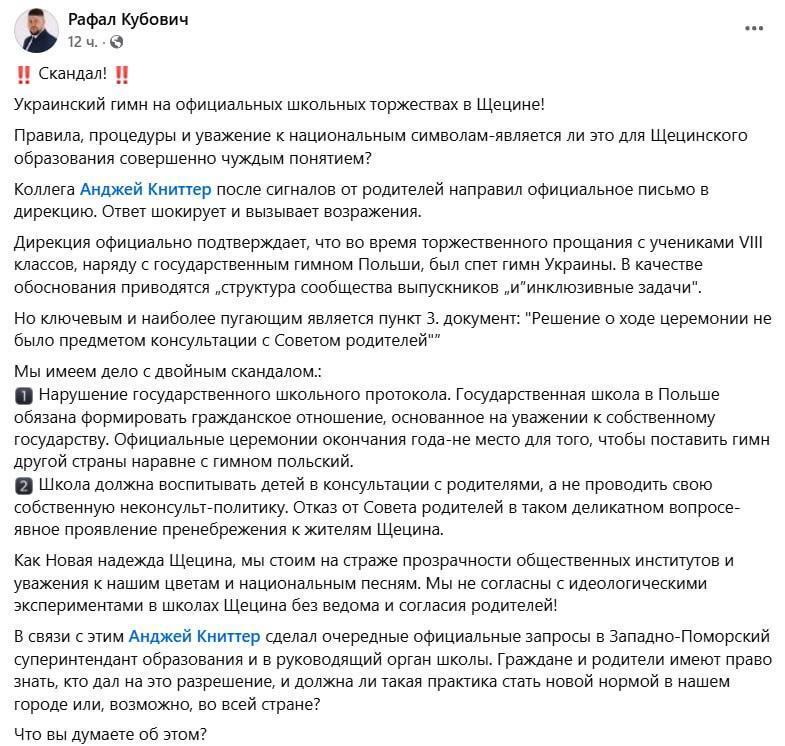
A screenshot from the Facebook page of Rafał Kubowicz, head of the Szczecin branch of the Eurosceptic New Hope party, circulated by pro-Russian propaganda Telegram channels
For comparison, it is worth noting that when the Ukrainian national anthem was performed on 1 September 2020 at School No. 47 in Szczecin, it generated a wave of support on social media. The school has been performing the Ukrainian anthem for more than ten years because it offers a Ukrainian-language education programme. Following Russia’s full-scale invasion, the number of Ukrainian children attending schools in Szczecin has likely increased, so the performance of the anthem itself should not be surprising, although public attitudes in Poland have changed since 2020.
Reactions to Jarosław Kaczyński’s letter
The publication of a letter from Jarosław Kaczyński, leader of the Polish opposition party Law and Justice (PiS), to his party colleagues prompted reactions across the pro-Russian segment of Telegram, including more than ten posts in the dataset analyzed.
Propagandists portrayed the politician’s remarks as the definitive formulation of Poland’s conditions and demands toward Ukraine. The central narrative presented in these posts was that “Ukraine has become an instrument of domestic politics in Poland” and that the Polish political elite had “united around an anti-Ukrainian agenda.”
Most channels simultaneously reproduced excerpts from Kaczyński’s letter as published by Polish media. The Strana.ua Telegram channel quoted him as saying: “Ukraine, with its cult of Bandera and other criminals, and its glorification of the UPA and OUN, will not join the European Union. If we win the elections, we certainly will not allow it.”
The RogandarNEWs channel (more than 124,000 subscribers) circulated similar quotations, adding an ironic comment about the alleged hypocrisy of Polish politicians: “How suddenly everyone has opened their eyes! So before this, there was supposedly no rabid Banderism in the ‘independent’ [Ukraine]? What hypocrites.” The implication was that Warsaw is now using the issue of Ukrainian nationalism as a convenient tool in its domestic political struggle against its opponents.
Telegram channels also promoted a Realpolitik-style explanation of the actions of Polish politicians. The anonymous channel MediaKiller2021 (more than 113,000 subscribers) claimed that historical grievances merely served as a distraction: “A Ukrainian victory in the war and the country’s subsequent integration into the EU are not in Poland’s interests. That is what the anti-Ukrainian hysteria is really about, while all the ‘historical grievances’ are nothing more than a convenient smokescreen.”
Other channels used Kaczyński’s letter to attack Volodymyr Zelenskyy personally. Marat Bashirov, a Russian political strategist and former representative of the Russian occupation administration in the Luhansk region, wrote on his Politjoystick Telegram channel (more than 250,000 subscribers) that the Ukrainian president was allegedly sabotaging European integration to preserve corrupt schemes and prolong the war: “It’s very simple: Zelenskyy does not want Ukraine to join the EU, which is why he is provoking Hungary, Poland, Slovakia, and others.”
Thus, reactions to Kaczyński’s letter were used to discredit the Ukrainian leadership while portraying Polish-Ukrainian relations as fragile and unstable.
The “March in memory of the victims of the Volyn massacre”
More than ten mentions across different Telegram channels included in the analyzed dataset (1, 2, 3, 4, 5, 6, 7, 8, 9, 10, 11, 12) concerned the march held in Warsaw on 4 July, or, as its organizers called it, the “March in Memory of the Victims of the Volyn Massacre.” The march was organized by the We Remember Volhynia Foundation (Fundacja Wołyń Pamiętamy), which is associated with the far-right Confederation coalition (Konfederacja Wolność i Niepodległość). The website of the Confederation of the Polish Crown party also announced another event in Warsaw on 12 July, titled the “Volhynia March.”
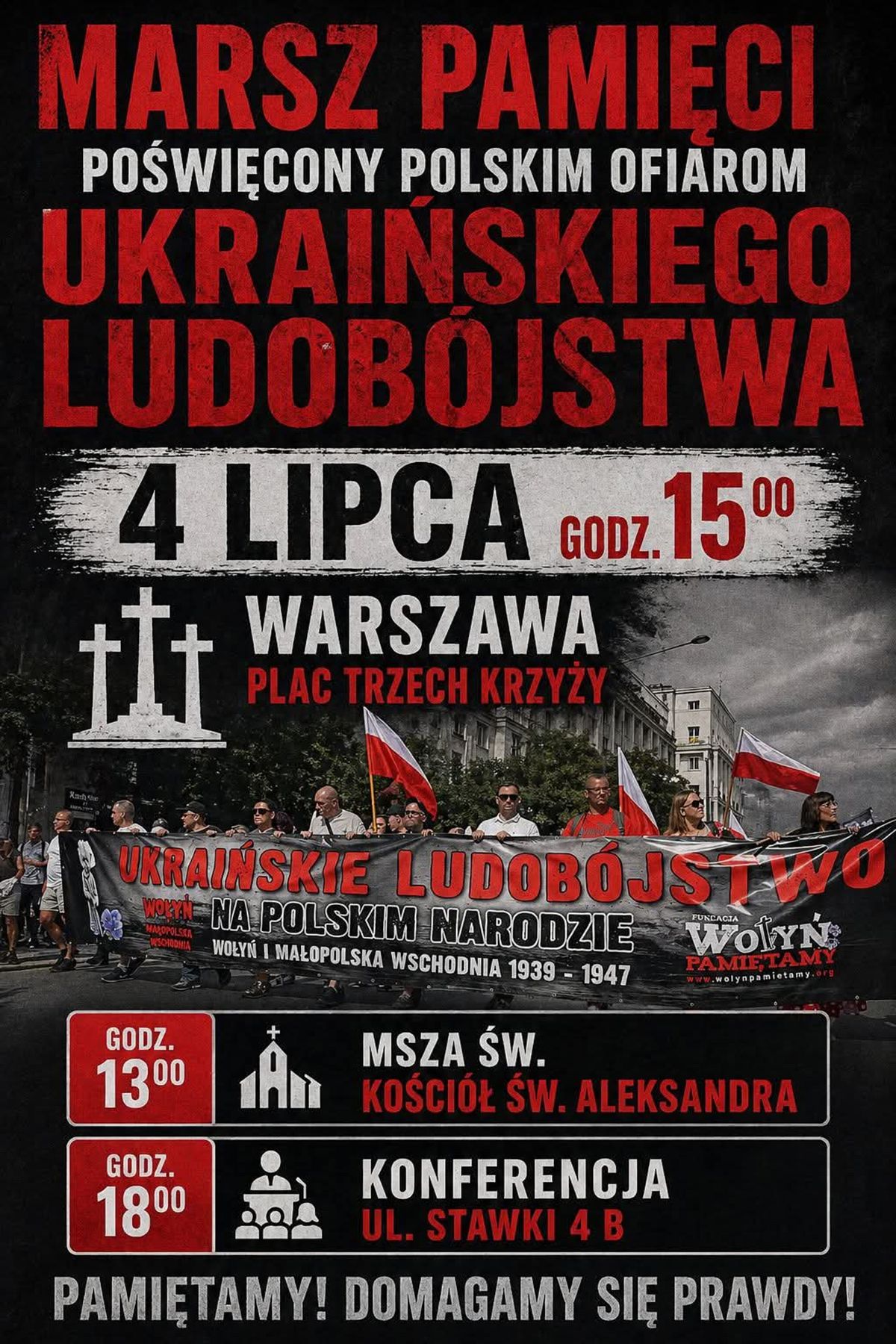
Poster inviting people to join the march in Warsaw on 4 July. Text: “The Ukrainian genocide of the Polish nation. We remember Volhynia.” Source
Russian and pro-Russian Telegram channels openly welcomed the 4 July march, as well as announcements that similar events would be held in other Polish cities, publishing photographs and videos from Warsaw. One example was the Telegram channel Signal (nearly 450,000 subscribers).
The channel Operation Z: War Correspondents of the Russian Spring (1.5 million subscribers) celebrated the fact that some participants wore T-shirts bearing the slogan: “A Banderite will never be my brother.” Dmitry Steshin, a propagandist and war correspondent for the Russian state newspaper Komsomolskaya Pravda, commented on the march—which drew several thousand participants—on his personal Telegram channel (more than 130,000 subscribers), advancing a conspiracy theory about possible Polish involvement in the war against Ukraine: “Poland senses that the time for dividing Ukraine is approaching. They have to act quickly. Hungary has already bargained with the Banderites for a kind of ethnic autonomy. The Pole’s Card has been distributed in the border region for a very long time. It will be interesting.”
In reality, Poland tightened the rules for obtaining the Pole’s Card in 2024 because of cases involving forged documents. Although some may regard the document—which has been issued since 2008—as an instrument of Polish “soft power,” Poland’s far-right politicians have, in fact, been critical of it, using it in anti-Ukrainian rhetoric. This has included parliamentary inquiries calling for Pole’s Cards to be revoked from students who were photographed with a UPA flag in 2016.
The issue of the Pole’s Card has also been used to incite hostility toward Ukrainian refugees since 2022. As TVN24 reported while debunking social media rumours, false claims circulated that Ukrainian refugees who arrived in Poland after February 2022 were automatically receiving this status en masse.
It is also likely that Russian journalists—or individuals cooperating with Russian media—interviewed participants in the march. At the very least, the Izvestia Telegram channel (nearly 135,000 subscribers) explicitly stated and published a video claiming to have received the following comment from one of the participants in Warsaw: “One of the demonstrators told Izvestia that he had come to honour the memory of Poles killed in Volhynia, Eastern Lesser Poland, and the Zamość region. The participant believes that Poland should not only strip Kyiv of awards, but also demand the return of the weapons and money that Warsaw has provided to Ukraine.”
This is a particularly convenient way for Russian media to exploit the emotional reactions of Polish participants to promote a narrative beneficial to Russia—that Ukraine should be deprived of Western military and financial assistance.