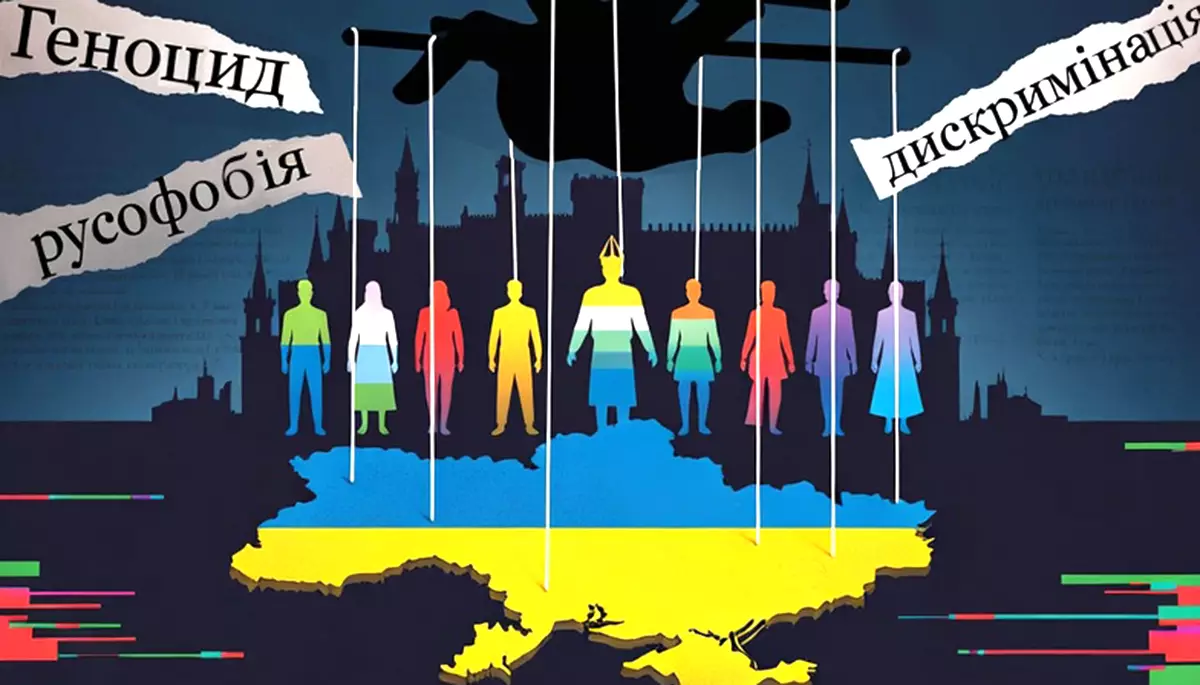




Українською читайте тут.
The Detector Media Research Center examined how Russian propaganda uses various minority groups for disinformation and to influence societies in Ukraine and other countries.
Key Findings
- Nearly every second disinformation message about minorities concerns the alleged "persecution of Russian speakers." Of the 306 entries in the EUvsDisinfo database containing the keyword "minorities" between 2016 and 2026, 166 (54%) directly concern claims of minority persecution. Of these 166 publications, 76 (46%) are devoted to the alleged "persecution of Russians and Russian speakers" in Ukraine and other European countries. This makes the theme of the "protection of Russian speakers" a central element of the propaganda repertoire in Russian state media.
- The same rhetorical template is applied to entirely different vulnerable groups. Regardless of whether the subject is Russians in the Baltic states, Muslims in Western Europe, or LGBT communities, propaganda reproduces a similar message structure: exaggerating threats or persecution, misusing human rights terminology, and assigning fixed roles of "aggressor," "victim," and "protector."
- The issue of minorities is systematically used to justify aggression against Ukraine. Narratives about the alleged "genocide" and "persecution" of Russian-speaking people in Ukraine have consistently featured among the main justifications for the full-scale invasion in 2022, as well as for the occupation of Crimea and parts of the Donetsk and Luhansk regions since 2014.
- Propaganda abuses terminology by blurring its meaning. Terms such as "discrimination," "genocide," "apartheid," "racism," and "Nazism" are applied to language legislation or other actions within the legal framework, equating them with crimes against humanity. This distorts public perception and makes it more difficult to debunk specific disinformation narratives.
- Fact-checking rebuttals often lack context, or that context is available only to Russian- and Ukrainian-speaking audiences. The analysis revealed a common weakness in fact-checking Russian disinformation: European fact-checkers frequently limit themselves to general statements in their rebuttals. This risks making fact-checking appear ideological and less convincing to audiences unfamiliar with the broader context.
- Neighboring countries’ demands regarding the rights of national minorities in Ukraine do not always reflect their own practices. In the cases of Hungary and Romania, both countries require Kyiv to uphold high standards for the Hungarian and Romanian minorities, respectively. At the same time, Hungary, for example, does not have a single school where Ukrainian is the language of instruction, while in Romania, there are Ukrainian studies programs at three universities, Ukrainian is taught as an elective in several dozen schools, and according to the 2021 census, at least 45,000 people identify as Ukrainian. By comparison, the Ukrainian minority in Hungary numbers nearly 25,000 people. According to various estimates, the Romanian minority in Ukraine numbers around 150,000 people, while the Hungarian minority numbers approximately 80,000.
- Ukraine carried out significant legislative work between 2022 and 2026 as part of its EU accession process to partially ease these tensions. The adoption of the Law "On National Minorities (Communities)," together with amendments introduced following the recommendations of the Venice Commission, as well as the agreement with Hungary signed on June 4, 2026, made it possible to open the first cluster of Ukraine's EU accession negotiations on June 15, 2026.
Introduction
When propaganda speaks about the "protection of minorities," it is worth asking: whom does it exclude in the process? Almost any community—ethnic, linguistic, religious, or sexual—may at some point find itself in the position of a group which, according to the UN definition, is "numerically smaller than the rest of the population of a State, in a non-dominant position, and possessing ethnic, religious or linguistic characteristics differing from those of the rest of the population." This definition is important because it links minority status not only to relative population size but also to power relations: a minority is the side whose voice carries less weight. According to the UN definitions based on the 1992 Declaration on the Rights of Persons Belonging to National or Ethnic, Religious and Linguistic Minorities, minorities are divided into four main groups: national, ethnic, religious, and linguistic.
We understand discrimination as it is defined in the fundamental UN human rights instruments, such as the International Convention on the Elimination of All Forms of Racial Discrimination, which Ukraine has also ratified: "Any distinction, exclusion, restriction, or preference" that has the purpose or effect of depriving a person of equal access to rights and freedoms in the political, economic, social, or cultural spheres. By contrast, the "persecution" most frequently referred to by propaganda is a vague, undefined concept and has no legal meaning.
Why does propaganda consistently rely on the issue of minorities and their alleged persecution? The easiest way to provoke an emotional response is to constantly reinforce the division between "us" and "them." Propaganda does not invent this mechanism of emotional reaction; rather, it seeks to amplify real or imagined threats posed by the "other" group in order to consolidate the "in-group" around a common enemy. Within this logic, minorities are particularly convenient because they are visible, distinct from the "majority," and can easily be transformed either into a symbol of "threat" or, conversely, into a pretext for "protection" that in reality conceals entirely different political objectives.
The analysis of 306 cases from the EUvsDisinfo database on which this study is based demonstrates that the structure of propaganda messages about different minorities is reproducible and repetitive, regardless of whether they concern Russians and Russian speakers in Ukraine or the Baltic states, Muslims in Western Europe, or LGBT communities. This is true even though the actual needs, challenges, and causes of discrimination affecting different groups in different societies may vary significantly.
We sought to determine whether, despite the differing real needs of various minorities, propaganda applies a similar set of rhetorical techniques to all of them. These include manipulating or criticizing the concept of human rights and exaggerating or downplaying threats facing more vulnerable groups. Russian state media, whose disinformation content forms the basis of the EUvsDisinfo database, use the issue of minorities to justify the aggressive policies of Russia's political leadership. The same rhetorical techniques that the Kremlin applies to "Russian speakers" in Ukraine and the Baltic states are reproduced in disinformation narratives about migrants, Muslims, and LGBT communities in Germany, France, and Moldova. Understanding these recurring patterns provides journalists, policymakers, and other stakeholders with a framework for recognizing new waves of disinformation before they escalate.
Methodology
The subject of this study is publications in the EUvsDisinfo database of disinformation cases (a project of the European External Action Service that identifies and debunks disinformation originating from Kremlin media) that contain references to minorities in both the Summary section of the disinformation case and its debunking (Response section). A retrospective analysis of cases published between 2016 and June 2026 was conducted to identify:
- the main themes and methods employed by Russian propaganda;
- changes over time in propaganda rhetoric concerning minorities;
- common approaches used by fact-checkers when debunking disinformation about minorities.
Some examples of disinformation concerning minorities are also described by the analysts based on cases from Detector Media's DisinfoChronicles monitoring project.
Between March 2016 and June 4, 2026, the EUvsDisinfo database contained 306 debunks that included references to minorities in both the disinformation claims and the corresponding fact-checks. Of these 306 cases, 166 concerned allegations of the persecution of minorities, representing 54% of the analyzed EUvsDisinfo publications. In the remaining cases, minorities were mentioned only within the arguments used to refute the disinformation.
The EUvsDisinfo database includes debunks of false claims originating from most countries around the world. Within the dataset analyzed for this study, allegations concerning the persecution of minorities referred to only 42 countries or territorial entities.
Key countries and regions in which the persecution of minorities was mentioned in EUvsDisinfo materials from March 2016 to June 4, 2026
When working with the data, we focused on the “Summary” and “Response” sections. Based on the main points of the disinformation messages, we determined whether the message concerned the oppression of minorities, what types of oppression were involved and which minorities were affected, who was perpetrating the oppression, where it was taking place, and by what means. The initial data annotation was performed using the large language model Gemma 4, which has 26 billion parameters. Next, analysts at the Detector Media Research Center processed the reports from EUvsDisinfo, verifying and refining the results produced by the large language model.
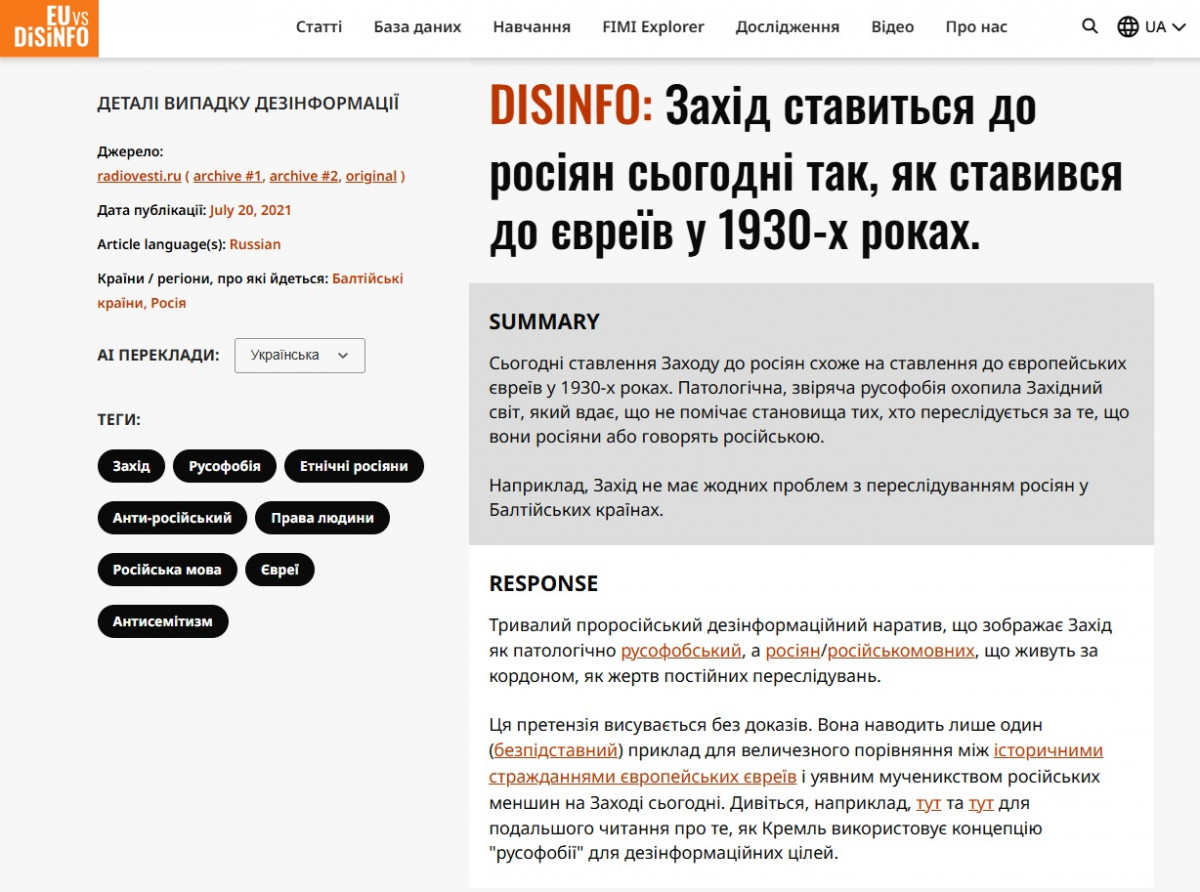
Example of a disinformation case description in the EUvsDisinfo database
A limitation of this analysis is that some of the primary sources and original disinformation posts from Russian sources and media are no longer available. Others have been preserved only as screenshots and archived links in the EUvsDisinfo database. This makes it difficult to reconstruct the full scope of the disinformation narratives. However, the available materials provide a snapshot of the disinformation narratives and insight into the time when fact-checkers documented them. The available data also illustrates the typical methods used to refute and debunk disinformation about minorities. This allows us to assess the priority of the topic of minorities among other topics manipulated by Russian propaganda, as well as to track the recurrence of these narratives over time and attempts to adapt them to audiences in different countries.
How does propaganda instrumentalize minorities? An analysis of fact-checkers' debunks
Among the cases in which the debunked disinformation claims concern the persecution of minorities, the most frequently mentioned groups are ethnic, linguistic, and religious minorities. Each case involving minorities in the EUvsDisinfo database contains a combination of different narratives concerning the alleged persecution of various minority groups. Of the 166 cases containing disinformation claims about the persecution of minorities, 76 concern the alleged "persecution of Russians and Russian speakers" in Ukraine and other European countries.
Since 2016, the issue of the alleged persecution of Russian speakers has been used to support Russia's claims to preserving the status quo within the territories of the former Soviet Union and the countries of the former Eastern Bloc. Russian propaganda and the Russian authorities presented the alleged persecution of Russian speakers as one of the justifications for the full-scale invasion of Ukraine in February 2022, claiming that the alleged "genocide could no longer be stopped by any other means."
Within propaganda narratives, states, supranational organizations, and non-state actors are assigned relatively fixed roles in simplified stories featuring "good" and "bad" characters. These narratives also include victims whom some actors allegedly seek to protect while others supposedly seek to harm. In Russian propaganda, Ukraine consistently appears both as an aggressor and as a victim of those to whom Russian propaganda attributes malicious intentions. According to the EUvsDisinfo database, one of the central narratives of Russian propaganda has been the claim that, following the Revolution of Dignity in 2013–2014, "neo-Nazis" and "Russophobes" came to power in Ukraine. It was precisely the alleged need to oppose them and to "protect bearers of Russian culture" that Russia repeatedly used to justify the occupation of Crimea and parts of Ukraine's Donetsk and Luhansk regions. Since 2019, legislative changes concerning the use of the Ukrainian language in the public sphere and the media have become another major target of Russian propaganda about Ukraine.
The post-Soviet states that joined the European Union—Lithuania, Latvia, and Estonia—are likewise assigned the role of "aggressors" in pro-Kremlin narratives about the alleged "persecution of representatives of the Russian language and culture." In these countries, Russian propaganda broadens the notion of representatives of Russian culture to include ethnic Ukrainians, Belarusians, and other residents of the former Soviet Union.
For the Baltic states, during the Soviet era the Russian language was the language of the Soviet state that deprived them of their independence. The restoration of Latvian, Lithuanian, and Estonian to the public sphere is therefore an act of overcoming the legacy of occupation and protecting those national cultures from the expansion of Russian influence. It is not, as Russian propaganda seeks to portray it, a form of discrimination, prohibition, or even the exclusion of Russian speakers from participation in local politics. In its most extreme manifestations, the disinformation cases documented in the EUvsDisinfo database equate the alleged "persecution of Russian speakers" in the Baltic states with xenophobia, racism, genocide, and apartheid.
Key minority groups whose oppression was mentioned in EUvsDisinfo articles from March 2016 to June 4, 2026
The instrumentalization of the protection of Russian culture, language, and religious communities to preserve the status quo that existed during the Soviet era, as well as the manipulation of the theme of “oppression of the Russian-speaking minority,” are also present in publications concerning Kazakhstan and other Central Asian states. There, propagandists also portray legislative changes aimed at promoting, for example, the Kazakh language as “harmful” to Russian. For Russian propaganda, the main “beneficiaries” of such “oppression of Russian speakers” in the post-Soviet space are the liberal democracies of Europe and America, which propagandists collectively refer to as “the West.” And “Western-funded non-governmental organizations (NGOs)” are sometimes cited as the instruments of oppression and the agents hindering, for example, concerts by Russian performers.
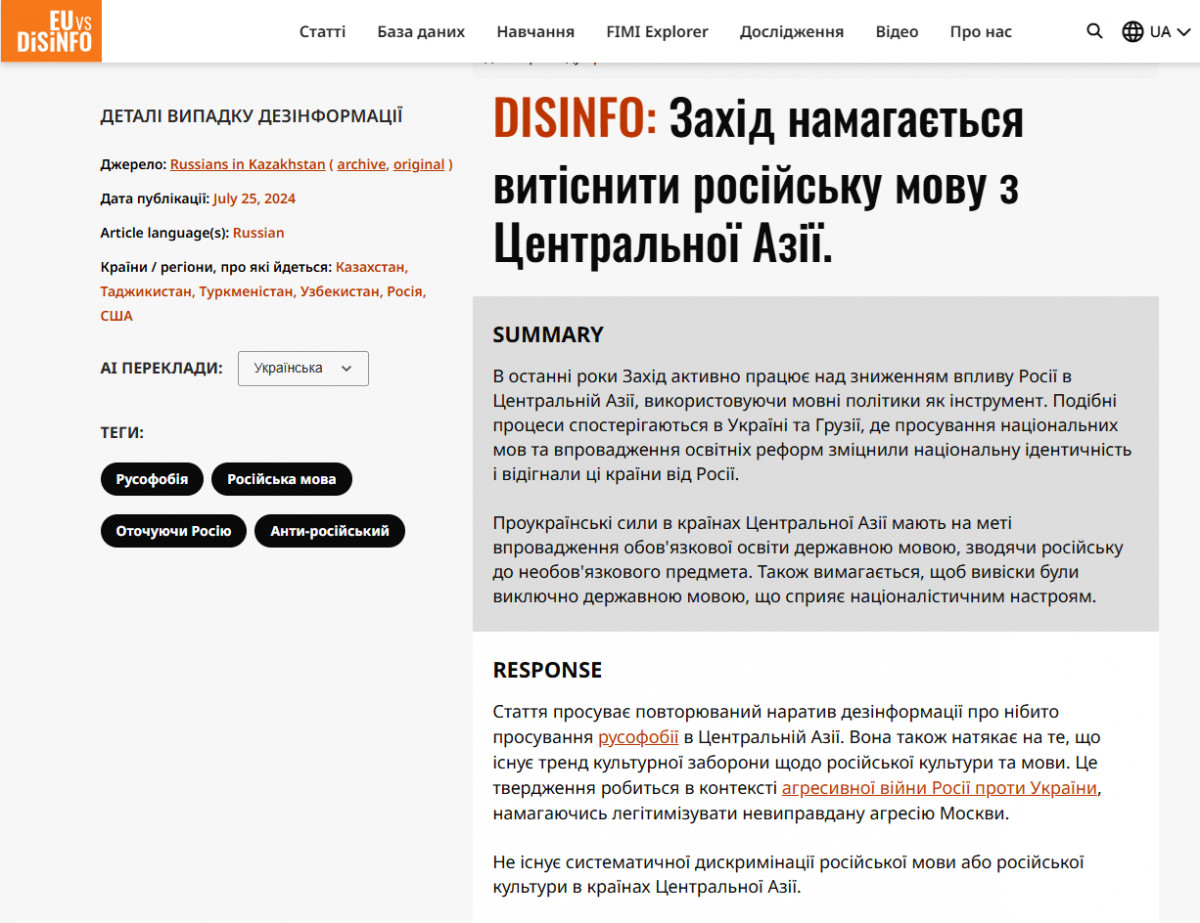
Example of a disinformation case description in the EUvsDisinfo database
When they need to focus their messages, propagandists single out specific countries from the broad concept of “the West”: the United States, the United Kingdom, or the EU. Or they single out individuals or organizations, such as environmental activist Greta Thunberg, businessman George Soros, or the International Renaissance Foundation. However, the main “enemies” in disinformation narratives about the oppression of national minorities—and, above all, Russian-speaking minorities—are still states, not intergovernmental bodies or international organizations.
Key actors allegedly oppressing minorities (based on posts on EUvsDisinfo from March 2016 to June 4, 2026)
Western countries, liberal democracies, and interstate and international organizations originating from liberal democracies also serve as "antagonists" in disinformation narratives about restrictions on religious freedom. These organizations are portrayed as destroying "traditional values" through their support for sexual minorities. In some cases, the antagonists are the conspiracy theory tropes of "global" or "ruling elites," a "world government," and similar actors.
Propagandists contrast respect for individual rights and the state's non-interference in private life with what they describe as the "traditional order." Within this conservative worldview, religious identities and gender roles are expected to remain immutable.
Disinformation actors systematically criticize liberal democracies by attacking the very concept of "respect for minority rights." According to propagandists, the West supports or promotes something "criminal," "perverse," "immoral," "degenerate," or "unnatural." This, in turn, creates space for propaganda to portray the political systems of liberal democracies as absurd and to depict Western countries as being "captured" by representatives of sexual or other minorities. Consequently, support for the development of democratic institutions, the rule of law, human rights, and related values is framed as "spending millions of dollars to destroy traditional values." Against this backdrop, the leaders of authoritarian, non-democratic regimes, such as Vladimir Putin, are presented as "defenders of traditional values" against "perverts and Satanists."
Russian propagandists also manipulate issues of discrimination against national and religious minorities for audiences in Western European countries. They do so both to discredit other states and to incite interreligious and interethnic hostility within European societies. The religious minority most frequently mentioned in Europe is Muslims, who are portrayed in disinformation narratives as a "threat to Christianity."
To make disinformation appear more credible and better substantiated, propagandists abuse terminology commonly used by lawyers, human rights advocates, and scholars, including discrimination, repression, persecution, genocide, occupation, racism, and antisemitism. They also invent analogous terms, such as Russophobia, and use them alongside academically and legally established concepts to supposedly "prove" that Russians are being oppressed by other states, interstate organizations, or corporations. Examples include conspiracy theories claiming that "Western elites are behind the genocide of Christians" in Europe, or the use of phrases such as "Islam is enslaving Europe," "genocide of Christians," and "Islamization of Europe." At the same time, Kremlin narratives frequently perform complete reversals whenever politically expedient, abruptly shifting from demonizing Muslims to presenting themselves as "defenders of Islam" or advocates of "freedom of expression" following incidents such as the public burnings of the Quran by far-right activists in Sweden and Denmark in 2023.
Other examples of this abuse of terminology include comparing the alleged persecution of Russians to genocide or to the persecution of Jews (antisemitism), as well as using terms such as discrimination and dictatorship to describe lawful actions taken by legislators or responses by citizens of countries once subjugated by Russia to Russian aggression. Another example is the unfounded branding of opponents of the Russian regime as "Nazis," "neo-Nazis," "antisemites," and similar labels.
Key “methods of oppressing minorities” based on disinformation narratives in EUvsDisinfo reports from March 2016 to June 4, 2026
One specific example of Russia’s abuse of international instruments for the protection of minority rights is the involvement of pro-Russian public figures in meetings of United Nations bodies so that they can repeat Russian propaganda claims “in their own words.” Such public figures useful to propaganda have included, at various times, for example, British musician Roger Waters and Tetyana Montyan, a former Ukrainian human rights activist who is now a Russian citizen and collaborator. Their appearances lend credibility and visibility to Russian disinformation and facilitate its dissemination to international audiences.
Common characteristics and shortcomings of fact-checking approaches to debunking disinformation about minorities
The fact-checking entries analyzed in the EUvsDisinfo database share a common weakness: they often lack the context that would enable audiences not only to understand the details of a particular case but also to follow the broader development of a given narrative. Entries that debunk a specific piece of disinformation—for example, a fabricated photograph, a manipulated video, or a statement made by a Russian television host—frequently omit contextual information that is accessible only to those who, for instance, understand Russian. As Kari Suomalainen, Nooa Nykänen, Hannele Seeck, Juna Kim, and Ella McPherson note in their article Fact-checking in journalism: an epistemological framework, even broader fact-checking publications in the form of journalistic articles or news reports cannot avoid a degree of subjectivity. This is because fact-checkers assess propagandists' claims that cannot be evaluated as objective "facts," while simultaneously relying on an understanding of truth as something constructed through discourse. They also face the practical impossibility—or at least the extreme difficulty—of changing audiences' deeply held beliefs.
Another factor that may contribute to the omission of context in fact-checking publications is, of course, the repetitive and "monotonous" nature of disinformation narratives. Authors of fact-checking materials may assume that the contextual background necessary for debunking has already become familiar to their audience. This creates the additional risk that fact-checking materials themselves may become ideological in tone or begin to resemble political talking points. In such cases, a disinformation claim is "lazily" refuted through broad, generalized statements that fail to account for the specific characteristics of the individual case or the complexity of the underlying realities. The following example illustrates such a partially ideological rebuttal, published in March 2026, concerning the liberal nature of Ukraine's political system in response to claims portraying Ukraine as a country characterized by "terror," "Russophobia," and the "persecution of Christians":
"Ukraine is a democratic country with transparent parliamentary and presidential elections, a functioning multiparty political system, and legal protection for ethnic minorities. Ukraine is a country characterized by national and cultural diversity, where ethnic minorities are not persecuted and where their cultural development is guaranteed by Articles 10 and 11 of the Constitution."
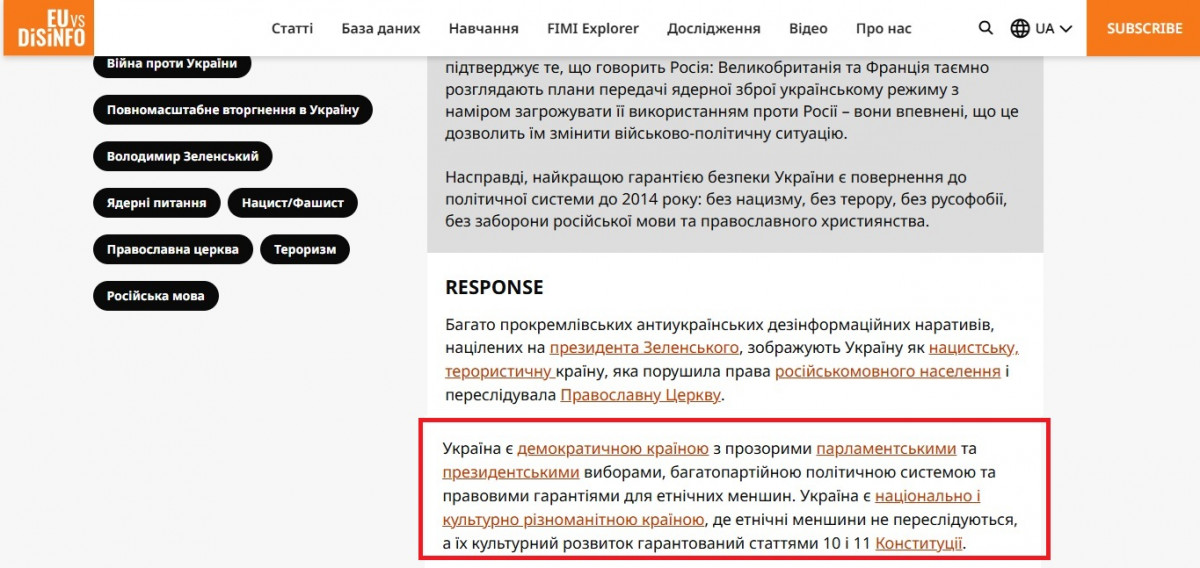
Example of a disinformation case description in the EUvsDisinfo database
The links in this paragraph, highlighted in the screenshot from the rebuttal, lead directly to the homepages of the Verkhovna Rada and the Office of the President of Ukraine, while the reference to “national and cultural diversity” links to the Ukrainian-language page of the State Service for Ethnic Policy and Freedom of Conscience (DESC). The original rebuttal was written in English, and even if a reader were to check these links, they would provide no added value or additional context, neither regarding the state of democratic institutions nor regarding real-world examples of cultural diversity.
Such and similar formulations hide behind statements about the existence of legislation, the nuance that the mere existence of a law does not guarantee its strict enforcement. Nor do they take into account the historical and political realities of recognizing and protecting minorities.
A comparative case study of the protection of national minority rights in Hungary and Romania
The most heated criticisms of Ukraine regarding national minority rights have centered on language legislation. Ukraine’s language and education policies were updated primarily to limit the use of the “aggressor’s language” (Russian), but the legislative changes affected all national minorities without exception: Hungarians in Transcarpathia, Romanians in Bukovina, Slovaks, and Bulgarians. This unintended consequence turned a technical issue into simmering conflicts with neighbors and a lever of pressure in the European integration process.
To understand the nature of these grievances and the progress made in resolving them, one must first examine what standards for the protection of national minorities exist in Ukraine’s neighboring countries and whether they mirror those applicable to Ukrainian communities abroad.
Hungary
Hungary is one of the most active advocates for the rights of its compatriots abroad and, at the same time, a country where formally high standards of minority protection within the country remain controversial in practice. The 2011 Constitution, which took effect following the 2014 elections, established the office of an ombudsman for each national minority. This effectively means that each community has a member of parliament without the right to vote, but with the authority to speak and raise questions. Furthermore, Hungary has signed but not ratified the European Charter for Regional or Minority Languages, so there are fewer legally binding standards in this area than in some neighboring countries. Regarding the Ukrainian minority in Hungary itself, Budapest has officially recognized Ukrainian as the language of a national minority, yet there are no elementary or secondary schools in Hungary where instruction is conducted in Ukrainian. Hungarian authorities attribute this to a lack of demand from the community. On the one hand, this can be justified by the small size of the diaspora. According to the 2022 census, nearly 25,000 people identified as part of the Ukrainian national minority in Hungary. On the other hand, there is a problem with the lack of institutional support from Kyiv, which is insufficient to meet the educational needs of Ukrainians in Hungary.
Hungary has formulated 11 demands regarding the protection of the Hungarian minority in Transcarpathia, which include: the restoration of the status of “national minority schools” with instruction in Hungarian; the right to choose the language of instruction in higher and vocational education; the translation of the National Multidisciplinary Test into Hungarian (except for tests in Ukrainian and foreign languages); the abolition of the 10% threshold for the application of language rights for “traditionally residing” minorities, the free use of Hungarian in elections, and—the most sensitive point—the demand for representation in the Verkhovna Rada through a separate electoral district or a proportional quota.
For 17 months, from November 2023 to June 2026, Hungary blocked the negotiation clusters on Ukraine’s EU accession, citing non-compliance with these requirements. On June 4, 2026, the new Prime Minister, Péter Magyar, announced a full agreement: Hungary lifted its veto after Kyiv agreed to amend the action plan and legislation on secondary education. The fundamental difference between Orbán and Magyar lay in their approach. Specifically, Viktor Orbán’s previous government insisted on a separate bilateral agreement that would enshrine the rights of Hungarians outside the framework of Ukrainian law. Magyar, on the other hand, agreed that the rights of the Hungarian minority would be implemented within the framework of existing Ukrainian legislation and the approved action plan, which are fundamentally different formats.
Romania
Romania is a state with a system of positive discrimination for national minorities in parliamentary representation: even if a minority party fails to pass the 5% electoral threshold, it is still entitled to one guaranteed seat in the lower house of Parliament. This quota applies, for example, to the Union of Ukrainians of Romania (UUR), founded in 1989. However, in practice, the situation is ambiguous. In 63 schools located in the counties with compact Ukrainian populations—Maramureș, Suceava, Dobruja, and Banat—the Ukrainian language is taught primarily as an elective subject and only upon request, while there is not a single full-fledged educational institution where Ukrainian is the language of instruction. At the same time, Romania insists that Bucharest provides its community in Ukraine with "the highest standards" and demands reciprocity from Kyiv, citing its own example as a model.
Romania expressed its dissatisfaction much more cautiously than Hungary, although no less systematically. Even before the Ukrainian law on national minorities was voted on in December 2022, the Romanian Ministry of Foreign Affairs stated that it had unsuccessfully sought consultations with the Ukrainian side. Immediately after the law was adopted, Bucharest called for the document to be revised, while President Klaus Iohannis, in a conversation with President Zelenskyy, insisted on finding solutions "similar to those provided for the Ukrainian community in Romania." Together with Hungary, Romania appealed to the Venice Commission regarding Ukraine's Law "On National Minorities (Communities)," the adoption of which was among the European Commission's recommendations for granting Ukraine candidate status. Bucharest's main substantive concerns related to the vague regulation of language use in official documentation and the requirement for mandatory simultaneous interpretation from minority languages during public events organized by civic associations.
The consultation process: where it took place and where it did not
Between 2022 and 2026, Ukraine carried out substantial work in the field of protecting the rights of national minorities, which can be structured into several key areas. In December 2022, the Verkhovna Rada adopted a new Law "On National Minorities (Communities) of Ukraine," replacing the outdated 1992 legislation. This was one of the seven conditions set by the European Union for launching accession negotiations. In September 2023, amendments to the law were adopted in line with part of the Venice Commission's recommendations: the definition of national minorities was broadened to be more inclusive, the use of minority languages in advertising and at public events was permitted, and the criteria for areas of compact residence were clarified. In December 2023, the alternative draft law No. 10288-1 entered into force, incorporating the assessments of the Council of Europe and granting private higher education institutions the right to choose the language of instruction from among the official languages of the European Union. Nevertheless, even after these amendments, the Law on National Minorities continued to generate disputes in Ukraine's relations with its neighboring states.
In its opinion of 12 June 2023, the Venice Commission generally welcomed the adoption of the first version of the Law on National Minorities. It noted that the law provided national minorities with a number of guarantees in line with international standards. However, to achieve "full compliance," the Commission recommended revising "a number of provisions," particularly those concerning the use of minority languages. In its opinion, the Venice Commission went beyond the scope of the law itself and also issued recommendations regarding Ukraine's laws on media and education. These recommendations prompted criticism of the Commission's opinion, including from opposition Member of Parliament Volodymyr Viatrovych of the European Solidarity party, the former head of the Ukrainian Institute of National Memory. He described the opinion as "openly biased" and argued that the recommendation to remove parallel signage in Ukrainian was not a measure to protect minorities but rather "discrimination against Ukrainians in their own state."
After the amendments entered into force in September and December 2023, the Venice Commission updated its opinion. It once again noted the "numerous improvements" and concluded that "a number of key recommendations had not been fully implemented," while expressing hope for further improvements.
The 2023 Law "On Education" effectively restored the situation that had existed before 2017 by explicitly guaranteeing the right to receive education in the languages of national minorities that are official languages of the European Union, as well as the right to use these languages alongside the state language. After private higher education institutions (HEIs) were granted the possibility to provide instruction in Hungarian, applicants were also given the opportunity to take the National Multi-Subject Test (NMT) for admission to HEIs in Hungarian, except for the Ukrainian language and foreign language examinations.
In 2024, following an open competition, the Council of Public Associations of National Minorities of Ukraine was established. In May 2025, the Department for Civil Society Affairs also created the Sector for the Promotion of Interethnic Harmony. Subsequently, bilateral consultations with several of Ukraine's neighboring states moved to a new working level. In particular, Ukraine and Bulgaria strengthened their partnership in the fields of education and science following the signing of a protocol on educational cooperation between the ministries of the two countries.
Following the change of government in Hungary and several rounds of technical negotiations, on 4 June 2026, the newly appointed Prime Minister Péter Magyar announced that a comprehensive agreement had been reached. The parties agreed, among other things, to allow students to communicate in Hungarian during school breaks, to provide educational documents in the minority language upon parents' request, and to translate the National Multi-Subject Test (NMT) into Hungarian, except for the Ukrainian language and foreign language tests. They also agreed to allow the use of Hungarian in election campaigning and on ballots in areas of compact minority residence. The demand for a separate electoral district in the Verkhovna Rada has not yet been discussed in Parliament. Hungary subsequently lifted its veto on all six EU accession negotiation clusters, and on 15 June 2026, in Luxembourg, the European Union member states officially opened the first negotiation cluster for Ukraine.
Do Ukraine's neighbors provide the Ukrainian minority with the rights they demand from Ukraine?
The question of whether Ukraine's neighbors uphold the same standards for their Ukrainian communities that they demand from Kyiv is central to understanding the asymmetry between their expectations of Ukraine and their own domestic practices. This can be illustrated through the example of the Ukrainian minority's right to education.
The Hungarian authorities explain the absence of schools with Ukrainian as the language of instruction by pointing to a lack of demand from the Ukrainian community. At the same time, Budapest finances Hungarian-language schools in Zakarpattia through its "motherland" support programs and expects Kyiv to provide a comparable level of institutional support.
According to the 2021 census, up to 45,000 people in Romania identify as Ukrainians, while a significantly larger number of Romanian citizens are of Ukrainian descent. The Union of Ukrainians of Romania holds a guaranteed seat in Parliament and publishes four newspapers and up to 40 books annually. Ukrainian language studies are offered at three university departments, where between 10 and 15 students enroll each year. In May 2026, during the visit of a Ukrainian delegation to Romania, and at the initiative of the First Ladies of Ukraine and Romania, Olena Zelenska and Mirabela Grădinaru, the universities of Bucharest, Cluj, and Suceava signed memoranda on joining the Global Coalition of Ukrainian Studies. In 2023, however, Bucharest called on Kyiv to ensure "the highest standards of minority protection"—that is, standards exceeding those it provides itself.
The examples of Romania and Hungary demonstrate that many of the needs of their respective national minorities in Ukraine can only be met through financial support and diplomatic assistance from their respective kin-states. This makes the protection of minority rights dependent on the institutional and economic capacity of those states. Potentially, this creates the risk of unequal implementation of the rights of Ukraine's Indigenous peoples, who do not have another state capable of supporting them in the same way. This should serve as an incentive for Ukraine to strengthen its diplomatic, economic, and institutional capacity to ensure equal protection of minority rights while also taking a more active role in advancing the rights of Ukrainians living abroad.
Conclusions
The comparability and recurring structure of propaganda messages, regardless of which minority they target, is the main observation emerging from the analysis of the EUvsDisinfo database. As a rule, disinformation actors amplify and reinterpret existing news events rather than inventing them. The instrumentalization of minorities and their use as vehicles for spreading disinformation is a method that the Kremlin deliberately applies across different countries. It adapts the narrative to the local context by focusing on the minority group that is most likely to resonate with a particular audience—for example, the alleged "persecution of Russian speakers" in the Baltic states or discrimination against Muslims in Western Europe. The recurring justification of Russian aggression under the pretext of "protecting the Russian-speaking minority" constitutes a continuous narrative linking propaganda surrounding the occupation of Crimea and parts of Donbas in 2014, the full-scale invasion of Ukraine in 2022, and the ongoing discourse about alleged "Russophobia" in Western countries. This undermines the argument that the language or cultural policies of post-Soviet states are the "cause" of Russia's aggressive rhetoric and actions. Instead, narratives about alleged discrimination serve as a pretext superimposed on a political decision to pursue aggression that has already been made. In this context, xenophobia functions both as a tool of aggression and as a means of preserving the status quo.
The abuse and manipulative use of legal terminology referring to international crimes constitute a separate dimension of propaganda techniques employed by the Russian state media and propagandists. When terms such as "genocide," "apartheid," or "discrimination" are used indiscriminately and in relation to virtually any news event, they undermine the credibility of the language of human rights itself. This makes it more difficult for the broader public to recognize and respond to genuinely critical situations and complicates the work of civil society organizations, human rights advocates, and international institutions.
The issue of fact-checking disinformation concerning minorities also deserves particular attention. If the structure of these narratives is largely repetitive and differs little across target groups—whether Russian speakers, Muslims, or LGBTQ+ communities—it raises the question of how effective fact-checking efforts based on the same broad human rights rhetoric can be, especially when the specific context of an individual case is lost. The findings of this study do not provide a simple answer as to which method is most effective in countering this type of propaganda. Rather, they point toward a broader direction: fact-checking efforts that expose logical fallacies in manipulative arguments—since propagandists rely more on emotional judgments than on factual evidence—or that explain the specific historical and political context to audiences unfamiliar with Russian or Ukrainian are likely to have greater long-term effectiveness.
Recommendations
- For Government Institutions and Diplomatic Missions
Strengthen institutional and diplomatic support for Ukrainian communities abroad. Ukrainian state institutions should systematically document and publicly communicate the state of protection of the rights of Ukrainian minorities in neighboring countries. This would help maintain a diplomatic balance in discussions with neighboring states and reduce the sensitivity of this issue in the context of Ukraine's European integration process. Testimonies from members of the Ukrainian diaspora and refugees also serve as a practical counterweight to the stereotypical image of Ukrainian refugees in the European Union promoted by Russian propaganda.
- For Fact-Checking Organizations and Journalists
Provide a broader context when a disinformation claim forms part of a recurring narrative rather than treating it as an isolated case. Fact-checks that rely solely on references to legislation or official government websites, without illustrating how legal provisions are implemented in practice, do little to improve understanding of the Ukrainian context, particularly for international audiences.
Ensure the accurate use of human rights terminology. Striking a balance between avoiding unnecessary amplification of propaganda narratives and producing repetitive debunks with little added value remains challenging. Propaganda slogans are often memorable, whereas fact-checks quickly fade from public attention, if they attract it at all. Nevertheless, it is essential to identify precisely which human rights term is being misused and explain the difference. When propaganda equates, for example, language legislation with "genocide" or "apartheid," fact-checkers should explicitly refer to the legal definitions of these terms and explain why the specific case does not meet those criteria, rather than simply stating that the claim is "false."