



Українською читайте тут.
Behind every Russian missile strike comes a wave of manipulation and lies spread by Russian officials and propagandists.
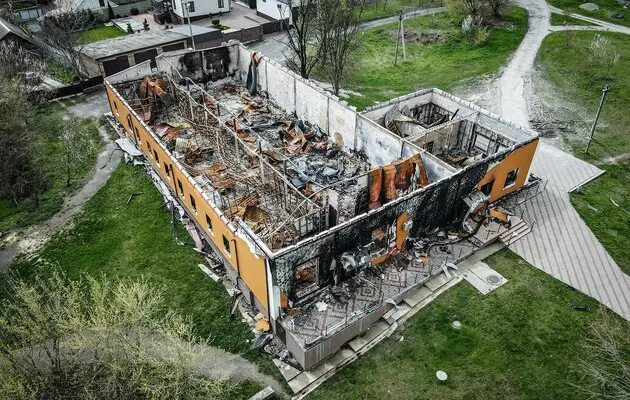
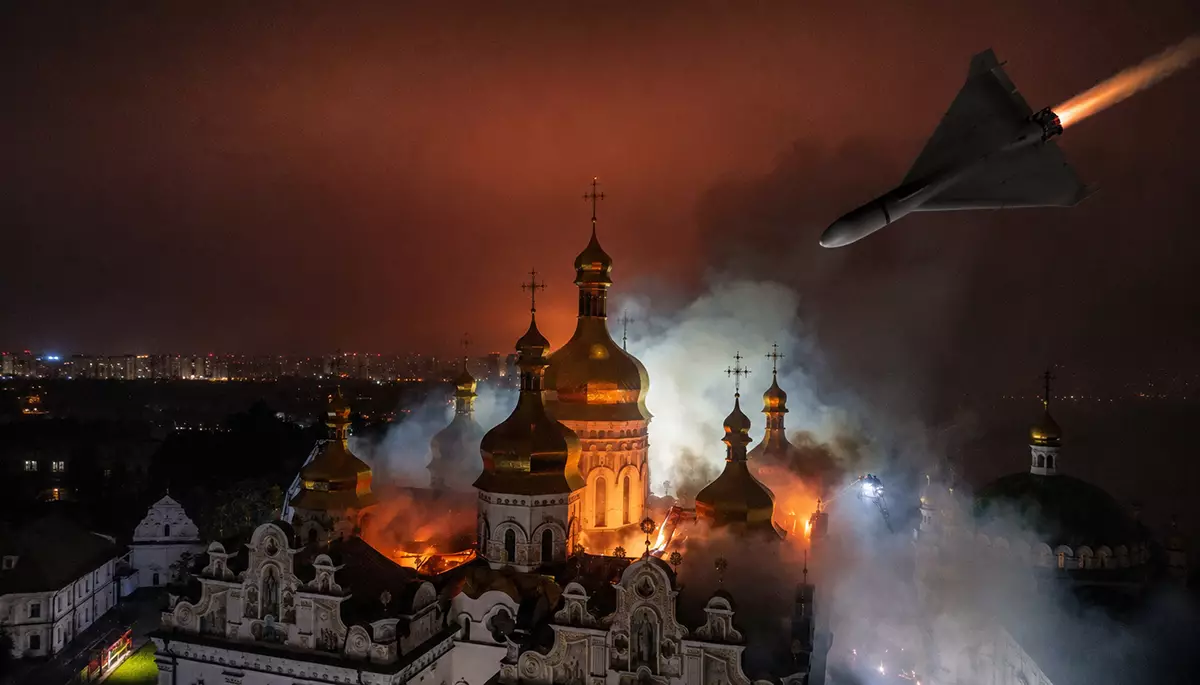
On the night of June 15, 2026, Russia launched one of the largest attacks against Ukraine since the beginning of the full-scale war: 70 missiles and more than 700 drones struck targets across the country. Among the sites hit were the Kyiv Pechersk Lavra, a UNESCO World Heritage Site, and Mystetskyi Arsenal, an architectural monument of national significance.
But that night was not an exception—it was yet another link in the systematic campaign to destroy cultural heritage that Russia has been waging since the first days of its full-scale invasion in February 2022. As of May 2026, UNESCO had verified damage to 536 cultural sites across Ukraine—from the wooden churches of Polissia to examples of Kharkiv constructivist architecture, from 16th-century monasteries in the Donetsk region to 19th-century UNESCO-protected buildings in Odesa. Such destruction is directed not only against Ukraine—it destroys heritage that belongs to all humanity.
Detector Media examines the systematic nature of Russia’s attacks, the response (and silence) of international institutions, as well as the propaganda machine that seeks to justify every new strike.
The Attack on the Kyiv Pechersk Lavra
As a result of the shelling on the night of June 15, numerous civilian and residential buildings, as well as cultural heritage sites in Kyiv, Kharkiv, Dnipro, and other cities, sustained damage. Among them, the Oleksandr Dovzhenko National Film Studio was damaged, with its oldest and largest costume collection destroyed; a Russian drone strike caused a fire at Mystetskyi Arsenal, where flames engulfed more than 1,000 square meters of the premises; a large fire broke out at the Academy of Modern Education secondary school; Nova Poshta’s largest innovative sorting terminal was destroyed; the House of Organ and Chamber Music in Dnipro was damaged; and the Kharkiv Art Museum, along with numerous civilian facilities, came under attack.

Kyiv Pechersk Lavra. Photo: General Staff of the Armed Forces of Ukraine, Facebook
A separate crime was the attack on the Kyiv Pechersk Lavra—a cultural and Orthodox landmark with more than a thousand years of history and the status of a UNESCO World Heritage Site. Sites with this status are protected under international humanitarian law, including the Hague Convention for the Protection of Cultural Property in the Event of Armed Conflict. Russia is also a signatory to this convention, which obliges its member states not to destroy such sites or use them for military purposes.
Minister of Culture Tetiana Berezhna reported that, “In addition to the Dormition Cathedral, the Lavra complex also sustained damage to the Treasury of the National Museum of the History of Ukraine, the Museum of Books and Printing of Ukraine, the National Historical Library of Ukraine, the National Academy of Managerial Staff of Culture and Arts, and the storage facilities of the National Museum of Folk Architecture and Life of Ukraine.”

Kyiv Pechersk Lavra. Photo: General Staff of the Armed Forces of Ukraine, Facebook
According to the Security Service of Ukraine (SBU), the strike on the Kyiv Pechersk Lavra was carried out using a Geran-2 unmanned aerial vehicle—the Russian version of the Iranian Shahed kamikaze drone. In its official statement, the agency said that “the Security Service investigators have classified this strike as a war crime and have already opened criminal proceedings under Part 1 of Article 438 of the Criminal Code of Ukraine,” adding that “comprehensive measures are being taken to establish all the circumstances of the Russian attack and bring those responsible to justice.”

Photo: Security Service of Ukraine (SBU)
In response to the massive strike on the night of June 15, Ukraine’s Ministry of Foreign Affairs announced the convening of an emergency meeting of the UN Security Council and the initiation of relevant procedures within the OSCE, the Council of Europe, and UNESCO. The ministry also criticized UNESCO’s response to the shelling of the Kyiv Pechersk Lavra, noting that the organization had limited itself to expressing concern without condemning Russia as the aggressor or responding to its systematic attacks against cultural heritage sites.
Saint Sophia Cathedral
Russia’s attack on the Kyiv Pechersk Lavra was not the first case of damage to a Ukrainian UNESCO World Heritage Site. Less than a year earlier, in June 2025, another massive attack on Kyiv damaged Saint Sophia Cathedral—the other component of the World Heritage property “Kyiv: Saint Sophia Cathedral and Related Monastic Buildings, Kyiv Pechersk Lavra.” Following its assessment, UNESCO confirmed damage to the eastern façade of the monument and expressed its “deep concern over the growing threat” to the cultural heritage of the Ukrainian capital. The organization specifically noted that the damage had been recorded after the Russian strike on Kyiv on June 10, 2025.
Thus, within the span of a single year, both components of one of Ukraine’s most valuable UNESCO World Heritage properties sustained damage: first Saint Sophia Cathedral and later the Kyiv Pechersk Lavra. This stands in sharp contrast to the Russian authorities’ long-standing claims of allegedly protecting the “shared” Orthodox and historical heritage of the East Slavic peoples.
In both cases, the Russian side denied responsibility. After the damage to Saint Sophia Cathedral, Kremlin-controlled media traditionally circulated false claims blaming Ukrainian air defense systems or alleging that the Ukrainian side had exaggerated the consequences of the strike. Following the attack on the Lavra, these narratives were repeated at the official level: Russian Foreign Ministry spokesperson Maria Zakharova called the accusations against Russia “a crude fabrication,” while the Russian Ministry of Defense claimed that the Dormition Cathedral had allegedly been damaged by a Patriot missile fired by Ukrainian air defense. At the same time, the Security Service of Ukraine published photographs of the Russian Geran-2 (Shahed) drone which, according to the investigation, was used to strike the territory of the protected site.
The Historic Centre of Odesa
Throughout the full-scale invasion, the Historic Centre of Odesa has repeatedly come under Russian attack, resulting in damage to numerous cultural and religious monuments.
On January 25, 2023, UNESCO inscribed the property “The Historic Centre of the Port City of Odesa” on the List of World Heritage in Danger. This list includes sites that face the risk of destruction due to natural causes or human activity.
In July 2023, Russian forces shelled the Port of Odesa. Debris and the blast wave damaged buildings located within the buffer zone of the Historic Centre of Odesa, including the Odesa Archaeological Museum, the Maritime Museum, and the Literary Museum. This was the first documented strike on the UNESCO protection zone after the site had been inscribed on the World Heritage List.

Destruction of the exhibition at the Odesa Literary Museum following the Russian attack on the night of July 20, 2023. Source: Oleksandra Kovalchuk/Facebook
Following the shelling, the Odesa City Council appealed to UNESCO with a proposal to expel Russia from the organization as a state that deliberately destroys cultural heritage of outstanding significance to humanity. On July 21, UNESCO condemned Russia’s attacks on Odesa’s cultural sites. However, the organization stated only that “this war poses an ever-growing threat to Ukrainian culture.”
On July 23, 2023, the Russian Ministry of Defense claimed that the attack had not targeted the city’s historic center but had instead been “a strike with precision weapons against facilities in Odesa where terrorist attacks against Russia involving drone boats were being prepared.” The Russian newspaper Rossiyskaya Gazeta wrote that these were allegedly “retaliatory strikes” for the “terrorist attack on the Crimean Bridge.”
On July 23, 2023, Russia struck the Transfiguration Cathedral as well as more than 25 architectural monuments when 12 Russian missiles hit the city center. The Transfiguration Cathedral (a cultural heritage site included on UNESCO’s list) suffered partial destruction of its central altar. The House of Scientists, the Odesa Stolyarsky State Music Lyceum, six residential buildings, and dozens of other structures were also damaged. Italian Prime Minister Giorgia Meloni subsequently pledged to help Ukraine restore the Transfiguration Cathedral in Odesa.

The interior of the Transfiguration Cathedral in Odesa after Russia’s attack on July 23. Source: Odesa Eparchy, TSN
Following the shelling, Ukraine’s Ministry of Culture and Information Policy appealed to UNESCO, which condemned the Russian attack:
“UNESCO is deeply dismayed and condemns in the strongest terms the brazen attack carried out by the Russian forces, which hit several cultural sites in the city center of Odesa, home to the World Heritage property ‘The Historic Centre of Odesa’.”
UNESCO Director-General Audrey Azoulay stated that “this outrageous destruction marks an escalation of violence against cultural heritage of Ukraine. I strongly condemn this attack against culture, and I urge the Russian Federation to take meaningful action to comply with its obligations under international law.” At the end of July 2023, a UNESCO mission arrived in Odesa to assess the damage inflicted on cultural and religious sites by the Russian missile strikes.
Meanwhile, the United Nations Office for the Coordination of Humanitarian Affairs (OCHA) in Ukraine reported on the missile strike against central Odesa on July 23 but did not mention that Russia was responsible for the attack.

Aerial view of the damage to the Transfiguration Cathedral. Source: Volodymyr Zelenskyy and Suspilne
The Russian Ministry of Defense also described this attack as a “retaliatory strike” for the attack on the Crimean Bridge. According to monitoring by the publication Meduza, Russian state media repeated the Russian Ministry of Defense’s press release and described the damaged cultural and historical monuments as “facilities that could have been used by Ukrainian nationalists to prepare terrorist attacks against Russia.” In a statement reported by the state media outlet Sputnik, the Russian Ministry of Defense added regarding the consequences of the attack that “the strike targeted facilities where terrorist attacks against Russia using maritime UAVs were being prepared. Foreign mercenaries were present at the sites. All targets were destroyed.”
Russian officials and propagandists also reacted to the destruction of the cathedral. Kremlin spokesperson Dmitry Peskov called reports of the attack on the Transfiguration Cathedral false, stating that “our armed forces never strike social infrastructure facilities, let alone temples, churches, or similar structures. We reject such accusations. This is an absolute lie.” Russian Foreign Ministry spokesperson Maria Zakharova went even further, claiming that Ukraine itself was responsible: “The damage to the Transfiguration Cathedral lies on the conscience of the Kyiv regime and the incompetent operators of air defense systems, which the Ukrainian army deliberately deploys in residential neighborhoods.”
On September 25, 2023, Russia shelled Primorsky Boulevard and Vorontsov Palace. The blast wave damaged nine cultural monuments within the boundaries of Odesa’s historic center. At least two people were killed.

One of the offices inside the Vorontsov Palace after the Russian attack on Odesa on September 25, 2023. Odesa City Council / Suspilne Odesa
In November 2023, the Odesa Museum of Fine Arts came under shelling. The museum, located within the protected zone of the “Historic Centre of the Port City of Odesa” World Heritage property, suffered damaged walls, shattered windows, and a partially collapsed roof. Seven exhibitions dedicated to the museum’s 124th anniversary were canceled. Five people were injured.

Photo of destruction inside the Odesa National Art Museum after a Russian missile struck its courtyard. Source: ONAM, Ukrainska Pravda Culture
In November 2024, Odesa was hit by a massive combined attack involving missiles and drones, resulting in damage to more than 20 architectural and urban heritage sites within the protected zone. Buildings from the 19th–20th centuries and educational institutions were damaged. UNESCO condemned the Russian attack and dispatched a mission to Odesa to assess the damage.

Fire in a historic building within the protected zone of the “Historic Centre of the Port City of Odesa” following a Russian drone strike on November 15, 2024. Source: Ministry of Culture
In January 2025, Russia launched a ballistic missile strike on the city center, damaging the Odesa Opera House, where the façade and interiors—including the ceremonial staircase—were affected, as well as the Hotel Bristol, where both the façade and interior were damaged. The buildings are located within a UNESCO-protected zone. Among the injured were two women.

Photo of the damage to the historic façade of the Bristol Hotel after the Russian attack on the night of February 1, 2025. Source: Suspilne Odesa
Sviatohirsk Lavra
The Holy Dormition Sviatohirsk Lavra in northern Donetsk region is another major historical and cultural landmark of eastern Ukraine. The history of its shelling, as well as the complete destruction of cities in the Donetsk region, serves as a striking illustration of how Russia actually treats the territories it claims it is “liberating.”
Following the start of the full-scale invasion, the monastic complex was repeatedly shelled by Russian forces, despite the presence of monks and civilians who had sought shelter from the hostilities on its grounds. As early as spring 2022, parts of the Lavra were damaged, including the Dormition Cathedral and buildings where monks and displaced civilians were living.

Damaged buildings of Sviatohirsk Lavra. Source: Vilne Radio
The most severe destruction occurred in May–June 2022. Russian strikes destroyed the St. George Skete of Sviatohirsk Lavra, and on May 30 a shelling damaged monastic buildings: two monks and a nun were killed, and several clergy members were injured. On June 4, shelling set fire to the All Saints Skete—a wooden church complex that was one of the most distinctive examples of contemporary wooden sacral architecture in Ukraine.
Both Sviatohirsk Lavra and the wooden All Saints Skete are included in the list of cultural sites verified by UNESCO as damaged, underscoring not only their Ukrainian but also their international significance.

Destroyed St. George Skete. Source: National Police

All Saints Skete engulfed in flames. Source: website of the Holy Dormition Sviatohirsk Lavra
Russia’s response to the destruction of Sviatohirsk Lavra followed a familiar pattern: the Russian Ministry of Defense claimed that the fire was caused by the actions of “Ukrainian saboteurs” and described the damage as minor. Meanwhile, UNESCO verified both damaged sites, but the organization’s response was limited to technical statements without condemning the aggressor.
Transfiguration Cathedral in Izium
The Transfiguration Cathedral in Izium is another of the oldest stone structures in Slobozhanshchyna and a monument of Ukrainian Baroque architecture, built in the late 17th century.
During the Russian shelling of Izium in 2022, the cathedral was damaged and partially lost its glazing. Unlike monuments that were completely destroyed, the Transfiguration Cathedral survived; however, its damage is significant in itself: one of the oldest sacred structures in the Kharkiv region came under attack—a monument that survived imperial and Soviet reconstructions, the Second World War, and decades of decline.

Transfiguration Cathedral in Izium. Source: “Ob’yektyv”
Church of the Nativity of the Blessed Virgin Mary in Viazivka
The Church of the Nativity of the Blessed Virgin Mary in the village of Viazivka in Zhytomyr region was a rare example of wooden sacral architecture of Polissia. Built in 1862, it stood on a stone foundation near the Zherev River and was important not only for the local community but also for researchers of traditional Ukrainian wooden architecture. Such churches are part of a broader European heritage of wooden construction: they preserve local building techniques, religious culture, and the landscape memory of small communities.
On the night of March 7, 2022, Russian forces shelled Viazivka and destroyed the church. Only the bell tower remained standing. The destruction of the church became one of the early symbols that Russia’s war is directed not only against Ukrainian cities and people, but also against the material evidence of Ukraine’s history.
Later, with financial support from UNESCO, conservation and stabilization works on the site began.

Church of the Nativity of the Blessed Virgin Mary in Viazivka. Source: Suspilne
The official Russian response to the destruction of the church in Viazivka was not recorded—the strike occurred in the first days of the full-scale invasion, when the propaganda machine had not yet developed unified responses to accusations of destroying civilian and cultural sites. However, the general position of the Russian Ministry of Defense at that time amounted to denying targeted strikes on civilian objects and referring to the “activities of Ukrainian radicals.” Nevertheless, the incident already drew international attention: the EU Delegation to Ukraine included the Viazivka church in its list of documented cultural heritage losses under the Art vs War program, and UNESCO financially supported conservation work to stabilize the remaining structure.
Ivankiv Local History Museum
On the second day after the full-scale invasion, on February 25, Russian forces destroyed the Ivankiv Local History Museum in Kyiv region. This part of Kyiv Oblast remained under occupation until the end of March 2022.

Photo of the beginning of the fire at the Ivankiv Museum. Source: MIPL
During the fire at the museum, 80% of the exhibits were destroyed. At that time, the museum housed antique objects and paintings by the artist Maria Prymachenko. Part of the paintings was saved.

The museum in Ivankiv after the shelling. Source: Ministry of Culture and Information Policy of Ukraine
At the time, Russian propaganda reported that cultural objects were destroyed and, as stated by Russian Ministry of Defense spokesperson Yuri Kotenokov regarding the destruction of a Jewish religious site in Uman, claimed that they were “being used by the Kyiv nationalist regime for military purposes.”
National Literary Memorial Museum of Hryhorii Skovoroda

Skovoroda Museum before Russian shelling. Source: Ukrainian Institute
The museum of the Ukrainian philosopher Hryhorii Skovoroda in the village of Skovorodinivka in Kharkiv region is located in an 18th-century building which, like its exhibits, has historical value and is under protection. The Skovoroda Museum was targeted by Russian forces at least twice. It was first attacked by a missile in May 2022. The missile struck the museum’s roof, causing a fire and destroying exhibits.

Main building of the Skovoroda Museum after the shelling. Author: Yuliia Hush. May 8, 2022
The second attack occurred in May 2026. This time, it was struck by a drone. It landed on the roof of the protective scaffolding above the museum, causing a new fire.
Derzhprom in Kharkiv

Panoramic view of Freedom Square in the city of Kharkiv. Source: Kharkiv-Day
On October 28, 2024, Russia attacked the Derzhprom building in Kharkiv with aerial bombs. This complex of administrative buildings, whose construction began in the 1920s, is considered one of the masterpieces of global constructivist architecture. Since April 2017, the structure has been under UNESCO protection.

Damage to the Derzhprom building in Kharkiv following a Russian airstrike on October 28, 2024. Source: Suspilne Kharkiv / Yevhen Hertner
Russia’s official response to the strike on Derzhprom once again fully followed the standard pattern: the Ministry of Defense did not acknowledge an attack on a heritage site, instead describing the target as a “command post” of the Armed Forces of Ukraine. UNESCO, for its part, condemned the attack and emphasized the site’s prior protected status.
Derzhprom is not included on the UNESCO World Heritage List, but since 2017 it has held candidate status, which limits the possibilities for applying the Hague Convention in full.
The Historic Centre of Lviv

The Bernardine Monastery in Lviv. Photo by Kateryna Sivakova. Source: Pro Lviv
For Russian propaganda, Lviv has become a city of “rampant Ukrainian nationalists.” However, the city, founded in the 13th century, has a far richer multicultural history than the one portrayed by Russian agitprop. Thanks to this heritage, the historic centre of Lviv has been under UNESCO protection since 2012. Located in western Ukraine, the city experiences fewer Russian attacks compared to places closer to Russia. However, it was precisely the UNESCO-protected city centre that became the site of an attack on March 24, 2026. As a result, a fire broke out in the Bernardine Monastery, a 16th-century architectural monument.

Fire at the Bernardine Monastery as a result of Russian shelling. Source: Glavred
Official Moscow neither acknowledged nor commented on the strike on Lviv. In propaganda television shows, the attack was presented in the context of the “destruction of NATO facilities in western Ukraine,” without any mention of the Bernardine Monastery. UNESCO and the Council of the European Union condemned the attack on the protected centre of Lviv and expressed concern over the systematic strikes against cultural sites. The strike on the Bernardine Monastery in Lviv is particularly telling: it occurred in a city located 1,200 kilometres from the front line, confirming the deliberate nature of attacks on cultural heritage sites.
A separate episode illustrating the symbolic logic behind Russian strikes in the Lviv region was the nighttime attack by Shahed drones on January 1, 2024. The targets were two sites commemorating the Ukrainian national liberation movement. The first was the Roman Shukhevych Museum in Bilohorshcha (a monument of national significance), dedicated to the commander of the Ukrainian Insurgent Army (UPA): the building was completely destroyed by fire following a direct hit.

Photo: the destroyed Roman Shukhevych Museum. Photo by UNIAN
The second target was the Lviv National University of Environmental Management in Dubliany, where the memorial museum of Stepan Bandera is located. Between 1928 and 1933, Bandera studied there at the Faculty of Agriculture and Forestry. The strike damaged the roof and floors of the university’s main building, which houses the museum exhibition. The attack took place on January 1, the 115th anniversary of Bandera’s birth.

Aftermath of the strike on the university in Dubliany. Photo: State Emergency Service of Ukraine
Lviv Mayor Andriy Sadovyi commented on this as follows: “Symbolic and cynical. A war against our history.”
Nor are the cases described above an exhaustive list. They are a sample illustrating the systematic nature of the destruction: from wooden churches in small communities to UNESCO World Heritage sites, from regional museums to monuments of globally significant avant-garde architecture. Meanwhile, every new attack on Ukraine’s cultural heritage is not merely another entry in a database. It is a signal that the cost of silence is rising.
The reactions of the Russian authorities to crimes against civilians and cultural sites generally follow a predictable script: first, Russians deny responsibility and blame Ukrainians; then, when denial becomes impossible, they shift attention to other events where it is easier to accuse someone else.
Unfortunately, the reactions of the international community to Russian attacks also follow a predictable pattern. They usually intensify immediately after an attack and then gradually fade away until the next crime occurs.