
Українською читайте тут.
The Kremlin’s propaganda is increasingly documenting the symptoms of a systemic crisis, while criticism of Putin is no longer an absolute taboo even among former supporters of the regime.
After the failure of the “Kyiv in three days” plan, when Russian propaganda was filled with triumphant rhetoric, its propagandists mastered a peculiar genre: they could spend hours listing the problems facing their country, yet with almost mystical persistence avoided discussing the causes of those problems. Like a doctor who carefully records a patient’s temperature, cough, and convulsions while diligently avoiding the question of the disease itself.
It was permissible to criticize ministers, generals, governors, bureaucracy, “individual mistakes,” and even mysterious “enemies who infiltrated the system.” But one territory remained almost religiously taboo. The war as the cause of the problems was often left unspoken, while the main name — Vladimir Putin — existed under a special set of rules. He could either be lavishly praised or treated as though he existed entirely outside earthly affairs. The consequences were discussed. The causes — much less frequently.
Only a few individuals, such as Igor Girkin, allowed themselves to criticize Putin personally. In the end, however, he, too, ended up behind bars.
Then, suddenly, there was an explosion. Longtime Kremlin loyalist Ilya Remeslo emerged with criticism of “the man himself.” For many years, he was not merely someone with pro-Kremlin views — he worked in circles that fought the Russian opposition, published materials against Alexei Navalny and other opponents of the authorities, and participated in campaigns to discredit opposition figures. In effect, he had spent years inside a system whose rules were well understood: one could talk about isolated mistakes, but not about the architect of the entire structure.
In 2026, however, Remeslo unexpectedly crossed a line that had previously seemed almost untouchable. He no longer spoke about individual officials or technical failures within the system. In his writings, he directly linked Russia’s problems to Putin himself and to the model of power that Putin had built. After that, Remeslo was placed in a psychiatric hospital. Strangely enough, he was released quickly. After his release, he gave an interview to Ksenia Sobchak in which he did not retract his statements.
What was particularly interesting was not only the criticism itself but also its logic. Remeslo essentially described something that had long been considered almost forbidden in Russia’s public sphere: if the system keeps producing the same problems year after year, then the question gradually shifts from “Who failed to carry out the order properly?” to the much more uncomfortable one: “Who created this system?” For Russia’s propaganda ecosystem, this is already close to heresy. It has become accustomed to explaining a crash by blaming bad mechanics rather than asking questions about the engineer who designed the machine.
The second striking symptom of the propaganda matrix falling out of balance was the story of Viktoria Bonya. At first glance, the case resembles a surreal performance: a glamorous socialite who has lived outside Russia for the past 15 years suddenly becomes a mouthpiece for social discontent. Her online reputation belongs to the world of TikTok, luxury brands, and lifestyle content, not analysis or political science. Yet it was precisely this background that made her outburst especially painful for the system.
To be fair, Bonya acted within the same “old paradigm,” in which it is acceptable to complain about consequences but forbidden to search for causes. She voiced an entire catalogue of grievances about the state of affairs in the country while carefully seasoning them with compliments directed at Putin. Her rhetoric combined loyal bows to the leader with criticism of socio-economic decline. Although she deliberately avoided discussing the war or the leadership’s strategic mistakes, the very fact that real problems were being voiced by such a “glossy” public figure sparked enormous public interest.
The system’s response was immediate and hysterical. Bonya came under attack from propaganda heavyweights, including Vladimir Solovyov and members of the State Duma, who traditionally view any independent initiative as a threat to their monopoly over the “correct” agenda. The incident quickly descended into farce: a fake story emerged claiming that Bonya had been included on the electoral lists of one of Russia’s pseudo-opposition parties. Although the information proved to be false, the mere appearance of such a rumor indicates that the issue of domestic social discontent has become so “hot” that political strategists are already trying to appropriate it for manipulation.
One question remains open: was this a spontaneous outburst of personal ambition or a subtle political technology designed to let off steam and divert attention from the real causes of the crisis?
Be that as it may, Bonya’s conduct was extremely cautious. She stressed that she gave comments exclusively to “friendly” media outlets and constantly softened sharp edges with expressions of loyalty to the country’s top leader. Nevertheless, the very fact that even such “distilled” and cautious complaints were enough to stir public opinion points to the system’s profound exhaustion. Russian propaganda, which spent years trying to convince citizens of the country’s prosperity, is now forced to battle its own “glamorous” instruments because even they, unintentionally, have begun drawing attention to the symptoms of an illness that people were forbidden to discuss openly.
The clearest indicator of the system’s crisis has been the drift within the segment of military bloggers, who until recently were the war’s most ardent apologists. What we are seeing today in the example of one of the most radical bloggers, known as “Trinadtsatyy” (Yegor Guzenko), is no longer merely criticism of individual decisions but a complete deconstruction of the meanings behind the “special military operation.” His rhetoric on Telegram demonstrates that the regime’s former guardians have become its harshest critics because they see the true state of the front without propaganda filters.
In his posts, Guzenko openly articulates ideas that people previously feared even to contemplate. He uses the derogatory nickname “Grandpa” when referring to Putin, openly questioning his resolve. In Guzenko’s logic, the authorities are afraid of making their own decisions because they fear the West:
“So what’s the point of getting a bunch of our soldiers killed? Wouldn’t it be better to simply hit them with a huge missile and advance across a radioactive wasteland?... Or is Grandpa simply afraid of what the ‘American partners’ might say?”
This harsh rhetoric highlights a profound disparity between the official narrative and reality. Guzenko directly describes the official reports from the St. Petersburg International Economic Forum about an “offensive along the entire front line” as part of a total system of lies. According to him, the country’s leadership receives a distorted picture because of collective complicity:
“The leadership’s incorrect understanding of the real combat situation is caused by a total system of lies that has bound the entire officer corps in mutual cover-up, where truthful information is simply never passed upward.”
This level of cynicism also extends to the socio-economic sphere. When the authorities announce a “package of measures” to solve the fuel crisis, for example, in Crimea, the military bloggers’ reaction is devastating. Guzenko openly mocks these promises:
“Does this mean that instead of gasoline coupons they’ll start handing out pieces of paper saying ‘we’re aware of the problem’ and ‘the issue is under control’? Unofficially: ‘Buy a bicycle, a donkey, or an electric scooter while you still can. It’ll be even more expensive soon!’”
Guzenko is not an exception. He is one of many.
These examples demonstrate that the taboo on criticizing Putin has been lifted within the ranks of radical “patriots.” “Grandpa” is no longer seen as a sacred strategist—for many, he has become an object of ridicule whose incompetence is viewed as the main cause of the coming catastrophe. The system has found itself trapped: it cannot deliver “victory,” yet it also cannot end the war, because every day of delay only accelerates the erosion of its ideological foundation.
The transformation of perceptions of Vladimir Putin among Russia’s elites is perhaps the most important indicator that the regime’s model had exhausted itself by 2026. Analysts at leading research centers, including Carnegie Politika, have documented a phenomenon that could be described as “desacralization through cynicism.” Whereas Putin was once regarded as a figure beyond the reach of earthly laws, today, behind the scenes of power and among “turbo-patriots,” he is increasingly referred to by the derogatory nickname “Grandpa.”
As researcher Alexander Baunov writes in his analysis for Carnegie Politika, “Putin is losing his magic. Power remains undivided in his hands, but its spell is fading. His true form is also emerging. People increasingly see an old man with scrawny legs and shrinking muscles under his baggy suit. The pre-war Putin, bare-chested and riding a horse, is now impossible to imagine.” This conclusion underscores that what we are witnessing is not merely a political crisis but a fundamental rupture between the sacralized image of the “leader” and a reality that can no longer be concealed even by means of total propaganda.
“For the first time since the full-scale invasion of Ukraine in 2022, the Russian elite appears to be on the brink of an internal schism. On the one hand, the Kremlin’s continued use of the war to justify new rounds of repression makes it seem as if it’s business as usual. On the other hand, unhappiness over the recent push for total control of the internet is increasingly visible, with even loyalists starting to publicly criticize the Kremlin and predict revolution,” political scientist Tatiana Stanovaya writes.
“Of course, public sentiment has also changed: 24% of Russians now report feelings of tension, irritation, melancholy, or fear, compared with 18% a year ago. Russians’ anxiety has risen to its highest level since 2024. As the Levada Center recorded at the time, similar figures were observed after the terrorist attack at Crocus City Hall in March and in August, when the Ukrainian Armed Forces broke into Russia’s Kursk region. Before that, the previous critical surge in negative sentiment came during mobilization. But there is one important difference: back then, anxiety increased only briefly, and, most importantly, it had little effect on political ratings—approval of the president fell by only a couple of percentage points, whereas now it has dropped by 7 percentage points for the president and by 10 percentage points for both the State Duma and the government,” the Russian outlet Verstka writes, citing sociological services.
Nevertheless, Vladimir Putin continues to pretend that nothing serious is happening. He has acknowledged that Ukrainian strikes are damaging Russia’s economy but insisted that it is “recovering quickly.”
“They (Ukraine) are certainly causing us some damage, but we are recovering quickly. They won't be able to cause us any serious problems,” Putin said during a meeting with servicemen participating in the Russian-Ukrainian war. Noting that more than 700,000 Russian troops are present in the zone of the “special military operation,” the term Moscow uses to describe the war in Ukraine, Putin said that his country is “virtually alone in confronting” the West.
Putin also stated that his country’s forces are not advancing in Ukraine “as quickly as we would like" but are nevertheless moving forward gradually, day by day.
“Little by little, we are bringing our territories under our control. We will achieve this; no one can doubt it,” Putin continued.
He also said that Russia would gradually increase the strength of its retaliatory strikes against Ukraine in order to “discourage them from attacking our civilian facilities.”
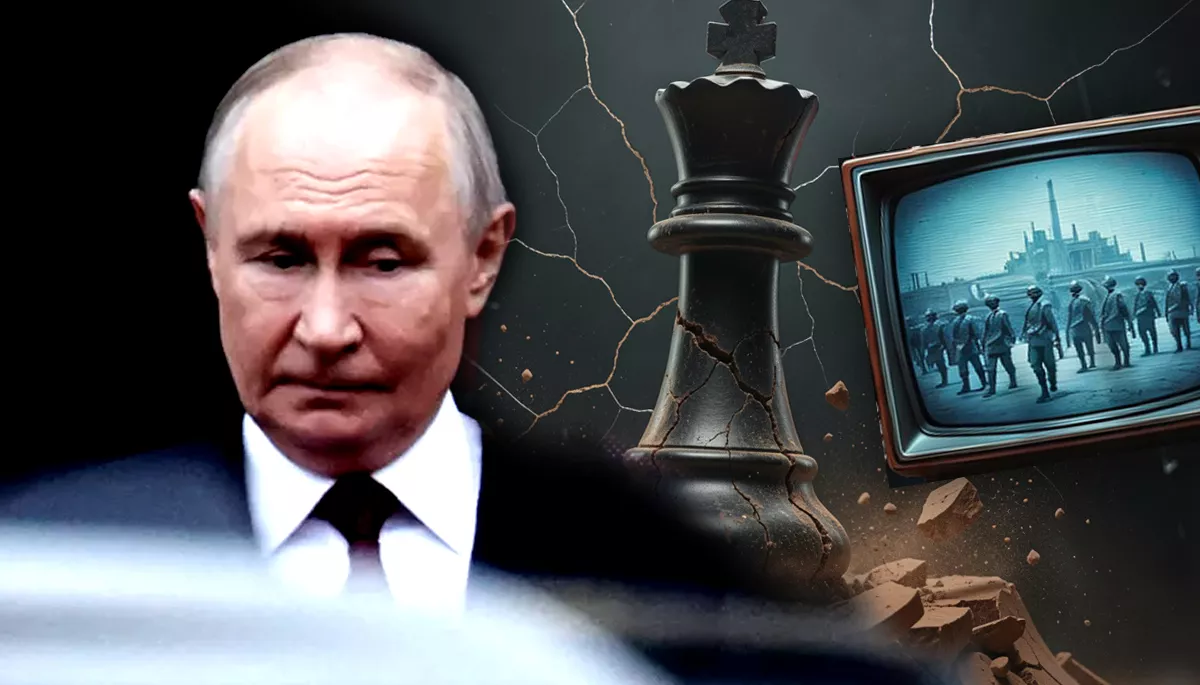
This contrast between Putin’s bunker optimism, as he continues projecting images of “stability” and “inevitable victory” to the world, and the growing chaos inside Russia itself is the main conclusion to be drawn from the first five months of 2026. While Russia’s president, in his speeches, is trying to preserve the reality of 2022, the country is sliding ever more rapidly into a phase in which the propaganda picture can no longer conceal fuel shortages, the strategic absurdity of the war, or, above all, the loss of fear of the “tsar.”
A system built upon the sacralization of a single individual has encountered the inevitable: once the “leader” ceases to be the guarantor of success and becomes a burden, yesterday’s apologists become the first to point out that the “king” is not merely naked but has lost any real connection with the world.
Russia has reached the point of no return, where the question “Who is responsible for the collapse?” no longer requires an answer—it has become obvious to everyone, from glamorous bloggers to radical military bloggers, and this realization itself is the final verdict on a regime that has exhausted its internal resources.