Українською читайте тут.
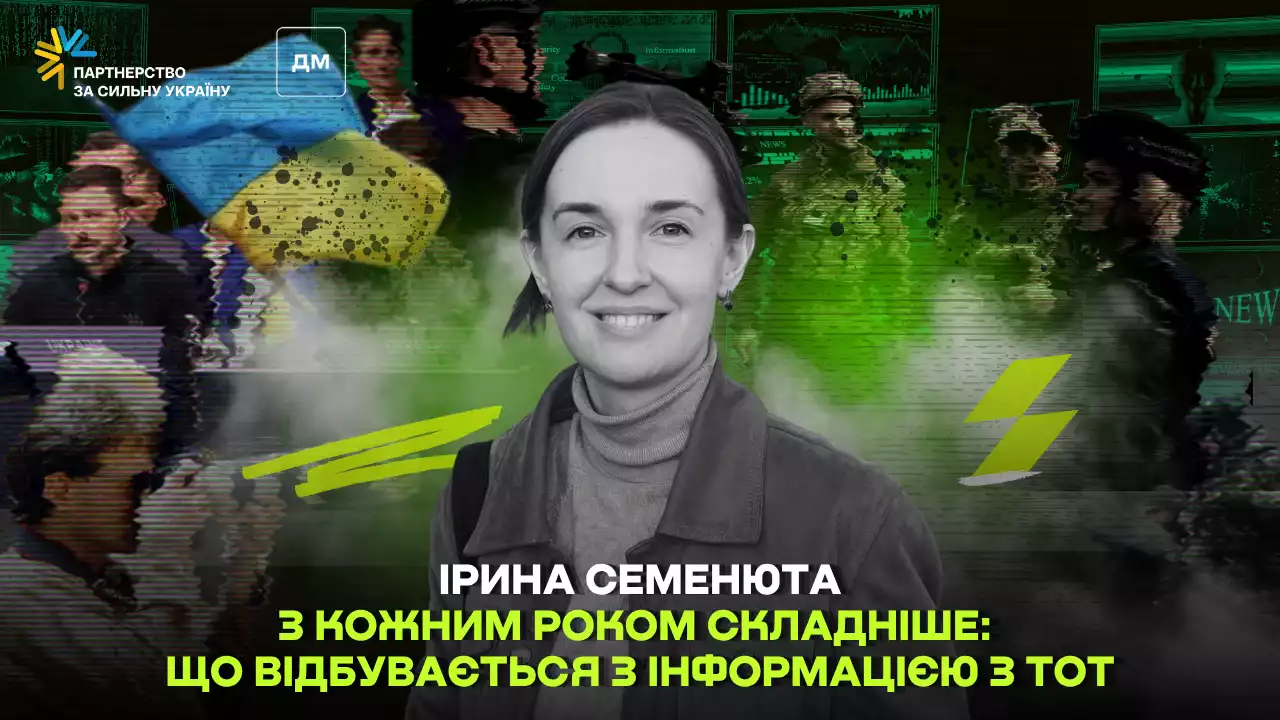
How do people living under occupation search for the truth—and do they risk their safety in doing so? In this new episode, we explore access to information, journalism without on-the-ground correspondents, and the role of local residents as vital sources.
In the podcast Mediumy (Mediums), Iryna Semeniuta, a journalist at Detector Media who covers, among other topics, Ukraine’s temporarily occupied territories, speaks about how VPNs, closed chat groups, and human trust help people overcome information isolation in areas occupied by Russia, why this is becoming increasingly dangerous, and how the very nature of media work is changing under occupation.
She also discusses why Ukrainian media must communicate with people in occupied territories in a language they understand, how to maintain that connection, and why the topic of occupation remains deeply underexplored.
You can subscribe to the Mediumy podcast on Apple Podcasts, Spotify, Megogo Audio, NV Podcasts, YouTube Music, YouTube, and other podcast platforms.
Episode highlights:
00:00 — “With each passing year, getting information from Ukraine becomes increasingly difficult.”
02:21 — “Journalists use VPNs to track what concerns people most.”
05:03 — “Information from the Russian side is becoming more closed off.”
07:49 — “People in occupation should not be the ones reaching toward Ukraine—we need to stay open and say, 'We are ready to welcome you.”
10:33 — “People do not understand what will happen to them after they leave, and we are not discussing this enough.”
13:38 — “Occupation is not a topic that can be covered once and exhausted. It is vast.”
“With each passing year, getting information from Ukraine becomes increasingly difficult.”
Natalka Sokolenko: Let’s begin by talking about how people in the temporarily occupied territories access information. It is clear that there is propagandistic content—we can set that aside immediately. But how do people get information about what is actually happening, both in the occupied territories themselves and in the free part of Ukraine?
Iryna Semeniuta: Through various apps, VPNs, and other methods of bypassing Russian restrictions. People have tools that allow them to access information from Ukraine. It is important to note that with each passing year, this is becoming increasingly difficult—not only from a technical standpoint, but also because of growing security risks.
Due to Russian bans and the use of certain applications, people may face consequences simply for using specific social media platforms or apps. This makes access to information more complicated. However, according to colleagues who report daily on life under occupation, this has not reduced people’s motivation to seek out information.
On the contrary, it is like pressing down on a spring: the more the occupation authorities try to impose restrictions and create an information vacuum, the more people seek access to alternative sources of information.
“Journalists use VPNs to track what exactly is troubling people.”
Natalka Sokolenko: What role do local residents of the temporarily occupied territories play as sources of information? It is clear that no Ukrainian media outlet can keep its own correspondent there, and it is extremely difficult for a journalist from any media organization to get in. This is partly because the Ukrainian authorities react strongly — and justifiably — to cases when someone enters Ukrainian territory without permission. With the occupiers’ permission, that is. So local residents remain the main sources of information. How does this work now?
Iryna Semenyuta: Every newsroom, every team, and even every individual journalist has their own experience working with these sources and their own view of the situation. For example, I no longer have any sources there. They did not want to continue communicating with me after the last time I asked them to help with certain information. But I want to add that not a single person I contacted refused for ideological reasons — not because I was supposedly a “propagandist” or a “Banderite.” They had other arguments: “I have a small child,” “I have elderly parents who need care,” “I don’t need problems at the border.”
My colleagues said they still have sources dating back to 2014 and have refined their cooperation methods so well that they continue to work despite Russian bans on social media and the overall worsening of the situation. Sometimes, people living in the occupied territories pass certain information to Ukrainian journalists and then decide to move to territory controlled by Ukraine. In such cases, on the one hand, we are glad they are safe; on the other hand, we lose a source.
In such situations, journalists often turn to closed or public local chats where people write about problems and express dissatisfaction with what is happening. This especially concerns public utility issues. There are many such chats on Russian social networks and messengers, including Telegram, VKontakte, and Odnoklassniki. Journalists can connect to them through VPNs using anonymous accounts and monitor what exactly concerns people. This also becomes a source of information: it can be verified, or journalists can contact some of the users directly, and people agree to talk about what is happening.
“Information from the Russian side is becoming more restricted.”
Natalka Sokolenko: But the question of verifying the information received by newsrooms still remains: how can it be checked? And in general, how has the approach to gathering information changed compared to the beginning of the full-scale invasion and the period of the ATO (Anti-Terrorist Operation) and JFO (Joint Forces Operation)?
Iryna Semenyuta: From 2014 until the full-scale invasion, people had the opportunity to meet at checkpoints, see each other, and even physically transfer information. Now that is impossible to imagine. Communication through social media has also become more difficult. At the same time, the methods of safe interaction have generally remained the same: secure messengers should be used — definitely not Telegram. Chats need to be deleted. If there is an opportunity to have a separate phone, it is worth using it for communication and subscriptions to Ukrainian media, while another “clean” device should be used for public outings.
The approaches to gathering information have also not fundamentally changed, but the process has become more difficult. Information from the Russian side is becoming more restricted. For example, to obtain a document from Roskomnadzor, it is enough to have a good VPN, switch to a Russian location, and access government websites. The question is whether they are still publishing everything there. A similar situation exists in the occupied territories: previously, life there was described in considerable detail, including through reports about officials’ activities—what they had rebuilt, whom they had visited, whom they had helped. In this way, it was possible to obtain information. With Russia’s new information policy and the restrictions introduced, such information is becoming increasingly scarce.
Natalka Sokolenko: Yes, indeed, restrictions in Russia are becoming tighter and tighter. On the other hand, this tightening of the screws, or compression of the spring, as you aptly put it, may have consequences for the relationship between the Russian authorities and both their own society and our citizens in the temporarily occupied territories.
“It shouldn’t be the people under occupation who have to reach out to Ukraine; we need to be open and say: ‘We’re ready to welcome you.’”
Natalka Sokolenko: Regarding people who, despite significant risks, continue cooperating with Ukrainian media: what are these risks, and is it possible to provide them with instructions on safe communication, how to maintain contact, and how to pass on information about events in the temporarily occupied Ukrainian territories?
Iryna Semenyuta: The best instruction is to have a spare “clean” device that will not expose a person in the event of a spontaneous inspection. As for maintaining communication, I first of all have a request to Ukrainian media professionals. It should not be people in the occupation reaching out to Ukraine and proving that they want to do so. We must be open and say, "Come back; we have not abandoned you, we are ready to welcome you."
Here, a difficult and debatable issue arises—the use of the Russian language. I am convinced this is not really a language issue; it goes beyond that. Under occupation, the Russian language is a tool that genuinely works. First of all, it is a matter of safety: a person consuming content in Russian—for example, “Donbas. Realii” in Russian—is at less risk than if they immediately turn on Ukrainian-language content. Regardless of the content itself, the Ukrainian language can instantly attract unwanted attention and create risks. In addition, using Russian makes it easier to reach people who are uncertain. Those who are categorically against Ukraine are almost impossible to persuade. But, for example, young people are easier to engage with information about what is happening in the territory controlled by Ukraine.
Therefore, in my opinion, content should be produced in Ukrainian, but for the temporarily occupied territories, it should also be duplicated in Russian. As for the content itself, it is important to explain to people what awaits them from a legal standpoint after they leave.
“People do not understand what will happen to them after leaving, and we are not discussing this enough.”
Iryna Semenyuta: I often heard people say, "Why should we go there? We are considered traitors there.” People do not understand what will happen to them after leaving, and we are not discussing this enough.
For example, recently I read a news story about a pensioner who had long been receiving her pension through her granddaughter in Ukraine. Later, problems arose with the bank account, and she traveled through Russia in order to resolve the issue at the bank. The comments under the story were full of outrage: how could she have stayed there for so long and "sat on two chairs"? At the same time, people do not understand how difficult it is to evacuate an elderly person from occupation, even from frontline areas, not to mention relatively safe settlements.
Such human stories need to be covered in order to show that the situation is not black and white — there are many nuances between these extremes, and anyone can find themselves in such circumstances. For example, if a person runs a shelter with several hundred animals, they cannot leave quickly; sometimes the issue cannot be resolved even in several months. The occupation has already happened, and people are approached with a choice: either cooperate and receive money because they need something to eat, or end up “in the basement.” And here the question of boundaries arises: where was cooperation forced—for the sake of preserving one’s own life and the safety of one’s family—and where does it already become a crime? It seems to me that inside the country, we lack discussion about this.
People remain in occupation not only because of ideological beliefs. They may be doctors whose lists of patients awaiting surgery or treatment are scheduled months in advance. They may be people caring for sick parents. Before the full-scale invasion, they could travel, including to Crimea. In the public sphere—even outside the media, on social networks—the very fact that a person remains in temporarily occupied territories already provokes outrage, rejection, and labeling, as though they support it.
As for instructions for people in the temporarily occupied territories, these include using secure messengers, being careful about what and where they say things, and generally taking an attentive approach to information and practicing information hygiene. At the same time, those communicating with occupied territories from areas controlled by Ukraine must exercise even greater responsibility and caution.
“The topic of occupation is not one you can cover once and exhaust. It is immeasurable.”
Natalka Sokolenko: This year, within the framework of the “Honor of the Profession” award, a special distinction for materials about life under occupation is being introduced. In your opinion, can such an award encourage journalists to work more actively on the topic of the temporarily occupied territories? Sometimes it seems that the people most interested in this topic are those who themselves come from these territories, for whom it is their native land. At the same time, Donetsk region, Luhansk region, Zaporizhzhia region, Kherson region, and Crimea are native land for all of us and for all journalists. Yet objectively, there are not many materials on the topic, and this has been the case since the times of the ATO: the share of materials about temporarily occupied territories is disproportionately small compared to other subjects.
Iryna Semenyuta: Yes, I agree. And I also agree that the people who most often speak and write about this are those who have personally lived through the experience and are internally displaced persons themselves. This is not only socially important information but also a personal issue that causes pain. That is why they talk about it.
It seems to me that competitions and initiatives such as “Honor of the Profession” help bring this topic beyond the boundaries of an informational bubble. This is not necessarily only about individual stories but about conveying why this topic must be covered, explored more deeply and in greater detail, and analyzed.
It is important to communicate this purpose to colleagues who may not have dealt with the issue before or who cover the war as war correspondents but do not look at it from this perspective. Perhaps this will spark their interest. I am very pleased that 91 submissions were entered for this special nomination — that is a lot, and I honestly did not expect it. Among these materials are many stories that may resonate with other colleagues and motivate them to expand their coverage of the topic. After all, occupation is not a subject that can be covered once and exhausted. It is so immense that almost every story will be moving, human-centered, about values, and socially important issues. There is no shortage of such stories. The problem is that there are not enough people bringing them to a broad audience.
Natalka Sokolenko: Ultimately, our history already offers an example of a time when Ukrainian lands were divided between empires, yet Ukrainians living on different sides of the borders tried to ignore those divisions and worked toward the creation of a united Ukraine. That is a worthy example to follow.
This project is implemented with the support of the Partnership Fund for a Resilient Ukraine (PFRU), funded by the governments of the United Kingdom, Estonia, Canada, Norway, Finland, Switzerland, and Sweden.
The Partnership Fund for a Resilient Ukraine (PFRU) is a multi-donor initiative funded by the governments of the United Kingdom, Estonia, Canada, Norway, Finland, Switzerland, and Sweden. The Fund’s mission is to strengthen Ukraine’s resilience in the face of Russian aggression by providing critically important support to communities in cooperation with Ukrainian government authorities, civil society, media, and the private sector.