
Українською читайте тут.
A discussion on how to counter the Kremlin’s information aggression without resorting to its authoritarian methods.
Cognitive threats have gone beyond individual countries and regions, as the world’s largest autocracies are conducting coordinated information operations. Democratic states, meanwhile, have yet to establish a fully developed cognitive security infrastructure.
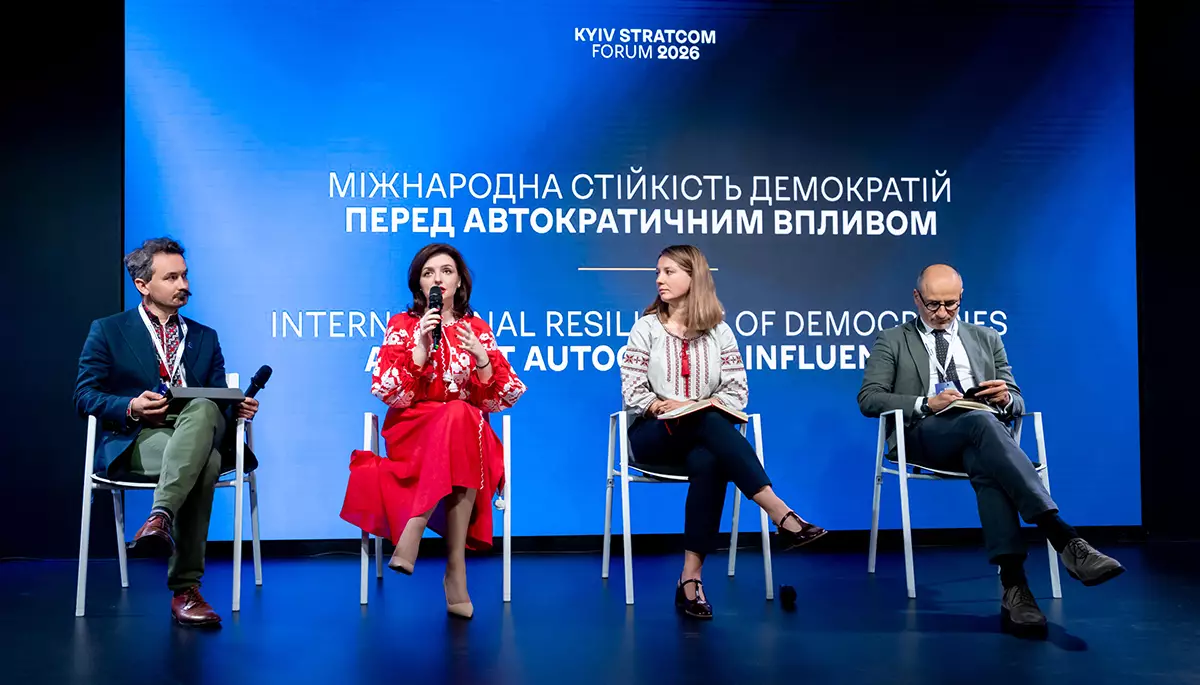
How to build such an infrastructure was the focus of the panel discussion “International Resilience of Democracies Against Autocratic Influence,” held on May 21 as part of the fifth Kyiv Stratcom Forum, organized by the Center for Strategic Communications.
Participants in the discussion included Mariana Betsa, Deputy Minister of Foreign Affairs of Ukraine; Matthew Reece, Director of the Policy Planning and Strategic Communications Department at the European External Action Service (EEAS); Mélodine Allier, Head of Strategic Communications at the French Ministry for Europe and Foreign Affairs; Andrei Țărnea, Head of Strategic Communications at Romania’s Ministry of Foreign Affairs; and Serhii Cherevatyi, Director of the Ukrinform news agency.
The discussion was moderated by Mykola Balaban, Deputy Head of the Center for Strategic Communications.
For many years, terms such as “propaganda,” “fake news,” “hate speech,” and “manipulation” have been widely used in public discourse. According to Mykola Balaban, while these terms remain important, they no longer fully capture the scale of the problem. He explained that today the struggle is taking place in the cognitive domain, where autocracies—and Russia in particular—seek to break democratic strength, erode trust, and make democratic societies doubt their own ability to act and endure.
Balaban said this is no longer a local threat but a global, coordinated, technologically enhanced instrument deeply intertwined with diplomacy, security, mass media, public communications, and international politics. He added that Ukraine has become one of the main testing grounds for Russia’s information warfare, and that after the launch of the full-scale invasion, the scope of this operation became global. The moderator asked how, from the perspective of Ukrainian diplomacy, Russia uses information influence to shape international policy, reduce support for Ukraine, and undermine democratic unity.
Deputy Foreign Minister of Ukraine Mariana Betsa said Russian propaganda has been extremely powerful for many decades, while also being highly adaptive and constantly adjusting to new political realities. According to her, since 2014—when Russia launched its aggression against Ukraine—and especially after the full-scale invasion in 2022, Moscow has been using different narratives for different regions of the world.
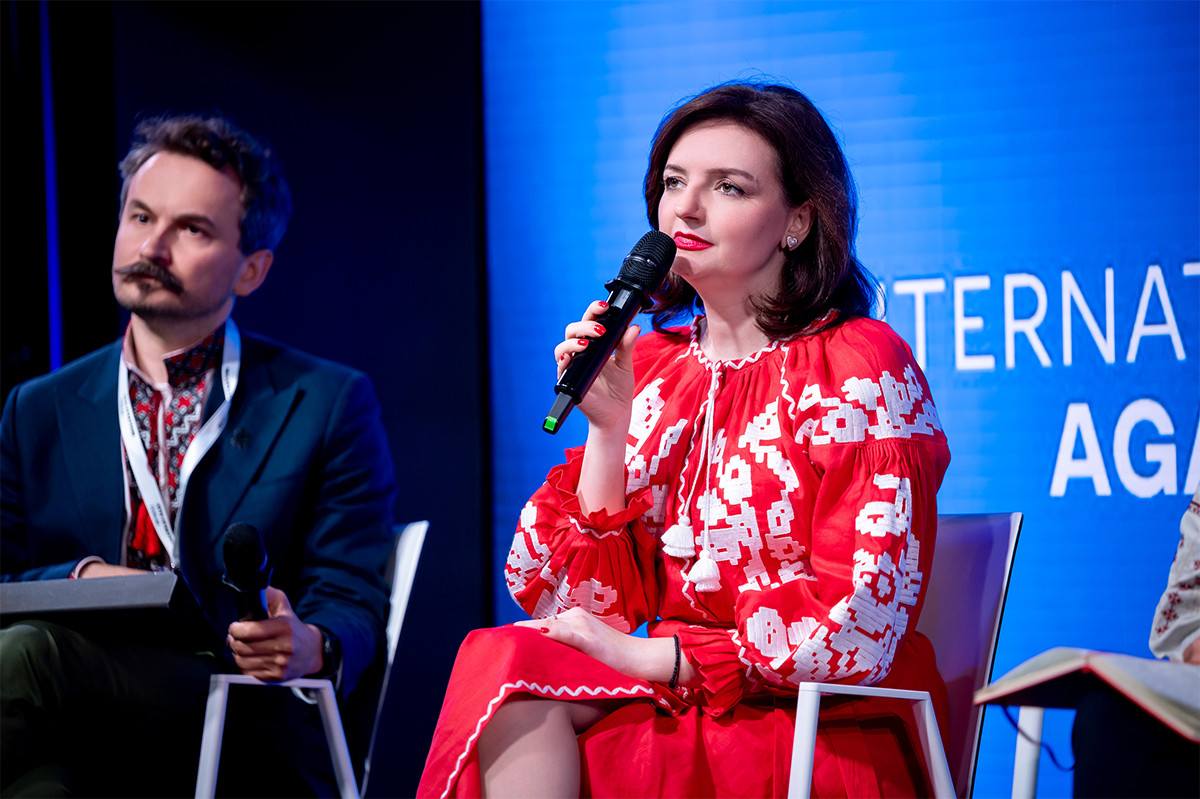
Mykola Balaban and Mariana Betsa
She explained that in Europe, Russia seeks to derail transatlantic unity, while in Africa and Latin America, it appeals to the communist Soviet era. According to Betsa, Russia adapts very quickly to political changes and shifts its narratives depending on regional specifics and geopolitical circumstances.
“If we look at this war, which is existential, it is a war of democracies against authoritarian regimes. This war is not only about Ukraine; it is also about Europe, about global security, about the global legal order, and about Russian ambitions far beyond Ukraine and Europe. It is an existential war in terms of whether democracy will survive and whether democracy will prevail over authoritarian regimes,” Betsa said.
She explained that authoritarian regimes are very well funded and highly institutionalized in conducting cognitive warfare. According to her, the entire state apparatus works to influence public opinion in various countries, not just within their own societies. Such regimes, the diplomat said, face none of the moral and legal constraints that exist in democratic countries.
Betsa also drew attention to Russian information campaigns promoting the narrative that Russia is supposedly winning the war. She said this narrative is being widely promoted in Africa, Latin America, the United States, and elsewhere. The diplomat stressed that it is crucial to understand that Russia is not winning and that Ukraine is capable of victory, provided it receives sufficient weapons and air defense systems.
“Ukraine is now on a new axis and in a much stronger position on the battlefield because unique technologies, particularly drone technologies, are helping our country. Ukraine is not only a recipient—it is also a contributor to global security. Russia has nevertheless influenced the opinions of some countries, and for diplomats it is very important to promote the narrative that Ukraine is strong on the battlefield, that Ukraine is strong in hybrid warfare, and capable of repelling Russia’s hybrid and disinformation attacks,” she said.
Betsa said Russia continues to use the issue of Ukrainian children as an element of information warfare. According to her, Russia has abducted around 20,000 Ukrainian children, while Ukraine has managed to return approximately 2,000. She added that this process is extremely difficult because Russia has not changed its core objectives—to destroy Ukraine as a country or as a nation.
The diplomat recalled that in December 2025, Ukraine proposed a draft resolution at the UN General Assembly concerning the return of Ukrainian children. According to her, adopting the document was not easy, as Russia promoted the argument that it had the right to abduct Ukrainian children allegedly “for their safety.” They also tried to influence the international community by falsely claiming that Ukraine was also abducting children.
“This is one of the new elements in the information sphere that we have been observing recently—how Russia uses the issue of children, the issue of our people, the human dimension of this war, to achieve its geopolitical interests and to reduce Western support,” Betsa said.

Mykola Balaban, Mariana Betsa, Matthew Reece(online), Mélodine Allier, and Andrei Țărnea
According to her, the main goal of Russian propaganda in Africa, Latin America, Europe, and the United States is to reduce support for Ukraine, weaken sanctions and air defense support, and reshape perceptions of the war. She referenced a speech by Russia’s permanent representative to the United Nations, Vasily Nebenzya, who tried to promote the narrative that Ukrainians and Russians are “one nation.”
“Of course, no one in Europe will take that at face value. But there are countries in the wider world that do not fully understand the causes of this war, and for them, hearing the narrative that Ukraine and Russia are one nation creates an entirely different perception,” she explained.
Betsa said the Russian narrative evolved from 2014 to 2022, and then again after the start of the full-scale invasion. Whereas Russia previously tried to portray the war as an internal Ukrainian conflict, it now promotes the claim that the war was supposedly provoked by the West and represents a “threat” to Russia.
She also spoke about the work of the Ukrainian Communication Group in Warsaw and cooperation with partners—the European Union and NATO—in countering disinformation. According to the diplomat, Ukraine and its partners are working to engage countries in the Global South, shape public opinion in Latin America, Africa, and Asia, and analyze shared threats to the democratic world.
Moderator Mykola Balaban said that France has developed important experience in countering manipulation while protecting democratic openness and freedom of expression. He noted that the French Republic has been actively working in this area and asked how democratic countries can respond to information threats.
Mélodine Allier, Head of Strategic Communications at France’s Ministry for Europe and Foreign Affairs, said France is expanding its own toolkit to counter information and psychological operations, including through the Viginum system. She explained that the central goal of French policy is to protect democracy, values, and principles—without using the same methods employed by authoritarian regimes.
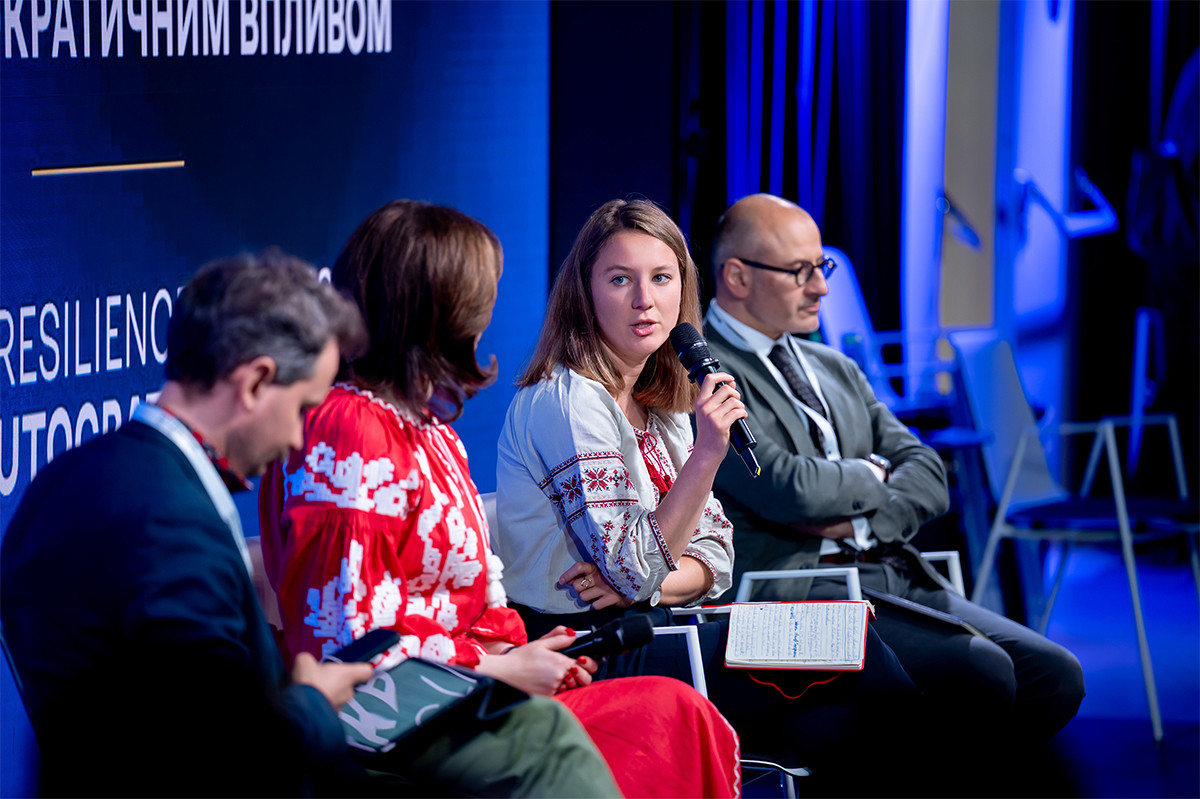
Mélodine Allier
“We have moral constraints and legal constraints. That means we respond through transparency and accountability, not by controlling the information space. We do not spread disinformation, we do not pay journalists, and we do not disseminate fake news,” Allier said.
At the same time, she explained that after Ukraine, France is one of the countries most affected by Russian information operations. According to the French Foreign Ministry representative, they constantly monitor what is being said about France abroad through their embassy network while also analyzing their own information environment.
Allier said France decided to respond actively to hate speech and fake news. For this purpose, the French Response account was created on X, where it is used to debunk disinformation about France, Europe, and European partners. She added that the initiative was later expanded to TikTok to reach younger audiences.
“Very often, we counter Russian disinformation targeting Ukraine that Russian actors inject into our information space. But this is not the only step we have decided to take, because that is a defensive approach. We need to take the initiative and start attacking—to develop our own communication and campaigns that expand our strategic vision and strategic objectives,” she explained.
According to Allier, supporting Ukraine is one of France’s key priorities. She added that several campaigns have already been implemented to strengthen public support for Ukraine within French society. France is also working to build resilience in civil society and independent media, which, according to the diplomat, are doing excellent work in countering disinformation.
The French Foreign Ministry representative said France cannot act alone and is therefore developing strong ties with European partners, as well as international and European institutions, to jointly counter hate speech and disinformation.
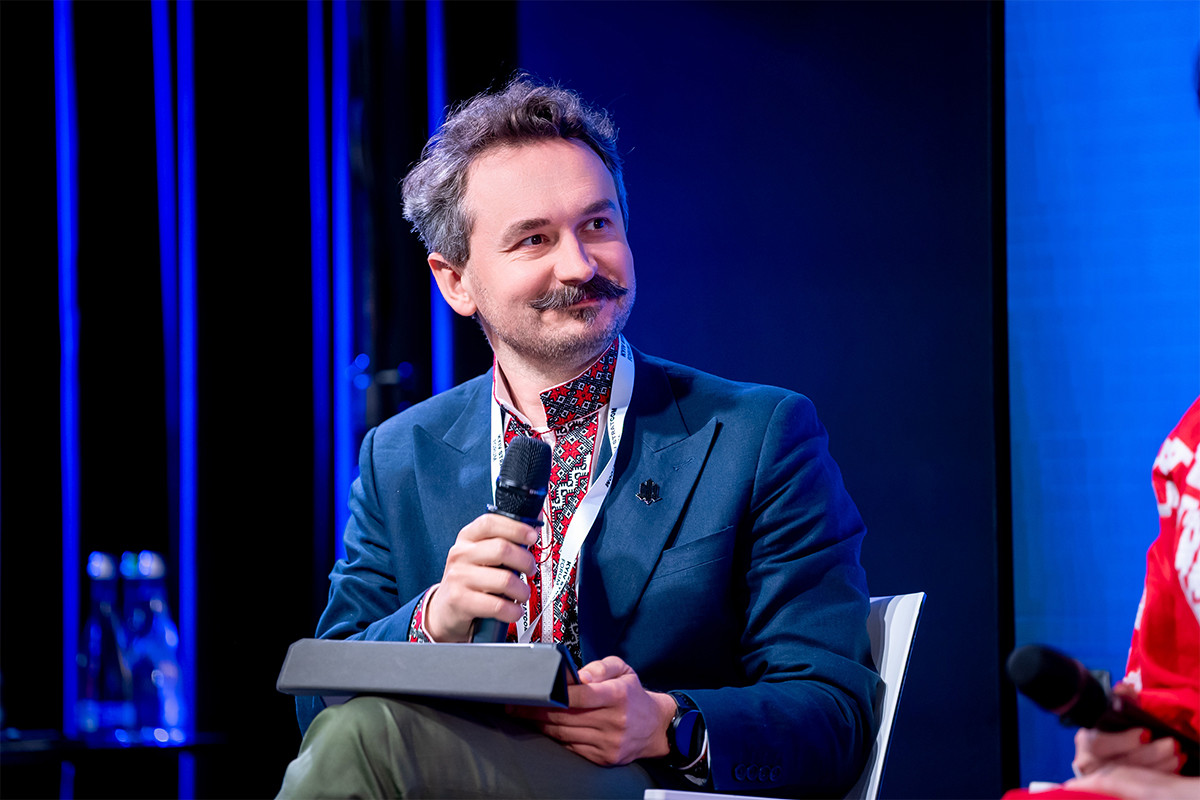
Mykola Balaban
Introducing the next speaker, moderator Mykola Balaban explained that Romania has a unique regional perspective, situated at the crossroads of the Black Sea, Moldova, Ukraine, and the Balkans. According to him, the country is one of the pillars of European security, making it important to understand how Romania sees its role in countering autocratic influence.
Andrei Țărnea, Head of Strategic Communications at Romania’s Ministry of Foreign Affairs, said Romania today has the longest “friendly border” with Ukraine, and therefore any Russian attempt to destabilize Romania directly affects Ukraine as well.
“Moscow targets Romania as a key part of its strategy to undermine Ukraine’s aspirations for sovereignty and democracy. By targeting Romania, they also endanger Ukraine—particularly its access to markets and its ability to cross the border with Europe and back,” Țărnea said.
He explained that Russian information operations are aimed not only at individual states but also at European audiences as a whole. According to the Romanian diplomat, Russia seeks to create division and destabilization in regions it considers part of its sphere of influence under its imperial logic.
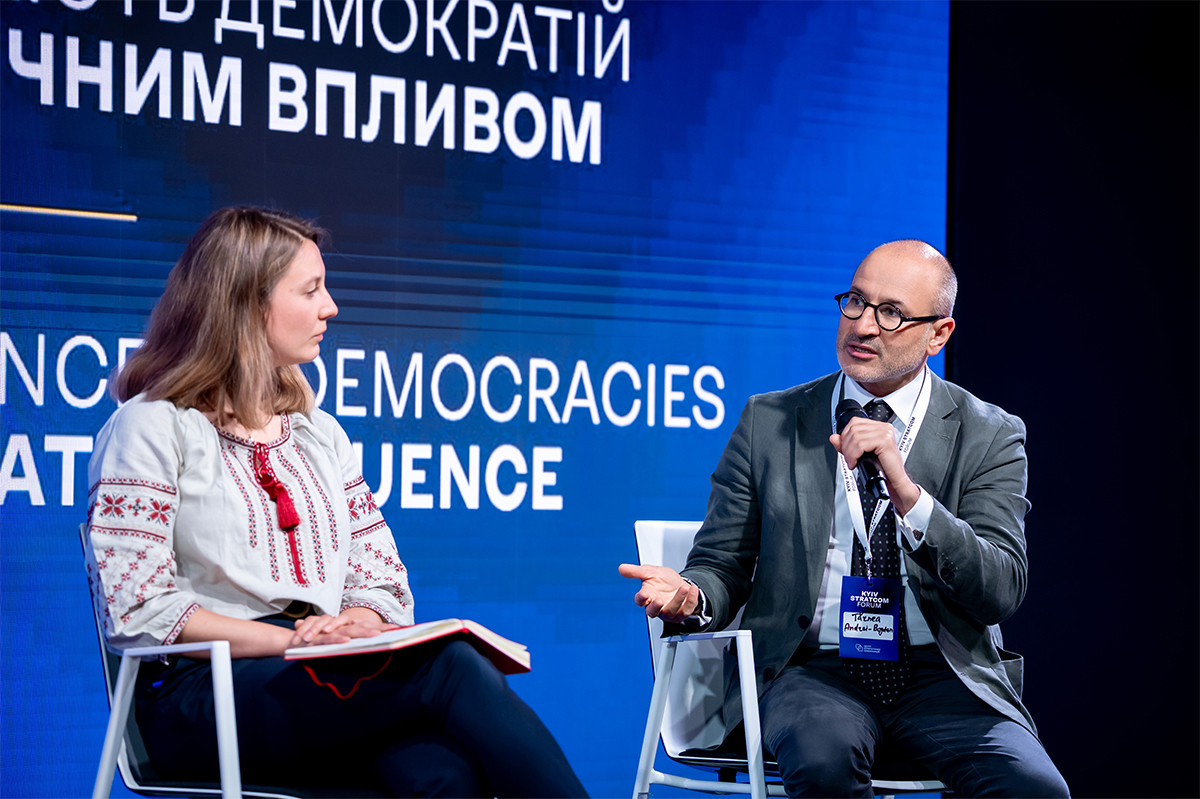
Mélodine Allier and Andrei Țărnea
He added that the Kremlin also uses external propaganda to generate support inside Russia itself. According to him, Russian authorities need to hear echoes of Russian narratives in European voices in order to use them later for domestic propaganda.
“Russian narratives are part of a broader propaganda effort—both internal and external—for strategic influence. This is about the war against Ukraine, and this war has one single cause: maintaining the regime in Russia. There are no strategic reasons for Russia to wage war against Ukraine or in Europe at all. The only reason is the domestic interests of a narrow circle of people in Moscow,” he said.
Țărnea believes Russia is not actually winning in the sphere of propaganda. According to him, some battles may be lost, especially in regions where Russia invested in influence networks for decades since Soviet times, such as Latin America and Africa, but the world is already waking up.
He added that Romania’s partners—including Japan, Canada, and South Korea—are increasingly discussing the impact of Russian destabilization efforts on democratic resilience. Democratic countries are already refining their tools not only for defense but also for moving onto the offensive in the information sphere.
He also highlighted Russia’s attempts to isolate its own population from the global information space. According to Țărnea, the creation of a separate Russian internet could result in Russian citizens being completely cut off from global information networks.
The moderator reminded the audience that the European Alliance of News Agencies (EANA) had decided to establish a new committee to counter disinformation. Ukrinform initiated this move, and the agency’s Director General, Serhii Cherevatyi, has chaired the committee since 2024. The moderator asked why this decision is especially important now and what it says about Ukraine’s role in shaping Europe’s response to the Russian disinformation threat.
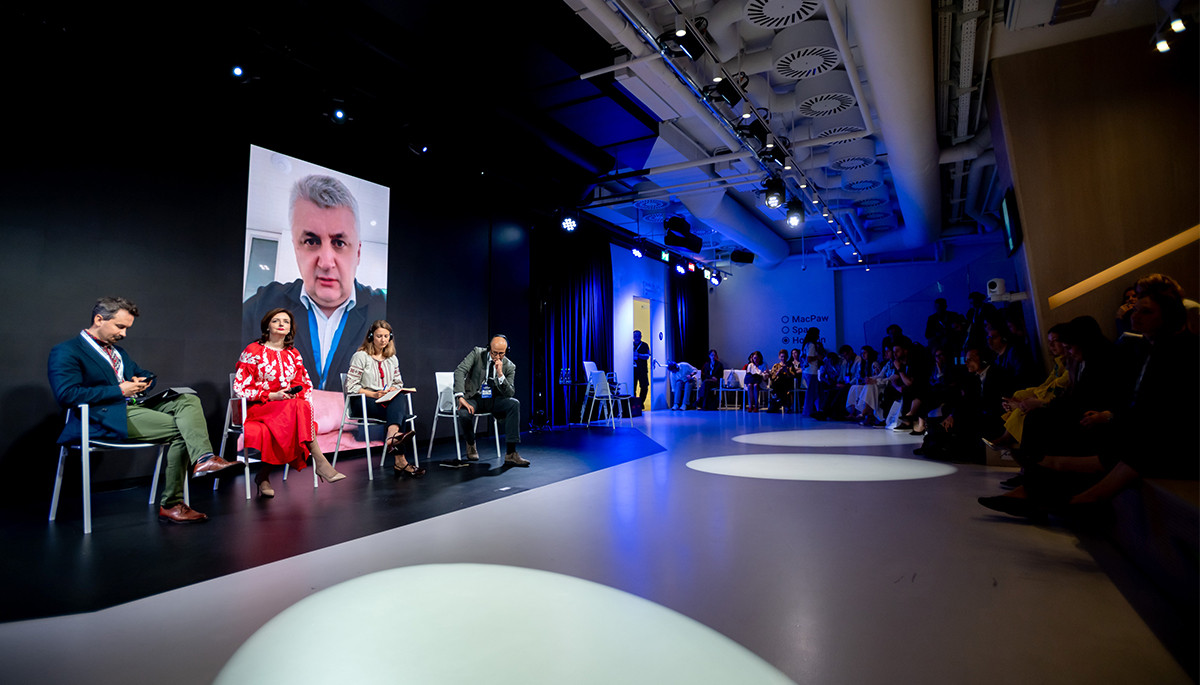
Serhii Cherevatyi (on screen)
Cherevatyi said the alliance includes 33 European countries, each represented by one news agency, and that he was re-elected last year for another term as head of the committee.
He also announced that representatives from the German agency DPA, Agence France-Presse (AFP), and Austria’s APA had joined the committee’s work.
“We conducted research among all European agencies on how Russian disinformation affects their work. This information is not yet public; the study was conducted internally within the alliance. Once the data has been processed and discussed with colleagues, we will be able to speak about it,” Cherevatyi said.
He explained that Ukraine uses every possible platform to counter Russian disinformation and propaganda, and that Ukrinform does so on a platform that includes Europe’s leading news agencies.
“In 2022, we succeeded in suspending TASS from participation in the alliance. We are now working to have it completely expelled from the organization at the next assembly. It is difficult because this requires a three-quarters majority vote,” he explained.
Cherevatyi added that the Ukrainian side is in constant talks with partners—including British, German, Romanian, and Slovak colleagues—to convince them of the need to fully exclude Russia from international professional organizations.
“We communicate every day and try to convince our partners that Russia, as an aggressor state waging a genocidal war, must be diminished even symbolically in every organization where this is possible,” the Ukrinform director concluded.
Mykola Balaban then addressed Matthew Reece, Director of Policy Planning and Strategic Communications at the European External Action Service (EEAS), asking how Russia’s attempts to influence Europe’s information space and undermine unity between Europe and Ukraine have changed in recent years.
“There are three dimensions of the war being waged against Ukraine. First, Russia against Ukraine. Second, Russia against Europe. And third, democracies against autocracies. Information operations are integrated into cognitive operations and other influence activities. They seek to divide Ukraine’s unity, the unity of the European Union in supporting Ukraine, and transatlantic ties themselves,” Reece said.
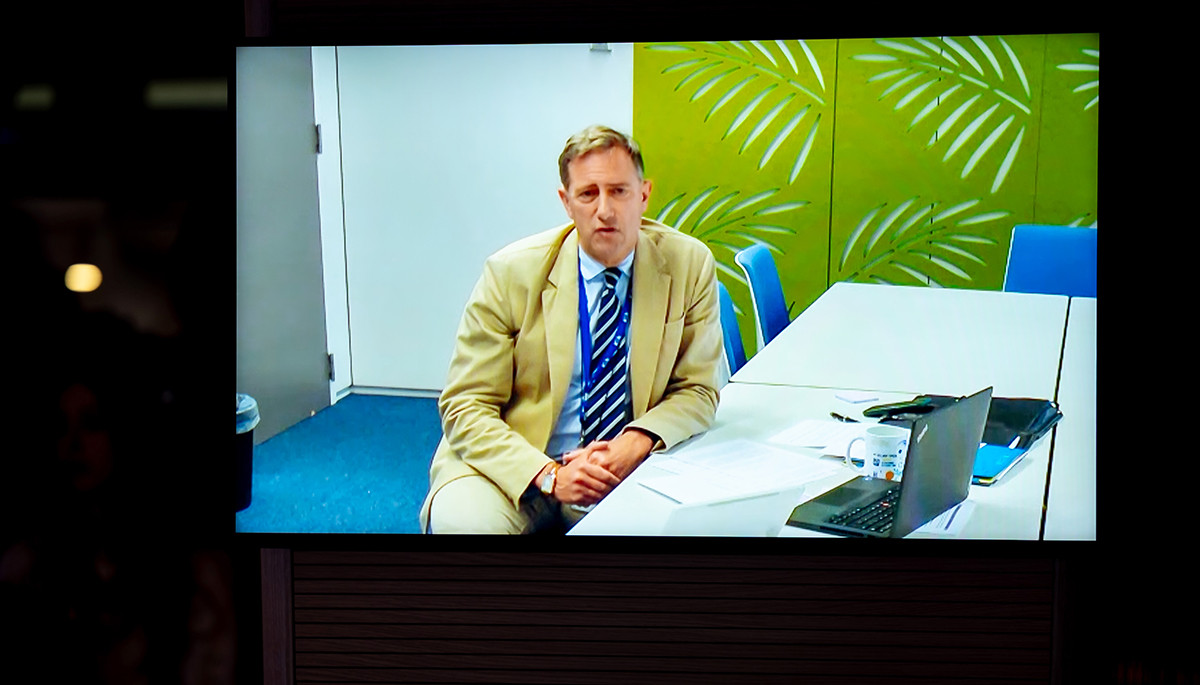
Matthew Reece
According to him, Russia is investing significant resources in these information campaigns, and the European Union now fully recognizes the scale and intensity of the threat. He said the Kremlin’s influence operations will only intensify, and therefore the EU is moving from analysis and basic tool-building toward more active measures.
Reece explained that earlier efforts focused on developing methodologies, tools, sanctions, and situational awareness. Now, he said, the EU is transitioning to a more offensive mode of action in order to deter and dismantle the infrastructure Russia uses for information influence.
“We are building a better operational picture across democracies. We are sharing analytical standards and methodologies because that gives us a common language. It allows us to communicate and function effectively together. And unfortunately, our authoritarian adversary is doing the same. If we understand these attacks in the same way and talk about them properly, we will be more successful in countering them,” the EEAS representative explained.
He also said it is important to begin with a positive narrative about the partnership between Ukraine and the European Union. According to Reece, the EU is launching the campaign ‘We Are Europe,’ in which Ukraine is positioned as a reliable partner with resources, resilience, and shared advantages for the region.
The EU representative said Russia is trying to conduct large-scale information operations through financial resources, but, at the same time, is failing to deliver on its own promises and is gradually losing ground.
“Russia is losing. There is already evidence that Russia is entering a prolonged and deep financial crisis. We are moving toward the 23rd sanctions package, and it is hurting them. They try to portray it as if it does not hurt them, but in reality, it does. We are inflicting catastrophic losses on Russia in this war,” Reece said.
He added that Russia is becoming increasingly dependent on China, making it important to continue communicating its weakening position, despite the existence of many skeptics.
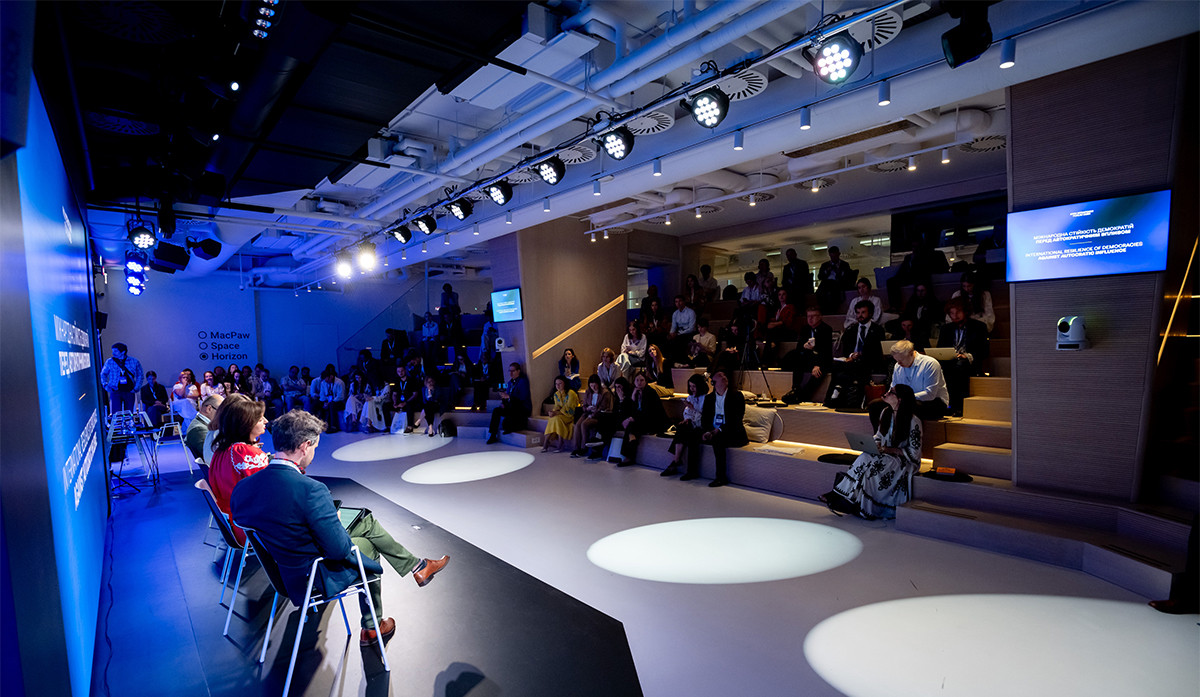
Audience at the Kyiv Stratcom Forum
According to the EEAS representative, effective counteraction requires scaling up efforts and working not only at the EU level but also together with NATO, the G7, and international partners. He said the EU has already launched a training program for information operations instructors in the security and defense sector for member states and partners.
“We believe this will be a long-term challenge, and it is necessary to prepare specialists in information influence. We now have better data, and we can more clearly see the infrastructure being used in Russia’s information operations,” Reece explained.
He also said that the EU is discussing new strategic decisions regarding Russia and expanding cooperation among partners to gather evidence and further apply sanctions. At the same time, Reece acknowledged that despite sanctions pressure, the Russian broadcaster Russia Today (RT) still remains present in the EU information space.
He emphasized that Ukraine currently possesses unique experience in resisting information aggression:
“We are now strengthening our support through cooperation and partnership with you. We have a partnership program with Ukrainian strategic communications and NATO. And we will have a joint study of Russian activities.”
He said Russia will continue trying to undermine the partnership between Ukraine and the EU, but the European Union will not allow that to happen. Reece announced that Ukraine is expected to be invited into the rapid early-warning system for information sharing and strengthening joint capacities in countering disinformation.
At the end of the event, audience members were also able to ask questions. Andrii Taranov, a member of the board of Suspilne, asked what Europe’s perspective is on fighting for a fair voice on digital platforms currently used across Europe, and whether there are plans not only to understand how to ensure fairness but also how to understand the algorithms behind these systems.
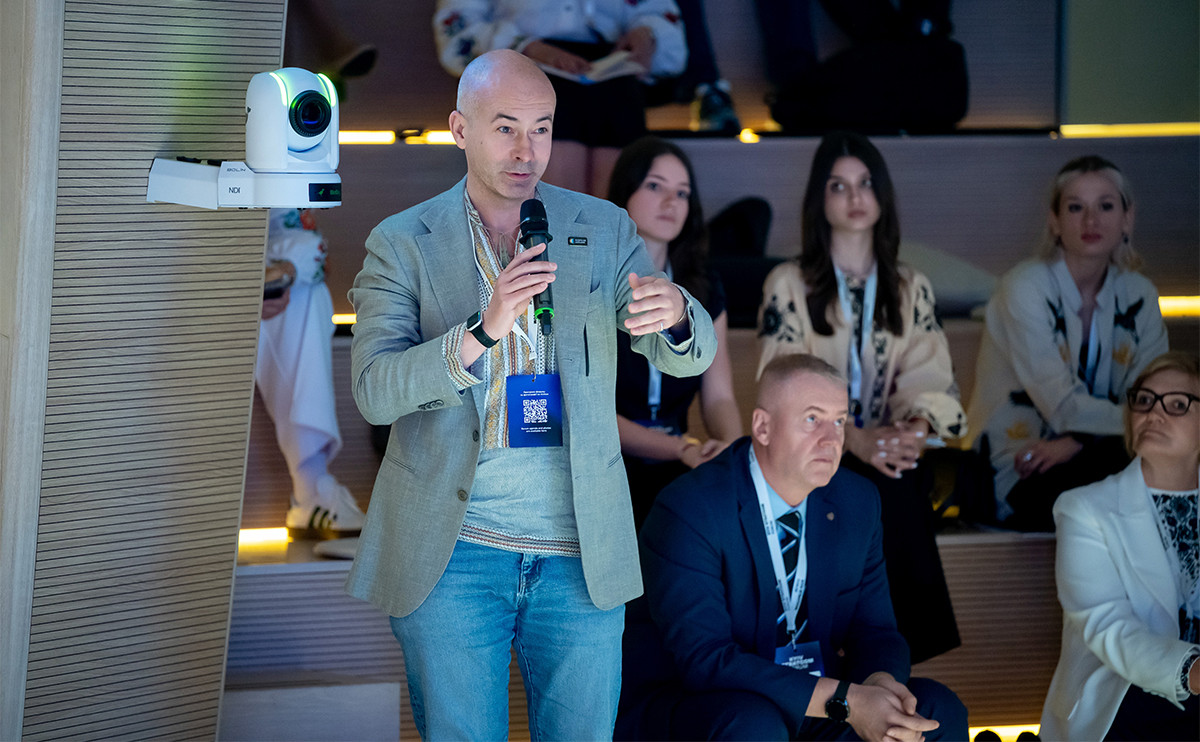
Andrii Taranov
Mélodine Allier replied that the main problem lies with the platforms themselves:
“France and the European Union are working very intensively to force platforms to take responsibility for what they spread and publish. In France, there is Arcom—the authority responsible for illegal and violent online content. And you are right that many of the problems are rooted precisely there.”
Andrei Țărnea said that an important tool is the Digital Services Act (DSA), although it is not perfect, and EU countries are still learning how to apply it in practice.
“It is not only about the regulation itself, but also how other partners respond to it. We are learning through these interactions. During the elections in Romania, we realized that the DSA is a pan-European norm for all member states, but it is national authorities that must apply it in each specific country when interacting with platforms. We have 6 million Romanians abroad, 5 million of whom are eligible to vote, and Russian anti-EU campaigns systematically target them. Meanwhile, Moldova is not part of the EU—and the DSA does not apply there,” he explained.
Țărnea noted that even if a court or law enforcement agency declares certain content illegal and orders a platform to remove it in Romania, that does not automatically mean the same will happen in Germany or France.
Vlada Dumenko, representing the International Center for Ukrainian Victory, asked when European politicians would begin speaking directly to their societies about the fact that Russia is attacking the European Union itself. She added that a greater sense of urgency needs to be created within European societies.
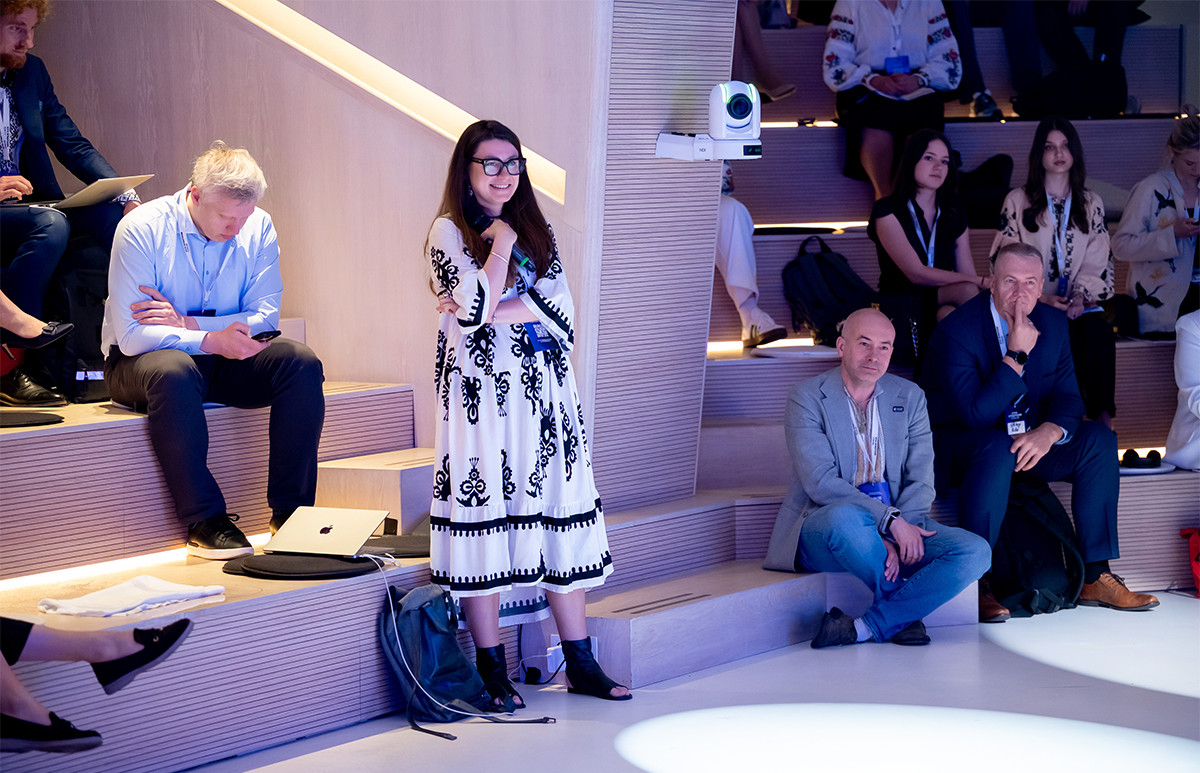
Vlada Dumenko
Mélodine Allier replied that this is a key issue that French President Emmanuel Macron has emphasized many times:
“We are doing tremendous work to inform civil society about what Russia is doing directly in France. For example, after October 7, 2023, Russian actors painted blue Stars of David on walls in France to provoke antisemitic sentiment and polarize society.”
Allier said the French side published a special report analyzing this campaign and linked it to the Doppelgänger ecosystem.
“A few months later, pig bones were placed near mosques in France. We also published a report on what exactly had been done. It was a very effective campaign. And now, I think French society understands what Russia is doing,” she added.
Olha Chyzhova, representing Ukrainian Prism, asked whether there are practical mechanisms for transferring Ukraine’s experience in cognitive resilience to European partners and what contribution Ukraine is making to European defense.
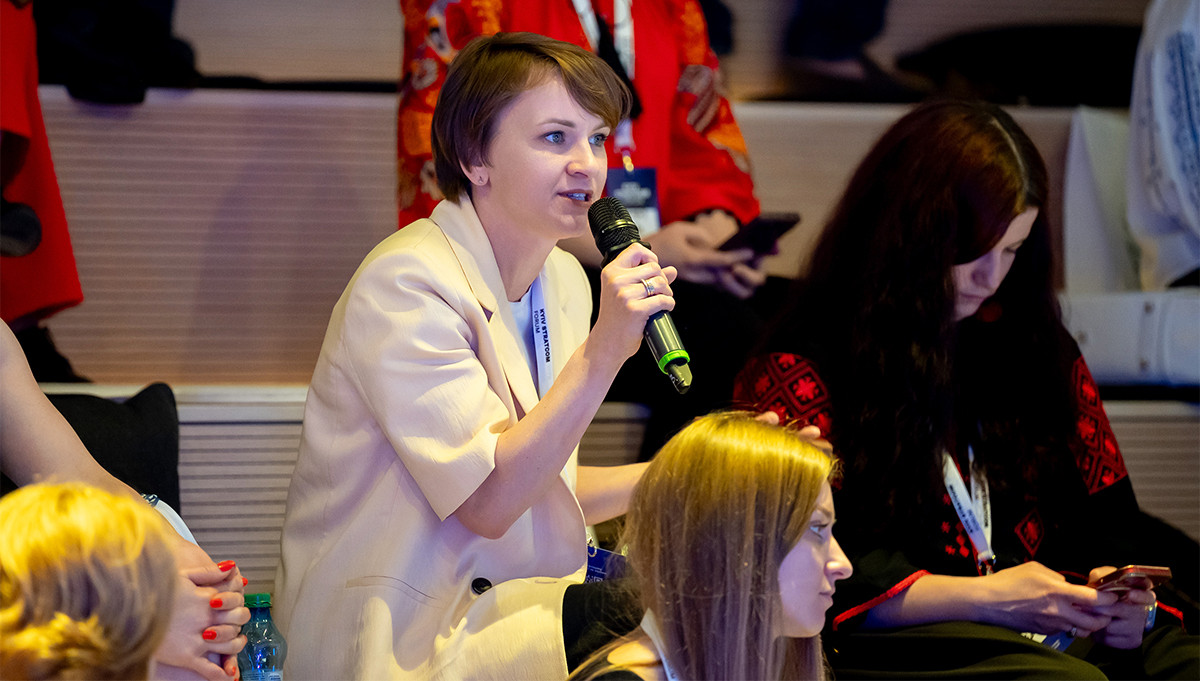
Olha Chyzhova
Andrei Țărnea replied that cooperation between Ukraine and European partners is already taking place in various formats:
“As for Romania, we work very closely with the Ukrainian Ministry of Foreign Affairs—not only bilaterally, but also trilaterally with Moldova, as well as with our Polish friends. We have a shared understanding of what is happening in Ukraine right now and how this cognitive frontline affects public consciousness.”
According to the Romanian Foreign Ministry representative, cooperation is also taking place within NATO, within the EU, and directly with Ukraine.
“We include Ukraine and always share our observations because Ukraine must understand what Russia is also doing abroad—in the Middle East, in Asia, and in the Pacific region. We are actively cooperating in these areas,” Țărnea explained.
Deputy Foreign Minister of Ukraine Mariana Betsa agreed that international mechanisms are critically important.
“Ukraine is only beginning to use drone technologies, as well as cognitive resilience and information capabilities, as instruments of struggle. We have annexes to security agreements with Romania and other countries, but we need more international mechanisms through which Ukrainian lessons can be applied abroad. This concerns bilateral cooperation with the European Commission and with other organizations. We have a project for this, but I think it still requires further thought,” she concluded.
Photos: Kyiv Stratcom Forum