
Українською читайте тут.
Three former prisoners told Detector Media about their experiences and the attempts by prison guards to influence them through propaganda.
Numerous testimonies from Ukrainian captives show that Russians not only systematically torture and physically break prisoners, but also try to destroy people psychologically, convince them that Russian propaganda is right, and strip them of their national identity. But the captives themselves say that such propaganda is not very effective.
Detector Media spoke with three former prisoners — Azov fighter Denys Fedorenko, serviceman Oleksandr K., and UNIAN journalist Dmytro Khilyuk — about the real impact of propaganda on Ukrainian prisoners, the typical techniques used by Russian torturers, and the fake stories that the prison guards themselves believe.
The tunnel to Zaporizhzhia and secret biolabs
Zaporizhzhia native Denys Fedorenko had only just enrolled in a political science program when the war began. A year later, he decided to join the already well-known Azov regiment. In a conversation with Detector Media, he recalls that out of 200 people, 120 were admitted to basic military training after the interviews. By the end, about thirty remained. There is a rule: you cannot be expelled; you can only quit of your own accord. But the regiment's training conditions are so tough that most people cannot endure them.
He stayed. Two years later, in 2017, he was wounded near the village of Shyroka Balka, not far from Mariupol. A shell fragment broke his arm and damaged a nerve so badly that the fingers of his left hand still do not bend; fragments became lodged in his soft tissues and leg and even pierced his helmet, but fortunately not his head.
He met the full-scale invasion in Mariupol as head of the regiment's operational analysis and planning department. He was wounded again — a sniper hit him in the leg and broke it. He lay in a bunker that the fighters called Zaliziaika — a makeshift hospital of sorts. He expected to die at any moment, because this bunker was hit twice by aerial bombs and some of the wounded were killed.
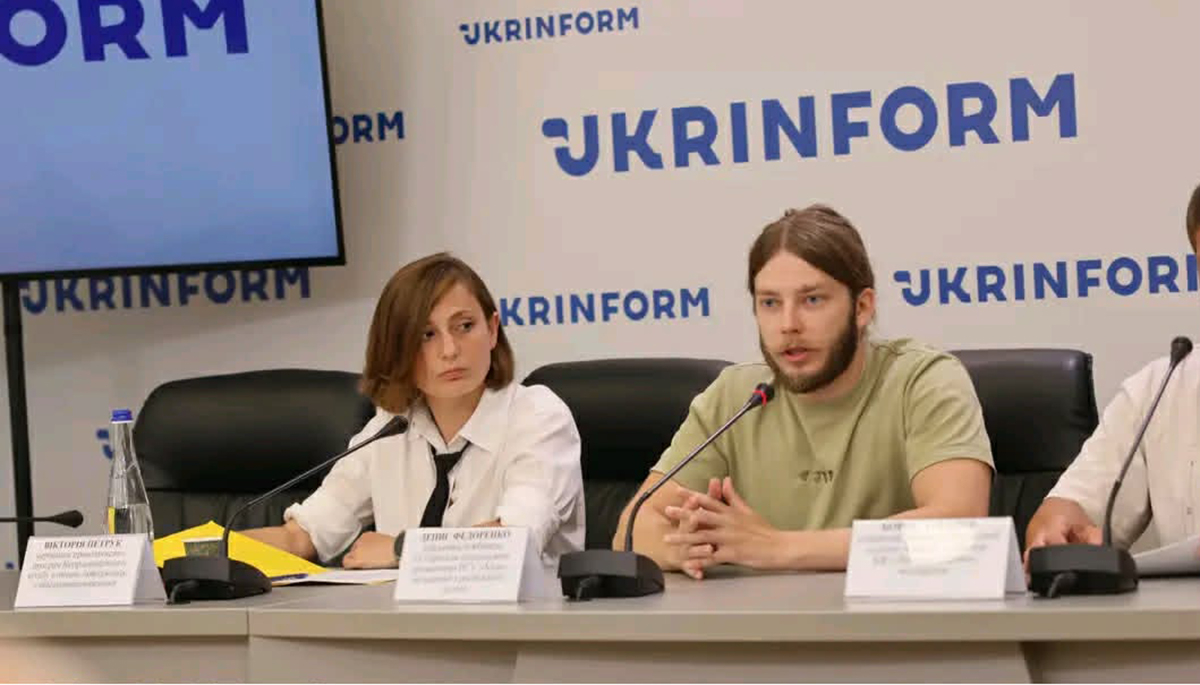
Human rights defender Viktoriia Petruk and Denys Fedorenko
He says there was no question of treatment, because on the first day they were given a painkiller injection, and after that only pills. His leg healed incorrectly. They ate once a day — half a plastic cup of porridge and a piece of salo.
On May 17, on the orders of the highest command, Azov fighters surrendered. He was taken to a hospital in the settlement of Novoazovsk. There, he was also interrogated by representatives of the so-called commandant's office of the Donetsk militants. At the beginning of the interrogation, they laid out a map of Mariupol in front of him and ordered him to indicate firing positions. Denys was surprised by the question, since the Ukrainian military had left their positions. But the separatists did not believe that the Azov fighters had surrendered together with their commanders, so he started playing dumb and pointed to random spots on the map with a pencil.
After that, the menacing representatives of the “authorities” warned him: “If our boys go there and one of them dies because you pointed to the wrong place — you're f**ked.” Denys says he had to pretend that he was frightened. But the funniest part came next.
The investigator asked where the US laboratory for producing biological weapons was located. Such laboratories had been repeatedly discussed on Russian propaganda shows. At first, he was surprised, but then, as he puts it, he had to make a tremendous effort not to show the “investigator” that he was an idiot. At first, he tried to appeal to logic:
— Comrade boss, there is no laboratory. Why would the Americans build a laboratory ten kilometers from the front? It's dangerous there. If there were one, it would be on US territory.
— Don't take me for a f***ing idiot, he says, showing him a photo of some old flasks from the Azovstal laboratory. — What is this?
Then Denys realized that he had to tell them what they wanted to hear. Otherwise, they would not believe him anyway.
— Comrade boss, the laboratory really did exist. But the cunning Americans evacuated it so that it wouldn't fall into your hands.
— Then why the f*** did you lie to me? Where exactly was it?
— You have to understand. I'm a senior soldier. And that was a secret laboratory. Who would tell me?
— That's true, too, the “comrade boss” agreed.
But they did not stop there. The next day, they called Denys in again, and the “comrade boss” put on a little performance for him. He pretended that someone had called him on the phone and was supposedly discussing the terms of a prisoner exchange. Then he hung up and theatrically asked:
— So, Denys, do you want to go home?
— Very much, comrade boss.
— A woman who handles exchanges just called me. An exchange is being planned. But whether you make it onto the list depends on you. On what you say.
He pushed a chair right up against Denys. He pulled out a homemade knife — the kind prisoners make. And began running it over Denys's trousers around the genital area. With a furious expression on his face:
— There's one problem. Your f***ing bastards cut our boys' balls off.
— All 26? Denys asks, pretending to be horrified.
— Yes, the “comrade boss” replies.
— I do not support the abuse of prisoners, Denys says.
— Here's the deal. Either you answer my questions truthfully right now and go home in an exchange. Or you stay here. And my mood can change, and I'll cut all your balls off.
Denys pretends that he is very frightened. He says:
— Yes, of course. I'll answer everything you ask.
And then the investigator asks a question that, Denys says, completely stunned him.
— Where is the tunnel to Zaporizhzhia? (For reference: the distance from Mariupol to Zaporizhzhia is 227 kilometers.)
— Comrade boss, if this tunnel really existed, why would we surrender, instead of leaving through it?
— Well, that's true, too. Maybe the tunnel collapsed and you couldn't get out.
— I don't know anything about any tunnel. I was at Azovstal only as a wounded man. I don't know about any tunnel.
The “comrade boss” displays unwavering confidence and asks:
— How could you have held out for so long? You were receiving reinforcements and ammunition from there. I understand: you don't want to go home.
— I really do.
— If you wanted to, you would tell the whole truth. What you told me is useful information. I will send this information to “President” Denis Pushilin. If he considers my report useful, you'll go home.
Denys Fedorenko did not go home. He says that although Pushilin is a son of a bitch, he is not an idiot who would take such nonsense seriously.
According to Fedorenko, propagandists from either the Donetsk separatists or Russia regularly came to the prisoners. And they all tried to squeeze out of the prisoners confirmation of various Kremlin talking points. One of them, from some Telegram channel, persistently asked another prisoner with the call sign Kombat who was depicted on the one- and two-hryvnia banknotes. Kombat pretended that he did not know.
Fedorenko believes that the propagandist wanted to build his report around the idea that Kyiv is historically Russian territory and that the Kyivan princes belong to Russian history.
Having failed to get the answer he wanted, the propagandist moved on to other questions: “I am interested in the crimes you (Ukrainians) committed.” Kombat replied that he could tell him about Russian crimes. For example, the bombing of residential areas. The man said: “That doesn't interest me. Tell me about yours.” “Our only crime is that we went to defend our country,” Kombat replied.
“Another time, the administrator of some separatist channel came,” Denys recalls. “He says, ‘I’m the performer of a song about Azovstal.’ He played it. It was based on ‘Plyve Kacha.’ They were burying someone at Azovstal. Basically, it was something pro-Russian. He asks, ‘What do you think?’ I say, ‘It’s some kind of shit.’ His face changed.”
Another time, five people came to the prisoners at once, with cameras and lights. A woman — an interviewer from Russian television. She was convinced that the Azov fighters were all Nazis from western Ukraine. And she was very surprised when she learned that Denys was from Zaporizhzhia, Kombat was from Mariupol, and their third fellow soldier — Akvil — was from the Kyiv region.
“She was surprised that we spoke Russian normally and asked whether we were punished for speaking Russian. And then — if we speak Russian, why are we fighting against Russia? As I understood it, she wanted to show a picture of Nazi Azov fighters killing people from eastern Ukraine because they speak Russian.
Then she asked us to show our tattoos. She was looking for a swastika and didn't find one. Akvil had Vasnetsov's Three Bogatyrs. And Kombat had a tank tattooed on him.”
Denys got the impression that she was angry and disappointed that she had not found anything.
The anthem under batons
Major Oleksandr K. (he does not want to give his last name) currently serves in a rear-area unit. At the time he was captured, he was deputy commander for moral and psychological support of one of the units of the 36th Marine Brigade. This unit was defending Mariupol at the Azovmash plants and the Illich Iron and Steel Works.
Five days after the full-scale invasion, the unit found itself completely surrounded, with a large number of dead and wounded and no food or water. They made two attempts to break out of the encirclement, but both failed. When they returned to Azovmash after the second attempt, the Russians were already there. The commanders received permission from the Supreme Commander-in-Chief to lay down their weapons.
The Ukrainian prisoners were held for two days in a hangar in the settlement of Sartana, and then transferred to Olenivka in Donetsk region — to a penal colony. Admission to prisons is a special procedure: guards form a human corridor, and the prisoners walk through it while being beaten with fists, feet, batons, stun guns, and so on. Then, every day for three weeks, they were taken out of their cells, lined up, and beaten without any explanation as to why.
“Physically, it isn't that frightening,” the major says. “Eventually, you can get used to the pain. Psychologically, it is much worse. You feel crushed. That is exactly why they do it — to break a person psychologically. Such procedures were repeated every time I was transferred to another pre-trial detention center. I never understood the purpose or reasons for the transfers.”
After Olenivka, Oleksandr was transferred to Taganrog, then to Novozybkov in Bryansk region, then to Kursk, and finally to Borisoglebsk in Voronezh region.
He spent less than a month in Taganrog. There, after reveille at six in the morning, the prisoners were forced to line up in their cell and the Russian national anthem was played. From the very first days, they were given the lyrics of the anthem and ordered to memorize them. During checks, they were ordered to recite it, and if they forgot the words, they were beaten.
“There were people who did not know Russian well, while others had head injuries,” Oleksandr K. recalls. “It was difficult for them to memorize the anthem without making mistakes, and so they were constantly beaten.” He believes this was done deliberately to humiliate them and destroy their national identity.
According to Oleksandr, in addition to the Russian anthem, they were forced to listen from morning until evening to “patriotic” Russian songs performed by Oleg Gazmanov, Vika Tsyganova, and others.
Six men were held in the cell in Taganrog. They received no news at all. But the guards repeatedly told them that the Russians had already bombed half of Ukraine and that the Poles had taken the western part of Ukraine. Oleksandr believes that such conversations were the guards' own initiative, as they tried to break the prisoners morally. He says it did not work, because nobody believed them.
At the Novozybkov pre-trial detention center, a television was installed in the cell. It showed one channel, and the prisoners were forced to watch political programs such as Vladimir Solovyov's show. The guards watched the Ukrainians through the surveillance camera to make sure they did not turn off the television.
Whether they did not have enough televisions or for some other reason, this lasted only one day. Then the television was moved to another cell for one day. And so on in turn.
At the Kursk pre-trial detention center, where Oleksandr was transferred after Novozybkov and where he spent a year and a half, one corridor was designated for Ukrainian prisoners. Russian criminals were held in the other corridors. Oleksandr K. says that the Russian convicts were not physically abused because law firms and human rights organizations monitored their treatment. This did not apply to the Ukrainians — they were beaten regularly.
The convicts had ordinary radios and televisions. They could turn them on and off as they pleased. In the cells of the Ukrainian prisoners, a loudspeaker had been installed, and from early morning they were forced to listen to Russian songs. They also constantly played the same audio recording about how an armed coup had allegedly taken place in Ukraine in 2014, about what a criminal Stepan Bandera was, and similar propaganda bullshit. The prisoners could not turn it off or lower the volume because the controls were located outside the cell.
Sometimes they turned it up to full volume — and within half an hour the prisoners would start getting headaches.
Oleksandr says that even this terrible soundtrack could be used to their advantage. They figured out that fifteen songs lasted one hour. This allowed them to keep track of time and helped them structure the day.
Once in Kursk, they were given a television that was not connected to a broadcast signal. There was a flash drive with a recorded program, in which the Armed Forces of Ukraine were accused of allegedly deliberately shooting down an Il-76 aircraft carrying 65 Ukrainian prisoners of war, six crew members, and two escorts on January 24, 2024, in the Belgorod region.
“We understood that the essence of the program was propaganda aimed at convincing us that Ukraine kills its own people. But we also understood that such an incident had happened — two men from our detention center had been taken for an exchange at that time, but not from our cell. This was psychologically depressing. Especially the thought that the guys had spent a year and a half in captivity, waited for the exchange, and then died on the day of the exchange. During the program, we tried to glean something useful for ourselves. They announced how many people were in captivity and how many had been exchanged. They read out figures for Ukraine and figures for themselves. We could compare them. And understand that the exchange process was indeed taking place. That was an optimistic moment,” Oleksandr recalls.
After two years in captivity, the lack of new information creates a psychological vacuum. Oleksandr K. says that it seems as though he has already thought about everything it was possible to think about and talked to everyone about everything. “We tried to seek out any information. A man came to us who had been captured a year earlier. He had fought in the Kupiansk area — we received a year-old piece of news and realized that the fighting was taking place in the same territory as it had at the very beginning. In other words, there had been no advance. The fact that Ukraine had not surrendered was very important for our psychological state.”
In the last pre-trial detention center, in Borisoglebsk, Voronezh region, twelve Ukrainian prisoners were held. To escape the emptiness, Oleksandr suggested coming up with topics for discussion every day. For example, where I want to see myself after the war ends. One person wanted to be released and open a barbershop (which, incidentally, he eventually did), someone wanted to buy an apartment, someone wanted to move to Zhytomyr or Ternopil.
“It was during this game that I started thinking about getting an education as a civilian psychologist,” Oleksandr says. “Because there is a difference between a military psychologist and a civilian one. A month after my release, I enrolled at Poltava Pedagogical University, and I am now studying for a master's degree.”
They discussed this topic for two weeks. There were other topics as well, such as family relationships, choosing books to read after release, and so on. According to Oleksandr K., the very act of thinking and discussing these things prevented them from sinking spiritually and psychologically.
Then Russian radio began to be played three times a week. It had a propaganda slant, but at the same time it was useful because the Ukrainians understood that their country had not surrendered.
Oleksandr assumes that the Russians have some kind of manuals on how to exert ideological and informational influence on prisoners. But they carry them out carelessly. The only thing they manage to do well is beat defenseless people.
“Besogon,” Bandera, and a television with one button
In the first days of March 2022, a shell hit the Khilyuk family's house in the village of Kozarovychi near Kyiv. The resident of the house, journalist Dmytro Khilyuk, together with his parents, was forced to move to the neighbors. On March 3, Dmytro and his father went to check the condition of their damaged house. Russian soldiers intercepted them in the yard.
Dmytro's father was held by the occupiers for nine days and then released. Dmytro was kept in custody because of his professional activities and civic position. He assumes that someone informed on him, as there were collaborators on his street as well. “If they had found the phone, they would have killed me: I had sent their coordinates via Viber to a person in the Armed Forces of Ukraine who was responsible for artillery in the defense of the capital,” Dmytro says.
Dmytro says that until March 16, he was moved from one place of detention to another, and then taken to Russia. First, he ended up in a pre-trial detention center in Novozybkov, Bryansk region. He was taken there through Belarus.
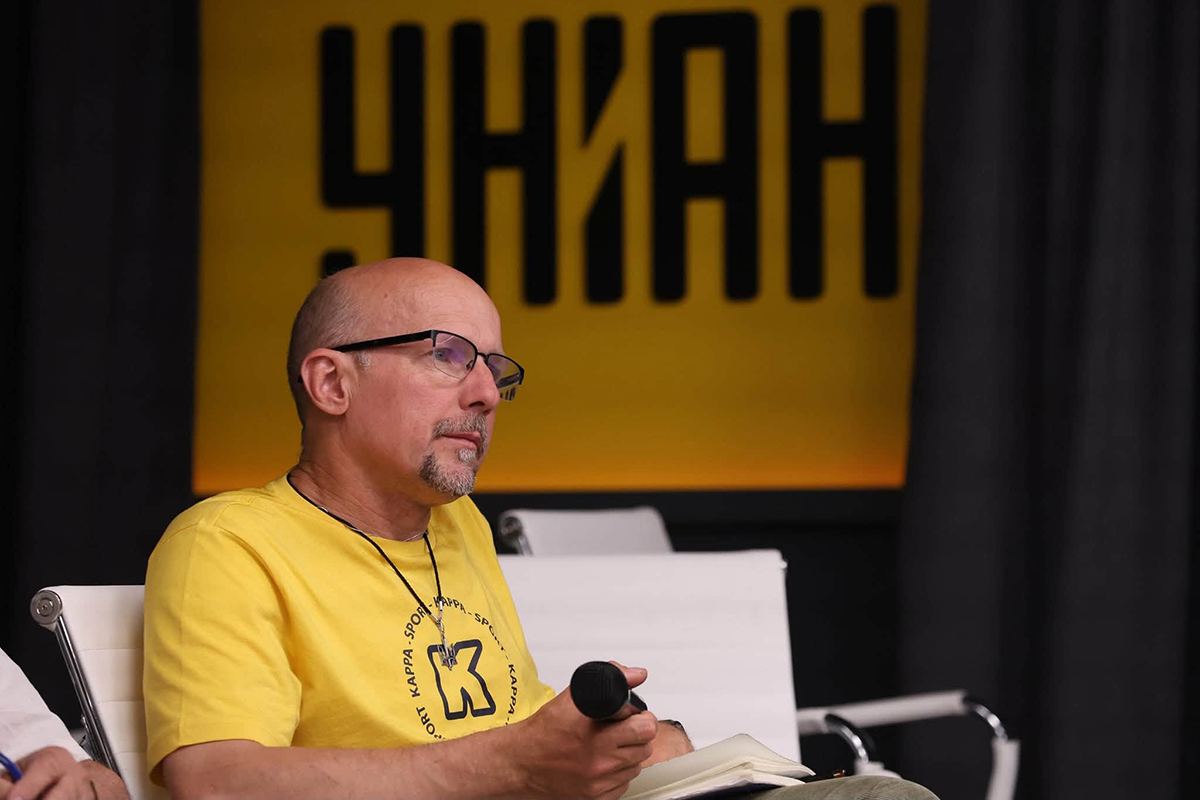
Dmytro Khilyuk
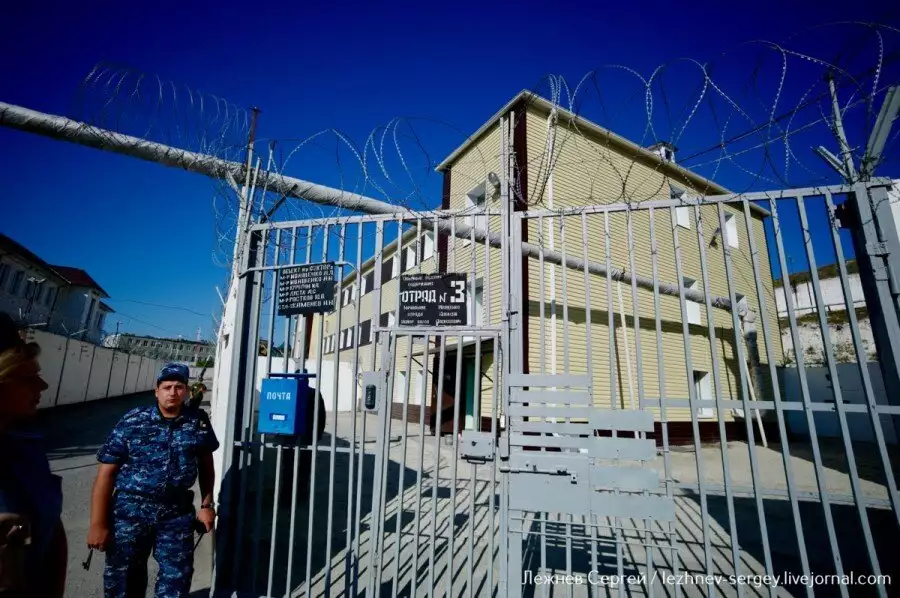
The windows in the prison were broken, and in some places there was no glass at all; there was almost no heating, except for a symbolic amount, and ice formed on the windows. The prisoners were freezing there until the end of May, even though May was already hot. It seems that this pre-trial detention center had already been closed and was reopened specifically for Ukrainians. Even the head was called back from retirement.
During intake, they were brutally beaten, just as Oleksandr had been. They were also forced to sign a piece of paper stating that they voluntarily agreed to cooperate with Russian law enforcement agencies, including reporting on the political views of their cellmates. But later, nobody ever asked them to do this. There were two of them in the cell — Dmytro and another civilian man from Irpin named Oleksandr.
During interrogations at this detention center, conducted by unidentified men, Dmytro was asked about events in Mariupol at the very beginning of the full-scale invasion and in Luhansk in 2014.
“I answered that I knew nothing about Mariupol,” Dmytro recalls, “because I was arrested almost in the first days. I was constantly asked, like everyone else, how I felt about nationalism and Stepan Bandera. I answered evasively, saying that Bandera had his title of Hero of Ukraine taken away by a court decision back in 2010, and that nationalism means loving your country without despising others. And in that sense, I am a nationalist.”
During morning checks, the guards constantly said either that Zelenskyy had fled to Poland or that Ukraine had already surrendered. But, Dmytro says, they were not believed.
“On April 4, the head of the detention center personally came to our cell,” Dmytro says, “and brought a plasma TV with a flash drive. He played the program ‘Besogon’ by Kremlin propagandist Nikita Mikhalkov. It contained the typical set of propaganda clichés of 2022: about biolabs in Mariupol, about migratory birds infected with human diseases that were allegedly carrying diseases into Russia.”
There were several televisions on the floor where Khilyuk was held. Just as in Oleksandr's case in Taganrog, they were carried from cell to cell. And they also had only one button — they showed Russian political or entertainment talk shows such as Field of Miracles with Leonid Yakubovich. In Khilyuk's cell, the antenna could not pick up a signal. But he could hear from the other cells how Russians on the talk shows talked only about victories. They remained silent about defeats. Dmytro compares this with the Soviet program Vremya, from which it was impossible to learn about the existence of any problems. But even from such truncated news, Dmytro understood that the war was continuing and that Ukraine was still fighting.
The televisions were carried from cell to cell until September 21, 2022 — when Putin announced mobilization. After that, the televisions disappeared, leaving only a radio in the corridor. In the morning, the Russian national anthem was played — this was typical of all facilities where Ukrainian prisoners were held. Everywhere, the guards also ordered the prisoners to memorize the anthem. In the cell where Khilyuk was held, someone said that the words were difficult to make out. They brought in a printed copy of the lyrics. Those who could not memorize the words were forced to do an endless number of push-ups.
Then, for about twenty minutes, they played Russian patriotic songs such as “Ya Russkiy” (“I am Russian”) or “Ya idu do kontsa” (“I will go to the end”).
Sometimes it was possible to learn the news from the guards — one of them even said that the Ukrainians had liberated Kherson. Conversations with him made it clear that the situation was not as rosy for the Russians as they portrayed it.
Dmytro spent 33 days alone in a two-person cell in Novozybkov. He says it was psychologically very difficult when there was nothing to do. He walked around the cell and counted his steps. He says he walked up to 40 kilometers a day. This helped him maintain his psychological and physical condition.
A year and two months later, Dmytro was transferred to a pre-trial detention center in Pakino, Vladimir region. His cell there was designed for four people, but eight were held in it. In February, guards came in and put up a black-and-white poster printed on a printer, featuring a photo of Soviet Union hero pilot Ivan Kozhedub. It bore the inscription: “This is Ivan Kozhedub. A Ukrainian and a hero. And you are a Banderite and a traitor to the West.”
“There were guys there who had been born already in independent Ukraine,” Dmytro says. “They didn't know who was on the poster. They asked, ‘Who is this guy?’ The older ones explained. ‘Why do we need this?’ they asked. They were told that it was supposed to make them feel ashamed. They just shrugged.”
In another prison, Soviet songs from the 1970s and 1980s, such as “We Are Each Other's Echo” and “A Man Is a Dog's Friend,” were played from six in the morning until ten at night. Somehow, Boris Grebenshchikov's song “Gorod Zolotoy” (“The Golden City”) from the film Assa also made it into the playlist. Dmytro says that these sounds simply tortured him.
In the so-called transfer cell, where prisoners were prepared to be sent home, there was other hostile propaganda on the walls, equally primitive: photos of Roman Shukhevych, Yevhen Konovalets, and Stepan Bandera with the inscription: “Their hands are covered in the blood of thousands of Ukrainians. Are these your heroes?”
Khilyuk says that if the prison administration has a task of re-educating Ukrainian prisoners, they are doing it very primitively. Their propaganda has no effect on anyone.
Photo: Ukrinform, UNIAN, Zmina