Since February 24, 2022, Detector Media has been monitoring the Ukrainian segment of social media and Kremlin media and documenting the chronology of Russian disinformation about Russia’s war against Ukraine.
Українською читайте тут.
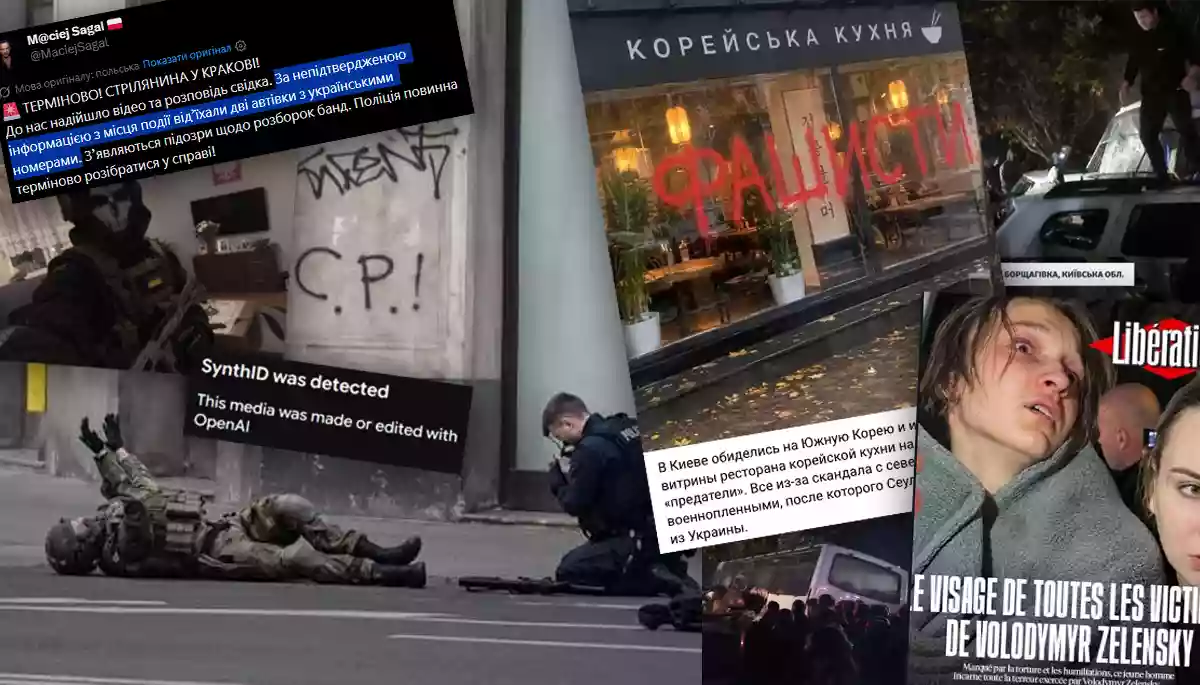
From November 4 to 10, 2026, Detector Media analysts documented 10 disinformation campaigns. Russian propagandists, among other things, forged the covers of foreign media outlets to portray a teenager from Petropavlivska Borshchahivka as a “victim of Azov torture,” and circulated an AI-generated image supposedly showing a Korean restaurant in Kyiv that had been vandalized. In the Polish information space, the tragedy in Kraków was exploited to spread unfounded accusations against Ukrainians.
Foreign media covers forged to support a fake story about an “Azov torture chamber”
Russian and pro-Russian Telegram channels circulated forged covers of the French newspapers Libération and La Croix and the Israeli magazine The Jerusalem Report, all supposedly dated November 3. They featured a photo of a boy wrapped in a blanket, described as a “victim of Zelenskyy” who had allegedly been rescued from an “Azov torture chamber.” The authors of the posts claimed that the story had already been picked up by the foreign press.
The disinformation was based on events that took place on November 2 in Petropavlivska Borshchahivka, where a crowd stormed a building used by the National Guard of Ukraine's 1st Azov Corps as a temporary accommodation point for military personnel. Before that, unverified reports of torture and a death had circulated on social media. According to Radio Liberty, no murdered or tortured people were found during the inspection of the building. The 14-year-old boy in the viral photo had himself taken part in the storming and fallen over a fence into the yard. The State Bureau of Investigation opened a criminal investigation, while the Office of the Military Ombudsman launched an inquiry into whether the rights of military personnel had been respected.
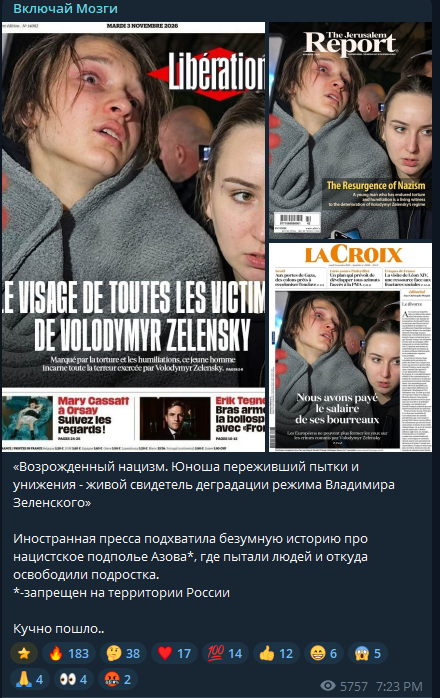
Screenshot from a propaganda Telegram channel
A fact-check of the covers also exposed the forgeries. The actual November 3 issue of Libération was devoted to the US midterm elections, while La Croix focused on Catholics' disillusionment with Donald Trump. The forgers replaced the main photographs and headlines while retaining some elements of the original designs. In particular, the fake La Croix cover still featured a caption about Trump supporters at a rally in Iowa, even though the image above it showed the teenager instead. There was no November 3 issue of The Jerusalem Report at all: the magazine is published every two weeks on Mondays, whereas the date in question fell on a Tuesday.
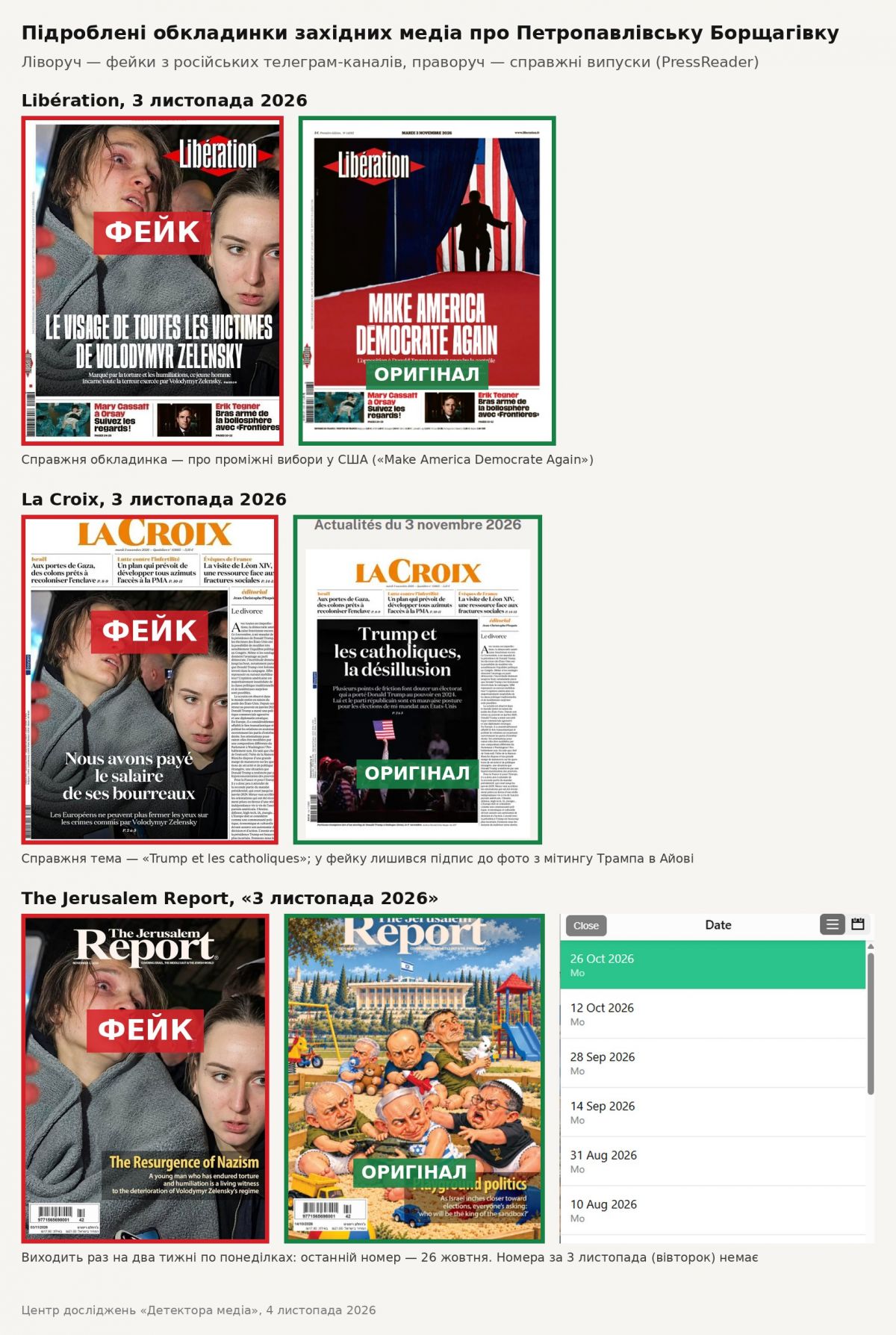
Comparison of the forged and authentic covers
In this way, propagandists exploited a real-life conflict and a photograph of a minor to spread a fabricated story about torture and discredit Ukrainian military personnel. The logos of well-known media outlets were intended to create the impression that the accusations had been confirmed by independent foreign journalists.
AI-generated image presented as a photo of a vandalized Korean restaurant in Kyiv
Pro-Russian Telegram channels circulated an image of the facade of a Korean restaurant bearing the word “fascists.” The authors claimed that the establishment was located in Kyiv and that the vandalism was allegedly a reaction by Ukrainians to deteriorating relations with South Korea.
In fact, as fact-checkers at StopFake established, the image had been generated using artificial intelligence. According to their findings, it contained an invisible SynthID digital watermark. There were also no reports of such an incident in Ukrainian media or from law enforcement agencies.
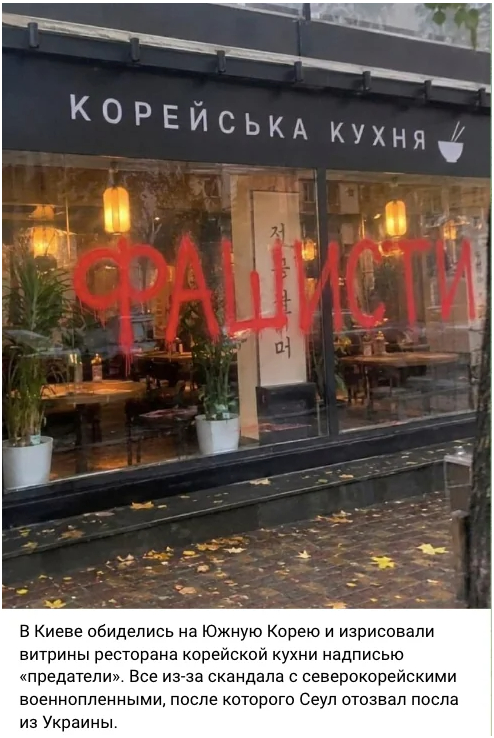
Screenshot from a propaganda Telegram channel
To make the fabrication seem plausible, it was linked to a real diplomatic dispute over the transfer of two North Korean prisoners of war to South Korea. Seoul accused Kyiv of disclosing information that could put the prisoners' families in North Korea at risk, while the Ukrainian side denied that any non-disclosure agreement existed. Propagandists exploited this tension to present an artificially generated image as evidence of Ukrainians' hostility toward Koreans. The aim was to turn a diplomatic disagreement into a story about alleged aggression and xenophobia in Ukrainian society.
Shooting in Kraków linked to Ukraine through rumors and forged photos
Following a shooting on November 7 in Kraków's Main Market Square, which left six people dead, social media users began circulating theories about the involvement of foreigners and a supposed “Ukrainian connection.” Even before the attacker's identity had been officially established, Tomasz Sakiewicz, editor-in-chief of Telewizja Republika, claimed on air that foreigners were involved. Other users wrote about cars with Ukrainian license plates that had allegedly fled the scene.
As Polish fact-checkers at Demagog established, these claims were circulated without any supporting evidence. The Polish police officially confirmed that the detained attacker was a Polish citizen.
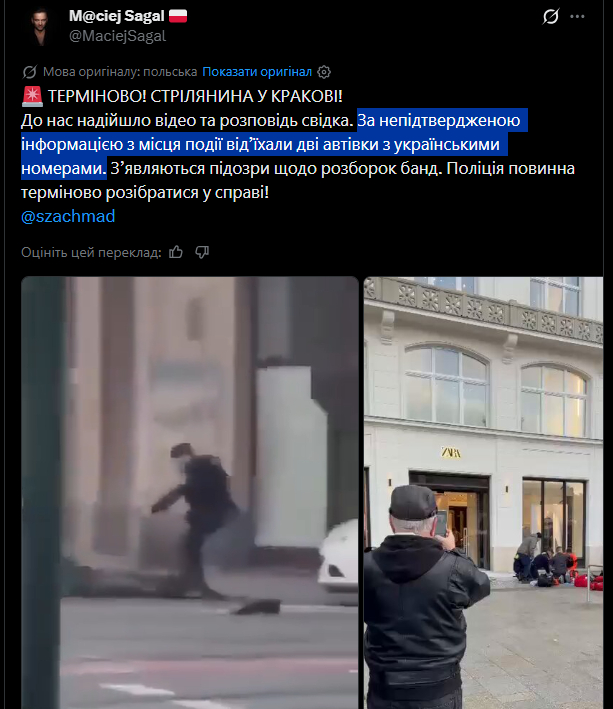
Rumors circulated on X claiming that “foreigners” had been involved in the attack and that “two cars with Ukrainian license plates” had been spotted shortly afterward. Screenshot from the M@ciej Sagal account
Another claim suggested that the man had allegedly fought in Ukraine as a member of the International Legion. The supposed “evidence” was a patch on his equipment depicting a white figure against a black background piercing a red heart with a spear. However, as Demagog explained, the image is a pirate flag known as the Blackbeard flag. Similar patches are used by military personnel from various countries, so they do not prove membership in any particular unit or participation in the war in Ukraine. Poland's Minister of National Defence, Władysław Kosiniak-Kamysz, also stated that the attacker had never served in the Polish military and had no connection to the armed forces.
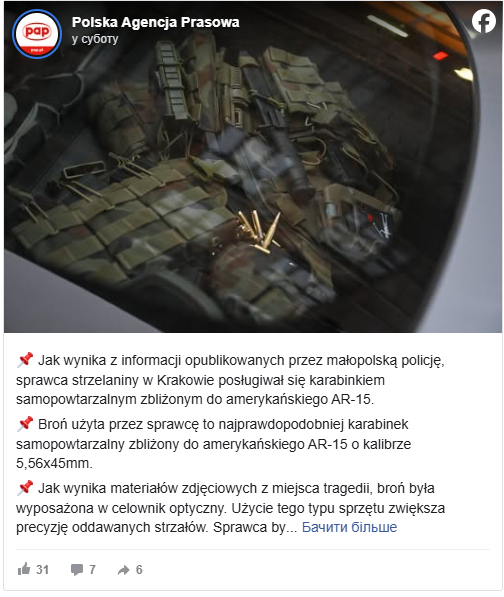
Screenshot of a Polish Press Agency post showing the patch on the shooter's uniform
Another supposed piece of evidence was a photo of a man wearing a vest with a Ukrainian flag, which was attributed to the attacker's Telegram account. Fact-checkers established that the image had been generated using AI: it contained a SynthID watermark. No convincing evidence was found that the account belonged to the attacker, and the post featuring the image had been edited after the attack and the suspect's arrest.
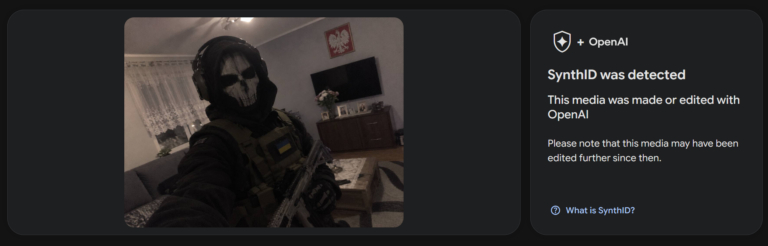
Photo supposedly showing a patch with the Ukrainian flag on the shooter's tactical vest — an AI-generated fake. Source: Demagog
In this wave of disinformation, speculation about the shooter's background was reinforced through the misinterpretation of symbols and artificially created “photographic evidence.” Such messages support a narrative promoted by Russian propaganda: that Ukrainians and foreign volunteers fighting on Ukraine's side pose a threat to Europeans. In reality, however, the alleged “evidence” does not establish any connection between the attacker and Ukraine, while the spread of baseless accusations fuels anti-Ukrainian sentiment.