
Українською читайте тут.
Since February 24, 2022, Detector Media has been monitoring the Ukrainian segment of social media and Kremlin media and documenting the chronology of Russian disinformation about Russia’s war against Ukraine.
From September 9 to 15, 2026, Detector Media analysts documented 11 disinformation narratives. In particular, social media users circulated a clickbait claim about two Russian fighter jets allegedly shot down by Romanian air defense systems, and fake graffiti featuring Zelenskyy in Warsaw; they used AI-generated photos of Friedrich Merz with Jeffrey Epstein; published an AI-generated map of the “partition of Ukraine” allegedly from The New York Times; and also circulated claims about an “anti-Ukrainian jihad” in Belgium.
Clickbait: Romanian air defense allegedly shot down two Russian fighter jets over its territory
At the end of August, a post about a group of Russian combat aircraft that allegedly flew deep into Romanian territory while carrying out a combat mission and were shot down by air defense forces was circulated in the Facebook group “Ukraina Onlain.” A few days later, this information also appeared in other Facebook communities, such as “Poshuk liudei Ukrainy ZNYKLI BEZVISTY UKRAINI/Rozlucheni viinoiu and “Novosti 24.”
Fact-checkers from the Gwara Media portal found that no such information had appeared on the official resources of Romanian authorities or in leading media outlets. In the Facebook group “Ukraina Onlain,” texts with identical content had been circulated more than 20 times since the beginning of June. Each of these posts follows the same pattern: users are first invited to watch a video in the comments, but when they follow the link, readers are taken to closed Telegram channels that are connected to one another.
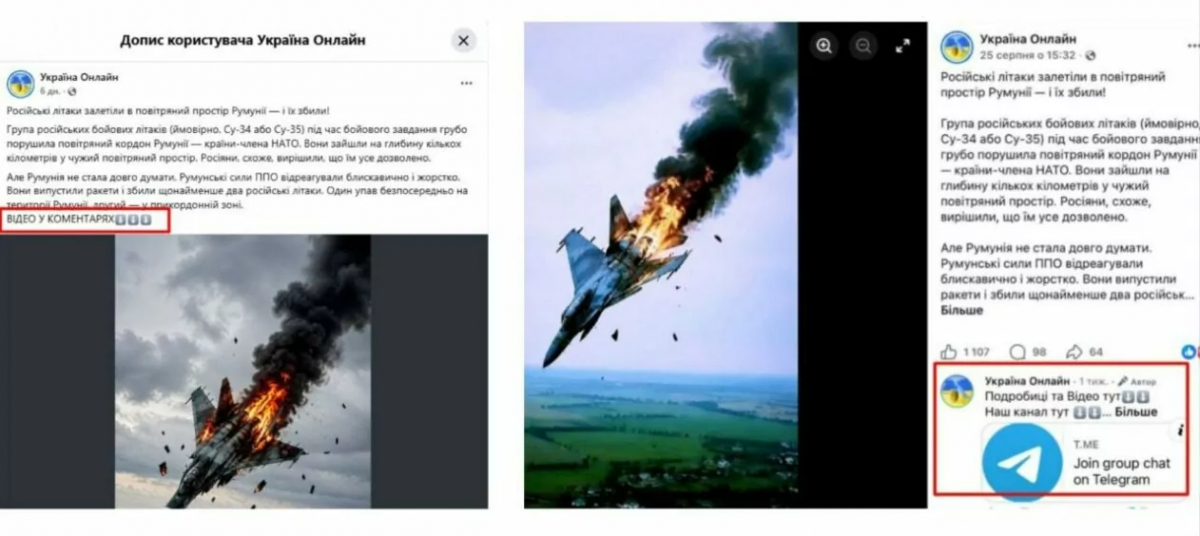
Links to pro-Russian Telegram channels under the posts (screenshot by Gwara Media)
One of them that particularly stands out is the closed Telegram channel “Sheptun,” which, according to information from the Center for Countering Disinformation under the National Security and Defense Council of Ukraine, is an anonymous resource that spreads Kremlin narratives under the guise of pseudo-patriotic content. The Security Service of Ukraine included “Sheptun” in the list of resources operated by Russian intelligence services.
Thus, the circulation of such information under sensational headlines serves as a tool for attracting users from the Ukrainian segment of Facebook to anonymous Telegram channels in order to spread hostile narratives under the guise of pro-Ukrainian resources.
Fake: An AI-generated photo of Friedrich Merz with Jeffrey Epstein was circulated on social media
On September 5, 2026, an account on the X network under the pseudonym Richard posted an image allegedly showing current Federal Chancellor of Germany Friedrich Merz standing next to American businessman and convicted sex offender Jeffrey Epstein. The author of the post hints that the German politician and the American billionaire were former friends.
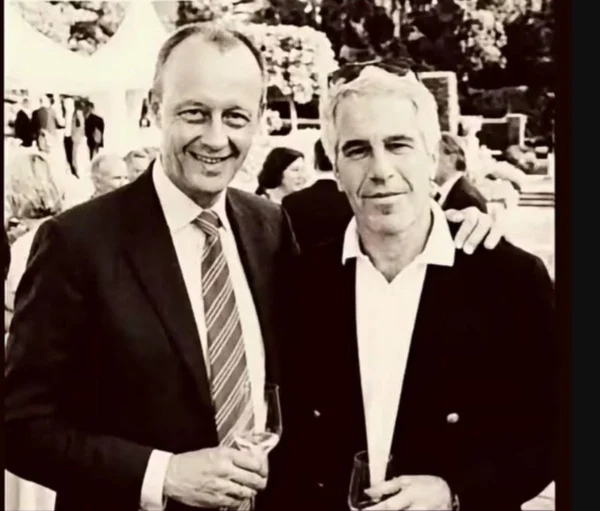
AI-generated photo of Merz with Epstein. Source: X
The image had already been circulating online since July this year. However, at that time it was claimed that the photograph had been taken on June 17, 2014, during Investor Day, an event organized by Black Rock in New York. Fact-checkers from Lead Stories found no evidence that either man attended the event. Moreover, Friedrich Merz began working at the German branch of this company only in January 2016, i.e. long after the appearance of the “compromising image.”
Early versions of the image contained the case number A-2014-017 and document number D-2014-0831. However, neither U.S. government websites nor the database of documents related to the Epstein case contained any results. In addition, fact-checkers checked the image using Google Gemini, where the system detected SynthID, an invisible digital watermark that Google uses to identify materials created by artificial intelligence.
Fake: The New York Times published a map of the “partition of Ukraine” between Russia and neighboring states
At the beginning of September, a number of pro-Russian public pages and Telegram channels published a map of the “partition of Ukraine,” presenting it as an insider report from the news outlet “The New York Times” (NYT). The authors of the posts claim that the publication thereby revealed the “conditions” allegedly put forward by the Kremlin for signing a peace agreement. In the published images, Ukraine’s territory is divided among four states: Russia (controlling the South and East), Poland (controlling the western regions), Hungary (controlling Zakarpattia Oblast), and Romania (controlling Chernivtsi Oblast). In addition, the authors of the publications add fake conditions to the image, allegedly concerning a reduction in the size of the Armed Forces of Ukraine, as well as Ukraine’s renunciation of NATO membership.
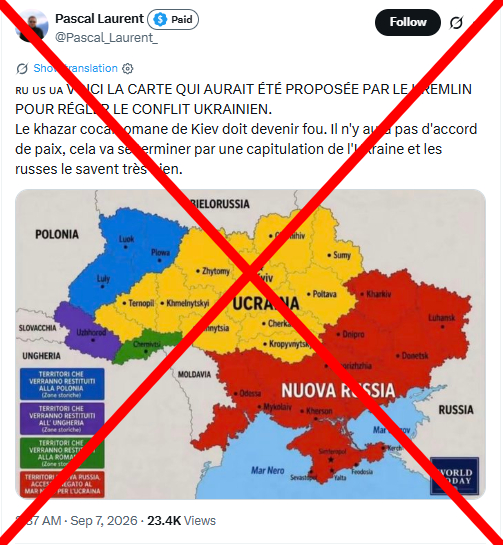
Fake map of the partition of Ukraine circulated by an X account. Source: Ukrinform
Fact-checkers from the Ukrinform portal established that this was fake. A search using the characteristic description of the map did not reveal any similar publications in The New York Times itself. It is also noteworthy that the boundaries of the regions on the map do not correspond to the actual administrative borders, while the proper names are labeled in Italian (Polonia, Ungheria, Romania, Nuova Russia, Mar Nero), indicating that the data is presented inaccurately and that the American publication was not involved in creating the post.
Pro-Russian information resources are actively spreading this fake against the backdrop of attempts by the U.S. administration to intensify the peace process in the Russian-Ukrainian war. Similar posts featuring the image of the “partition of Ukraine” map are being circulated with the aim of sowing distrust in Ukraine’s relations with its Western partners.
Mobilization cards for Poles: how an AI-generated photo became “evidence” of NATO preparing for war
After Polish media reported that legal mobilization cards were being sent to reservists, fake photos of such documents began appearing online. The first to circulate such images were pro-Russian and Ukrainian Telegram channels. In particular, on September 4, just a few hours after the publication of the original RMF FM report, the Telegram channel “Trukha Ukraina” shared an image of such a card for the first time. The same image was posted by the “Politika Strany” channel of the pro-Russian information portal “Strana UA.” After that, such AI-generated images also began appearing on Russian websites. In a publication, “StranaUA” refers without a hyperlink to information from the Polish Central Military Recruitment Center, claiming that this is a standard and annual procedure.
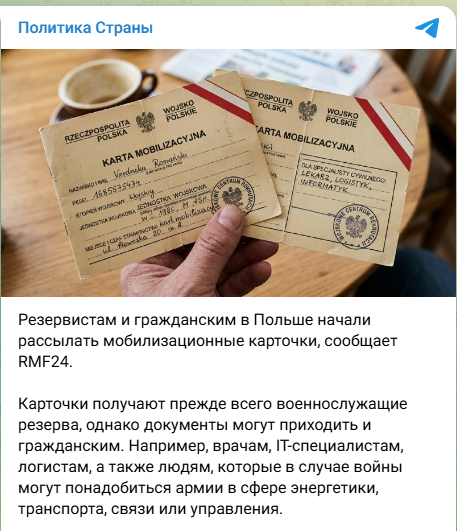
Image of a fake AI-generated mobilization card in a pro-Russian Telegram channel
The Polish fact-checking project Demagog analyzed the image circulated in Telegram channels. In particular, Polish fact-checkers examined the image using the Hive Moderation tool, which showed a 99.9% probability that the image had been generated by artificial intelligence. In addition, the image is full of logical inconsistencies: first, the card lists a nonexistent military rank, “wojskry”; second, genuine mobilization cards, the format of which was approved by an official regulation of Poland’s minister of national defense on May 22, 2024, exist in three colors: red — for the passive reserve, green — for military personnel, and blue — for civilian personnel of the Ministry of Defense. Accordingly, the documents shown in the photographs do not comply with the official regulations governing military conscription documents.
Similar manipulations fuel the narrative of an “aggressive West,” which Russia periodically promotes through both pro-Kremlin and Ukrainian information resources. By intensifying war hysteria, the Kremlin seeks to rally its own society around anti-Western rhetoric.
Fake: Ukrainians were “declared jihad” in Eupen, Belgium
Recently, Russian media have been circulating false claims that the Muslim community in Eupen, Belgium, declared an “anti-Ukrainian jihad.” The authors of the publications claim that local Muslims are threatening Ukrainians with violence because of an allegedly “interethnic” conflict that resulted in the death of a Syrian refugee. According to The Brussels Times, the incident occurred on August 30, 2026, as a result of an argument between children that escalated into a mass brawl involving around 50 people.
Fact-checkers from the StopFake portal found that the deceased man was of Turkish origin and had four children. Moreover, the Belgian publication did not mention the ethnic background of the groups involved in the conflict even once in its post. Meanwhile, the German-language publication BRF.be claims that the conflict took place between Kurdish-Turkish and Russian ethnic groups, which completely refutes the information circulated by Russian media. According to another German-language website, Grenzecho, some Ukrainians also took part in the conflict alongside Russians. At the same time, none of the above-mentioned resources mentions any declaration of an “anti-Ukrainian jihad.”
Thus, Russian media resorted to manipulation and exaggeration of real facts. This is done in order to spread the narrative of a massive surge of hatred toward Ukrainians abroad.
Fake: Graffiti featuring Zelenskyy with the words “Give me money” was “found” in Warsaw
Photos allegedly showing “graffiti” on one of Warsaw’s buildings were circulated on Facebook and in pro-Russian Telegram channels: the wall supposedly depicted Volodymyr Zelenskyy with the words “Give me money.” The message was intended to convince the audience that Ukraine is financially draining Poland and that its president is not a warrior but a beggar. According to Polish fact-checkers from Demagog, the post was first published at 16:08 on September 7 by the Russian-language Telegram channel “Pridnestrovets,” after which, within several hours, it was picked up by other pro-Russian Telegram channels, the Polish-language propaganda channel Ruski Shipek, as well as websites belonging to the network of Russian propaganda resources “Pravda.”
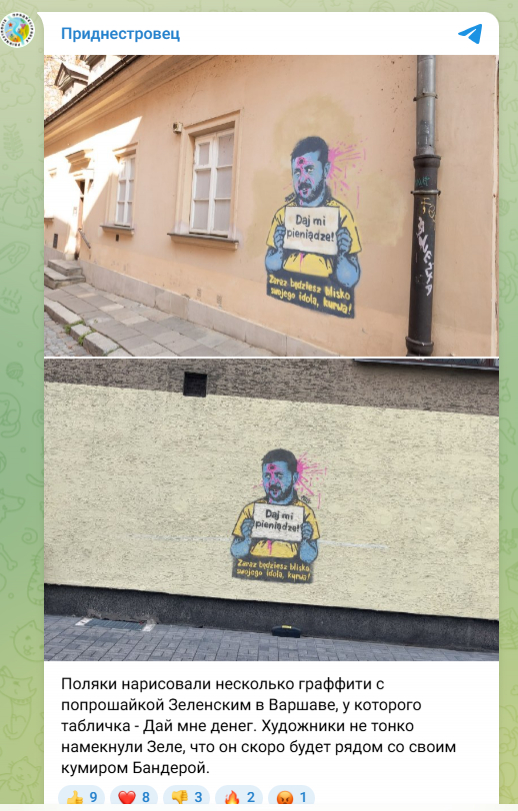
Probable original source of the fake: screenshot of a pro-Russian propaganda Telegram channel
Fact-checkers from Demagog identified the probable address of the building shown in the photographs — 14 Brzozowa Street in Warsaw — and personally checked it on September 8, 2026: there was no graffiti on the wall, only an ordinary stain that had been digitally “drawn over” in the photo to resemble Zelenskyy.
This is not the first similar fake: Georgian fact-checkers from Myth Detector recorded a similar case back in 2023 — at that time, Russians, disguising themselves as German media outlets, circulated a story about a “search for the author of graffiti” in Berlin, in which Zelenskyy allegedly ate the hand of a Ukrainian soldier. Spanish fact-checkers Maldita.es link similar disinformation efforts to the larger coordinated Russian influence campaign “Overload” (“Overload”).
Operation “Overload” is aimed not so much at ordinary readers as at fact-checkers, journalists, and researchers, with the goal of flooding them with a stream of similar fakes and forcing them to spend resources debunking them. At the same time, the image of Zelenskyy as a beggar works to undermine trust in Ukraine among the Polish audience — a country whose military and humanitarian support for Ukraine is one of the Kremlin’s priority targets for undermining.