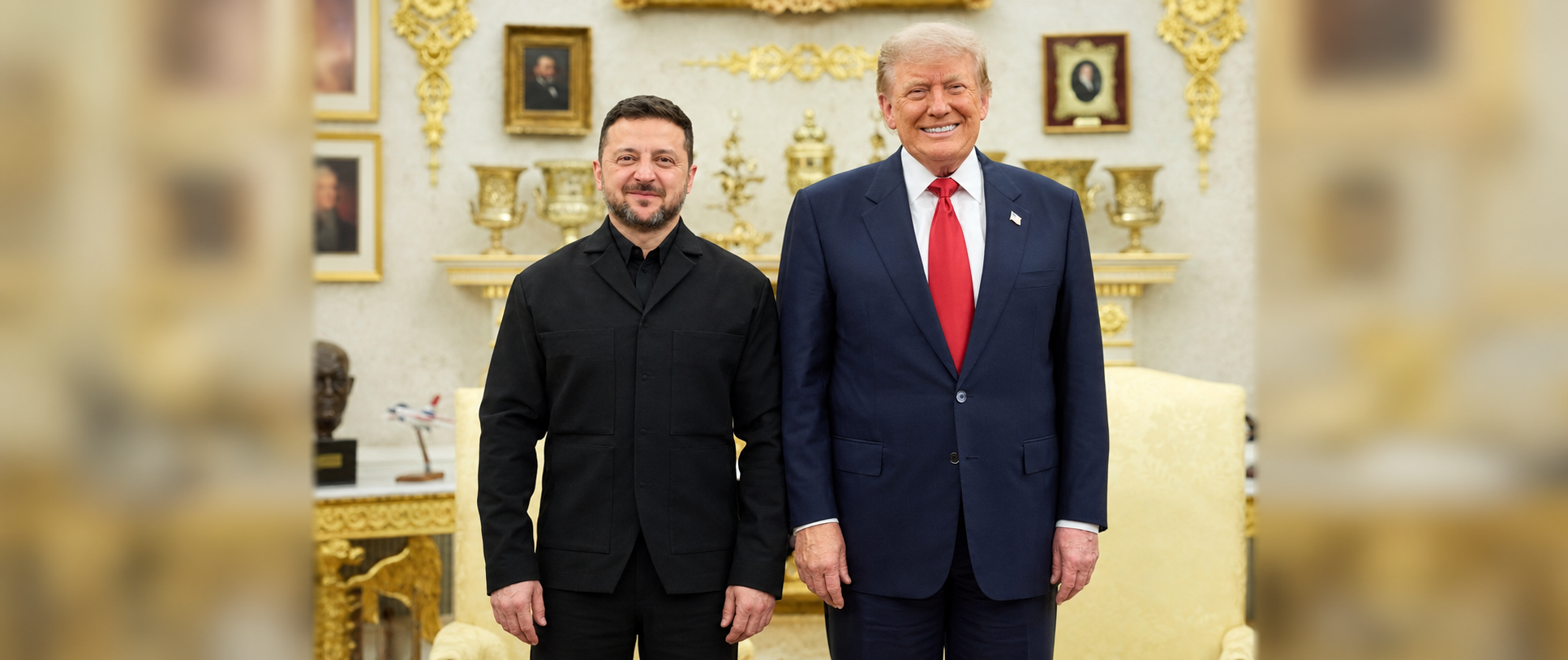

Donald Trump’s demands that Ukraine hold elections during active hostilities have become a recurring feature of the US leader’s thinking whenever he fails to secure concessions from Ukraine.
In response to a question from journalist Tetiana Kozyrieva about what he would like to say to people in Ukraine who suffer from Russian missile strikes every day and are starving under occupation, US President Donald Trump suggested on October 10 that Ukrainians elect a “new leader” who would be “capable of making a deal” with Russia.
Ukraine’s Foreign Minister Andrii Sybiha responded to Donald Trump’s remarks by saying that the decision on elections rests with the Ukrainian people and that statements from abroad only confirm that the president is doing his job well. Ukrainian President Volodymyr Zelenskyy, meanwhile, said he was ready for elections if Russia agreed to a “complete ceasefire for 60 days.”
According to an analysis by the Detector Media Research Center, Donald Trump’s demands that Ukraine hold elections resurface several times a year. His statements are among the most prominent catalysts for discussions about holding elections during active hostilities.
However, Donald Trump’s calls for elections in Ukraine appear to reflect an emotional reaction rather than a consistent position. They most often accompany or follow demands that Ukraine agree to a particular way of ending hostilities favored by Donald Trump’s inner circle or by Russia.
The dynamics and peaks of discussions about holding elections on Ukrainian social media from the beginning of 2025 to autumn 2026. Detector Media, based on YouScan data.
Demands from Donald Trump and members of his inner circle for a change of president began just weeks after Trump returned to the US presidency in January 2025. In February of that year, a confrontation took place between Volodymyr Zelenskyy and US Vice President J. D. Vance in the Oval Office. Following the clash, the US president and vice president began talking about replacing Ukraine’s president.
According to Detector Media’s study, which examined posts with more than 1,000 views or reactions and posts by Telegram, X, Threads, and Bluesky users with more than 1,000 followers, the first spike that year in discussions about holding elections in Ukraine during active hostilities occurred in February 2025. That month, posts supporting elections during active hostilities accounted for almost 17% of all posts in the analyzed dataset that discussed holding elections.
The next peak in demands from the US president for Ukraine to hold presidential elections came between December 2025 and February 2026. At the time, calls for elections followed demands that Ukraine agree to Donald Trump’s “peace initiative.” Its terms included Ukraine ceding to Russia territories in Donetsk and Luhansk regions that Russia had not occupied, in exchange for US security guarantees, and enshrining non-alignment and non-membership in military-political alliances such as NATO in the Constitution. Donald Trump’s “peace initiative” never became an interstate agreement.
The recurring demands for elections are accompanied by recurring arguments explaining why elections cannot be held in Ukraine during wartime. Arguments against holding elections during active hostilities are based on a repeated list of legal, security, and organizational obstacles.
The main legal “pillar” of the argument against holding elections is Article 19 of the Law of Ukraine “On the Legal Regime of Martial Law,” which prohibits elections during martial law. Security- and organizational-related arguments concern the impossibility of ensuring a free expression of the people’s will, conducting election campaigns, and organizing voting for military personnel, refugees, and people in occupied territories while hostilities continue.
Clusters of arguments for and against holding elections in Ukraine during active hostilities in the analyzed sample. Detector Media, based on YouScan data.
Donald Trump’s and his inner circle’s demands that Ukraine hold presidential elections generate debates for and against elections in the Ukrainian information space. In addition to Trump’s assertion that Ukraine “should” hold elections, participants in the Ukrainian information space add arguments about the state’s insufficient effectiveness during active hostilities and corruption.
Arguments that elections are essential to preserving democracy in Ukraine resurfaced following Mykhailo Fedorov’s resignation as Ukraine’s defense minister. At the time, the former minister called for finding a “legal, safe, and realistic mechanism” for restoring elections.
Notably, Donald Trump and Ukrainian opinion leaders focus on replacing the president. Parliamentary renewal and local elections, by contrast, are more often mentioned as an “add-on.” This suggests that re-electing or replacing the person in the presidency is somehow expected to automatically change how the rest of the state institutions operate and alter Ukraine’s foreign policy course. Or that corruption is somehow expected to decline without law enforcement agencies doing their jobs effectively.
The debate over elections in Ukraine provides fodder for bots. Some 67% of the posts in the dataset on which the study was based were reposts or verbatim repetitions appearing two or more times, while 81 posts had been shared more than 100 times. Among these most widely circulated texts were claims that elections were wanted by “external forces” and that Ukraine’s partners had malicious intentions toward the country. This, in turn, damages the image of the United States in Ukraine and plays into the hands of Russian propaganda.
At the same time, statements by Donald Trump, his inner circle, Ukrainian opinion leaders, and bots have no impact on the legislation that prohibits elections in Ukraine. Nor do they clarify how elections could be organized while hostilities continue, Russia refuses to agree to a cessation of hostilities, and Moscow violates the “ceasefires” announced by Donald Trump.
The latest instance occurred on October 11. Donald Trump announced an “energy ceasefire.” Volodymyr Zelenskyy said that Ukraine’s agreement to the ceasefire came as news to him. Meanwhile, Russia did not suspend its attacks on Ukraine’s civilian infrastructure for a single day during the supposed ceasefire, striking, for example, a thermal power plant in Kharkiv.
The following day, Kremlin spokesperson Dmitry Peskov said Russia was prepared to stop shelling for just one day, on election day, but said nothing about halting the Russian army’s offensive. Russian Foreign Minister Sergei Lavrov went even further, repeating the claim that announcing a ceasefire during preparations for elections in Ukraine would amount to a “respite on the battlefield” that, in Lavrov’s view, “Zelenskyy has not earned.”
Ultimately, Donald Trump most often brings up elections in Ukraine when he fails to get what he wants from the country. And what he wants increasingly appears to concern two things: concessions to his business interests and a willingness to submit to terms acceptable to the aggressor, Russia. This pattern does not prove a direct causal link, but it does suggest that this line of thinking has become a consistent feature of Donald Trump’s approach.
By virtue of his office, Donald Trump’s statements about elections in Ukraine are almost guaranteed to become media headlines and spark discussions on social media. Yet these statements do nothing to change reality. Once again, the president of the world’s most powerful country has failed to compel the Russian regime to comply with the conditions that would make elections in Ukraine possible.
Photo: Office of the President