
Українською читайте тут.
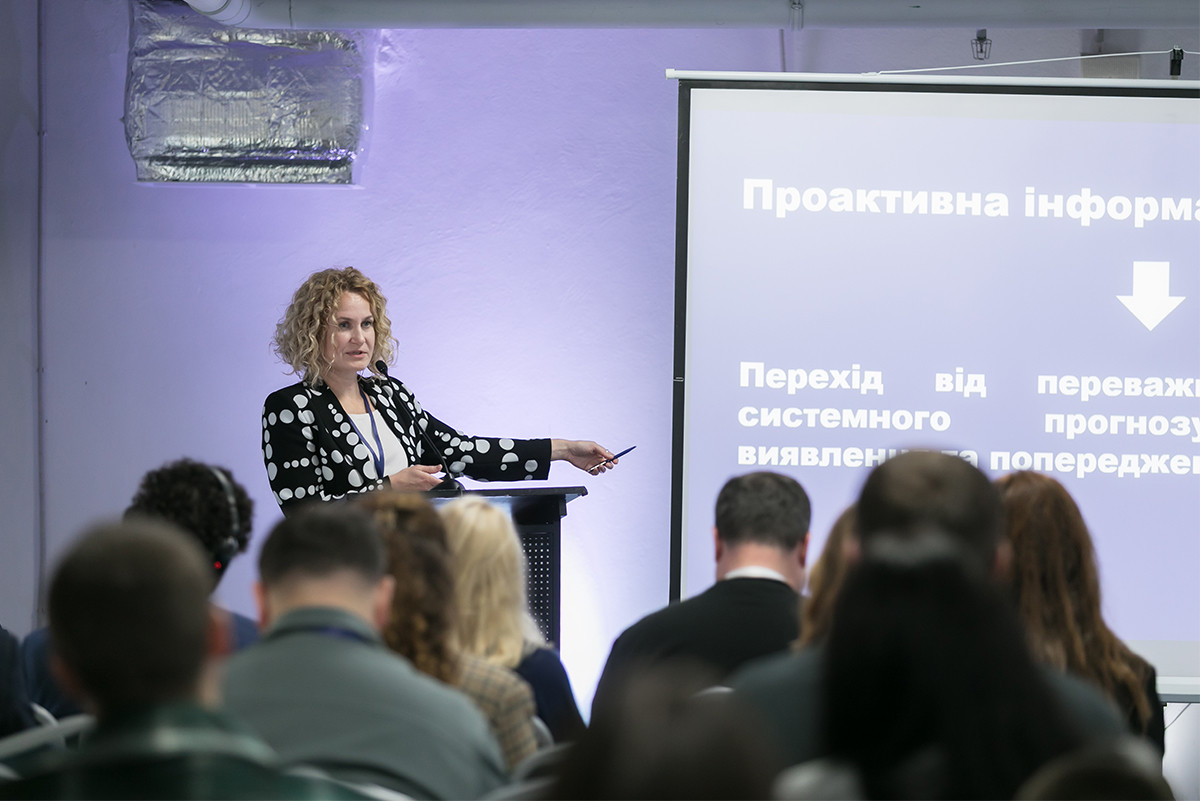
The document was presented by Hanna Krasnostup, Director of the Department of Strategic Communications and Promotion of Ukrainian Culture at the Ministry of Culture of Ukraine.
The Ministry of Culture presented a draft Information Security Strategy, which has already passed the approval process and may soon be submitted for consideration by the government. Hanna Krasnostup, Director of the Department of Strategic Communications and Promotion of Ukrainian Culture, spoke about the challenges the document will address, the goals it sets, and how its effectiveness will be measured.
According to Hanna Krasnostup, more than 20 state authorities were involved in preparing the document. She also spoke about the legal framework for developing the strategy, as discussions are currently ongoing among experts about the legal basis on which this document is being prepared: “We have the main law — ‘On National Security of Ukraine,’ which refers to the existence of the National Security Strategy. This is the main security document on the basis of which all other strategies are planned and developed.”
She explained that the National Security Strategy is a long-term planning document. It is designed for more than five years and is developed on the instructions of the President of Ukraine within six months after taking office. The current National Security Strategy was approved in 2020. It, in turn, provides for the existence of an information security strategy.
The previous strategy was in effect until 2025 and expired together with the operational plan for its implementation. However, according to her, work on the new document began back in January 2025, so its first draft is now available.
“We are coordinating the final version of the draft strategy with the staff of the National Security and Defense Council. After that, it will be ready for submission to the government for consideration in accordance with the established procedure. What does this mean? The government approves it and submits it to the staff of the National Security and Defense Council. The National Security and Defense Council considers and approves it, then submits it to the president for approval by presidential decree. So we expect that we will have an information security strategy in the near future, since the document has formally already gone through all the necessary approvals,” she explained.
The draft of the new Information Security Strategy provides for a number of changes. According to Hanna Krasnostup, the main focus is on a shift toward proactive information security: from predominantly responding to threats to systematic forecasting, early detection, and prevention.
Krasnostup’s presentation states that the goal of the Strategy is to strengthen the state’s capabilities to ensure its information security and resilience to destructive influence, protect the information space, support social and political stability through strategic communications, strengthen defense capabilities, protect Ukraine’s state sovereignty, territorial integrity, and democratic constitutional order, as well as ensure the rights and freedoms of every citizen.
According to Krasnostup, the implementation period was initially proposed to run from 2025 to 2030, but the final timeframe will depend on when the document is approved.
She also said that the most extensive discussions during the preparation of the document concerned not global or national challenges and threats, but the concepts and terms that all participants in the process should use but which are currently absent from legislation. These include FIMI and RIMI — foreign and, separately, Russian information manipulation and interference.
As a result, the working group prepared a glossary of 23 terms. Krasnostup said that it included precisely those concepts that are directly used in the text of the strategy.
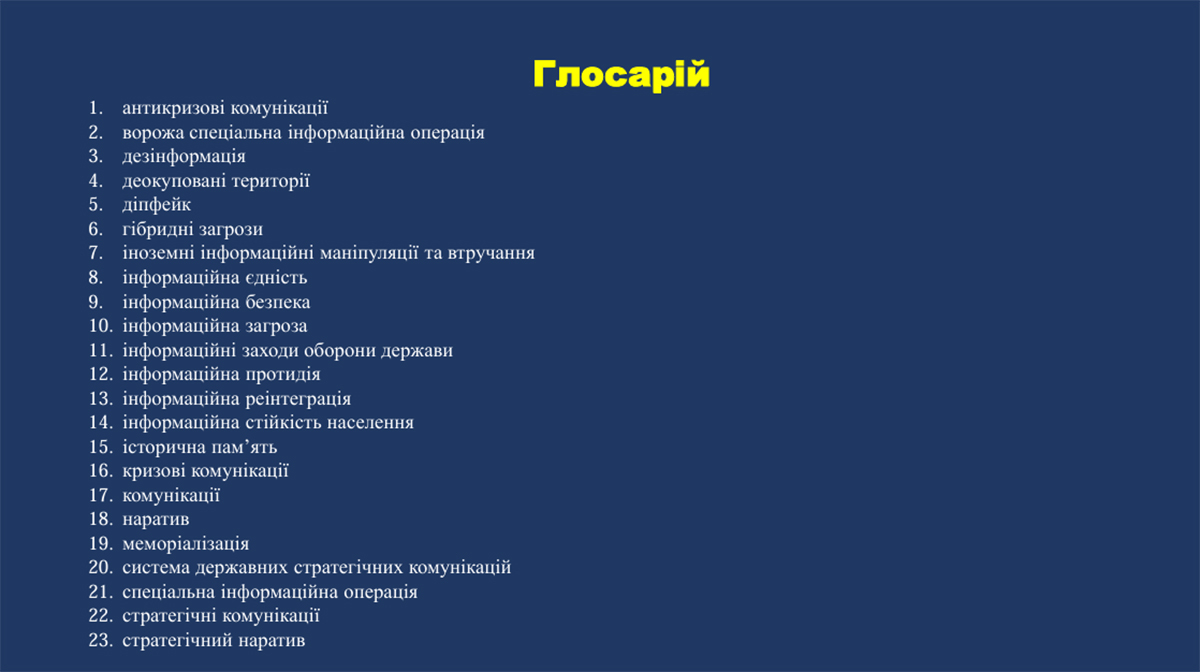
Glossary
According to Hanna Krasnostup, the content of the strategy was essentially divided into three parts. Two of them — global and national challenges and threats — were also included in the previous Information Security Strategy, which was in effect until 2025. The new document adds an assessment of the implementation of the Information Security Strategy for the period through 2025.
A separate section will cover tasks, stages, results, indicators, and estimated necessary resources. Each of the eight strategic goals includes tasks, 47 in total.
“For each strategic goal, my colleagues and I developed a list of tasks. They will then be elaborated in the operational plan of measures. There should be two plans. The first plan is for three years, depending on the duration of the strategy and its approval. And the second plan, under which tasks, measures, responsibility for implementation, and deadlines for implementing the relevant measure are developed for each strategic goal. And this was a challenge for us. The operational plan must contain quantitative and qualitative indicators. That is, not the number of measures carried out — that will tell us nothing, because that is implementation. But clear indicators so that we can draw conclusions about the effectiveness of the strategy’s implementation: what had an impact, how the preferences of our audience have changed, and how much more resilient we have become,” Krasnostup said.
The final part is devoted to the procedure for monitoring and evaluating the results of the implementation of the Strategy and reporting. According to Krasnostup, the effectiveness of such monitoring will largely depend on how well the operational plan for implementing the strategy is drafted.
The strategy also separately defines the global context. According to Hanna Krasnostup, the working group identified four key challenges: disinformation and the globalization of disinformation campaigns, Russian information manipulation and interference, artificial intelligence, and an insufficient level of media literacy.
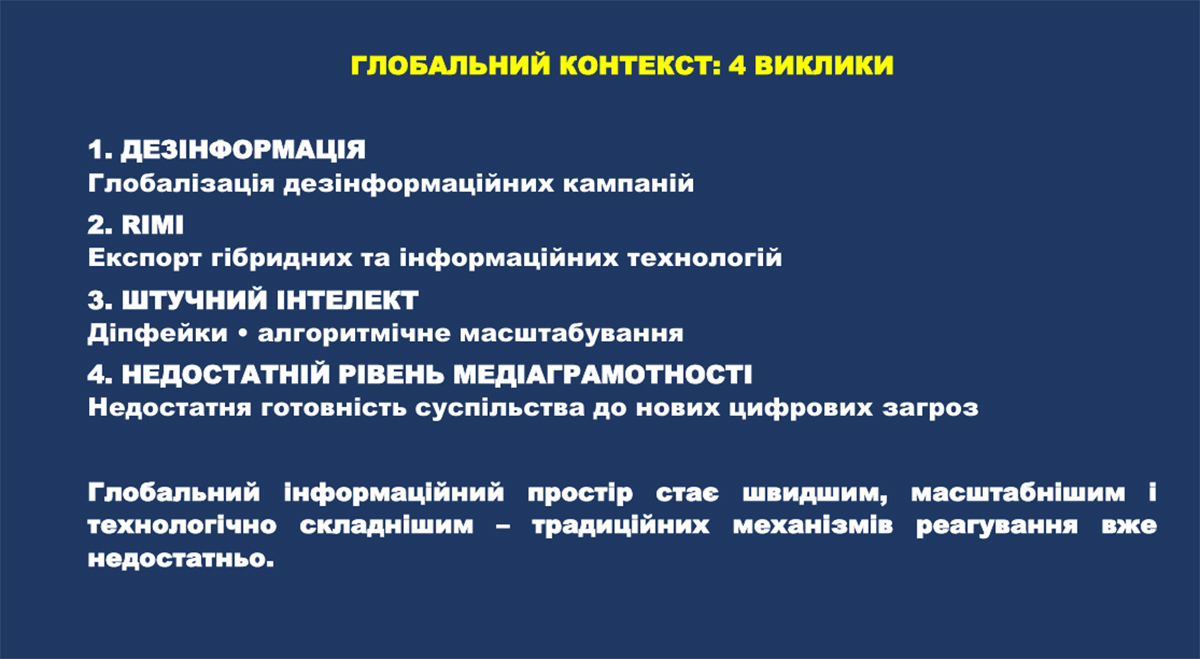
Global challenges
Artificial intelligence, Krasnostup explained, not only has positive potential but also creates new threats. These include deepfakes and the algorithmic scaling of content, which can affect societal resilience.
An insufficient level of media literacy was also identified as one of the global challenges. The global information space is becoming faster, larger, and more technologically complex, so traditional response mechanisms are no longer sufficient.
Media consumption trends were an important part of the analysis. According to Hanna Krasnostup, the Ministry of Culture is trying to take into account the results of various studies in this area, and the identified trends remain relevant.
In particular, an InMind study conducted in 2023 showed that the number of people who use the internet every day is steadily increasing each year. In 2023, this figure reached 89%, while among people aged 18–35, 98% reported using the internet every day. 87% of respondents use smartphones to consume news, and among the younger 18–35 age group, this figure is 97%. Krasnostup explained that this information is important for understanding national challenges, including the ways information and manipulation are disseminated.
Particular attention was paid to the popularity of digital platforms. According to Krasnostup’s presentation, almost all respondents in the NDI study conducted in 2026 use Telegram (92%), Instagram (81%), TikTok (69%), and YouTube (68%) every day, indicating an extremely high saturation of the digital environment and the multiplatform nature of consumption. Alongside various information hygiene strategies, trust in information is often viewed through the lens of skepticism: nothing can be considered 100% certain.
According to the quantitative study of media consumption among Ukrainians, “MediaTrack 2025”, conducted by Suspilne, 67% of respondents aged 18–70 have experience using AI, while 47% use AI at least once a week. 48% of AI users turn to AI instead of searching for information on news websites, social media, or Google. More than 50% of those surveyed may simply ask AI what is happening in the world. Viewers are increasingly watching television programs not via broadcast television, but through OTT platforms (Kyivstar TV or Megogo) and YouTube. YouTube has become the country’s main “television,” where viewers are increasingly willing to pay for content.
The next section of the document concerns national challenges and what is expected to change after the strategy is approved and its implementation begins.
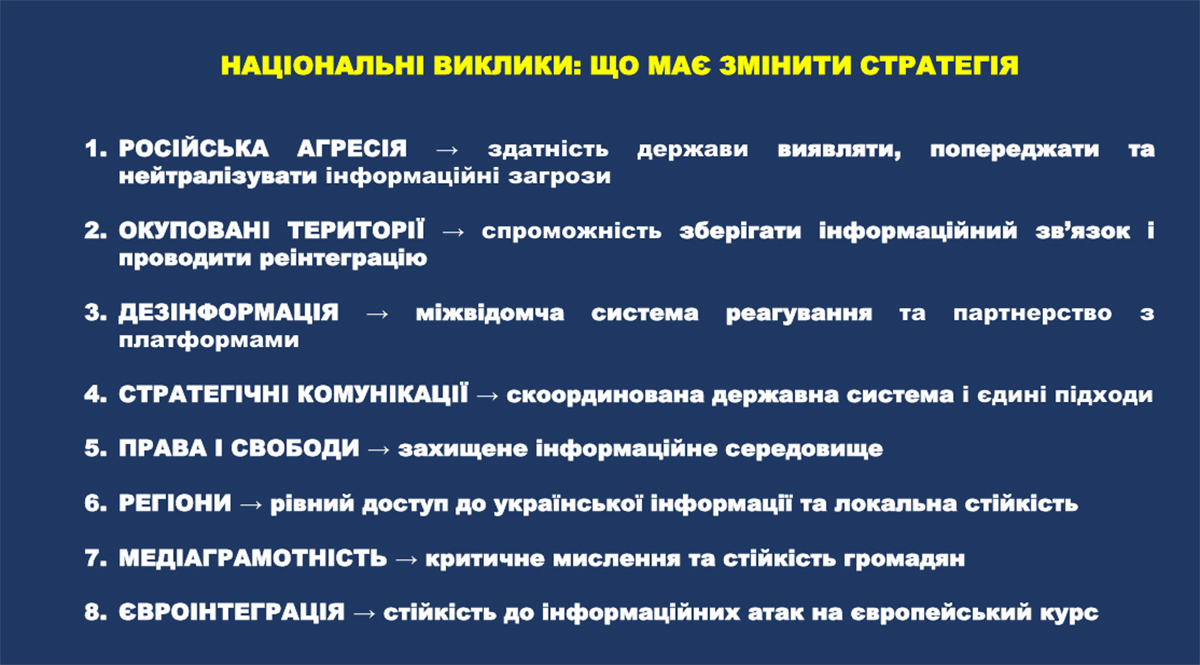
National challenges
The working group identified eight challenges, including Russian aggression, occupied territories, the spread of disinformation, strategic communications, and others. The strategy is aimed at strengthening the state’s ability to detect, prevent, and neutralize information threats, maintain information links with the occupied territories and carry out reintegration, protect the information environment, ensure equal access to Ukrainian information from all regions, and strengthen resilience to information attacks.
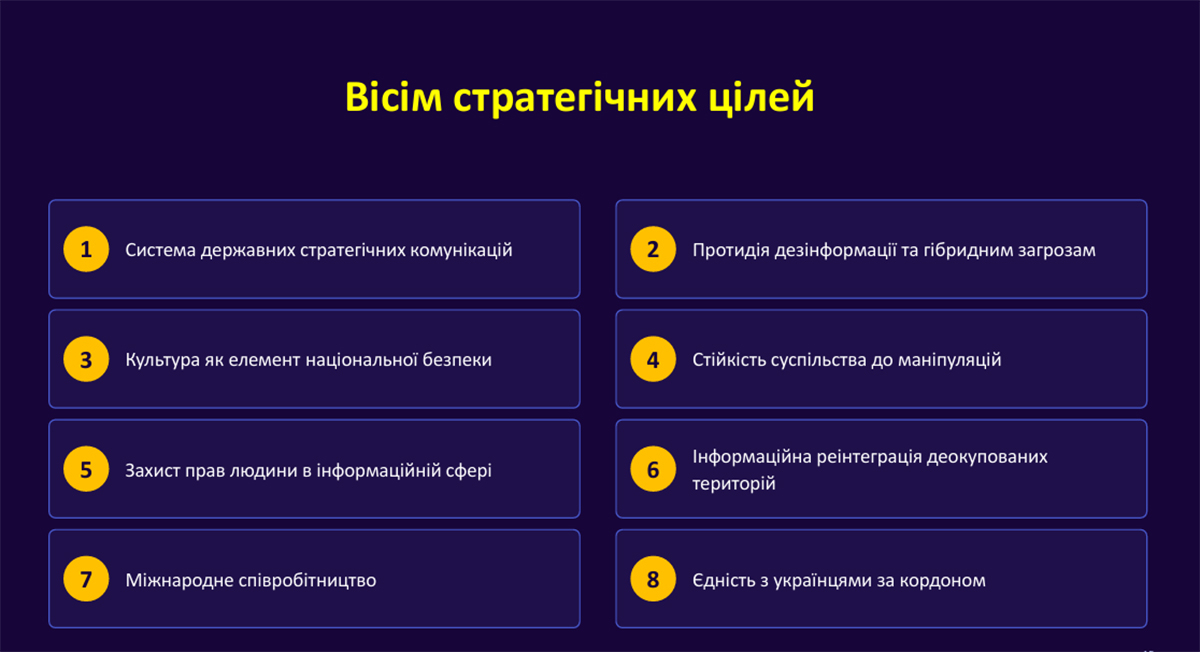
Eight strategic goals
The first strategic goal of the new Information Security Strategy provides for the development of a system of government strategic communications. It should ensure the proactive dissemination of Ukrainian narratives in the national and international information space and promote Ukrainian national and civic identity.
“It would be incorrect to say that we currently do not have a government strategic communications system. Is it effective? No. That is my personal assessment. This system is complex. A large number of government bodies are involved in strategic communications. As of January 1, 2026, we officially transferred the strategic communications functions to the State Television and Radio Broadcasting Committee. The state institution ‘Center for Strategic Communications and Information Security’ never got off the ground and never became operational due to a lack of budget funding,” the official said.
The ministry, she added, is working on implementing the tasks that have already been formulated together with other agencies and regional military administrations.
The second strategic goal is to counter disinformation, hybrid threats, foreign information manipulation and interference in the national information space.
A separate goal of the strategy is devoted to culture, which is why in 2026 the president’s initiative to produce Ukrainian content, “Tysyachovesna”, was launched. Expert discussions are being held in parallel, since, according to Krasnostup, each area is determined based on the preferences and needs of the audience.
Krasnostup cited Russia as an example, where the Internet Development Institute operates. Through this organization, millions of dollars are allocated to social advertising, books, videos, films, animation, children’s content, and content for adults. Therefore, in her opinion, Ukraine needs to be proactive in this area in order to fill the media space with its own high-quality products.
“Civil society institutions may say that we are investing large amounts of money in propaganda. No. It can be entertainment, educational, informative, or historical content, but in Ukrainian, high-quality, and interesting. We are doing everything to ensure that it appears in the near future,” Kasnostup said.
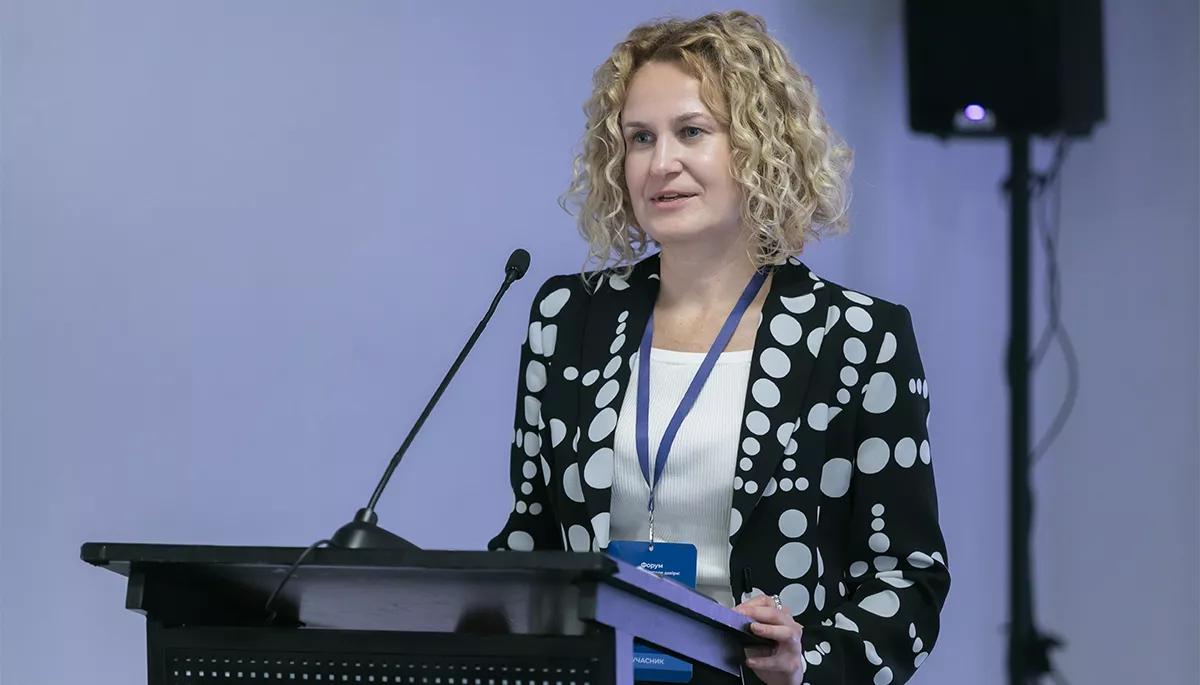
Hanna Krasnostup during the presentation
The third strategic goal treats culture as an element of national security that encompasses various areas of Ukrainian society’s life. Hanna Krasnostup says that historical memory is preserved through support for national cultural products and memorialization, which creates conditions for strengthening Ukrainian national and civic identity.
“Culture is our core. If we have a cultural identity, we have something to protect, something to be proud of, someone to mourn — we are stronger. This is our inner world. And there is something worth protecting. As long as there is culture, there is a nation,” she said.
The fourth strategic goal concerns the resilience of Ukrainian society to disinformation, hybrid threats, foreign information manipulation, and interference in Ukraine’s national information space.
According to Krasnostup, Ukraine has a strong track record in media literacy, but it still ranks in the middle of international and European indices.
“As long as almost half of our population uses AI to search for news, that is not okay. The Ministry of Culture will support all media literacy initiatives aimed at overcoming this problem. There is the ‘White List’ of quality media, and there are a large number of initiatives. Oksana Moroz, IREX, Detector Media — everyone is doing a lot, but there is still work to be done. That is why we insist that media literacy must be reflected in a separate strategic goal of the Information Security Strategy. If we are not media-literate, it will be very easy to defeat us if we do not respond to this,” she said.
Hanna Krasnostup also mentioned a Gradus study, according to which people aged 55 and older show the highest interest in educational media literacy initiatives (33%). Thus, contrary to popular belief, older people are not the most vulnerable audience.
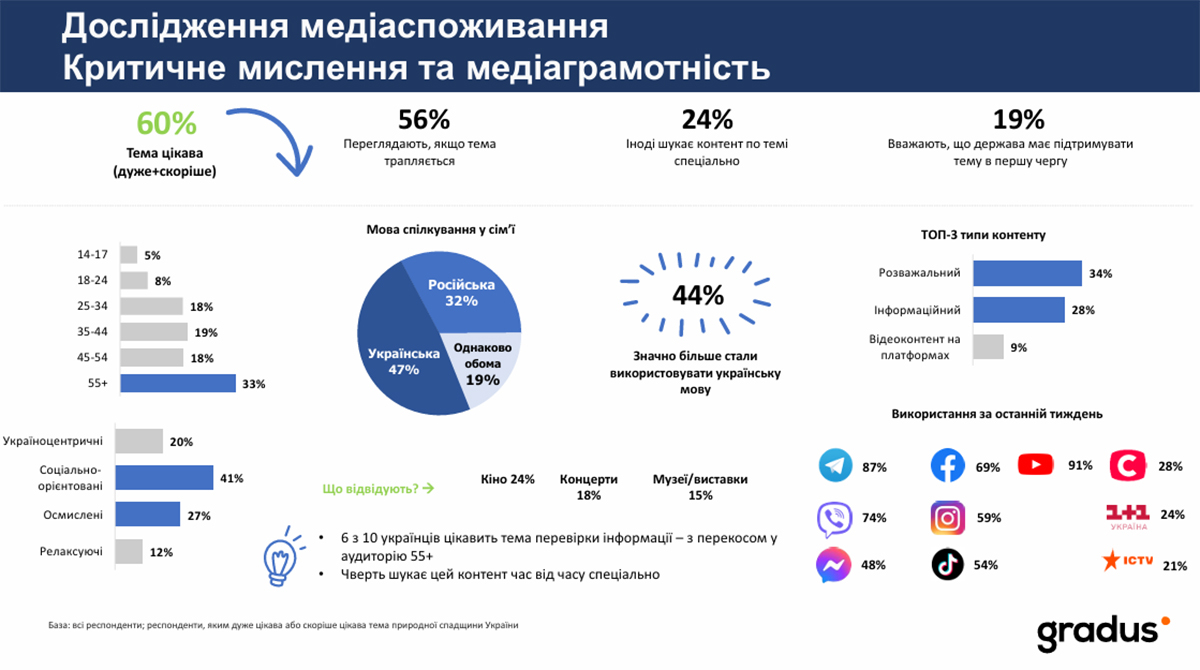
Media consumption study
Krasnostup also mentioned the study “Russian propaganda in video games”, conducted by Games Gathering with the support of the Ukrainian Cultural Foundation. According to its findings, around 80% of such games are aggressive. Since 2014, and especially after 2022, they have used not only narratives but also geographical maps, depicting, for example, parts of Ukraine as Russian territory.
According to her, Russia spent $19 million on games in 2024 and $43 million over three years — but this is only what researchers managed to find in its budget.
66% of all games feature propaganda at a “leading” or “regular” frequency. 80.4% of the games in the sample (40 out of 50) exploit the “law enforcement and security forces” thematic cluster (promoting Russia’s security agencies and military). 60% of games released between 2022 and 2025 feature a high level of aggressive propaganda (by comparison, this figure was only 7.7% between 1991 and 2013).
Krasnostup believes that Russian games are not particularly high-quality yet, but they are improving, so the threat to young people is growing. Moreover, video games are played not only by children.
The fifth strategic goal is to improve mechanisms for protecting human rights in the areas of collecting, storing, using, and disseminating information; freedom of expression and belief; and access to objective and reliable information.
According to the Access Info Europe methodology, Ukraine ranks first among 15 European countries in terms of access to public information, scoring 227 out of a possible 300 points. It ranks 55th out of 180 countries in terms of press freedom, according to the 2026 World Press Freedom Index published by Reporters Without Borders.
According to Krasnostup, Ukraine has much to be proud of, but there is also room for improvement. For example, when responding to information requests, institutions may provide detailed and timely answers that do not actually address what journalists asked. In addition, not all media outlets are accessible and provide information in formats such as sign language.
Furthermore, according to her, during the four years and seven months of Russia’s full-scale war against Ukraine, 977 crimes have been committed against journalists and media outlets, and 28 media workers remain in Russian captivity.
“We have the Coordination Committee for the Protection of Journalists, Media Hubs, and the Journalists’ Solidarity Centers run by the National Union of Journalists of Ukraine. This network in Ukraine works very effectively for both Ukrainian and international journalists. What we can do together is appeal to our partners, for example, to provide Media Hubs and Journalists’ Solidarity Centers with equipment, helmets, body armor, including for women, laptops, EcoFlow power stations — anything that will help create comfortable working conditions. Unfortunately, the state cannot cover everything. As of August, there were 7,252 media outlets in Ukraine, and 99.99% of them were privately owned. But we must create favorable conditions for every media outlet. That is why this strategic goal is important for our Information Security Strategy,” she said.
The sixth strategic goal is to implement measures for the information reintegration of Ukrainian citizens living in territories temporarily occupied by Russia and to restore effective channels for providing people with objective and reliable information in the de-occupied territories of Ukraine.
According to Hanna Krasnostup, it was important to divide this goal into two parts to take into account the situation in the free and occupied territories of Ukraine. Russia is waging a war not only in the physical and information spaces. It is a war of meaning that affects the cognitive space: culture, ideology, religion, language, art — everything that creates meaning in human existence. There is also a semantic (conceptual) war, which is a “war for the right to name phenomena and events,” described by Anton Vaino, head of the Russian Presidential Administration, as the highest level of warfare.
The seventh strategic goal is to ensure Ukraine’s information security internationally. According to Krasnostup, the key stakeholder here is the Ministry of Foreign Affairs, but it must not act in isolation. Instead, it must operate within a system in which every government body contributes within its area of responsibility.
The eighth strategic goal is to ensure information unity and support Ukrainian national and civic identity among Ukrainians living abroad.
“We must ensure that people receive objective and reliable information about Ukraine and create favorable conditions for their return. This is, of course, about more than information and communication campaigns. The state must create social and economic conditions. And our shared task is to ensure information security and inform people about it,” Krasnostup said.
Regarding funding, she explained that the ministry would not rely exclusively on the state budget, as that would be impossible. In addition to state budget funds approved for the relevant year and local budget allocations within approved limits, the strategy will be supported by financial assistance from international partners and other sources not prohibited by Ukrainian law.
“I would like to emphasize that it is very important for the operational plan to have clear quantitative and qualitative indicators for each task so that we can monitor the results. We have, of course, included indicators,” she said.
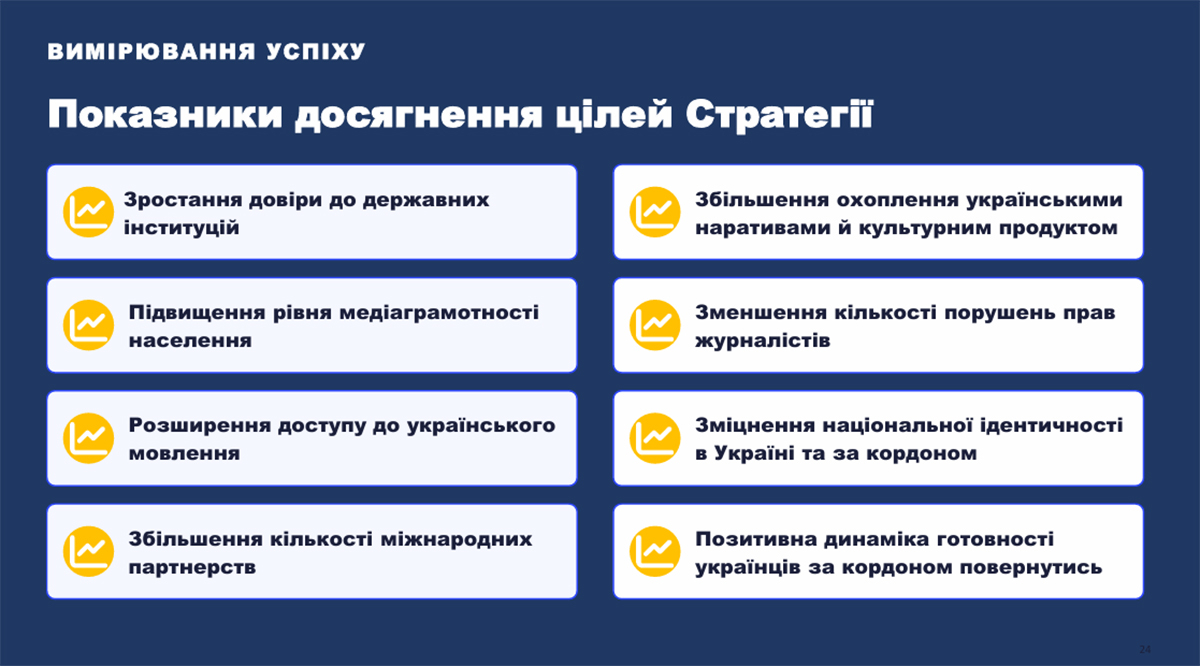
Measuring success
“It is clear that this is a comprehensive set of measures, but it also concerns the state’s information policy, raising the population’s media literacy, expanding access, increasing the number of international partnerships, increasing the presence of Ukrainian narratives and cultural products, reducing the number of violations of journalists’ rights, strengthening national identity in Ukraine and abroad, and a positive trend in the willingness of Ukrainians living abroad to return. This is the result we will be able to see. It will show whether our strategic documents are being implemented or whether they have remained merely on paper,” Krasnostup explained.
She added that it was very important to ensure that electricity, internet access, and broadcasting — both television and radio — were available everywhere so that people could choose their sources of information and have full access to them.
Krasnostup also identified stronger international cooperation and the information unity of Ukrainians as important outcomes. “We are one people. Every Ukrainian, regardless of where we live, is part of our society. We must keep people informed and make sure we stay connected with them,” she concluded.
Presentation slides provided by Hanna Krasnostup