



Українською читайте тут.
We analyze how global media interpret the events in Davos, what key points they highlight when covering the positions of Zelensky, Europe, and Trump, and what vision of the West’s future they present to their audiences.
The World Economic Forum in Davos took place on January 21–23, 2026, against the backdrop of rising global security tensions and a shifting U.S. role in world affairs. The event was held under the theme “The Spirit of Dialogue.”
Alongside the traditional economic agenda—macroeconomic stability, supply chains, technology, and the energy transition—the forum’s key topics included Russia’s war against Ukraine, prospects for a peace settlement, the future of transatlantic security, and Europe’s role amid a possible reduction in U.S. engagement.
However, the Forum took place with the active participation of U.S. President Donald Trump, whose statements on NATO, Europe, and potential territorial changes—particularly regarding Greenland—became key topics in most political discussions in Davos.
At the same time, U.S. initiatives on global security and mediation in conflicts were discussed, including the war in Ukraine and the situation in the Middle East.
President Zelensky delivered several public addresses and held a series of bilateral meetings with Western leaders. He did not confirm his participation in the forum until the last moment: on January 20, the day after the forum opened, he said he was “choosing Ukraine” amid a massive Russian bombardment and would not go to Davos. However, after several statements by Trump about the need to meet with the Ukrainian president, Zelensky decided to travel to the forum.
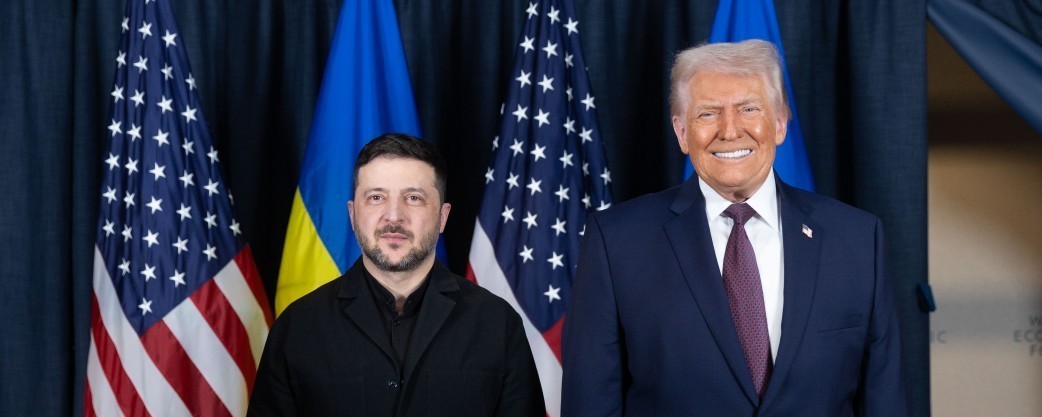
The meeting took place on January 22. The Ukrainian president described it as “good and positive.” He stressed that Ukraine is working on a peace agreement every day and that the United States and Europe must support Ukraine. Trump also said the meeting went “well.” According to Zelensky, the leaders discussed their teams' work and Ukraine's air defense.
In this context, journalists and reporters shifted their focus to how the forum’s key participants articulated the crisis and the transformation of the Western order. Below is how the global media covered Davos.
The American outlet The New York Times, in its article “Zelensky Laces Into Europe, Saying It Must Step Up or Be Left Behind,” frames his current Davos speech primarily as a sharp rhetorical shift and a deliberate break with established diplomatic tone. The author focuses not on specific proposals or agreements, but on the tone of the Ukrainian president’s speech—“tough,” “unexpected,” and potentially risky for relations with key European allies. The article emphasizes that this criticism came at a moment when Europe remains Ukraine’s main donor and political partner amid U.S. disengagement.
“Mr. Zelensky’s speech, delivered at the World Economic Forum in Davos, Switzerland, was among his most scathing critiques of Europe. It was unexpected, given that the continent has become Ukraine’s most reliable ally as the Trump administration has stepped back from supporting Kyiv’s war effort,” the article notes. “His remarks risked straining Ukraine’s alliance with a continent that has remained a steadfast source of financial, humanitarian and military support throughout the war, especially after the United States under Mr. Trump disengaged from Ukraine.”
On the one hand, the outlet acknowledges Ukraine’s difficult domestic situation (the front line, energy strikes), but on the other, it highlights the potential cost of such rhetoric—the risk of tensions with Europe.
The piece is structured as a contrast between roles: Europe is portrayed as an indispensable ally of Ukraine and, at the same time, as weak, confused, and unprepared for independent leadership. Journalist Konstantin Meyer emphasizes that, within this framing, Zelensky appears not as a petitioner but as a moral and strategic critic speaking from the position of a frontline state to a continent accustomed to relying on the American “security umbrella.”
Another New York Times article, “Fact-Checking President Trump’s Speech in Davos,” provides a detailed verification of his statements. The piece is structured in a fact-checking format but serves a broader purpose—deconstructing Trump’s political style. From the outset, the outlet argues that this was not so much a diplomatic speech at a global forum as a series of manipulations that Trump is transferring from U.S. domestic politics onto the international stage. The article’s author, Linda Qiu, cites historians and researchers, creating a rational counterweight to Trump’s emotional and impulsive rhetoric. This is not a “opinion versus opinion” debate, but a comparison of facts with political myth-making.
The most high-profile element of the speech was Trump’s claim that after World War II, the United States “gave” Greenland to Denmark, allegedly voluntarily relinquishing control over the island. In reality, this refers only to a 1941 agreement that allowed the U.S. to station military bases in Greenland while explicitly recognizing Danish sovereignty. The author emphasizes that even at the peak of American power, there were no legal grounds for annexation, and all subsequent agreements only confirmed Denmark’s sovereignty.
Another section of the speech focused on NATO. Trump again claimed that before him, the United States had essentially financed the Alliance alone while allies paid nothing. This assertion is misleading: the U.S. never covered 100% of NATO’s budget, and the increase in allied defense spending was a gradual process driven not only by Trump’s pressure but also by Russia’s full-scale aggression against Ukraine. Equally false is the claim that the U.S. “got nothing” from NATO, since the Alliance invoked Article 5 for the first time after the September 11 attacks, providing direct military support to the United States.
In addition, Trump repeated several previously debunked claims—from inflated figures on aid to Ukraine to absurd statements about drug prices falling by “thousands of percent.”
In its article “Zelenskyy blasts global inaction on Iran, claims Europe stuck in 'Greenland mode',” Fox News frames Zelensky’s speech as evidence supporting its own narrative: the world is becoming more dangerous not because of excessive U.S. toughness, but due to European weakness and Western indecision. In the journalistic portrayal, Zelensky appears not as a diplomat but rather as a hard-nosed realist speaking the language of power, making him a convenient interlocutor for a conservative U.S. audience (the outlet is known for its Republican-leaning stance).
Another key point is the expanded focus beyond Ukraine. Reporter Morgan Phillips references Iran, Belarus, Taiwan, China, and global supply chains, turning Zelensky’s speech into a broader warning about the failure to contain authoritarian regimes. Ukraine is presented as an example, not an exception: its war fits into a larger picture of global confrontation.
In its article “Zelenskyy lays into ‘lost’ Europe for trying to ‘change’ Trump and not dealing with global threats,” CNBC presents the points made by the Ukrainian president during his Davos speech as an indicator of strategic frustration. In this interpretation, Europe’s problem is not a lack of resources but a lack of agency. Ukraine appears not only as a victim of war but also as a mirror reflecting Europe’s inability to move from words and tradition to real power.
“In a week where the focus in Davos has been on U.S. threats to annex Greenland, its tariffs on European countries and a new Gaza 'Board of Peace,' Zelenskyy began his speech saying Europe’s inaction left his country feeling like it was living through 'Groundhog Day,'" the authors write.
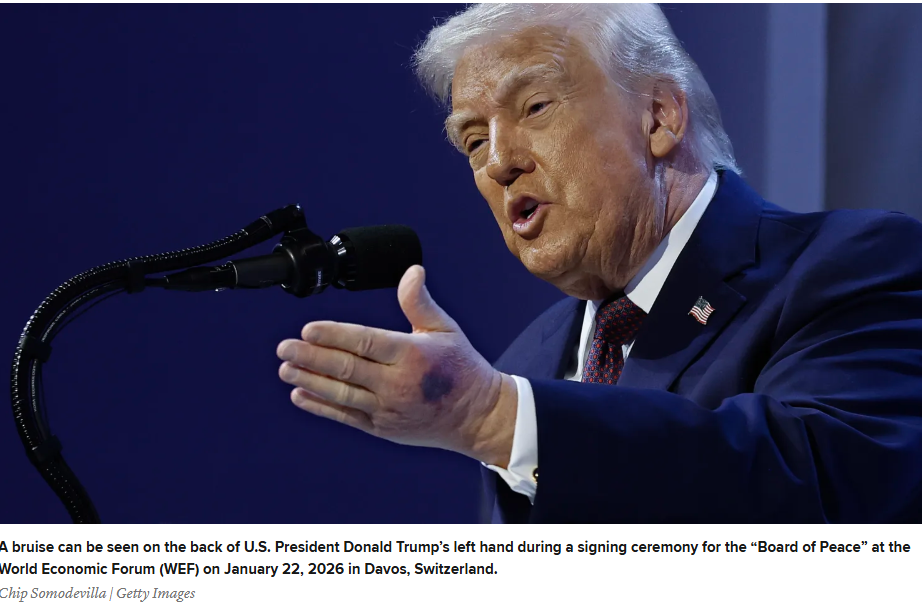
A screenshot from the CNBC article highlights a bruise on the back of U.S. President Donald Trump’s left hand during the signing ceremony of the “Board of Peace” at the World Economic Forum on January 22, 2026, in Davos, Switzerland.
CNBC does not question the legitimacy of Europe’s support for Ukraine nor directly label it as weak; instead, Europe is portrayed as an actor stuck in a U.S.-dependent holding pattern. The visual and editorial contrasts are noteworthy: the mention of Trump’s bruise and the “Board of Peace” in Gaza is not incidental but a way to illustrate the scattered nature of the Western agenda, where symbols, gestures, and ad hoc initiatives crowd out systematic solutions.
“Ukraine’s Zelenskyy says his repeated warnings to Europe feel like ‘Groundhog Day’” — this is the title of the AP publication reviewing Volodymyr Zelensky’s Davos speech and his meeting with Donald Trump. The article begins by noting that Zelensky criticized Europe for its slow, fragmented, and insufficient response to Russia’s aggression against Ukraine.
It then covers the Trump-Zelensky talks that preceded the speech, quoting Trump saying that due to Russian shelling, “the people of Ukraine are truly suffering” and that it is “impossible to live” in Ukraine.
At the end, AP reporters discuss preparations for the upcoming meeting between delegations from Ukraine, the U.S., and Russia, including Zelensky’s remark that, as a result of negotiations, Russia—not just Ukraine—must be compelled to make concessions.
MS NOW, in its article “Zelenskyy won’t travel to Davos to meet with Trump, official says” (published before it was clear whether the Ukrainian president would attend the forum), uses Trump’s Davos speech to illustrate the risks of personalized foreign policy. In this journalistic framing, the problem is not Zelensky’s “slowness” or Putin’s “stubbornness,” but that the peace process is treated like a real estate deal, where insults, pressure, and chaos replace strategy. For an American audience, this story highlights how the war in Ukraine becomes another tool of Trump’s domestic political style—with potentially dangerous consequences for allies and global stability.
The journalists emphasize Trump’s coarse language and the symmetrical belittling of both sides: his simultaneous labeling of Zelensky and Putin as “stupid” is presented as evidence that the war is reduced to a “deal,” with no attention to the moral and legal asymmetries of the conflict. The authors note conflicting reports about a potential Trump-Zelensky meeting, discrepancies between statements from the White House and Ukrainian officials, and changes in Trump’s own wording over several hours. This reinforces the article’s main point: American diplomacy appears less as a controlled process and more as a series of ad hoc improvisations.
In the Politico article “Zelenskyy scolds Europe in Davos as peace talks drag on,” it is reported that at the World Economic Forum in Davos, Donald Trump and Volodymyr Zelensky unexpectedly agreed that European leaders need to act far more decisively. The authors then criticize Trump for being overly optimistic about the prospects of a peace agreement between Ukraine and Russia, despite the lack of progress on key issues—specifically, a compromise regarding Russia’s demands to receive parts of Donbas, as well as security guarantees for Ukraine and the presence of Western troops in the country.
On January 22, the British outlet The Guardian published an article focused mainly on Zelensky’s speech at the Davos Forum, titled “Get out of Greenland mode and stand up for yourself, Zelenskyy tells Europe.” The article summarizes the main points of his address and notes that the Ukrainian president criticized European countries amid Trump’s demands regarding Greenland for their passivity and inability to defend themselves, while avoiding criticism of Trump himself. “Despite Trump’s limited and scattershot support for Ukraine since taking office one year ago, Zelenskyy focused instead on Europe’s role in the conflict, accusing the continent’s leaders of complacency and inaction,” the piece states. The Trump-Zelensky meeting is also mentioned briefly, within the general context of Ukraine-U.S.-Russia talks.
Another British outlet, Sky News, covered Zelensky’s Davos visit in detail, publishing several news pieces on his meeting with Trump, his speech, his meeting with the Swiss president, and statements regarding post-war negotiations and the capture of a Russian tanker by French forces. Special attention was given to Zelensky’s speech. Deborah Haines, the outlet’s security and defense editor, published an article titled “Zelenskyy drops brutal truth bombs upon European allies.” “Volodymyr Zelenskyy dropped a barrage of truth bombs on his European allies about their collective failure to stand up to Russian President Vladimir Putin and be respected by his US counterpart, Donald Trump,” the article notes.
The British newspaper The Independent placed a piece on Zelensky’s speech on its front page for the January 23 edition. The headline read: “Zelensky turns on Europe: You're all talk and no action.”
Leading German outlets also actively covered events at the Davos Forum, particularly Zelensky’s meeting with Trump and his speech. Die Zeit described the Zelensky-Trump meeting as “short but constructive” and “positive on both sides,” highlighting Trump’s statement that “the war must end.” They also noted Zelensky’s remarks about achieving agreements on U.S. security guarantees.
Frankfurter Allgemeine Zeitung added that the meeting took place amid tension over Trump’s earlier statements, but both presidents avoided public conflict, and Zelensky appeared “cautiously optimistic.”
Tagesschau called Zelensky’s forum speech “his toughest in recent years,” emphasizing his criticism of Europe’s weakness, which tries to “convince Trump to change” rather than taking independent leadership in defense. German media highlighted the sharp tone toward the EU (including Germany), contrasting it with Zelensky’s relatively softer dialogue with Trump.
The French outlet Le Monde highlights the “unusual” shift in Zelensky’s speech away from his typically “warm rhetoric” toward European allies, who, the publication reminds readers, are “the main political and financial sponsors of Kyiv.” It notes that Zelensky addressed Europe as a whole, without mentioning any specific country. The article also draws attention to the Ukrainian president’s statement about reaching an agreement with Trump on security guarantees for Ukraine.
In a similar vein, France24 described Zelensky’s Davos speech as “highly offensive” to Kyiv’s “key supporters,” noting that the president called Europe “fragmented” and “lost.” Le Parisien echoed this wording, using “lost” in the headline of its article on Zelensky’s address.
The leading Italian news agency ANSA published a report titled “Zelensky Criticizes ‘Confused and Divided’ Europe; Trilateral Meeting with the U.S. and Russia to Take Place Today,” which combines coverage of Volodymyr Zelensky’s speech in Davos with news of a meeting between U.S. and Russian representatives in the Kremlin. The article is illustrated with a photo of the Ukrainian president, but the subheadline reflects the Russian side’s assessment of the bilateral meeting: “Kremlin: Meeting Between Putin and Witkoff Was Very Useful.”
The publication begins with a quote from Russian diplomatic adviser Yuri Ushakov about the planned trilateral meeting in Abu Dhabi, followed by a description of Zelensky’s Davos speech. This reflects the chronological order of events but may subtly influence readers in ranking the relative importance of the statements. The article concludes by noting that Putin does not share the optimism expressed by U.S. representatives in Davos regarding a quick end to the war.
Meanwhile, on January 23, the homepage of ANSA—which, according to a Reuters Institute survey, is trusted by 74% of Italians—featured a live stream of updates on the Abu Dhabi negotiations. In this stream, Italian Foreign Minister Antonio Tajani is quoted reacting to Zelensky’s Davos speech during the Italy-Germany Business Forum in Rome:
“In my view, Europe has ensured Ukraine’s independence and made significant efforts to support it politically, financially, and militarily. At the same time, it seems that in its relations with Europe, this is not always properly reflected.”
The popular Italian center-left daily Corriere della Sera focused on the speeches of politicians and diplomats in Davos, particularly on how the summit revealed a deepening rift within Western elites. The report first highlighted a strong speech by Canadian Prime Minister Mark Carney, followed by Trump’s response, in which he withdrew Canada’s invitation to his “Board of Peace,” framing it as a reaction to Carney’s critique of the “old order” geopolitics. Italian readers were shown that Trump’s position was both assertive and contradictory, while also being criticized by other leaders present.
La Repubblica published an analysis of President Zelensky’s tough speech, noting his criticism of divisions within Europe—“Sembra il giorno della marmotta,” or the sense of “Groundhog Day,” meaning nothing will change if Europe does not act. According to author Paolo Mastrolilli, many in Europe share Zelensky’s concerns, given that the Trump administration openly shows impatience with its historical allies. At the same time, he reminds readers that Europeans are building a slow but long-term strategy to defend Ukraine, whereas Trump is willing to sacrifice territory for quick agreements that must be reached with Russia.
Il Fatto Quotidiano focused on Trump’s dominance at the forum and Zelensky’s initial decision not to attend following Russian attacks. The report highlights the presence of Putin’s envoy Kirill Dmitriev and Zelensky’s participation despite Ukraine’s energy crisis. The outlet described the Forum as monopolized by Trump, whose program revolved entirely around him—both in the official sessions, where other issues like climate change were less visible, and in parallel events, including announcements regarding Gaza and meetings on Ukraine.
The publication also quotes Italian Foreign Minister Antonio Tajani criticizing Zelensky’s speech, noting that Europe is making maximum efforts to support Ukraine. It is important to note that Il Fatto Quotidiano has a history of publishing unbalanced coverage; the Strategic Communications Center has analyzed how, in certain articles, the outlet advanced pro-Russian narratives.
The Canadian outlet The Globe and Mail characterized Prime Minister Mark Carney’s Davos speech as a turning point in Canadian foreign policy, publishing the full text of the speech alongside analytical articles examining its implications for Canada’s role in a Trump-era world order. Columnist John Turley-Ewart described Carney’s address as “one of the most influential speeches by a Canadian prime minister in a generation,” marked by a stark realism regarding the collapse of the postwar international order. The Globe highlighted Carney’s central argument: “the old world is gone,” and “middle powers” must build strategic autonomy while maintaining the values that underpin their interactions.
The Canadian public broadcaster CBC provided comprehensive coverage, calling Carney’s speech provocative and noting his declaration of the end of the U.S.-led, rules-based international order. CBC emphasized Carney’s call for middle powers to reduce dependence on major states and his support for Denmark regarding Greenland. The coverage also highlighted literary references in his speech to Václav Havel and his “principled yet pragmatic” approach to foreign policy.
Conclusions
Western media coverage of Volodymyr Zelensky’s speech and meetings at the World Economic Forum in Davos resembles a recap of another episode in a serialized story, where interconnected plotlines flow into one another without a clear narrative break. At the beginning, the key protagonists are in one set of relationships; by the end, those dynamics have shifted. Sometimes, the storyline leaves an open-ended intrigue about what comes next.
In this case, at the start of the Forum, attention was focused on U.S. actions regarding Greenland. Immediately after the Forum ended, coverage shifted to the next “episode”: the talks in Abu Dhabi, which some outlets began covering even before Davos concluded. Volodymyr Zelensky sided with the Europeans on the Greenland issue, while Trump ruled out the use of force and economic sanctions against those defending Greenland’s right to remain part of Denmark. Later, both Zelensky and Trump criticized Europeans for a lack of decisiveness.
Depending on their background and perspective, authors focused on different aspects of the same storyline. American journalists and columnists criticized Europe for lacking agency. Meanwhile, journalists and commentators in some European outlets criticized both Volodymyr Zelensky and Donald Trump for undermining Europe’s global role.
The intrigue remains and will unfold in the next episode, which began without a diplomatic intermission. This episode will center on negotiations between delegations from Ukraine, the United States, and Russia in the United Arab Emirates.