
Українською читайте тут.
Pro-Kremlin Telegram channels initially tried to dismiss the collapse of the Kerch Bridge arch as an “AI-generated fake”, then described it as a “British operation” and a “terrorist attack” ahead of a “new Yalta”. They ended up calling for the destruction of all bridges across the Dnipro, and Ukraine itself for good measure.
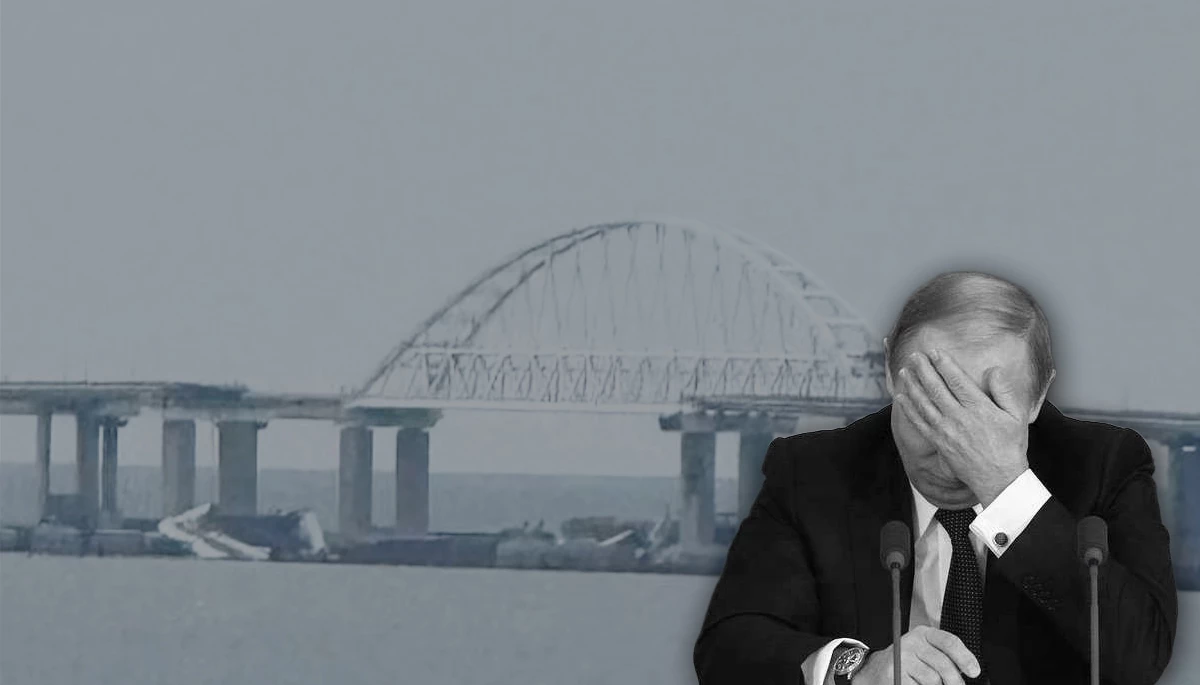
On the night of 17 November 2026, Ukraine’s Defence Forces attacked the Kerch Bridge (also commonly known as the Crimean Bridge) for the second time in 24 hours. As a result of the strikes, the arch and a section of the bridge’s road span collapsed into the Kerch Strait, while the arch above the railway section was also damaged. According to the Security Service of Ukraine (SBU), the operation lasted about a month and consisted of seven stages. First, Ukrainian forces targeted Russian air defence systems, electronic warfare systems and radars. At the final stage, fighters from the SBU’s Alpha Special Operations Centre struck the road section using Palianytsia missile drones. Neptune and Ruta missiles, as well as FP-5 Flamingo cruise missiles, were also used. This was the fourth strike on the bridge since 2022, but the first to achieve such significant results.
The strike came at a particularly sensitive moment. That same night, Russian ballistic missiles hit Kyiv’s Northern and Southern bridges, while Vladimir Putin was heading to China for his first trilateral meeting with Donald Trump and Xi Jinping on the sidelines of the APEC summit in Shenzhen. It was against this backdrop that Russian propaganda constructed its explanations of what had happened.
To find out how Russian propagandists reacted to the strike, we analysed 2,699 posts mentioning the Crimean Bridge published by Telegram channels on 17–18 November. The data from Telegram channels was provided by Lets Data. We focused primarily on 1,223 posts from 169 channels classified by the data provider as malicious actors. These included Russian state media, pro-war bloggers, military correspondents and pro-Russian anonymous channels targeting Ukrainian audiences.
“Did your phone battery die?”: propaganda’s morning silence
In the first few hours after the strike, official Russian sources limited themselves to a statement by Sergei Aksyonov, head of the Russian occupation administration in Crimea, announcing that traffic across the bridge had been suspended. The Russian news channel Lentach (391,000 subscribers) noted that the morning broadcasts of state television channels had said nothing about the strike: “Instead, television propaganda provided extensive coverage of the overnight attack on Kyiv’s Northern and Southern bridges”.
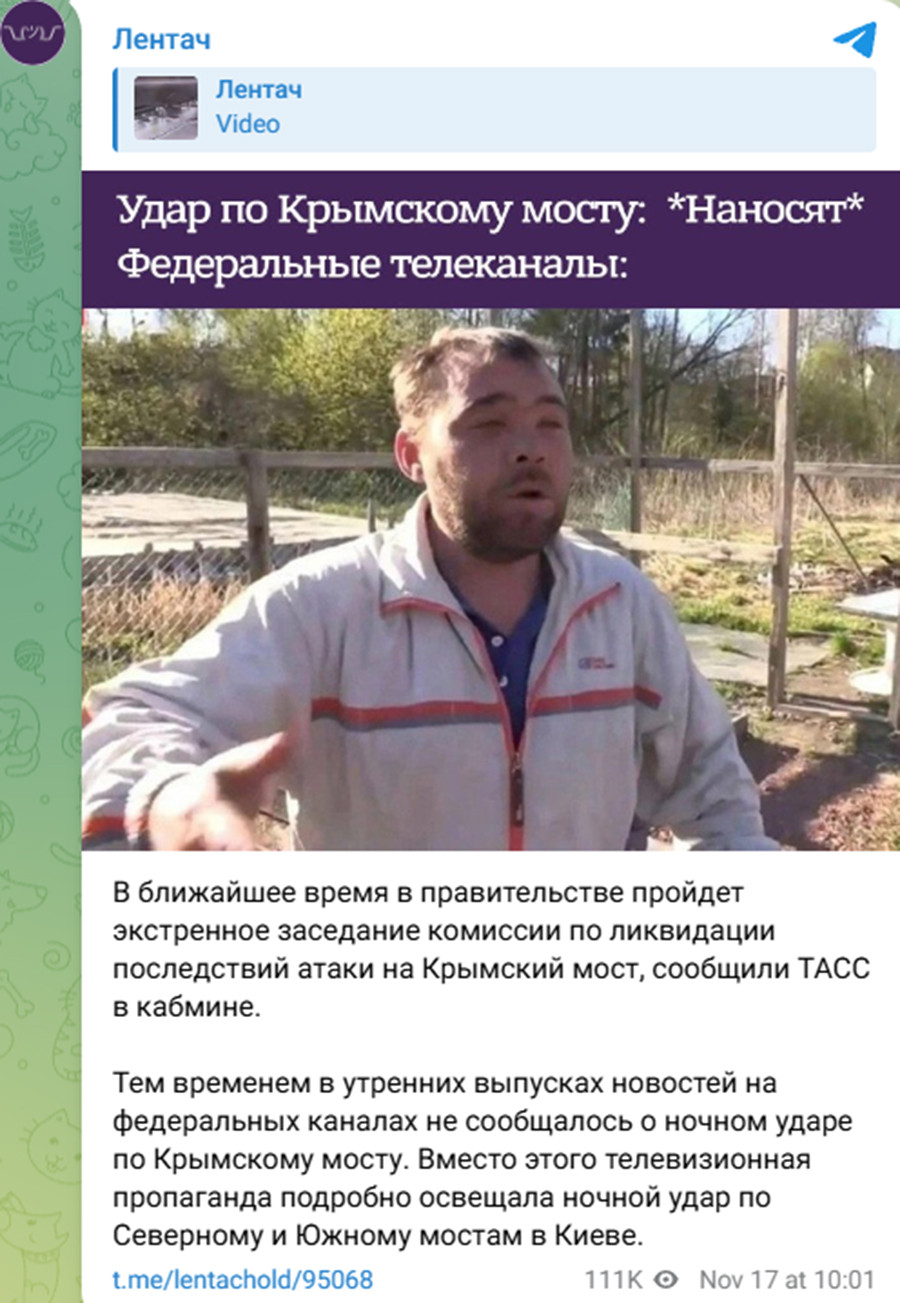
Summary of the initial reaction of Russian state television channels to the destruction of the bridge. Telegram screenshot
Meanwhile, pro-war channels questioned the footage of the strike’s aftermath that began appearing online. The Telegram channel of the propagandist outlet Tsargrad (351,000 subscribers) quoted military correspondent Dmitry Steshin: “The most striking video, allegedly showing the collapse of the arch, has a very strange duration — 1.5 seconds. Did the phone battery die? Or was that all the AI managed to generate… Don’t fall for it, hold off on the dopamine rush”. Another Telegram channel with more than 300,000 subscribers advised its readers not to draw conclusions about the bridge’s condition before official comments were issued.
The official comments, however, were extremely vague. When announcing the opening of a criminal case on terrorism charges, Russia’s Investigative Committee mentioned only an attack involving “drones” and “damage to the structure”, without a single word about the collapsed arch. The fake-news narrative persisted even after Russian military correspondents acknowledged the collapse and Zelenskyy released footage of the strike.
Later on 17 November, the Telegram channel of propagandist Andrei Medvedev (182,000 subscribers) reposted an “instruction” explaining how supposedly to manufacture fake reports using a smaller channel: “Take a photo of the Crimean Bridge explosion from October 2022. Put it into a neural network with a prompt like ‘add more destruction, change the colour shades’”. The text was also reposted by a channel called Ukraina.ru (494,000 subscribers), which urged its readers to “practise information hygiene”.
“It will be even better”: downplaying the damage
Once denying the collapse became impossible, official propaganda shifted to reassuring the public. Kremlin spokesperson Dmitry Peskov stated: “There is, in fact, no doubt whatsoever that the bridge will be restored. And it will be even better than it was before”. Russian propaganda outlets and dozens of pro-war channels circulated this statement within minutes. Deputy Prime Minister Andrei Nikitin, in turn, assured the public that Russia had the “expertise” needed to restore the bridge “within a short timeframe”.
Another narrative promoted by propaganda was that the bridge had supposedly never been important for supplying anything to the peninsula. Mikhail Razvozhayev, the occupation-appointed governor of Sevastopol, and Oleg Kryuchkov, an adviser to Aksyonov, stressed that “hardly any cargo was transported” across the bridge. According to Razvozhayev, rumours of a “blockade” of Crimea were being spread by the “enemy”. On 19 November, Putin claimed that the bridge had not been used for military purposes: “A long time ago, I gave a direct order that the Crimean Bridge should not be used to transport either military equipment or ammunition. We did not even transport oil or petroleum products”. The General Staff of the Armed Forces of Ukraine, however, described the bridge as an important supply route for fuel, ammunition and military equipment.
Pro-war bloggers picked up the narrative that attacking the Crimean Bridge was “pointless”. “A serious strike. But pointless… Last time, the bridge was restored in four months at a cost of $15 million”, propagandist Diana Panchenko (404,000 subscribers) wrote on her Telegram channel. Another channel with 260,000 subscribers promised that the bridge would “be restored and resume operations, just as it did after both previous attacks”.
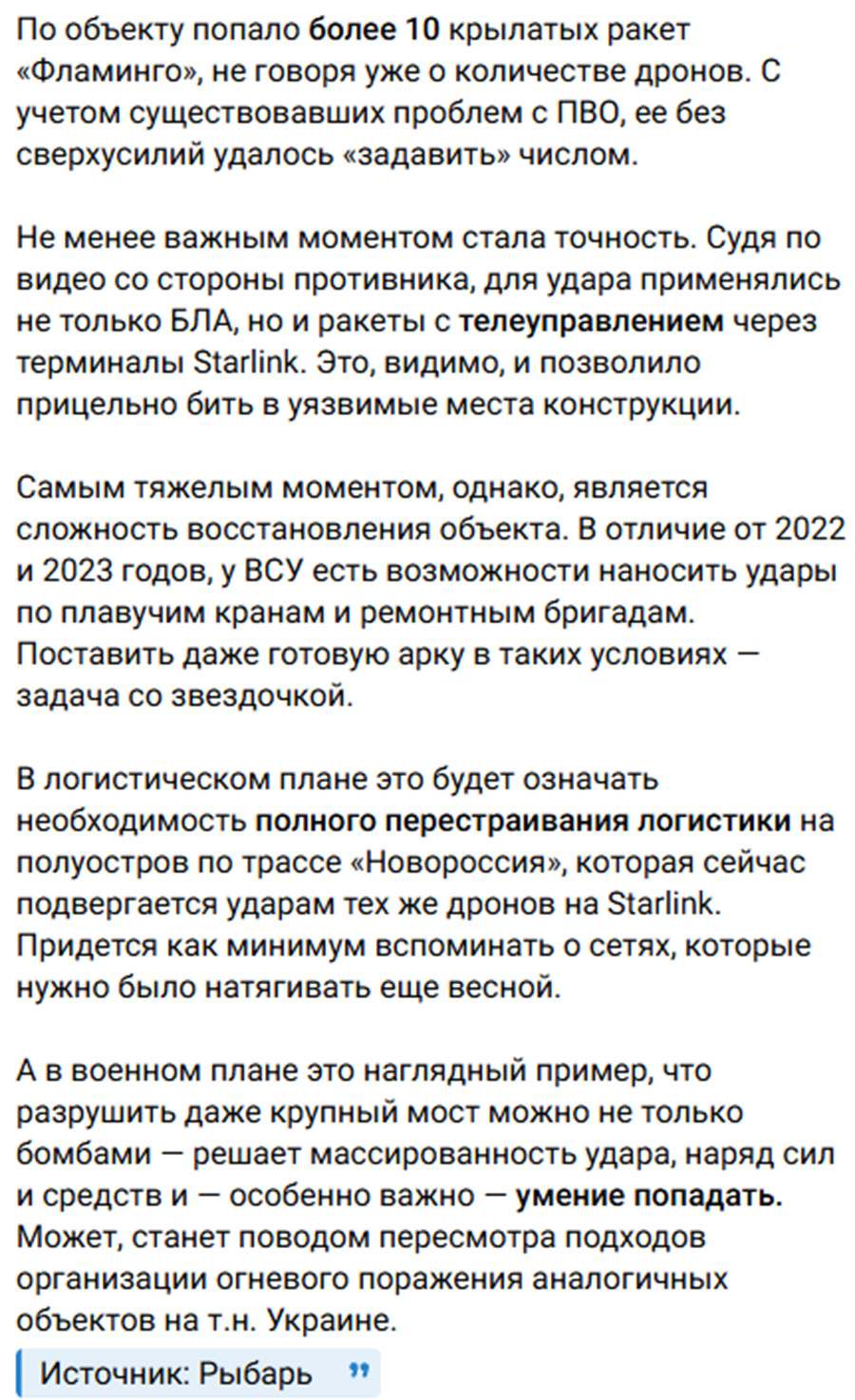
Some propagandists, however, acknowledged the opposite. Military correspondent Alexander Kots (469,000 subscribers), in particular, admitted: “The damage is serious, there's no point in pretending otherwise. There won't be any cars on the bridge for the next few months”. Kots described the purpose of the strike as cutting off the peninsula’s “main artery”. The Rybar channel (1.5 million subscribers), whose post was shared by other channels, warned that the Ukrainian Armed Forces could target floating cranes and repair crews, meaning that “even installing a ready-made arch under these conditions would be a particularly difficult task”.
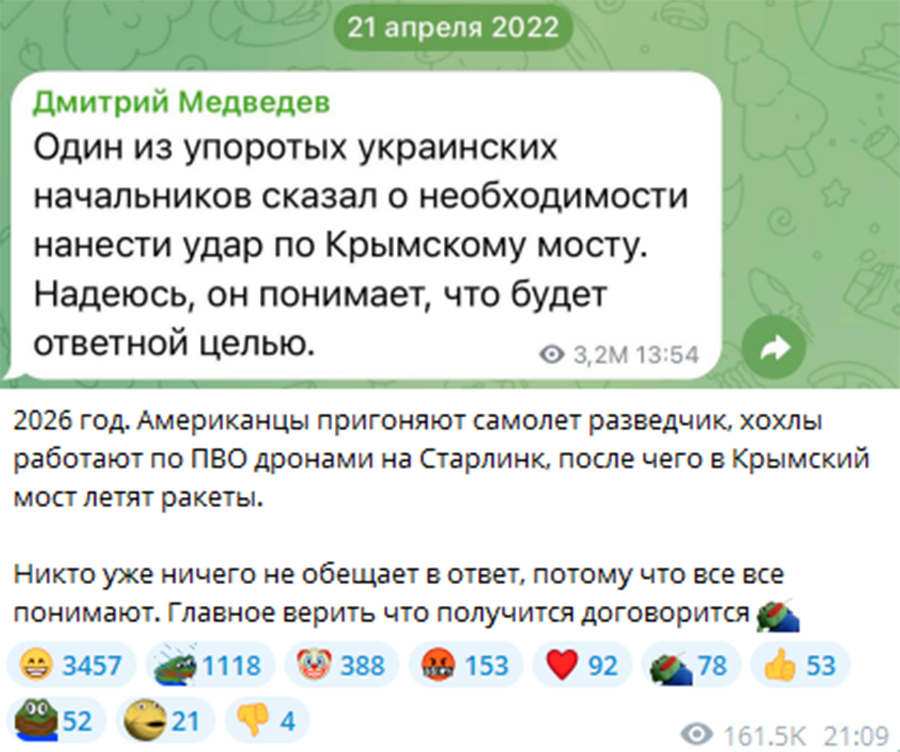
An example of acknowledging the consequences of the destruction of the Crimean Bridge, alongside calls to “learn” how to strike bridges in Ukraine. Telegram screenshot
“Britain attacked through the hands of Ukrainians”: shifting responsibility to the West
One of the most popular propaganda narratives was that Ukraine was supposedly incapable of carrying out such an operation on its own. Britain, a traditional enemy, was identified as both the mastermind and a participant in the attack. As early as the morning of 17 November, several propaganda channels circulated identical claims that the bridge had been attacked with British Storm Shadow missiles, while targeting data had been provided by a British RC-135W Rivet Joint reconnaissance aircraft. Kots titled his analysis “Britain attacked the Crimean Bridge through the hands of Ukrainians”. “Could Kyiv have pulled off such an operation on its own? No. British intelligence is behind the strike, and it urgently needs to derail the upcoming negotiations in China”, claimed the Ostashko! Important channel (425,000 subscribers).
Another version pointed to Washington. “The Trump administration was fully aware of the operation being prepared. Moreover, there is a high probability that it was the one planning it. The missile that hit the bridge was programmed to strike by an American officer”, wrote the Telegram channel of “political scientist” Dmitry Yevstafyev (205,000 subscribers). Blogger Mykhailo Onufriienko (483,000 subscribers) repeated almost exactly the same claim. Propagandist Vladimir Solovyov went even further, according to a post by Ksenia Sobchak’s channel Bloody Lady (1.17 million subscribers): “Tonight, NATO effectively launched direct aggression against us, crossing every red line”.
Neither Zelenskyy’s statement that Ukrainian weapons had been used nor the announcement by the Dutch company Destinus that its Ruta missiles had hit the bridge undermined this narrative. Tsargrad dismissed Destinus’s statement as a publicity stunt and continued to insist that Storm Shadow missiles had been used. One propaganda Telegram channel (516,000 subscribers) mocked a Times article about Ukraine’s own communications system that did not rely on Starlink: “We believe it. Especially when it comes from the tabloid Times”.
Significantly, different propagandists interpreted US Deputy Secretary of Defense Elbridge Colby’s remarks at the Ramstein meeting in opposite ways. One channel (222,000 subscribers) presented them as an admission that the United States “had been providing and would continue to provide targeting data” for Ukrainian missiles. Another (52,000 subscribers), on the contrary, portrayed them as criticism of Kyiv for striking the bridge.
“Terrorist attack” ahead of a “new Yalta”
Russian officials described the attacks on the Crimean Bridge as “terrorism” aimed at “derailing negotiations”. Russia’s Investigative Committee opened a criminal case under the article on terrorist acts, while Russian Foreign Ministry spokesperson Maria Zakharova stated: “Like any terrorists, Kyiv needs to promote its crimes”. Peskov did not rule out a connection between the strike and the summit in Shenzhen. Bogdan Bespalko, a member of the Presidential Council for Interethnic Relations, told Russian media that for the Ukrainian authorities, “war is a guarantee of survival and a business”, and that they would therefore stage provocations “to disrupt the further course of negotiations”.
Propaganda Telegram channels developed this narrative further. “LOUD Ukrainian strikes ALWAYS coincide with the days of negotiations”, Diana Panchenko wrote. “Why did Ze strike the Crimean Bridge right now? It is quite obvious: they need a pretext to accuse Russia of derailing peace talks”, wrote one anonymous pro-Russian Telegram channel controlled by Russia but posing as “Ukrainian” (424,000 subscribers). A Russian propaganda channel presenting itself as a “fact-checking” outlet (363,000 subscribers) insisted that the bridge “is not a military target” and that Ukraine was “making up some kind of secret military logistics”.
TV presenter Olga Skabeyeva, writing on her Telegram channel (216,000 subscribers), paraphrased the aforementioned Times article as follows: “Terrorists from the Ukrainian Armed Forces told The Times that they intend to kill the workers who will repair the Crimean Bridge. They admitted that the strike itself was a PR stunt”. In fact, the Ukrainian officer had spoken about a “symbolic gesture” ahead of the summit and the continuation of strikes against a military target.
“A mirror response” in the form of genocide
The strikes on Kyiv’s bridges, which also took place on the night of 17 November, were immediately presented by propaganda as retaliation. “An answer for the Crimean Bridge: epic footage of the strike on a bridge in Kyiv”, the Ostashko! Important channel commented on a video. But this was not enough for most pro-war channels. “It would be a good idea to make sure that there are no intact bridges left across the Dnipro in Ukraine at all”, wrote a propaganda channel with 301,000 subscribers. On his own channel, “political scientist” Yevstafyev suggested “starting an infrastructure war”: “systematically destroying all bridges across the Dnipro, cutting off the enemy’s nuclear power plants from the power supply (achieving a complete blackout)”. Propagandists made no mention of the fact that Russian forces had already been striking bridges in Kyiv before the attack on the Crimean Bridge.
There were also fresh hints about the possible use of nuclear weapons. “Eighty-nine per cent of subscribers believe that our sworn partners are asking for a third publicly known combat deployment of the Oreshnik. For the attack on the Crimean Bridge, we could equip the missiles with a more serious warhead. Not a kinetic one. A special one”, military correspondent Kots wrote. The Redacted P6 channel (1.04 million subscribers), citing “sources”, claimed that the use of “heavier means of destruction” was only “a matter of time”, and that the targets would “most likely be chosen in western Ukraine”. Solovyov demanded an “unprecedentedly harsh” response and the “elimination of Ukraine’s political leadership”.
The propagandists’ rhetoric quickly moved from attacks on infrastructure to denying Ukraine’s right to exist. “Tonight, the enemy finally hit the bridge. The bridge will be restored. Ukraine will cease to exist”, wrote another military correspondent, Yuri Kotenok (309,000 subscribers), on his channel. “As long as Ukraine exists, the threat will remain. No Ukraine, no problem”, declared Yulia Vityazeva (48,000 subscribers), a former Odesa resident turned propagandist. A propaganda channel with more than 50,000 subscribers promised that Ukraine’s joy would “turn into incessant howling”, while “reconstruction, statehood and all the rest” would “never happen”. Another channel, called Adequate Z (261,000 subscribers) — a name that hardly reflects the content of its posts — suggested bringing the “pigsty” back to “pre-industrial conditions”.
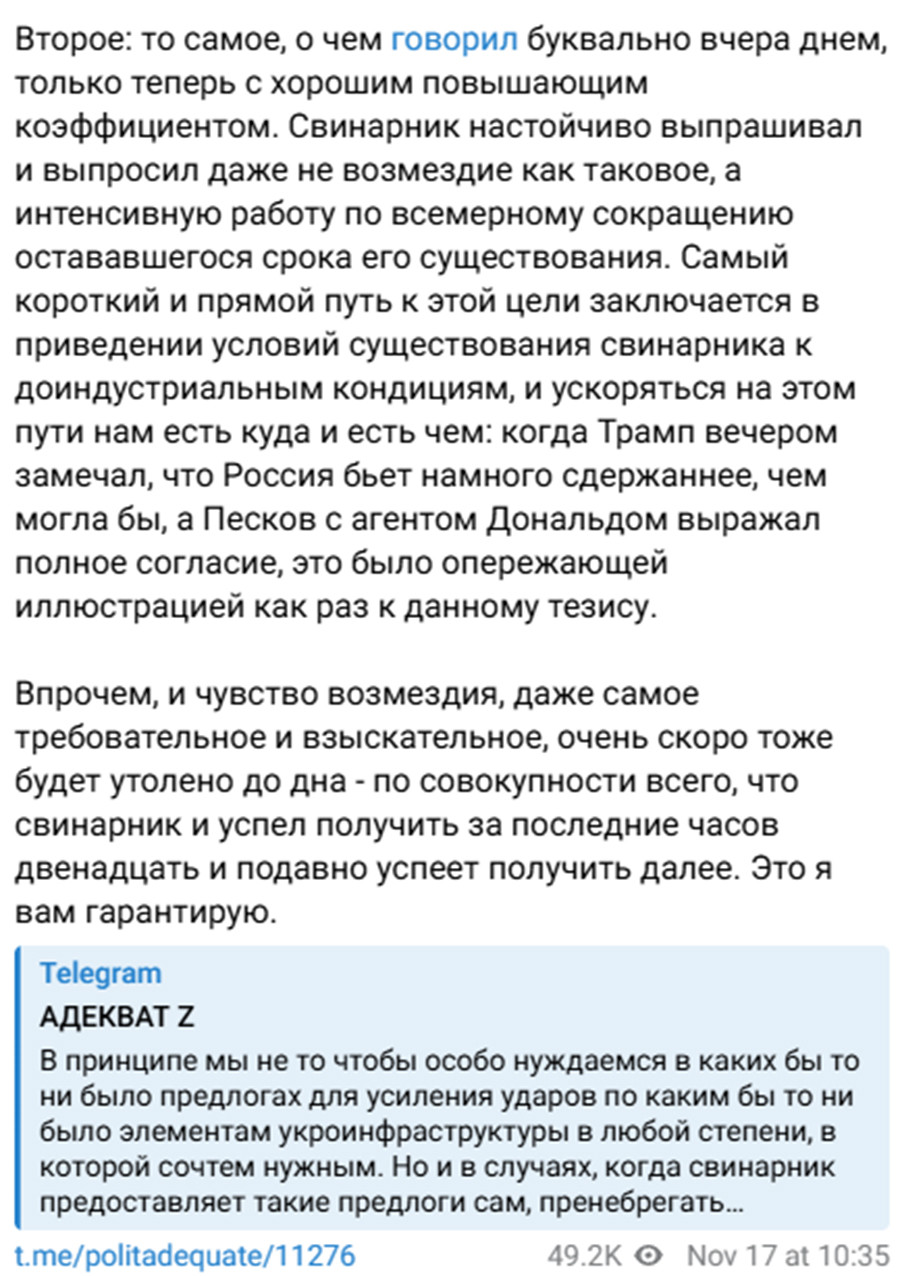
An example of threats made by propagandists. Telegram screenshot
“The Leopold era”: disappointment and self-criticism
At the same time, the strike also caused obvious frustration among pro-war audiences with their own government, which was accused of incompetence, weakness and insufficient ruthlessness. The most outspoken criticism appeared in the comments under posts by former Ukrainian MP and current Russian blogger Oleh Tsaryov (401,000 subscribers). “Why isn't Putin taking a tougher stance now? The whole country is waiting for at least one bridge in Kyiv to stop not just functioning but simply existing by morning… Otherwise, we will show the whole world how weak we are”, one reader wrote. Another suggested replacing the phrase “the Putin era” with “the Leopold era. A time wasted” (apparently alluding to Leopold the Cat, a character from a Soviet animated series who used to say, “Let's live together in peace”). A third commenter sarcastically noted that a bridge in Kyiv built by Soviet construction workers had survived a ballistic missile strike, “while the Crimean Bridge, built by… Putin's construction workers, collapsed”.
Bloggers with large audiences also criticised the authorities. Onufriienko demanded that those responsible for “strategic mistakes” be “publicly punished”, as well as those guilty of “systematic lies in reports to the top leadership”. A propaganda Telegram channel (222,000 subscribers) admitted: “Even in terms of our own conventional capabilities, we fall short of Israel”. A Tsargrad commentator called for the creation of dedicated air defence forces, arguing that the Aerospace Forces were “failing to fulfil their mission of protecting the country's airspace”. A channel with more than 670,000 subscribers sarcastically recalled Dmitry Medvedev's threats of 21 April 2022: “Nobody promises anything in response anymore, because everyone understands everything. The main thing is to believe that an agreement can be reached”.
An example of angry posts by Russian pro-war authors. Telegram screenshot
A dedicated “firefighting team” was working against this wave of criticism. For example, the Shakhnazarov channel (152,000 subscribers) shared a text by TV presenter Artem Sheinin, who argued that emotional discussions about “retaliation” would become part of the effect the enemy was seeking to achieve. “The bare minimum that each of us can and must do is not to get overly emotional”, Sheinin concluded.
Russian propaganda’s reaction to the collapse of the Kerch Bridge went through several stages: silence and claims of an “AI-generated fake”, downplaying the damage, shifting responsibility to London and Washington, and, ultimately, calls for an “infrastructure war”.
As after previous successful Ukrainian strikes, propaganda targeted two audiences. The general public was reassured with promises that the bridge would “be even better than before”. The radical segment was incited with calls to destroy bridges across the Dnipro, energy infrastructure and Ukraine itself. Ukrainians were targeted with intimidation and claims that Zelenskyy was “derailing peace”.
The strike also exposed growing frustration with the Kremlin’s “strategic patience”. Propaganda is turning this frustration into demands for escalation.