
Українською читайте тут.
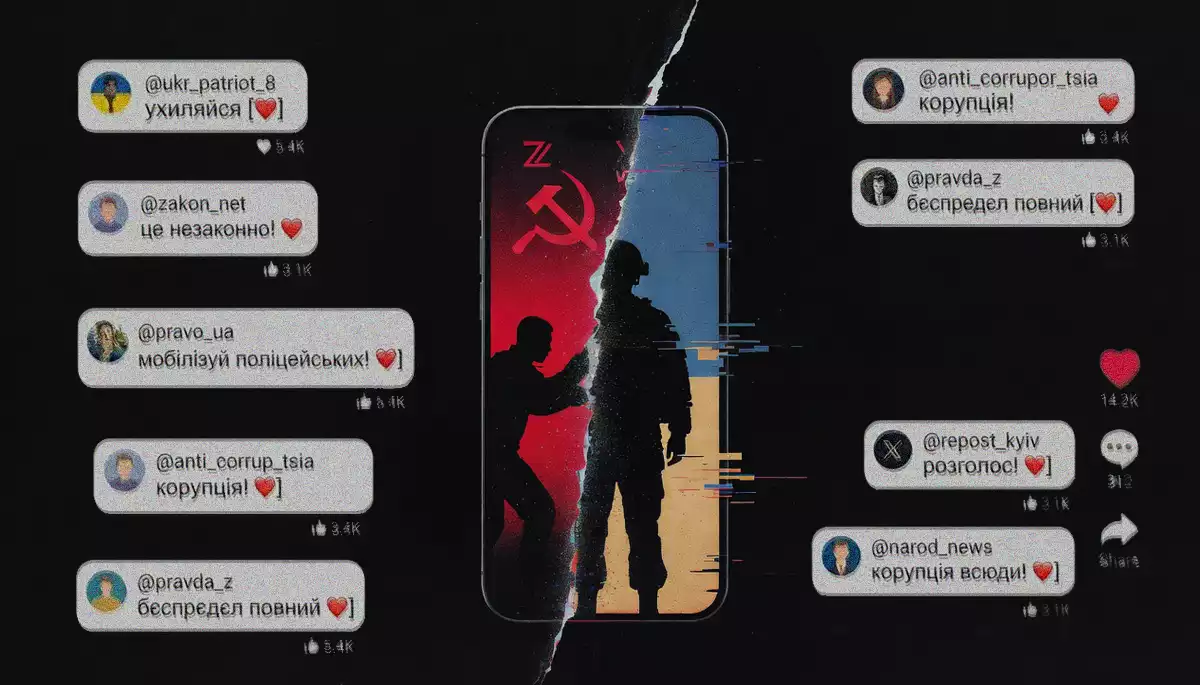
Government communications and explanations of the need for mobilisation in Ukraine account for only 8% among the videos suggested by the platform in the web version under the hashtag #mobilisation.
Key findings
Videos depicting the use of force during mobilisation make up nearly 38% of the sample and receive 10–12% more shares and comments compared to other posts, indicating higher audience engagement with such content.
Criticism of the necessity of mobilisation in Ukraine is present in approximately 26% of videos in the sample, while only 14% of posts articulate support for it. The median aggregate engagement metrics of critical content are nearly twice as high as those of supportive videos.
Videos advancing claims about the illegitimacy of mobilisation — both disinformational and speculatively framed for discussion — constitute ~30% of the analyzed videos. At the same time, their median reach metrics are lower, which may indicate certain limitations for harmful content imposed by the platform’s algorithms.
Discourse that can be considered constructive regarding the topic of mobilisation — arguments in favour of military service and mobilisation — is the most marginal: it accounts for only 8% of the analysed videos and is characterised by lower engagement metrics compared to critical content. This merely reflects the distribution of videos with different narratives within the sample, as well as the lack of pro-government communication, and is not indicative of the platform’s policies regarding the ‘visibility’ of any particular type of content.
Certain signs of coordinated activity have been identified: some accounts systematically publish thematically homogeneous videos featuring incidents involving the use of force, imitating the behaviour of ordinary users. One account posted 80 videos over five days of observation.
AI-generated manipulative content about mobilisation has been detected in the sample, but was not dominant or particularly visible in the studied sample under the hashtag mobilisation (#мобілізація). A few of such videos were not labelled by the platform as artificially created, although they contained watermarks from generative AI tools (such as Sora). This includes, in particular, videos featuring fake speeches by public figures — Ukrainian officials and military commanders.
Government communication, especially from top-level officials, urging conscription to the Ukrainian armed forces, is virtually absent on the platform. This vacuum is filled by emotional, manipulative, and disinformational content, shaping a fragmented and predominantly negative picture of mobilisation among TikTok users.
Introduction
TikTok is the second most popular social media platform in Ukraine, according to the Uamaster digital agency. As of January 1, 2026, it has 21.5 million users. Of these, 12.6 million are men, which is nearly one-third more than the number of female users.
TikTok has repeatedly been identified as a platform where AI-generated disinformation about mobilisation spreads most actively, as reported by the Centre for Countering Disinformation and Ukrainian fact-checkers, including VoxCheck. False claims about mobilisation in Ukraine have also drawn the attention of international fact-checkers, for example, from Bulgaria. Olesia Horiainova, coordinator of the Recruitment Support Centre at the Ukrainian Security and Cooperation Centre, stated that disinformation messages about mobilisation on TikTok are intended to undermine recruitment efforts for Ukraine’s Security and Defence Forces.
Anton Muraveinyk, head of the analytical department at the 'Come Back Alive' Initiative Centre, said in an interview with Suspilne that although, formally, mobilisation in Ukraine falls under the responsibility of the Cabinet of Ministers, in practice the process—along with the negativity it generates—has been 'delegated' to the Ground Forces of the Armed Forces of Ukraine. At the same time, there is a lack of communication from top state officials that would encourage people to mobilise or at least honestly report on the problems within the mobilisation process and ways to resolve them.
For example, the new Minister of Defence, Mykhailo Fedorov, on April 24, 2026, reported on his first three months in office, listing 30 completed or priority tasks and areas of work. Among them was the 'preparation of a comprehensive transformation to improve recruitment and service conditions in the Defence Forces.' It is evident that many aspects of service conditions in Ukraine’s Defence Forces require reform; however, it is important to note that recruitment is not the same as mobilisation and accounted for only about 10% of enlistment into the Armed Forces in 2025. The minister did not use the word ‘mobilisation’ in his reports at all.
TikTok is certainly not the only social media platform where disinformation about mobilisation and military service spreads. However, given the social sensitivity of the topic of mobilisation and the predominance of a male audience over a female one in the 25–34 age group on TikTok, the Detector Media Research Centre decided to examine which type of discourse—destructive (manipulative and anti-mobilisation narratives) or constructive (explaining the need for mobilisation and discussing rules and legal norms)—prevails on the platform.
As of April 20, 2026, according to the platform, 107.7 thousand videos are available under the hashtag #мобілізація. However, this figure does not reflect videos that have been removed from the platform. For example, according to web archive data, on March 11, 2023, there were 321.7 million videos with this hashtag on TikTok.
A hashtag cloud of tags used alongside #мобілізація that appeared in at least three videos. Detector Media Research Centre, based on 503 videos from March 16–20, 2026.
TikTok does not provide structured information about posts and their distribution to representatives of civil society organisations and academic institutions from Ukraine, as is also the case for most countries outside the EU and North America. However, it does allow users to explore videos under trending hashtags within the TikTok Creative Centre content creation space. Although the videos presented as examples associated with a given hashtag may not fully reflect the everyday user experience, they serve as samples of the types of video content consumed by TikTok users. Accordingly, they may influence the choice of topics and modes of representing reality by creators who aim to produce content that becomes popular on TikTok.
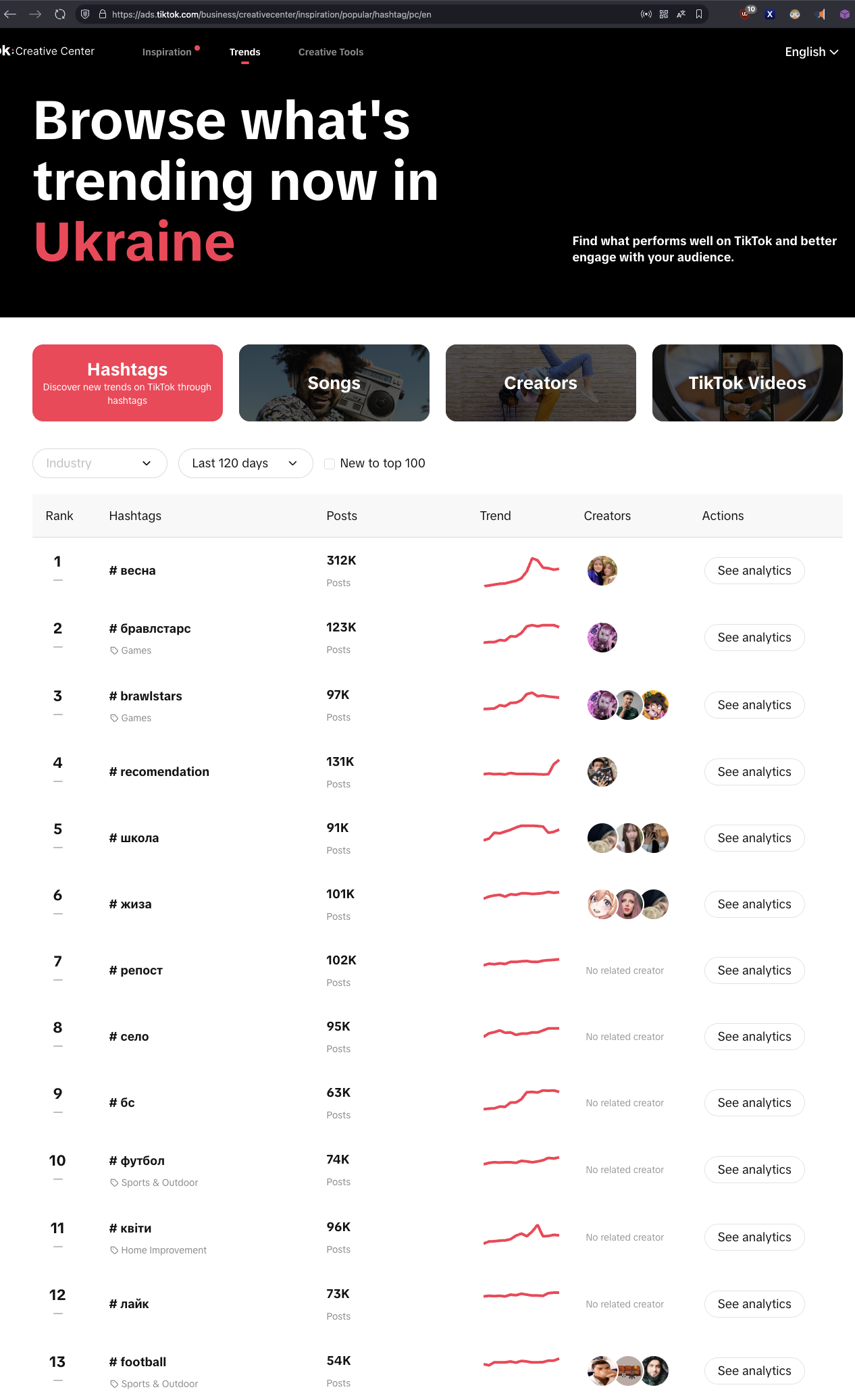
A list of hashtags on TikTok from users in Ukraine as of April 20, 2026, including the number of posts with each hashtag over the past 120 days. Screenshot of the TikTok Creative Centre page.
Given the limitations on access to TikTok’s API for researchers in Ukraine, studying specific issues is possible through several approaches: either by simulating user behaviour or by collecting available videos for analysis that are displayed under a given hashtag and accessible to creators in the TikTok Creative Centre. For this study, the second approach was chosen.
Methodology
The calculations and assessments in this report are based on an analysis of unique videos that were displayed between March 16–20, 2026, in the non-logged-in web version of TikTok in Ukraine under the hashtag #мобілізація. Researchers were aware that such an approach may not fully reflect the daily user experience of TikTok application users, among those who are willing to explore the topic of mobilisation in Ukraine. Analysts from the Detector Media Research Centre reviewed the videos shown on TikTok under the hashtag #мобілізація twice a day, between 16:00 and 20:00 during this period, and collected key popularity metrics for each of them. They also analysed the content of the videos across several defined dimensions:
- whether they refer to mobilisation in Ukraine;
- whether they depicted the use of force by Territorial Recruitment Centre (TRC) staff or the police, or against them;
- whether the videos included assessments of the legality of mobilisation in Ukraine or suggestions to avoid mobilisation;
- whether the videos criticised medical personnel involved in the mobilisation procedure;
- whether the videos presented arguments in favour of mobilising.
Between March 16–20, TikTok offered between 160 and 284 videos per viewing session under the hashtag #мобілізація. Some of the videos displayed in the non-logged-in web version were repeated on subsequent days. These repeated videos were typically positioned at the top of the page. Using this approach, over the course of five days, it was possible to review and compare 1,547 videos. Of these, 359 were repeated two or more times over the five days, while 316 appeared no more than once.
The number of TikTok videos that do and do not contain information about conscription in the Ukrainian army under the hashtag #мобілізація.
The number of TikTok videos that contain the hashtag #мобілізація but are not related to the topic of mobilisation in Ukraine. Infographic: Detector Media Research Center.
Another 172 videos displayed under the hashtag in a non-logged-in web version of TikTok did not contain any practical references to mobilisation in Ukraine. These included videos about mobilisation in Russia or potential mobilisation in Belarus or content unrelated to mobilisation altogether, such as advertisements for mobile video games, TikTok challenges, humorous videos, or everyday life moments of users, reviews of mobile devices, and so on. At the same time, it is not possible to determine with certainty whether, in some cases, this reflects the deliberate misuse of the hashtag (hashtag misuse or hashtag abuse) by certain users to promote their own content under a popular topic, or whether it is a feature of TikTok’s content display algorithms.
Distribution of key content categories in videos with the hashtag #мобілізація on TikTok, reviewed between March 16–20, 2026, according to calculations by the Detector Media Research Centre.
Based on the analysed videos and in the absence of publicly known information about the platform’s content ranking approaches, it can be assumed that TikTok prioritises the display of newer and more popular videos under a given hashtag, as well as the most popular videos over a certain period. However, it is not technically possible to accurately determine the exact time frame for which the most popular videos on a given topic are shown.
Among the 503 videos reviewed that TikTok displayed under the hashtag #мобілізація, 328 were published between January 1 and March 20, 2026. Another 129 were published in 2025, 30 in 2024, and 7 and 3 in 2023 and 2022, respectively.
Key metrics of the reviewed videos with the hashtag #мобілізація by monthly breakdown. Infographic: Detector Media Research Center.
Among the videos with the highest numbers of views and comments are two videos with 7.6 million views about searches conducted at the office of the head of the Khmelnytskyi Regional Medical and Social Expert Commission (MSEC), published in November 2024. Notably, the video was posted on the account of a serviceman and blogger, Colonel of the Armed Forces of Ukraine Anatolii Shtefan, who cannot be attributed as a destructive critic of mobilisation. Another is a video from February 2025 featuring a man in military uniform who says he does not condemn people who avoid military service out of fear. The third most popular video was published in March 2023. It has 6.8 million views and 22 thousand comments and shows Ukrainian soldiers congratulating women on March 8.
Thus, it can be assumed that the videos promoted by TikTok’s algorithm primarily reflect user behaviour and preferences, rather than solely the intentions of those who publish video content under a given hashtag—whether that content resembles Russian propaganda about mobilisation or, conversely, pro-Ukrainian or entertainment content.
The dataset of 503 videos mentioning mobilisation and military service in Ukraine is certainly not fully representative and cannot be considered as statistically reflecting the everyday experience of a TikTok user. However, it provides a snapshot containing examples of videos with the hashtag #мобілізація that users in Ukraine may observe. Given the inability to obtain structured data from the platform within Ukraine, this approach to data processing is one of the few available and methodologically justified. In particular, it allows for capturing both the most recent videos and representative examples of the most popular videos on the topic of mobilisation and military service from the past.
The Detector Media Research Centre has contacted representatives of ByteDance with questions regarding the principles of selection and ranking of videos under the hashtag #мобілізація on the platform. As of the publication of this research, a response is pending and will be published separately.
Videos involving the use of force during mobilisation
Out of 503 videos that analysts from the Detector Media Research Centre coded as related to mobilisation in Ukraine, 191, or nearly 38%, demonstrated instances of or contained references to the use of force during mobilisation.
The number of videos demonstrating the use of force during mobilization on the web version of TikTok under the hashtag #мобілізація from March 16 to 20, 2026. Infographic: Detector Media Research Center
A typical example of such videos is amateur footage in which individuals resist police officers or employees of the Territorial Recruitment and Social Support Centres (TCR and SSC) during attempts at detention or document checks. In some of the video recordings, one can observe attacks on state-authorised personnel responsible for conducting mobilisation or maintaining public order. Among those who publish these videos, there are accounts with neutral names or foreign-sounding names, which may create the impression that these accounts publish news or function as personal or thematic pages. However, all of their videos are dedicated to the use of force during mobilisation.
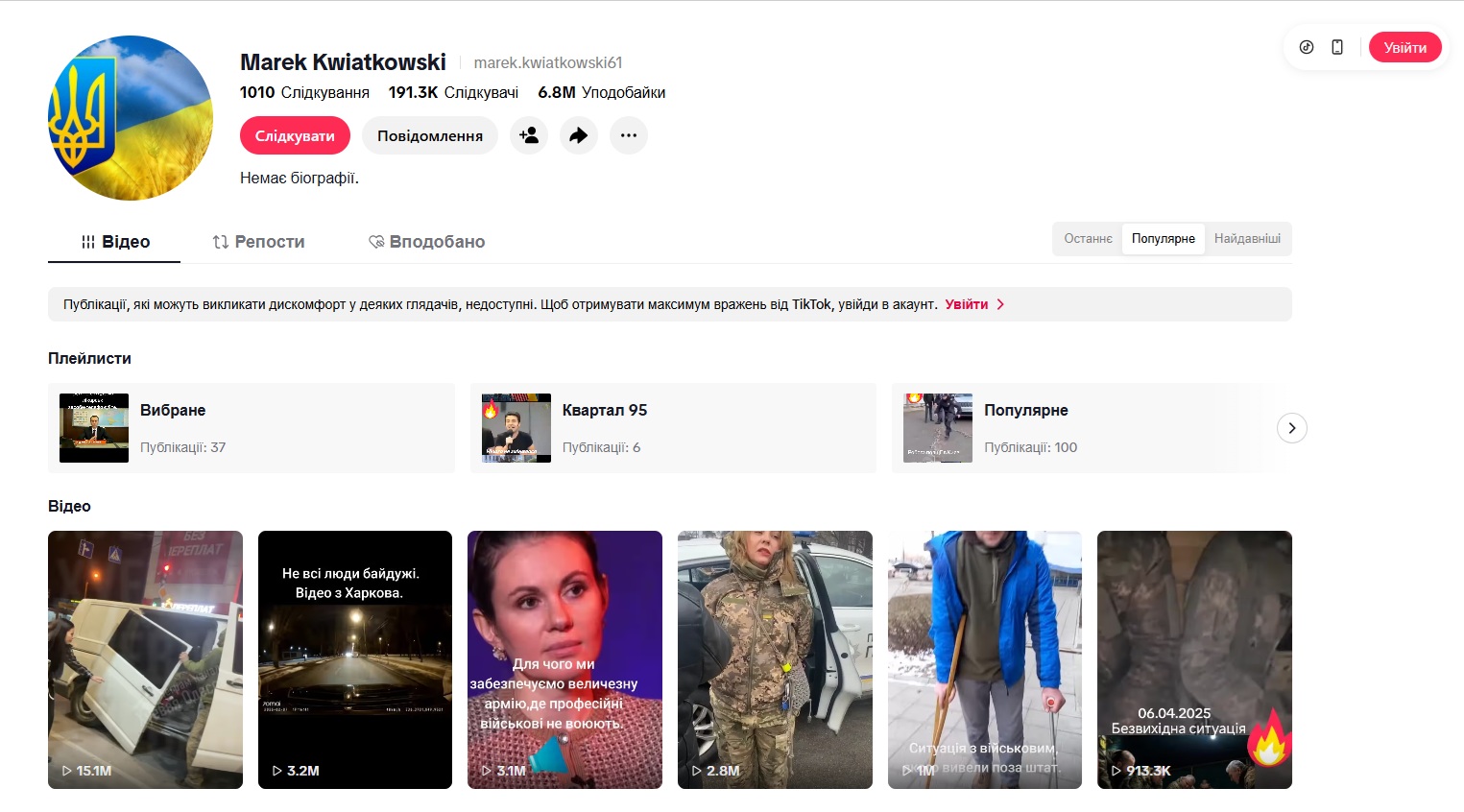
Screenshot — TikTok account @marek.kwiatkowski61
An example is the account @marek.kwiatkowski61, on which videos began to be published in December 2024. The first six videos on this account can be considered ‘neutral,’ likely posted to make the account imitate the behaviour of a normal user and avoid raising suspicion. Starting from the seventh video, all subsequent ones are devoted to the topic of unlawful or forceful methods during mobilisation in Ukraine. It is unlikely that a set of similar videos of the same specific theme, published with regular frequency, reflects the behaviour of an average platform user. Individual videos on the account have, over the course of its existence, garnered several million views. During the observation period from March 16 to 20 alone, we recorded 80 videos from this account under the hashtag #мобілізація.
Most of the analysed videos of this kind, in which force was used against people in the streets, did not contain additional commentary from the authors of the posts, such as evaluations of mobilisation methods or objections to its necessity. It is likely that in cases where such videos are published for propagandistic purposes, the informational impact of images depicting violence or unlawful actions is considered sufficient in itself to demotivate viewers and discredit the state’s mobilisation efforts.
Medians of views, comments, and shares of videos that contain depictions of the use of force during mobilisation. Infographic: Detector Media Research Center
Videos depicting the use of force during mobilisation do not have dramatically higher numbers of views, shares, or comments compared to any other videos about mobilisation in Ukraine. However, the median performance indicators show that videos about the use of force still receive 10% more shares and 12% more comments compared to the median for videos that do not involve the use of force. If we set aside the assertion that such videos may be deliberately disseminated by Russian propagandists, these figures may indicate higher audience engagement compared to videos that do not depict the use of force during mobilisation. However, the median number of views for videos showing the use of force is ~32% lower than for videos without such scenes. Without access to TikTok’s API and data, one can only speculate that the platform algorithmically restricts the display of such videos to some extent.
The overwhelming majority of comments with the highest number of reactions under such videos contain negative statements about individuals authorised to carry out mobilisation. Criticism of the authorities and the state as a whole is also frequently encountered. In cases of videos showing attacks on Territorial Recruitment Centres and the police, or the involvement of bystanders in assisting those resisting detention, the comments often express approval of such actions. At the same time, in cases where such assistance from people present at the scene is not provided, the comments include condemnation, accusations of a lack of solidarity, and indifference. It is worth noting that comments and reactions to them constitute a space in which it is difficult to determine the authenticity of the accounts leaving them, and bot farms may quite successfully operate there, amplifying critical or negative sentiment among users regarding mobilisation. Reviewing comments under the videos helped researchers determine the categories by which the videos were coded; however, the analysis of the comments themselves falls outside the scope of the study.
Attitudes toward the need for mobilisation
Criticism of the very need for mobilisation in Ukraine is present in slightly less than 26% of the analysed videos, whereas support for mobilisation in Ukraine is articulated in 14% of the analysed videos. In the remaining 60% of videos, the need for mobilisation in Ukraine is not criticised.
Number of videos criticising the need for mobilisation in Ukraine on the web version of TikTok under the hashtag #мобілізація from March 16 to 20, 2026. Infographic: Detector Media Research Center
Even in cases where videos express criticism of the methods of conducting mobilisation, explicit or implicit rejection of the need for mobilisation in Ukraine is present in only 68 out of 129 videos containing criticism. Moreover, in such cases, the criticism is directed at specific instances of mobilisation without broader generalisations about the need for mobilisation in Ukraine. Authors of such recordings often express negative attitudes directly toward members of notification groups and the police officers accompanying them, describing their actions as unlawful. This also applies to one of the most common video formats encountered by researchers — commentary by lawyers and critics of mobilisation on specific provisions of legislation. In such videos, ‘TikTok lawyers’ most often discuss particular violations in the mobilisation process, inconsistencies with legal norms, or qualify the actions of employees of the Territorial Recruitment Centres and Military Medical Commissions, but generally do not oppose the mobilisation process as such.
At the same time, in videos that condemn specific instances of mobilisation or its methods, one can encounter statements supporting the necessity of mobilising certain categories of people, including civil servants. A widespread narrative is the claim that it is not ‘ordinary people’ who should be mobilised, but rather police officers, veterans, military pensioners, or pensioners of the Ministry of Internal Affairs system, civil servants, members of parliament, or any other category that, in the eyes of content authors, can be considered as ‘privileged.’ The Head of the National Police of Ukraine, Ivan Vyhivskyi, commented on the involvement of police officers in the Defence Forces during a briefing following the shooting of people in Kyiv on April 18: “The National Police employs slightly more than 100,000 officers. 25,000 of them are women. And 13,500 are officers who have not reached the age of 25; that is, they are below mobilisation age. At the same time, about 9,000 police officers are constantly fighting on the front line, and more than 30,000 are engaged and working in territories close to the combat zone.”
Narratives about the ‘mobilisation of police officers’ are not necessarily realistic to implement, as they complicate the maintenance of public order and law enforcement activities. However, they are part of a broader discussion about fairness and equality in the rules of mobilisation in Ukraine. Alongside this, there are calls for more equitable mobilisation, a revision of reservation (exemption) principles, and the establishment of limited terms of service.
Medians of aggregate indicators of views, comments, and shares of videos that contain, respectively, criticism, approval, or the absence of reflection regarding the need for mobilisation in Ukraine. Infographic: Detector Media Research Center
Despite the limited transparency of TikTok’s algorithms, it can still be assumed that the platform most likely prioritises the most recent videos. Without information from the platform itself, it is impossible to determine when peaks in the publication of videos criticising mobilisation in Ukraine occurred. Six out of ten such videos reviewed during the study were published in 2026. Meanwhile, older videos may have been deleted or blocked, or they may not have entered the trends under the hashtag #мобілізація on the days the videos were reviewed. However, based on the analysed clips, it can be stated that the median aggregate indicators of views, comments, and shares for videos containing criticism of mobilisation are nearly twice as high compared to videos that articulate support for mobilisation.
Videos about the illegitimacy of mobilisation
Videos articulating the illegitimacy of mobilisation accounted for nearly 30% of the analysed videos that contained the hashtag #mobilisation, were labelled as related to this topic, and were not cases of hashtag misuse or hashtag abuse. This category includes both disinformation messages and news, speculative, or discussion-based content regarding lowering the mobilisation age or the mobilisation of women.
Number of videos in the web version of TikTok under the hashtag #мобілізація with geolocation in Ukraine from March 16 to 20, 2026, that mention the ‘illegitimacy’ of mobilisation. Infographic: Detector Media Research Center
Analysts from the Research Centre collected and compared key parameters of such videos—namely, indicators of views, shares, and comments — and compared them with other videos processed during the study period. At least within the sample that fell into the data collection period, the aggregate median indicators of views, shares, and comments for videos that referred to mobilisation as ‘illegitimate’ were lower than for videos without such mentions.
It is difficult to establish a direct correlation explaining the difference in indicators between the two groups of videos; however, this may indicate, for example, certain efforts by TikTok as a platform to limit the distribution of such videos to users.
Medians of views, comments, and shares of videos that contain and do not contain assessments of the legitimacy of mobilisation in Ukraine. Infographic: Detector Media Research Centre
An example in this category of videos is the story of the mobilisation of a man with dwarfism from the Vinnytsia region. TikTok videos in which Oleksandr Artiukh describes the circumstances of his mobilisation, including alleged demands for bribes from medical personnel, which were included in the sample, received few views or were later removed by the platform. The website “Suspilne Vinnytsia” publishes Artiukh’s story. The article states that the Vinnytsia Regional Prosecutor’s Office has opened criminal proceedings under Article 366 of the Criminal Code of Ukraine (official forgery). In general, videos about the mobilisation of a man with a height of 148 centimetres appeared several times in the analysed dataset, published by different users.
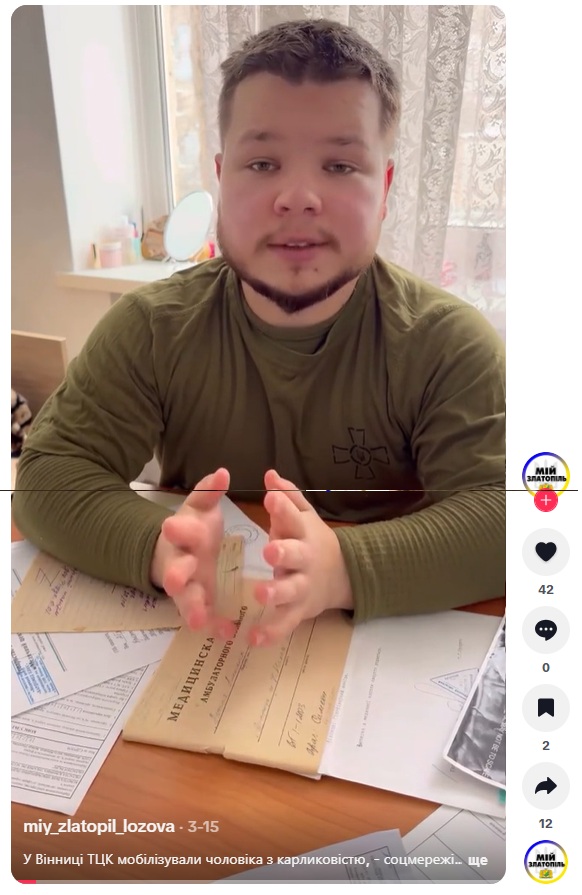
Screenshot — TikTok
Approval of evading conscription and/or military service
The share of posts expressing proposals or support for ideas of evading mobilisation and military service in the analysed videos is about 8% (40 out of 503 videos).
Medians of views, comments, and shares of videos that contain and do not contain approval of evasion of mobilisation. Infographic: Detector Media Research Centre
Unlike videos criticising the need for mobilisation, the median numbers of views and comments for such videos are lower compared to videos that do not express the idea of avoiding mobilisation. However, they tend to have relatively more shares than videos without expressions supporting evasion of mobilisation. Such videos are likely niche. They do not reach a broad target audience; however, without transparent data from TikTok itself, it is difficult to draw a definitive conclusion as to whether this is the result of the platform’s algorithm distributing such videos to Ukrainian audiences or the company’s efforts to limit their spread.
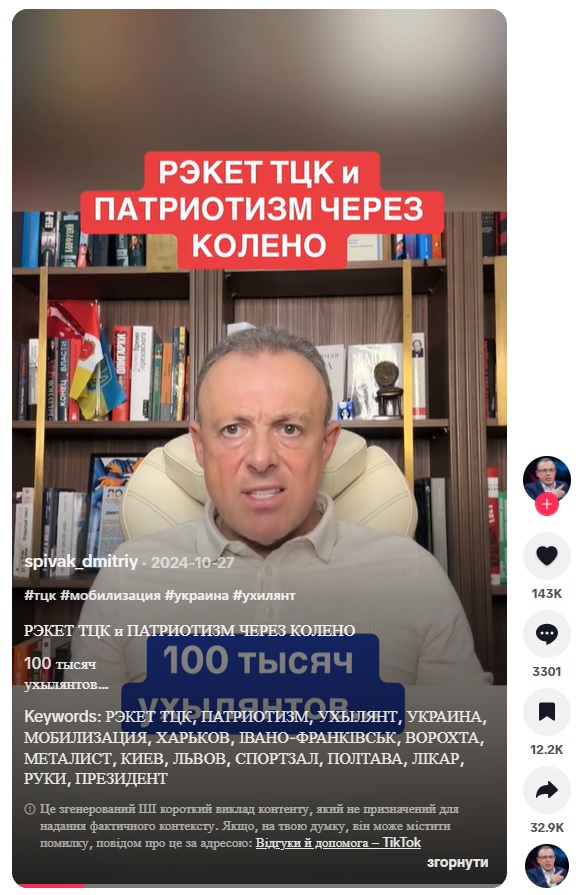
A video containing manipulation about the number of employees of the Territorial Recruitment Centres in the account of former MP Dmytro Spivak received more than 143,000 likes. Screenshot — TikTok
Among the videos classified by researchers in this category is a clip from October 2024 from the TikTok account of former Odesa City Council deputy Dmytro Spivak, known for disseminating pro-Russian propaganda narratives. In the video, he assures his viewers that ‘in no country that has gone through war has there been 'busification,’ citing as examples Russia, North Korea, Israel, and Uzbekistan (!). Spivak does not specify which war in Uzbekistan he is referring to, while simultaneously engaging in manipulation by referring to the servicemen of the Territorial Recruitment and Social Support Centres as ‘100,000 draft evaders who took an oath.’ As of the end of 2024, 36,000 employees and servicemen were working and serving in the Territorial Recruitment and Social Support Centres across all categories, including notification groups. This figure also included 7,000 civilian civil servants.
In another typical video from this group, a user who, judging by other videos on their account, is located abroad, criticises Volodymyr Zelenskyy as incapable of ending the war and calls on viewers to avoid mobilisation and ‘save their lives.’ The account description states: ‘Consultation regarding relocation on Instagram,’ followed by a link. This is a classic case of the so-called ‘regulatory gray zone.’ Under the DSA (Digital Services Act of the EU), TikTok cannot monitor users’ private correspondence, even if it concerns illegal services or illicit business. In this case, there is also a ‘spillover’ of audiences between social networks: while direct links to Telegram might attract the attention of platform safety algorithms, in the case of Instagram, this is less obvious.
Criticism of medical personnel involved in work with mobilised individuals
On October 4, 2024, the State Bureau of Investigation of Ukraine reported exposing illicit enrichment by the head of the Khmelnytskyi Regional Medical and Social Expertise Center, Tetiana Krupa, and her son, an official of the regional office of the Pension Fund of Ukraine, Oleksandr. During searches, nearly 6 million US dollars in cash and valuable jewellery were found. The officials’ family also owns 30 real estate properties, 9 vehicles, real estate abroad, and more. This case led to searches of other medical professionals involved in mobilisation, reforms in the functioning of medical and sanitary expert commissions, and a wave of disinformation about corruption in mobilisation.
A fragment of a video from the searches of the officials (without commentary) was the most popular video criticising medical personnel involved in mobilisation in Ukraine. This video had 7.6 million subscribers. It was published by a Ukrainian military media figure, Colonel Anatolii Shtefan. Regarding his registration on TikTok in November 2021, he stated that he did so to reach a younger audience and counter Russian propaganda: “When I joined TikTok and saw what Russian propaganda was doing to our children, I decided to register. Young people became interested, and subscribers started to grow.”
At the time of data collection, videos criticising the activities of members of military medical commissions and other medical personnel involved in mobilisation in Ukraine accounted for only about 4% of the videos in the analysed videos under the hashtag #мобілізація.
Medians of views, comments, and shares of TikTok videos that contain and do not contain criticism of medical personnel in the mobilisation of individuals. Infographic: Detector Media Research Centre
In 14 out of 20 videos assigned to this category, medical personnel were mentioned indirectly in videos containing commentary on mobilisation legislation. In six other cases, examples were provided in which medical professionals allowed individuals with serious diagnoses to undergo training or military service.
Arguments in favour of conscription and military service
Forty videos featuring constructive discourse or arguments in favour of mobilisation account for nearly 8% of the processed publications.
Medians of views, comments, and shares of TikTok videos that contain and do not contain arguments in favor of mobilisation and military service. Infographic: Detector Media Research Center
In the analysed dataset, there are three key clusters of videos in support of mobilisation in Ukraine. The first cluster includes videos with the argument that it is necessary to mobilise because otherwise Russia will win, and men will be forcibly mobilised into the Russian army.
The second cluster includes videos containing arguments in favor of changing the categories of people subject to mobilisation: the mobilization of women or civil servants exempted from mobilisation, police officers, and changes to the starting age of mobilisation to 23, 20, or 18 years. Among such videos, there are reflections based on contemporary news hooks about “fair mobilisation” from two members of parliament: Yuliia Tymoshenko and Oleksii Honcharenko.
The third cluster includes videos with arguments in favour of military service and preparation for it, presented by mobilized individuals and volunteers from various social groups, or videos arguing for the lack of alternatives to current mobilisation practices as they exist today.
In the second category, the videos were generated using generative artificial intelligence. The videos clearly displayed a watermark indicating that they were generated using, in particular, OpenAI’s text-to-video model, Sora. The first video contained a montage of footage showing a speech at a podium and a general view of a session hall of the Verkhovna Rada of Ukraine. A voice resembling that of Volodymyr Zelenskyy stated that police officers should be mobilized. This video did not have additional platform labeling as AI-generated. In another case, a video with the idea of mobilizing people from the age of 23, both men and women, was labeled by TikTok itself as AI-generated. The inauthenticity of a video depicting a person resembling the commander of the 429th UAV brigade “Achilles,” Yurii Fedorenko, was primarily indicated by unnatural voice quality and visual irregularities.
It should be noted that, in general, videos supporting the need for mobilisation are also published from accounts that predominantly post criticism of mobilisation. Most often, this concerns videos calling for intensified mobilisation, the use of stricter mobilisation methods, lowering the mobilisation age, and similar themes. Most likely, ‘anti-mobilisation’ accounts publish such videos to intimidate their audience and provoke anger toward speakers who support mobilisation measures and toward the state in general.
Special cases and other observations
Some of the observations regarding videos under the #мобілізація tag are caused, paradoxically, by the lack of transparency in TikTok’s algorithms. Among the videos reviewed by analysts during the research period were, for example, a number of videos that did not contain the #mobilization hashtag but were still shown to users in the web version of TikTok on the #mobilization tag page. These are most likely videos from accounts targeting a Russian-speaking audience, or at least Russian-speaking users, or from authors located directly in Russia. This was inferred either from the content of the videos themselves or from other videos on the same accounts. How and why these videos are being targeted (or at least can be targeted) at Ukrainian audiences remains unclear.
Among such videos encountered by researchers, for example, were clips about the mobilization of students in Russia and in the temporarily occupied territories or anti-migrant raids in Russia after which migrants could potentially be mobilised into the Russian army (from the account ‘Адекватный Русский’). There were also videos about a new general mobilisation in Russia (from the account named ‘СВОи Рядом’). In another video from May 2024, authored by a Russian ‘war correspondent’ (propagandist), it was claimed that in the Kursk region, Russian military forces allegedly captured ‘a couple of girls, foreign female sniper mercenaries in the Armed Forces of Ukraine’ (from the account novosti.em24). A common feature of such accounts is the presence of an active link to a Telegram channel in the profile description, often accompanied by a call to subscribe.
TikTok’s policy in Russia remains controversial: officially, the company states that strict restrictions are in place, but in practice, users find ways to bypass them, and Russian media reported as early as May 2024 that the platform had become accessible again in Russia. Officially, the company’s policy has remained unchanged since March 2022; details, including labelling of content published by state-sponsored Russian media accounts, are available on the company’s official website.
Among accounts that primarily disseminate either AI-generated, unlabelled content on abuses during mobilization or manipulative videos regarding Territorial Recruitment Centers, the sample included videos from the accounts: Uhyliant_UA and vony__kradut. This includes, in particular, AI-generated content that manipulated a story about a serviceman of the Bucha District Territorial Recruitment Center declaring gold bars worth 7.7 million UAH. The AI-generated video depicted gold declarations as a mass trend among Territorial Recruitment Centre employees. Journalists from Ekonomichna Pravda, citing information from the court registry, report “rates” of abuses by employees of Territorial Recruitment Centres and Social Support Centres. For example, payments ranging from $1,500 to $7,000 were allegedly demanded for removal from wanted lists or for fraudulent deferments in various regions of Ukraine.
It is impossible not to highlight cases of corruption within the mobilisation system; however, before specific court decisions are issued, generalisations spread through social networks carry destructive signals for society. In this case, the only constructive recommendation for the platform would be to more clearly label AI-generated content; perhaps then, users, after an initial emotional reaction, would be more inclined to examine specific cases in greater detail.
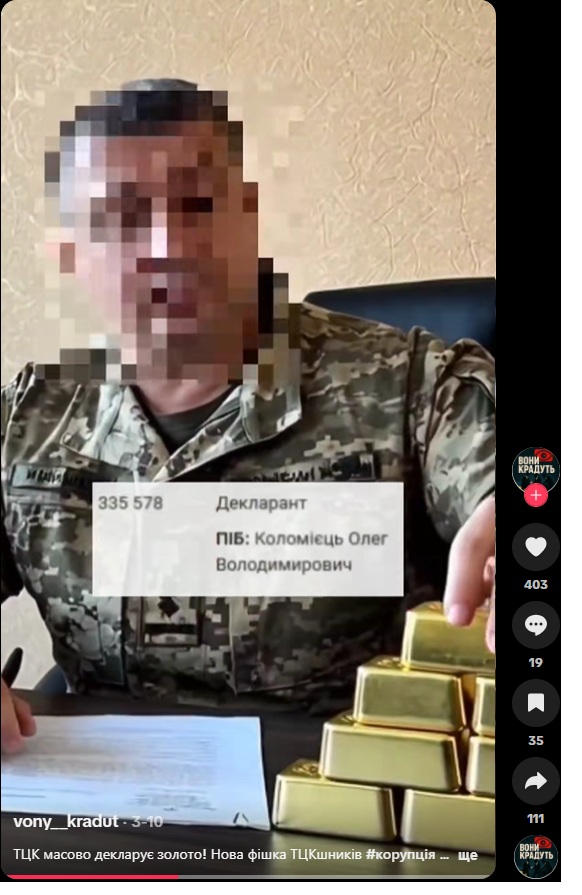
Video with signs of generative AI. Screenshot of a video on TikTok
Conclusions
The analysis of 503 unique videos under the hashtag #мобілізація on TikTok, collected from a non-logged-in web version of TikTok, March 16 – 20, 2026, demonstrates a clear predominance of destructive discourse over constructive one. Videos depicting the use of force during mobilisation accounted for nearly 38% of the sample and, compared to the rest of the videos, had 10–12% more shares and comments, indicating higher audience engagement.
Criticism of the necessity of mobilisation as such is present in approximately one quarter of the analysed videos.
Constructive discourse with arguments in favour of military service is the most marginal: it covers only 8% of the analysed videos and is characterised by lower engagement metrics compared to critical publications. This merely reflects the distribution of videos with different narratives within the sample, as well as the lack of pro-government communication, and is not indicative of the platform’s policies regarding the ‘visibility’ of any particular type of content.
The study identified signs of anti-mobilisation activity on the platform that appear to be coordinated in nature: certain accounts systematically publish videos of violent incidents exclusively, imitating the behaviour of ordinary users.
AI-generated manipulative content about mobilisation has been detected in the sample, but was not dominant or particularly visible in the studied sample. A few of such videos were not labelled by the platform as artificially created, although they contained watermarks from generative AI tools (such as Sora).
Content that directly denies the legitimacy of mobilisation shows lower median reach indicators, which may suggest certain efforts by TikTok to limit this type of content; however, this cannot be confirmed without transparent data from the platform itself.
An important contextual conclusion is the limited visibility of systematic state communication on mobilisation from the highest levels of government. This vacuum is filled with a variety of content, including on TikTok. As a result, users are left with a fragmented picture composed of isolated legal provisions, incidents of force used by officials, and emotional or manipulative content, all of which influence attitudes toward mobilisation in Ukraine.
The dominant pro-Ukrainian argument in favour of mobilisation in the videos is reduced to a warning about forced mobilisation into the Russian army in the event of defeat, which reflects more a fear of defeat than positive motivation for service.
Recommendations
For state communication: purposefully create TikTok-native content in short, platform-specific formats rather than repurposed materials. There is a lack of explanations of legal procedures, rights of appeal, reservation rules, and issues of fairness in mobilisation. Cooperation with active officers and veterans who already have an audience on the platform should be considered. This would help strengthen constructive discourse and its participants on the platform.
The need to provide Ukrainian researchers with access to structured data. TikTok (ByteDance) should explore options for providing data access (preferably via API) to civil society organisations and academic institutions in Ukraine, as independent monitoring of platform influence is currently limited mostly to manual observation.
The need to address communication gaps at the highest state and political level. The Office of the President, the Cabinet of Ministers, and the Ministry of Defence should communicate more frequently and more transparently about mobilisation, rather than replacing it with ‘recruitment’ messaging or avoiding the term ‘mobilisation’ in official communication. This would create more opportunities for constructive content, including on TikTok.
Introduce additional labelling of AI-generated content. TikTok should consistently and more visibly apply AI-content labels to materials depicting Ukrainian officials and commanders, as well as ensure compliance with existing rules regarding thematically uniform accounts whose behaviour does not correspond to that of ordinary users.
Monitoring TikTok as a separate priority for civil society. Ukrainian fact-checkers, journalists, and non-governmental organisations — potentially with funding from donor organisations or the platform itself — should systematically monitor TikTok, promptly debunk AI-driven manipulations, and develop constructive formats that go beyond fear of forced conscription into the Russian army as the dominant pro-Ukrainian argument.