Українською читайте тут.
The Russian authorities illegally used the occupied Ukrainian territories as an electoral reserve to simulate the results of their “elections” to the State Duma.
From September 18 to 20, Russia held the so-called “single voting day,” during which central and local authorities simulated the expression of the people’s will to “elect” predetermined individuals as deputies of the State Duma, the Russian parliament.
The only party that declared an anti-war position, Yabloko, was barred from participating in the elections, while members of the party were subjected to repression. Russian voters could see only government-approved candidates on the ballot, yet even under such conditions, the election results, according to Russia’s opposition media, for example Novaya Gazeta Europe, had to be massively falsified. Through such falsifications, the ruling United Russia party obtained a result of nearly 58% according to party lists, based on preliminary information from Russia’s Central Election Commission, as well as 208 out of 225 seats in single-member constituencies. Thus, Putin’s party is expected to obtain approximately 347 of the 450 seats in the State Duma, which would be a record number of United Russia deputies for the entire period.
However, despite the Kremlin’s full control over the electoral process and the widespread falsifications, the main reason for the illegitimacy of the “elections” in Russia is that they were held not only in Russia but also in the occupied territories of Ukraine. The holding of “elections” by the occupiers in the seized territories and the involvement in the State Duma of deputies who are supposedly “elected,” but in fact appointed, from these territories makes the entire electoral process and its results illegitimate.
On September 21, Ukraine’s Ministry of Foreign Affairs published a statement calling the pseudo-elections in the seized Ukrainian territories “null and void”: “The holding of ‘elections’ in the temporarily occupied territories is illegal, and their results are null and void. This violates Ukrainian national legislation and international law, depriving the entire parliamentary election process in Russia as a whole, as well as the composition of the Russian parliament, of the remnants of legitimacy.”
European Commission Vice-President Kaja Kallas called the elections “so-called” and “fake” and proposed imposing new sanctions on those involved in holding them in the occupied Ukrainian territories.
The Council of Europe issued a similar statement. The United Kingdom, Norway, Australia, New Zealand and Canada also condemned the fake “elections,” calling their conduct in the seized Ukrainian territories “part of a broader system of occupation.”
How the “elections” were simulated in the occupied territories
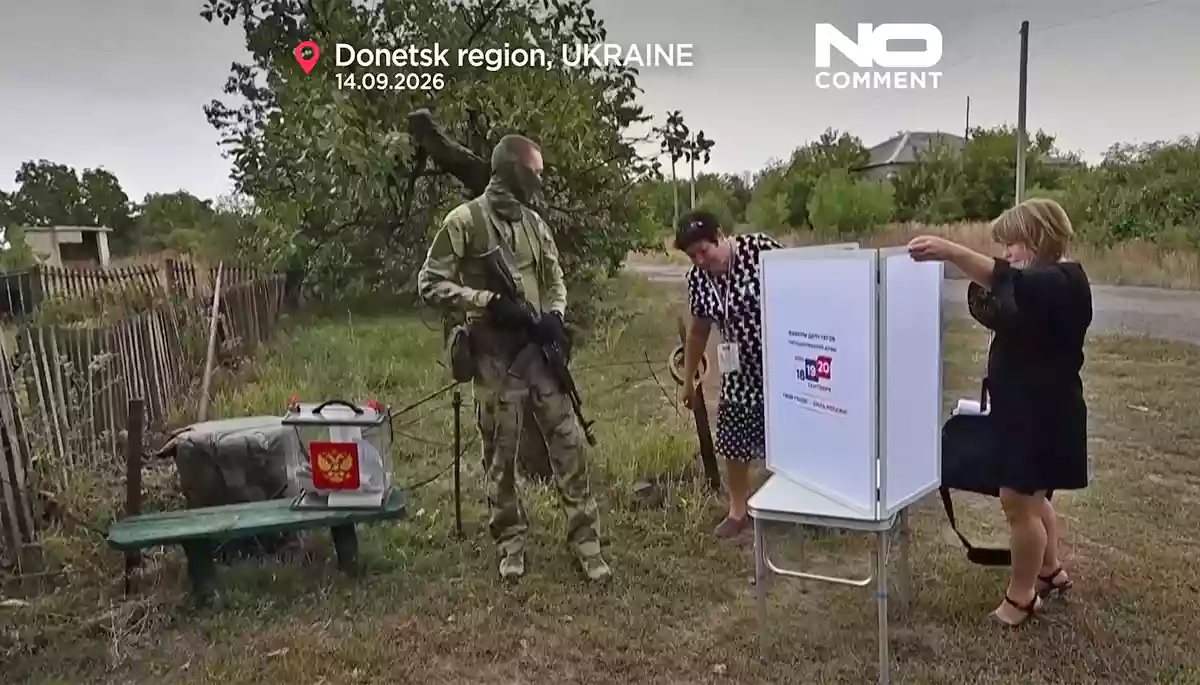
In most of the temporarily occupied territories, the “elections” began long before the officially designated voting dates at polling stations. So-called early voting was held from August 28 to September 17 and took place through door-to-door visits by “mobile groups” consisting of members of election commissions, police officers and armed Russian military personnel. In videos and photos that captured the process in some places, military personnel can be seen carrying ballot boxes and carefully monitoring the “expression of will” of local residents.
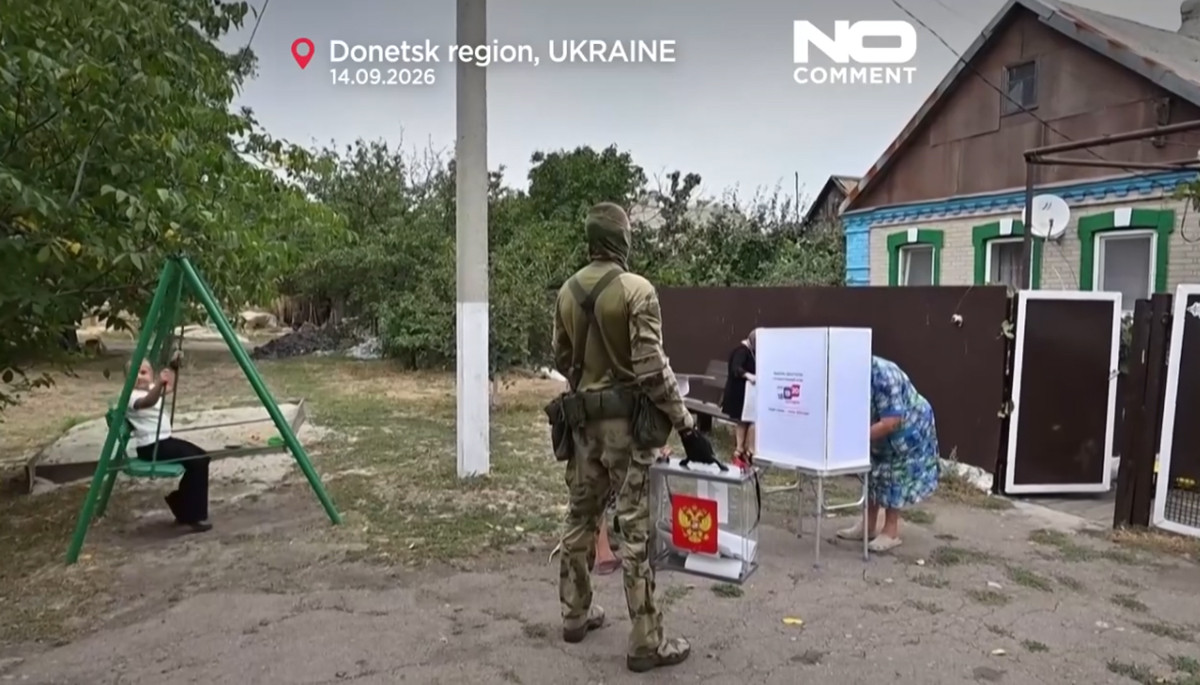
The process of “early mobile voting” in the occupied part of Donetsk region under the control of Russian military personnel. Source: Euronews
Local occupation administrations announced that most voters had cast their ballots before September 18. In particular, as early as the morning of September 18, the “election commission” of the occupied part of Donetsk region reported a figure of 75% of voters who had allegedly participated in the voting. After the first day of official voting, the occupiers estimated turnout at 80%. Similar figures were announced by the occupiers in other territories: more than 79% in Luhansk region, 80% in Zaporizhzhia region and 74% in Kherson region. Turnout in Crimea was noticeably different, where only 47% was recorded, and 63% in Sevastopol.
Overall, Russia’s Central Election Commission estimated turnout in the elections at more than 59%. Thus, in the occupied territories (except Crimea), turnout for the Russian elections is anomalously high and more similar to the figures announced in the so-called “electoral sultanates” such as Chechnya and Dagestan, where protocols record more than 90% of people having voted, with an almost unanimous “choice” required by the authorities. At the same time, it is worth taking into account that the actual turnout in the elections is even lower than the announced 59%, since it includes information from these “sultanates,” ballot stuffing and other falsifications. It is not possible to determine even approximately the actual percentage of people who voted in the occupied territories.
In Russia, independent observers were present at some individual polling stations, and at these stations results were recorded that differed noticeably from the overall figures, with United Russia receiving fewer votes than other parties on the ballot. Based on these data, Russian opposition media conduct calculations (The Insider, “Novaya Gazeta Europe”), estimating that United Russia actually received a significantly lower percentage of the vote and suggesting that 18 of the 30 million ballots cast for the ruling party could have been “fake.” In the occupied territories, however, where “mobile voting” took place with the participation of military personnel, there can be no question of any monitoring or assessment of the “genuineness” of the results.
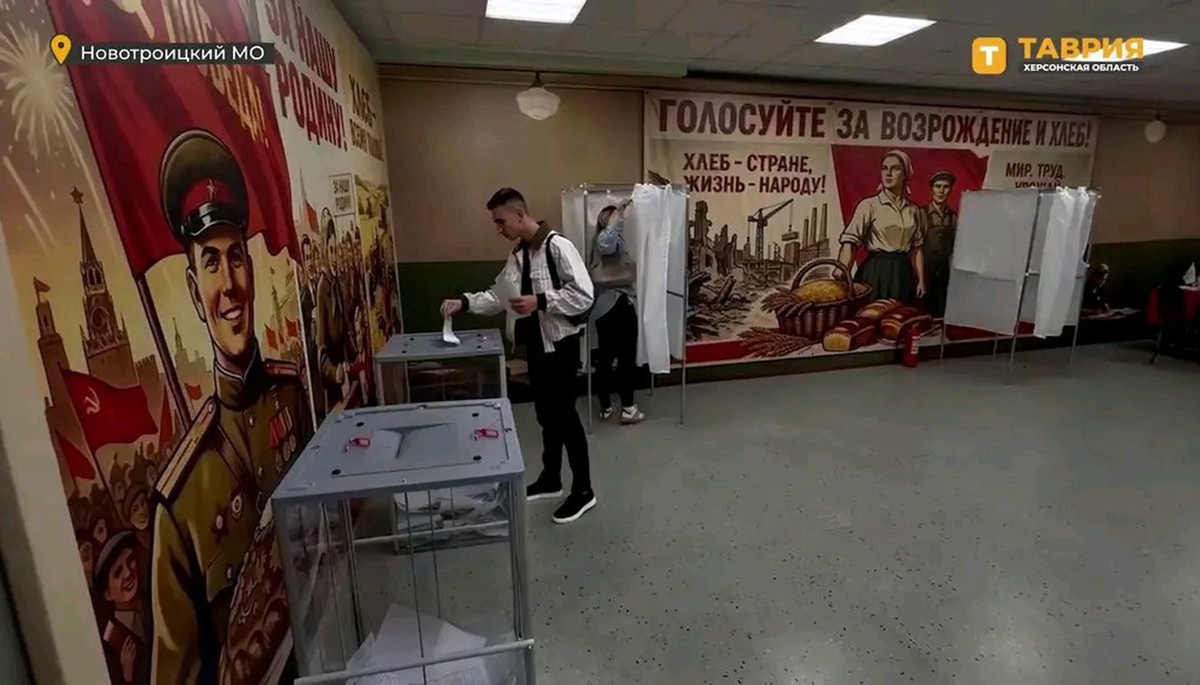
One of the polling stations in the occupied part of Kherson region with Soviet propaganda posters. Source: propaganda media
What could be seen in the videos from polling stations published by propaganda media was that there were no queues. According to journalists, there was also no active election campaign in the occupied territories.
In particular, Mariupol journalist Anna Murlykina says that this year’s election campaign was notable for the minimum amount of campaigning, including silence on local television. According to her, the occupiers did not even publish information about the addresses of polling stations.
Luhansk’s Realna Hazeta also writes about the “silence” surrounding the elections. Regarding Crimea, Denys Chystikov, Deputy Permanent Representative of the President of Ukraine in the Autonomous Republic of Crimea, said that the occupiers “tried not to irritate the population” and not to mention the elections.
Such “secrecy” does not correspond well with the occupiers’ reported turnout of 70–80%. It can be assumed that the “mobile groups” accompanied by security forces made such efforts to force all residents of the Ukrainian territories they could reach to vote, and thus ensured this “turnout.” However, reports in local Telegram chats suggest the opposite: many people did not see any election commissions at all. Therefore, the version in which these figures exist only in the protocols signed by the occupiers’ election commissions appears much more plausible. In any case, there can be no question of any “voluntary expression of will” or “representation” of the occupied territories in the State Duma.
Appointed parliamentarians: who entered the State Duma from the occupied territories
The occupation authorities divided the Ukrainian territories into eleven single-member constituencies: four in Crimea, three in Donetsk region, two in Luhansk region, and one each in Zaporizhzhia and Kherson regions. Given the simulated nature of the electoral process in the occupied territories, it would be more appropriate to speak of the appointment rather than the “election” of deputies in these constituencies.
Thus, according to the preliminary results announced by Russia’s Central Election Commission, in Donetsk region, the following people were appointed as deputies: Russian propagandist and “war correspondent” Irina Kuksenkova, former “prime minister” of the occupation government of Donetsk region Oleksandr Borodai, and Serhii Makarov, deputy director of the coal-mining company Impex-Don.
Kuksenkova was born in Kyiv, but has worked in Russian media since 2004. In 2022, she worked on media coverage of Russia’s full-scale invasion, including during the assault on Mariupol and in Hostomel, where she recorded a report next to the destroyed Mriya aircraft. As journalist Denys Kazanskyi wrote, Kuksenkova was the lover of Russian General Volodymyr Alekseyev of the Main Directorate of the General Staff of the Russian Armed Forces (formerly the GRU). Information about Kuksenkova’s relationship with Alekseyev has also been confirmed by independent Russian media (Verstka). The connection with a high-ranking general likely contributed to the propagandist’s promotion to the State Duma.
Oleksandr Borodai became known in 2014 as one of the key figures in the Russian occupation of Donetsk region. The Moscow political technologist was appointed “prime minister” of the separatist administration by its curators, and when a decision was made to replace its leaders with local figures, he obediently resigned. In recognition of his loyalty, in 2021 Borodai became a State Duma deputy on the United Russia party list. In September 2026, Borodai was accused in Russia of organizing extortion from Russian servicemen, embezzling funds intended for food supplies, and “humanitarian” vehicles. However, this did not prevent him from being “reelected” in the constituency allocated to him.
Serhii Makarov is the least publicly known of the “Donetsk” single-member candidates. It is known that he was born in Donetsk and worked in the coal industry. In recent years, he has been associated with the company Impex-Don, which manages coal assets in the occupied territory. An interesting detail about the deputy is that he was elected from the Horlivka constituency, to which the occupiers also included Kramatorsk, Sloviansk and other cities that are not under their control.
In Luhansk region, two representatives of the local occupation body known as the “People’s Council,” Denys Kolesnikov and Ivan Sanaiev, became deputies of the Russian parliament. Kolesnikov was born in Luhansk and was engaged in the construction business. Ivan Sanaiev is a native of Sorokyne (Krasnodon until 2016); in 2010, he was elected to the city council from the Party of Regions. Both Kolesnikov and Sanaiev became collaborators in 2014, joining separatist structures in Luhansk region. Both are under sanctions imposed by Ukraine’s National Security and Defense Council and have been accused by the Security Service of Ukraine of encroaching on Ukraine’s territorial integrity and of collaboration activities.
Unlike in Luhansk region, in Zaporizhzhia region the occupiers failed to find a “worthy” candidate, sending Oleksii Tikhomirov, a representative of the occupation structures in Crimea, to the State Duma. In 2010–2014, he was a deputy of the Crimean Supreme Council from the Communist Party of Ukraine and assisted Russia’s occupation of the peninsula. Tikhomirov headed one of Crimea’s largest fuel companies, Atan-Krym, and was deputy head of the so-called Audit Chamber of Crimea.
In Kherson region, Olena Dmytruk, the widow of former Ukrainian Party of Regions MP and Kherson Regional Council deputy Mykola Dmytruk, who died in 2021, was appointed as a deputy. Dmytruk owned Khersonlift and a number of other companies that remained in the de-occupied part of the region. After 2022, she joined the occupiers, was placed in charge of the Nova Kakhovka Bakery, and received the position of first deputy speaker of the occupation Kherson Regional Duma.
In occupied Crimea, the only Ukrainian territory where illegal elections to the State Duma have been held before, the same people who had previously received mandates were mostly reappointed as deputies. Yurii Nesterenko, Leonid Babashov and Tetiana Lobach became deputies again. All three had been engaged in business in Crimea before 2014 and joined the occupation authorities after Russia seized the peninsula. The new female deputy was Yanina Pavlenko, who before the occupation had been a deputy of the Supreme Council of the Autonomous Republic of Crimea and had also headed the Novyi Svit champagne winery and the Massandra wine-making association. After the occupation, the wineries went to Putin’s friend Yurii Kovalchuk, while Pavlenko instead received the position of head of the occupation administration of Yalta. As Krym.Realii writes, during the full-scale invasion Pavlenko joined the “Bars-Krym” territorial defense unit under the call sign “Mother” and regularly helps Russian military personnel.
Thus, it can be seen that the occupation authorities are attempting to create a picture of “popular representation” of the Ukrainian territories in the State Duma, mostly finding local figures to delegate to the Russian parliament. At the same time, some constituencies are given to Russian appointees who participated in the seizure of Ukrainian territories, as in the case of Borodai and propagandist Kuksenkova. And from Zaporizhzhia region, an already vetted Crimean collaborator was sent.
Overall, the 70–80% “turnout” announced by the occupiers bears little resemblance to the result of free voting. The early collection of votes accompanied by armed military personnel, the almost invisible campaign, and the absence of independent oversight make it impossible to establish how many people actually participated in the “elections.” Instead, these figures allow the Kremlin to demonstrate an alleged mass support among local residents.