
Українською читайте тут.
Since February 24, 2022, Detector Media has been monitoring the Ukrainian segment of social media and Kremlin media, documenting the chronology of Russian disinformation about Russia's war against Ukraine daily.
From June 17 to 23, 2026, Detector Media analysts documented 13 disinformation narratives. Among them, Russian propagandists spread false claims that the strike on the Kyiv-Pechersk Lavra had been "staged," discredited Ukrainian refugees through fake videos styled as Euronews reports, manipulated the topic of Polish assistance to unemployed people, and distorted an arbitration ruling in The Hague by presenting it as an alleged "recognition" of Crimea as Russian.
Some of these disinformation campaigns were aimed at shifting responsibility away from Russia for attacks on civilian infrastructure, fueling anti-Ukrainian sentiment in Europe, and creating the illusion of international legitimization of Russia's occupation.
AI-generated images presented as "evidence" that the strike on the Kyiv-Pechersk Lavra was staged
Following Russia's attack on Kyiv on the night of June 15, during which the Kyiv-Pechersk Lavra was among the sites damaged, Russian propaganda outlets began spreading a conspiracy theory claiming that the strike on the shrine had been "staged." According to these posts, photographers with professional equipment had allegedly been present near the impact site in advance and captured the moment of the attack. Based on this, propagandists claimed that the damage to the Lavra had supposedly been a Ukrainian "provocation" intended to discredit Russia and pressure Western partners.
However, the images circulated as "evidence" were not authentic photographs. StopFake fact-checkers established that the pictures showing the alleged "photographers" had been generated using artificial intelligence. Verification with AI detection tools confirmed that neural networks had created the images.
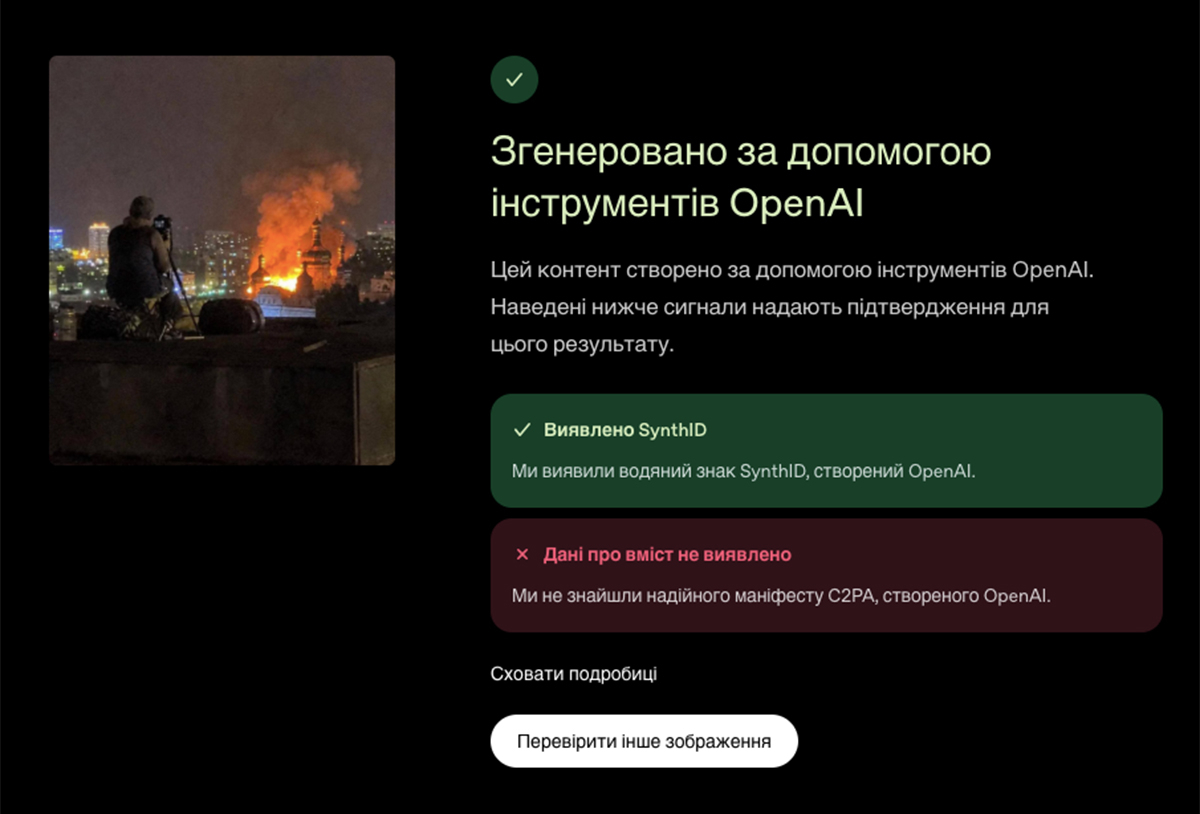
Verification of one of the fake images. Source: StopFake
This fake fits into a broader Russian narrative alleging that Ukraine stages attacks on itself. Kremlin propaganda regularly attempts to shift responsibility for Russian strikes onto Ukraine or portray attacks on civilian infrastructure as "provocations." In this case, artificially generated images were used to make a conspiracy theory appear to be supported by "visual evidence."
Fake Euronews videos discredited Ukrainian refugees
Videos designed in the style of the international broadcaster Euronews were circulated on X with false accusations against Ukrainian refugees. One video claimed that 100 police officers in France connected to investigations involving Ukrainians had allegedly been killed. Another claimed that Ukrainian refugees were supposedly creating fake photos and videos to blackmail married Europeans.
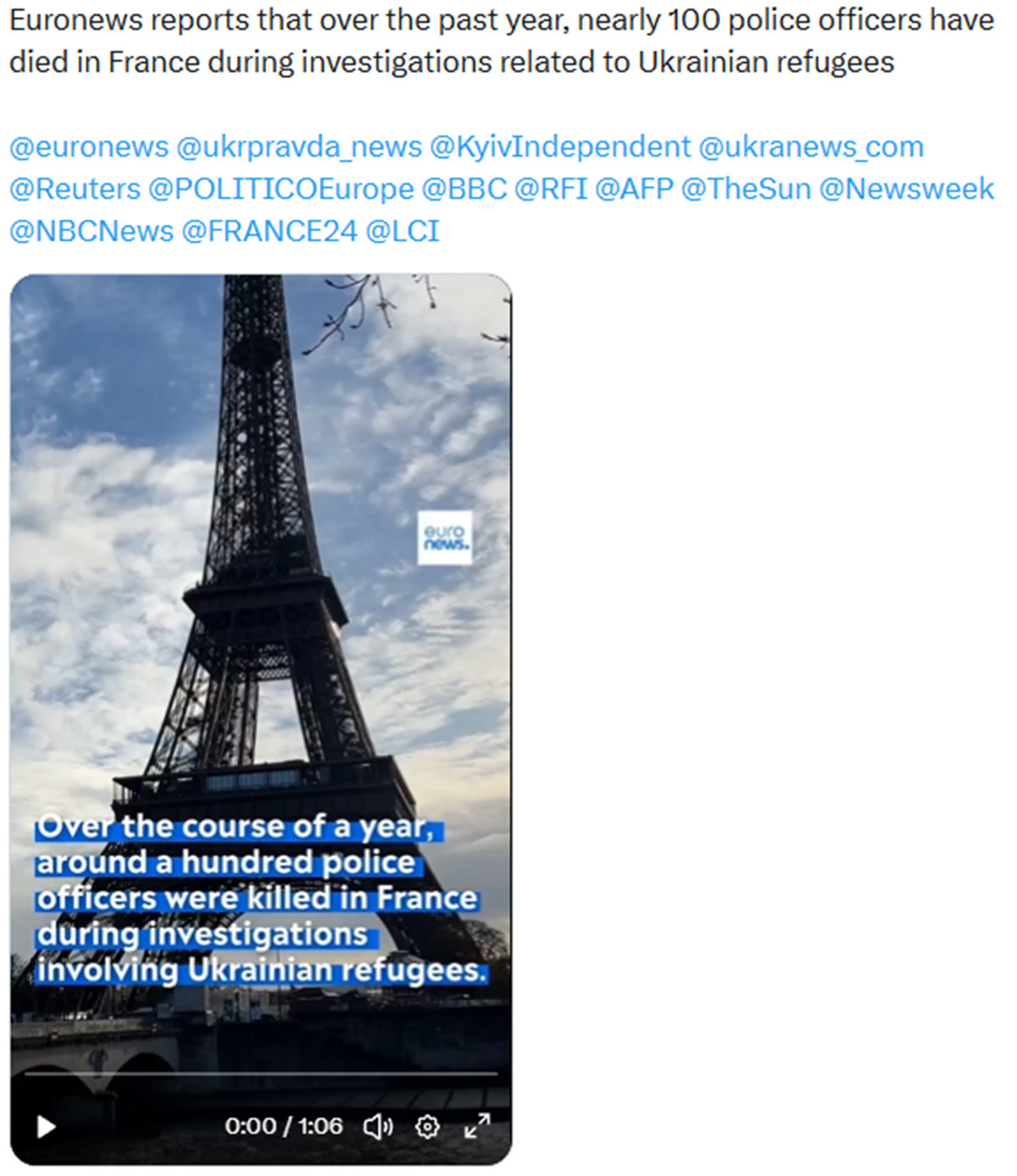
Screenshot of a post containing a fake video. Source: X
In reality, there is no evidence that Euronews created or published such reports. These videos were never posted on the broadcaster's official website or social media pages and were instead distributed through private accounts and pro-Russian profiles. Some of the accounts sharing these videos had shown almost no activity for many years, suggesting the possible use of dormant or pre-prepared accounts for coordinated disinformation campaigns.

Screenshot of one of the accounts spreading fake videos. Source: X
The fake videos also contained features uncharacteristic of Euronews journalism, including emotional language, sweeping generalizations about "Ukrainian refugees," unsubstantiated accusations, and fabricated quotations. In one of the videos, for example, propagandists used an alleged quote by historian Hasok Chang containing offensive claims about Ukrainians, although there is no reason to believe he ever made such statements.
The purpose of these fabrications is to create an image of Ukrainians as a source of crime, fraud, or social danger for European audiences. At the same time, these disinformation campaigns also target Ukrainian audiences by creating the impression that Ukrainian refugees in Europe are supposedly being widely stigmatized and rejected.
Polish unemployment program portrayed as a "privilege" for Ukrainians
A manipulated claim spread in the Polish segment of social media and in statements by representatives of the far-right Confederation party alleged that Polish employment offices were providing Ukrainians with non-refundable payments of up to 17,000 zlotys. Politicians described this as "financing the colonization of Poland" and "privileges for a minority."
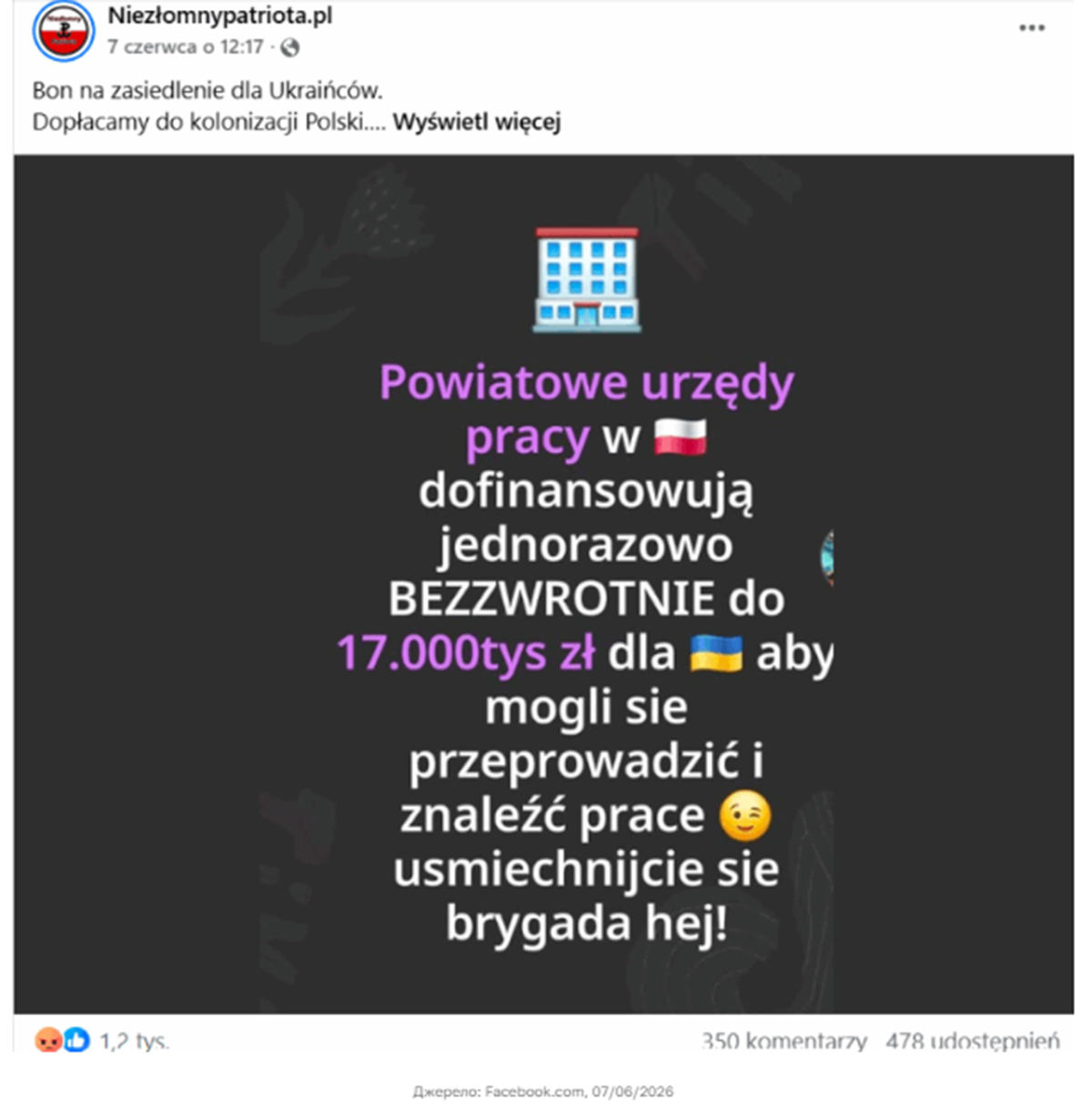
Facebook post: "We are subsidizing the colonization of Poland. Citizens of Ukraine can receive up to 17,000 zlotys from the Polish employment service." Source: Demagog
In reality, as Polish fact-checkers from Demagog explain, the claim refers to the "settlement bonus," a Polish support program for unemployed people who have found a job in another city and need to relocate. This instrument has existed since 2014, meaning it was introduced long before Russia's full-scale invasion and the mass arrival of Ukrainian refugees in Poland.
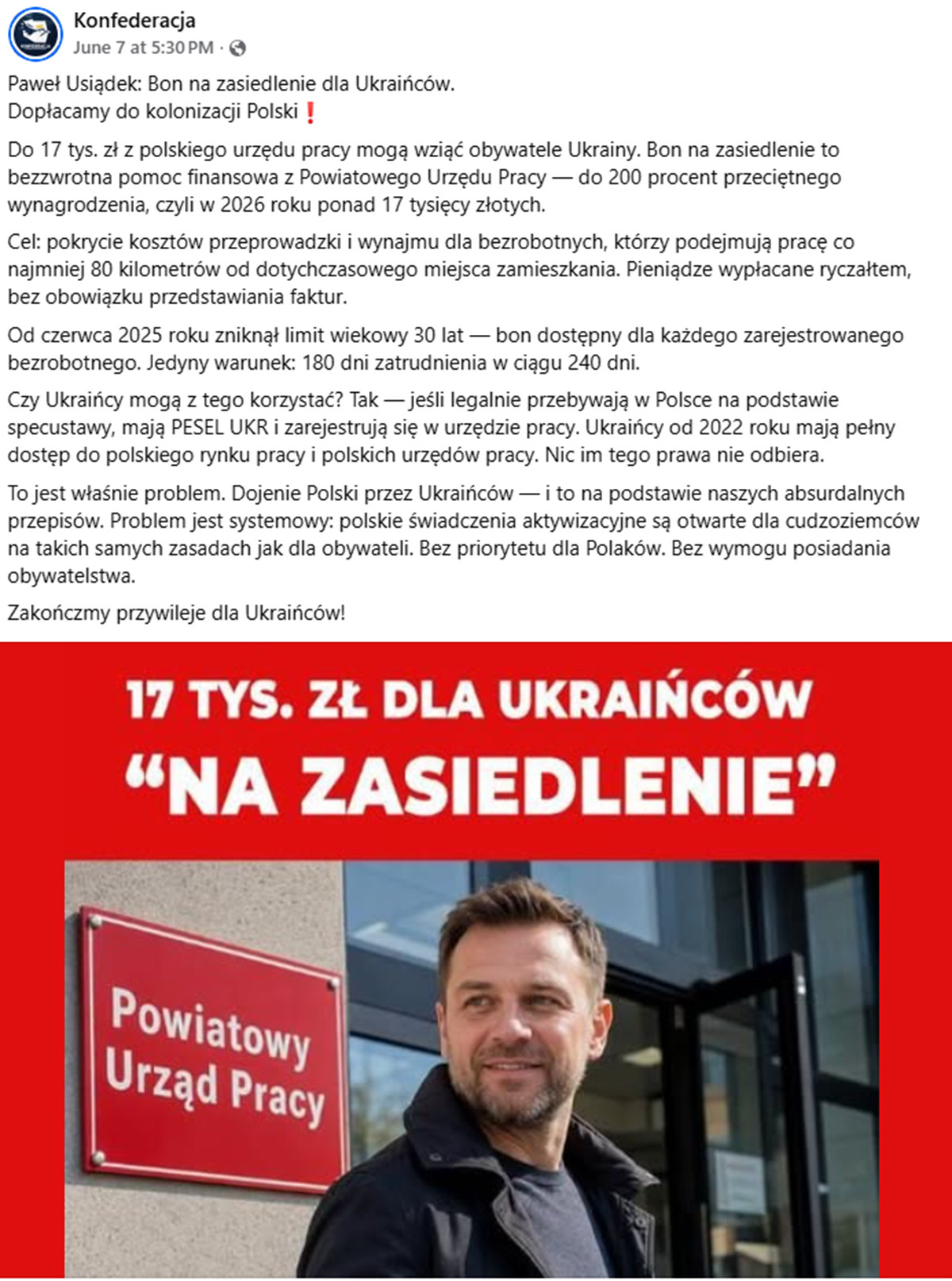
Facebook post on the Konfederacja page inciting anti-Ukrainian sentiment
The benefit is not a special payment for Ukrainians. It is available to all registered unemployed people, including Polish citizens and foreigners legally residing in the country who are eligible for unemployment status. Receiving the funds also does not mean they are simply "handed out." Applicants must have a specific job offer, relocate a significant distance, officially work or operate a business for a specified period, and earn at least the minimum wage. If these conditions are not met, the funds must be repaid.
Therefore, claims about "special payments for Ukrainians" are manipulative. Propagandists and radical politicians exploited a legitimate Polish labor market program to present it as alleged proof of "privileges" for Ukrainians and to fuel anti-Ukrainian sentiment.
Arbitration ruling in The Hague falsely presented as "recognition" of Crimea as Russian
Disinformation circulated in the Georgian segment of Facebook and in Russian state media claiming that the International Court of Justice in The Hague had allegedly recognized occupied Crimea and its adjacent waters as "Russian property." This is how Russian propaganda interpreted the ruling in the maritime dispute between Ukraine and Russia.
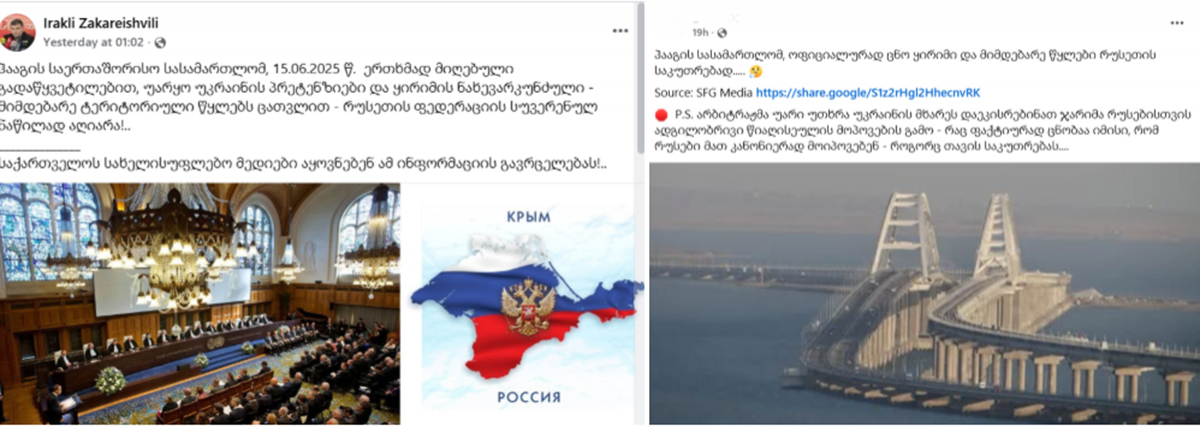
Facebook posts in Georgian claiming Russia's alleged victory in the arbitration court. Source: Myth Detector
This narrative was debunked by Georgian fact-checkers from Myth Detector and the Ukrainian outlet Vgoru. In reality, the case was heard not by the International Court of Justice but by the Permanent Court of Arbitration in The Hague. The proceedings concerned Russia's violations of international maritime law in the Black Sea, the Sea of Azov, and the Kerch Strait—not the issue of sovereignty over Crimea. The arbitral tribunal had no authority to determine who owns Crimea and did not consider that question at all.
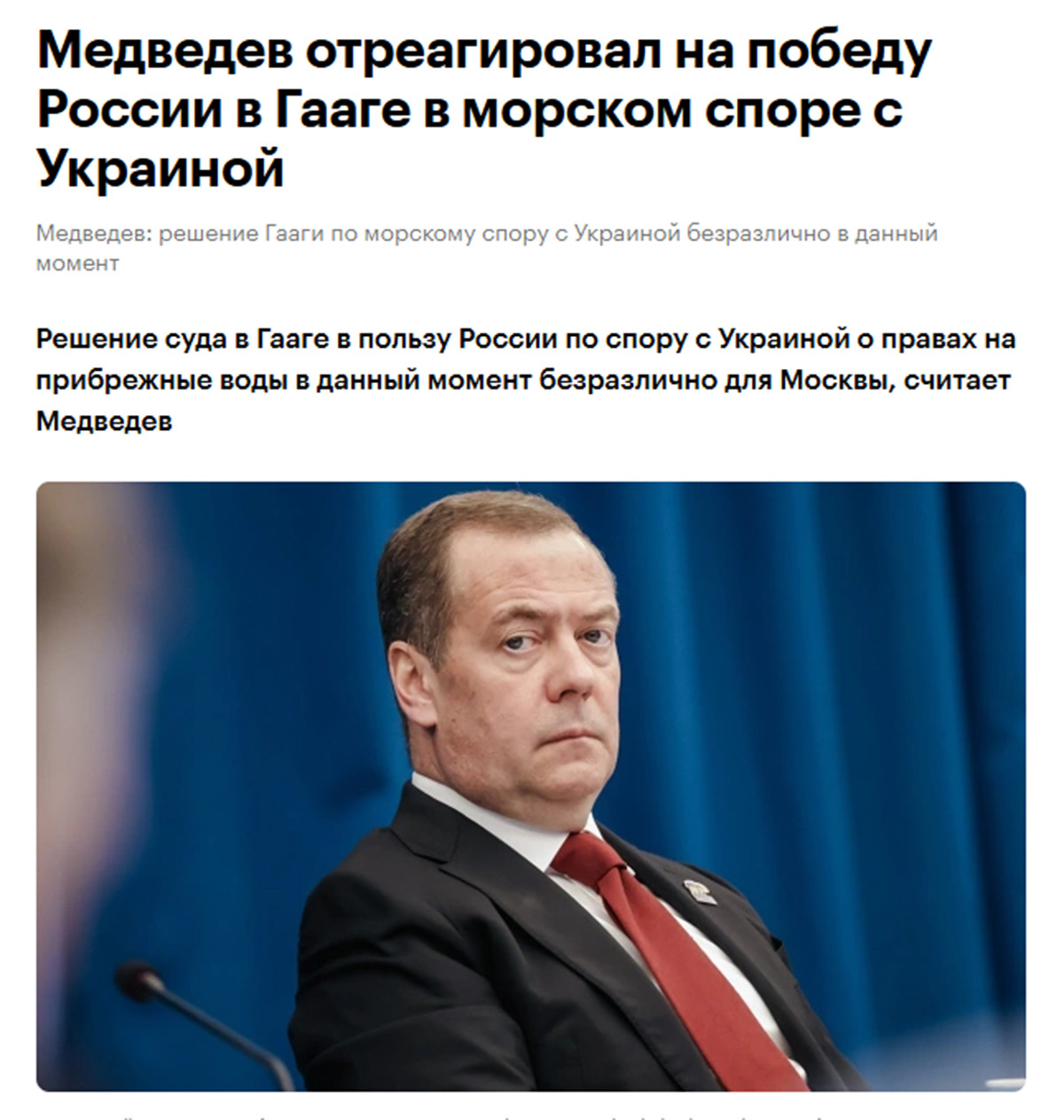
Screenshot of a publication in a Russian media outlet
Among other findings, the tribunal concluded that Russia had violated environmental regulations during the construction of the Kerch Bridge by failing to conduct an adequate environmental impact assessment. At the same time, regarding some of Ukraine's claims, the tribunal either found no violation or concluded that it lacked sufficient jurisdiction. Russian officials and propaganda media took these findings out of context and portrayed them as a "major victory" for Moscow.
The arbitration ruling does not change Crimea's internationally recognized status. The peninsula remains part of Ukraine, and claims that it has supposedly been "recognized" as Russian are yet another attempt by the Kremlin to impose the consequences of its occupation on the world as a "new reality."
All materials from the Chronicles of Disinformation can be found at disinfo.detector.media