


Українською читайте тут.
Telegram channels are counting potential losses from an advertising ban, while “patriotic” bloggers complain about a “stab in the back of the front.”
On February 10, 2026, Russia began tightening restrictions on Telegram. The Russian regulator, Roskomnadzor, confirmed that it is continuing to introduce gradual technical limitations on the service due to the platform's leadership’s “failure to comply with Russian legislation.” According to sources cited by several Russian media outlets, the Kremlin may go even further: the messenger could reportedly be fully blocked in Russia within the next year.
Reports of a possible ban have united a wide range of actors—from opposition bloggers to pro-Kremlin commentators and so-called “war correspondents.” For many of them, Telegram has become the primary channel for disseminating information and political mobilization.
Telegram gained particular importance after the start of Russia’s full-scale invasion of Ukraine in 2022. It is here that an entire ecosystem of so-called “war correspondents” emerged, providing daily commentary on the battlefield, publishing frontline videos, and promoting their own narratives about the war.
For Russian propaganda, the messenger has become a platform for rapidly spreading Kremlin narratives, testing new messaging, and mobilizing loyal audiences. Telegram is also used to coordinate fundraising for military units, share information about the situation at the front, and distribute instructions to pro-war bloggers and supporters.
Amid increasing pressure on Telegram, Russian authorities are actively promoting their own digital alternatives. State institutions are effectively pushing users to switch to a new messaging app called Max, which has already been dubbed “police-controlled” in the Russian online space—implying it is under the control of law enforcement. Critics argue that its main function is not communication but surveillance: the service is integrated with state systems and could potentially give security agencies access to users’ private correspondence.
This policy has sparked resistance even among pro-Kremlin circles. Some military bloggers and even certain Russian lawmakers have expressed dissatisfaction with attempts to push Telegram out in favor of state-backed platforms.
The conflict between Russian authorities and Telegram founder Pavel Durov has been ongoing for more than a decade. Durov, who previously created the social network VKontakte, left Russia in 2014, citing pressure from security services. His new project, Telegram, was positioned from the outset as a platform with enhanced privacy and encryption—officially the main reason for its standoff with the Kremlin.
In 2018, a Russian court ordered the blocking of the messenger after the company refused to provide the Federal Security Service (FSB) with encryption keys to decrypt users’ messages. Roskomnadzor launched a large-scale technical blocking campaign, during which millions of IP addresses were blocked, causing disruptions to internet services across Russia.
However, the attempt proved ineffective: Telegram bypassed restrictions by changing servers and traffic routes, while users relied on VPNs. In 2020, Russian authorities effectively abandoned the blockade and lifted restrictions, acknowledging the impossibility of fully shutting down the service.
Nevertheless, tensions have not disappeared. Telegram remains both a useful propaganda tool for the Kremlin and a risky platform for uncontrolled information flows—making the new restrictions introduced in 2026 another stage in this long-running confrontation.
The Detector Media Research Center analyzed how official propaganda and the Russian blogosphere are reacting to the prospect of a Telegram ban. The study examined 262 posts published between February 9 and March 9, 2026, in Russian and pro-Russian Telegram channels containing combinations of keywords such as “Telegram,” “telega,” and “restrictions,” “slowdown,” “blocking,” “ban,” and similar terms. The data was provided by the company Lets Data.
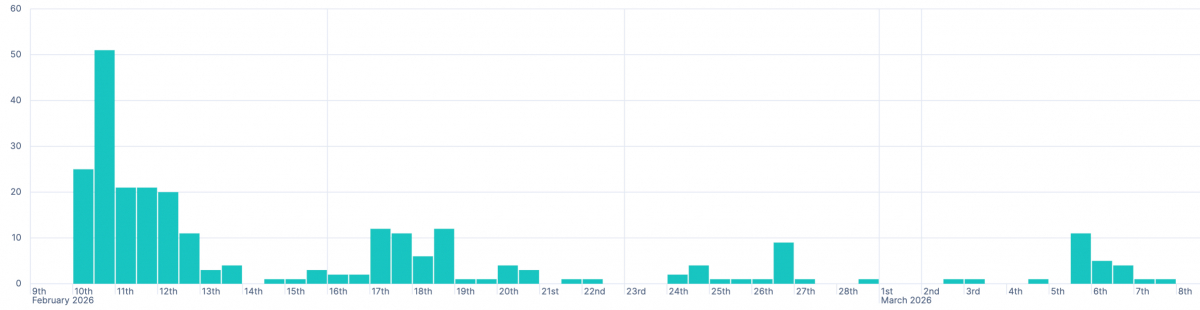
Dynamics of publications in Russian and pro-Russian Telegram channels from February 9 to March 9, 2026. Source: LetsData
Formal Justifications for Blocking and the Struggle for Influence
The first group of narratives in the analyzed Telegram channels focused on explaining the official reasons and arguments in favor of blocking Telegram. To support these claims, the channels cited Russian officials, who referred either to Russian legislation or to the number of content removal requests that Telegram allegedly ignored.
For example, State Duma deputy Andrey Svintsov—quoted in the analyzed channels—expressed dissatisfaction with the level of communication between Russian state bodies and Telegram, and explicitly stated that the company should pay more taxes to the Russian budget: “Telegram interacts with Roskomnadzor, but does so, as they say, ‘through gritted teeth.’ As if Telegram is so big, and Russia is some backward place. If the messenger wants to operate and earn billions of dollars in Russia, we are not against it. But it must comply with Russian law.”
Russia’s Minister of Digital Development, Maksut Shadayev, in an interview with TASS widely circulated on Telegram, said that the messenger systematically fails to comply with Russian legal requirements. These laws oblige all messaging services operating in Russia and serving Russian users to store records of voice calls, calls, and message content within Russian territory. He also claimed the service ignored “150,000 requests to remove channels, materials, and posts containing prohibited information. 18,000 requests to block channels of Nazi groups and more than 100,000 requests to remove materials or channels spreading fake information about the Russian army went unanswered.”
One of the arguments used by deputy Svintsov was intimidation: he suggested that paid Telegram Premium users could be labeled as “sponsors of terrorist organizations” if the messenger were officially banned: “I believe that if Telegram does not take the necessary measures within the next month or month and a half—namely, begin cooperating with Roskomnadzor and the FSB to counter terrorist threats—it would be possible for the FSB to take comprehensive steps to recognize Telegram as an extremist organization.”
A possible Telegram ban was also framed as part of an internal struggle among Russian elites (“Kremlin towers”), particularly over financial flows and influence. For instance, amid reports of further slowdowns and predictions of a ban, shares of another popular Russian social network, VK, were said to be rising. One Telegram channel with over 225,000 subscribers claimed: “The goal of spreading information about a full Telegram ban in Russia starting April 1 is to pump up VK shares. The authors of this ‘brilliant idea’—Vladimir Kiriyenko and the harmful minister Maksut Shadayev—have completely ignored the negative consequences of such news. First and foremost, a noticeable decline in trust in the authorities. So far, the presidential administration has recorded a 7–9% shift, but this is only the beginning. However, Sergey Kiriyenko from the presidential administration will not allow his son, Vladimir Kiriyenko from VK, to be punished.” Vladimir Kiriyenko, the son of Sergey Kiriyenko (First Deputy Head of the Presidential Administration), has served as CEO of VK (formerly Mail.ru Group) since 2021.
The “Towers of the Federation” Telegram channel (nearly 200,000 subscribers) linked discussions about a Telegram ban to Russia’s State Duma elections scheduled for autumn 2026: “When the ban on Telegram gains momentum (June–August), channel authors will be ordered in categorical terms to move to the national messenger MAX, where the domestic policy bloc aims to create a vacuum of opinions ahead of the State Duma elections.”
The authors of this anonymous channel also added a conspiratorial angle, claiming that two factions exist within the Russian elite—those supporting and those opposing restrictions on the messenger. They place the “Kiriyenko family,” Minister Shadayev, and FSB Director Alexander Bortnikov in the first group—those with either financial interests or control over resources needed to develop and promote the MAX messenger.
The opposing group, according to the channel, includes the “Rotenberg clan” and certain representatives of the presidential administration and Russia’s Ministry of Defense, described either as maintaining “special contacts with Pavel Durov” or as being interested in receiving “truthful information from the front.”
Another post from the same channel presents a more conspiratorial explanation, pointing to the influence of a so-called “pro-China party” within Russia’s ruling elites: “Roskomnadzor has confirmed restrictions on Telegram. Blocking Telegram is a move by the pro-China faction within Russia. The domestic ‘Golden Shield’ project is the brainchild of those opposed to the ‘spirit of Anchorage’ and to winding down the ‘special military operation’ under vassal dependence on China. A platform fully loyal to the Russian audience (Telegram), with strong pro-government support, is only opposed by lobbyists advocating total bans and the concept of ‘Russia as a besieged fortress.’”
All for the MAX Messenger and Advertising Budgets
Some of the monitored channels openly promoted switching to the so-called national messenger MAX or tried to convince audiences that what was really at stake was a battle over advertising budgets. A post shared by several Telegram channels claimed that any change in Telegram’s status—even if it is not officially designated as an extremist platform—would limit or make it impossible for Russian advertisers to legally place ads on Telegram, and for channel authors to legally earn money:
“The decision by the antimonopoly service and Roskomnadzor declaring advertising on Telegram and YouTube illegal (announced on March 5 — DM) is primarily a maneuver to shift the audience to the domestic state messenger MAX. The authorities chose not to pursue the scenario of labeling Telegram extremist but instead used a legal loophole involving a ‘restricted access’ status. This lever systematically cuts off legal budgets, forcing channel authors to move to the new messenger.”
Some channels expressed confusion over contradictory statements by different state bodies regarding Telegram’s future: “What adds irony is that since 2018, Telegram has been officially banned in Russia by court decision, and that ruling has not been revoked. Yet everyone uses Telegram, state institutions spend billions of rubles on Telegram channels, agencies issue advertising tokens, and collect taxes. But now, according to the Federal Antimonopoly Service, all of this is illegal. So what will the FAS do next?” wrote a channel with an audience of nearly 175,000 subscribers.
Telegram channels also circulated a statement by the Association of Bloggers and Advertising Agencies noting that, despite the lack of a formal legal ban, companies are already cutting advertising budgets or suspending activity on the platform.
The Shot channel, with an audience of over 1.3 million subscribers, is convincing readers that the Max messenger is ready for the arrival of “millions of new users amid rumors of a complete ban on Telegram.” According to the channel:
“According to our data, the national messenger Max is currently actively strengthening its position: within a week, users have created more than 1 million private channels. Government institutions are transferring their assets to the new social network — in particular, important notifications are arriving there the fastest.”
In reality, Russian media and social media users regularly report malfunctions and unsatisfactory performance of the Max messenger. Publications also circulate — citing Russian media — claiming that Roskomnadzor may lack the technical resources to simultaneously block both the services of Mark Zuckerberg’s company Meta (primarily YouTube and the WhatsApp messenger) and Telegram:
“Roskomnadzor cannot handle slowing down YouTube and Telegram at the same time — it lacks the technical capacity. Providers are required to use DNS servers from Roskomnadzor, which effectively gives the agency a crude but functioning switch to turn off YouTube in Russia. But Roskomnadzor literally has to choose whom to strangle.”
Against the backdrop of rumors about a possible block and further slowdown of Telegram, propagandists and pro-Russian bloggers have also begun more actively advertising the Max messenger and urging their audiences to switch to it. For example, collaborator Dmytro Vasylets did this in his Telegram channel (with an audience of nearly 390,000 subscribers):
“However, despite all these twists and turns with Telegram, it is important to have a ‘Plan B,’ so don’t forget to subscribe to my channel on Max, where all the content from my Telegram channel is duplicated.”
Other Russian opposition bloggers, such as Ilya Shipelin, reacted with irony, noting that “on the day Telegram was blocked (in fact, when Telegram’s operation in Russia was slowed down on February 10 — DM), ‘Max’ allowed all sorts of riffraff to create channels without personal permission from Roskomnadzor. True, everything works poorly, and this function is not yet available on Android.”
“Does Roskomnadzor Want Results—or Is It Sabotaging Someone?”
Russian Telegram bloggers have also developed arguments against banning the platform. The first layer of these narratives appeals to “ordinary people,” claiming that both the state and citizens would lose from a ban:
“The same people who donate even a single ruble to support the front rely on fast information. And the state itself has invested heavily in governors’ channels, official accounts, and patriotic opinion leaders. So the question arises: does Roskomnadzor really want results, or is it putting spokes in someone’s wheels?” wrote the propaganda Telegram channel “Kryminformum,” which has 66,000 subscribers.
They also argued that a ban would harm Russian military personnel and pro-war “military correspondents,” especially those not fully aligned with the Presidential Administration’s agenda—those who raise uncomfortable issues and avoid official registration.
“The Ru-segment on Telegram is simply the strongest. And it is specifically the patriotic one. I cannot recall a time when our reasonable lobby was this strong. And now they want to abandon it without any fight, when we are in a winning position. And the issue here is not about Russia, but about Russian speakers in general. Yes, Belarusians, Kazakhs, and a few other countries where the Russian language still remains will stay, but in that case, there will be very few of us left,” wrote the Telegram channel “Belorusskiy Silovik,” which has 660,000 subscribers.
Telegram is important for Russia’s information agenda and the management of military operations, since on Telegram, “people argue and quarrel over who among them is the bigger patriot and who loves Putin more. Leaving a modern and convenient messenger to the enemy without a fight is hardly a good decision… Telegram remains, in many ways, almost the only means of communication in the troops,” wrote the Telegram channel “Svodki Opolcheniya Novorossii,” which has 440,000 subscribers.
Russian Telegram users also attributed to Ukrainians a sense of joy that there would be fewer Russians on the platform. As an example of such a Ukrainian, propagandists “appointed” adviser to the head of the Office of the President of Ukraine, Mykhailo Podolyak. In particular, a Telegram channel with 890,000 subscribers claimed that Podolyak was pleased that there would be less Russian propaganda on Telegram and that the adviser to the head of the Presidential Office had “called on Roskomnadzor to focus on finishing off Telegram and other platforms widely used at the front.”
“The Nazi is gloating because he knows how important Telegram is for communication in Russia, especially in the zone of the ‘special military operation,’” this is how Podolyak’s position was described in four propaganda Telegram channels targeting residents of the temporarily occupied territories of Ukraine.
Those who expressed regret over the possible closure of Telegram searched for those responsible according to the familiar logic of “the tsar is good, the boyars are bad.” The managers of the Russian messenger Max and officials from Roskomnadzor were blamed for a “planned sabotage” involving restrictions on Telegram’s operation and its possible shutdown. Meanwhile, the sharpest criticism directed at Vladimir Putin was “the inaction of the president and security services regarding the organizers of this bacchanalia.”
At the same time, some Telegram propagandists expressed confidence that Telegram would not be completely blocked in Russia. They referred either to past experience, when the messenger’s administration had previously made concessions to the Russian authorities, or to their “own sources,” which allegedly assured them: “Don’t worry, Telegram will stay.”
If Telegram were nevertheless blocked in Russia, Russians were reminded of the possibility of using the messenger from other IP addresses. In this way, Russians already circumvent the blocking of Instagram, the slowdown of YouTube, and other web tools banned by the Russian authorities. Arguments that for those using VPNs “Roskomnadzor is not really an obstacle” were also spread by Russian media that have operated for years despite restrictions and blocking, such as Meduza and Novaya Gazeta.
Telegram propagandists also argued that banning Telegram would harm Russian information operations and propaganda as a component of the war against Ukraine. However, such arguments hardly seem viable. Blocking Telegram in Russia would at most discourage amateur trolls who are unable to bypass restrictions by changing their IP address. Meanwhile, actors and propagandists linked to the Russian state are unlikely to disappear anywhere.
“Ukrainians Took Away Starlink, Our Own Are Taking Away Telegram”
A major theme among Russian pro-war bloggers discussing the “slowdown” and possible future blocking of Telegram is the potential harm such actions could cause to Russia’s own military. Propagandists openly acknowledge a “complete failure” in providing troops with standard military communication tools and emphasize Telegram’s crucial role in frontline coordination. Restrictions on Telegram by Russian regulators are being compared, in terms of impact, to cutting off Starlink access for Russian forces.
Russian “war correspondent” Alexander Sladkov wrote on his Telegram channel (720,000 subscribers) that the issue of blocking Telegram is “harsh for people”: “What will replace ‘Telegram’ in the special military operation? The West already knocked us down for two days by disabling Starlink. And now we are burying this channel of command and communication as well. If you take a rifle from a soldier, give him another, even better one. But here they’re just taking it away—leaving him without a weapon.”
A similar point was made by Andrey Medvedev, deputy head of radio broadcasting at Russia’s state media holding VGTRK. In his Telegram channel (180,000 subscribers), he argued that while a “national messenger” is needed for “digital sovereignty,” the timing of restricting Telegram is inappropriate for the military: “In a situation where we already have obvious problems with Starlink, and all horizontal communication between units is built on Telegram chats—along with improvised reconnaissance-strike systems—it hardly seems like the best moment to cut off or slow down Telegram.”
Medvedev also stressed that Telegram serves as a tool for Russia to project propaganda externally—in Ukraine and across the former Soviet Union—meaning the Kremlin risks undermining its own influence.
A large Telegram channel called “Arkhangel Spetsnaza” (over one million subscribers), which positions itself as close to the Russian military, reported concerns circulating among troops: “The primary problem is the loss of coordination between units: established communication channels will collapse. With limited internet access at positions, intelligence transmission will slow down, and the absence of Telegram will worsen the situation.”
In another post, widely shared by other propaganda channels, Telegram is described not just as an information source but as a “lifeline” for occupying forces: “It’s clear what will happen if Telegram is shut down: thousands of servicemen will be left without communication, which during an offensive will lead to fatal consequences—especially considering there is no Starlink and communication is still not properly established in some areas.”
The channels also highlight another concern: disruption of fundraising for the military. “Our entire front depends on these collections: fundraising for ‘Mavics’ (drones) that bring victory on the battlefield will drop to zero.”
According to the authors, without Telegram, Russian citizens who donate to the army may simply lose interest in the war: “Just so you know, drones are bought for fighters by people interested in the overheated topic of the ‘special military operation’—and this happens on Telegram.”
Not only propagandists but also active participants in combat have spoken out. Russian soldiers have recorded video appeals criticizing Roskomnadzor and asking that information about the harm of blocking Telegram be “passed on to Vladimir Putin.” In one such video, a masked man claiming to organize anti-drone operations said their coordination depends entirely on Telegram: “You want to take this tool away from us… Those who sow the wind will reap the storm… Did you even ask us what you are trying to ban? Did anyone come and check whether this would be useful?”
Smaller propaganda channels were even more aggressive, accusing regulators of betrayal: “The enemy couldn’t even dream that traitors inside the Russian state would give such a gift during offensive operations by blocking Telegram.”
It is reported that news is coming from the front about soldiers searching for VPNs to maintain communication, while in the Belgorod region, residents are unable to receive information about shelling. “A complex social infrastructure was destroyed by traitors in a single moment,” the post says.
The authors of the channel also state that they will not move to the “dump called the Max messenger.”
“The hands of the traitors from Roskomnadzor are stained with the blood of civilians from Belgorod, the blood of soldiers in the Zaporizhzhia region, and with lost square kilometers. This blood is also shared by those who justify the blocking of Telegram with so-called state interests,” the authors accuse Russian officials and propagandists.
Blocking Telegram in Russia will not affect propaganda channels primarily targeting audiences in Ukraine and run directly by Russian special services. However, smaller or more independent Russian propagandists — those who built their own “blogosphere” on Telegram — fear losing their Russian audience and the financial flows they controlled through fundraising for the front and advertising.
At the same time, official propaganda promotes the Max messenger and insists that Telegram is violating Russian legislation.