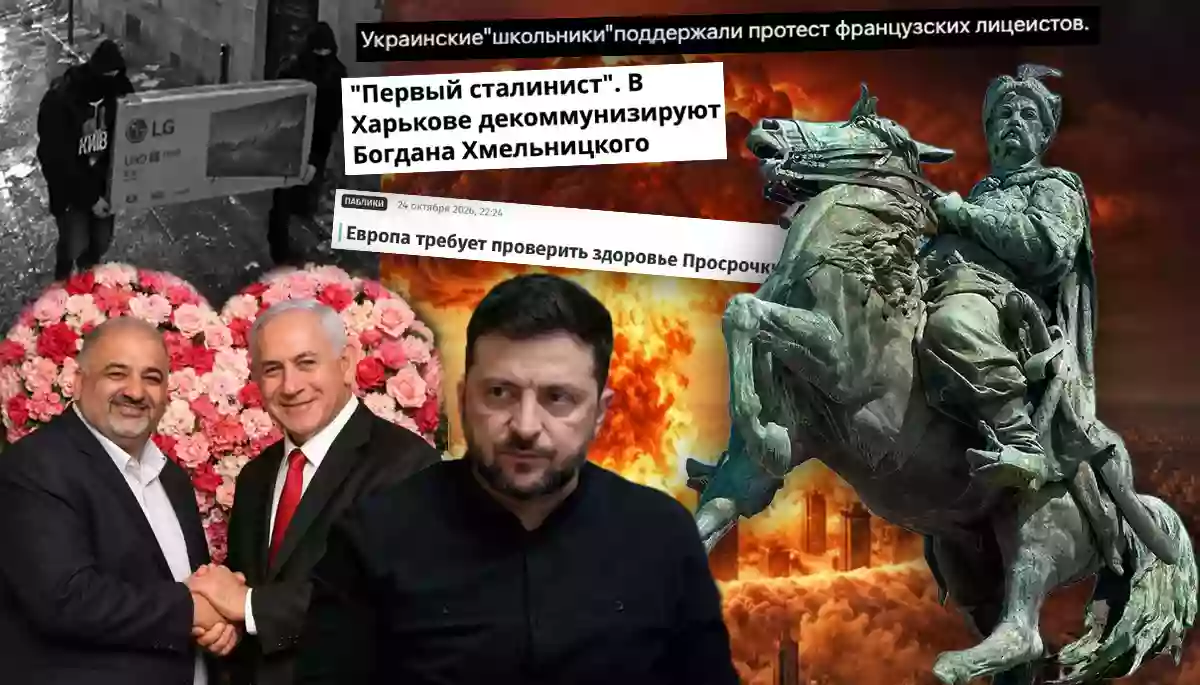

Since February 24, 2022, Detector Media has been monitoring the Ukrainian segment of social media and Kremlin media and documenting the chronology of Russian disinformation about Russia’s war against Ukraine.
Українською читайте тут.
Between 28 October and 3 November 2026, analysts from Detector Media documented 15 disinformation fabrications. In particular, Russian propagandists circulated false claims regarding the alleged "de-communisation" of Bohdan Khmelnytskyi in Kharkiv, an AI-generated "Ukrainian connection" to looting during protests in France, falsified petitions against the Ukrainian leadership, as well as AI manipulations and bot networks used during parliamentary elections in Serbia and Israel.
Fake Claim Regarding the Alleged "De-communisation" of Bohdan Khmelnytskyi in Kharkiv
Russian media outlets and pro-Kremlin Telegram channels circulated disinformation claiming that Kharkiv had supposedly "de-communised the Stalinist Bohdan Khmelnytskyi". Propagandists asserted that under pressure from Ukrainian nationalist organisations, the city council had renamed a boulevard named after the Hetman as part of an alleged campaign to destroy Soviet monuments and historical heritage. Kremlin sources attempted to portray this administrative decision as proof of a crackdown on all Ukrainian and Soviet history.
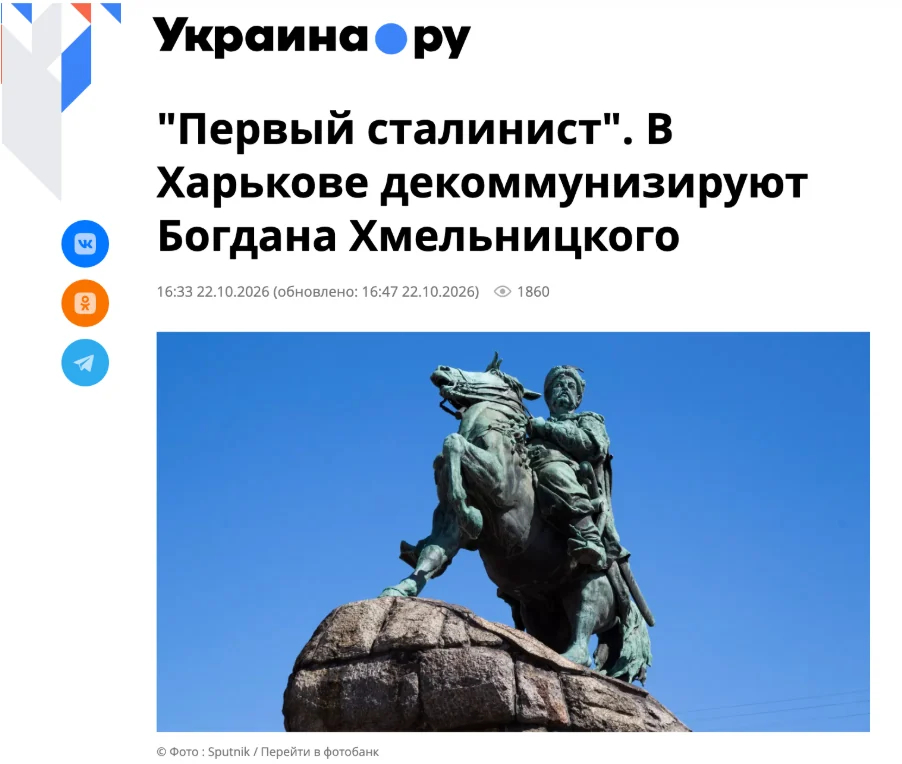
In reality, this report is a misrepresentation of the facts. 17th-century Hetman Bohdan Khmelnytskyi lived centuries before the emergence of communist ideology, Stalinism, or the Soviet regime; treating him as a subject of de-communisation is therefore legally and historically baseless. Furthermore, the city council passed the resolution as part of a measure to streamline local toponymy. The actual reason for the renaming was to resolve confusion caused by duplicate street names within the city. A Bohdan Khmelnytskyi Street already existed in central Kharkiv, whilst the presence of a boulevard by the same name in the Nemyshlianskyi District created navigation difficulties for urban transport, emergency services, and postal workers. At an extraordinary session, the city council renamed the site in honour of the "Omega" Special Purpose Centre—a military unit actively countering Russian armed aggression at the front line.
AI-Generated Fake About a "Ukrainian Connection" to Looting During Mass Protests in Marseille
A video clip purporting to be CCTV footage from Marseille, France, circulated on social media. The footage depicts two masked youths carrying a boxed television out of a shop, with one of them wearing a hoodie bearing the word "Kyiv". Pro-Russian users and accounts immediately seized upon the inscription in an attempt to prove the involvement of Ukrainian refugees or citizens in looting and chaos during nationwide protests in France.
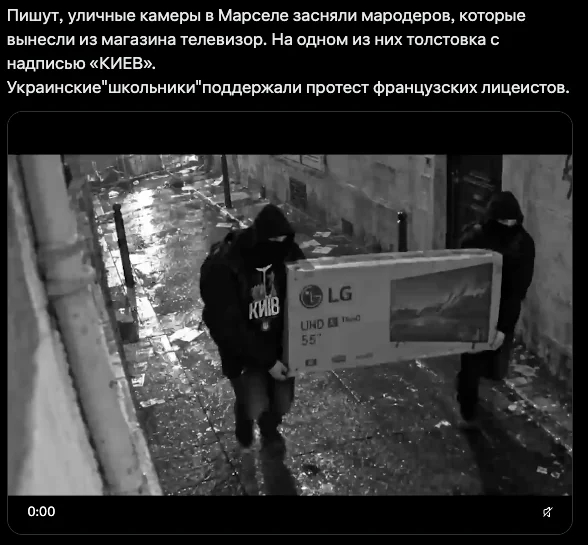
Fact-checkers at StopFake verified the origin of the viral video using the SynthID detection tool—an invisible digital watermark indicating content generated by neural networks. The analysis clearly confirmed that the video footage was created using artificial intelligence.
At the same time, mass unrest, arson, and looting did occur in France amidst social protests in October. According to French authorities, approximately half a million people took to the streets, at least three thousand retail outlets suffered damage, and total losses reached hundreds of millions of euros. Police detained over 2,500 looters, and law enforcement acknowledged the severity of the situation despite the deployment of tens of thousands of security personnel. President Emmanuel Macron stated that "foreign information manipulation" was aiming to destabilise the country.
Falsified Petition Requesting the "Forced Hospitalisation" of Volodymyr Zelenskyy
Pro-Russian networks and Telegram channels shared edited screenshots of an online petition that had supposedly gathered nearly 200,000 signatures demanding the forced hospitalisation of Ukrainian President Volodymyr Zelenskyy at a drug treatment clinic. The creators of the fake promoted the narrative that the Ukrainian leader allegedly exhibited severe signs of addiction and therefore had no moral right to govern the country or manage financial aid from international partners and taxpayers' money.
StopFake's inspection of petition platforms where this appeal was supposedly published, such as petitions.com, revealed no such initiatives under relevant keywords or transliteration variants of the surname (Zelenskyy, Zelenskiy, etc.). Open online platforms of this nature carry no legal weight, do not require identity verification, and fail to enforce a "one person, one signature" principle, leaving vote tallies vulnerable to manipulation via scripts and bots.
Bot Networks and Election-Related AI Slop in the Serbian Parliamentary Elections
During the snap parliamentary elections in Serbia, a disinformation campaign unfolded, orchestrated by a coordinated network of 332 fake accounts. Over a short period, they published tens of thousands of messages, heavily promoting incumbent leader Aleksandar Vučić and carrying out systematic attacks on the independent opposition outlets N1 and Nova.rs.
International and Serbian research projects, including the Balkan Free Media Initiative, FakeNews Tragač, Raskrikavanje, and Istinomer, documented that over two-thirds of the disinformation fabrications targeted the opposition "Student List" and its leader, Ilija Srdanović. Propagandists used doctored photographs, fake land registry extracts alleging luxury real estate abroad, and cheap AI-generated content ("AI slop") to link students with separatists.
Social media platforms responded to this activity with extreme passivity, blocking only a small fraction of the identified bot infrastructure, which allowed the core of the network to continue shaping the information environment.
Bots and Deepfakes in the Israeli Elections
During the parliamentary elections in Israel, artificial intelligence became a central campaigning tool, with legal political parties and campaign headquarters themselves—particularly Benjamin Netanyahu's Likud party—emerging as the primary generators of synthetic content rather than external hackers.
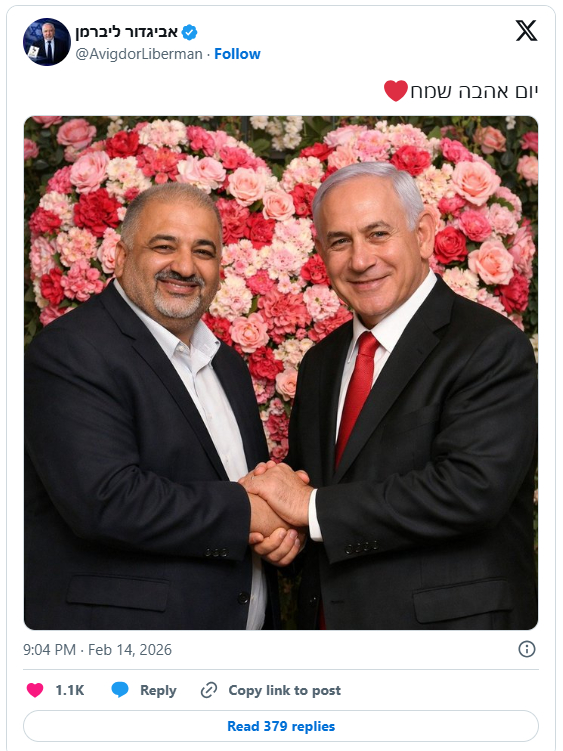
Politicians created deepfakes and AI-generated clips: fabricated images depicting opposition leaders aligned with Arab parties, manipulative scenes involving military personnel, and tactics designed to frighten the public with apocalyptic scenarios, including a generated image of a nuclear explosion over Tel Aviv and warnings of a "second Holocaust".

The organization FakeReporter uncovered an extensive bot network featuring AI-generated faces posing as ordinary citizens, which spread messages from far-right forces and attacked political rivals. Meanwhile, rules passed by the Knesset mandating the labelling of synthetic content proved belated and ineffective, as labels were frequently concealed, and the emotional impact of the fake content outpaced any judicial injunctions.